Charles Gannsen Research
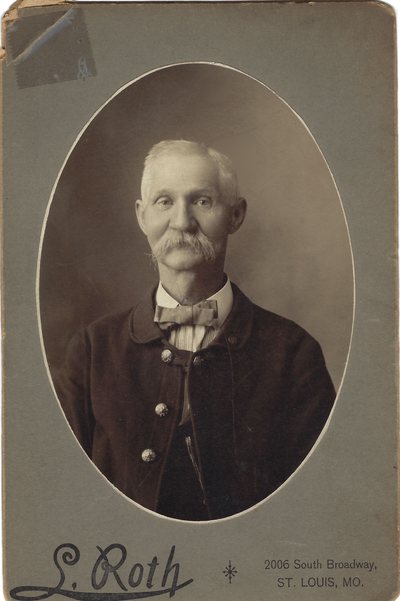
Charles Gannsen
c. 1835 – 1903

His signature in German script, “Karll L. Gannsen” (the initial is also read as C), on his enlistment at St. Louis, 2 December 1862

He gave his birthplace as Trendelburg in the Electorate of Hesse. He probably last lived in nearby Deisel and was possibly born there. Crossed the Atlantic, possibly in 1859. Three years in the Union artillery. Seven children in the German neighborhoods of St. Louis. A name written down fourteen different ways, and a family still looking for where it came from.
The latest: The book makes the case that he was possibly Karl Ludwig Hofedietz, an orphan of Deisel born on 13 November 1837 and summoned as a missing emigrant in 1900, and that a Konze family possibly took him in, which would explain the name he used. He is the leading candidate among the boys still open, not the only one, and the case is not proven. Read the case in “The Boy from the Goose Corner.”
Read the book
The book, chapter by chapter, for family and descendants.
- Part OneThe Life of Charles Gannsen
- Part TwoThe Family
- Part ThreeThe Posterity
- Part FourThe Search for His Origin
Start here
The evidence behind every claim: primary sources, parish registers, the surname problem, what has been searched, and what is still open.
Open the researchers’ page
Help find Charles
Which family in Hesse was his? The leading candidate and the other boys who could be him, the records that would settle each one, and how you can help.
Where was Charles on any day from 1859 to 1903?
The book. Charles Gannsen and His Family tells his life and follows his descendants, with every source in the notes. About the book
The Gannsen family emblem, designed for the book by Jed Johnson. It is modern family-history art, not an inherited coat of arms.
Portrait of Charles: Louis Roth studio, St. Louis. Courtesy of the author’s second cousin once removed.
Background scenes: Matthäus Merian, Trendelburg (Topographia Hassiae, 1655); Charles Graham, St. Louis from the Mississippi River (Harper’s Weekly, 1888), courtesy of the Missouri Historical Society, St. Louis.