This appendix describes the datasets behind the book, all of them compiled for this book from the records. Each entry gives what the dataset holds, what it covers, how its records were read, how many records it has and how to cite it. The tables here are summaries. The full files are on the research website, at the addresses given with each dataset.1
In this chapter
- D1. The boys of Trendelburg, Deisel and Friedrichsfeld, 1833–41
- D2. Emigration releases of the eight villages, 1832–1866
- D3. Where the village emigrants settled
- D4. Village emigrants on passenger lists, 1848–1865
- D5. Passenger lists searched for Charles
- D6. His surname as written, 1862–1903
- D7. The 1870 St. Louis census, pages read
- D8. St. Louis searches for the boys and the village emigrants
- D9. Parish registers searched
- D10. The names database
- D11. Kurhessians in three St. Louis German Evangelical churches, 1850–1880
- D12. Witnesses and godparents in Charles’s family, 1866–1881
- Notes
- Emigrants who followed family, 1840–66: the chart
Each dataset says how its records were read. “Read in the pages” means that every entry was read in the image of the original record. “Index only” means that the entries come from a name index or an abstract. Either can point to a record, but neither can prove that a record does not exist. Where a dataset mixes the two, each row says which.
To cite a dataset, name the author, the dataset, its version date and this appendix, then give the file. For example: Jed Johnson, comp., “Boys baptized at Deisel, Trendelburg and Friedrichsfeld, 1833–1841: ledger and fates,” dataset compiled for this book, version of 31 October 2026, in Charles Gannsen and His Family, appendix “The Data Behind This Book,” dataset D1; file at https://charles-research.netlify.app/data/leads.csv. Cite the original record as well whenever you use a single entry; every row of every dataset names its record.
Table G.1 lists the twelve datasets.
Table G.1. The datasets of this book
| No. | Dataset | Coverage | How read | Records |
|---|---|---|---|---|
| D1 | Boys of the three home parishes: ledger and fates | Baptisms 1833–41, followed forward | read in the pages | 426 boys |
| D2 | Emigration releases of the eight villages | 1832–66 | index only | 1,314 entries; 794 people |
| D3 | Where the village emigrants settled | Parties leaving 1846–66 | mixed, by row | 44 parties |
| D4 | Village emigrants on passenger lists | Arrivals 1848–65 | mixed, by row | 73 parties; 166 people |
| D5 | Passenger lists searched for Charles | Arrivals 1853–62 | mixed, by row | every list a negative |
| D6 | His surname as written | 1862–1903 | read in the pages | 57 records |
| D7 | 1870 St. Louis census, pages read | Wards 5, 8, 9, 10 and 11 | read in the pages | 3,351 pages |
| D8 | St. Louis searches for the boys and the village emigrants | Records 1850–1900 | index only, with controls | 1,197 searches |
| D9 | Parish registers searched | Baptisms 1833–41 and later books | by row | 46 verified rows |
| D10 | Names database | German and American records, 1600s–1900s | by row | about 101,000 rows |
| D11 | Kurhessian marriages in three St. Louis churches | 1850–80 | read in the pages | 104 entries |
| D12 | Witnesses and godparents in Charles’s family | 1866–81 | read in the pages | 17 entries |
Note: the full files are on the research website; each dataset’s fields, files and citation follow below.
D1. The boys of Trendelburg, Deisel and Friedrichsfeld, 1833–41
What it is. One row for every boy whose baptism at Trendelburg, Deisel or Friedrichsfeld gives a birth date from 1833 to 1841, with what became of him. It is the ledger behind the chapter “The Candidates and How They Were Ruled Out.” Coverage. The baptism registers of the three parishes, every entry of every month. The author followed each boy forward through confirmations, marriages, burials, civil registers, the emigration index and American records. How read. Read in the pages; each boy’s row names the record that closes him. Records. 426 boys: 150 died in childhood, 249 were followed to an adult life, three are probably traced and twenty-four are untraced.2
Fields. id (parish letters and the boy’s number); parish; Archion register, image and entry number; birth date; name as baptized; parents; born out of wedlock (yes or no); status (died young, eliminated, probably traced or untraced); the record that settles him; next step. A second file, boy-fates-1833-41.csv, adds the fate group. The chart of the boys’ fates in the chapter “The Candidates and How They Were Ruled Out” and table G.2 use it. The groups come from the wording of each row, with seven corrections made by hand after a reading of every row; each row shows its group.
Table G.2 sorts the boys by what became of them.
Table G.2. What became of the boys born 1833–41, by parish
| Fate | Deisel | Trendelburg | Friedrichsfeld | All |
|---|---|---|---|---|
| Died in childhood | 71 | 60 | 19 | 150 |
| Stayed in Germany, at home or at a place not named | 87 | 54 | 14 | 155 |
| Moved to a named German town or Prussia | 15 | 9 | 3 | 27 |
| Emigrated overseas | 48 | 13 | 6 | 67 |
| Probably traced (still open) | 2 | 0 | 1 | 3 |
| Untraced (still open) | 12 | 12 | 0 | 24 |
| Total | 235 | 148 | 43 | 426 |
Source: compiled by the author from the three parishes’ baptism registers and later records; dataset D13.
Files: leads.csv and boy-fates-1833-41.csv. Cite as: Jed Johnson, comp., “Boys baptized at Deisel, Trendelburg and Friedrichsfeld, 1833–1841: ledger and fates,” dataset D1.4
D2. Emigration releases of the eight villages, 1832–1866
What it is. Every entry for the eight villages of today’s town of Trendelburg (Deisel, Trendelburg, Friedrichsfeld, Eberschütz, Sielen, Gottsbüren, Stammen and Langenthal) in the LAGIS index of Hessian emigrants (Hessische Auswanderer). Each entry abstracts a release from Hessian citizenship, the paper a man or family needed to leave lawfully. Coverage. Releases dated 1832–66, from the files of the district office of Hofgeismar (Hessisches Staatsarchiv Marburg, Best. 180 Hofgeismar). Some volumes of 1858–60 are missing. How read. Index only. A release shows permission to leave, not a departure. Records. 1,314 index entries. The same person can appear in several entries. Counted once each, by village, surname, forenames and release year, they are 794 people, 782 of them with a year.5
Fields. index id; entry as indexed (surname, forenames, village, year); village; release year; year of birth; trade; destination; party (alone or with family); spouse; family members; means (unitless as indexed); archive reference and page; whether the person is listed as a dependant; person key (village, surname and forenames written in one standard spelling, and year). A person is one person key with one year of birth.
Many emigrants followed an earlier emigrant of the same surname and village. Table G.3 gives their share of the people released in each period, by two rules. The loose rule counts any earlier release of the surname; the strict rule counts only a release at least two years earlier, under another first forename. The two rules give a low and a high figure. Simone Wegge’s shares for all Kurhessen used the loose rule.6
Table G.3. Emigrants who followed an earlier emigrant of the same name and village, 1832–66
| Years | People released | Following, loose rule (%) | Following, strict rule (%) | All Kurhessen (Wegge) |
|---|---|---|---|---|
| 1832–45 | 48 | 15 | 12 | 7% (1840) |
| 1846–49 | 86 | 52 | 34 | 22% (1848) |
| 1850–53 | 136 | 18 | 15 | — |
| 1854–57 | 359 | 42 | 29 | 43% (1857) |
| 1858–66 | 153 | 63 | 45 | no data after 1857 |
Sources: compiled by the author from the LAGIS emigration index, dataset D27; all Kurhessen from Wegge8.
The chart below counts the same eight villages. In Charles’s day each was a separate community. On 31 December 1970, in the Hessian reform of local government, they were joined into one town, Trendelburg, so this book calls them “today’s Trendelburg.” The search for Charles’s baptism centers on three of them, Trendelburg, Deisel and Friedrichsfeld, the home villages. The counts use all eight because the larger numbers show the pattern of leaving more clearly.9
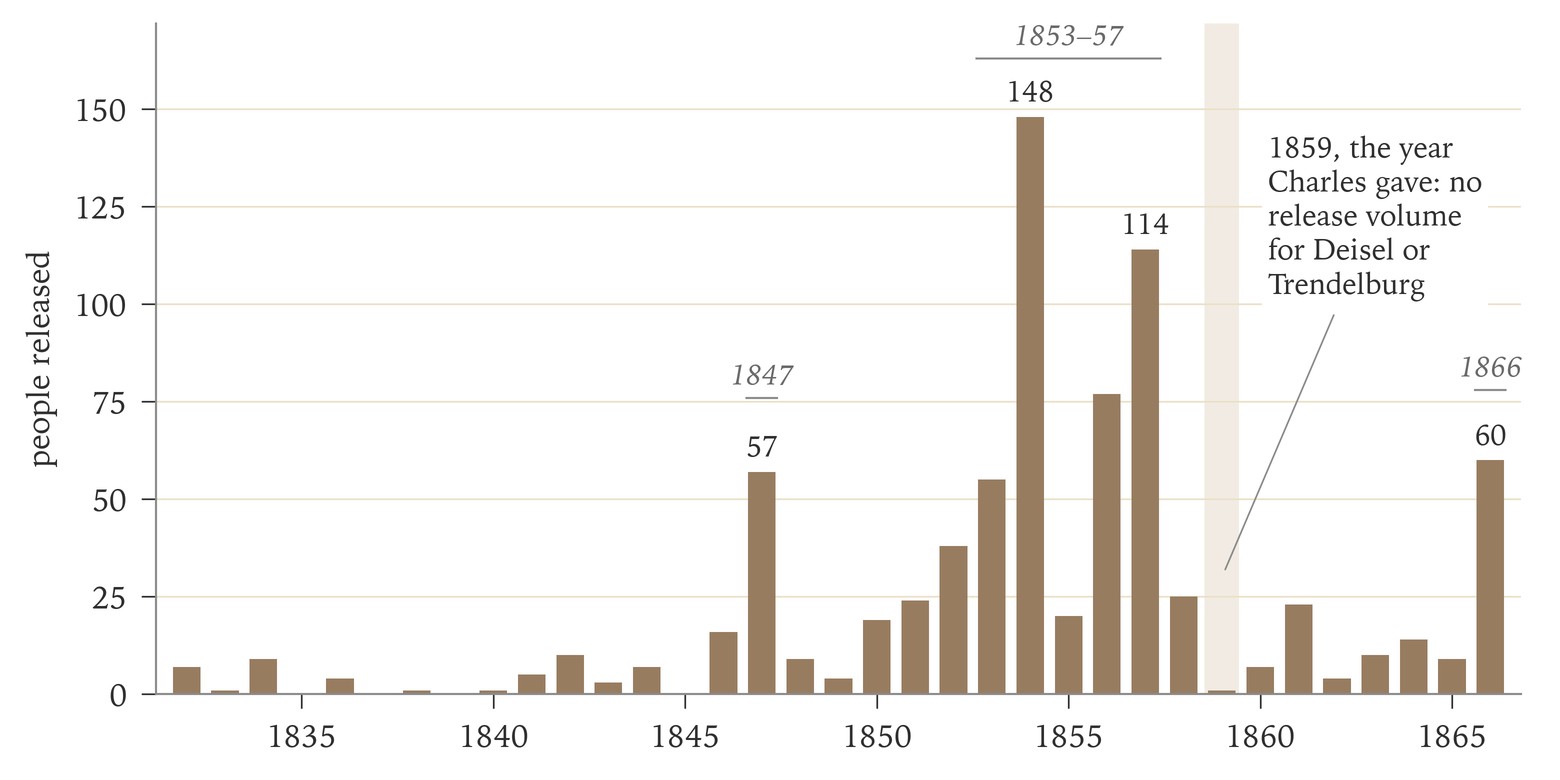
Lüdicke’s count. Martina Lüdicke counted 249 emigrants from Deisel in 1833–66, 227 of them bound for America. This book’s count of the state’s release index for the same years gives 243 people, 224 of them for America, within about three percent of hers. The two counts differ slightly in method: she counted people by the year they left and used files beyond the release volumes.11 By her count, ninety-five single people and twenty-eight families went to America in 1833–66. Of the 104 emigrants whose occupations she tabulated, thirteen were farmers, twelve shoemakers and six tailors, and fifty-six gave none.12 In the chart of Deisel’s emigrants in the chapter “Leaving Hesse, c. 1858–1859,” her yearly bars add up to about 215 of her 227. Her list of emigrants gives no year for some of them. Her totals leave out children not named when a family emigrated. For 1850 she found 26 and the index holds 8. The author read her yearly figures from her bar chart, so they are estimates, and checked them against her table of yearly loss rates.13
Files: lagis-releases-eight-villages.csv; chain-migration-by-period.csv; family-chains-3plus-years.csv (the 28 village surnames released in three or more years). Cite as: Jed Johnson, comp., “Emigration releases of the eight villages of today’s Trendelburg, 1832–1866, from the LAGIS index,” dataset D2.
D3. Where the village emigrants settled
What it is. One row for each emigrant party from Trendelburg, Deisel and Friedrichsfeld that has been placed in America or followed elsewhere, with the place, its grade and the evidence. It is the source of the table of destinations in the chapter “Leaving Hesse, c. 1858–1859.” How read. Each row names its records and says which were read in the image. Records. 44 parties; thirty-five placed at probably or better. Fields. id; name; village; year left; in the release index (yes or no); place group and place; grade (proven, very probably, probably, possibly, or landing only); sources; note; evidence; St. Louis search status and sources. File: village-emigrant-destinations.csv, with its own README.14
D4. Village emigrants on passenger lists, 1848–1865
What it is. One row for each party found on a passenger list, with ship, ports, date and how it was read: 68 parties from the eight villages and five from three neighboring ones (Hümme, Schöneberg and Lamerden). Coverage. Only the parties this research looked for and found: a convenience sample, not every emigrant. How read. 43 parties read in the pages of the list, thirty from an index only. Records. 73 parties, 166 people, and six more parties from the neighboring towns, kept apart.15
Fields. party id; surname and members; village; release year; ship; departure and arrival ports; arrival date; ages or trades on the list; whether they match the release index; other villagers on board; how read; source; notes; number of people; voyage key; scope. Four columns were added on 2 November 2026: placement grade (in the book’s grade words, or “landing only” when nothing later in America is tied to the landing); coverage (read in the pages or index only); the row’s bearing on the search for Charles; and a flag for the fourteen rows whose old grade wording needed judgment.
Table G.4 counts the parties by port of arrival.
Table G.4. Village emigrant parties by port of arrival, 1848–65
| Port of arrival | Parties (no.) | People (no.) |
|---|---|---|
| New York | 37 | 90 |
| Baltimore | 27 | 63 |
| Philadelphia | 4 | 7 |
| New Orleans | 3 | 4 |
| Port Elizabeth, South Africa | 1 | 1 |
| Not stated | 1 | 1 |
| Total | 73 | 166 |
Source: compiled by the author from passenger lists, read in the pages or in an index; dataset D416.
The chart shows the same parties by year of arrival.17
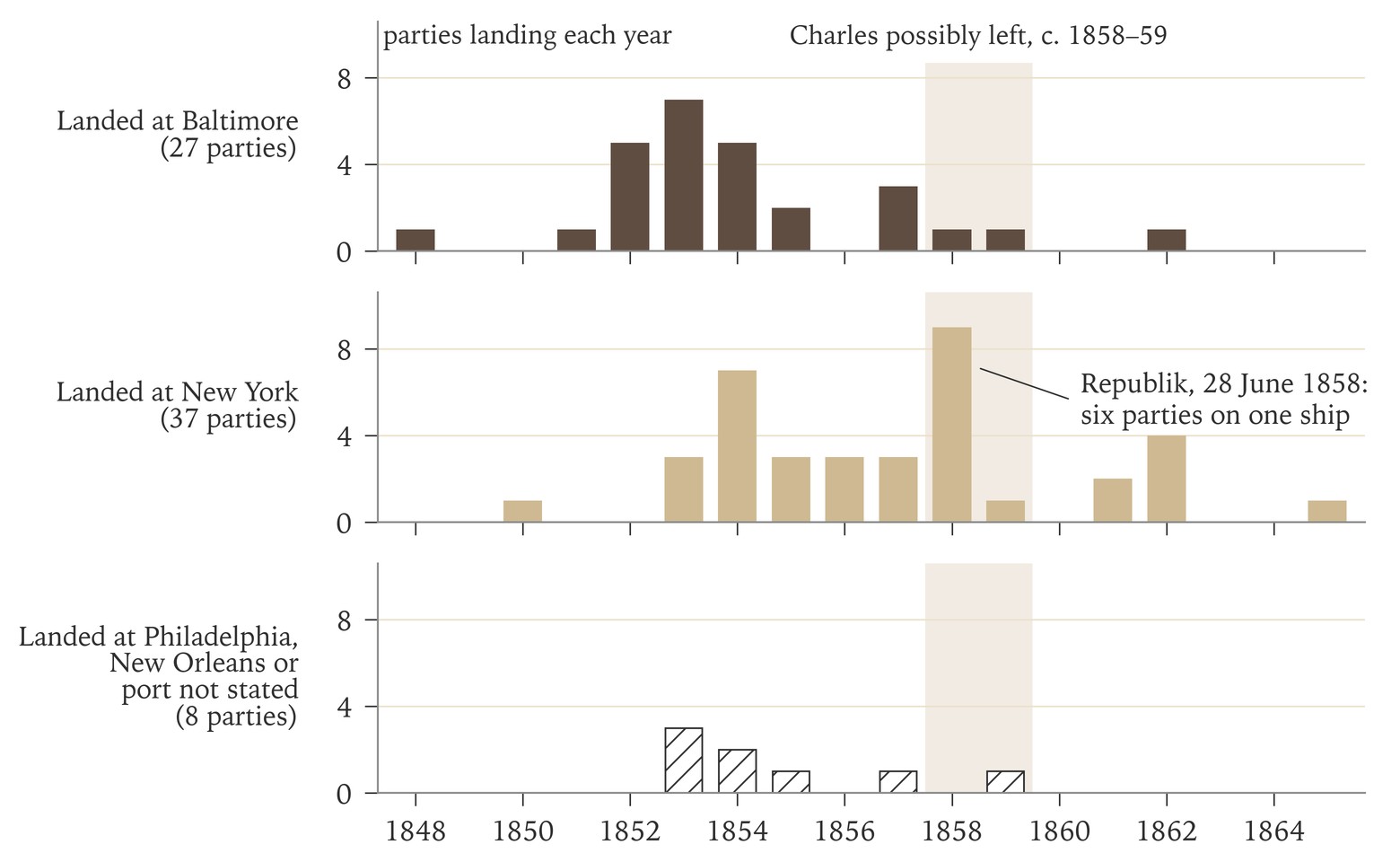
File: ship-arrivals.csv. Cite as: Jed Johnson, comp., “Emigrants of the eight villages of today’s Trendelburg on passenger lists, 1848–1865,” dataset D4.
D5. Passenger lists searched for Charles
What it is. Each passenger list and index searched for Charles himself, with the ship, the date, how it was read and the result. No search found him. A negative result counts only as far as the search went, so each line says whether the list was read page by page, screened for certain surnames, or searched in an index. Coverage. Arrivals at New York, New Orleans, Baltimore and Galveston, 1858 to August 1862; the Hamburg lists of 1855–63; and the Germans to America data. File: charles-manifest-sweeps.md.19
D6. His surname as written, 1862–1903
What it is. One row for each record that gives Charles’s surname, with the form, the year, the kind of record and its grade. How read. Read in the pages. Records. 57 records, giving 26 forms besides Johnson. Fields. year; form as written; family of forms (Ga-, Go-, K- or C-, Jansen, Johnson); kind of record; record; source; grade of the tie to Charles (city-directory lines only).
Table G.5 shows that the spellings sort by who held the pen.
Table G.5. Forms of his surname by who wrote them, 1862–1903
| Form begins | His own hand | Printed notices | Church registers | Census and federal | Directories | All |
|---|---|---|---|---|---|---|
| Ga- | 2 | 8 | 1 | 3 | 10 | 24 |
| Go- | 0 | 0 | 3 | 2 | 2 | 7 |
| K- or C- | 0 | 0 | 4 | 0 | 7 | 11 |
| Jansen | 0 | 1 | 2 | 0 | 2 | 5 |
| Johnson | 0 | 0 | 0 | 0 | 10 | 10 |
Source: compiled by the author from every record found that gives his surname; dataset D620.
File: surname-forms.csv.21
D7. The 1870 St. Louis census, pages read
What it is. One row for each page of the 1870 census of St. Louis read line by line for Charles and his household, with the ward, page, image, date read and result. Coverage. Wards 11 (824 pages), 5 (754), 8 (670), 9 (579) and 10 (523). For wards 2, 3, 4, 6, 7 and 12 and the county, the search used the index only. How read. Read in the pages. Records. 3,351 pages; all negative for Charles. Two further rows record the index passes of the whole city. Fields. ward; subdivision; page; image; film; dates enumerated; method; date read; reader (session); result; notes; log. File: census1870_read_log.csv.22
D8. St. Louis searches for the boys and the village emigrants
What it is. Two logs of searches made in St. Louis records. The first covers the boys of D1, to test whether any of them is Charles under another name. The second covers the emigrant parties of D3, to learn whether any of them settled where Charles did. Each search names its source, its query, and a control: a name known to be in the source, searched the same day, to show the search worked. How read. Index only. A name hit is not a match until another record ties it to the boy. Records. 1,076 searches for 358 boys, all but one with a passing control, and one possible match (Martini), since judged very probably not him. Another 121 searches covered 40 parties, four of them found in St. Louis. Fields. boy or party id; name; source; query; date; control passed; hits; relevant hits; conclusion; note; log. Files: stl-search-log-candidates.csv and stl-search-log.csv.23
D9. Parish registers searched
What it is. One row for each parish, or group of parishes, whose registers were searched for Charles’s baptism, with the years, the method, the result and what remains. The map of the parishes searched and the appendix “How the Research Was Done” draw on it. How read. Each row says whether the registers were read boy by boy, read for a pattern (every Carl, every Konze or Gans, every boy born out of wedlock, every birth near 26 January), or searched in an index only. Records. 46 verified rows (rows still at a first reading are not counted), for a search that covers 57 places. Fields. ring; place; status; parishes; baptism years read; method; result; open task; category; winter-months and day-by-day passes; read status (first pass or verified); baptisms counted; evidence; logs. File: search-coverage.csv.24
D10. The names database
What it is. Every person named in the research, one row per record, each with a confidence label: confirmed (checked against the image), published (from a published expert source, chiefly Klaus Kunze’s village family books), unverified, hypothesis, or eliminated. Records. About 101,000 rows; about 95,000 of them come from Kunze’s village family books and the Dornette database, cited row by row. Privacy. The website copy leaves out anyone born after 1925 without a recorded death. The database is searchable on the research website (names-database.html); the website does not offer it as a download, because most of its rows are the work of others.
D11. Kurhessians in three St. Louis German Evangelical churches, 1850–1880
What it is. Every marriage entry in which at least one party came from Kurhessen, with the home places as written and the district. Coverage. St. Marcus, 1850–80; Holy Ghost, 1855–80 (home places in full only for 1855–58, residence only for 1859–71); St. Peter’s, 1855–60: some 5,000 entries in all. By design, the search left out Catholic registers: Charles’s district was almost wholly Protestant, and he married at St. Marcus. How read. Read in the pages (one identification rests on an index match). Records. 104 entries, a minimum, because Pastor Wall recorded residence rather than origin for most of 1860–66, and from August 1877 the St. Marcus entries often give only the residence or the state. Three involve Kreis Hofgeismar: Charles himself (St. Marcus, 1866), the groom Wilhelm Freise of Helmarshausen (St. Marcus, 1874) and, probably, the Helmarshausen couple Heinrich Gauding and Elisabeth Zimmermann (St. Peter’s, 1857). No one else from Deisel, Trendelburg or Friedrichsfeld appears. Fields. register; years; image; date and entry number; persons; home places as written; district (Kreis); source; how read. File: stlouis-kurhessian-marriages-1850-80.csv.25
Table G.6 counts the entries by the district of the first Kurhessian party.
Table G.6. Kurhessian marriages in three St. Louis churches, by home district, 1850–80
| District (Kreis) | Entries (no.) |
|---|---|
| Marburg and Kirchhain | 16 |
| Kassel | 15 |
| Fritzlar | 14 |
| Frankenberg | 7 |
| Ziegenhain, Eschwege and Hanau with Gelnhausen (5 each) | 15 |
| Rotenburg, Schlüchtern (4 each) | 8 |
| Melsungen, Hünfeld (3 each) | 6 |
| Hofgeismar (Charles’s district) | 3 |
| Hersfeld, Witzenhausen, Homberg (2 each); Schaumburg (1) | 7 |
| Not identified | 13 |
| Total | 104 |
Source: compiled by the author from the St. Marcus, Holy Ghost and St. Peter’s marriage registers; dataset D1126.
D12. Witnesses and godparents in Charles’s family, 1866–1881
What it is. The witnesses at Charles’s wedding and the godparents of his children, with their origin and whether any was a Kurhessian. How read. Read in the pages; each identification carries the grade given in the chapter “The Godparents and Witnesses, 1866–1881.” Records. 17 entries: the four witnesses at the 1866 wedding and thirteen godparent entries at the children’s baptisms. None came from Kreis Hofgeismar; the one Kurhessian tie is Catharina Albrecht (1870), born in St. Louis to a father from Heinebach, Kreis Melsungen. Fields. event; date; person as written; role; identification grade; origin; Kurhessian (yes or no); source. File: charles-family-sponsors-1866-81.csv.27
Notes
27 notes
- Jed Johnson, comp., “The data behind Charles Gannsen and His Family,” version of 3 November 2026. [DSREADME]
- Forward trace of every boy baptized at Trendelburg, Deisel and Friedrichsfeld born 1833–41. [LEDGER]
- Jed Johnson, comp., “Boys baptized at Deisel, Trendelburg and Friedrichsfeld, 1833–1841,” dataset compiled for this book. [DSFATES]
- Jed Johnson, comp., “Boys baptized at Deisel, Trendelburg and Friedrichsfeld, 1833–1841,” dataset compiled for this book. [DSFATES]
- An entry such as “Sohn d. Friederich” can stand for several children of one head. Counted once for each birth year given, the same entries give 822 people; the charts in the chapter “Leaving Hesse” count each person once, as here. Jed Johnson, comp., “Emigration releases of the eight villages of today’s Trendelburg, 1832–1866,” dataset compiled for this book. [DSLAGIS]
- Simone A. Wegge, “Chain Migration and Information Networks,” Journal of Economic History 58, no. 4 (December 1998). [WEGGE98C]
- Jed Johnson, comp., “Emigration releases of the eight villages of today’s Trendelburg, 1832–1866,” dataset compiled for this book. [DSLAGIS]
- Simone A. Wegge, “Chain Migration and Information Networks,” Journal of Economic History 58, no. 4 (December 1998). [WEGGE98C]
- Stadt Trendelburg, “Kurzportrait & Geschichte,” https://
www (accessed 5 November 2026). [TRDLTOWN].trendelburg .de/ stadt-trendelburg/ kurzportrait-geschichte - Landesgeschichtliches Informationssystem Hessen (LAGIS), Hessische Auswanderer, Nr. 128; Jed Johnson, comp., “Emigration releases of the eight villages of today’s Trendelburg, 1832–1866,” dataset compiled for this book. People who left without a release are not counted. Each bar counts the people released that year, each person once by name, village and release year; of the 794, 12 have no year and are not drawn. They were released in about 333 parties, a household or a person traveling alone. [LAGIS59] [DSLAGIS]
- Martina Lüdicke, „Verschwunden ist der Strand…“: Studien zur Auswanderung nach Amerika aus Kurhessen in den Jahren 1831–1866, dargestellt am Beispiel des Dorfes Deisel (Kreis Hofgeismar), Die Geschichte unserer Heimat 14 (Hofgeismar: Verein für hessische Geschichte und Landeskunde, Zweigverein Hofgeismar, 1994), 18 (the consent of parents or guardian for a minor; illegal emigration in the 1850s about as large as legal, after Auerbach 1985, 21; the rule of 1853 sending home travelers without a release or an overseas passport, citing HStAM 180 Hofgeismar Nr. 640), 26 (population 1852–58; the mayor, Köster, in 1856, citing HStAM 180 Hofgeismar Nr. 57), 32–34 (249 emigrants, 1833–66; emigrants by year, figure 2 on p. 33; single persons and families), 43 (the military obligation from 1 January of the year a man reached the age of service, after Auerbach 1985, 20f.; Philipp Feuring, 1861, citing HStAM 180 Hofgeismar Nr. 116), 48–49 (Leimbach; Helwig Carl; the petition of 1862, citing HStAM 180 Hofgeismar Nr. 1998), 50 (places where the Deisel emigrants settled), 57 (the Deisel emigrants’ song), 78–79 (tables 3 and 5, population and births), 81 (tables 9 and 10: loss of population to emigration, and occupations of the emigrants, 1833–66), 86–89 (list of the emigrants, with none named for 1859 or 1860; its sources include HStAM 180 Hofgeismar Nr. 115) (the author’s translation). [LUEDCTX]
- As in note 11. [LUEDCTX]
- As in note 11. [LUEDCTX]
- Compiled from the emigration index (LAGIS Hessen, Auswanderer aus Hessen) and these American records: U.S. censuses 1850–1900 and naturalization, death and burial indexes on FamilySearch and Ancestry (https://
www ) (index level unless stated). [VILLUS].ancestry .com - Jed Johnson, comp., “Emigrants of the eight villages of today’s Trendelburg on passenger lists, 1848–1865,” dataset compiled for this book. [DSSHIPS]
- Jed Johnson, comp., “Emigrants of the eight villages of today’s Trendelburg on passenger lists, 1848–1865,” dataset compiled for this book. [DSSHIPS]
- Jed Johnson, comp., “Emigrants of the eight villages of today’s Trendelburg on passenger lists, 1848–1865,” dataset compiled for this book. [DSSHIPS]
- Jed Johnson, comp., “Emigrants of the eight villages of today’s Trendelburg on passenger lists, 1848–1865,” dataset compiled for this book. Of the 73 parties, 68 are from the eight villages and five from three neighboring ones, Hümme, Schöneberg and Lamerden (72 drawn; the seventy-third sailed to Port Elizabeth, South Africa, in a year not known). Each panel shows the port of landing, not where they settled. They are a sample of the emigrants this research looked for, not of all who left. In June 1858 the Republik brought six parties from Trendelburg, Deisel and Gottsbüren into New York on one ship. [DSSHIPS]
- The Appendix D list “Passenger Lists Searched, 1853–1862,” which lists the ships read in the image and the indexes searched. [PASS]
- Jed Johnson, comp., “Charles Gannsen’s surname as written, 1862–1903,” dataset compiled for this book, version of 3 November 2026; compiled from the author’s table of the twenty-eight records of the name and the city-directory lines of the appendix “Charles in the City Directories.” [DSSPELL]
- Jed Johnson, comp., “Charles Gannsen’s surname as written, 1862–1903,” dataset compiled for this book. [DSSPELL]
- 1870 U.S. census, St. Louis city and county, p. 344. [C1870]
- Jed Johnson, comp., “St. Louis searches for the boys of 1833–1841 and the village emigrants,” datasets, version of 1 November 2026, the two search-log files (candidates and full log) on the research website, https://
charles-research and https://.netlify .app/ data/ stl -search -log -candidates .csv charles-research : accessed 11 November 2026; sources searched (FamilySearch, St. Louis Genealogical Society, Missouri Soldiers’ Records and others), each with a control search; index only. [DSSTL].netlify .app/ data/ stl-search-log .csv - Parish search coverage, 57 places of Kreis Hofgeismar. [COVER]
- Jed Johnson, comp., “Kurhessian parties in the marriage registers of St. Marcus, Holy Ghost and St. Peter’s Evangelical churches, St. Louis, 1850–1880,” dataset compiled for this book, version of 3 November 2026. [DSKURH]
- Jed Johnson, comp., “Kurhessian parties in the marriage registers of St. Marcus, Holy Ghost and St. Peter’s Evangelical churches, St. Louis, 1850–1880,” dataset compiled for this book, version of 3 November 2026. [DSKURH]
- St. Marcus German Evangelical Church (St. Louis, Missouri), marriage register 1866, p. 135. [GPMAR]
Also on this page
Emigrants who followed family, 1840–66: the chart
This chart was printed in the chapter “Leaving Hesse” from build 10 and was cut from the book on 11 November 2026. It is kept here, with the figures it shows, beside dataset D2 and Table G.3.
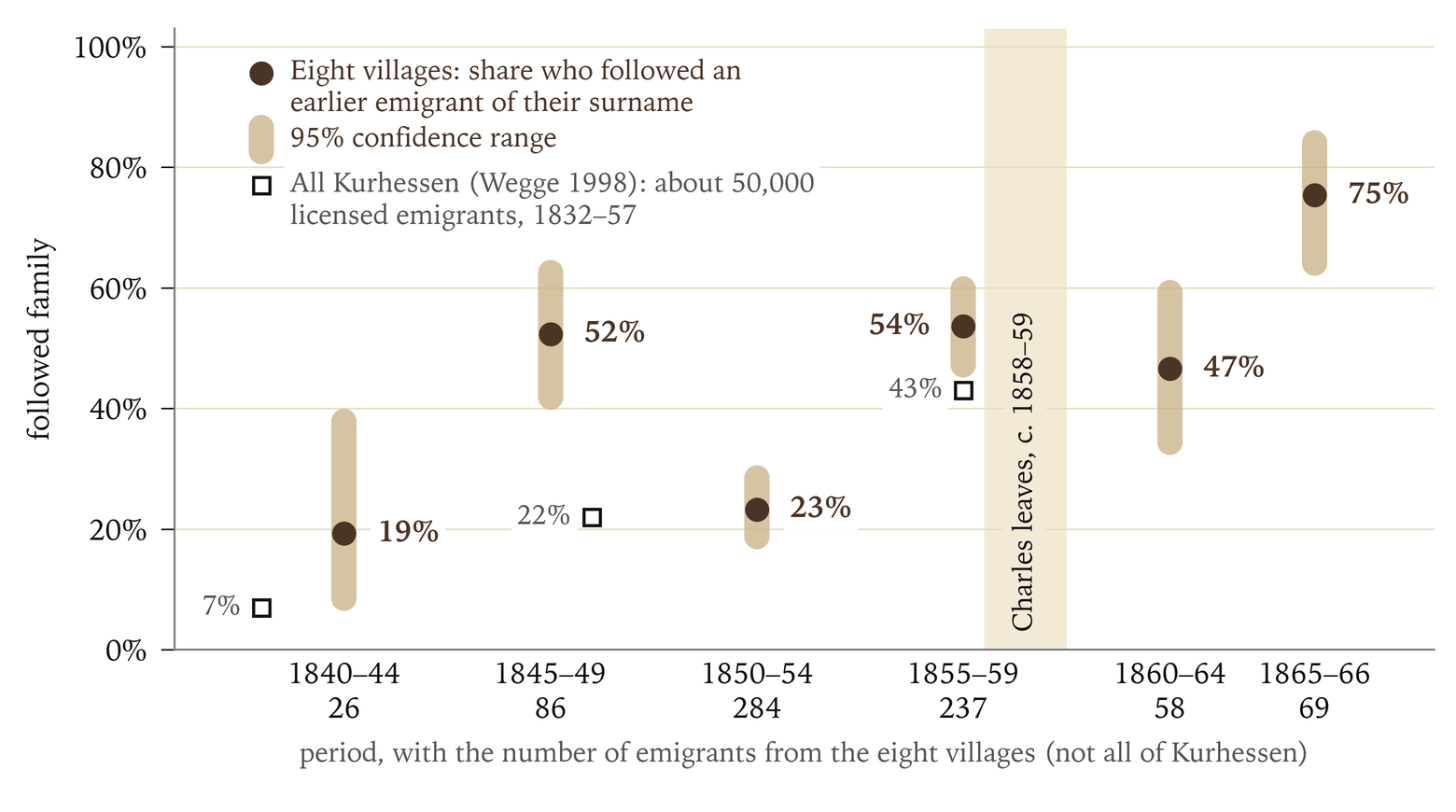
The figures behind the dots are below. The chart groups the years in fives; Table G.3 groups them around the hungry years and Charles’s departure, so the two do not line up row for row. The chart counts the 760 people released in 1840–66; the 22 released in 1832–39 are in Table G.3 but not in the chart.
| Years | People released | Followed family | Share (%) | 95% range (%) |
|---|---|---|---|---|
| 1840–44 | 26 | 5 | 19 | 9–38 |
| 1845–49 | 86 | 45 | 52 | 42–63 |
| 1850–54 | 284 | 66 | 23 | 19–28 |
| 1855–59 | 237 | 127 | 54 | 47–60 |
| 1860–64 | 58 | 27 | 47 | 34–59 |
| 1865–66 | 69 | 52 | 75 | 64–84 |
| Total, 1840–66 | 760 | 322 | 42 | — |
“Followed family” uses the loose rule: an earlier release of the same surname from the same village. The 95 percent ranges are Wilson score intervals. Some volumes of 1858–60 are missing, so the counts for 1855–59 and 1860–64 are probably lower than the true numbers of releases. Drawn by scripts/fig_chain_dots.py from lagis-releases-eight-villages.csv, 11 November 2026. Sources: dataset D2 [DSLAGIS]; Wegge 1998 [WEGGE98C].