In the winter of 1870–71 a directory canvasser called at 718 Gate Street and recorded “Johnson Charles, conductor, St. Louis R. R.”1 By then Charles had given up the saloons.2 No record says why, but his path was a common one. In one Pennsylvania town around 1900, most men who gave up their saloons went back to work for wages.3 A streetcar conductor’s wage was small, but it did not depend on customers, licenses or a landlord’s creditors.
In this chapter
It was a new kind of work for him: wages from a company, on its cars and on its schedule. The records of the Gate Street years show a man who probably held paid work through the hard times after 1873, while his family grew.4
Edwards’ 1871 directory, printed that spring, carried his line.5 Its names were gathered in a canvass of the city made that year, so the entry shows where Charles lived that winter. It is the first record of him on Gate Street and the first to show him working for a street railway.6 In 1890 Charles himself put the move earlier, telling the Pension Bureau that he had moved to Gate Street in 1869. The directories do not bear this out: the 1869 directory still lists the family on Closey Street.7
718 Gate Street
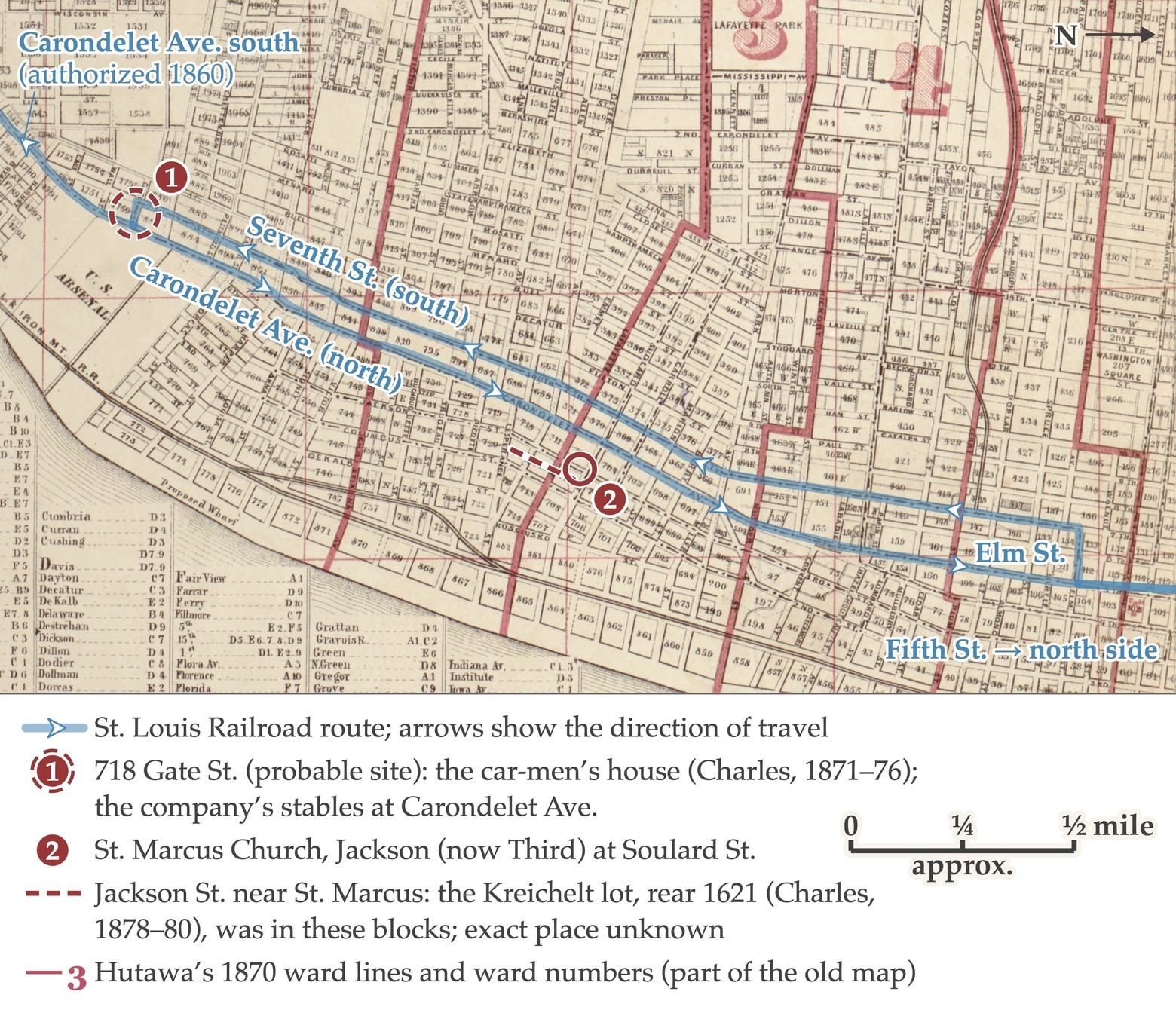
Gate Street was a short side street that no longer exists.8 It ran up from Carondelet Avenue, now South Broadway, past Seventh Street to Eighth Street. Arsenal Street was the next street to the north, and Lyon Park lay across the avenue.9 Gate Street lay in the brewery district, a few minutes’ walk from the Anheuser and Lemp breweries.
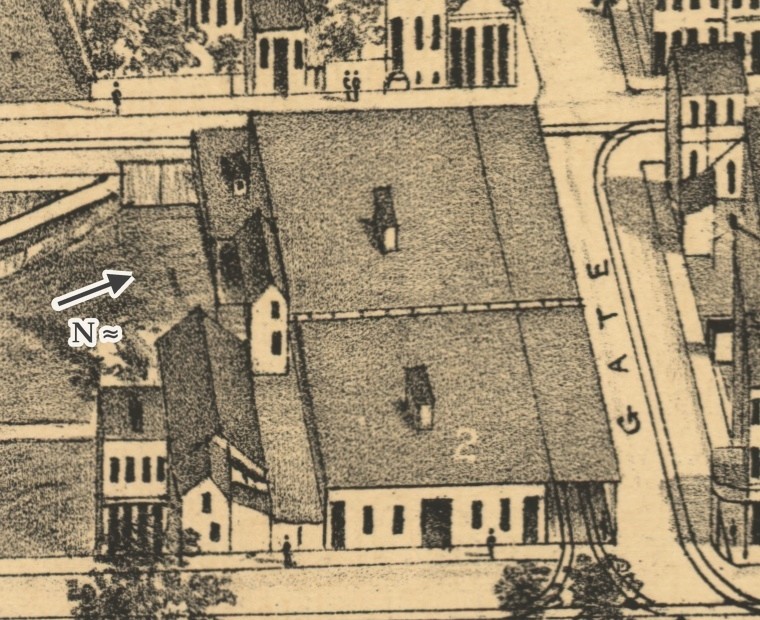
The house at 718, Charles’s address, was a boarding house for the crews of the St. Louis Railroad Company. The company’s own stables stood a block away, across Seventh Street at the corner of Gate Street and Carondelet Avenue.10 Gate Street had been the end of the line, which probably explains why the stables stood there. A state law of January 1860 let the company extend its tracks “south from Gate street, along the Carondelet road, to the city limits.”11
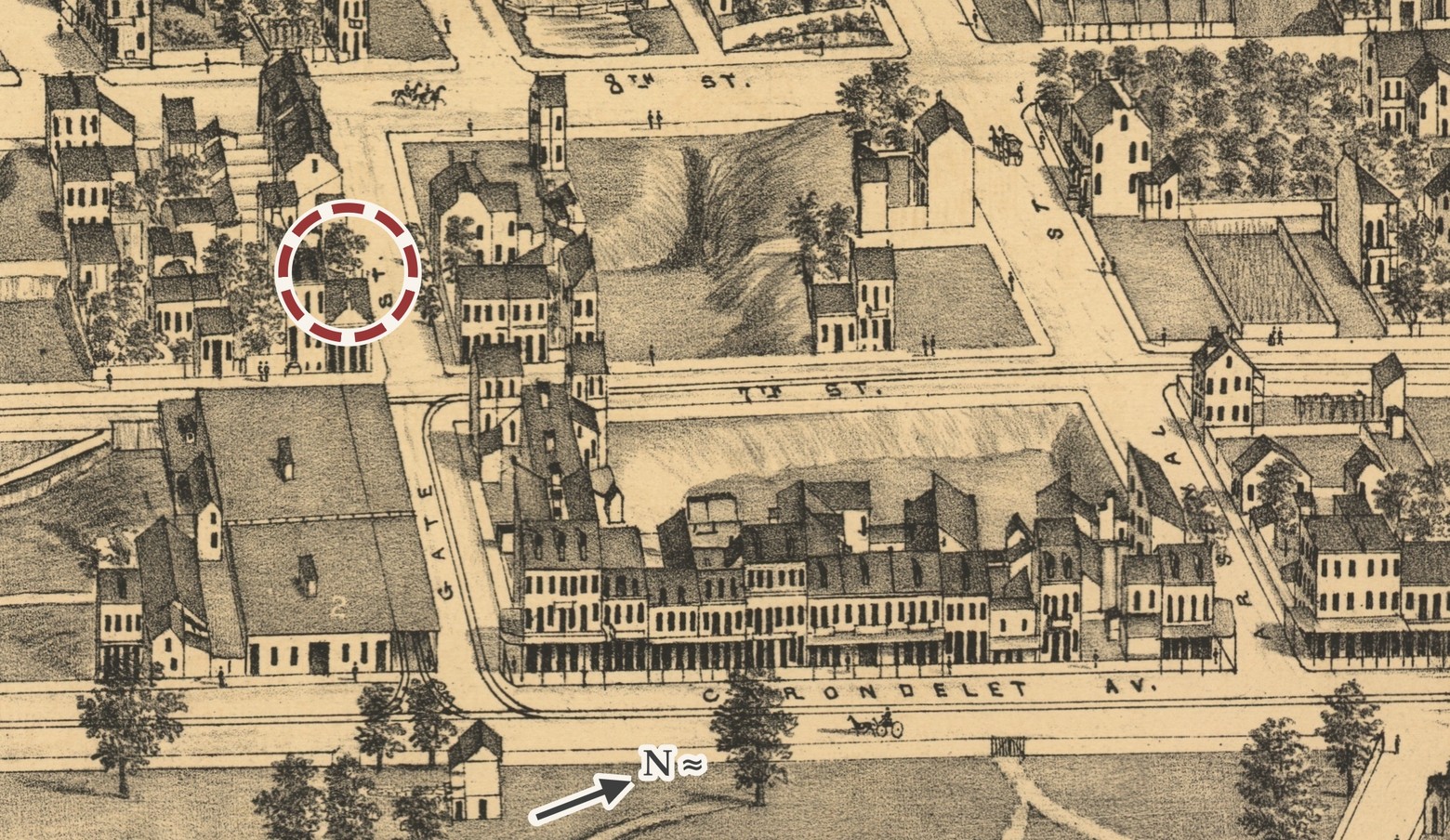
The 1870 census and the 1871 directory name the people around the house in the winter of 1870–71. George Rothweiler, an agent, lived next door at 716 Gate with his sons. In the 1871 directory a hostler (a stableman), Michael Shugrue, lived at 720 Gate. He was possibly one of the men who cared for the car company’s horses.13
One neighbor worked with Charles and later swore for him. Henry D. Niemeier lived at the corner of Gate Street and Carondelet Avenue, a block from Charles’s house. He was a horse-car conductor from 1866, and in 1868–71 the directories name his employer as the St. Louis Railroad, Charles’s line.14 In 1890 he swore that he knew of Charles’s ailments because he “has worked with” him.15 He had married Anna Rohmann in 1861 at St. Marcus, the church where Charles and Auguste were married and their children baptized.16
On the cars
The first horse-drawn streetcars in St. Louis began running in 1859, the year the 1900 census gives for Charles’s arrival.18 On 4 July 1859 the Olive Street line had only two cars on the track, and they carried more than 3,000 paying passengers.19 The St. Louis Railroad Company, formed that year, built the Broadway line, the long route along the top of the river bluffs that joined the north side to the south. On the south side its cars ran by way of Seventh Street and Carondelet Avenue. Every south-side address Charles is known to have had lay within a few blocks of the line.20 It was the longest line in the city, from North St. Louis to the Arsenal, and in the late sixties it was extended to Baden and the Wild Huntsman; south of Elm Street it ran on a single track.21 About fifteen years after the first line opened, St. Louis had fourteen lines and six hundred cars. Twenty-three hundred horses and about seven hundred mules pulled them. Kargau thought the companies “cared little for the wishes and rights of the passengers.”22
Each small car had a crew of two. The driver stood on the open front platform in all weather, with the team and the brake, and watched the track ahead. The conductor, on the rear platform, took the fares and handled the cash, called out the streets, and saw the passengers safely on and off.25 When the war ended, Black riders still had to stand on the outside platform. By June 1867 the lines had agreed to let them ride inside, but conductors on two cars soon refused to let them in. Neptune and Caroline Williams sued one line. They said a conductor had pushed Caroline off a car as she tried to board, while she was pregnant and carrying a baby. By May 1868 the circuit court had ruled that every public transportation company had to let Black passengers ride inside. It awarded the Williamses one cent.26 A Philadelphia promoter of the cars claimed in the late 1850s that horses grew so used to the bell that they stopped and started on its signal alone.27
The directories name Charles’s employer only twice. Edwards’ 1871 directory lists him as a conductor of the St. Louis Railroad.28 In Gould’s 1875–76 directory the line “Kouson Charles, driver St. Louis R. R.” is very probably his, and it names him as a driver for the same company.29 In the directories between he is a conductor and then a driver at 718 Gate (720 Gate in the 1872–73 directory), with no employer named. Given the house by the company’s stables and the jobs, he probably worked for the St. Louis Railroad in those years too.30
In 1885, nine years after Charles’s last year with it, the St. Louis Railroad paid its conductors more than its drivers.31 If it paid the same way in his years, Charles’s move from conductor to driver was possibly not a promotion. No record says why he changed, but Henry Niemeier had also gone from conductor to driver by 1875–76.32
In the Gate Street years the directories spelled his name differently almost every year, and the church registers used four more spellings. So in the city’s records he became both Gannsen and Johnson (see “The Name He Signed”).33
The company and its men
The men Charles joined on the St. Louis Railroad were a mixed crew. The 1869 directory lists more than fifty of the company’s men by name, Henry Niemeier among them. They were conductors, drivers, hostlers, a blacksmith, a trackman and one “Fitzpatrick Michael, watchman St. Louis R. R.” About a quarter of the names are German, and the rest are Irish and American.34 Henry Niemeier is the only one of those men whose life can be traced alongside Charles’s, and he left the cars at about the same time.35
The company employed its own watchmen, one in 1869 and seven in 1885.36 No record found connects Charles with the company’s watchmen.37
The work, the pay and the hours
As a driver on the St. Louis Railroad in the mid-1870s, Charles probably worked days of fourteen hours or more, nearly every day of the year.39 He had a growing family to keep on what he earned, but his own hours and pay are not recorded.40
The city’s rules and the state’s surveys show what that work typically was for a man in his place. The city’s 1866 street-railway rules limited the horse cars to six miles an hour. They required the conductor and the driver to “keep a vigilant watch” for people on the track, “especially children.” The conductor also had to “announce to the passengers the names of the streets.”41 On Charles’s own line the distances were long. In 1875 the Post-Dispatch reported that “a conductor making his eight regular trips a day travels 96 miles—672 miles in one week.”42
The companies worked their men far longer than their horses. Missouri’s Bureau of Labor Statistics first collected St. Louis figures in 1879, three years after Charles’s last entry with the company. The street railways told it that their men earned on average $9.00 for a week of about ninety-five hours, less than ten cents an hour, and that wages had fallen thirty percent since 1872.43 A car horse was held to about five hours a day, because longer shifts of starting and stopping lamed the animals, and was sold after about five years.44 Paid by the trip, as the St. Louis Railroad’s crews were by 1885, a conductor or driver who missed a day earned nothing for it.45 In 1879 the streetcar companies told the Bureau that their men worked 360 days a year.46
The Bureau surveyed the street railways again in 1893, and its report said of the old horse cars: “The drivers and conductors on horse-cars usually work 14 to 18 hours a day.” The Bureau’s agents also talked with the men. A motorman of the new electric cars said he had come off his car in winter “covered with a coating of ice nearly three inches thick, and so numb as to be barely able to walk.”47 The front platform of a horse car, where Charles stood as a driver, was no better sheltered. The early cars had no stoves, and one old rider remembered that in winter their floors were bedded with straw.48
Poor health on the cars
In his 1890 statement, written out in his pension agent’s office, Charles said he had “often lost twenty (20) days out of the month.” Over the years, he said, he had lost half his working time.49 He made the statement to support a pension claim, and it does not say which years it means. Henry Niemeier, who had worked with him, swore in 1890 that Charles had lost considerable time from work.50 John Hebbeler, a witness to his identity on his pension declaration of February 1891, had known him for twenty years, since about 1871, his first years on the cars.51
Charles named Dr. Charles Reiss as the first doctor who treated him after his discharge. In 1869 Reiss had his office at Carondelet Avenue and Arsenal Street, at the end of the Gate Street block.52
1872: a christening and the Epizootic
The family grew at Gate Street. A daughter, Auguste, with her mother’s name, was born on 4 March 1872 and baptized at St. Marcus on 23 June. Her godparents, all from her mother’s family, are in the chapter “The Godparents and Witnesses, 1866–1881.”53
In June 1872 St. Louis was host to the eighteenth North American Saengerfest, a festival of German singing societies, held from the twelfth to the sixteenth. A hall built for it at a cost of $60,000, between Eleventh and Twelfth Streets, St. Charles Street and Washington Avenue, seated twelve thousand. Its stage held two thousand singers.54
On the afternoon of Monday 29 July 1872 the driver of car No. 15 of the Fifth Street line was sunstruck in the Arsenal grounds. A doctor named Reiss was called to him, and the next morning’s Democrat reported that the doctor “entertains doubts of his recovery” and that the driver’s name was not known.55 The Fifth Street line was the St. Louis Railroad under its everyday name, the company the 1871 directory gives as Charles’s employer.56 The doctor was very probably the same Dr. Charles Reiss whom Charles later named as his first doctor after the war.57 The 1872 directories list Charles as a conductor.58
In the presidential election of 1872 the first and second wards, two of the most German in the city, gave small majorities to Horace Greeley, the Democratic candidate, over Grant. No Democrat for president had carried those wards since the 1850s.59
In late fall 1872 most of the streetcars stopped running. An epidemic of horse flu, the Great Epizootic, spread from Canada across the eastern United States and made the horses and mules of every city too sick to work. In many cities the cars stood idle for weeks.60 The disease was probably equine influenza.61 The Missouri Democrat reported that at nine o’clock on the evening of 6 December every line in the city except the Fifth Street line had stopped. The Fifth Street line had kept forty cars on the street, and that evening it still had twenty-three running; later it took off more.62 The next day it still ran twenty-eight, and its superintendent said he would use anything “that goes on four feet” to keep the cars going.63 Whether the St. Louis Railroad paid its men while the horses were sick is not known.64 The company’s own report for the year says that when the plague threatened, it laid in large supplies of coal. Through the winter every man in its employ was supplied with it at fifteen cents a bushel. Warm clothing was bought at wholesale prices, and the men who wanted it were furnished it at cost.65 By the 1872–73 directory Charles was a driver.66
On 8 December 1872, two days after the other lines stopped, Charles and Auguste were godparents at St. Marcus to their nephew August, born on 27 August. He was the son of Auguste’s brother August Kreichelt and his wife Maria, née Mincke.67 It is the first time Charles is known to have been a godparent. August Kreichelt had been a godparent to Charles’s own daughter six months earlier. The 1872 directory lists August as a conductor too, living at 2410 Carondelet Avenue, and he was possibly on the same line as Charles.68
Eleven days after the christening the snow came. On the night of 19 December a heavy storm set in, and before nine o’clock nearly all the company’s cars were snowbound.69
The Panic of 1873
The Panic of 1873 brought hard times. In St. Louis, wages, jobs and the trade unions all suffered, and street-railway wages fell.70 The directories list Charles with a trade through those years.71 His fifth child, Louise, was born on 26 December 1873 and baptized on 22 February 1874.72
Charles’s 1890 statement to the Pension Bureau does not match the directories. In it he said he moved in 1874 to 2409 South Broadway and stayed “about 8” or “about 3” years; the clerk’s figure can be read either way. Then, he said, he moved to 2412 South 2nd Street, but no directory or census lists him at either address.73
Two more records from these years are possibly or probably his. Besides “Konsen Charles, driver,” the 1873–74 and 1874 directories have a second line at 718 Gate. The 1873–74 directory reads “Conzen Charles, salesman Henry Imgound, r. 718 Gate.”74 “Henry Imgound” is very probably a misprint for Herman Imgrund, a grocer in the same directory.75 The line is possibly his: the address is his, and the trade possibly fits as well, since a grocer’s salesman often took orders and delivered them and the same directory lists him as a driver.
On 25 August 1874 the pastor of Holy Ghost Evangelical Church recorded a “Chas. Konzen” and Georg Hendel as the witnesses at a marriage. The couple were Carl Franz Doering and Christiana Wolfsberger, née Ober, both of St. Louis County. The witness is probably Charles, who was then the only Charles with that spelling in the directories.76 He possibly came to the wedding through his wife’s family, because Holy Ghost was the Kreichelts’ church before Auguste married. The chapter “The Name He Used: Gans, Konze or Another Name” weighs what this witness’s name can show.77
Other men lived at 718 Gate too. On 8 October 1874 the Westliche Post reported that Robert Duft of that house had been thrown from his wagon on Seventh Street near Elm and had broken a leg.78 The next February the first floor of the two-story house next door, No. 716, was advertised for rent as healthy and open, one block from the street railway.79
On Sunday 9 May 1875 there was shooting near the company’s Southern Stables, close to Carondelet Avenue and Gate Street. Charles then lived on Gate Street, at no. 718.80 The company’s superintendent, Alexander Fuqua, met two men he had discharged, John Goodrich and Charles McDonald, there.81 When the two used threatening language toward him for discharging them, he drew a revolver and fired four shots.82 Both men were wounded and taken to the City Hospital, and the fourth shot went through the coat of the man who started the cars at the Arsenal.83 In June the Court of Criminal Correction heard part of the case against Fuqua, charged with assault to kill.84
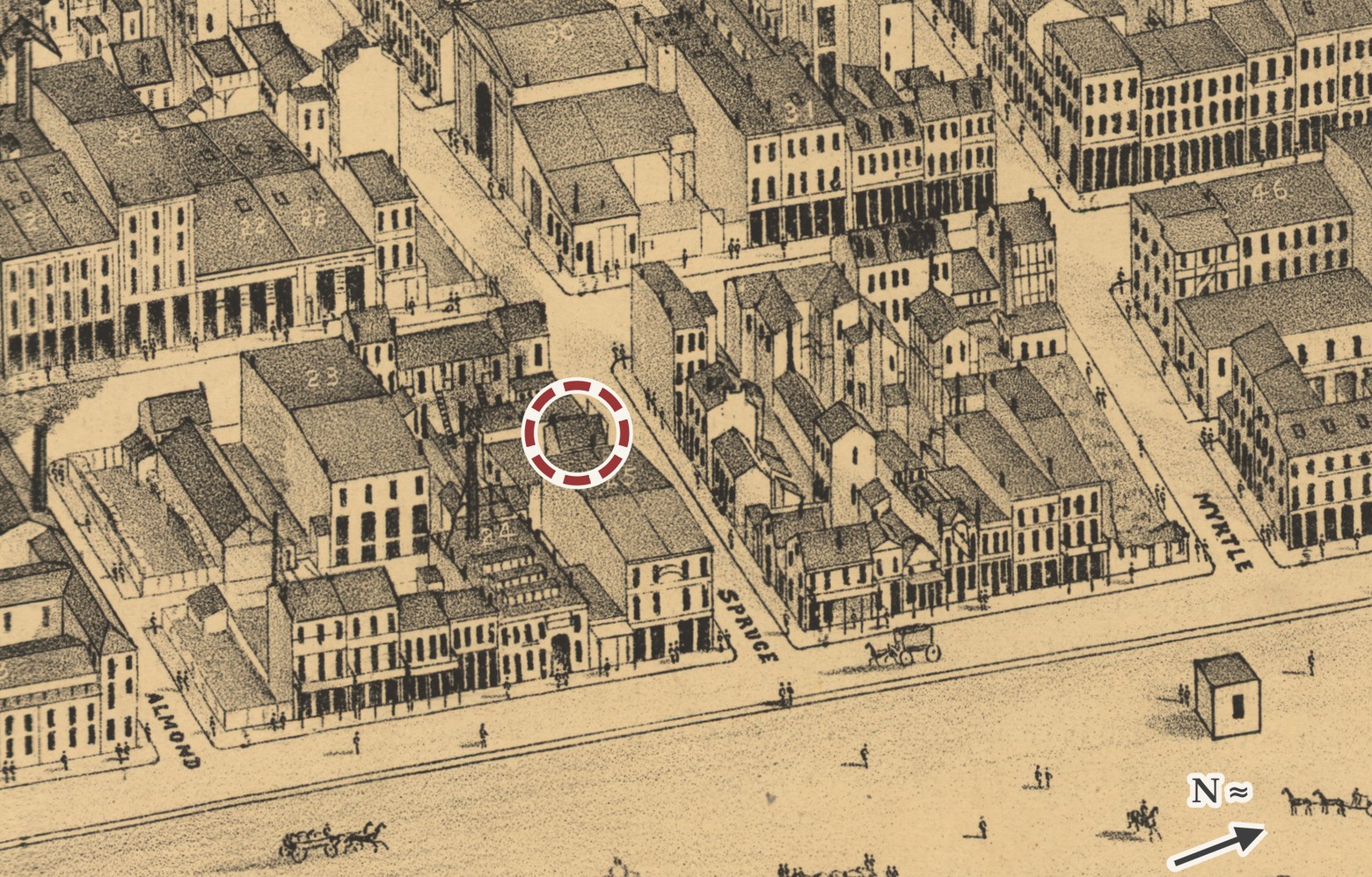
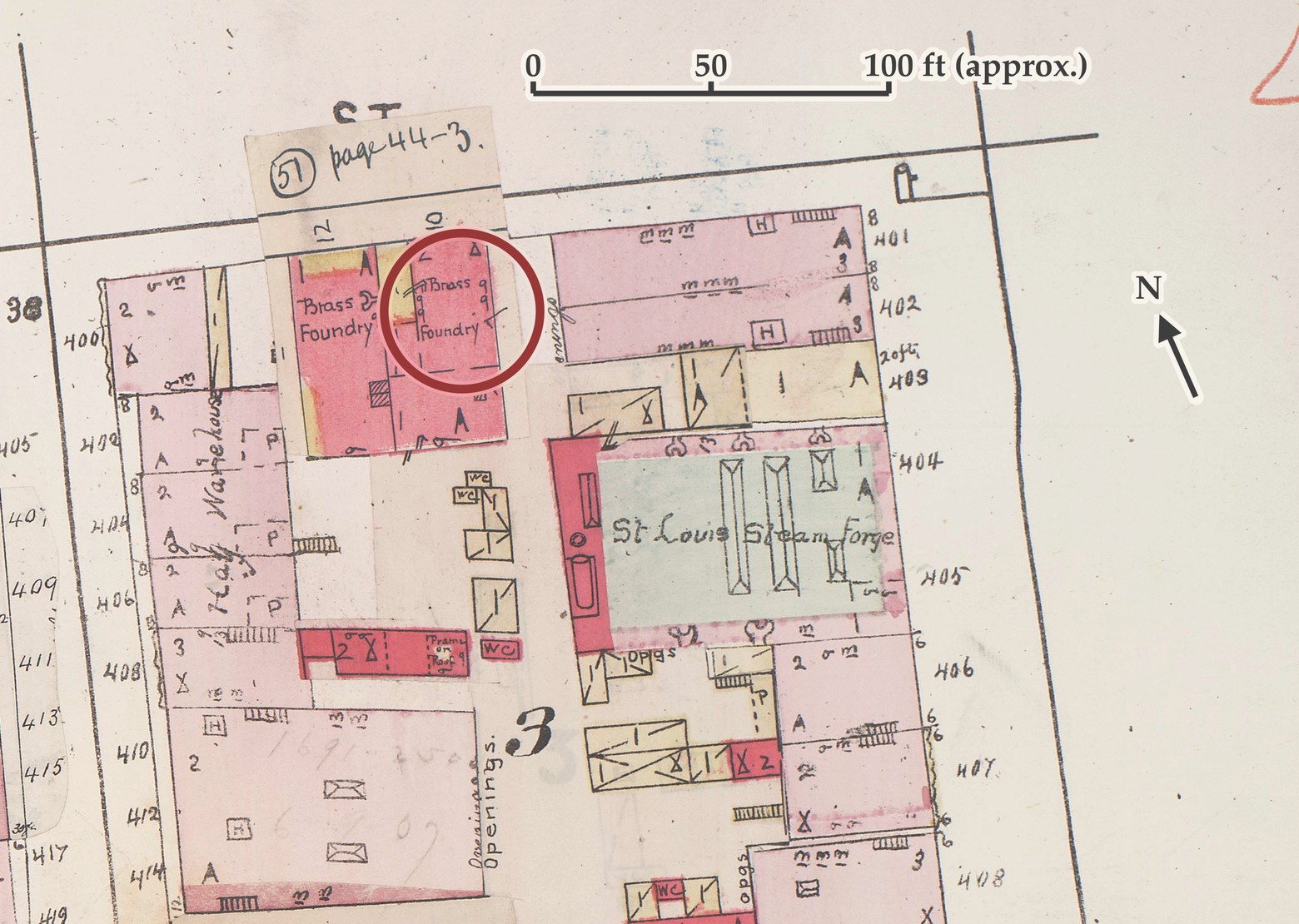
For part of 1875 Charles very probably left the street railway. The 1875 directory lists him as “Konson Charles, driver Gustav Stuhr,” and gives “Gantzen Charles, baker” at his home on Gate Street.85 Gustav Stuhr was a baker from Oldenburg in northern Germany.86 That year he kept a bakery at 10 Spruce Street, down by the levee, and lived on South Fifth Street.87 Spruce Street was about two miles north of Gate Street. Stuhr is not in the 1875–76 directory, which very probably shows Charles back on the St. Louis Railroad.88
Erwin Carl, the last child born on Gate Street, was born on 27 August 1875 and baptized on 3 October.91 He shared his first name with his godfather, Erwin Spraul, very probably the brewer who had lived next door at 720 Gate Street.92 The chapter “The Godparents and Witnesses, 1866–1881” tells of the baptism.93 The boy grew up as Charles Johnson Jr.94
By the end of 1875 Charles had a wife and five children to keep, on a driver’s pay, and the hard times that began in 1873 were not over.95
Notes
95 notes
- Edwards’ St. Louis Directory, 1871, p. 352, image 1512. — Proven. [D1871]
- City of St. Louis, deeds of trust, 14 May 1869, pp. 539–540, images 315–316; “The Courts — Court of Criminal Correction,” The St. Louis Republican ( title “The St Louis Republic”), Thu 16 Sep 1869, p. 2; Missouri Democrat ( “St. Louis Globe-Democrat”), 21 May 1869, p. 4; St. Louis Deeds of trust, 18 Jan 1870, Vol. 400. [DOT69] [REP69] [BUSE69] [DOT70]
- Ron Rothbart, “The Ethnic Saloon as a Form of Immigrant Enterprise,” International Migration Review 27, no. 2 (Summer 1993), p. 349. — Possible. [ROTHBART93]
- Address chronology of Charles, 1865–1903, pages 28 and 29. The chronology is set out on the research website page “Charles’s Addresses and Occupations, Year by Year.” St. Louis city directories (Edwards’, Gould’s), 1860–1904, every volume searched under every known spelling of the surname; Edwards’ 1872, p. 270; James Neal Primm, Lion of the Valley, pp. 308 and 326–27. St. Marcus Evangelical Church, St. Louis: baptism of Auguste Gonsen, 1872, p. 352; St. Marcus Evangelical Church (St. Louis, Missouri), baptism register 1874, p. 402, no. 8178/41, Louise Jansen; Erwin Carl Konsen (Charles Johnson Jr.), p. 453, entry 8854/282, image 488, https://
www . [RES] [DIRS] [PRIMM] [AUG] [LOU] [ERW].familysearch .org/ ark:/ 61903/ 1:1:6DL7-LBQN - Edwards’ St. Louis Directory, 1871, p. 352, image 1512. Four other plain “Johnson Charles” lines are on the same page: two laborers, a mate and a porter, besides Charles H., L. and P. None of them is a car man or lives near Gate Street. The 1871 and 1872 directories list only one Charles of any family spelling at 718 Gate, and 718 Gate is his address in the 1872–76 directories, under Konsen and Gonson. [D1871]
- Introductory matter of Edwards’ St. Louis Directory 1870 (dated April 1870; FamilySearch image group number (IGN) 109296989, image 8, https://
www : accessed 11 November 2026) and 1871 (“Introductory,” p. 21, on “the canvass made this year” and the fire at the printing office in February 1871; the city officers “elected April 4, 1871” in the front matter; Missouri Digital Heritage, St. Louis Mercantile Library, https://.familysearch .org/ ark:/ 61903/ 3:1:3QHK-LQZY-BQMZ mdh : accessed 11 November 2026), showing the canvass seasons. The 1870 directory, compiled from about January to March 1870, does not list him on Gate Street. [CANVASS].contentdm .oclc .org/ digital/ collection/ p16795coll7/ id/ 1029 - Charles Gannson (Private, Battery B, 2nd Missouri Light Artillery, Civil War), pension application no. Inv. 749,432, certificate no. 684,507; Case Files of Approved Pension Applications of Veterans Who Served in the Army and Navy Mainly in the Civil War and the War with Spain, 1861–1934; Civil War and Later Pension Files; Record Group 15: Records of the Department of Veterans Affairs; National Archives, Washington, D.C.; digital copy of the file supplied to the author by the National Archives, imaged at https://
charles-research : accessed 30 October 2026. Mail-order copies ordered by the author, first a partial file, order F21-314123835E, submitted 14 February 2017 and delivered electronically, and then the complete file, order F41-523680269E, submitted 8 September 2019 and sent by mail. Charles was a sergeant from 7 November 1863 until 15 March 1865. Pension file p. 28. [PEN].netlify .app/ pension-file .html - Glen Holt and Tom Pearson, St. Louis Streets Index, p. 16. Gate Street is not among the city’s streets of 1994 listed in the index. [STLSTR]
- Richard J. Compton and Camille N. Dry, Pictorial St. Louis. [PICT75]
- Richard J. Compton and Camille N. Dry, Pictorial St. Louis. The 1868–69 directory already lists four of the company’s drivers and conductors at 718 Gate, before Charles came. — Proven. Richard J. Compton and Camille N. Dry, Pictorial St. Louis. [PICT75] [PICT75]
- “An act concerning street railroads in the city of St. Louis,” approved 16 Jan 1860, §5, as printed in J. G. Woerner, ed. A Digest of the Charter and the Revised Ordinances of the City of St. Louis (St. Louis, 1866), ch. 18, “Of Street Railroads,” §12, pp. 263–264, and in the appendix of acts. Internet Archive, digestofcharterr00sain (https://
archive : accessed 8 November 2026). [ACT1860].org/ details/ digestofcharterr00sain - Edwards’ St. Louis Directory, 1871, p. 352, image 1512; St. Louis directory 1873–74, p. 843; J. Thomas Scharf, History of Saint Louis City and County, vol. 1., p. 698. The view runs from Carondelet Avenue past Seventh Street to Eighth Street, drawn in perspective. The circle is on the south (left) side of the street, just above the Seventh Street corner. The house itself cannot be picked out. The 1873–74 directory lists the next-door neighbor, Erwin Spraul, a brewer, at 720 Gate. He was very probably the godfather of Charles’s son Erwin Carl (Charles Jr.). Under the city’s house-numbering ordinance of December 1865, even numbers were on the south side of a street and the 700s began at Seventh Street. So 718 lay a few lots west of the corner. The plate’s key labels the long building at Gate Street and Carondelet Avenue (no. 2) “Stables St. Louis Rail Road Co.”: the stables of the company Charles worked for. The plate also shows the company’s tracks. A single line turns out of Seventh Street, runs down Gate Street and curves onto Carondelet Avenue. Two more run out of the end of the stables onto the avenue. On the next plate to the north, Dry drew a horse car on Seventh Street and another on Carondelet Avenue, the two streets of the company’s line. [D1871] [GPSPRDIR] [SCHARF1]
- 1870 U.S. census, St. Louis County, Missouri, population schedule, St. Louis Ward 1, image 87, dwelling 611, family 721, household of George Rothweiler, 45, born Baden, with his wife Mina and six sons (FamilySearch https://
www : accessed 29 October 2026); Edwards’ St. Louis Directory 1871, “Rothweiler George, agt. r. 716 Gate,” “Rothweiler Henry B. student, R. E. Rombauer, r. 716 Gate,” “Shugrue Michael, hostler, r. 720 Gate” (FamilySearch film 109296989, images 783 and 1719). Read in the images. [C1870G].familysearch .org/ ark:/ 61903/ 3:1:S3HY-69BS-TVN - Henry D. Niemeier: Edwards’ and Gould’s St. Louis directories, p. 632. Niemeier was born in Hanover about 1837–38. Edwards’ 1868–69, p. 561; 1870, p. 495; 1870–71, p. 656. — Proven. [NIEMEIER]
- Charles Gannson (Private, Battery B, 2nd Missouri Light Artillery, Civil War), pension application no. Inv. 749,432, certificate no. 684,507; Case Files of Approved Pension Applications of Veterans Who Served in the Army and Navy Mainly in the Civil War and the War with Spain, 1861–1934; Civil War and Later Pension Files; Record Group 15: Records of the Department of Veterans Affairs; National Archives, Washington, D.C.; digital copy of the file supplied to the author by the National Archives, imaged at https://
charles-research : accessed 30 October 2026. Mail-order copies ordered by the author, first a partial file, order F21-314123835E, submitted 14 February 2017 and delivered electronically, and then the complete file, order F41-523680269E, submitted 8 September 2019 and sent by mail. Charles was a sergeant from 7 November 1863 until 15 March 1865. Pension file p. 20. [PEN].netlify .app/ pension-file .html - Henry D. Niemeier: Edwards’ and Gould’s St. Louis directories, p. 632. St. Marcus marriage register 1861, No. 710/52, image 363. — Proven. [NIEMEIER]
- A closer look at the same plate: the stables (no. 2) on the corner of Gate Street and Carondelet Avenue, with the car tracks curving in from Gate Street to the stable door.
- J. Thomas Scharf, History of Saint Louis City and County, vol. 2, p. 1732, p. 1206. 1900 U.S. census, St. Louis, Ward 9, enumeration district 129, sheet 5-B, line 96. In June 1900 he was boarding at 170 Sidney Street. [SCHARF] [C1900]
- Helen Davault Williams, “Social Life in St. Louis from 1840 to 1860,” Missouri Historical Review 31, no. 1. [WILLIAMS36]
- Joseph Rippey, Rippey’s Index Map and Business Guide of St. Louis, Mo. (St. Louis, 1888), street railways: “St. Louis Railroad Company—From Grand avenue on north to Keokuk on south, via Broadway and Seventh, seven and a half miles”; transcribed at https://
www , read 31 Oct 2026; J. Thomas Scharf, History of Saint Louis City and County (Philadelphia, 1883), vol. 2, pp. 1206–1208, p. 1207; St. Louis Railroad Co. v. Northwestern St. Louis Railway Co., 2 Mo. App. 69 (St. Louis Court of Appeals, 25 Apr 1876), opinion of Lewis, J., quoting city ordinances no. 4371 (10 Mar 1859) and no. 4467 (30 Jun 1859) on the company’s route and tracks; Caselaw Access Project (https://.cable-car-guy .com/ html/ ccstlouis .html static : accessed 8 November 2026). [RIPPEY88] [OCC-SCHARF] [STLRR59].case .law/ mo-app/ 2/ html/ 0069-01 .html - Ernst D. Kargau, The German Element in St. Louis, p. 170, pp. 243–44. Kargau calls the company the St. Louis Railway Company and the line the Bremen–Arsenal or Fifth Street line. The directories name Charles’s employer as the “St. Louis R. R.” Its length made the line “far less profitable than its owners had a right to expect” (p. 244). [KARGAU]
- Ernst D. Kargau, The German Element in St. Louis, p. 170, p. 244. The first line opened in 1859, so the count falls about 1874. The directories call Charles a conductor in 1871–72 and a driver from 1872. [KARGAU]
- Glen Holt and Tom Pearson, St. Louis Streets Index, p. 16. Page 16, “Broadway”: Fifth Street downtown and Carondelet Avenue to the south became Broadway in 1883, when a city ordinance named the “entire thoroughfare” Broadway. [STLSTR]
- “An act concerning street railroads in the city of St. Louis,” approved 16 Jan 1860. [ACT1860]
- John H. White Jr. “Horse Power,” Invention & Technology 8:1 (Summer 1992): 41–51, on horse-car crews, hours and pay in American cities; its figures are from cities other than St. Louis. Online at https://
www (accessed 4 November 2026); “The Street Railway System of Saint Louis,” Street Railway Journal, June 1895, transcribed at https://.inventionandtech .com/ node/ 85567 www (accessed 4 November 2026); J. G. Woerner, ed. A Digest of the Charter and the Revised Ordinances of the City of St. Louis (St. Louis, 1866), art. V, pp. 538–540. [WHITE92] [STLRR] [OCC-DIG1866].cable-car-guy .com/ html/ ccsrj_stl .html - Kristen Layne Anderson, Abolitionizing Missouri, pp. 151–52, 192–93, pp. 151–52. Nothing records how Charles’s own line or Charles himself treated Black riders. [ANDERSON16]
- Clay McShane and Joel A. Tarr, The Horse in the City: Living Machines in the Nineteenth Century, Animals, History, Culture (Baltimore: Johns Hopkins University Press, 2007), 5–6, 14, 66, 106, 119–20, 150, 152 and 161; EBSCO eBook Collection, through Utah Valley University Library, read 2 Nov 2026; quotations checked in the page images. Page 66. “Early St. Louis Street Railways,” written by “Tomique” in the St. Louis Times, 8 May 1907, reprinted in “Missouri History Not Found in Textbooks,” Missouri Historical Review 24, no. 4 (July 1930): 605–7, at 606; Internet Archive, sim_missouri-historical-review_1930-07_24_4. Read in the page images, 2 Nov 2026. A reminiscence written about fifty years after the fact; “How a Street Railroad Company Lost a Nickel,” from the St. Louis Republican, 11 Jan 1875, reprinted in “Missouri History Not Found in Textbooks,” Missouri Historical Review 42, no. 2 (January 1948): 205–6; Internet Archive, sim_missouri-historical-review_1948-01_42_2. Read in the page images, 2 Nov 2026. In these years some St. Louis lines ran one-man cars called “bobtails.” The driver worked alone, and passengers dropped their fares in a glass box. Clay McShane and Joel A. Tarr, The Horse in the City, p. 66. Whether Charles’s line used them is not known. The bobtail was first built in New Orleans in 1860 and weighed under 1,200 pounds, so one horse could pull it. Riders complained that the cars were crowded and slow. The managers liked them because they saved the pay of a conductor. [MCSHANE07] [TOMIQUE07] [BOBTAIL75] [MCSHANE07]
- Edwards’ St. Louis Directory, 1871, p. 352, image 1512. [D1871]
- Gould’s St. Louis Directory, for 1875, p. 340, p. 522, p. 886. Gould’s 1875–76 directory (title year 1876), p. 507. — Very probable. [D1875]
- Edwards’ Fourteenth Annual Directory of St. Louis, for 1872, p. 270, https://
mdh ; Gould’s St. Louis Directory, 1873–74 (title year 1874): p. 509, “Konsen Charles, driver, r. 718 Gate.” He is “Johnson Charles, conductor, r. 718 Gate” in the two 1872 directories and “Konsen Charles, driver, r. 718 Gate” in 1873–74. The 1872–73 directory has “Gansen Charles, driver, r. 720 Gate.” That is either the house next door or a misprint for his own. The research website page “Charles’s Addresses and Occupations, Year by Year” gives each line. [D1872] [D1874].contentdm .oclc .org/ digital/ collection/ p16795coll7/ - Missouri Bureau of Labor Statistics and Inspection, [Seventh] Annual Report, p. 182. It paid its fifty-two conductors 40 or 50 cents a trip and its fifty-two drivers 33 or 40 cents. [OCC-BLS1885]
- Henry D. Niemeier, born in Hanover about 1837: Edwards’ and Gould’s St. Louis directories: 1866–67 p. 632. Gould’s 1875–76 directory, p. 680. [NIEMEIER]
- Address chronology of Charles, 1865–1903, pages 28 and 29. The address chronology is set out on the research website page “Charles’s Addresses and Occupations, Year by Year.” St. Louis city directories (Edwards’, Gould’s), 1860–1904, every volume searched under every known spelling of the surname, 1877 and 1882–84 in the image: 1879, p. 512; The surname record: twenty-eight attestations of Charles’s surname in fourteen spellings. [RES] [DIRS] [SURN]
- Edwards’ Eleventh Annual Directory to the Inhabitants, Institutions, Incorporated Companies, Manufacturing Establishments, Business, Business Firms, etc., etc., in the City of St. Louis, for 1869 (St. Louis: Charless Publishing and Manufacturing Co., 1869), entries for employees of the “St. Louis R. R.,” among them “Fitzpatrick Michael, watchman St. Louis R. R.” p. 318 (Internet Archive, Directory_St_Louis_1869, image n263, https://
archive : accessed 8 November 2026, read in the page image) and the conductor and hostler living on Gate Street (searchable text). [OCC-D1869].org/ details/ Directory_St_Louis_1869 - Edwards’ and Gould’s St. Louis city directories, 1866–1891 (Gould’s 1891, p. 1025: Henry D. Niemeier, driver, r. 3006 S. 9th, Missouri Digital Heritage, St. Louis Mercantile Library city directories, https://
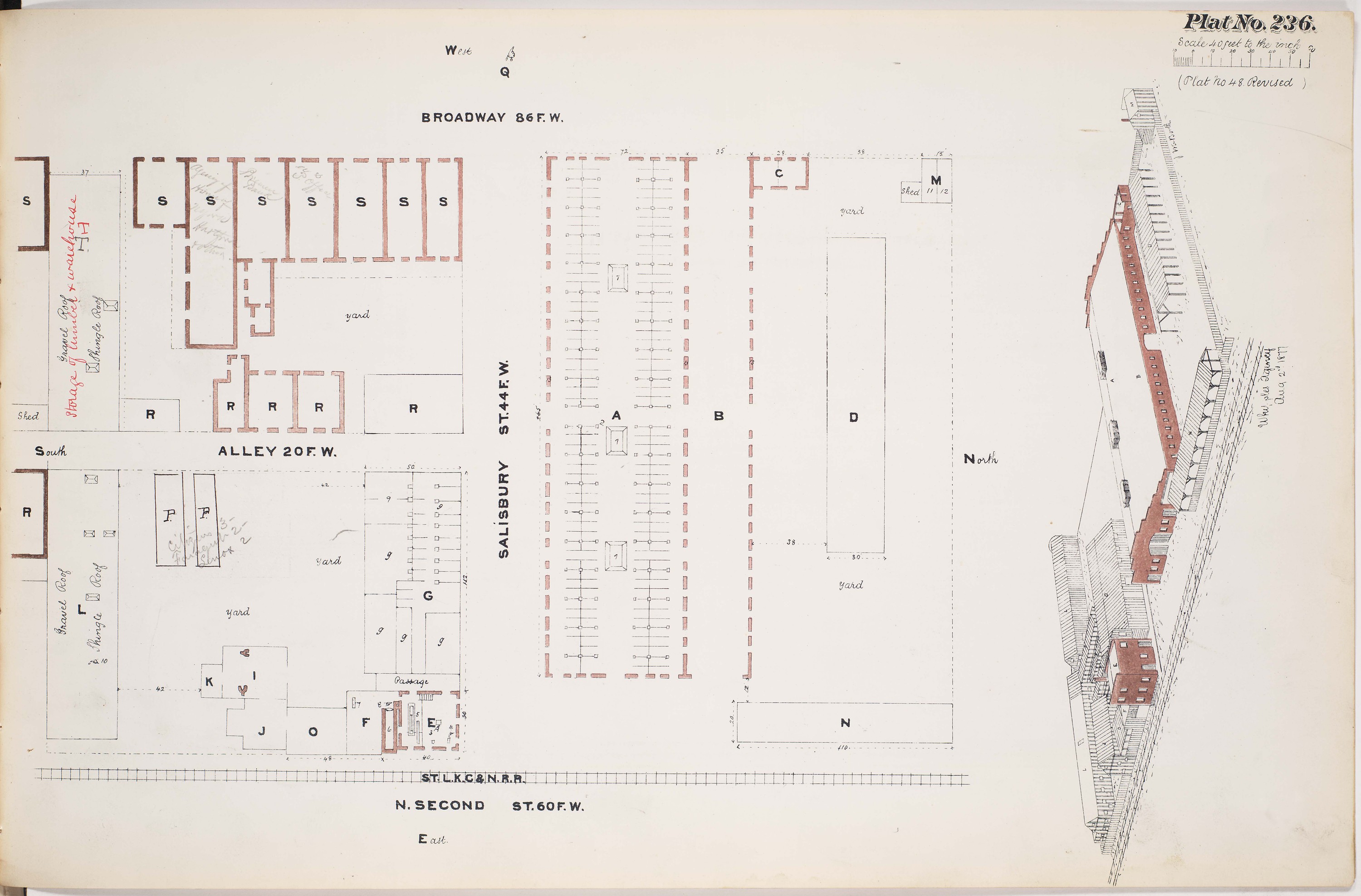
mdh : accessed 11 November 2026, read in the image; Charles Gannsen, conductor and driver at 718 Gate, 1871–1876, the St. Louis Railroad named as his employer in 1871 and 1875–76, each line cited with its image on the research website page “Charles’s Addresses and Occupations, Year by Year”); U.S. Census 1880, first enumeration, St. Louis, ED 65, sheet 566-A, “Henry Niemeyer, 42, Brewer, born Hanover” (FamilySearch M6FK-KZ1); Theodore Gottlob, New Orleans passenger list, 27 Dec 1853; U.S. Census 1880, John “Hipler” (Hebbeler), teamster, born Germany (M6N9-YM8); Find a Grave index, John Hebbeler, died 12 Jan 1902. Index entries: “United States, Census, 1880,” database, FamilySearch (https://.contentdm .oclc .org/ digital/ collection/ p16795coll7/ id/ 31928 www and https://.familysearch .org/ ark:/ 61903/ 1:1:M6FK-KZ1 www : accessed 2 November 2026); Henry D. Niemeier: Edwards’ and Gould’s St. Louis directories, p. 632. The line Charles worked did not keep its horses. The Broadway line switched to cable about 1890, and in 1895 it was still a cable line. “The Street Railway System of Saint Louis,” Street Railway Journal, June 1895, on the St. Louis Railroad Company and its Broadway cable line (“The rails on the Broadway cable line, which have now been in service five years”; “It has not been decided whether or not to operate the Broadway cable line by electricity”), transcribed at https://.familysearch .org/ ark:/ 61903/ 1:1:M6N9-YM8 www (accessed 4 November 2026). [DIRS] [NIEMEIER] [SRJ95].cable-car-guy .com/ html/ ccsrj_stl .html - Edwards’ Eleventh Annual Directory to the Inhabitants, Institutions; Missouri Bureau of Labor Statistics and Inspection, [Seventh] Annual Report, p. 182. In 1885 it paid them $2.00 for a twelve-hour day, more than its hostlers or its track repairers earned. A. Whipple’s Insurance Maps, 2nd series, Special Risks, St. Louis, Mo., 1878, vol. 5, plat 236 (“Plat No. 48 revised”), “St. Louis Street Railway Co.’s Stables, Broadway and Salisbury Streets,” plan and description. Washington University Libraries, Whipple Volumes, record 108230 (https://
data : accessed 4 November 2026; Missouri Historical Society, sponsor); public domain (CC0). Read in the image. An 1878 insurance map names the “St. Louis Street Railway Co.’s Stables,” at Broadway and Salisbury Streets. Its plan shows what such men guarded: a stable 565 feet long, a car shed, a feed mill, shops, a horse hospital, and “Three night watchmen.” [OCC-D1869] [OCC-BLS1885] [WHIP78].library .wustl .edu/ record/ 108230 - St. Louis city directories (Edwards’, Gould’s), 1860–1904, every volume searched under every known spelling of the surname; Edwards’ 1872, p. 270. [DIRS]
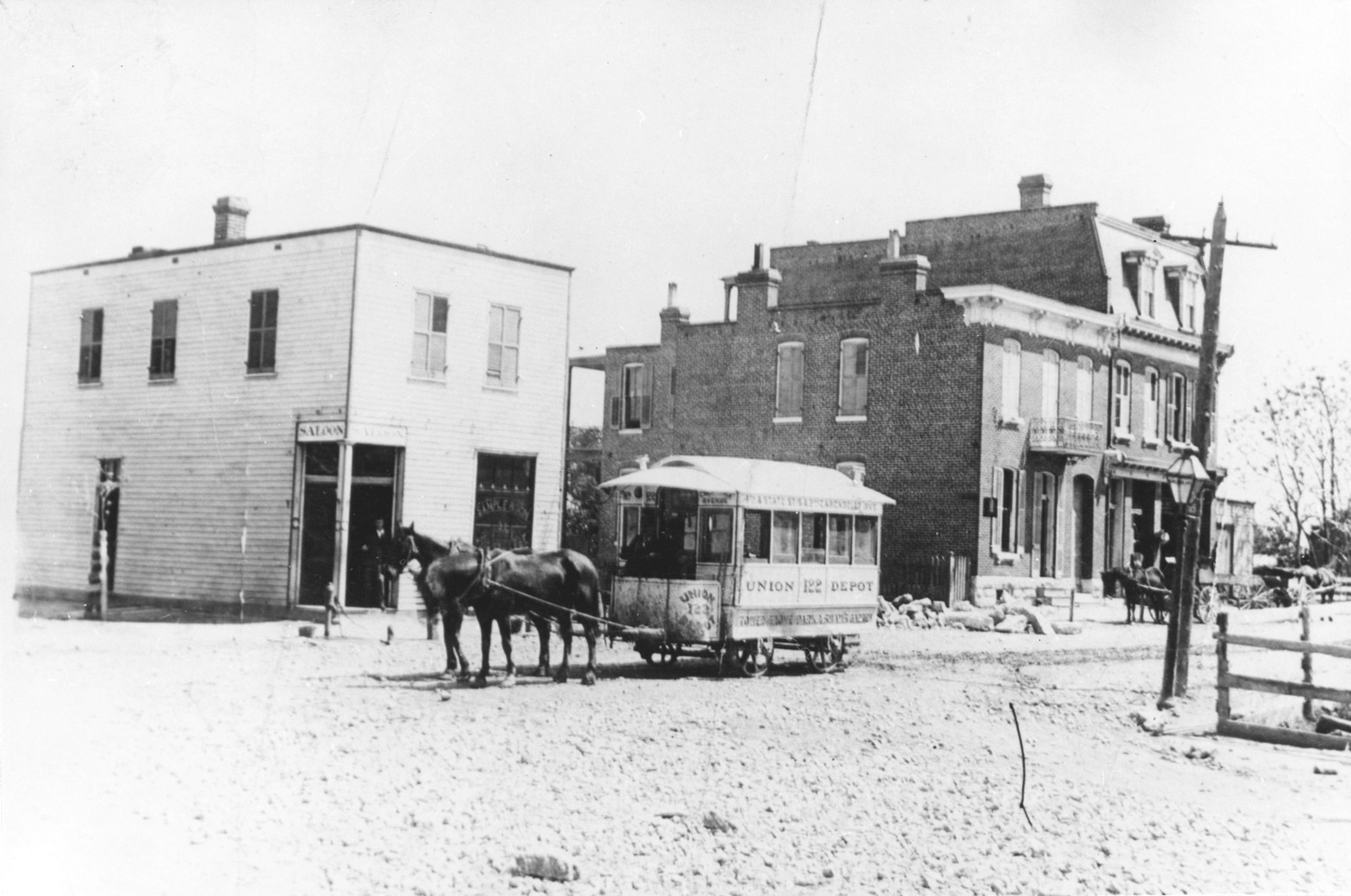
- The board above its windows names Carondelet Avenue, and the panel below them Tower Grove Park and Shaw’s Garden. It belonged to another company, not Charles’s.
- Gould’s St. Louis Directory, 1873–74 (title year 1874): p. 509, “Konsen Charles, driver, r. 718 Gate”; Gould’s St. Louis Directory, for 1875, p. 340, p. 522, p. 886; Missouri Bureau of Labor Statistics, First Annual Report, for the year ending January 1, 1880 (Jefferson City, 1880), p. 96; Missouri Bureau of Labor Statistics and Inspection, Fifteenth Annual Report, for the year ending November 5, 1893 (Jefferson City, 1893), “Street Railways,” pp. 275–280; John H. White Jr. “Horse Power,” Invention & Technology 8:1 (Summer 1992). — Probable. [D1874] [D1875] [OCC-BLS1880] [OCC-BLS1893] [WHITE92]
- St. Louis city directories (Edwards’, Gould’s), 1860–1904, every volume searched under every known spelling of the surname; Edwards’ 1872, p. 270. [DIRS]
- J. G. Woerner, ed. A Digest of the Charter and the Revised Ordinances of the City of St. Louis (St. Louis, 1866), art. V, pp. 538–540. [OCC-DIG1866]
- “The Lines of Cars,” St. Louis Post-Dispatch, Tue. 19 Oct 1875, p. 4, on the Fifth Street road: “A conductor making his eight regular trips a day travels 96 miles—672 miles in one week” ( image 138955893); imaged, (https://
www : accessed 12 November 2026). Read twice, independently, in the page image, 12 Nov 2026. [PD75L].newspapers .com/ image/ 138955893/ - Missouri Bureau of Labor Statistics, First Annual Report, for the year ending January 1, 1880 (Jefferson City, 1880), p. 96. The Bureau’s words: “The average weekly wages paid by one company, is $9.00, which is a fair statement of the wages paid on all street railways in the city. … the hours of labor, per week, average 95.” The figures usually quoted for horse-car pay come from other American cities, and they are higher: two to two and a half dollars a day for days of twelve to sixteen hours. In Providence in the 1870s, a company paid its conductors $2.50 a day and its drivers $2.25. Its historian found that this was more than streetcar men earned in New York or St. Louis (pages 26–27). John H. White Jr. “Horse Power,” Invention & Technology 8:1 (Summer 1992); Scott Molloy, Trolley Wars: Streetcar Workers on the Line (Washington, D.C.: Smithsonian Institution Press, 1996), 25–28 (28: the conductors’ rules, from the Union Railroad’s rule book of 1865) and 32; Internet Archive, https://
archive , read 2 Nov 2026; quotations checked in the page images. A study of the Union Railroad of Providence, Rhode Island, 1864 to about 1892. [OCC-BLS1880] [WHITE92] [MOLLOY96].org/ details/ trolleywarsstree0000moll - Clay McShane and Joel A. Tarr, The Horse in the City, pp. 6 and 152. [MCSHANE07]
- Missouri Bureau of Labor Statistics and Inspection, [Seventh] Annual Report, p. 182. [OCC-BLS1885]
- Missouri Bureau of Labor Statistics, First Annual Report, for the year ending January 1, 1880 (Jefferson City, 1880), p. 96. [OCC-BLS1880]
- Missouri Bureau of Labor Statistics and Inspection, Fifteenth Annual Report, for the year ending November 5, 1893 (Jefferson City, 1893), “Street Railways,” pp. 275–280; Missouri Bureau of Labor Statistics and Inspection, Fifteenth Annual Report, for the year ending 5 Nov 1893 (Jefferson City, 1893), pp. 275–286, street railways; Internet Archive, annualreport06servgoog (https://
archive : accessed 9 November 2026). [OCC-BLS1893] [BLS93].org/ details/ annualreport06servgoog - “Early St. Louis Street Railways,” written by “Tomique” in the St. Louis Times, 8 May 1907. [TOMIQUE07]
- Charles Gannson (Private, Battery B, 2nd Missouri Light Artillery, Civil War), pension application no. Inv. 749,432, certificate no. 684,507; Case Files of Approved Pension Applications of Veterans Who Served in the Army and Navy Mainly in the Civil War and the War with Spain, 1861–1934; Civil War and Later Pension Files; Record Group 15: Records of the Department of Veterans Affairs; National Archives, Washington, D.C.; digital copy of the file supplied to the author by the National Archives, imaged at https://
charles-research : accessed 30 October 2026. Mail-order copies ordered by the author, first a partial file, order F21-314123835E, submitted 14 February 2017 and delivered electronically, and then the complete file, order F41-523680269E, submitted 8 September 2019 and sent by mail. Charles was a sergeant from 7 November 1863 until 15 March 1865. Pension file p. 29. The chapter “The Watchman and the Pension, 1885–1895” quotes it. [PEN].netlify .app/ pension-file .html - Charles Gannson (Private, Battery B, 2nd Missouri Light Artillery, Civil War), pension application no. Inv. 749,432, certificate no. 684,507; Case Files of Approved Pension Applications of Veterans Who Served in the Army and Navy Mainly in the Civil War and the War with Spain, 1861–1934; Civil War and Later Pension Files; Record Group 15: Records of the Department of Veterans Affairs; National Archives, Washington, D.C.; digital copy of the file supplied to the author by the National Archives, imaged at https://
charles-research : accessed 30 October 2026. Mail-order copies ordered by the author, first a partial file, order F21-314123835E, submitted 14 February 2017 and delivered electronically, and then the complete file, order F41-523680269E, submitted 8 September 2019 and sent by mail. Charles was a sergeant from 7 November 1863 until 15 March 1865. Pension file p. 20. [PEN].netlify .app/ pension-file .html - Charles Gannson (Private, Battery B, 2nd Missouri Light Artillery, Civil War), pension application no. Inv. 749,432, certificate no. 684,507; Case Files of Approved Pension Applications of Veterans Who Served in the Army and Navy Mainly in the Civil War and the War with Spain, 1861–1934; Civil War and Later Pension Files; Record Group 15: Records of the Department of Veterans Affairs; National Archives, Washington, D.C.; digital copy of the file supplied to the author by the National Archives, imaged at https://
charles-research : accessed 30 October 2026. Mail-order copies ordered by the author, first a partial file, order F21-314123835E, submitted 14 February 2017 and delivered electronically, and then the complete file, order F41-523680269E, submitted 8 September 2019 and sent by mail. Charles was a sergeant from 7 November 1863 until 15 March 1865. Pension file p. 12. [PEN].netlify .app/ pension-file .html - Charles Gannson (Private, Battery B, 2nd Missouri Light Artillery, Civil War), pension application no. Inv. 749,432, certificate no. 684,507; Case Files of Approved Pension Applications of Veterans Who Served in the Army and Navy Mainly in the Civil War and the War with Spain, 1861–1934; Civil War and Later Pension Files; Record Group 15: Records of the Department of Veterans Affairs; National Archives, Washington, D.C.; digital copy of the file supplied to the author by the National Archives, imaged at https://
charles-research : accessed 30 October 2026. Mail-order copies ordered by the author, first a partial file, order F21-314123835E, submitted 14 February 2017 and delivered electronically, and then the complete file, order F41-523680269E, submitted 8 September 2019 and sent by mail. Charles was a sergeant from 7 November 1863 until 15 March 1865. Pension file p. 28. Edwards’ Eleventh Annual Directory, City of St. Louis, for 1869, p. 649, https://.netlify .app/ pension-file .html archive . The family lived on the block from the winter of 1870–71. The statement gives no year for the treatment. [PEN] [REISS69].org/ details/ Directory_St_Louis_1869/ page/ n596 - St. Marcus Evangelical Church, St. Louis: baptism of Auguste Gonsen, 1872, p. 352. — Proven. St. Marcus German Evangelical Church (St. Louis, Missouri), baptism register 1872, p. 352, No. 7519/196. [AUG] [GPB72]
- Ernst D. Kargau, The German Element in St. Louis, p. 170. No record shows that Charles attended. [KARGAU]
- “The driver of car No. 15 of the Fifth street line was sunstruck in the Arsenal grounds …,” city items, Missouri Democrat (St. Louis), Tue. 30 Jul 1872, p. 4, col. 2 ( image 571040604, filed as “St. Louis Globe-Democrat”; https://
www : accessed 11 November 2026). Read twice, independently, in the page image, 11 Nov 2026. [GD72S].newspapers .com/ image/ 571040604/ - Edwards’ St. Louis Directory, 1871, p. 352, image 1512; Item on travel to the fair, city news, Missouri Republican (St. Louis; title “The St Louis Republic”), Mon. 18 Sep 1871, p. 2: “The Fifth street line—St. Louis railroad—will carry passengers to Bremen avenue” ( image 666855962); imaged, (https://
www : accessed 12 November 2026). Read twice, independently, in the page image, 12 Nov 2026. In September 1871 the Missouri Republican named the two together: “The Fifth street line—St. Louis railroad.” “Street Railroads. The Fifth Street Line—President’s Report for the Year Ending April 7, 1873,” St. Louis Democrat (masthead; title “St. Louis Globe-Democrat”), Fri. 26 Sep 1873, p. 1: John F. Madison’s “seventh annual report” of the St. Louis Railroad Company. Under “Horse Plague”: “on the night of the 19th December a heavy snow storm set in. … before 9 o’clock nearly all the cars were snow-bound”; “we laid in large supplies of coal … every man in our employ was supplied during the winter at fifteen cents per bushel”; warm clothing was laid in “at wholesale prices, and the men who desired it were furnished the same at cost” ( image 571051317); imaged, (https://.newspapers .com/ image/ 666855962/ www : accessed 12 November 2026). Read twice, independently, in the page image, 12 Nov 2026; the date, the coal and the clothing were settled on a third reading. In 1873 the company’s own annual report was printed under the head “The Fifth Street Line.” — Proven. [D1871] [REP71F] [GD73R].newspapers .com/ image/ 571051317/ - Edwards’ Eleventh Annual Directory, City of St. Louis, for 1869, p. 649. The paper gives only the surname. The 1869 directory also lists a Dr. Charles Reis downtown, at 712 Chestnut Street. — Very probable. [REISS69]
- Edwards’ Fourteenth Annual Directory of St. Louis, for 1872, p. 270. [D1872]
- Kristen Layne Anderson, Abolitionizing Missouri, pp. 151–52, 192–93. Pages 192–93, her table numbered 6.6, from the Westliche Post, 8 November 1872. [ANDERSON16]
- John H. White Jr. “Horse Power,” Invention & Technology 8:1 (Summer 1992). [WHITE92]
- Clay McShane and Joel A. Tarr, The Horse in the City, p. 150. [MCSHANE07]
- “The Epizootic. Desolate Appearance of the Streets,” Missouri Democrat (St. Louis; running head “The Missouri Democrat”; title “St. Louis Globe-Democrat”), 7 Dec 1872, p. 4 ( image 571046716); imaged, (https://
www : accessed 2 November 2026). Read in the image. [GD72].newspapers .com/ image/ 571046716/ - Epizootic items, city news, Missouri Democrat (St. Louis), Sun. 8 Dec 1872, p. 4 ( image 571046774, filed as “St. Louis Globe-Democrat”; https://
www : accessed 11 November 2026): “The Fifth street line have twenty-eight cars on duty, having taken off but twelve.” Read twice, independently, in the page image, 11 Nov 2026. [GD72B].newspapers .com/ image/ 571046774/ - Scott Molloy, Trolley Wars. Page 32: in storms the Providence company paid its crews only by the trip. [MOLLOY96]
- “Street Railroads. The Fifth Street Line—President’s Report for the Year Ending April 7, 1873,” St. Louis Democrat. [GD73R]
- St. Louis city directories (Edwards’, Gould’s), 1860–1904, every volume searched under every known spelling of the surname; Edwards’ 1872, p. 270. Gould’s 1872–73, p. 306. [DIRS]
- St. Marcus German Evangelical Church (St. Louis, Missouri), baptism register 1872, p. 367, No. 7730/407, August Kreichelt, born 27 Aug 1872, baptized 8 Dec 1872; St. Marcus Evangelical Church (St. Louis, Missouri), baptism register 1872, p. 367. — Proven. [GPB72N] [GOD72]
- St. Louis city directories (Edwards’, Gould’s), 1860–1904, read year by year in the image under every spelling of the surname, with the Kreichelt, Pinkepank, Brauneis, Orlemann and Misch entries (Gould & Aldrich’s 1872, p. 435, “Kreichelt August, conductor, r. 2410 Carondelet av.,” Missouri Digital Heritage pointer 3557, read in the image). — Possible. [DIRS]
- “Street Railroads. The Fifth Street Line—President’s Report for the Year Ending April 7, 1873,” St. Louis Democrat. [GD73R]
- James Neal Primm, Lion of the Valley, pp. 326–27. Missouri Bureau of Labor Statistics, First Annual Report, for the year ending January 1, 1880 (Jefferson City, 1880), p. 96. [PRIMM] [OCC-BLS1880]
- Gould’s St. Louis Directory, for 1875, p. 340, p. 522, p. 886. [D1875]
- St. Marcus Evangelical Church (St. Louis, Missouri), baptism register 1874, p. 402, no. 8178/41, Louise Jansen. — Proven. St. Marcus German Evangelical Church, baptism register 1874, p. 402, image 463. [LOU] [GPB74]
- Charles Gannson (Private, Battery B, 2nd Missouri Light Artillery, Civil War), pension application no. Inv. 749,432, certificate no. 684,507; Case Files of Approved Pension Applications of Veterans Who Served in the Army and Navy Mainly in the Civil War and the War with Spain, 1861–1934; Civil War and Later Pension Files; Record Group 15: Records of the Department of Veterans Affairs; National Archives, Washington, D.C.; digital copy of the file supplied to the author by the National Archives, imaged at https://
charles-research : accessed 30 October 2026. Mail-order copies ordered by the author, first a partial file, order F21-314123835E, submitted 14 February 2017 and delivered electronically, and then the complete file, order F41-523680269E, submitted 8 September 2019 and sent by mail. Charles was a sergeant from 7 November 1863 until 15 March 1865. Page 28, statement received 14 June 1890. Address chronology of Charles, 1865–1903, pages 28 and 29. The chronology is set out on the research website page “Charles’s Addresses and Occupations, Year by Year.” — Possible. [PEN] [RES].netlify .app/ pension-file .html - Gould’s St. Louis Directory, 1873–74 (title year 1874): p. 509, “Konsen Charles, driver, r. 718 Gate.” Page 212 (“Conzen Charles, salesman Henry Imgound”), image 668. — Possible. [D1874]
- Gould’s St. Louis Directory, 1873–74 (title year 1874): p. 509, “Konsen Charles, driver, r. 718 Gate.” Gould’s 1873–74 directory, p. 212 (“Henry Imgound”); p. [438] and the grocers’ list, p. 1086 (Herman Imgrund). [D1874]
- Holy Ghost Evangelical Church (St. Louis, Missouri), marriages 1874, no. 993, p. 71; St. Louis city directories (Edwards’, Gould’s), 1860–1904, every volume searched under every known spelling of the surname; Edwards’ 1872, p. 270. — Probable. [WIT74] [DIRS]
- Holy Ghost (Heilige Geist) German Evangelical Church, St. Louis, baptisms 1854, p. 3, p. 2; Holy Ghost Evangelical Church (St. Louis, Missouri), marriages 1854, p. 161; Holy Ghost Evangelical Church, St. Louis, marriages 1867, p. 281, no. 55, 27 Oct 1867, “Franz Carl Döring & Christine Wilhelmine Niebuhr geb. Strautmann, beide v. St. Louis Cy.,” witnesses Louis Christen and Ernst Arwin (St. Louis Genealogical Society scan HOLY11-M-1867-3, p. 4; read in the image); Missouri, Marriages, 1750–1920, Carl F. Doering and Christiana Wolfsberger, 25 Aug 1874 (FamilySearch V2DZ-RY7; FHL film 528180, image group number (IGN) 007513822), index only; 1870 U.S. census, Central Township, St. Louis County, Christ and Christena Wolfsberger (NARA M593, IGN 004273859, image 384, line 34; FamilySearch M4XL-952), index only; St. Louis City death register, Catharine Doering, 44, d. 14 May 1867, Cheltenham, buried Holy Ghost Cemetery (vol. 1, p. 574), St. Louis Genealogical Society index; Edwards’s and Gould’s St. Louis directories 1873–74 and 1874, “Doering Charles, gardener, r. Benton Station P. R. R.” (1873–74, p. 251); Hümme confirmations 1846, no. 4, Johann Georg Carl Hendel, b. 18 Nov 1831 (Archion, Hümme Konfirmationen 219529, image 30, p. 53); St. Louis directories and U.S. censuses 1860–1880 and LAGIS Hessische Auswanderer searched for Georg Hendel without result (17 Oct 2026); imaged, Archion (https://
www : accessed 2 November 2026); FamilySearch (https://.archion .de/ de/ viewer/ churchRegister/ 219529 www ), by the image group numbers and images given; citing Landeskirchliches Archiv der EKKW, Kassel. When Auguste’s infant sister Minerva was baptized there in 1854, her sponsor was a Caroline Döring from another Döring family of the church. No record links that family to the groom of 1874. The bride and groom were probably a widow and a widowed gardener of St. Louis County. No tie between them and Charles has been found. Georg Hendel, the other witness, has not been found in the St. Louis directories or the censuses of 1860–80, so he cannot test the identification. [KHGB54] [DOR54] [WIT74B].familysearch .org - Westliche Post (St. Louis, Missouri), 8 Oct 1874, p. 3, local news, under “Unfälle”: “Robert Duft, No. 718 Gate Straße wohnhaft, wurde an der siebenten Straße, nahe Elm, von seinem Wagen geworfen und erlitt einen Beinbruch” ( image 640623402); imaged, (https://
www : accessed 11 November 2026). Read in the image twice independently, 11 November 2026. In the German type the surname could also be read Dust, because f and the long s look alike. [WP74D].newspapers .com/ image/ 640623402/ - Advertisement “Zu vermiethen,” 716 Gate Straße: the first floor of a two-story house, in a healthy, open situation, one block from the street railway; Westliche Post (St. Louis, Missouri), 28 Feb 1875, p. 4 ( image 640607619), and Abend-Anzeiger (St. Louis, Missouri), 1 Mar 1875, p. 2 (image 642090028); imaged, (https://
www , https://.newspapers .com/ image/ 640607619/ www : accessed 11 November 2026). Read in the images, one reader each, 11 November 2026. [RENT75].newspapers .com/ image/ 642090028/ - Gould’s St. Louis Directory, for 1875, p. 340, p. 522, p. 886. [D1875]
- “A Murderous Affray. Discharged Car Drivers Attack the Superintendent of the Fifth Street Railway,” St. Louis Democrat ( title “St. Louis Globe-Democrat”), Mon. 10 May 1875, p. 1: John Goodrich and Charles McDonnell “met Alexander Fuqua, superintendent of the St. Louis Street Railroad Company, near the Southern Stables, in the vicinity of Carondelet avenue and Gate street”; they “used violent, offensive and threatening language towards Fuqua for discharging them. Fuqua drew a revolver and fired four shots at the two men”; both were taken to the City Hospital; “The fourth shot went through the skirt of Alexander Mockelby’s coat,” the “starter of the cars at the Arsenal” ( image 571023983); imaged, (https://
www : accessed 12 November 2026). Read twice, independently, in the page image, 12 Nov 2026. The Democrat of 10 May spells the second man McDonnell and calls both men discharged car drivers. The court report of 19 June spells him McDonald and calls them conductors. Court of Criminal Correction, St. Louis Democrat ( title “St. Louis Globe-Democrat”), Sat. 19 Jun 1875, p. 3: “The case of Alexander Fuqua, charged with assault to kill, was partly heard in the Court of Criminal Correction yesterday. Defendant was superintendent of car stables, and John Goodrich and Charles McDonald were conductors of street cars, but had been discharged” ( image 571018203); imaged, (https://.newspapers .com/ image/ 571023983/ www : accessed 12 November 2026). Read twice, independently, in the page image, 12 Nov 2026. [GD75F] [GD75J].newspapers .com/ image/ 571018203/ - “A Murderous Affray. Discharged Car Drivers Attack the Superintendent of the Fifth Street Railway,” St. Louis Democrat, Mon. 10 May 1875. [GD75F]
- “A Murderous Affray. Discharged Car Drivers Attack the Superintendent of the Fifth Street Railway,” St. Louis Democrat, Mon. 10 May 1875. [GD75F]
- Court of Criminal Correction, St. Louis Democrat, Sat. 19 Jun 1875. [GD75J]
- Gould’s St. Louis Directory, for 1875, p. 340, p. 522, p. 886. — Very probable. [D1875]
- “Gustav H. Stuhr Dead. He Conducted a Bakery Forty-Four Years in St. Louis,” St. Louis Post-Dispatch, 3 Jan 1903, p. 2 ( image 138850648); imaged, (https://
www : accessed 30 October 2026). Read in the image; 1880 U.S. census, St. Louis, Missouri, household of Gustav Stuhr, baker, born Germany, with his wife Emilie and children Auguste, Gerhard, Emilie and Clara: first enumeration, ED 4, sheet 63-D (FamilySearch https://.newspapers .com/ image/ 138850648/ www ), and second enumeration, ED 11, sheet 80-C (https://.familysearch .org/ ark:/ 61903/ 1:1:M6FX-MTZ www ) (accessed 30 October 2026). Index only. He was about forty years old, with a wife, Emilie, and four children. [STUHR-OBIT] [CEN1880S].familysearch .org/ ark:/ 61903/ 1:1:M6FY-VTG - Gould’s St. Louis Directory, for 1875, p. 340, p. 522, p. 886. [D1875]
- Gould’s St. Louis Directory, for 1875, p. 340, p. 522, p. 886. Gould’s 1875–76 directory, pp. 856–857 and 507. The 1879 directory lists a “Johnson Charles, baker. r. rear 1623 Jackson,” the back house on the Kreichelt lot. Gould’s 1880 directory, p. 600, has “Kreichelt George, pedlar, r. 1621 Jackson.” The chapter “Jackson Street and the Cotton Press, 1877–1884” explains why the line is probably his. Gould’s St. Louis Directory, for 1879, p. 512, p. 898; For the Kreichelt family, the sources given in the chapter on Auguste and the Kreichelt family: Clausthal parish registers; St. Louis city directories 1864–1883; 1870 U.S. census, St. Louis County, Missouri, population schedule, St. Louis Ward 3, household of George Kreichelt (FHL film 4263033, image 476). [D1875] [D1879] [GPKREI]
- Gould’s St. Louis Directory, for 1875, p. 340, p. 522, p. 886; Richard J. Compton and Camille N. Dry, Pictorial St. Louis; Oliver & Whipple’s Fire Insurance Map of St. Louis, Mo., 1876, vol. 1, plate 44, nos. 10 and 12, no. 51. Spruce Street runs up from the levee (bottom) toward Main Street. The bakery stood on its south (left) side, between Main Street and the levee. The 1876 insurance map numbers the lot “10” about halfway along the block, behind the long building on the levee corner (no. 25 in the plate’s key). The building itself cannot be picked out on the drawing. North is to the right and a little up the page; the arrow is approximate. [D1875] [PICT75] [WHIP76]
- Gould’s St. Louis Directory, for 1875, p. 340, p. 522, p. 886; Oliver & Whipple’s Fire Insurance Map of St. Louis, Mo., 1876, vol. 1, plate 44, nos. 10 and 12, no. 51. A correction slip pasted over the lot later labels Nos. 10 and 12 “Brass Foundry,” so the map shows the building after the bakery had gone. It was a brick building of two stories at the front and one at the back. Pink marks brick, yellow wood. [D1875] [WHIP76]
- Erwin Carl Konsen (Charles Johnson Jr.), p. 453, entry 8854/282, image 488. — Proven. [ERW]
- St. Marcus Evangelical Church (St. Louis, Missouri), baptism register 1875, p. 453. [ERW]
- St. Marcus German Evangelical Church, baptism register 1875, p. 453, image 488. [GPB75]
- Erwin Carl Konsen (Charles Johnson Jr.), p. 453, entry 8854/282, image 488. [ERW]
- St. Marcus Evangelical Church, St. Louis: baptism of Auguste Gonsen, 1872, p. 352; St. Marcus Evangelical Church (St. Louis, Missouri), baptism register 1874, p. 402, no. 8178/41, Louise Jansen; Erwin Carl Konsen (Charles Johnson Jr.), p. 453, entry 8854/282, image 488; James Neal Primm, Lion of the Valley, pp. 326–27. [AUG] [LOU] [ERW] [PRIMM]
Also on this page
Online extra
This figure stood in the printed chapter until 25 October 2026 and is kept here.
Supplements
Records, images and data on this website that go with this chapter.