Can the DNA show who Charles was? Not yet. Nothing in it contradicts a German origin for Charles, but it does not choose a parish or a surname. The leading candidate, Karl Ludwig Hofedietz (see “The Boy from the Goose Corner”), can be tested from both sides. A descendant of one of his sisters can take an autosomal test, which tests the mother’s side, and a man of the Hofedietz male line can take a Y test, which tests the father’s.
In this chapter
What the DNA shows so far
Charles’s Y chromosome probably descends from a medieval Ashkenazi Jewish lineage.1 No relative in Germany has yet been identified. A small group of German matches rooted in the Deisel area is weak evidence for an origin there, and it is not yet placed on Charles’s own line.2 The two tests that bear on Karl Ludwig, one of a descendant of his sisters and one of a Hofedietz man, have not been done.3
The records reconstruct who Charles was, and DNA can test whether the biological line agrees with them. In the best case it can also point to relatives the records have not found. Two kinds of test have been taken. The author descends from Charles in the direct male line, and he took a Big Y-700 test at FamilyTreeDNA (chart 29.1), which reads the Y chromosome passed from father to son.4 He has also had his autosomal DNA, which comes from all his ancestors, compared at FamilyTreeDNA, AncestryDNA and MyHeritage (figure 29.1). A close relative, shown as “the close relative” in the table of matches in the appendix “How the Research Was Done,” has also taken autosomal tests, so matches can be sorted to the side of the family that descends from Charles.5 The figures come from the testing companies’ match lists. Matches are identified by code (M01, M02 and so on), and their names and identifying details are withheld.
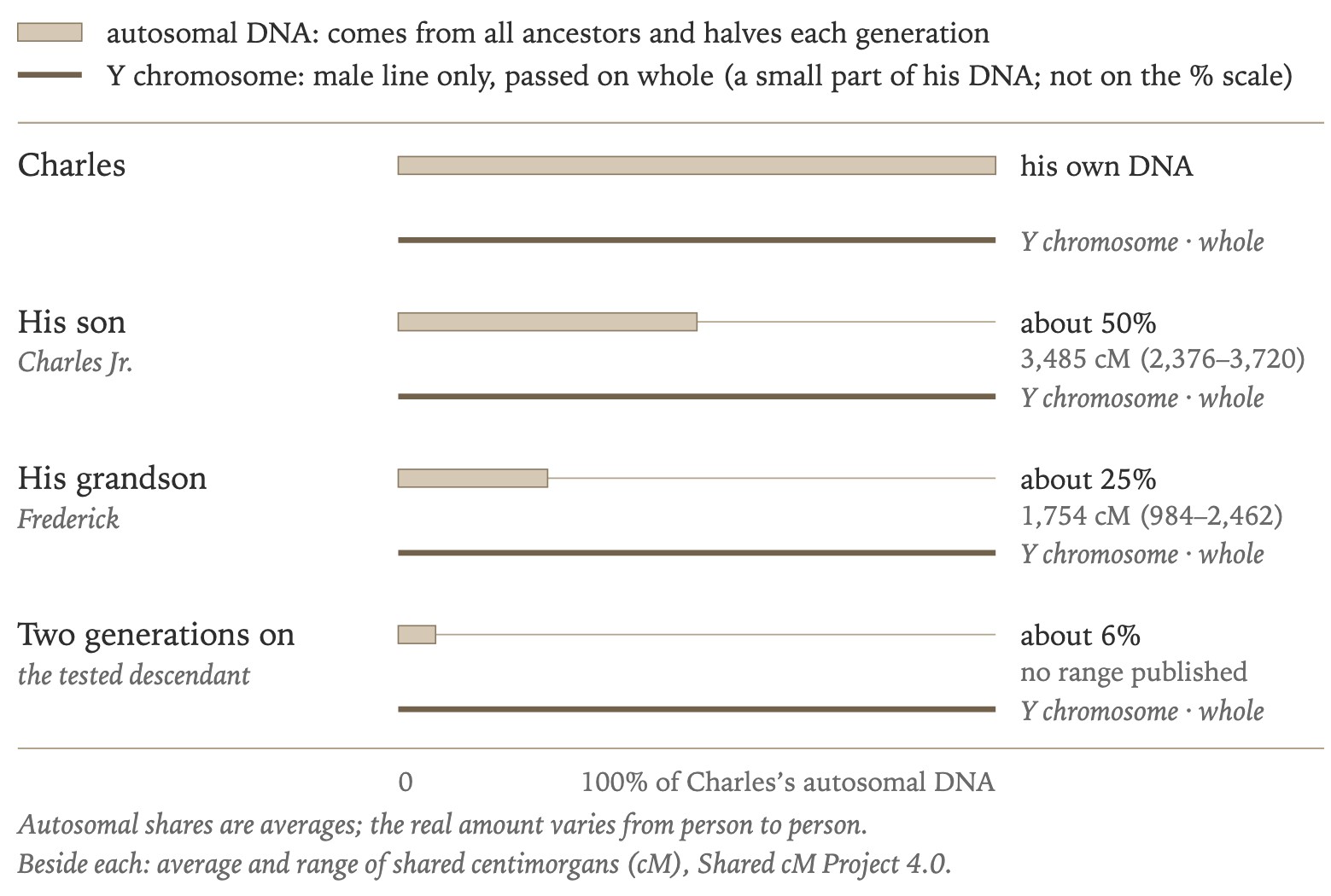
What each test measures
A Y chromosome passes almost unchanged from father to son, so it follows a single line: a man’s father, his father’s father, and so on back. Small changes accumulate along that line over centuries. A test like the Big Y places a man on a family tree of those changes, ending in a “terminal” (last) branch shared only with his nearest relatives in the male line. Autosomal DNA, by contrast, is reshuffled in every generation and comes from all of a person’s ancestors at once, so it finds cousins on every side, but each ancestor’s share halves with each generation.7 A surname in nineteenth-century Germany normally passed down that same male line, so the Y test can speak to a surname, but only to the surname of the man’s father in blood.
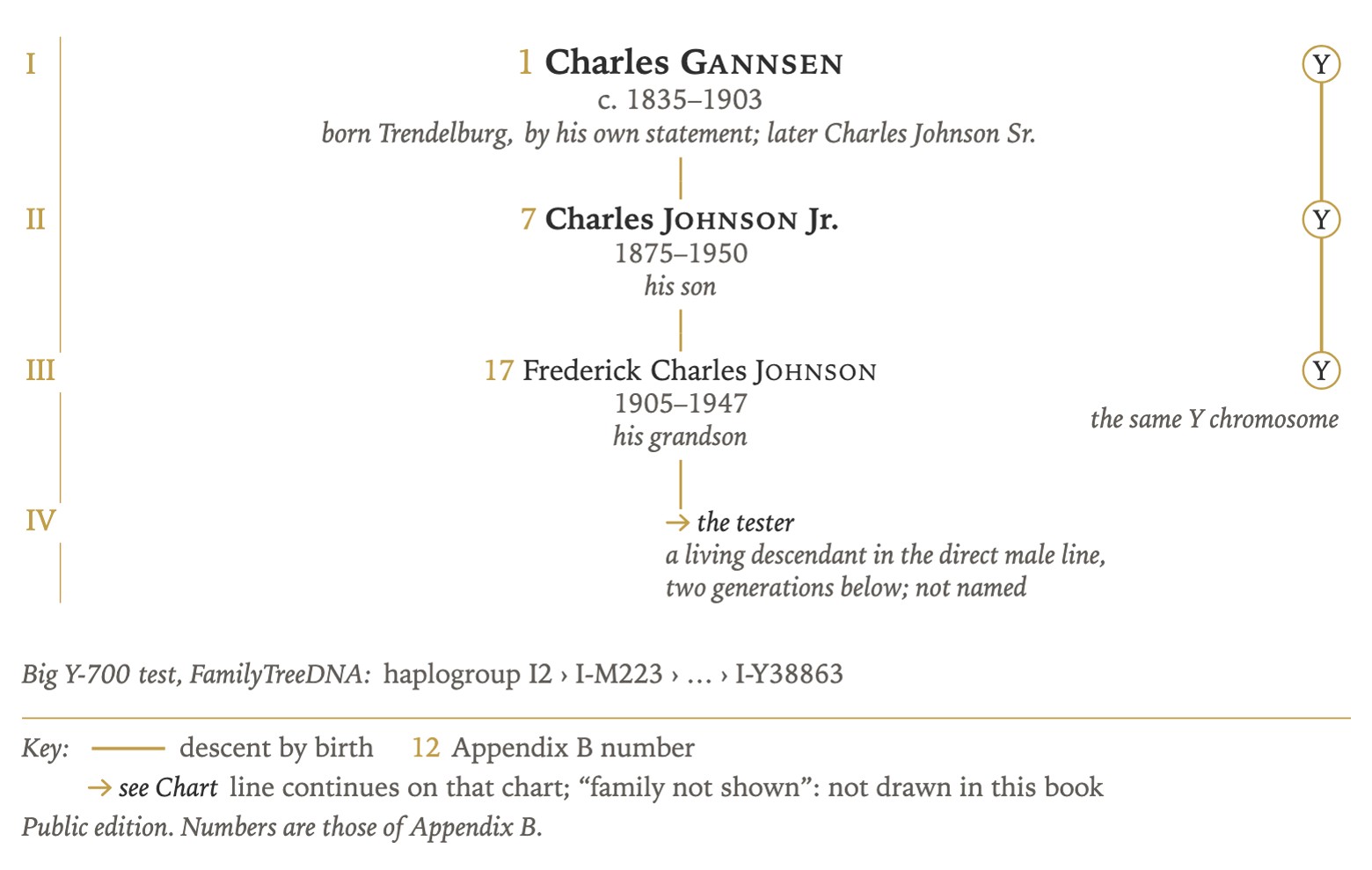
Three answers and what each predicts
Three answers to the question of who Charles was are open, and each predicts different results. Table 29.2 gives the tests and the amounts.
- Karl Ludwig Hofedietz. A descendant of one of his sisters should share DNA with Charles’s descendants. A man of the Hofedietz male line should fall on Charles’s Y branch, unless an unrecorded father came between.
- Another open boy. Descendants of Karl Ludwig’s sisters should share no such DNA, and a Hofedietz man should fall on another branch. Matches rooted in these villages could still appear, and a cousin from that boy’s own family should match.
- A boy from outside these villages. The same two tests should come back negative. No group of matches from these villages should prove to lie on Charles’s own line, and his true relatives should have roots elsewhere.
No single result decides among them, because a result settles the question only if it fits Karl Ludwig and no other boy.
The Y-DNA result
The simplest reading is that Charles’s male line descends from a man of the late Middle Ages who belonged to an Ashkenazi Jewish lineage. On the present evidence that is probably right, not proven. It rests on a handful of tested men, and a single new tester on the branch with a different background could change this reading.9
The Big Y test places Charles’s male line in haplogroup I2, one of the main branches of the Y-chromosome tree. Within it the line falls on the I-M223 branch, and at its finest resolution on a small branch labeled I-Y38863 (figure 29.2).10 YFull, an independent analysis service, worked from the same test data and placed it on the same branch.11 This is a reanalysis of one test, not a second sample, but the two services built their trees separately and reached the same result.
The two services broadly agree on the age of the branch. FamilyTreeDNA estimates that the men on I-Y38863 share a common male-line ancestor who lived about 1450, within a wide range of uncertainty, roughly 1100 to 1670. YFull (YTree v14.07.00, 2 November 2026) estimates that the branch formed about 750 years before 1950. It estimates that its members’ common ancestor lived about 650 years before 1950, about 1300 (95 percent interval about 850 to 1575). Either way the shared ancestor lived in the Middle Ages, several centuries before Charles.12 The branch is young by the standards of the Y tree, and that makes it useful, because a man who tests onto it shares a male-line ancestor with Charles within a few hundred years.
The I-M223 branch as a whole is old and widespread across Europe, but Charles’s own small branch is not. The other men on and just above I-Y38863 trace their documented male lines to east-central Europe, to Poland, Russia, Lithuania, and Belarus. Their families appear, from their own records, to be Ashkenazi Jewish.13 Of the four men who match Charles’s line at the Big Y level, three name an earliest paternal ancestor in a Jewish family of Poland, Russia or Lithuania. The fourth lists only Belarusian and Polish Jewish family names.14
The larger branch around I-Y38863, I-Y11261, holds two sister branches whose common ancestors lived about 750 and 800 years before 1950. Every other tester on it whose origin YFull records comes from eastern Europe, several of them Yiddish-speaking. That is the pattern a founder lineage of the medieval Ashkenazi population would leave: that population passed through a bottleneck of a few hundred people about 25 to 32 generations ago.15
These men are not close cousins. Their genetic distance from Charles’s line, the number of differences between the Y chromosomes, is moderate, which is consistent with a common ancestor in the late Middle Ages rather than in the last few generations. On the older Y test, which counts repeated markers (called STRs), three of these men differ from Charles’s line at 3 of 67 markers or at 7 or 8 of 111. On the Big Y, which reads single-letter changes (called SNPs), the four differ at 13 to 29 positions. Five of those positions are the mutations so far found only in Charles’s line. Table 29.1 gives the figures for each man.16
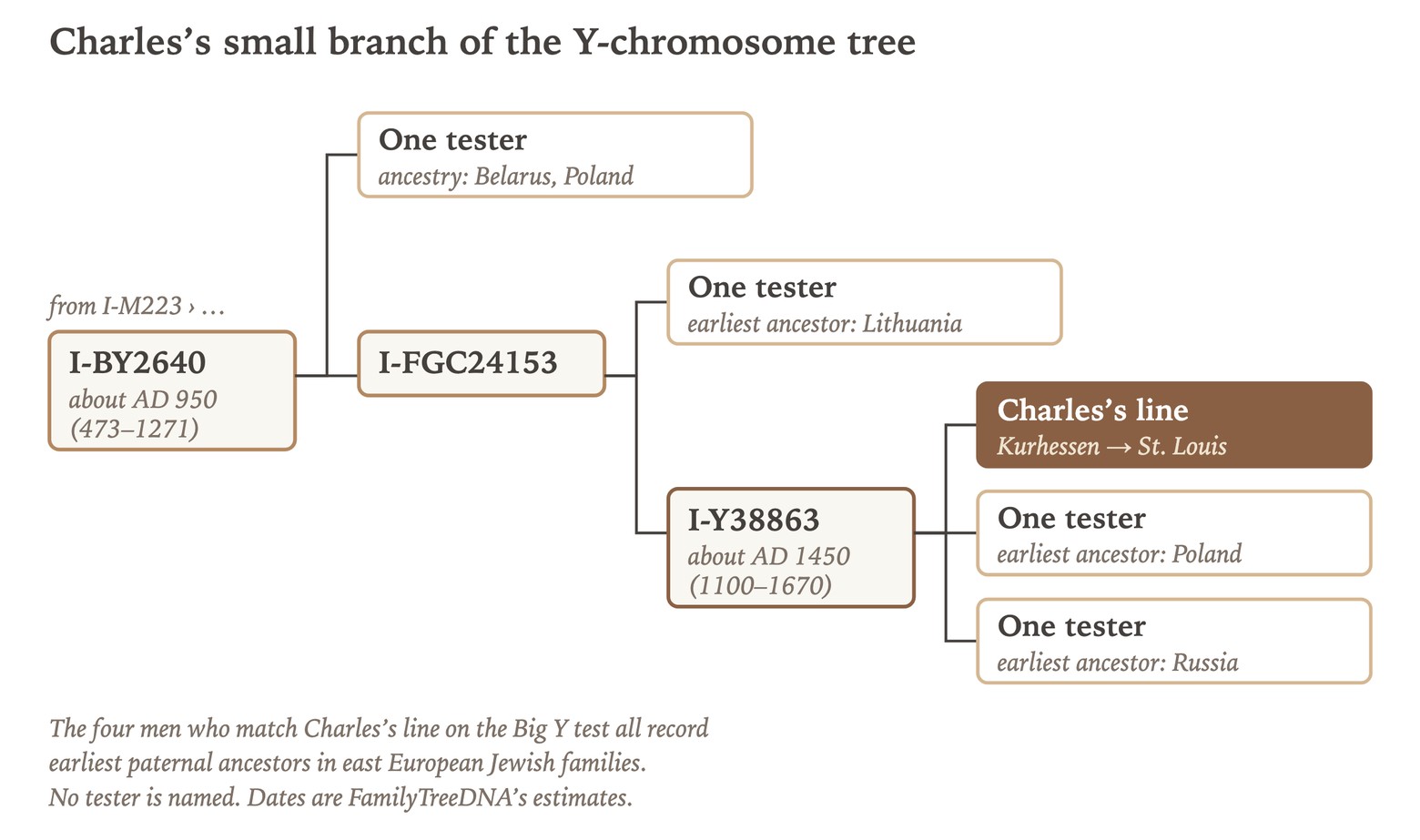
Table 29.1. The four Big Y matches
| Code | Branch | Earliest paternal origin given | Big Y positions that differ (SNPs) | Older test: markers that differ (STRs) |
|---|---|---|---|---|
| M21 | I-Y38863 | Russia | 13 | 3 of 67; 3 of 37 |
| M20 | I-Y38863 | Poland | 14 | 7 of 111; 4 of 67; 3 of 37 |
| M22 | I-FGC24153 | Lithuania | 16 | 8 of 111; 4 of 67; 4 of 37 |
| M23 | I-BY2640 | None given; family names from Belarus and Poland | 29 | No match listed |
Each Big Y count includes the five mutations found only in Charles’s line. M21 took the shorter Big Y-500 test. Source: FamilyTreeDNA match lists18.
The rest of Charles’s Y-chromosome results are ordinary for his branch, with no rare values that would point elsewhere.19 A new tester who shared those five mutations would be a much closer relative.20 Farther off, two men who match on neighboring and broader branches of the same old lineage name a paternal ancestor in Sweden. Their lines meet Charles’s in the Middle Ages or earlier, so they say nothing about where his family lived in his own time.21
What the Y result does not show
The Y result does not make Charles or his family Jewish. Charles lived and died a Protestant Christian: he married at St. Marcus, a German Evangelical church in St. Louis, had his children baptized there and was buried from it.22 If he was Karl Ludwig Hofedietz, he was also baptized and confirmed in the Reformed church at Deisel. The Y chromosome speaks only of a distant ancestor in the male line, not of the religion of anyone in the nineteenth century. The ancestor could have joined a Christian community long before Charles’s time. An unrecorded father in some generation (what geneticists call a non-paternal event) could also have carried the line into a Hessian family much later.23
It does not weigh against Karl Ludwig more than against any other boy born to a Christian couple. Every Christian family proposed for Charles would need the same explanation: a convert, an adoption, or an unrecorded father somewhere in the centuries before his birth. One account would need none of these: that Charles’s own father was Jewish and that he was born out of wedlock. No record has been found for it, and “The Boy from the Goose Corner” sets out how far it has been tested.
It does not point to a place, because a branch with a handful of members and a medieval common ancestor cannot be resolved to a region within Germany or to a parish.24
It does not name a surname. A Y-DNA match points to a surname line only as a clue, which autosomal DNA and records must then support.25 The Big Y matches include no Konze, Kontzen, Contze, Gans, or Kunze male line and no Hessian place, and neither do the 96 men who match on the older, shorter Y test.26 The Y result also does not favor a Christian Gans family over Konze: either family, being Christian, would need the explanation given above.27
The autosomal results
The autosomal matches have not yet led to a relative in Germany, although the match lists are large. There were about 14,400 matches at FamilyTreeDNA, about 7,200 at MyHeritage and about 22,100 at AncestryDNA. FamilyTreeDNA now places about 2,800 of its matches on the Johnson side.28
The search of the matches covered both surnames proposed for Charles, Konze and Gans, in all their spellings, and also Gannsen and Kreichelt. It also covered the matches’ trees, for births at Trendelburg, Deisel and Hofgeismar. The few Gans matches are small and lead to Dutch, Scandinavian, British, or Rhineland families, none on the father’s side, and on Ancestry no father’s-side match names Konze, Gans, Trendelburg, Deisel, or Hofgeismar. No match sharing a meaningful amount of DNA has an independently documented line from any of these families or places.29
Three tables in the appendix “How the Research Was Done” give the figures for the matches that this chapter names by code. They set out each match’s size and the relationships possible at that size, the positions of the Deisel-area group on chromosome 17, and the chance of each relationship. The book gives trees by region only. “Frederick’s side” is the line of Charles’s grandson Frederick Charles “Fred” Johnson, which holds the Gannsen, Kreichelt, Misch and Hahl families.
Estimates, tree tools and other leads
AncestryDNA and MyHeritage each estimate the regional makeup of a descendant’s DNA, and they assign roughly half of it to Germanic and Dutch regions, with most of the rest British and Irish.30 These estimates add almost nothing about Charles. A descendant several generations down carries only a small fraction of his DNA, the Germanic share includes Auguste Kreichelt’s and every other German ancestor’s, and the regions cannot tell Hesse from Bavaria or Saxony. As expected, neither company reports a European Jewish region, because a medieval ancestor’s share of anyone’s DNA today is far too small to measure.31
AncestryDNA’s ThruLines and MyHeritage’s theories of relationship find relatives by tracing a path through other people’s trees to a shared ancestor. They propose no parent for Charles, because the ancestor needed here, Charles’s father, is in no tree.32
Other leads among the matches were also examined and set aside: a tree with a Kontze in it and a few small Kunze matches.33
The Hofedietz searches
The search of the matches also looked for Hofedietz (also written Hofeditz), Karl Ludwig’s family, and what it found says nothing about Charles on its own. Two small matches on the Johnson side, M06 and M07, sharing 10 and 8 centimorgans, lead to trees with Hofeditz ancestors. Matches of this size are below the size that can be relied on alone. Researchers set their own lower limits, some as high as 20 centimorgans.34 M06 leads to a woman of that name, who is not known to be kin to Ricus Hofedietz, the father named at Karl Ludwig’s baptism. A check of shared matches places it on another side of the family altogether, and it does not appear on the close relative’s own list. The other tree also holds other families of the area, so its shared DNA cannot be assigned to the Hofedietz line, and on that list it sorts to his mother’s family.35
The Deisel-area group
MyHeritage, where far more Germans have tested, shows a small group of German matches with roots in the Deisel area itself. The group is weak evidence for a Deisel-area origin, and it does not yet point to any one family. Two German testers, M01 and M02, who match both the author and the close relative, on the Johnson side, have well-documented trees in that area, where Karl Ludwig’s mother was born. M01 shares about 55 centimorgans with each of them, and M02 about 45 with the close relative. The two also match each other and are distant kin, through a family of the 1700s. Their DNA in common with the family very probably lies on one and the same stretch of chromosome 17, so they count as one link, not two.36
Testers triangulate when three or more of them, none closely related to another, all share the same stretch with one another; close relatives such as a parent and child count as one.37 M02’s two long stretches are shared with both the close relative and the author, which shows that they came down on that side of the family. Because the two are close relatives, this places the segments but is not yet a triangulation. M01 keeps his segments hidden, so his position is inferred. All fifteen testers who share with both M01 and M02 and show a segment have it on chromosome 17.38 Triangulation is good supporting evidence, not proof.39
That stretch is also crowded with other testers, many of them Ashkenazi Jewish families, who share it in pieces. Five of them, tested in the chromosome browser, triangulate with the author and M02 on parts of it. A long unbroken segment possibly points to a distant common ancestor in the Deisel-area families. It is also possibly an old segment shared with Ashkenazi families, and then it need involve no couple from the Deisel area. No single ancestor shared with Charles has been found, and these villages married among themselves so often that the link possibly runs through more than one family.40
Several small matches in the lists are to people whose ancestral surnames are distinctly Ashkenazi, and many of them overlap one block on chromosome 17. They are probably noise, of a kind common in stretches of the genome where small matches pile up because of shared ancient ancestry. They are not a second view of the Y result, which concerns a medieval ancestor too remote to leave detectable autosomal DNA. The Ashkenazi-surname matches in that stretch of chromosome 17 are on the father’s side, like the Deisel-area group.41
The Deisel-area group also cannot yet be placed on Charles’s own line. Their trees carry no Kreichelt name and no Clausthal place, so Auguste’s family is probably not the link. But the matches are known only to share DNA with the close relative. His side of the family also descends from Michael Misch of the Rhineland and Christina Hahl of Hesse-Darmstadt, the parents of Charles Jr.’s wife. It also descends from the family of the wife of Charles’s grandson Frederick, whose colonial lines include Hessian emigrants of the 1700s. The Misch and Hahl families have no known tie to northern Hesse, and the group has not been tested against that last side. No descendant of Charles through his daughters has tested on MyHeritage to settle it. On AncestryDNA a later check also found no group of father’s-side matches from the area.42 If the Deisel-area group proves to descend from Charles’s own family, it could lead to the first German relative found. If it descends from the Misch or Hahl families, or from the family of Frederick’s wife, it would add to what is known of them instead.43
How close the German matches are
A standard table built from tens of thousands of known relationships gives the chance of each relationship for a given amount of shared DNA. For the largest German match, 55 centimorgans with a tested descendant, the chance of a tie at the level of a descendant of a brother or sister of Charles is about one in five. A closer tie adds about one chance in ten. The other seven chances in ten lie farther off. The two small Hofeditz matches, M06 and M07, fall beyond fourth cousin about three times in five. In villages that married among themselves for centuries they could run through any old family, and the table cannot allow for that, so the true chances are lower still. The matches fit an origin near Deisel, but they do not point to a family.44
Sorting the matches by family
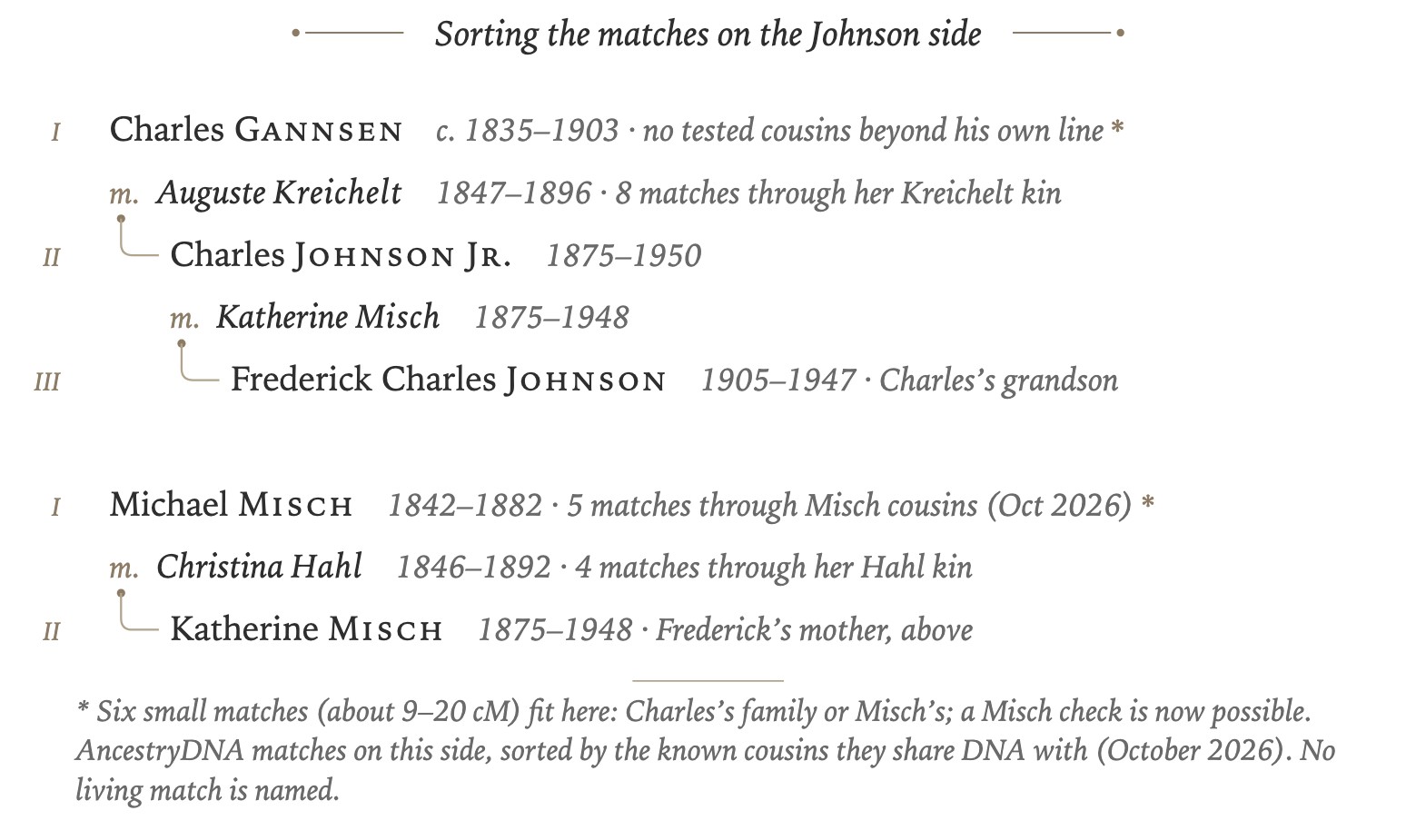
Close relatives on both sides of the author’s family have also tested at AncestryDNA, so every match can be sorted to the father’s side or the mother’s, and often to one grandparent. Close cousins share hundreds or thousands of centimorgans. On the side that leads to Charles, no group of matches sharing 20 centimorgans or more points to any family not already known.
One small group of six matches, M14 to M19, sharing about 9 to 20 centimorgans, sits on the side of Charles’s grandson Frederick (Fred Johnson). Fred’s four grandparents were Charles, Auguste, Michael Misch, and Christina Hahl (figure 29.3). The group matches no known relative of Auguste or of Christina Hahl, so it could descend from Charles’s family or from Michael Misch’s. By October 2026 the first cousins on the Misch side had tested, and none of the six is among their shared matches. That is slight evidence for Charles’s family. But small matches are often missing from those lists, so it does not settle the question.45
One larger match on Frederick’s side, M05, sharing about 49 centimorgans, has not yet been placed in any of the four families. His DNA on chromosome 17 lies just beyond the crowded stretch, so the caution about that stretch does not weaken it.
X and mitochondrial DNA
Two other kinds of test cannot help with Charles’s origin. A man passes no X chromosome to his son, so X-DNA can reach Charles only through a descendant whose line from him runs through daughters. For any descendant through his sons, such as the Johnson line, it can never reach him. Mitochondrial DNA follows the line of mothers, and a man does not pass it on, so none of his descendants carries his mother’s line.47
What DNA could still decide
Two kinds of test could now bear on the case for Karl Ludwig Hofedietz, which the chapter before this one sets out, and they work together.
The autosomal test reaches his mother’s side, because Karl Ludwig’s sisters shared his mother, Amalie Weller, and their descendants carry some of her DNA whoever his father was. A descendant of Elise Wiegand of Sielen, or of the twins Amalie Junker and Maria Kleine-Döve of the Ruhr, should share DNA with Charles’s descendants. A great-grandchild of Elise and a great-grandson of Charles would be third cousins, who share about 73 centimorgans on average. They would share about 48 if Karl Ludwig and his sisters had different fathers. Table 29.2 gives the figures for each kind of cousin.48 A match of that size, with no other shared family, would be good evidence, though not proof on its own, and no match across several such cousins would weigh against the case.49
The Y test reaches his father’s side. Charles’s Y line is shared with Ashkenazi Jewish families, but no man of Ricus Hofedietz’s male line has tested, so nobody knows what his Y line was. If Charles was Karl Ludwig, either the Hofedietz male line carries the same signature, or there is an unknown father somewhere in his paternal line. A test of a Hofedietz man would help to show which. The nearest living men of the line descend from Ricus’s son Andreas, who was born out of wedlock and named as Ricus’s son in his 1833 marriage entry. So a test there tests Andreas’s father as well. If such a man tested onto I-Y38863 and shared two or more of the mutations now found only in Charles’s line, that would show that Charles shares the Hofedietz male line. That would be good evidence, weighed below, and with the records it would point to Karl Ludwig or one of his full brothers, but it would not prove that Charles was a son of Ricus. If he did not fall on that branch, the break could lie in Charles’s line, in Andreas’s, or in another generation, so a mismatch would not by itself rule out Karl Ludwig. The father named at a baptism is not always the father in blood.50
How often that happened has been measured: about one in a hundred children in each generation in studies of European families, and about four times as many among laborers and weavers (the Hofedietz men were linen weavers).51 Over the ten father-to-son links between a great-great-grandson of Andreas and a great-great-grandson of Charles, those small rates add up. Even if Charles was Karl Ludwig and both lines ran from Ricus as the registers say, a mismatch would turn up about one time in seven to one time in ten, and more often at the laborers’ rate.
Together the two tests could weigh heavily on the question. A match on either side that meets the conditions in Appendix C, read with the records, would raise the case to “probably,” and a match on both sides to “very probably.” For the Y test, those conditions require a man of Andreas’s line who shares two or more of Charles’s five mutations. An amendment of 11 November 2026 to the plan the search fixed in advance (see the appendix “How the Research Was Done”), made before any result, set that rule.52 No single result would prove the case.
A match through the sisters with no Hofedietz Y match would still point to Amalie Weller as his mother, but would leave his father in blood open. A Hofedietz match with no match through the sisters would still support Ricus’s sons, though more weakly when few mutations are shared. The likeliest reason for the missing match would be chance: about 8 true third cousins in 100 share no detectable DNA. A break in the Wiegand line is less likely, about 3 in 100.53 No match on either side, from one cousin of each kind, would count against Karl Ludwig, moderately, and bring the other open boys back into view. Appendix C, “How the Research Was Done,” sets out the larger result that would rule him out.
Through the local history society at Deisel, a Hofeditz man has agreed to take a Y test, although how his line joins Ricus’s family is not yet proven.54 No one has taken either test yet. Letters have also gone to other Hofeditz families in Germany, and a search of the close relative’s matches at Ancestry found no descendant of the sisters among them.55
Table 29.2 sets out each test that someone could now take, how the tester would be related to a great-grandchild and to a great-great-grandchild of Charles, and what each result would mean. The amounts are the averages and ranges reported by thousands of testers of known relationship in the Shared cM Project. A range that begins at 0 means some true cousins share no DNA that can be measured. So one cousin who does not match proves little, while several who do not, at the nearer generations, would weigh against the case.56
The weight of each possible result was set before any test, so that the results cannot shape their own reading.57 If both tests matched, with four or five shared mutations, Karl Ludwig’s share among the open boys would rise to over 99 percent. If neither matched, it would fall to 34 percent.58 The ratio set for each result, the reasons and a chart of every case are in the appendix “How the Research Was Done.” A share orders the work and does not by itself raise a grade.
Table 29.2. DNA tests that could still decide the case
| Tester | Expected relationship and shared DNA (cM, average and range), to a great-grandchild / a great-great-grandchild of Charles | If Charles was Karl Ludwig | If he was not | Result |
|---|---|---|---|---|
| Y-DNA: a man of the Hofedietz male line, descended from Ricus’s son Andreas (born 1809), for example a great-great-grandson | Same male line as Charles’s male-line descendants, from Ricus (born 1789), if no unrecorded father intervened. Y-DNA is not measured in cM. In autosomal DNA: half third cousin once removed, 37 (0–139) / half fourth cousin, less than for a fourth cousin, often none | He falls on I-Y38863 with Charles’s line, and possibly shares some of the five mutations now found only in Charles’s line, each line carrying one or two of its own | He falls on another branch. Then Charles was not of Ricus’s male line in blood, or Andreas was not, or an unrecorded father came later in one line. On its own this does not rule out Karl Ludwig59 | Not yet tested60 |
| Autosomal: a descendant of any of Karl Ludwig’s three sisters: Elise Wiegand of Sielen, Amalie Junker of Witten, or Maria Kleine-Döve of Dortmund | Great-grandchild: third cousin, 73 (0–234) / third cousin once removed, 48 (0–192) Great-great-grandchild: third cousin once removed, 48 (0–192) / fourth cousin, 35 (0–139) | Shares DNA in about this range on the father’s side, more often and more with a great-grandchild of Charles than with a great-great-grandchild, and with no other family in common. Two matches from different sisters’ lines that share the same stretch of DNA would be strong evidence | Shares no DNA, or only small amounts traced to another family | Not yet tested |
| The same sister-line testers, if Karl Ludwig and his sisters had different fathers (Amalie Weller their only parent in common) | Great-grandchild: half third cousin, 48 (0–168) / half third cousin once removed, 37 (0–139) Great-great-grandchild: half third cousin once removed, 37 (0–139) / half fourth cousin, less than for a fourth cousin, often none | Shares DNA, but less: Charles was Amalie Weller’s son with a father other than Ricus in blood | As above: no DNA, or only small amounts traced to another family | Not yet tested |
Sources: Shared cM Project61; FamilyTreeDNA Big Y-700 result62.
Where the question stands
The match lists at all three companies were last read in full in late October 2026, and nothing new bearing on Charles had appeared.63 New people test every month, and a single new match could change a sentence here.64
A Y test of a man of a documented Konze or Gans male line would bear only on those surnames. If the Konze ties came from a foster home, which the chapter before this one finds possible, it would not be expected to bear on Charles at all.65
The DNA so far agrees with the records in general, and nothing in it contradicts a German origin, but it does not answer the questions this part of the book has been asking. It does not confirm Trendelburg, Deisel or any other parish, it does not choose between Gans and Konze, and it has not yet tested Karl Ludwig. One test is now in view: the Hofeditz man found through the Deisel history society has agreed to take the Y test. No known descendant of Karl Ludwig’s sisters has tested. Until a cousin of each kind does, the case rests on the records.
Notes
65 notes
- FamilyTreeDNA Big Y-700 test of a direct male-line descendant of Charles. [BIGY]
- Autosomal tests of a descendant of Charles: FamilyTreeDNA Family Finder match list and segment export (7 Jun 2026; match list searched again 10 and 18 Oct 2026; close-relative link 18 Oct 2026; compared with a close relative of the tested descendant, 21 Oct 2026). [AUTO]
- Letters to the Heimatverein Deisel asking for help in finding a Konze or Gans male-line descendant for a Y-DNA test, sent 22 Oct 2026, and a Hofedietz male-line volunteer, sent 28 Oct 2026; emails to five Hofeditz men and three family researchers in Germany asking for a Hofeditz male-line volunteer for a Y-DNA test, sent 29 Oct 2026; the author’s email of 8 Nov 2026 to the Heimatverein Deisel, thanking it for finding a Hofeditz man willing to take a Y-DNA test and asking for his father’s and grandfather’s names (project correspondence). [YREC]
- FamilyTreeDNA Big Y-700 test of a direct male-line descendant of Charles. [BIGY]
- Autosomal tests of a descendant of Charles: FamilyTreeDNA Family Finder match list and segment export (7 Jun 2026; match list searched again 10 and 18 Oct 2026; close-relative link 18 Oct 2026; compared with a close relative of the tested descendant, 21 Oct 2026). [AUTO]
- Blaine T. Bettinger, The Shared cM Project, version 4.0 (March 2020), averages and ranges of shared centimorgans by relationship, as presented in DNA Painter’s Shared cM Project tool (dnapainter
.com/ , accessed 6 November 2026). Autosomal DNA comes from every ancestor. The figures are those that testers of that relationship share in the Shared cM Project, which gives no figures for a great-great-grandchild. [SCP4]tools/ sharedcmv4 - Blaine T. Bettinger, The Family Tree Guide to DNA Testing and Genetic Genealogy, pp. 53–54. [BETT]
- A father passes his Y chromosome to his son almost unchanged, so the tester’s Y chromosome is, in effect, Charles’s, and the branch it falls on, I-Y38863, is Charles’s branch, if each father named in the records was the father in blood. At the usual rates there is about one chance in twenty that one of the four fathers in the line was not.
- FamilyTreeDNA Big Y-700 test of a direct male-line descendant of Charles. [BIGY]
- FamilyTreeDNA Big Y-700 test of a direct male-line descendant of Charles. [BIGY]
- YFull, YTree v14.07.00 (2 November 2026), independent analysis of the same Big Y data, branch I-Y38863 (I-M223 > … > I-Y11261 > I-Y39743 > I-Y38863; formed about 750 years before 1950, 95% interval 1,150–400; common ancestor about 650 years before 1950, 95% interval 1,100–375; parent branch I-Y39743 formed about 1,750 and common ancestor about 750 years before 1950) (https://
www : accessed 4 November 2026); the larger branch I-Y11261, with its two sub-branches, I-Y39743 and I-Y52940, and its testers’ recorded origins (https://.yfull .com/ tree/ I-Y38863/ www : accessed 12 November 2026); Y-STR review, 6 June 2026. [YFULL].yfull .com/ tree/ I-Y11261/ - FamilyTreeDNA Discover, haplogroup report for I-Y38863 (common ancestor about 1450 CE, 95% interval 1096–1670) and for I-BY2640 (common ancestor about 950 CE, 95% interval 472–1270), public data, https://
discover and https://.familytreedna .com/ y-dna/ I-Y38863/ story discover (accessed 6 November 2026); YFull, YTree v14.07.00 (2 November 2026). [DISCOVER] [YFULL].familytreedna .com/ y-dna/ I-BY2640/ story - FamilyTreeDNA Big Y-700 test of a direct male-line descendant of Charles; YFull, YTree v14.07.00 (2 November 2026). [BIGY] [YFULL]
- FamilyTreeDNA Big Y-700 test of a direct male-line descendant of Charles. [BIGY]
- YFull, YTree v14.07.00 (2 November 2026); Shai Carmi, Ken Y. Hui, Ethan Kochav et al., “Sequencing an Ashkenazi Reference Panel Supports Population-Targeted Personal Genomics and Illuminates Jewish and European Origins,” Nature Communications 5 (2014): 4835, https://
doi (a recent Ashkenazi bottleneck of effective size 250–420, 25–32 generations ago, inferred from shared segments, Results and fig. 3c); PubMed Central, PMC4164776 (https://.org/ 10 .1038/ ncomms5835 pmc : accessed 4 November 2026). [YFULL] [CARMI14].ncbi .nlm .nih .gov/ articles/ PMC4164776/ - FamilyTreeDNA Big Y-700 test of a direct male-line descendant of Charles. [BIGY]
- Each box at the right is one tested man, shown only by the origin he gives for his earliest paternal ancestor. Dates are estimates of when each branch’s common ancestor lived.
- FamilyTreeDNA Big Y-700 test of a direct male-line descendant of Charles. [BIGY]
- YFull, YTree v14.07.00 (2 November 2026). [YFULL]
- FamilyTreeDNA Big Y-700 test of a direct male-line descendant of Charles. [BIGY]
- FamilyTreeDNA Big Y-700 test of a direct male-line descendant of Charles. [BIGY]
- St. Marcus Evangelical Church, St. Louis: marriage register 1866, p. 135, entry 676/4 (FamilySearch image group number (IGN) 007769184, image 381); baptism registers 1866–81 (FHL film 1503034); burial register, pp. 240–241, no. 3393, 19 Dec 1903; imaged, FamilySearch (https://
www : accessed 12 July 2026); citing “St. Marcus Evangelical Church records, 1847-1981,” microfilm of originals at the Eden Archives in St. Louis, Missouri. [RECS].familysearch .org/ ark:/ 61903/ 3:1:3Q9M-CSMZ-1NJC - FamilyTreeDNA Big Y-700 test of a direct male-line descendant of Charles. [BIGY]
- FamilyTreeDNA Big Y-700 test of a direct male-line descendant of Charles. [BIGY]
- Blaine T. Bettinger and Debbie Parker Wayne, Genetic Genealogy in Practice, pp. 13 and 18, p. 32. [BETTWAYNE]
- FamilyTreeDNA Big Y-700 test of a direct male-line descendant of Charles. [BIGY]
- Hessisches Staatsarchiv Marburg, Best. 18 Nr. 2631. [JEW]
- Autosomal tests of a descendant of Charles: FamilyTreeDNA Family Finder match list and segment export (7 Jun 2026; match list searched again 10 and 18 Oct 2026; close-relative link 18 Oct 2026; compared with a close relative of the tested descendant, 21 Oct 2026). [AUTO]
- As in note 28. [AUTO]
- Autosomal tests of a descendant of Charles: FamilyTreeDNA Family Finder match list and segment export (7 Jun 2026; match list searched again 10 and 18 Oct 2026; close-relative link 18 Oct 2026; compared with a close relative of the tested descendant, 21 Oct 2026). AncestryDNA ethnicity estimate; MyHeritage DNA, Ethnicity Estimate v2.5 (7 Jun 2026). [AUTO]
- As in note 30. [AUTO]
- Autosomal tests of a descendant of Charles: FamilyTreeDNA Family Finder match list and segment export (7 Jun 2026; match list searched again 10 and 18 Oct 2026; close-relative link 18 Oct 2026; compared with a close relative of the tested descendant, 21 Oct 2026). AncestryDNA ThruLines (28 Jun to 21 Oct 2026); MyHeritage match list and Theory of Family Relativity (7 Jun to 22 Oct 2026). [AUTO]
- Autosomal tests of a descendant of Charles: FamilyTreeDNA Family Finder match list and segment export (7 Jun 2026; match list searched again 10 and 18 Oct 2026; close-relative link 18 Oct 2026; compared with a close relative of the tested descendant, 21 Oct 2026). [AUTO]
- Blaine T. Bettinger and Debbie Parker Wayne, Genetic Genealogy in Practice, pp. 13 and 18, p. 147. [BETTWAYNE]
- Autosomal tests of a descendant of Charles: FamilyTreeDNA Family Finder match list and segment export (7 Jun 2026; match list searched again 10 and 18 Oct 2026; close-relative link 18 Oct 2026; compared with a close relative of the tested descendant, 21 Oct 2026). [AUTO]
- As in note 35. [AUTO]
- Patricia Lee Hobbs, “Correlating Documentary and DNA Evidence to Identify an Unknown Ancestor,” in Advanced Genetic Genealogy, p. 252, pp. 252–53. [HOBBS19]
- Autosomal tests of a descendant of Charles: FamilyTreeDNA Family Finder match list and segment export (7 Jun 2026; match list searched again 10 and 18 Oct 2026; close-relative link 18 Oct 2026; compared with a close relative of the tested descendant, 21 Oct 2026). [AUTO]
- Blaine T. Bettinger and Debbie Parker Wayne, Genetic Genealogy in Practice, pp. 13 and 18, pp. 84 and 87. [BETTWAYNE]
- Autosomal tests of a descendant of Charles: FamilyTreeDNA Family Finder match list and segment export (7 Jun 2026; match list searched again 10 and 18 Oct 2026; close-relative link 18 Oct 2026; compared with a close relative of the tested descendant, 21 Oct 2026). [AUTO]
- As in note 40. [AUTO]
- Autosomal tests of a descendant of Charles: FamilyTreeDNA Family Finder match list and segment export (7 Jun 2026; match list searched again 10 and 18 Oct 2026; close-relative link 18 Oct 2026; compared with a close relative of the tested descendant, 21 Oct 2026). AncestryDNA father’s-side matches with trees in the villages of Kreis Hofgeismar, checked for shared matches among themselves, 28 October 2026. [AUTO]
- Autosomal tests of a descendant of Charles: FamilyTreeDNA Family Finder match list and segment export (7 Jun 2026; match list searched again 10 and 18 Oct 2026; close-relative link 18 Oct 2026; compared with a close relative of the tested descendant, 21 Oct 2026). [AUTO]
- Blaine T. Bettinger, The Shared cM Project, version 4.0 (March 2020), averages and ranges of shared centimorgans by relationship, as presented in DNA Painter’s Shared cM Project tool (dnapainter
.com/ , accessed 6 November 2026); Autosomal tests of a descendant of Charles: FamilyTreeDNA Family Finder match list and segment export (7 Jun 2026; match list searched again 10 and 18 Oct 2026; close-relative link 18 Oct 2026; compared with a close relative of the tested descendant, 21 Oct 2026). [SCP4] [AUTO]tools/ sharedcmv4 - Autosomal tests of a descendant of Charles: FamilyTreeDNA Family Finder match list and segment export (7 Jun 2026; match list searched again 10 and 18 Oct 2026; close-relative link 18 Oct 2026; compared with a close relative of the tested descendant, 21 Oct 2026). [AUTO]
- Matches that share DNA with known Kreichelt, Hahl or Misch cousins are sorted to those lines; the six small matches that share with none of them are shown as open. In all the chart sorts 23 matches: 8 through Kreichelt cousins, 4 through Hahl cousins, 5 through Misch cousins and the 6 open.
- Blaine T. Bettinger, The Family Tree Guide to DNA Testing and Genetic Genealogy, p. 118. [BETT]
- Blaine T. Bettinger, The Shared cM Project, version 4.0 (March 2020), averages and ranges of shared centimorgans by relationship, as presented in DNA Painter’s Shared cM Project tool (dnapainter
.com/ , accessed 6 November 2026). [SCP4]tools/ sharedcmv4 - Autosomal tests of a descendant of Charles: FamilyTreeDNA Family Finder match list and segment export (7 Jun 2026; match list searched again 10 and 18 Oct 2026; close-relative link 18 Oct 2026; compared with a close relative of the tested descendant, 21 Oct 2026). [AUTO]
- FamilyTreeDNA Big Y-700 test of a direct male-line descendant of Charles. For the branch I-Y38863 and the mutations found only in Charles’s line. [BIGY]
- Maarten H. D. Larmuseau, Joost Vanoverbeke, Anneleen Van Geystelen, no. 1772; Maarten H. D. Larmuseau, Koen Matthijs and Tom Wenseleers, no. 5; Maarten H. D. Larmuseau, Pieter van den Berg, Sofie Claerhout, no. 23. Studies of Flemish families found about 0.9 percent a generation (95 percent interval 0.41 to 1.75), and a study of a German population 0.94 percent. Across several European and South African populations the rate has stayed near 1 percent. A study looked at 513 pairs of men in Belgium and the Netherlands whose male lines were proved in the registers. It found an unrecorded father in about one or two children in a hundred in each generation. The rate was about four in a hundred among laborers and weavers. The author’s reckoning from the study’s rates, not the study’s own: five links from Ricus to each of the two men. At 1.6 percent a generation the chance of at least one break in ten links is about 15 percent; at the farmers’ 1.1 percent, about 10 percent; at 4.1 percent, about 34 percent. The Hofedietz men were linen weavers. The study is of the Low Countries, not Hesse. The link through Andreas, who was born before his parents married, is less certain than these rates assume, so the true chance of a mismatch is higher. [LARMUSEAU13] [LARMUSEAU16] [LARMUSEAU19]
- Jed Johnson, comp., “What would change the conclusion: criteria fixed in advance, 3 November 2026,” and “Amendment 1 to the preregistration of 3 Nov 2026,” both in the docs folder of “The data behind Charles Gannsen and His Family” (dataset compiled for this book, version of 3 November 2026; see the dataset’s README), written before the results of the lying-in, Ring 1, Marburg, Duisburg and DNA searches it names; their SHA-256 checksums are in CHECKSUMS.sha256. “Amendment 2 to the preregistration of 3 Nov 2026,” dated 11 November 2026 and made before any DNA result, in the docs folder of the same dataset, changes the Big Y rule. [PREREG]
- Jed Johnson, comp., “DNA decision plan, fixed 10 November 2026,” blind setting. [DNAPLAN]
- Letters to the Heimatverein Deisel asking for help in finding a Konze or Gans male-line descendant for a Y-DNA test, sent 22 Oct 2026. The author’s email of 8 Nov 2026 to the Heimatverein Deisel. [YREC]
- Letters to the Heimatverein Deisel asking for help in finding a Konze or Gans male-line descendant for a Y-DNA test, sent 22 Oct 2026; Autosomal tests of a descendant of Charles: FamilyTreeDNA Family Finder match list and segment export (7 Jun 2026; match list searched again 10 and 18 Oct 2026; close-relative link 18 Oct 2026; compared with a close relative of the tested descendant, 21 Oct 2026). Emails to five Hofeditz men and three family researchers in Germany, sent 29 Oct 2026; the close relative’s AncestryDNA match list searched for the sisters’ families and villages, 29 Oct 2026. [YREC] [AUTO]
- Blaine T. Bettinger, The Shared cM Project, version 4.0 (March 2020), averages and ranges of shared centimorgans by relationship, as presented in DNA Painter’s Shared cM Project tool (dnapainter
.com/ , accessed 6 November 2026); Blaine T. Bettinger, The Family Tree Guide to DNA Testing and Genetic Genealogy, pp. 29–30, 67. On the difference between finding no match and evidence against a hypothesis, see Mills, “QuickLesson 24.” Elizabeth Shown Mills, “QuickLesson 24: Evaluating DNA as Evidence,” Evidence Explained (https://tools/ sharedcmv4 evidenceexplained : accessed 1 November 2026). [SCP4] [BETT] [QL24].com/ content/ quicklesson -24 -evaluating -dna -evidence - European Network of Forensic Science Institutes, p. 17. Pages 7 (section 3.3) and 22. [ENFSI15]
- Jed Johnson, comp., “DNA decision plan, fixed 10 November 2026,” blind setting. [DNAPLAN]
- FamilyTreeDNA Big Y-700 test of a direct male-line descendant of Charles. [BIGY]
- Letters to the Heimatverein Deisel asking for help in finding a Konze or Gans male-line descendant for a Y-DNA test, sent 22 Oct 2026. Letter to the Heimatverein Deisel asking for a Hofedietz male-line volunteer, sent 28 Oct 2026; the author’s email of 8 Nov 2026 to the Heimatverein Deisel. [YREC]
- Blaine T. Bettinger, The Shared cM Project, version 4.0 (March 2020), averages and ranges of shared centimorgans by relationship, as presented in DNA Painter’s Shared cM Project tool (dnapainter
.com/ , accessed 6 November 2026). [SCP4]tools/ sharedcmv4 - FamilyTreeDNA Big Y-700 test of a direct male-line descendant of Charles. [BIGY]
- The full reads were made on 22 and 23 October 2026, with checks of particular matches on 28, 29 and 31 October and of the Hofedietz line on 2 and 3 November.
- Autosomal tests of a descendant of Charles: FamilyTreeDNA Family Finder match list and segment export (7 Jun 2026; match list searched again 10 and 18 Oct 2026; close-relative link 18 Oct 2026; compared with a close relative of the tested descendant, 21 Oct 2026). [AUTO]
- Letters to the Heimatverein Deisel asking for help in finding a Konze or Gans male-line descendant for a Y-DNA test, sent 22 Oct 2026. [YREC]
Also on this page
More of the chapter, as printed until 28 October 2026
The tests and the Y result, as printed until 28 October 2026
This passage of the printed chapter “What DNA Can and Cannot Say” was shortened on 28 October 2026 so that family readers can get through Part Four. The text that stood in the book is kept here. No living person who matched the tests is named.
The records reconstruct who Charles was. DNA can test whether the biological line agrees with them, and in the best case it can point to relatives the records have not found. Two kinds of test have been taken. The compiler, a descendant in Charles's direct male line, took a Big Y-700 test at FamilyTreeDNA, which reads the Y chromosome passed from father to son. The compiler's autosomal DNA has also been compared at FamilyTreeDNA, AncestryDNA and MyHeritage, using the companies' standard tests. These are called microarray tests, and they read several hundred thousand points on a person's DNA. [BIGY] [AUTO] This chapter reports what those tests show and what they cannot. No living person who matched the tests is named here.
The I-M223 branch as a whole is old and widespread across Europe. Charles's own small branch is not. On both the FamilyTreeDNA and the YFull trees, the other men on and just above I-Y38863 trace their documented male lines to east-central Europe, naming Poland, Russia, Lithuania, Belarus and neighboring lands. Their families appear to be Ashkenazi Jewish, by their documented ancestors, surnames and given names. That description is drawn from what the testers record about their own ancestors, not from a label assigned by the testing company. [BIGY] [YFULL] Four men match Charles's line at the Big Y level. Three name an earliest paternal ancestor in a Jewish family of Poland, Russia or Lithuania, and the fourth lists only Belarusian and Polish Jewish family names. [BIGY] (This is the match list as it was read again on 23 October 2026, unchanged.)
The autosomal results, as printed until 28 October 2026
This passage of the printed chapter “What DNA Can and Cannot Say” was shortened on 28 October 2026 so that family readers can get through Part Four. The text that stood in the book is kept here. No living person who matched the tests is named.
AncestryDNA and MyHeritage each estimate the regional makeup of a descendant's DNA. The two companies draw their regions differently but agree on the main point. Roughly half of the tested descendant's DNA is assigned to Germanic and Dutch regions, with most of the rest British and Irish, from other lines of the family. [AUTO] This adds almost nothing about Charles. A descendant several generations down carries only a small fraction of his DNA, an eighth or less. The Germanic share also includes the DNA of Auguste Kreichelt, who was German too, and of every other German ancestor in the tree. The test cannot isolate Charles's contribution. And the regions are broad. "Southern Germanic Europe" or "Germanic" includes Hesse but cannot tell it from Bavaria, the Rhineland or Saxony. [AUTO] Neither company reports a European Jewish region, as would be expected. The Y result points to a Jewish ancestor of the Middle Ages, whose share of anyone's autosomal DNA today is far too small to measure. The estimates neither confirm nor contradict it. [AUTO]
The matches have been searched for both surnames proposed for Charles, Konze and Gans, in all their spellings, and for other surnames: Gannsen; Kreichelt, his wife's family; and Grandjot and Herwig, two families of the Trendelburg area possibly linked to the Konzes by marriage. The matches' trees have been searched for births at Trendelburg, Deisel and Hofgeismar. The few Gans matches are small and lead to Dutch, Scandinavian, British or Rhineland families, none to Kreis Hofgeismar. At FamilyTreeDNA, which since October 2026 sorts matches by parent, none of the six Gans matches falls on the father's side. On Ancestry, no father's-side match names Konze, Gans, Trendelburg, Deisel or Hofgeismar, and none of the father's-side trees opened shows a Hessian place. The handful of trees showing a birth at Trendelburg or Deisel appear, from the relatives they share with the family, to be related through its other lines. No match sharing a meaningful amount of DNA has an independently documented line from any of these families or places. [AUTO]
In July 2026 two small matches turned up that share one large German tree including a Kontze. They were examined and set aside. A few matches are named Kunze, a similar surname, and share 10 to 17 centimorgans (the unit of shared DNA, explained below). They lead to Baden, American or unplaced trees, none to Kurhessen. [AUTO] (The two Kontze-tree matches shared little DNA, and none of the relatives they shared with the family belonged to the Deisel–Langenthal group described above. That tree's principal family name belongs to the Gütersloh district of Westphalia, some fifty miles (80 km) west-northwest of Trendelburg.) In October 2026 the father's-side matches were also searched for the surnames of every other family proposed for Charles. No family had two or more matches of its own, and the single small match with a Deisel tree descends from several village families at once. [AUTO]
AncestryDNA's ThruLines proposes ancestors from other members' trees. It proposes no parent for Charles. The only matches it routes through him descend from his own son and are known cousins. MyHeritage's tree-based theories of relationship have proposed none at all. These tools work by finding a path through other people's trees to a shared ancestor. The ancestor needed here, Charles's father, is in no tree. [AUTO]
Close relatives on both sides of the tested descendant's family have also tested at AncestryDNA, so Ancestry can sort every match to the father's side or the mother's. Matches to known cousins show which of the father's grandparents a match descends through. Shared DNA is measured in centimorgans, and close cousins share hundreds or thousands. On the side that leads to Charles, no group of matches sharing 20 centimorgans or more points to any family not already known.
One small group of six matches, sharing about 9 to 20 centimorgans, sits on the side of Charles's grandson Frederick (Fred Johnson, the son of Charles Jr. and Katherine Misch, whose four grandparents were Charles, Auguste, Michael Misch and Christina Hahl). It matches no known relative of Auguste Kreichelt or of Christina Hahl, the mother of Charles's daughter-in-law Katherine Misch. It could descend from Charles's family or from that of Katherine's father, Michael Misch. In October 2026 Ancestry's ThruLines began to route five small matches, of about 9 to 33 centimorgans, through Michael Misch's father, by way of three of Michael Misch's brothers and sisters. They are the first tested cousins on the Misch side. None of the six in the group appears among these Misch cousins' shared matches. That leans slightly toward Charles's family, but small matches are often missing from those lists. Some of the new Misch-side matches also share DNA with known Hahl cousins, so they must be sorted themselves before they can settle the question. [AUTO]
First, several small matches are to people whose ancestral surnames are distinctly Ashkenazi, and many of them overlap one block on chromosome 17. They are single shared stretches of DNA (segments) of about 9 to 20 centimorgans. These matches are probably noise, of a kind common in any population. Small segments shared with many members of a population are common, most of all in stretches of the genome where matches pile up because of shared ancient ancestry rather than a recent common ancestor. These matches are not a second view of the Y result, and they are not evidence for or against it. The Y result concerns a medieval ancestor too remote to leave detectable autosomal DNA. [AUTO]
Second, the Deisel–Langenthal group described above lies in the same stretch of chromosome 17 as these small Ashkenazi-surname matches. A comparison with the tested descendant's father at FamilyTreeDNA in October 2026 showed that the Ashkenazi-surname matches in that stretch are on the father's side as well. Every one sharing 10 centimorgans or more there also matches him. That makes the stretch look like a pile-up region, where small matches are common and say little, and it is why the group counts as one link and deserves less weight than its size suggests. If it proves to descend from Charles's own family, it could lead to the first German relative found. If it descends from the Misch or Hahl families, it would add to what is known of them instead. [AUTO]
Supplements
Records, images and data on this website that go with this chapter.