In the family’s one photograph of Charles, a white-haired man sits in a high-backed chair and looks straight at the camera. The studio framed him in an oval on the card. His hair is thin on top, and he wears a full mustache and no beard. His dark coat closes down the front with round, bright buttons, over a white shirt and a wide bow tie. The portrait was probably made in his last years (see “Widowhood and Last Years, 1896–1903”).1 On its back someone later added a note: “Johnson / Father of / Charles Johnson / Grandfather of Henry.”2
In this chapter
- He was capable, and others saw it
- He made his American life inside his wife’s family
- He was ambitious, and it did not pay
- He endured
- He was loyal, and men were loyal to him
- He kept the name he signed, but not his ties to home
- Was he better off for coming?
- What the records settle, and what is still open
- Notes
- About the pictures
- Supplements
That note is nearly all the family remembered of Charles, and he left them almost nothing else to know him by. Words in his name survive only in a few sworn papers in his pension file and in the notices signed with his name for his son, his wife and his saloons. His pension agent’s office and other clerks wrote out the sworn papers in English, and nearly all the notices ran in the German papers.3
What kind of man he was has to be judged from what he did, because the records show what he did and not what he felt. From what he did, this book makes six judgments. Each rests on more than one record, and each is set against the men around him. Together they describe a man who was capable and ambitious, made his American life inside his wife’s family, endured, stayed loyal and kept the name he signed.
He was capable, and others saw it
He left Kurhessen as a young man, possibly in 1859. No record found shows family beside him on the crossing, or anyone waiting at the other end.4 The journey from Kurhessen to St. Louis took weeks, by a route no record shows, and it ended in a city where he probably did not yet speak English.5 Within four years he was a soldier of the Union, and within seven he had a wife and a home of his own.
He could read and write: he very probably wrote German, and the 1900 census recorded that he could also read, write and speak English.6 The army recorded him as a farmer, but the rest of his record shows a man who could do more than farm work.
The army saw it: it made him a corporal within six months and a sergeant within a year.7 On the April 1864 roll of Battery B he was one of only two men from Kurhessen among 105, so he rose among strangers.8 In the summer of 1865 the army trusted him with work at the headquarters of the Department of the Missouri, where he served among the clerks and messengers.9 He had lost his rank that March, but so had at least four corporals of the battery in the same spring.10
He made his American life inside his wife’s family
His family in America was the family he married into. He married Auguste Kreichelt of Clausthal at St. Marcus on 7 January 1866, eighteen days after his discharge.11 For the next thirty years the records place him close to her family. He lived on their lot on Jackson Street from 1878.12 The death notices of her father in 1883 and her mother in 1894 name him among the sons-in-law.13 Her kin, and families tied to hers by marriage then or later, filled fifteen of the nineteen named sponsor places at the seven baptisms of his children (see “The Godparents and Witnesses, 1866–1881”).14
No relative of his own appears in any St. Louis record found.15 None of the godparents came from his side, although people from his home villages did live in St. Louis in the same years16 (see “Leaving Hesse, c. 1858–1859”).17
The people around him came from many places. About twenty-five people outside his children are named with him in the records, and they came from Hanover, Hesse-Darmstadt, Württemberg, Baden, Westphalia, the Palatinate, France, New York and St. Louis. None came from his home district.18 Few people from Kreis Hofgeismar lived in the city for him to know. Of about five thousand marriages at three German Evangelical churches of the city between 1850 and 1880, only two besides his own involved anyone from that district, and one of those only probably. Most of the entries give no home place in Europe.
Whether by choice or by circumstance, he built his life from his wife’s people, his comrades and his workmates. He possibly came alone, since the St. Louis records found name no relative of his, and that is also part of why his origin is so hard to find.19
He was ambitious, and it did not pay
He was willing to take a chance on his own account, and in the saloon years he did more than pour beer for another man. He organized a brewery picnic in 1867, opened a bar of his own in 1868 and very probably offered free concerts with a full band at his beer garden in 1869. He leased and ran a business and advertised it in the newspapers.20
He tried, more than once, to work for himself, and few laborers did that even once. In Boston from 1880, only about one unskilled laborer in twenty became a clerk, a salesman or a small proprietor within ten years. The men who reached that level were also the ones who most often fell back.21 Each time Charles went back to wages, as most small saloonkeepers did (see “The Saloon Years, 1866–1870”).22 The record shows the wish clearly, but it does not show his reasons.
His saloon property was a lease and fittings in 1869, very probably his, and a barroom outfit that he probably bought. Apart from these, his only known property was a burial lot, and a horse and wagon he owned for ten days in 1868.23
He endured
Charles worked long days, later worked in poor health, and kept going.24 After the saloon years he worked for wages, and he changed trades often.25 A trade is on record for him in thirty-one of his thirty-four working years in St. Louis, from 1866 to 1899 (see the research website page “Charles’s Addresses and Occupations, Year by Year”). For 1870 the record is only that barroom outfit, and 1889 and 1896 are blank.26
His hours on the cars were far longer than most workingmen’s (see “The Horse-Car Years, 1870–1876”).27
He was probably at work in most years, and out of work at times, like nearly every man of his class. His one proven spell without work, five months in 1879–80, was the ordinary length.28 Against the standard of his time, a man with a trade on record in all but three of thirty-four years did not drift. He moved from job to job, the usual way an unskilled man stayed employed, and his longest runs, on the cars and as a watchman, were long for such work.
He probably changed trades so often because of his health and because he had no craft to rely on. No record shows him trained in a trade.29 In 1890 the pension surgeons found him ruptured and partly deaf.30 A watchman’s post, which he kept for twelve years, was probably work that a man with a rupture could do. Employers of the time often kept such posts for older and disabled men.31
In 1890 he told the pension office that his rupture, deafness and rheumatism had cost him half his working time.33 The half-time claim comes from a pension statement written in his agent’s office, and such statements described a man’s injuries at their worst. The rest of the record does not depend on it. In 1891 he swore that he was “unable to earn a support by manual labor by reason of Rupture, and loss of hearing.”34 From 1891 to the end of his life he drew an invalid pension of $12 a month under the Act of 1890, which paid for a disability whatever its cause.35
Three of his children and his wife died before him. In 1890 he lost two grown daughters eight months apart, Maria Josephine at twenty-two in May and Auguste at eighteen in December.36 His wife died six years later.37 The notices in his name for his son in 1867 and his wife in 1896 use the usual phrases of a German death notice. But the later one speaks as from him, of his “most dearly beloved wife.” He possibly wrote both; the wording was a common form.38
His old age was both like and unlike that of most workingmen of his time. In 1900 about two-thirds of American men older than sixty-four were still at work. Most could not afford to stop, and those who did stop with little money, or the few who were widowed and needed support, moved in with their children.39 Charles probably went on working into his sixties, and by June 1900 he had probably stopped, at about the age the 1900 census gives, sixty-three, which was earlier than most.40 Few pensioners at his rate stopped at all: in 1900 only 8 percent of veterans drawing $12 a month or less were retired. His rupture and deafness probably made the difference. His pension put him among more than a third of the elderly men of the North who drew one.41
He was loyal, and men were loyal to him
His ties lasted: men who had served or worked with him swore for him twenty and twenty-five years later. August Derr and Christian Meyer had served with him in 1863 and made affidavits for him in 1890. Henry Stoll had known him since 1867, John Hebbeler since about 1871, and Henry Niemeier since their years on the cars.42 Sociologists have found that such ties to acquaintances, beyond family and old neighbors, are what open work and a place in a community.43 For a man with no known kin in America, those ties came from the army, the horse cars and the saloons.
He was loyal to others too. On DeKalb Street his neighbor Theodore Gottlob witnessed his pension declaration. In 1900 Charles asked the Probate Court to name a curator for Gottlob’s orphaned sons, who were his daughter-in-law’s half-brothers (see the chapter “Widowhood and Last Years, 1896–1903”).44
Was he a Union man by conviction? He probably was: he left no word on slavery or the Union, but what he did points that way. He volunteered at St. Louis on 2 December 1862 and signed for three years, not a short term. He put his life at risk for the Union, served the three years out and rose to sergeant.45 Six years later, in November 1868, a Charles Johnson, very probably Charles, reopened Schnerr’s saloon with a “grand Republican victory lunch” for Grant’s election.46 He became a citizen as a discharged soldier.47 His pension was for a rupture and rheumatism, which he traced to his service, and he joined the Grand Army of the Republic.48 No record shows him in the home guard of 1861, in which his future wife’s father and brother served, and he enlisted when the draft was close at hand (see the chapter “St. Louis before the War, 1859–1862”). But among the Germans of St. Louis, the city’s strongest Union vote, his record is that of a loyal Union man.49
He belonged to no German society that any record shows. His one association was the Grand Army,50 and it dismissed him.51 That dismissal counts against the rest of this record. The order of January 1896 says only that a court-martial of his own post, Colonel Meumann Post No. 496, had found against him, and that he was “dishonorably discharged and dismissed.”52 No charge has been found in the Grand Army’s journals or the city’s papers.53 It was probably not about his pension. The cause of his dismissal remains unknown (see “The Watchman and the Pension, 1885–1895”).54 Courts-martial were rare in the Grand Army everywhere.55
He kept the name he signed, but not his ties to home
He signed in German forms of his name all his life.56 In 1862, on the day he enlisted, he signed himself “Karll Gannsen,” with a middle initial, in Kurrent.57 In 1900, petitioning for Gottlob’s orphaned sons, he still signed “Charles G[?]nnson,” the vowel after the G unclear.58 His 1867 and 1896 notices print two of the forms, “Gannsen” and “Gannson.”59 In 1862 and 1866 he also named his state and his village.60
Others called him Johnson. From the enlistment clerk of 1862 onward, English-speaking clerks often recorded him under that name, and he probably used it himself at times. When two of his children married, in 1887 and 1895, the licenses recorded his consent under the name Charles Johnson (see “The Watchman and the Pension, 1885–1895”). The Sidney Street household is “Koncen” in the 1900 directory and Johnson in the 1901 directory, and his children’s notices of his death call him Charles Johnson.61 His children buried him under that name,62 and the cemetery kept his lot under the name recorded for it in 1867 (see “Lot 7”).63 The full story of the name is in “The Name He Signed.”
But no letter home is known, and none of his own people appear beside him in forty years. On the back of his portrait he is only “Johnson,” the father of Charles Johnson.64 He passed his name to his son, not his story.
Was he better off for coming?
Probably, though not in money: in St. Louis he married and raised a family. Had he stayed in Kurhessen, he would have faced the draw by lot for military service, like any young man of his kind. Under the recruitment law of 1848 it took men from the year they turned twenty-one through their thirtieth year.65 Most boys of his generation in those villages lived as small farmers, day laborers, or craftsmen where they were born. Of the twenty-one boys of the Deisel class of 1849 whose baptisms are identified, twelve stayed and married or died at home (see “Kurhessen: Deisel and Trendelburg, c. 1835–1858”).66
In St. Louis he did not grow rich, and in money and property he probably died poor. He owned no house and left no estate for the probate court, and the Soldiers’ Home that held his pension papers recorded his effects as “None.”67 In his last years his one steady income was his pension.68 He died of cancer of the stomach, in the City Hospital, in December 1903.69
But he had served the Union, and he had married into a large family that surrounded him. Many foreign-born veterans without families ended their days in a soldiers’ home.70 Charles was admitted to one only on paper,71 and he lived beside his children; from 1900 he boarded between two of their households.72 His family saw to his burial: his funeral left his son’s house, his four surviving children signed his notices, and he was buried in the family lot he had bought in 1867.73
His descendants give the clearer answer, and Parts Two and Three follow them.74 The appendix “The Descendants of Charles Gannsen: A Genealogy” traces those who have died. His son and grandsons found work in German St. Louis, at a lumber yard and the Anheuser-Busch brewery (see the chapter “Charles Johnson Jr. and Katie Misch, 1875–1950”). Some of his later descendants served in the armed forces, and some worked for the city. His crossing begins the American story of his family.
What the records settle, and what is still open
The records of his American life settle its main facts: his enlistment and service, his marriage, his pension, his death and his burial. Where he came from is the question those records leave open, and Part Four takes it up. In 1862 he named Trendelburg as his birthplace, and in 1866 the St. Marcus pastor recorded that he came from “Deiße,” probably Deisel, the village next door.75 No baptism has yet been tied to him. The vowel a in his own signatures points to Gans, and the forms that others recorded in St. Louis point to Konze, but neither name is proven.76 All 426 boys baptized at Trendelburg, Deisel and Friedrichsfeld in 1833–41 were followed, and twenty-seven are still open.77 Any one of them was possibly Charles. A record could settle the question. DNA tests could also help, but no single result is proof on its own; each must be read with the records.78
Before that search come the people who lived beside him: the family he married into, and his seven children and their families.
Notes
78 notes
- Mount imprint read on a scan of the portrait (family collection), p. 1075. The studio address, 2006 South Broadway, is first listed in Gould’s 1890 directory, p. 1113. — Probable. [ROTH]
- Mount imprint read on a scan of the portrait (family collection), p. 1075. The studio address, 2006 South Broadway, is first listed in Gould’s 1890 directory, p. 1113; p. 1075 is the 1889 directory, which lists Roth at 1633 South Broadway. [ROTH]
- Charles Gannson (Private, Battery B, 2nd Missouri Light Artillery, Civil War), pension application no. Inv. 749,432, certificate no. 684,507; Case Files of Approved Pension Applications of Veterans Who Served in the Army and Navy Mainly in the Civil War and the War with Spain, 1861–1934; Civil War and Later Pension Files; Record Group 15: Records of the Department of Veterans Affairs; National Archives, Washington, D.C.; digital copy of the file supplied to the author by the National Archives, imaged at https://
charles-research : accessed 30 October 2026. Mail-order copies ordered by the author, first a partial file, order F21-314123835E, submitted 14 February 2017 and delivered electronically, and then the complete file, order F41-523680269E, submitted 8 September 2019 and sent by mail. Charles was a sergeant from 7 November 1863 until 15 March 1865; “Neue Anzeigen” [New notices], Westliche Post (St. Louis, Missouri), Thu 31 Oct 1867, p. 2, death notice of the son George; Westliche Post (St. Louis, Missouri), 21 Dec 1896, p. 4, image 640916401. [PEN] [WP67B] [WP96].netlify .app/ pension-file .html - 1900 U.S. census, St. Louis Ward 9, ED 129. [C1900]
- Charles Gannson (Private, Battery B, 2nd Missouri Light Artillery, Civil War), pension application no. Inv. 749,432, certificate no. 684,507; Case Files of Approved Pension Applications of Veterans Who Served in the Army and Navy Mainly in the Civil War and the War with Spain, 1861–1934; Civil War and Later Pension Files; Record Group 15: Records of the Department of Veterans Affairs; National Archives, Washington, D.C.; digital copy of the file supplied to the author by the National Archives, imaged at https://
charles-research : accessed 30 October 2026. Mail-order copies ordered by the author, first a partial file, order F21-314123835E, submitted 14 February 2017 and delivered electronically, and then the complete file, order F41-523680269E, submitted 8 September 2019 and sent by mail. Charles was a sergeant from 7 November 1863 until 15 March 1865; Volunteer Enlistment, 2 Dec 1862, images 154–156. His 1866–1868 notices all ran in the German papers. His 1890 pension statement is in English. But his pension agent’s office wrote it out and he only signed it, so it shows nothing about his English. The first record that he could read, write and speak English is the 1900 census, and it does not say who answered for him. The 1890 census, the only earlier one that asked whether a man could speak English, was lost after a fire in 1921. [PEN] [LIT].netlify .app/ pension-file .html - Volunteer Enlistment, 2 Dec 1862, images 154–156. 1900 census, St. Louis Ward 9, ED 129, sheet 5-B (penned), line 96. [LIT]
- Compiled Service Record cards, Battery B, 2nd Missouri Light Artillery (NARA M405, roll 327; Fold3 file 228767500, https://
www : accessed 29 October 2026): enrollment, hospital (22 Dec 1862); Missouri Adjutant General’s card file, “2d (Old) Reg’t Art. Vols.,” two cards. [CSR] [AGOCARD].fold3 .com/ file/ 228767500 - Missouri Adjutant General, descriptive roll, Company B. [AGO1]
- Compiled Service Record cards, Battery B, 2nd Missouri Light Artillery (NARA M405, roll 327; Fold3 file 228767500, https://
www : accessed 29 October 2026): enrollment, hospital (22 Dec 1862); M405 roll 327 (roll image 1582), Gannsen file: Special Orders No. 92, Headquarters Department of the Missouri. [CSR] [SO92].fold3 .com/ file/ 228767500 - Missouri State Archives, Soldiers’ Records: War of 1812 – World War I, service cards. [MOCARDS]
- St. Marcus Evangelical Church (St. Louis, Missouri), marriage register 1866, p. 135, entry 676/4, image 381; Auguste Kreichelt and the Kreichelt family. [MAR66] [KRWEB]
- Gould’s St. Louis Directory, 1878, p. 340. [D1878]
- Anzeiger des Westens (St. Louis, Missouri), 22 Sep 1883; Anzeiger des Westens, 17 Aug 1894, p. 4. [NOT83] [NOT94]
- St. Marcus German Evangelical Church (St. Louis, Missouri), baptism register 1866, pp. 164–165; Auguste Kreichelt and the Kreichelt family; St. Marcus German Evangelical Church (St. Louis, Missouri), baptism registers, FamilySearch image group number (IGN) 007769183: 1866, pp. 164–165, No. 5201/372 (image 342, https://
www : accessed 29 October 2026). [GPB66] [KRWEB] [SBAPT].familysearch .org/ ark:/ 61903/ 3:1:3Q9M-CSMZ-B3Y4-1 - Birthplaces of seventeen people named with Charles in the pension file and the saloon papers: none from Kreis Hofgeismar (the “FAN table,” research log of 10 Oct 2026). The table is summarized in the chapter “Where and When He Was Born.” [FANSTL]
- St. Paul’s Evangelical Church, St. Louis, baptisms 1860, p. 11. [STPAUL60]
- Birthplaces of seventeen people named with Charles in the pension file and the saloon papers: none from Kreis Hofgeismar (the “FAN table,” research log of 10 Oct 2026). [FANSTL]
- Birthplaces of seventeen people named with Charles in the pension file and the saloon papers: none from Kreis Hofgeismar (the “FAN table,” research log of 10 Oct 2026). Marriage registers of St. Marcus 1850–80, Holy Ghost 1855–80 and St. Peter’s 1855–60, read in the images (see “What We Still Do Not Know”). [FANSTL]
- Birthplaces of seventeen people named with Charles in the pension file and the saloon papers: none from Kreis Hofgeismar (the “FAN table,” research log of 10 Oct 2026). The table is summarized in the chapter “Where and When He Was Born.” [FANSTL]
- Westliche Post (St. Louis, Missouri), Fri 23 Aug 1867, p. 2, image 641135228, image 641135271; Westliche Post (St. Louis, Missouri), 15 Jun 1868, p. 2, image 640596759; St. Louis Evening Post, 13 May 1869, p. 4, “Free Concert … Charley Konson’s Park Avenue Gardens.” [WP67A] [WP68] [EP69]
- Stephan Thernstrom, The Other Bostonians: Poverty and Progress in the American Metropolis, 1880–1970 (Cambridge, Mass.: Harvard University Press, 1973), 58 and 233; Internet Archive, https://
archive , read 2 Nov 2026; checked in the page images. Thernstrom, p. 58; about one in six men who began in white-collar work later fell back to manual work (p. 233). [THERNSTROM73].org/ details/ otherbostoniansp0000ther - St. Louis city directories: 1866, p. 484, “Jansen Charles, bartender”; 1867, p. 359, “Gannssen Charles, saloon, 1206 Park av.”; 1868, p. 414, “barkeeper”; 1869, p. 440, “saloonkeeper”; 1871, p. 352, “conductor, St. Louis R.R.”; 1872–73, p. 306, “driver”; 1877, p. 372, “driver”; 1880, p. 390, “Gansen Charles, liquors”; 1885 “lab.”, 1887–96 “watch.”; 1899, p. 889, “Johnson Charles, watch.” Each line is cited with its image on the research website page “Charles’s Addresses and Occupations, Year by Year”; imaged, Missouri Digital Heritage, St. Louis Mercantile Library city directories (https://
mdh : accessed 11 November 2026), and FamilySearch (https://.contentdm .oclc .org/ digital/ collection/ p16795coll7/ www : accessed 11 November 2026), by the pages, image group numbers and images given there; St. Louis bills of sale, 17 and 27 Jun 1868; St. Louis Deeds, Book 382, https://.familysearch .org www ; City of St. Louis, deeds of trust, 14 May 1869. [OCC] [BOS68] [LEASE69] [DOT69].familysearch .org/ ark:/ 61903/ 3:1:3Q9M-CSJ6-RWN3 - Old St. Marcus Cemetery lot register, vol. 1; St. Louis bills of sale, 17 and 27 Jun 1868. [LOT] [BOS68]
- Missouri Bureau of Labor Statistics, First Annual Report, for the year ending January 1, 1880 (Jefferson City, 1880), p. 77, p. 96. Charles Gannson (Private, Battery B, 2nd Missouri Light Artillery, Civil War), pension application no. Inv. 749,432, certificate no. 684,507; Case Files of Approved Pension Applications of Veterans Who Served in the Army and Navy Mainly in the Civil War and the War with Spain, 1861–1934; Civil War and Later Pension Files; Record Group 15: Records of the Department of Veterans Affairs; National Archives, Washington, D.C.; digital copy of the file supplied to the author by the National Archives, imaged at https://
charles-research : accessed 30 October 2026. Mail-order copies ordered by the author, first a partial file, order F21-314123835E, submitted 14 February 2017 and delivered electronically, and then the complete file, order F41-523680269E, submitted 8 September 2019 and sent by mail. Charles was a sergeant from 7 November 1863 until 15 March 1865. Pension file pp. 11, 29 and 30. [OCC-BLS1880] [PEN].netlify .app/ pension-file .html - St. Louis city directories (Edwards’, Gould’s), 1860–1904, every volume searched under every known spelling of the surname. [DIRS]
- St. Louis city directories (Edwards’, Gould’s), 1860–1904, every volume searched under every known spelling of the surname; St. Louis city directories: 1866, p. 484, “Jansen Charles, bartender.” [DIRS] [OCC]
- Missouri Bureau of Labor Statistics, First Annual Report, for the year ending January 1, 1880 (Jefferson City, 1880), p. 77. In 1879 the street railways told Missouri’s Bureau of Labor Statistics that their men worked ninety-five hours a week, some of them 110, and 360 days a year. In the same survey a railroad repair shop reported fifty-two hours a week and 300 days, and coopers about fifty-seven to sixty-four hours, with a third of the year or more lost. Bureau of Labor Statistics, First Annual Report (1880), p. 77 (coopers: employers, 64 hours a week and 231 days worked; employees, 56½ hours and 86 days lost) and p. 96 (repair shop; street railways). [OCC-BLS1880]
- 1880 U.S. census, first enumeration (5 June 1880), St. Louis, SD 1, ED 40, p. 14, dwelling 77, family 135, “Ganser, Charles,” 36, lines 45–50; Alexander Keyssar, Out of Work: The First Century of Unemployment in Massachusetts (Cambridge: Cambridge University Press, 1986), 58, 91 and 301; Internet Archive, https://
archive , read 2 Nov 2026; quotations and figures checked in the page images. In Massachusetts in 1885, a depression year, between 27 and 30 percent of men in almost every age group were out of work at some time in the year, for four to five months on average. In 1900, a good year, day laborers still had a 40 percent chance of losing work. Keyssar, pp. 91 and 301. [C1880J] [KEYSSAR86].org/ details/ outofworkfirstce0000keys - Declaration of Recruit, Volunteer Enlistment and surgeon’s certificate, 2 Dec 1862, St. Louis; Edwards’ St. Louis Directory, 1871, p. 352, https://
www . [ENL62] [D1871].familysearch .org/ ark:/ 61903/ 3:1:3QHK-XQZY-TKS8 - Charles Gannson (Private, Battery B, 2nd Missouri Light Artillery, Civil War), pension application no. Inv. 749,432, certificate no. 684,507; Case Files of Approved Pension Applications of Veterans Who Served in the Army and Navy Mainly in the Civil War and the War with Spain, 1861–1934; Civil War and Later Pension Files; Record Group 15: Records of the Department of Veterans Affairs; National Archives, Washington, D.C.; digital copy of the file supplied to the author by the National Archives, imaged at https://
charles-research : accessed 30 October 2026. Mail-order copies ordered by the author, first a partial file, order F21-314123835E, submitted 14 February 2017 and delivered electronically, and then the complete file, order F41-523680269E, submitted 8 September 2019 and sent by mail. Charles was a sergeant from 7 November 1863 until 15 March 1865. Pension file p. 33. [PEN].netlify .app/ pension-file .html - Carole Haber, Beyond Sixty-Five: The Dilemma of Old Age in America’s Past (Cambridge: Cambridge University Press, 1983), 117; Internet Archive lending copy, https://
archive , read 2 Nov 2026; checked in the page image. Haber, p. 117, gives the example of an old steelworker made plant watchman. [HABER83].org/ details/ beyondsixtyfived0000habe - Sources of the map “Charles Gannsen’s St. Louis addresses, 1865–1903”: stops 1, 8 and 9 are from his own later statements, and 7 from the directories. Gate Street no longer exists, Lesperance Street is not on present-day street maps, and the blocks of Jackson Street (now Third Street) were cleared. Positions on those streets and on Closey Street are approximate. Closey Street is now part of Thirteenth Street, Columbus Street is now Second Street, and Main Street is now First Street (Glen Holt and Tom Pearson, St. Louis Streets Index [St. Louis Public Library, 1994], pp. 45, 108 and 121). Solid pins use present-day house numbers; 718 Gate Street stood at Gate Street and Carondelet Avenue (now Broadway), between Wall and Arsenal Streets (Compton and Dry, plate 10, 1875). 168 Sidney Street (19) is placed instead from the 1909 fire-insurance map (Sanborn Map Company, Insurance Maps of St. Louis, Missouri, vol. 4 [New York, 1909], sheet 68, block 756; Library of Congress, Geography and Map Division). The ward lines of 1870 are traced, to about half a block, from Julius Hutawa’s ward map of that year: City of St. Louis ([1870]), Library of Congress Geography and Map Division, G4164.S4 1870 .H8. They are not drawn in the close-up, where the line between Wards 1 and 2 ran along Barton Street.
- Charles Gannson (Private, Battery B, 2nd Missouri Light Artillery, Civil War), pension application no. Inv. 749,432, certificate no. 684,507; Case Files of Approved Pension Applications of Veterans Who Served in the Army and Navy Mainly in the Civil War and the War with Spain, 1861–1934; Civil War and Later Pension Files; Record Group 15: Records of the Department of Veterans Affairs; National Archives, Washington, D.C.; digital copy of the file supplied to the author by the National Archives, imaged at https://
charles-research : accessed 30 October 2026. Mail-order copies ordered by the author, first a partial file, order F21-314123835E, submitted 14 February 2017 and delivered electronically, and then the complete file, order F41-523680269E, submitted 8 September 2019 and sent by mail. Charles was a sergeant from 7 November 1863 until 15 March 1865. Pension file p. 29. [PEN].netlify .app/ pension-file .html - Charles Gannson (Private, Battery B, 2nd Missouri Light Artillery, Civil War), pension application no. Inv. 749,432, certificate no. 684,507; Case Files of Approved Pension Applications of Veterans Who Served in the Army and Navy Mainly in the Civil War and the War with Spain, 1861–1934; Civil War and Later Pension Files; Record Group 15: Records of the Department of Veterans Affairs; National Archives, Washington, D.C.; digital copy of the file supplied to the author by the National Archives, imaged at https://
charles-research : accessed 30 October 2026. Mail-order copies ordered by the author, first a partial file, order F21-314123835E, submitted 14 February 2017 and delivered electronically, and then the complete file, order F41-523680269E, submitted 8 September 2019 and sent by mail. Charles was a sergeant from 7 November 1863 until 15 March 1865. Pension file p. 11. [PEN].netlify .app/ pension-file .html - William H. Glasson, Federal Military Pensions in the United States, p. 233. Glasson, pp. 234–37. Charles Gannson (Private, Battery B, 2nd Missouri Light Artillery, Civil War), pension application no. Inv. 749,432, certificate no. 684,507; Case Files of Approved Pension Applications of Veterans Who Served in the Army and Navy Mainly in the Civil War and the War with Spain, 1861–1934; Civil War and Later Pension Files; Record Group 15: Records of the Department of Veterans Affairs; National Archives, Washington, D.C.; digital copy of the file supplied to the author by the National Archives, imaged at https://
charles-research : accessed 30 October 2026. Mail-order copies ordered by the author, first a partial file, order F21-314123835E, submitted 14 February 2017 and delivered electronically, and then the complete file, order F41-523680269E, submitted 8 September 2019 and sent by mail. Charles was a sergeant from 7 November 1863 until 15 March 1865. Pension file p. 9 ($12 a month from 12 February 1891) and p. 3 (last paid at $12). [GLASSON18] [PEN].netlify .app/ pension-file .html - Old St. Marcus Cemetery lot register, vol. 1; St. Marcus Evangelical Church, St. Louis, death register 1890, pp. 6–7, no. 1897. [LOT] [MJD]
- Westliche Post (St. Louis, Missouri), 21 Dec 1896, p. 4, image 640916401. [WP96]
- “Neue Anzeigen” [New notices], Westliche Post (St. Louis, Missouri), Thu 31 Oct 1867, p. 2, death notice of the son George; Westliche Post (St. Louis, Missouri), 21 Dec 1896, p. 4, image 640916401. [WP67B] [WP96]
- Dora L. Costa, The Evolution of Retirement: An American Economic History, 1880–1990 (Chicago: University of Chicago Press, 1998), 1, 2 and 41; Internet Archive, https://
archive , read 2 Nov 2026; checked in the page images. Costa, pp. 1–2. [COSTA98].org/ details/ evolutionofretir0000cost - St. Louis city directories (Edwards’, Gould’s), 1860–1904, every volume searched under every known spelling of the surname; 1900 U.S. census, St. Louis Ward 9, ED 129. Costa, p. 41; retirement ran about 40 percent higher among men in poor health. [DIRS] [C1900]
- Theda Skocpol, Protecting Soldiers and Mothers: The Political Origins of Social Policy in the United States (Cambridge, Mass.: Belknap Press of Harvard University Press, 1992), 1 and 112; Internet Archive, https://
archive , read 2 Nov 2026; checked in the page images. Skocpol, p. 1. [SKOCPOL92].org/ details/ protectingsoldie0000skoc - General Affidavit of Christian Meyer, 5 May 1890, no. Inv, no. 684,507, pp. 22–23; General Affidavit of August Derr, 14 May 1890, no. Inv, no. 684,507, p. 26; General Affidavit of Henry Stoll, 29 Sep 1890, no. Inv, no. 684,507, p. 16; Charles Gannson (Private, Battery B, 2nd Missouri Light Artillery, Civil War), pension application no. Inv. 749,432, certificate no. 684,507; Case Files of Approved Pension Applications of Veterans Who Served in the Army and Navy Mainly in the Civil War and the War with Spain, 1861–1934; Civil War and Later Pension Files; Record Group 15: Records of the Department of Veterans Affairs; National Archives, Washington, D.C.; digital copy of the file supplied to the author by the National Archives, imaged at https://
charles-research : accessed 30 October 2026. Mail-order copies ordered by the author, first a partial file, order F21-314123835E, submitted 14 February 2017 and delivered electronically, and then the complete file, order F41-523680269E, submitted 8 September 2019 and sent by mail. Charles was a sergeant from 7 November 1863 until 15 March 1865; Henry D. Niemeier: Edwards’ and Gould’s St. Louis directories, p. 632. Pension file p. 12 (Hebbeler) and p. 20 (Niemeier). [PEN22] [PEN26] [PEN16] [PEN] [NIEMEIER].netlify .app/ pension-file .html - Mark S. Granovetter, “The Strength of Weak Ties,” American Journal of Sociology 78, no. 6 (May 1973): 1360–80, at 1378; JSTOR, https://
www (accessed 6 November 2026), read through Utah Valley University Library, 2 Nov 2026; checked in the page image. Granovetter, p. 1378. [GRANOVETTER73].jstor .org/ stable/ 2776392 - Application for guardianship, 15 Sep 1900, image 984; Theodore Gottlob’s own records, all read in the images, p. 98. Madison County, Illinois, marriage register p. 202, No. 908 (1883). [GUARD00] [JGOTT]
- Declaration of Recruit, Volunteer Enlistment and surgeon’s certificate, 2 Dec 1862, St. Louis; Compiled Service Record cards, Battery B, 2nd Missouri Light Artillery (NARA M405, roll 327; Fold3 file 228767500, https://
www : accessed 29 October 2026): enrollment, hospital (22 Dec 1862). [ENL62] [CSR].fold3 .com/ file/ 228767500 - Mississippi Blätter (St. Louis), Sun 8 Nov 1868, p. 9. [MB68P]
- St. Louis Court of Criminal Correction, naturalization, 21 Oct 1868, p. 126; St. Louis Naturalization Record Indexes 1844–1876, image 4805. [NAT68] [NATCARD]
- Charles Gannson (Private, Battery B, 2nd Missouri Light Artillery, Civil War), pension application no. Inv. 749,432, certificate no. 684,507; Case Files of Approved Pension Applications of Veterans Who Served in the Army and Navy Mainly in the Civil War and the War with Spain, 1861–1934; Civil War and Later Pension Files; Record Group 15: Records of the Department of Veterans Affairs; National Archives, Washington, D.C.; digital copy of the file supplied to the author by the National Archives, imaged at https://
charles-research : accessed 30 October 2026. Mail-order copies ordered by the author, first a partial file, order F21-314123835E, submitted 14 February 2017 and delivered electronically, and then the complete file, order F41-523680269E, submitted 8 September 2019 and sent by mail. Charles was a sergeant from 7 November 1863 until 15 March 1865; Roster of the Department of Missouri, Grand Army of the Republic, and Its Auxiliaries, 1895 (Kansas City: Western Veteran, 1895), pp. 39–40. Pension file p. 14. [PEN] [GAR95].netlify .app/ pension-file .html - Kristen L. Anderson, “German Americans, African Americans, and the Republican Party in St. Louis, 1865–1872,” Journal of American Ethnic History 28, no. 1; Andrew Zimmerman, “From the Rhine to the Mississippi,” Journal of the Civil War Era 5, no. 1 (2015). Anderson, pp. 34 and 43–44: German wards gave the Republicans their largest majorities in 1860, 1864 and 1868. Zimmerman, p. 16: the city’s German leaders used their press to spread their own politics among German readers. The lunch shows that Charles shared his neighbors’ politics; it is weaker evidence of a conviction of his own, so the grade stays “probably.” [ANDERSON08] [ZIMMERMAN15]
- Missouri Historical Society, Socialer Saengerchor Records, 1866–1880; Roster of the Department of Missouri, Grand Army of the Republic, and Its Auxiliaries, 1895 (Kansas City: Western Veteran, 1895), pp. 39–40; G.A.R. Dept. of Missouri, Journal of the 15th Annual Encampment (1896), General Orders No. 9, 2 Jan 1896. [MHSSOC] [GAR95] [GAR96]
- G.A.R. Dept. of Missouri, Journal of the 15th Annual Encampment (1896), General Orders No. 9, 2 Jan 1896. [GAR96]
- G.A.R. Dept. of Missouri, Journal of the 15th Annual Encampment (1896), General Orders No. 9, 2 Jan 1896. [GAR96]
- Searches for the charge: G.A.R. Journals 1893–1910, p. 2, p. 5, images 640771222 and 640790693. Westliche Post, 12 Dec 1895, p. 2, and 11 Jan 1896, p. 5 ( images 640771222 and 640790693, https://
www : accessed 10 October 2026). [GARPRESS].newspapers .com/ image/ 640771222/ - Searches for the charge: G.A.R. Journals 1893–1910, p. 2, p. 5, images 640771222 and 640790693. G.A.R. Journals 1893–1910 and St. Louis newspapers 1889–1904 searched; Westliche Post, 12 Dec 1895, p. 2, and 11 Jan 1896, p. 5 ( images 640771222 and 640790693, https://
www : accessed 10 October 2026). Charles Gannson (Private, Battery B, 2nd Missouri Light Artillery, Civil War), pension application no. Inv. 749,432, certificate no. 684,507; Case Files of Approved Pension Applications of Veterans Who Served in the Army and Navy Mainly in the Civil War and the War with Spain, 1861–1934; Civil War and Later Pension Files; Record Group 15: Records of the Department of Veterans Affairs; National Archives, Washington, D.C.; digital copy of the file supplied to the author by the National Archives, imaged at https://.newspapers .com/ image/ 640771222/ charles-research : accessed 30 October 2026. Mail-order copies ordered by the author, first a partial file, order F21-314123835E, submitted 14 February 2017 and delivered electronically, and then the complete file, order F41-523680269E, submitted 8 September 2019 and sent by mail. Charles was a sergeant from 7 November 1863 until 15 March 1865; G.A.R. Dept. of Missouri, Journal of the 15th Annual Encampment (1896), General Orders No. 9, 2 Jan 1896. [GARPRESS] [PEN] [GAR96].netlify .app/ pension-file .html - Larry M. Logue, To Appomattox and Beyond: The Civil War Soldier in War and Peace (Chicago: Ivan R. Dee, 1996), 14, 96 and 135; Internet Archive, https://
archive , read 2 Nov 2026; checked in the page images. Logue, p. 96. [LOGUE96].org/ details/ toappomattoxbeyo0000logu - Volunteer Enlistment, 2 Dec 1862, images 154–156; Charles Gannson (Private, Battery B, 2nd Missouri Light Artillery, Civil War), pension application no. Inv. 749,432, certificate no. 684,507; Case Files of Approved Pension Applications of Veterans Who Served in the Army and Navy Mainly in the Civil War and the War with Spain, 1861–1934; Civil War and Later Pension Files; Record Group 15: Records of the Department of Veterans Affairs; National Archives, Washington, D.C.; digital copy of the file supplied to the author by the National Archives, imaged at https://
charles-research : accessed 30 October 2026. Mail-order copies ordered by the author, first a partial file, order F21-314123835E, submitted 14 February 2017 and delivered electronically, and then the complete file, order F41-523680269E, submitted 8 September 2019 and sent by mail. Charles was a sergeant from 7 November 1863 until 15 March 1865. Pension file signatures on pp. 11, 13, 14, 29 and 30. [LIT] [PEN].netlify .app/ pension-file .html - Declaration of Recruit, Volunteer Enlistment and surgeon’s certificate, 2 Dec 1862, St. Louis. [ENL62]
- Application for guardianship, 15 Sep 1900, image 984. [GUARD00]
- “Neue Anzeigen” [New notices], Westliche Post (St. Louis, Missouri), Thu 31 Oct 1867, p. 2, death notice of the son George; Westliche Post (St. Louis, Missouri), 21 Dec 1896, p. 4, image 640916401. [WP67B] [WP96]
- Declaration of Recruit, Volunteer Enlistment and surgeon’s certificate, 2 Dec 1862, St. Louis; St. Marcus Evangelical Church (St. Louis, Missouri), marriage register 1866, p. 135, entry 676/4, image 381. [ENL62] [MAR66]
- The surname record: twenty-eight attestations of Charles’s surname in fourteen spellings; St. Louis city directories (Edwards’, Gould’s), 1860–1904, every volume searched under every known spelling of the surname; St. Louis Post-Dispatch, death notice, 18 Dec 1903, p. 12; Westliche Post (St. Louis, Missouri), 19 Dec 1903, p. 8. Gould’s 1900, p. 1034 (FamilySearch IGN 008703822, image 519), “Koncen Charles, lab. r. 168 Sidney”; Gould’s 1901, p. 978, “Johnson Charles, woodwkr. r. 168 Sidney” (his son). [SURN] [DIRS] [PD03] [WP03]
- St. Marcus Evangelical Church (St. Louis, Missouri), burial register, pp. 240–241, no. 3393, image 943. [BUR03]
- Old St. Marcus Cemetery lot register, vol. 1. [LOT]
- Mount imprint read on a scan of the portrait (family collection), p. 1075. The studio address, 2006 South Broadway, is first listed in Gould’s 1890 directory, p. 1113; p. 1075 is the 1889 directory, which lists Roth at 1633 South Broadway. [ROTH]
- “Rekrutirungs-Gesetz vom 29sten September 1848,” in Sammlung von Gesetzen, vol. 11, no. XXIII. [KHGS48]
- Evangelische Kirchengemeinde Deisel (Deisel, Kreis Hofgeismar, Kurhessen), “Konfirmationen 1831–1926” [Confirmations 1831–1926] (Archion register 218836), column “Namen und Stand der Eltern”: class of 1847 (images 930–931, pp. 59–61), 1848 (images 932–934, pp. 62–66), 1849 (images 934–936, pp. 67–71), 1850 (image 938, p. 74, no. 1, Friedrich Hillebrand, “privatim confirmirt”). Some occupational readings are uncertain and are so described in the text; imaged, Archion (https://
www : accessed 19 July 2026) > Hessen > Landeskirchliches Archiv der Evangelischen Kirche von Kurhessen-Waldeck > Kirchenkreis Hofgeismar > Deisel > Konfirmationen 1831-1926; citing Landeskirchliches Archiv der Evangelischen Kirche von Kurhessen-Waldeck, Kassel. [DCONF].archion .de/ de/ viewer/ churchRegister/ 218836 - St. Louis probate court card index, G, J and K (G roll: FamilySearch film 114935349, images 313–356, 1000–1041 and 4395–4415; J roll: film 114935405, images 2345–2415 and 3305–3381; K rolls: films 114935420, images 627–642, and 114935439, images 2153–2177; https://
www , https://.familysearch .org/ search/ film/ 114935349 www , https://.familysearch .org/ search/ film/ 114935405 www and https://.familysearch .org/ search/ film/ 114935420 www : accessed 9 November 2026), and full-text searches of St. Louis probate and deed records, 1866–1906, under all known spellings (negative for real estate and for estates of Auguste and Charles); Historical Register of National Homes for Disabled Volunteer Soldiers, p. 2072, no. 2072. [PROB] [DAN].familysearch .org/ search/ film/ 114935439 - Charles Gannson (Private, Battery B, 2nd Missouri Light Artillery, Civil War), pension application no. Inv. 749,432, certificate no. 684,507; Case Files of Approved Pension Applications of Veterans Who Served in the Army and Navy Mainly in the Civil War and the War with Spain, 1861–1934; Civil War and Later Pension Files; Record Group 15: Records of the Department of Veterans Affairs; National Archives, Washington, D.C.; digital copy of the file supplied to the author by the National Archives, imaged at https://
charles-research : accessed 30 October 2026. Mail-order copies ordered by the author, first a partial file, order F21-314123835E, submitted 14 February 2017 and delivered electronically, and then the complete file, order F41-523680269E, submitted 8 September 2019 and sent by mail. Charles was a sergeant from 7 November 1863 until 15 March 1865. [PEN].netlify .app/ pension-file .html - City of St. Louis, certificate of death, burial permit no. 10619 (register no. 4166); St. Marcus Evangelical Church (St. Louis, Missouri), burial register, pp. 240–241, no. 3393, image 943; St. Louis Post-Dispatch, death notice, 18 Dec 1903, p. 12. [DC03] [BUR03] [PD03]
- Larry M. Logue, To Appomattox and Beyond. Logue, p. 135. [LOGUE96]
- Historical Register of National Homes for Disabled Volunteer Soldiers, p. 2072, no. 2072. [DAN]
- 1900 U.S. census, St. Louis Ward 9, ED 129. [C1900]
- Westliche Post (St. Louis, Missouri), 19 Dec 1903, p. 8; Old St. Marcus Cemetery lot register, vol. 1. [WP03] [LOT]
- Louise (Foster, Fletcher), p. 402, image 463; Friedrike C. C. A. (Kate Ruddy), p. 285, entry 6644/141, image 403; Erwin Carl Konsen (Charles Johnson Jr.), p. 453, entry 8854/282, image 488; Bertha (Rothschild, Offer, Polkinghorne): baptism p. 574. [LOU] [KATE] [ERW] [BER]
- Declaration of Recruit, Volunteer Enlistment and surgeon’s certificate, 2 Dec 1862, St. Louis; St. Marcus Evangelical Church (St. Louis, Missouri), marriage register 1866, p. 135, entry 676/4, image 381; Working positions of the research, October 2026. [ENL62] [MAR66] [DEC]
- The surname record: twenty-eight attestations of Charles’s surname in fourteen spellings. [SURN]
- Forward trace of every boy baptized at Trendelburg, Deisel and Friedrichsfeld born 1833–41. [LEDGER]
- Working positions of the research, October 2026. [DEC]
Also on this page
About the pictures
The printed captions of these pictures were shortened on 25 October 2026. Their full text is kept here.
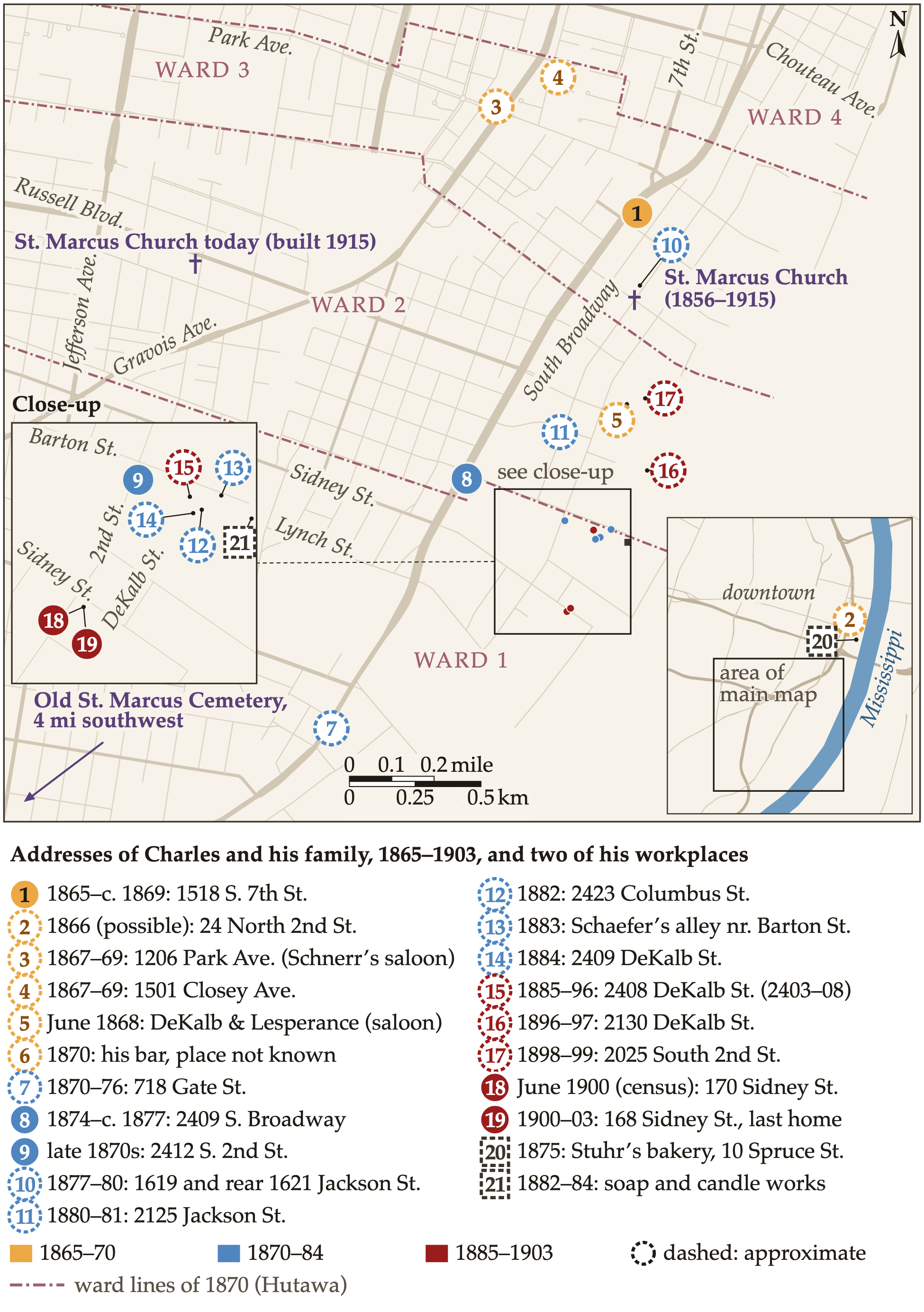
Charles's St. Louis addresses, 1865–1903. Sixteen places where Charles, his wife Auguste or their household are recorded, numbered in date order and colored by period. Every one lies in or near the near-south riverfront neighborhoods (Soulard, LaSalle Park and Kosciusko), apart from two early addresses near downtown and on the north riverfront (inset). Solid circles are placed by present-day house numbers. Dashed circles are approximate: Gate, Lesperance and Closey streets no longer exist, and Jackson Street was renamed Third Street and its blocks here were cleared. The 1866 address on North 2nd Street is possible only. Old St. Marcus Cemetery, where Charles was buried, lies about 4 miles to the southwest. Where markers would overlap, a short line joins the number to its place.
The man in the records: the pension file
The closing paragraph of the printed chapter was rewritten on 26 October 2026. Its earlier text is kept here.
The fullest single source for his American life is the forty-page pension file. His addresses, his children’s names, his description and his own account of his service all come from it. [PEN] The search for the Hessian family he came from is the subject of Part Four. [DEC]
Sources for this section
- PEN Civil War pension file of Charles Gannson, Battery B, 2nd Mo. Lt. Art. invalid application 749,432, certificate 684,507, file F41-523680269E, RG 15, National Archives; page numbers (PEN 03 … PEN 39) are PDF page numbers, re-transcribed from the images on 10 Oct 2026 (p. 28 = address statement received 14 Jun 1890; p. 30 = Inability Affidavit of 7 Oct 1890). pension-file corrections.
- DEC Working positions adopted in October 2026, while his German family remains unidentified (surname: possibly Gans or Konze, or another name; Konze has more of the evidence, but no record yet proves either; places: Trendelburg (his own statement) and Deisel (probable last home); birth: 26 January, year uncertain, c. 1833–1841 (1835 only from the burial register)), with the evidence summarized in Part Four.
Supplements
Records, images and data on this website that go with this chapter.