German
Not yet transcribed.
English
Not yet translated.
← The Köster Letters · Letter-by-letter summaries · Facsimile
Each leaf beside its text. 66 leaves · 27 verified · 0 machine OCR · 11 Kurrent, unread.
This page deliberately shows you work in three different states rather than a uniform wall of text, because the states are not equally trustworthy and the difference matters more than the convenience of hiding it.
The letters themselves are public domain, and so are the Gotha digitisates (confirmed by the library, 20 July 2026). Corrections are welcome and will be credited — if you read Kurrent, the grey rows are where you are most needed.
Not yet transcribed.
Not yet translated.
Not yet transcribed.
Not yet translated.
Not yet transcribed.
Not yet translated.
Not yet transcribed.
Not yet translated.
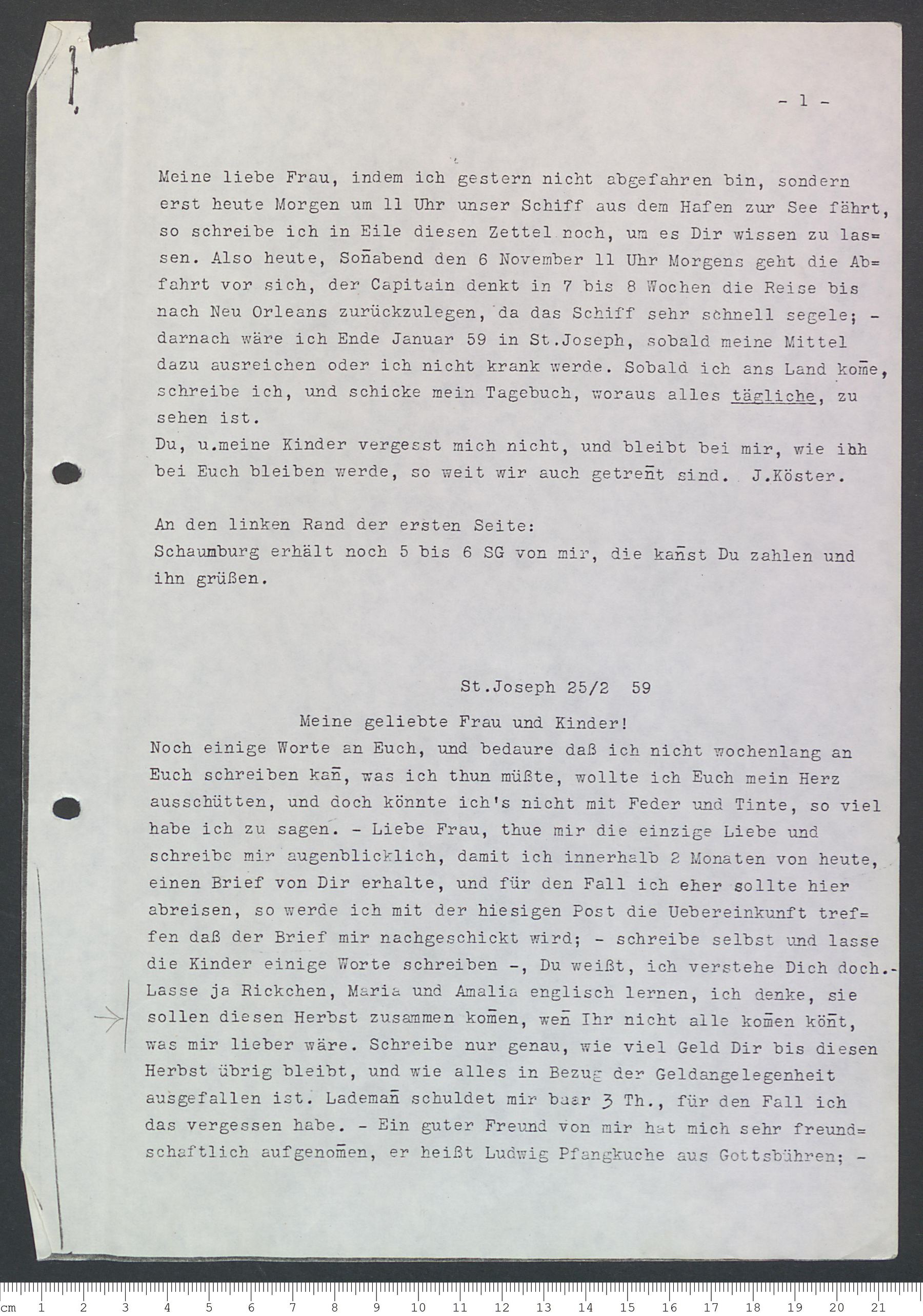
Page header: – 1 – · Two letters: the harbour note of 6 November 1858, and the opening of St. Joseph, 25 February 1859
Meine liebe Frau, indem ich gestern nicht abgefahren bin, sondern erst heute Morgen um 11 Uhr unser Schiff aus dem Hafen zur See fährt, so schreibe ich in Eile diesen Zettel noch, um es Dir wissen zu lassen. Also heute, Sonnabend den 6 November 11 Uhr Morgens geht die Abfahrt vor sich, der Capitain denkt in 7 bis 8 Wochen die Reise bis nach Neu Orleans zurückzulegen, da das Schiff sehr schnell segele; – darnach wäre ich Ende Januar 59 in St. Joseph, sobald meine Mittel dazu ausreichen oder ich nicht krank werde. Sobald ich ans Land komme, schreibe ich, und schicke mein Tagebuch, woraus alles tägliche zu sehen ist.
Du, u. meine Kinder vergesst mich nicht, und bleibt bei mir, wie ich bei Euch bleiben werde, so weit wir auch getrennt sind. J. Köster.
[Editor:] An den linken Rand der ersten Seite: Schaumburg erhält noch 5 bis 6 SG von mir, die kannst Du zahlen und ihn grüßen.
St. Joseph 25/2 59 — Meine geliebte Frau und Kinder!
Noch einige Worte an Euch, und bedaure daß ich nicht wochenlang an Euch schreiben kann, was ich thun müßte, wollte ich Euch mein Herz ausschütten, und doch könnte ich's nicht mit Feder und Tinte, so viel habe ich zu sagen. – Liebe Frau, thue mir die einzige Liebe und schreibe mir augenblicklich, damit ich innerhalb 2 Monaten von heute einen Brief von Dir erhalte, und für den Fall ich eher sollte hier abreisen, so werde ich mit der hiesigen Post die Uebereinkunft treffen daß der Brief mir nachgeschickt wird; – schreibe selbst und lasse die Kinder einige Worte schreiben –, Du weißt, ich verstehe Dich doch.
Lasse ja Rickchen, Maria und Amalia englisch lernen, ich denke, sie sollen diesen Herbst zusammen kommen, wenn Ihr nicht alle kommen könnt, was mir lieber wäre. Schreibe nur genau, wie viel Geld Dir bis diesen Herbst übrig bleibt, und wie alles in Bezug der Geldangelegenheit ausgefallen ist. Lademann schuldet mir baar 3 Th., für den Fall ich das vergessen habe. – Ein guter Freund von mir hat mich sehr freundschaftlich aufgenommen, er heißt Ludwig Pfangkuche aus Gottsbühren; –
My dear wife, since I did not sail yesterday, but our ship only leaves harbour for sea this morning at 11 o'clock, I write this note in haste to let you know. So today, Saturday 6 November at 11 in the morning, the departure takes place; the captain reckons on making the voyage to New Orleans in 7 to 8 weeks, as the ship sails very fast — by that reckoning I should be in St. Joseph at the end of January '59, provided my means stretch to it and I do not fall ill. As soon as I come ashore I shall write, and send my diary, from which everything day by day can be seen.
You and my children, do not forget me, and stay with me as I shall stay with you, however far apart we are. J. Köster.
[Editor:] In the left margin of the first page: Schaumburg is still owed 5 to 6 SG by me; you can pay it and give him my greetings.
St. Joseph, 25 February 1859 — My beloved wife and children!
A few more words to you, and I am sorry I cannot write to you for weeks on end, which is what I should have to do if I wanted to pour out my heart to you — and even then I could not do it with pen and ink, I have so much to say. Dear wife, do me the one kindness and write to me this instant, so that within two months from today I have a letter from you; and should I leave here sooner, I shall make an arrangement with the post office here to have the letter forwarded. Write yourself, and let the children write a few words — you know I understand you anyway.
Do have Rickchen, Maria and Amalia learn English; I think they should come out together this autumn, if you cannot all come, which I would prefer. Write exactly how much money you have left by this autumn, and how everything has turned out as regards the money matter. Lademann owes me 3 Thaler cash, in case I have forgotten it. — A good friend of mine has taken me in most kindly; he is called Ludwig Pfangkuche of Gottsbühren.
⭐ Doubled consonants are written with a macron, not doubled letters — the typist reproduces Köster's own Verdopplungsstrich: kome, getrent, Soñabend, kañ, wen, aufgenomen. Expanded silently above. This is the same convention at issue in Charles's 1862 signature. ⚠️ Also: the friend is Gottsbühren here, with an h, against the project's usual Gottsbüren.
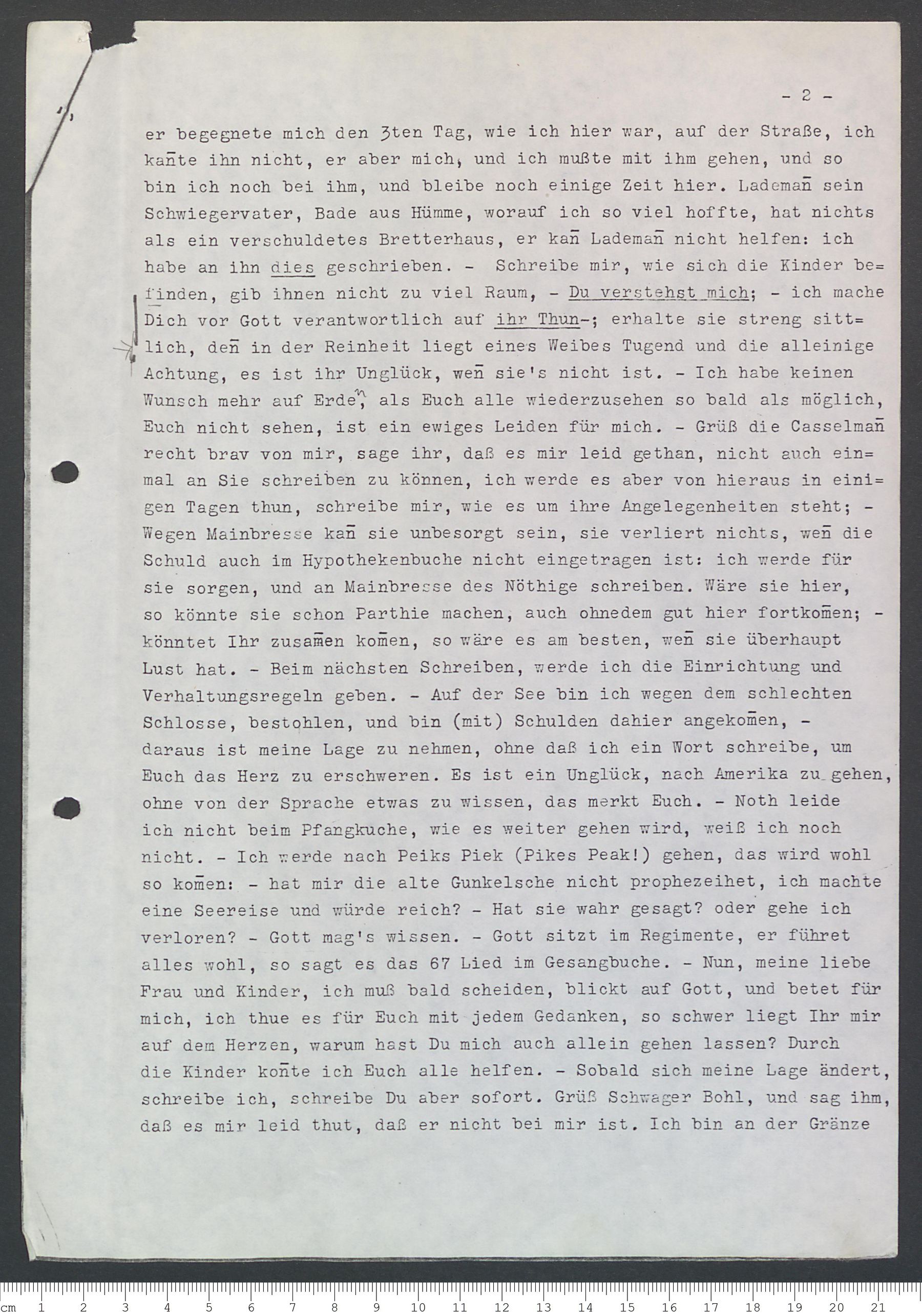
Page header: – 2 – · St. Joseph, 25 February 1859, continued
…er begegnete mich den 3ten Tag, wie ich hier war, auf der Straße, ich kannte ihn nicht, er aber mich, und ich mußte mit ihm gehen, und so bin ich noch bei ihm, und bleibe noch einige Zeit hier. Lademann sein Schwiegervater, Bade aus Hümme, worauf ich so viel hoffte, hat nichts als ein verschuldetes Bretterhaus, er kann Lademann nicht helfen: ich habe an ihn dies geschrieben.
Schreibe mir, wie sich die Kinder befinden, gib ihnen nicht zu viel Raum, – Du verstehst mich; – ich mache Dich vor Gott verantwortlich auf ihr Thun –; erhalte sie streng sittlich, denn in der Reinheit liegt eines Weibes Tugend und die alleinige Achtung, es ist ihr Unglück, wenn sie's nicht ist. – Ich habe keinen Wunsch mehr auf Erden, als Euch alle wiederzusehen so bald als möglich, Euch nicht sehen, ist ein ewiges Leiden für mich.
Grüß die Casselmann recht brav von mir, sage ihr, daß es mir leid gethan, nicht auch einmal an Sie schreiben zu können, ich werde es aber von hieraus in einigen Tagen thun, schreibe mir, wie es um ihre Angelegenheiten steht; – Wegen Mainbresse kann sie unbesorgt sein, sie verliert nichts, wenn die Schuld auch im Hypothekenbuche nicht eingetragen ist: ich werde für sie sorgen, und an Mainbresse des Nöthige schreiben. Wäre sie hier, so könnte sie schon Parthie machen, auch ohnedem gut hier fortkommen; – könntet Ihr zusammen kommen, so wäre es am besten, wenn sie überhaupt Lust hat. – Beim nächsten Schreiben, werde ich die Einrichtung und Verhaltungsregeln geben.
Auf der See bin ich wegen dem schlechten Schlosse bestohlen, und bin (mit) Schulden dahier angekommen, – daraus ist meine Lage zu nehmen, ohne daß ich ein Wort schreibe, um Euch das Herz zu erschweren. Es ist ein Unglück, nach Amerika zu gehen, ohne von der Sprache etwas zu wissen, das merkt Euch. – Noth leide ich nicht beim Pfangkuche, wie es weiter gehen wird, weiß ich noch nicht.
Ich werde nach Peiks Piek (Pikes Peak!) gehen, das wird wohl so kommen: – hat mir die alte Gunkelsche nicht prophezeihet, ich machte eine Seereise und würde reich? – Hat sie wahr gesagt? oder gehe ich verloren? – Gott mag's wissen. – Gott sitzt im Regimente, er führet alles wohl, so sagt es das 67 Lied im Gesangbuche.
Nun, meine liebe Frau und Kinder, ich muß bald scheiden, blickt auf Gott, und betet für mich, ich thue es für Euch mit jedem Gedanken, so schwer liegt Ihr mir auf dem Herzen, warum hast Du mich auch allein gehen lassen? Durch die Kinder konnte ich Euch allen helfen. – Sobald sich meine Lage ändert, schreibe ich, schreibe Du aber sofort. Grüß Schwager Bohl, und sag ihm, daß es mir leid thut, daß er nicht bei mir ist. Ich bin an der Gränze…
…he met me in the street on my third day here; I did not know him, but he knew me, and I had to go with him, and so I am still with him, and shall stay here a while yet. Lademann's father-in-law, Bade of Hümme, on whom I had pinned so much hope, has nothing but a mortgaged plank house; he cannot help Lademann. I have written this to him.
Write and tell me how the children are; do not allow them too much licence — you understand me. I hold you answerable before God for what they do. Keep them strictly decent, for a woman's virtue and her only claim to respect lie in her purity, and it is her ruin if she is not. I have no wish left on earth but to see you all again as soon as possible; not seeing you is a perpetual suffering to me.
Give Frau Casselmann my warm greetings; tell her I have been sorry not to be able to write to her too, but I shall do so from here within a few days. Write and tell me how her affairs stand. As to Mainbresse she may set her mind at rest — she loses nothing even though the debt is not entered in the mortgage book: I shall look after it for her and write what is needed to Mainbresse. If she were here she could make a match by now, and would do well here even without one; if you could come out together that would be best, assuming she has any inclination at all. In my next letter I shall set out the arrangements and the rules to follow.
At sea I was robbed, owing to the bad lock, and arrived here in debt — from which you may judge my situation, without my writing a word to weigh down your hearts. It is a misfortune to go to America without knowing anything of the language; mark that. I suffer no want at Pfangkuche's; how things will go on I do not yet know.
I shall go to Peiks Piek (Pikes Peak!) — that is likely how it will turn out. Did not old Frau Gunkel prophesy that I would make a sea voyage and grow rich? Did she speak true, or am I going to be lost? God may know. God sits in government and guides all things well, as hymn 67 in the hymn-book says.
Now, my dear wife and children, I must soon close. Look to God and pray for me; I do so for you with every thought, so heavily do you lie on my heart. Why did you let me go alone? Through the children I could have helped you all. As soon as my situation changes I shall write — but write to me at once. Greet brother-in-law Bohl, and tell him I am sorry he is not here with me. I am on the frontier…
⭐ New surname variant: Mainbresse (twice). The project's corpus has Meimbresse / Meinbresse / Meimbressen / Merkam / Merkamm; Mainbresse is not among them and should be added to the LAGIS query set — this is exactly the variant-blindness failure mode logged in the note of 18–19 Jul 2026. Also Gottsbühren / Casselmann spellings, and the editor's own gloss “Peiks Piek (Pikes Peak!)” — the exclamation mark is the 1930s transcriber's, not Köster's. Macron doubling expanded silently throughout (kañte, kañ, fortkomen, zusamen, konte, angekomen).
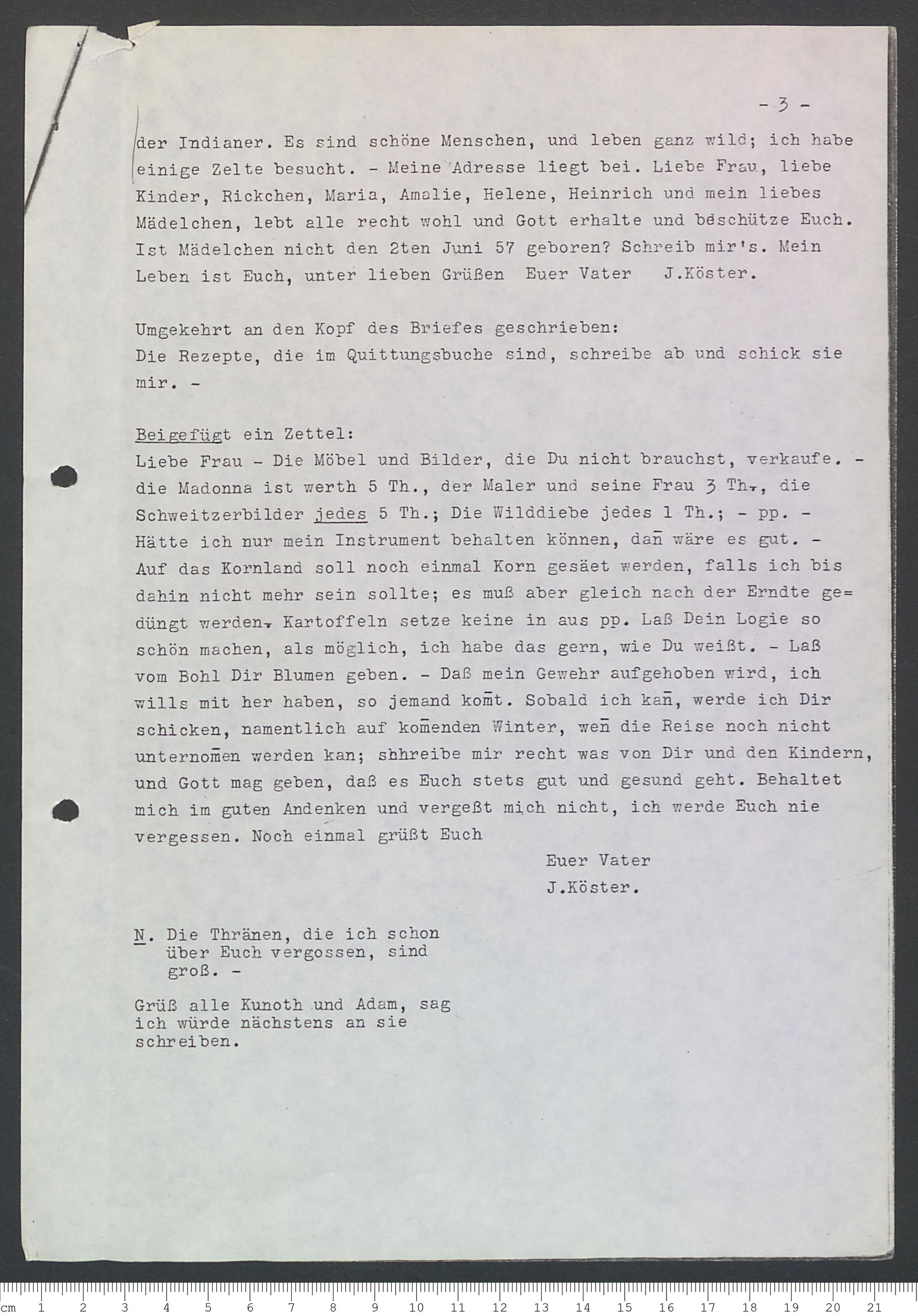
Page header: – 3 – · End of the 25 February 1859 letter, with two enclosed slips
…der Indianer. Es sind schöne Menschen, und leben ganz wild; ich habe einige Zelte besucht. – Meine Adresse liegt bei. Liebe Frau, liebe Kinder, Rickchen, Maria, Amalie, Helene, Heinrich und mein liebes Mädelchen, lebt alle recht wohl und Gott erhalte und beschütze Euch. Ist Mädelchen nicht den 2ten Juni 57 geboren? Schreib mir's. Mein Leben ist Euch, unter lieben Grüßen Euer Vater J. Köster.
[Editor:] Umgekehrt an den Kopf des Briefes geschrieben: Die Rezepte, die im Quittungsbuche sind, schreibe ab und schick sie mir. –
[Editor:] Beigefügt ein Zettel: Liebe Frau – Die Möbel und Bilder, die Du nicht brauchst, verkaufe. – die Madonna ist werth 5 Th., der Maler und seine Frau 3 Th., die Schweitzerbilder jedes 5 Th.; Die Wilddiebe jedes 1 Th.; – pp. – Hätte ich nur mein Instrument behalten können, dann wäre es gut. –
Auf das Kornland soll noch einmal Korn gesäet werden, falls ich bis dahin nicht mehr sein sollte; es muß aber gleich nach der Erndte gedüngt werden. Kartoffeln setze keine in aus pp. Laß Dein Logie so schön machen, als möglich, ich habe das gern, wie Du weißt. – Laß vom Bohl Dir Blumen geben. – Daß mein Gewehr aufgehoben wird, ich wills mit her haben, so jemand kommt.
Sobald ich kann, werde ich Dir schicken, namentlich auf kommenden Winter, wenn die Reise noch nicht unternommen werden kann; schreibe mir recht was von Dir und den Kindern, und Gott mag geben, daß es Euch stets gut und gesund geht. Behaltet mich im guten Andenken und vergeßt mich nicht, ich werde Euch nie vergessen. Noch einmal grüßt Euch Euer Vater J. Köster.
N. Die Thränen, die ich schon über Euch vergossen, sind groß. –
Grüß alle Kunoth und Adam, sag ich würde nächstens an sie schreiben.
…of the Indians. They are handsome people and live quite wild; I have visited some of their tents. — My address is enclosed. Dear wife, dear children — Rickchen, Maria, Amalie, Helene, Heinrich and my dear little girl — fare you all well, and God preserve and protect you. Was little one not born on 2 June '57? Write and tell me. My life is yours; with fond greetings, your father, J. Köster.
[Editor:] Written upside down at the head of the letter: Copy out the recipes that are in the receipt book and send them to me.
[Editor:] A slip enclosed: Dear wife — sell the furniture and pictures you do not need. The Madonna is worth 5 Thaler, the painter and his wife 3, the Swiss pictures 5 each, the poachers 1 each, and so on. If only I had been able to keep my instrument, all would be well.
The corn land is to be sown with corn once more, in case I should no longer be here by then; but it must be manured directly after the harvest. Plant no potatoes in it, etc. Have your lodging made as pretty as you can — I like that, as you know. Have Bohl give you flowers. See that my gun is put away; I want it brought out to me if anyone comes.
As soon as I can I shall send you money, particularly for the coming winter if the journey cannot yet be undertaken. Write me plenty about yourself and the children, and God grant that you always fare well and stay healthy. Keep me in kind remembrance and do not forget me; I shall never forget you. Once more, greetings to you — your father, J. Köster.
N. The tears I have already shed over you are great.
Greet all the Kunoths and Adam; say I shall write to them shortly.
⭐ A children roster in his own words — Rickchen (Friederike), Maria, Amalie, Helene, Heinrich, and the youngest, Mädelchen. ⚠️ Date conflict worth keeping: he asks “Ist Mädelchen nicht den 2ten Juni 57 geboren?” — but the 1961 Lebenslauf (img 0028) gives Marie Sophie gen. Mimi as born 2 July 1856. An emigrant father four months out is unsure of his youngest child's birthday and has to ask. Treat the Lebenslauf as the stronger source; the letter is the more human one. ⭐ New names for the database: Kunoth and Adam (Adam is already in the 1937 index).
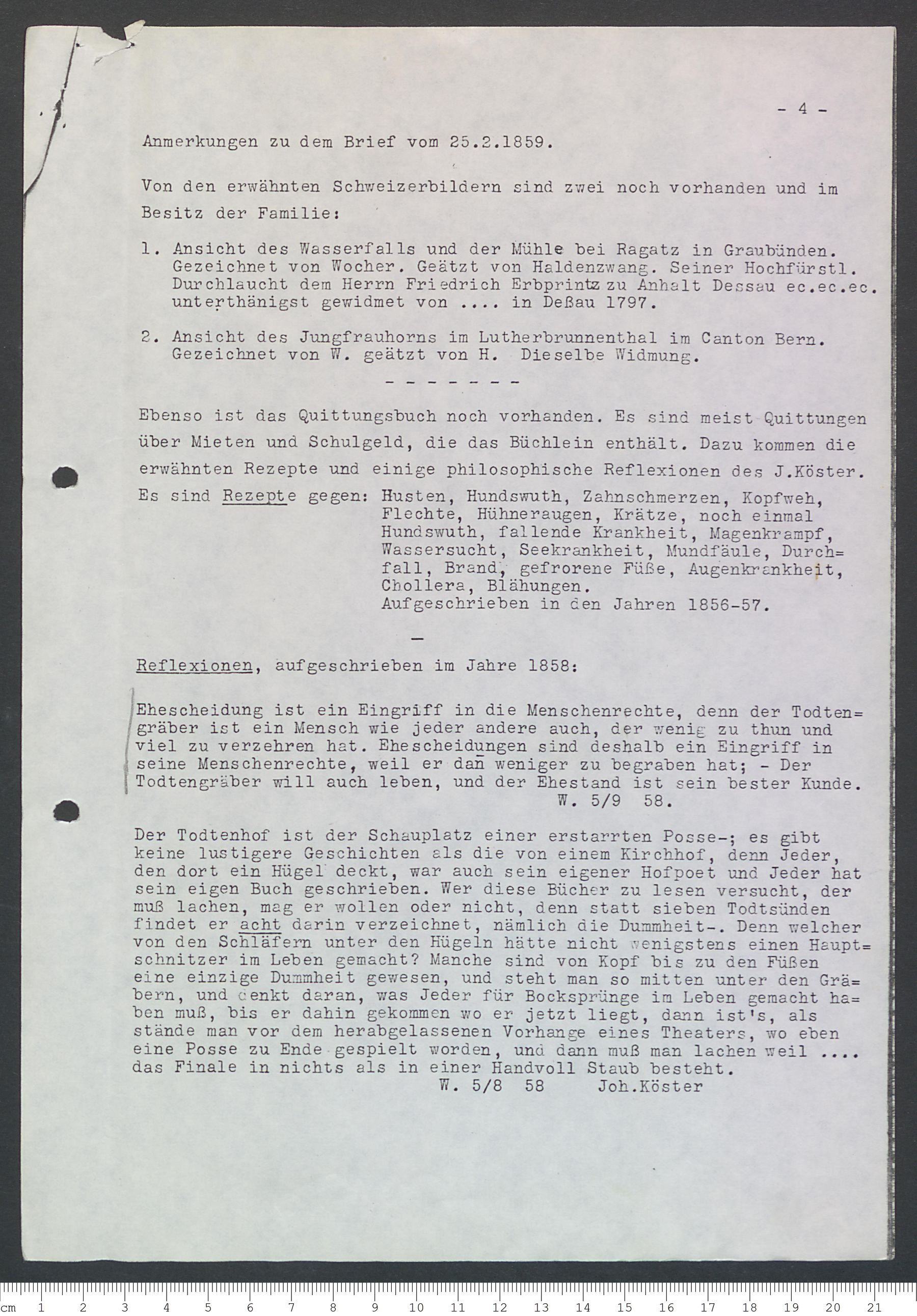
Page header: – 4 – · Editor's notes to the letter of 25 February 1859 — surviving objects, the receipt book, and two reflections of 1858
Anmerkungen zu dem Brief vom 25.2.1859.
Von den erwähnten Schweizerbildern sind zwei noch vorhanden und im Besitz der Familie: 1. Ansicht des Wasserfalls und der Mühle bei Ragatz in Graubünden. Gezeichnet von Wocher. Geätzt von Haldenzwang. Seiner Hochfürstl. Durchlaucht dem Herrn Friedrich Erbprintz zu Anhalt Dessau ec.ec.ec. unterthänigst gewidmet von …. in Deßau 1797. — 2. Ansicht des Jungfrauhorns im Lutherbrunnenthal im Canton Bern. Gezeichnet von W., geätzt von H. Dieselbe Widmung.
Ebenso ist das Quittungsbuch noch vorhanden. Es sind meist Quittungen über Mieten und Schulgeld, die das Büchlein enthält. Dazu kommen die erwähnten Rezepte und einige philosophische Reflexionen des J. Köster.
Es sind Rezepte gegen: Husten, Hundswuth, Zahnschmerzen, Kopfweh, Flechte, Hühneraugen, Krätze, noch einmal Hundswuth, fallende Krankheit, Magenkrampf, Wassersucht, Seekrankheit, Mundfäule, Durchfall, Brand, gefrorene Füße, Augenkrankheit, Chollera, Blähungen. Aufgeschrieben in den Jahren 1856–57.
Reflexionen, aufgeschrieben im Jahre 1858:
„Ehescheidung ist ein Eingriff in die Menschenrechte, denn der Todtengräber ist ein Mensch wie jeder andere auch, der wenig zu thun und viel zu verzehren hat. Ehescheidungen sind deshalb ein Eingriff in seine Menschenrechte, weil er dann weniger zu begraben hat; – Der Todtengräber will auch leben, und der Ehestand ist sein bester Kunde.“ W. 5/9 58.
„Der Todtenhof ist der Schauplatz einer erstarrten Posse–; es gibt keine lustigere Geschichten als die von einem Kirchhof, denn Jeder, den dort ein Hügel deckt, war auch sein eigener Hofpoet und Jeder hat sein eigen Buch geschrieben. … statt sieben Todsünden findet er acht darin verzeichnet, nämlich die Dummheit–. … dann ist's, als stände man vor dem herabgelassenen Vorhange eines Theaters, wo eben eine Posse zu Ende gespielt worden, und dann muß man lachen weil …. das Finale in nichts als in einer Handvoll Staub besteht.“ W. 5/8 58. Joh. Köster
Notes on the letter of 25 February 1859.
Of the Swiss pictures mentioned, two survive and are in the family's possession: 1. View of the waterfall and mill near Ragatz in Graubünden, drawn by Wocher, etched by Haldenzwang, humbly dedicated to His Serene Highness Friedrich, Hereditary Prince of Anhalt-Dessau, at Dessau 1797. — 2. View of the Jungfrauhorn in the Lauterbrunnen valley, Canton Bern; drawn by W., etched by H. Same dedication.
The receipt book also survives. It contains mostly receipts for rent and school fees, together with the recipes mentioned and some philosophical reflections by J. Köster.
There are remedies against: cough, rabies, toothache, headache, ringworm, corns, scabies, rabies again, the falling sickness [epilepsy], stomach cramp, dropsy, seasickness, mouth rot, diarrhoea, gangrene, frostbitten feet, eye disease, cholera, wind. Written down in the years 1856–57.
Reflections, written down in the year 1858:
On divorce, mock-legalistically: it is an infringement of human rights — the gravedigger's. He is a man like any other, with little to do and much to consume; divorce leaves him fewer people to bury. The gravedigger wants to live too, and marriage is his best customer. — Wehlheiden, 5 September 1858.
On the churchyard: it is the scene of a farce frozen in place. There are no funnier stories than a graveyard's, since everyone under a mound there was his own court poet and wrote his own book. Anyone who tries to read them must laugh whether he likes it or not — for instead of seven deadly sins he finds eight recorded there, the eighth being stupidity. Standing among the graves and thinking what capers each must have cut before arriving where he now lies, it is like facing the lowered curtain of a theatre where a farce has just been played out; and then one has to laugh, because the finale consists of nothing but a handful of dust. — Wehlheiden, 5 August 1858. Joh. Köster
⭐ Köster as a writer, three months before emigrating. These two aphorisms — mordant, theatrical, anticlerical in temper — are the earliest of his own prose in the series, and they corroborate the Lebenslauf's note that he later worked as a Redakteur on German-American papers. ⭐ “W.” = Wehlheiden, his wife's home (Christiane Sophie Gunkel aus Wehlheiden, per the Lebenslauf), so both are datelined there in August–September 1858, weeks before he sailed. ⭐ The 19-item recipe list of 1856–57 is an unexpectedly good source for ordinary Hessian domestic medicine on the eve of emigration — note Seekrankheit among them, written down the year before he needed it. English above paraphrases the two reflections rather than rendering them line by line; the German is the text of record.
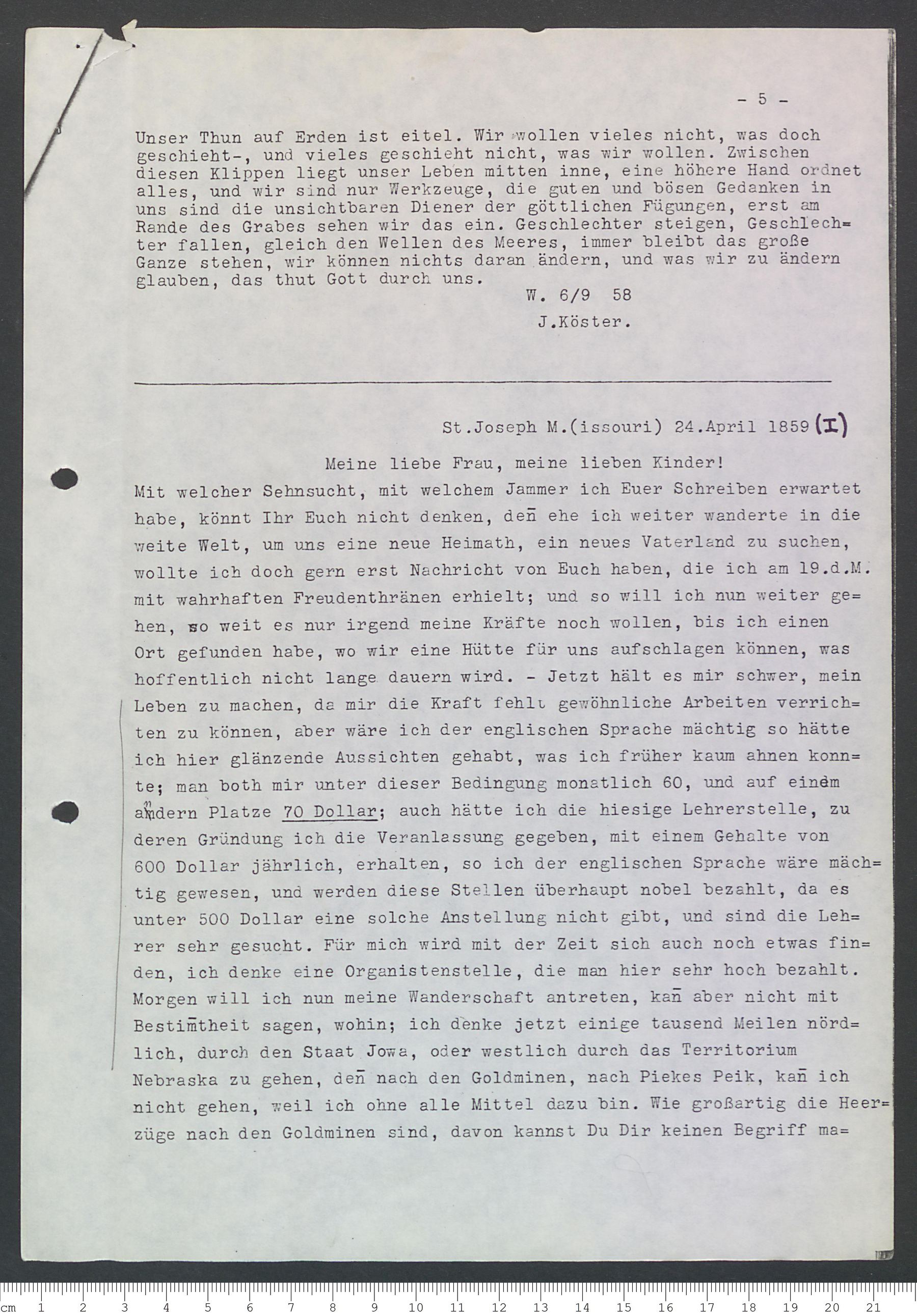
Page header: – 5 – · A third reflection (Wehlheiden, 6 Sept 1858), then the letter of St. Joseph, 24 April 1859 (I)
„Unser Thun auf Erden ist eitel. Wir wollen vieles nicht, was doch geschieht–, und vieles geschieht nicht, was wir wollen. Zwischen diesen Klippen liegt unser Leben mitten inne, eine höhere Hand ordnet alles, und wir sind nur Werkzeuge, die guten und bösen Gedanken in uns sind die unsichtbaren Diener der göttlichen Fügungen, erst am Rande des Grabes sehen wir das ein. Geschlechter steigen, Geschlechter fallen, gleich den Wellen des Meeres, immer bleibt das große Ganze stehen, wir können nichts daran ändern, und was wir zu ändern glauben, das thut Gott durch uns.“ W. 6/9 58. J. Köster.
St. Joseph M.(issouri) 24. April 1859 (I) — Meine liebe Frau, meine lieben Kinder!
Mit welcher Sehnsucht, mit welchem Jammer ich Euer Schreiben erwartet habe, könnt Ihr Euch nicht denken, denn ehe ich weiter wanderte in die weite Welt, um uns eine neue Heimath, ein neues Vaterland zu suchen, wollte ich doch gern erst Nachricht von Euch haben, die ich am 19. d. M. mit wahrhaften Freudenthränen erhielt; und so will ich nun weiter gehen, so weit es nur irgend meine Kräfte noch wollen, bis ich einen Ort gefunden habe, wo wir eine Hütte für uns aufschlagen können, was hoffentlich nicht lange dauern wird.
Jetzt hält es mir schwer, mein Leben zu machen, da mir die Kraft fehlt gewöhnliche Arbeiten verrichten zu können, aber wäre ich der englischen Sprache mächtig so hätte ich hier glänzende Aussichten gehabt, was ich früher kaum ahnen konnte; man both mir unter dieser Bedingung monatlich 60, und auf einem andern Platze 70 Dollar; auch hätte ich die hiesige Lehrerstelle, zu deren Gründung ich die Veranlassung gegeben, mit einem Gehalte von 600 Dollar jährlich erhalten, so ich der englischen Sprache wäre mächtig gewesen, und werden diese Stellen überhaupt nobel bezahlt, da es unter 500 Dollar eine solche Anstellung nicht gibt, und sind die Lehrer sehr gesucht. Für mich wird mit der Zeit sich auch noch etwas finden, ich denke eine Organistenstelle, die man hier sehr hoch bezahlt.
Morgen will ich nun meine Wanderschaft antreten, kann aber nicht mit Bestimmtheit sagen, wohin; ich denke jetzt einige tausend Meilen nördlich, durch den Staat Jowa, oder westlich durch das Territorium Nebraska zu gehen, denn nach den Goldminen, nach Piekes Peik, kann ich nicht gehen, weil ich ohne alle Mittel dazu bin. Wie großartig die Heerzüge nach den Goldminen sind, davon kannst Du Dir keinen Begriff ma…
A third reflection, on providence: our doing on earth is vain — much we do not want happens, and much we want does not. Our life lies between these rocks; a higher hand orders everything and we are only tools, the good and evil thoughts in us being the invisible servants of divine dispensation, which we grasp only at the graveside. Generations rise and generations fall like the waves of the sea; the great whole always stands, we can alter nothing of it, and what we believe ourselves to alter, God does through us. — Wehlheiden, 6 September 1858. J. Köster.
St. Joseph, Missouri, 24 April 1859 (I) — My dear wife, my dear children!
You cannot imagine with what longing, with what misery I have waited for your letter; for before I wandered further into the wide world to seek us a new home, a new fatherland, I did want news of you first — which I received on the 19th of this month, with true tears of joy. And so now I mean to go on, as far as my strength will still carry me, until I have found a place where we can put up a hut for ourselves, which will not, I hope, take long.
At present I find it hard to make my living, since I lack the strength to do ordinary labour. But if I had command of the English language I should have had brilliant prospects here, more than I could have guessed before. On that condition I was offered 60 dollars a month, and in another place 70; I should also have had the teaching post here — which was founded at my instigation — at a salary of 600 dollars a year, had I known English. These posts are handsomely paid: there is no such appointment under 500 dollars, and teachers are much in demand. Something will turn up for me too in time — an organist's post, I think, which is very well paid here.
Tomorrow I mean to set out on my wanderings, though I cannot say for certain where. I am thinking now of going some thousands of miles north, through the state of Iowa, or west through the Territory of Nebraska — for I cannot go to the gold mines, to Pike's Peak, being wholly without the means. You can form no idea of the scale of the caravans heading for the gold mines…
⭐⭐ HARD WAGE DATA, St. Joseph, April 1859 — feeds Chapter 3 directly. English-speaking work offered at 60 and 70 dollars a month; a teaching post at 600 dollars a year, with no such appointment under 500. Set beside the 19 Jul 2026 wages-and-prices work and the twelve dollars a month quoted in the autograph leaf (0113–0119): the spread between a labourer's wage and an English-speaking professional's is the whole immigrant economy in one paragraph. ⭐ And the barrier is language, not skill — he is repeatedly offered good work on condition of English, and cannot take it. This is the strongest single statement in the series of what an unlettered German arrival like Charles faced. ⚠️ Piekes Peik here, Peiks Piek on p. 2 — his spelling of Pike's Peak is unstable; Jowa = Iowa.
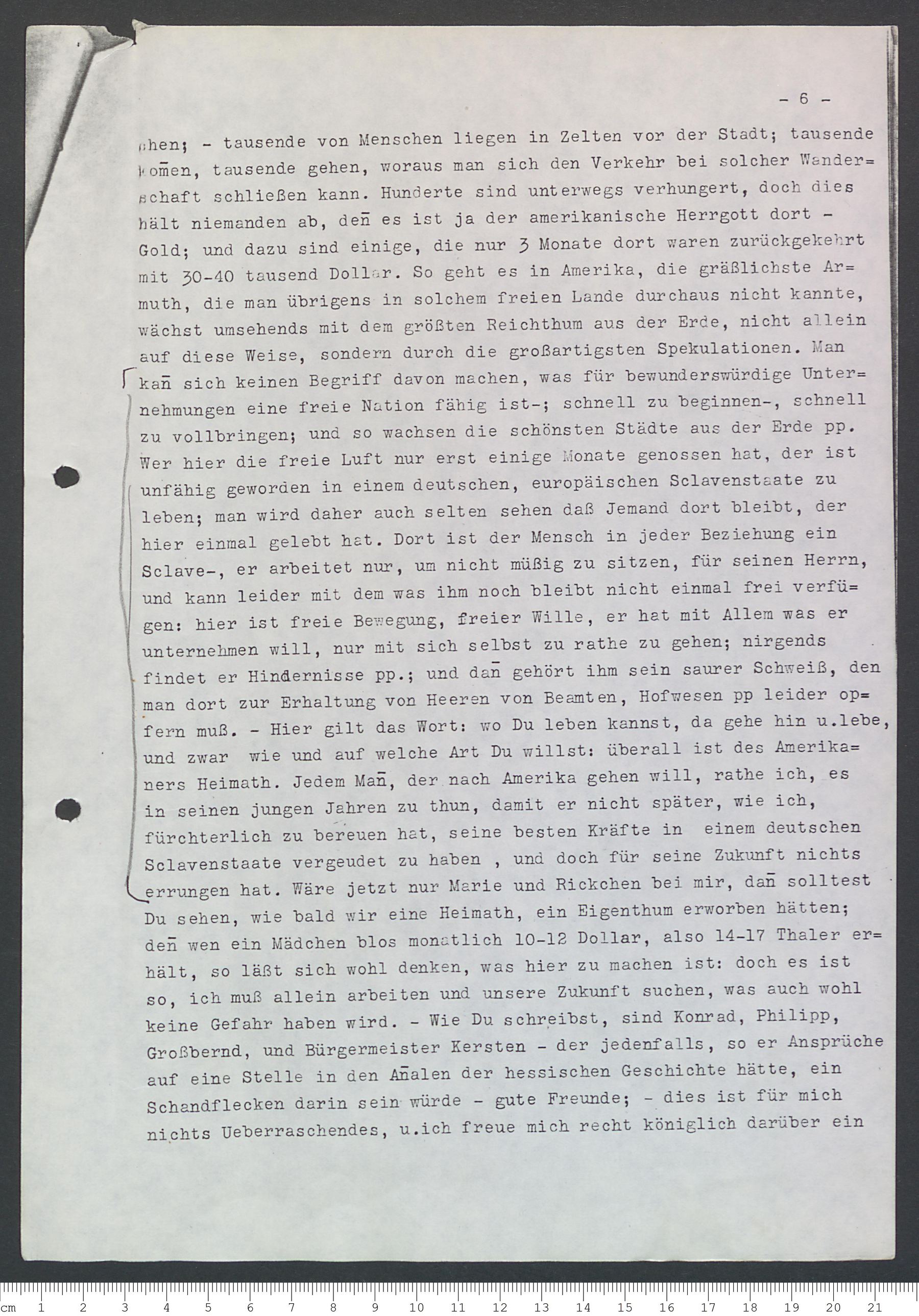
Page header: – 6 – · St. Joseph, 24 April 1859, continued — the gold rush, and the case for America
…chen; – tausende von Menschen liegen in Zelten vor der Stadt; tausende kommen, tausende gehen, woraus man sich den Verkehr bei solcher Wanderschaft schließen kann. Hunderte sind unterwegs verhungert, doch dies hält niemanden ab, denn es ist ja der amerikanische Herrgott dort – Gold; und dazu sind einige, die nur 3 Monate dort waren zurückgekehrt mit 30–40 tausend Dollar.
So geht es in Amerika, die gräßlichste Armuth, die man übrigens in solchem freien Lande durchaus nicht kannte, wächst umsehends mit dem größten Reichthum aus der Erde, nicht allein auf diese Weise, sondern durch die großartigsten Spekulationen. Man kann sich keinen Begriff davon machen, was für bewunderswürdige Unternehmungen eine freie Nation fähig ist–; schnell zu beginnen–, schnell zu vollbringen; und so wachsen die schönsten Städte aus der Erde pp.
Wer hier die freie Luft nur erst einige Monate genossen hat, der ist unfähig geworden in einem deutschen, europäischen Sclavenstaate zu leben; man wird daher auch selten sehen daß Jemand dort bleibt, der hier einmal gelebt hat. Dort ist der Mensch in jeder Beziehung ein Sclave–, er arbeitet nur, um nicht müßig zu sitzen, für seinen Herrn, und kann leider mit dem was ihm noch bleibt nicht einmal frei verfügen: hier ist freie Bewegung, freier Wille, er hat mit Allem was er unternehmen will, nur mit sich selbst zu rathe zu gehen; nirgends findet er Hindernisse pp.; und dann gehört ihm sein saurer Schweiß, den man dort zur Erhaltung von Heeren von Beamten, Hofwesen pp leider opfern muß.
Hier gilt das Wort: wo Du leben kannst, da gehe hin u. lebe, und zwar wie und auf welche Art Du willst: überall ist des Amerikaners Heimath. Jedem Mann, der nach Amerika gehen will, rathe ich, es in seinen jungen Jahren zu thun, damit er nicht später, wie ich, fürchterlich zu bereuen hat, seine besten Kräfte in einem deutschen Sclavenstaate vergeudet zu haben, und doch für seine Zukunft nichts errungen hat.
Wäre jetzt nur Marie und Rickchen bei mir, dann solltest Du sehen, wie bald wir eine Heimath, ein Eigenthum erworben hätten; denn wenn ein Mädchen blos monatlich 10–12 Dollar, also 14–17 Thaler erhält, so läßt sich wohl denken, was hier zu machen ist: doch es ist so, ich muß allein arbeiten und unsere Zukunft suchen, was auch wohl keine Gefahr haben wird.
Wie Du schreibst, sind Konrad, Philipp, Großbernd, und Bürgermeister Kersten – der jedenfalls, so er Ansprüche auf eine Stelle in den Annalen der hessischen Geschichte hätte, ein Schandflecken darin sein würde – gute Freunde; – dies ist für mich nichts Ueberraschendes, u. ich freue mich recht königlich darüber ein…
…thousands of people are camped in tents outside the town; thousands come, thousands go, from which you may judge the traffic of such a migration. Hundreds have starved on the road, yet this deters nobody, for the American Lord God is out there — gold; and besides, some who were there only three months have come back with thirty or forty thousand dollars.
So it goes in America: the most frightful poverty — which in such a free country was formerly quite unknown — springs up out of the ground alongside the greatest wealth, and not only in this way but through the most enormous speculations. One can form no idea what admirable undertakings a free nation is capable of: quick to begin, quick to accomplish; and so the finest cities grow up out of the earth.
Whoever has breathed the free air here for only a few months has become incapable of living in a German, European slave-state. One will therefore seldom see anyone stay there who has once lived here. There a man is in every respect a slave: he works only so as not to sit idle, and for his master, and cannot even freely dispose of what is left him. Here there is free movement, free will; in everything he undertakes he has only himself to consult, and nowhere does he meet obstacles — and then his hard-earned sweat belongs to him, which there must be sacrificed to the upkeep of armies of officials and court establishments.
Here the saying holds: go where you can live, and live — in whatever way and manner you please; everywhere is the American's home. To every man who means to go to America I give this advice: do it in his young years, so that he does not later, like me, have terribly to regret having squandered his best strength in a German slave-state and gained nothing for his future after all.
If only Marie and Rickchen were with me now, you would see how soon we should have won a home and property of our own; for when a girl gets a mere 10 to 12 dollars a month — that is 14 to 17 Thaler — you may well imagine what is to be made here. But so it is: I must work alone and seek our future, which will hardly be dangerous.
You write that Konrad, Philipp, Großbernd and Mayor Kersten are good friends — Kersten who, if he had any claim to a place in the annals of Hessian history, would be a stain upon them. This does not surprise me in the least, and I am royally glad of it…
⭐⭐ CORRECTION — “freie Bewegung, freier Wille” is HERE, not only in the autographs. The note of 18–19 Jul 2026 and the narrative page attribute that phrase to the autograph leaves 0113–0119. It stands on this typescript page, in the letter of 24 April 1859, inside a sustained political argument. Both site pages should be corrected to cite p. 6 / image 0059. ⭐⭐ EXCHANGE RATE, stated by the writer: 10–12 dollars = 14–17 Thaler (≈1.4 Th. per dollar), and it is a girl's monthly domestic wage — a second hard data point for the Chapter 3 wages work, and one that prices women's labour, which the 1749 Deisel spinning figures also turn on. ⭐ “Politischer Druck” documented. The Personalkarte gives that as his emigration cause; this page is the evidence — Germany as a Sclavenstaat, sweat consumed by officialdom and court, and the advice to emigrate young. ⭐ Names: Großbernd (the family of the Wilhelmine he was already living with — note he mentions them coolly to his wife), Konrad and Philipp (his brothers), and Bürgermeister Kersten of Wehlheiden (located there on p. 8), whom he loathes.
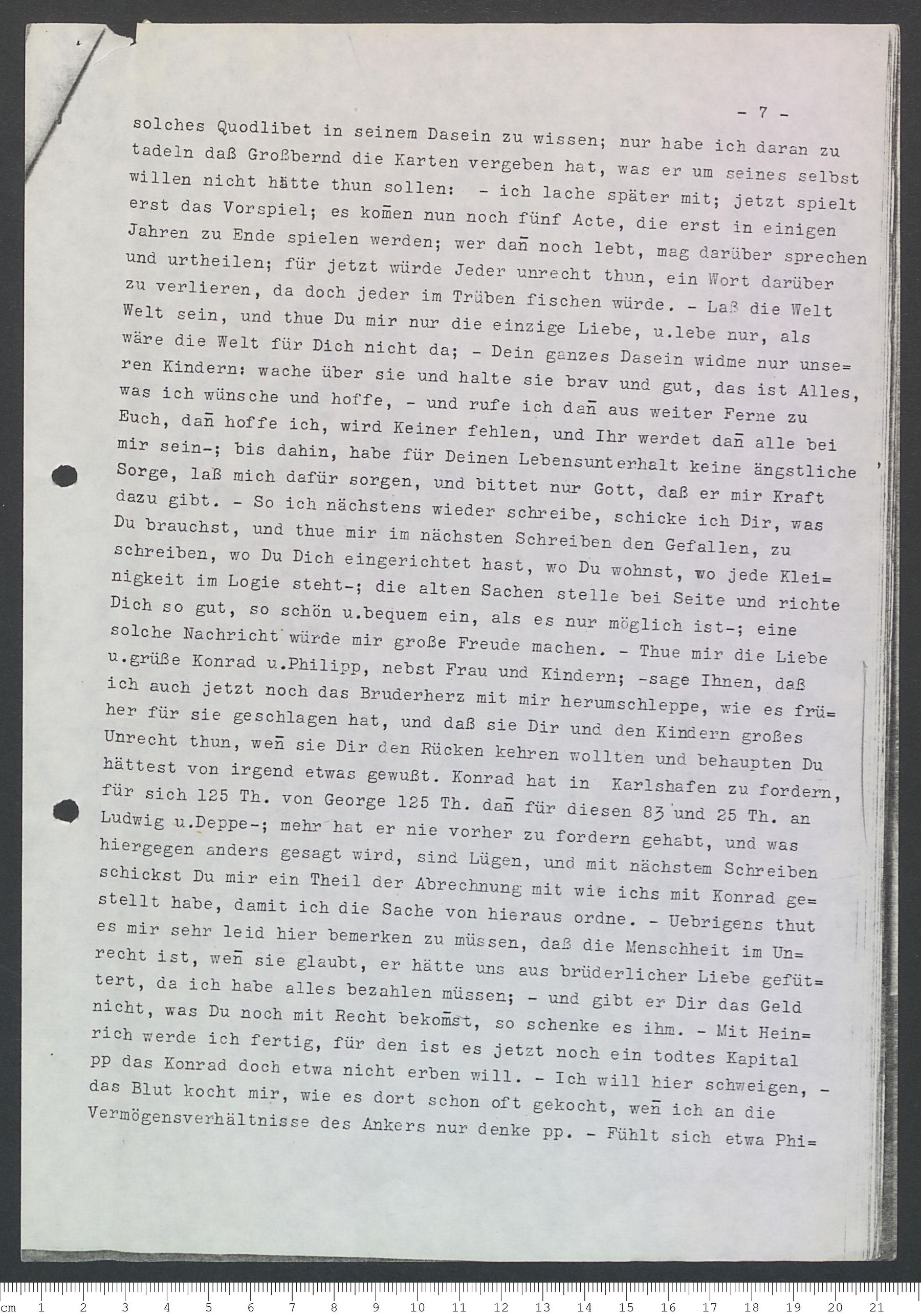
Page header: – 7 – · St. Joseph, 24 April 1859, continued — the family quarrel over money
…solches Quodlibet in seinem Dasein zu wissen; nur habe ich daran zu tadeln daß Großbernd die Karten vergeben hat, was er um seines selbst willen nicht hätte thun sollen: – ich lache später mit; jetzt spielt erst das Vorspiel; es kommen nun noch fünf Acte, die erst in einigen Jahren zu Ende spielen werden; wer dann noch lebt, mag darüber sprechen und urtheilen; für jetzt würde Jeder unrecht thun, ein Wort darüber zu verlieren, da doch jeder im Trüben fischen würde.
Laß die Welt Welt sein, und thue Du mir nur die einzige Liebe, u. lebe nur, als wäre die Welt für Dich nicht da; – Dein ganzes Dasein widme nur unseren Kindern: wache über sie und halte sie brav und gut, das ist Alles, was ich wünsche und hoffe, – und rufe ich dann aus weiter Ferne zu Euch, dann hoffe ich, wird Keiner fehlen, und Ihr werdet dann alle bei mir sein–; bis dahin, habe für Deinen Lebensunterhalt keine ängstliche Sorge, laß mich dafür sorgen, und bittet nur Gott, daß er mir Kraft dazu gibt.
So ich nächstens wieder schreibe, schicke ich Dir, was Du brauchst, und thue mir im nächsten Schreiben den Gefallen, zu schreiben, wo Du Dich eingerichtet hast, wo Du wohnst, wo jede Kleinigkeit im Logie steht–; die alten Sachen stelle bei Seite und richte Dich so gut, so schön u. bequem ein, als es nur möglich ist–; eine solche Nachricht würde mir große Freude machen.
Thue mir die Liebe u. grüße Konrad u. Philipp, nebst Frau und Kindern; – sage Ihnen, daß ich auch jetzt noch das Bruderherz mit mir herumschleppe, wie es früher für sie geschlagen hat, und daß sie Dir und den Kindern großes Unrecht thun, wenn sie Dir den Rücken kehren wollten und behaupten Du hättest von irgend etwas gewußt.
Konrad hat in Karlshafen zu fordern, für sich 125 Th., von George 125 Th., dann für diesen 83 und 25 Th. an Ludwig u. Deppe–; mehr hat er nie vorher zu fordern gehabt, und was hiergegen anders gesagt wird, sind Lügen, und mit nächstem Schreiben schickst Du mir ein Theil der Abrechnung mit wie ich's mit Konrad gestellt habe, damit ich die Sache von hieraus ordne.
Uebrigens thut es mir sehr leid hier bemerken zu müssen, daß die Menschheit im Unrecht ist, wenn sie glaubt, er hätte uns aus brüderlicher Liebe gefüttert, da ich habe alles bezahlen müssen; – und gibt er Dir das Geld nicht, was Du noch mit Recht bekommst, so schenke es ihm. – Mit Heinrich werde ich fertig, für den ist es jetzt noch ein todtes Kapital pp das Konrad doch etwa nicht erben will. – Ich will hier schweigen, – das Blut kocht mir, wie es dort schon oft gekocht, wenn ich an die Vermögensverhältnisse des Ankers nur denke pp. – Fühlt sich etwa Phi…
…to know such a hotchpotch in his existence. My only complaint is that Großbernd dealt the cards, which for his own sake he ought not to have done. I shall laugh along later; at present only the prelude is being played, five acts are still to come and will not finish for some years yet. Whoever is still alive then may speak and judge; for now anyone would do wrong to waste a word on it, since everyone would only be fishing in muddy water.
Let the world be the world, and do me the one kindness of living as though the world were not there for you. Devote your whole existence to our children: watch over them and keep them decent and good — that is all I wish and hope. And when I then call to you from far off, I hope none will be missing and you will all be with me. Until then, have no anxious care for your keep; let me see to that, and only pray God to give me the strength for it.
When I write again shortly I shall send what you need; and do me the favour in your next letter of writing where you have settled, where you live, where every little thing stands in the lodging. Put the old things aside and make yourself as well, as prettily and as comfortably set up as you possibly can — such news would give me great joy.
Do me the kindness of greeting Konrad and Philipp, with their wives and children; tell them that even now I still carry a brother's heart about with me, as it once beat for them, and that they do you and the children a great wrong if they mean to turn their backs on you and claim that you knew anything of the matter.
Konrad's claims at Karlshafen are: 125 Thaler for himself, 125 from George, then for the latter 83 and 25 Thaler owing to Ludwig and Deppe. He never had more to claim than that, and whatever is said to the contrary is lies. With your next letter send me part of the account as I settled it with Konrad, so that I can put the matter in order from here.
I am very sorry to have to note here that people are in the wrong if they think he fed us out of brotherly love, since I had to pay for everything. And if he does not give you the money you are still rightfully owed, then make him a present of it. With Heinrich I shall manage; for him it is still dead capital as yet, which Konrad presumably does not want to inherit. I will say no more here — my blood boils, as it often boiled there, when I so much as think of the financial affairs of the Anker.
⭐ “des Ankers” = the Gasthaus zum Anker at Wehlheiden, his wife's family inn (the Lebenslauf, img 0028, gives Christiane Sophie Gunkel aus Wehlheiden, Wirthschaft zum Anker). The quarrel running through this page is over that inn's estate. ⭐ A debt ledger in Thaler — 125, 125, 83, 25 at Karlshafen — useful alongside the dollar/Thaler rate on p. 6. ⭐ Note the theatrical figure again (Vorspiel, fünf Acte), the same voice as the 1858 aphorisms on p. 4. ⚠️ Großbernd appears here as an antagonist — “dealt the cards” in the family quarrel — written to the wife he was already deceiving with a Großbernd daughter. The letters are not naive about this family; he simply never says which member.
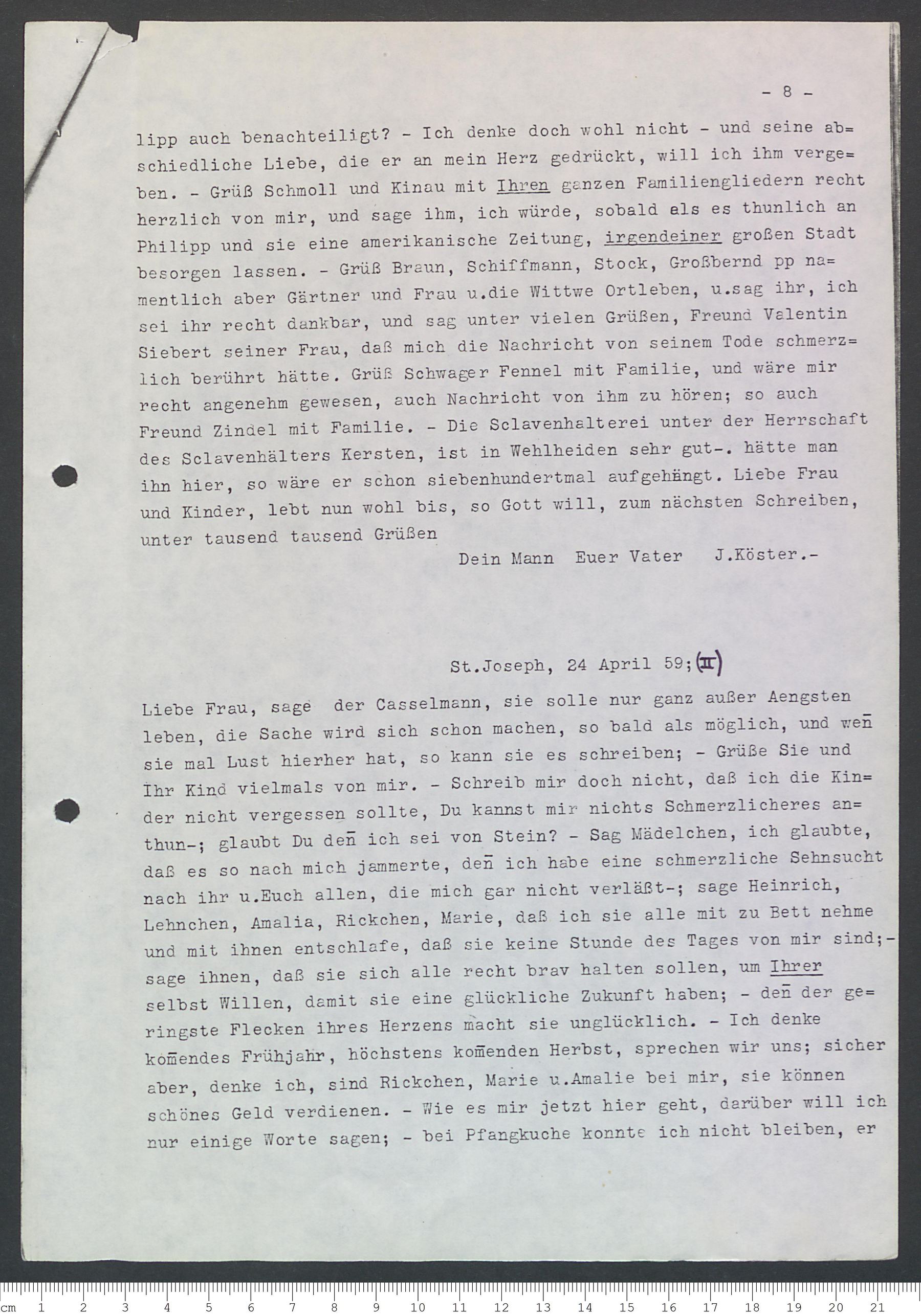
Page header: – 8 – · End of letter I, then St. Joseph, 24 April 1859 (II)
…lipp auch benachteiligt? – Ich denke doch wohl nicht – und seine abschiedliche Liebe, die er an mein Herz gedrückt, will ich ihm vergeben.
Grüß Schmoll und Kinau mit Ihren ganzen Familiengliedern recht herzlich von mir, und sage ihm, ich würde, sobald als es thunlich an Philipp und sie eine amerikanische Zeitung, irgendeiner großen Stadt besorgen lassen. – Grüß Braun, Schiffmann, Stock, Großbernd pp namentlich aber Gärtner und Frau u. die Wittwe Ortleben, u. sag ihr, ich sei ihr recht dankbar, und sag unter vielen Grüßen, Freund Valentin Siebert seiner Frau, daß mich die Nachricht von seinem Tode schmerzlich berührt hätte. Grüß Schwager Fennel mit Familie, und wäre mir recht angenehm gewesen, auch Nachricht von ihm zu hören; so auch Freund Zindel mit Familie.
Die Sclavenhalterei unter der Herrschaft des Sclavenhälters Kersten, ist in Wehlheiden sehr gut –. hätte man ihn hier, so wäre er schon siebenhundertmal aufgehängt. Liebe Frau und Kinder, lebt nun wohl bis, so Gott will, zum nächsten Schreiben, unter tausend tausend Grüßen. Dein Mann Euer Vater J. Köster. –
St. Joseph, 24 April 59; (II)
Liebe Frau, sage der Casselmann, sie solle nur ganz außer Aengsten leben, die Sache wird sich schon machen, so bald als möglich, und wenn sie mal Lust hierher hat, so kann sie es schreiben; – Grüße Sie und Ihr Kind vielmals von mir.
Schreib mir doch nicht, daß ich die Kinder nicht vergessen sollte, Du kannst mir nichts Schmerzlicheres anthun–; glaubt Du denn ich sei von Stein? – Sag Mädelchen, ich glaubte, daß es so nach mich jammerte, denn ich habe eine schmerzliche Sehnsucht nach ihr u. Euch allen, die mich gar nicht verläßt–; sage Heinrich, Lehnchen, Amalia, Rickchen, Marie, daß ich sie alle mit zu Bett nehme und mit ihnen entschlafe, daß sie keine Stunde des Tages von mir sind;– sage ihnen, daß sie sich alle recht brav halten sollen, um Ihrer selbst Willen, damit sie eine glückliche Zukunft haben; – denn der geringste Flecken ihres Herzens macht sie unglücklich.
Ich denke kommendes Frühjahr, höchstens kommenden Herbst, sprechen wir uns; sicher aber, denke ich, sind Rickchen, Marie u. Amalie bei mir, sie können schönes Geld verdienen. – Wie es mir jetzt hier geht, darüber will ich nur einige Worte sagen; – bei Pfangkuche konnte ich nicht bleiben, er…
…was Philipp disadvantaged too? I think not — and the parting affection with which he pressed me to his heart, I will forgive him.
Give Schmoll and Kinau and all their family members my warmest greetings, and tell him that as soon as it is practicable I shall have an American newspaper, from some large city, sent to Philipp and to them. Greet Braun, Schiffmann, Stock, Großbernd and the rest — but especially Gärtner and his wife, and the widow Ortleben; tell her I am truly grateful to her. And say, with many greetings to friend Valentin Siebert's wife, that the news of his death touched me painfully. Greet brother-in-law Fennel and his family; I should have been glad to have news of him too, and likewise friend Zindel and his family.
Slaveholding under the rule of the slaveholder Kersten is doing very well in Wehlheiden. If we had him here he would have been hanged seven hundred times over. Dear wife and children, fare you well now until, God willing, the next letter, with a thousand thousand greetings. Your husband, your father, J. Köster.
St. Joseph, 24 April 59 (II)
Dear wife, tell Frau Casselmann she may live entirely free of anxiety; the matter will settle itself as soon as possible, and if she ever has an inclination to come out here she has only to write. Greet her and her child many times from me.
Do not write to me that I ought not to forget the children — you can do me nothing more painful. Do you think I am made of stone? Tell little one I thought she pined for me so, for I have an aching longing for her and for you all that never leaves me. Tell Heinrich, Lehnchen, Amalia, Rickchen and Marie that I take them all to bed with me and fall asleep with them, that they are not away from me for an hour of the day. Tell them they should all keep themselves decent, for their own sakes, so that they may have a happy future — for the least stain on their heart makes them unhappy.
I think that next spring, at the latest next autumn, we shall speak together; but I am sure Rickchen, Marie and Amalie will be with me, they can earn good money. As to how I am faring here I will say only a few words: I could not stay with Pfangkuche, he…
⭐ CORRECTION to the p. 6 note: Kersten is of WEHLHEIDEN, not Deisel. This page places him there explicitly. ⭐ A greeting list of eleven households — Schmoll, Kinau, Braun, Schiffmann, Stock, Großbernd, Gärtner, Wittwe Ortleben, Valentin Siebert (newly dead), Schwager Fennel, Zindel. Most are Wehlheiden/Kassel rather than Deisel; run them against the 1937 index (0033–0035) before adding to the names DB. ⭐ He plans to bring the three eldest daughters out to earn — consistent with the girls' wage of 10–12 dollars quoted on p. 6. ⚠️ Worth noting without overreading: he calls Germany a Sclavenstaat and a Hessian mayor a Sclavenhälter while writing from Missouri, a slave state, in 1859 — the actual institution around him goes unmentioned here. The metaphor is doing political work; ✅ ANSWERED by img 0092 (April 1862): he does address it, and welcomes emancipation — the conditions are happy „weil … auch die Sclaverei ihre Vernichtung findet“. The silence in 1859 was of the moment, not of principle. ⭐ The break with Pfangkuche begins mid-sentence; continues on p. 9.
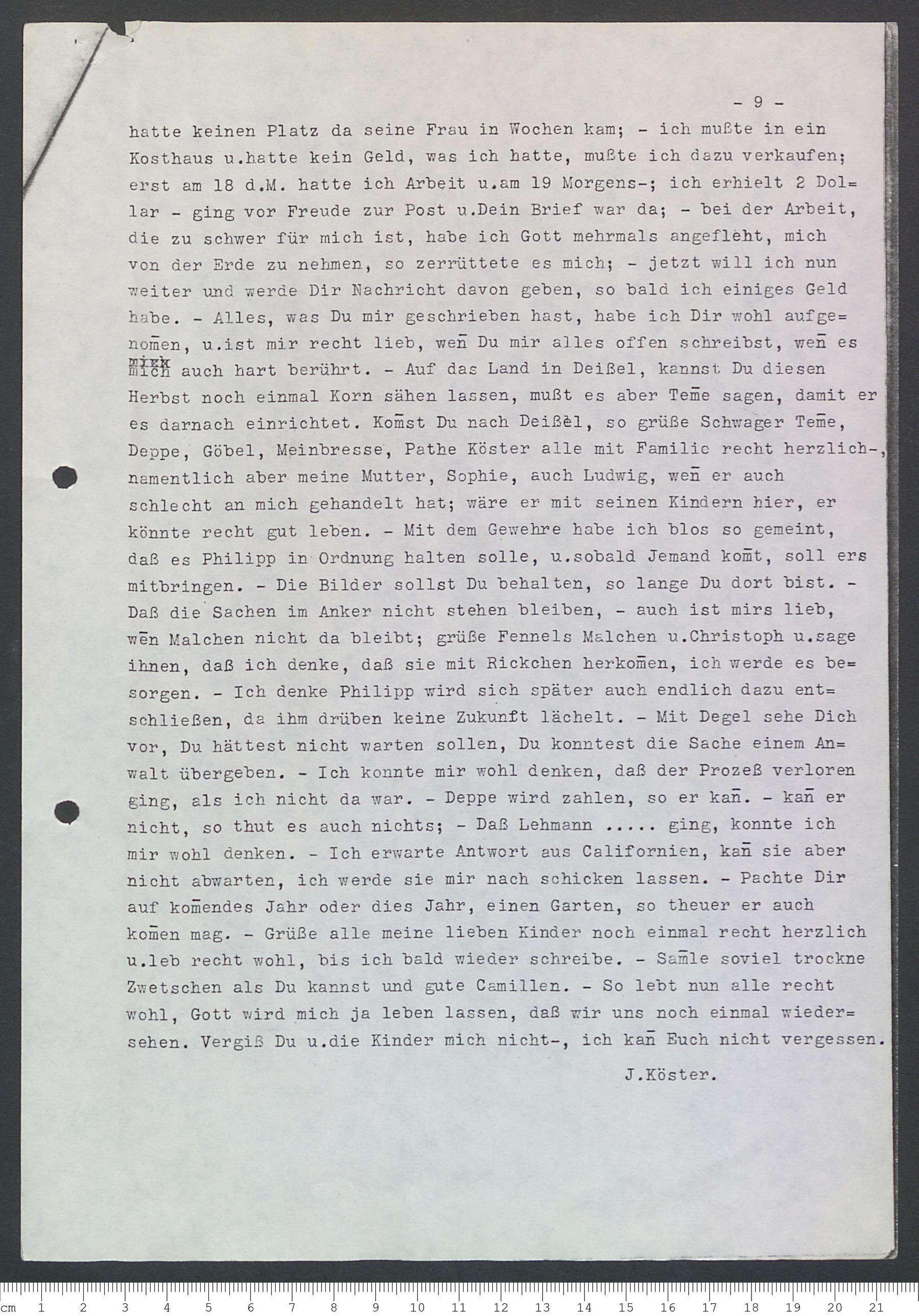
Page header: – 9 – · End of St. Joseph, 24 April 1859 (II) — destitution, and the „Deißel“ passage
…hatte keinen Platz da seine Frau in Wochen kam; – ich mußte in ein Kosthaus u. hatte kein Geld, was ich hatte, mußte ich dazu verkaufen; erst am 18 d. M. hatte ich Arbeit u. am 19 Morgens–; ich erhielt 2 Dollar – ging vor Freude zur Post u. Dein Brief war da; – bei der Arbeit, die zu schwer für mich ist, habe ich Gott mehrmals angefleht, mich von der Erde zu nehmen, so zerrüttete es mich; – jetzt will ich nun weiter und werde Dir Nachricht davon geben, so bald ich einiges Geld habe.
Alles, was Du mir geschrieben hast, habe ich Dir wohl aufgenommen, u. ist mir recht lieb, wenn Du mir alles offen schreibst, wenn es mich auch hart berührt.
Auf das Land in Deißel, kannst Du diesen Herbst noch einmal Korn sähen lassen, mußt es aber Teme sagen, damit er es darnach einrichtet. Kommst Du nach Deißel, so grüße Schwager Teme, Deppe, Göbel, Meinbresse, Pathe Köster alle mit Familie recht herzlich–, namentlich aber meine Mutter, Sophie, auch Ludwig, wenn er auch schlecht an mich gehandelt hat; wäre er mit seinen Kindern hier, er könnte recht gut leben.
Mit dem Gewehre habe ich blos so gemeint, daß es Philipp in Ordnung halten solle, u. sobald Jemand kommt, soll er's mitbringen. – Die Bilder sollst Du behalten, so lange Du dort bist. – Daß die Sachen im Anker nicht stehen bleiben, – auch ist mir's lieb, wenn Malchen nicht da bleibt; grüße Fennels Malchen u. Christoph u. sage ihnen, daß ich denke, daß sie mit Rickchen herkommen, ich werde es besorgen. – Ich denke Philipp wird sich später auch endlich dazu entschließen, da ihm drüben keine Zukunft lächelt.
Mit Degel sehe Dich vor, Du hättest nicht warten sollen, Du konntest die Sache einem Anwalt übergeben. – Ich konnte mir wohl denken, daß der Prozeß verloren ging, als ich nicht da war. – Deppe wird zahlen, so er kann. – kann er nicht, so thut es auch nichts; – Daß Lehmann ….. ging, konnte ich mir wohl denken. – Ich erwarte Antwort aus Californien, kann sie aber nicht abwarten, ich werde sie mir nach schicken lassen.
Pachte Dir auf kommendes Jahr oder dies Jahr, einen Garten, so theuer er auch kommen mag. – Grüße alle meine lieben Kinder noch einmal recht herzlich u. leb recht wohl, bis ich bald wieder schreibe. – Sammle soviel trockne Zwetschen als Du kannst und gute Camillen. – So lebt nun alle recht wohl, Gott wird mich ja leben lassen, daß wir uns noch einmal wiedersehen. Vergiß Du u. die Kinder mich nicht–, ich kann Euch nicht vergessen. J. Köster.
…had no room, as his wife was in childbed. I had to go into a boarding house and had no money; what I had, I was obliged to sell for it. Only on the 18th of this month did I get work, and on the morning of the 19th I received 2 dollars — went to the post office for joy, and your letter was there. At the work, which is too heavy for me, I have several times implored God to take me from the earth, so it shattered me. Now I mean to move on, and shall send you word of it as soon as I have some money.
Everything you have written to me I have taken in good part, and I am glad when you write me everything openly, even when it touches me hard.
On the land at Deißel you can have corn sown once more this autumn, but you must tell Teme, so that he arranges it accordingly. If you go to Deißel, give my warmest greetings to brother-in-law Teme, Deppe, Göbel, Meinbresse and Godfather Köster, all with their families — but especially to my mother, to Sophie, and to Ludwig too, ill though he has acted by me; were he here with his children he could live very well.
About the gun I only meant that Philipp should keep it in order, and as soon as anyone comes he should bring it with him. The pictures you are to keep as long as you are there. I am glad the things at the Anker are not being left standing — and glad too if Malchen does not stay there. Greet Fennel's Malchen and Christoph and tell them I think they should come out with Rickchen; I shall see to it. I think Philipp will finally bring himself to it later too, since no future smiles on him over there.
Be careful with Degel; you should not have waited, you could have handed the matter to a lawyer. I could well imagine the case would be lost with me not there. Deppe will pay if he can — if he cannot, it does not matter. That Lehmann … went, I could well imagine. I am expecting an answer from California, but cannot wait for it; I shall have it forwarded.
Rent yourself a garden for next year, or this year, however dear it comes. Greet all my dear children once more most warmly, and fare well until I write again soon. Gather as many dried plums as you can, and good chamomile. So fare you all well; God will surely let me live, that we may see one another once more. Do not forget me, you and the children — I cannot forget you. J. Köster.
⭐ This is the „Deißel“ leaf — the passage the project cites for Köster's own spelling of the village, and the site's quotation is confirmed word for word against the image. Note the spelling here is Meinbresse, against Mainbresse on p. 2: two forms within one letter series. ⭐ The destitution is worse than the summaries convey. Turned out when Pfangkuche's wife went into childbed, in a boarding house with nothing, selling his possessions; first work on 18 April, first 2 dollars on the 19th — and at labour “zu schwer für mich” he repeatedly begged God to take him from the earth. He is 43, and this is three months after landing. Read against Charles arriving at ~24 with no English either, it is the best available picture of what the first months cost. ⭐ His mother was still living in 1859 (Marie Fremder, d. 1870), and he still held land at Deißel and directed its sowing from Missouri.
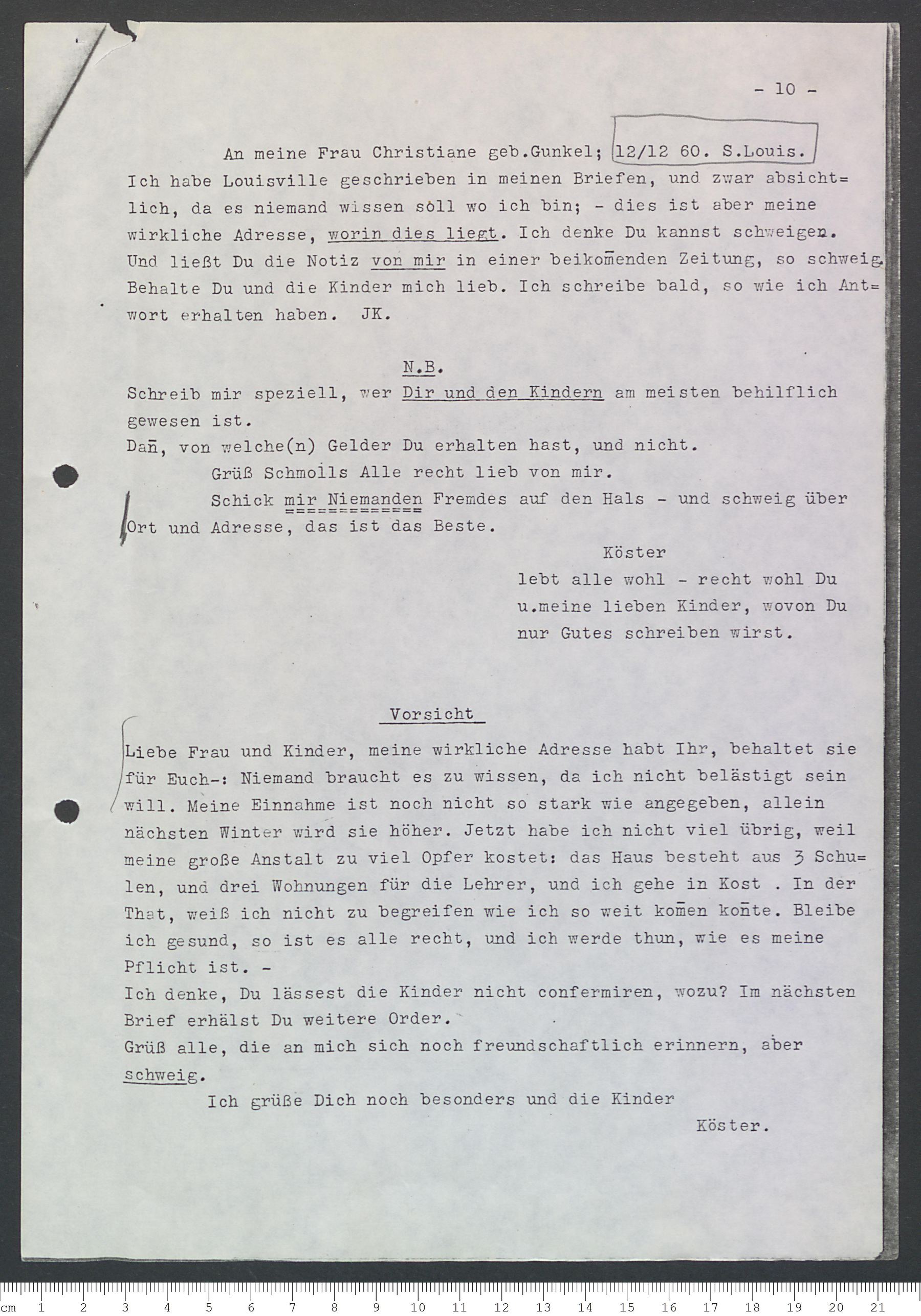
Page header: – 10 – · The false-dateline confession, and the slip headed <em>Vorsicht</em>
An meine Frau Christiane geb. Gunkel; [boxed:] 12/12 60. S. Louis.
Ich habe Louisville geschrieben in meinen Briefen, und zwar absichtlich, da es niemand wissen soll wo ich bin; – dies ist aber meine wirkliche Adresse, worin dies liegt. Ich denke Du kannst schweigen. Und ließt Du die Notiz von mir in einer beikommenden Zeitung, so schweig. Behalte Du und die Kinder mich lieb. Ich schreibe bald, so wie ich Antwort erhalten haben. JK.
N.B. — Schreib mir speziell, wer Dir und den Kindern am meisten behilflich gewesen ist. Dann, von welche(n) Gelder Du erhalten hast, und nicht. Grüß Schmolls Alle recht lieb von mir. Schick mir Niemanden Fremdes auf den Hals – und schweig über Ort und Adresse, das ist das Beste. Köster. lebt alle wohl – recht wohl Du u. meine lieben Kinder, wovon Du nur Gutes schreiben wirst.
Vorsicht — Liebe Frau und Kinder, meine wirkliche Adresse habt Ihr, behaltet sie für Euch –: Niemand braucht es zu wissen, da ich nicht belästigt sein will. Meine Einnahme ist noch nicht so stark wie angegeben, allein nächsten Winter wird sie höher. Jetzt habe ich nicht viel übrig, weil meine große Anstalt zu viel Opfer kostet: das Haus besteht aus 3 Schulen, und drei Wohnungen für die Lehrer, und ich gehe in Kost. In der That, weiß ich nicht zu begreifen wie ich so weit kommen konnte. Bleibe ich gesund, so ist es alle recht, und ich werde thun, wie es meine Pflicht ist. –
Ich denke, Du lässest die Kinder nicht confermiren, wozu? Im nächsten Brief erhälst Du weitere Order. Grüß alle, die an mich sich noch freundschaftlich erinnern, aber schweig. Ich grüße Dich noch besonders und die Kinder. Köster.
To my wife Christiane née Gunkel; [boxed:] 12/12 60. St. Louis.
I have written Louisville in my letters, and deliberately so, since no one is to know where I am — but this is my real address, which is what lies behind it. I think you can keep quiet. And if you read the notice about me in an enclosed newspaper, then say nothing. Keep loving me, you and the children. I shall write soon, as soon as I have had an answer. JK.
N.B. — Write and tell me specifically who has been most helpful to you and the children. Then, which monies you have received and which not. Give all the Schmolls my warm greetings. Send no strangers to trouble me — and say nothing about place and address, that is best. Köster. Fare you all well — right well you and my dear children, of whom you will write me nothing but good.
Caution — Dear wife and children, you have my real address; keep it to yourselves: nobody needs to know it, as I do not wish to be bothered. My income is not yet as large as I stated, but next winter it will be higher. At present I have little to spare, because my large establishment costs too much in sacrifices: the house consists of 3 schools and three dwellings for the teachers, and I take my board out. In truth, I cannot grasp how I was able to come this far. If I stay well, all is right, and I shall do as my duty requires.
I think you will not have the children confirmed — what for? In the next letter you will receive further instructions. Greet all who still remember me kindly, but say nothing. I greet you especially, and the children. Köster.
⭐ CORRECTION — this confession is NOT undated. It carries a boxed dateline in the typescript: 12/12 60. S. Louis. ⇒ 12 December 1860, St. Louis. The letter-by-letter page currently files it under “Undated slips”; that needs fixing. ⭐ Confirms the page-number correction: this leaf's header is – 10 –, so image 0064 is p. 11, as the note of 18–19 Jul 2026 concluded. Note also “Du lässest die Kinder nicht confermiren” — he forbids the children's confirmation, matching the Personalkarte's note that he was nicht kirchlich.
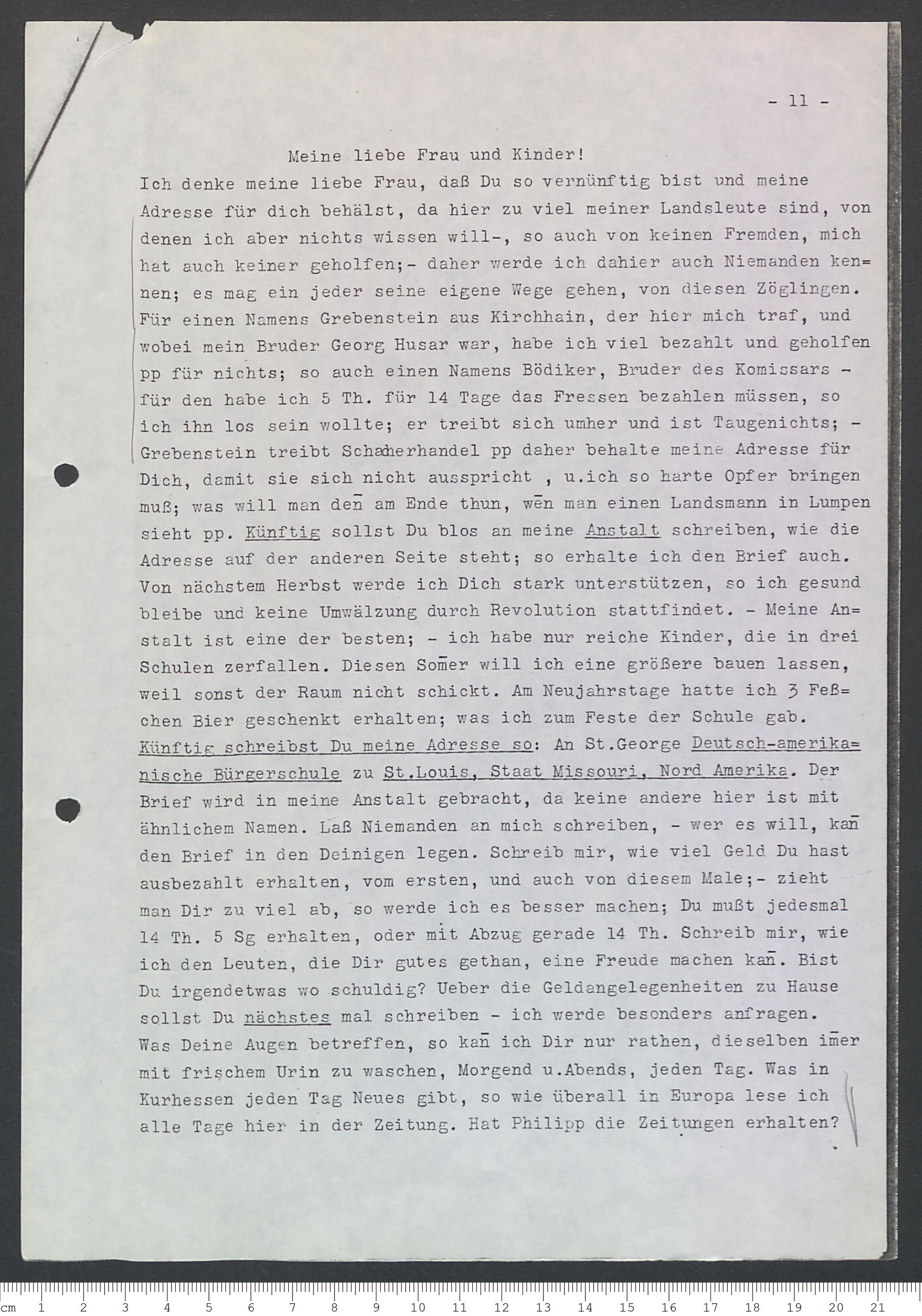
Page header: – 11 – · St. Louis, early 1861 — ⭐ the „Landsleute“ page, the single most important leaf in the series for this project
Meine liebe Frau und Kinder!
Ich denke meine liebe Frau, daß Du so vernünftig bist und meine Adresse für dich behälst, da hier zu viel meiner Landsleute sind, von denen ich aber nichts wissen will–, so auch von keinen Fremden, mich hat auch keiner geholfen; – daher werde ich dahier auch Niemanden kennen; es mag ein jeder seine eigene Wege gehen, von diesen Zöglingen.
Für einen Namens Grebenstein aus Kirchhain, der hier mich traf, und wobei mein Bruder Georg Husar war, habe ich viel bezahlt und geholfen pp für nichts; so auch einen Namens Bödiker, Bruder des Komissars – für den habe ich 5 Th. für 14 Tage das Fressen bezahlen müssen, so ich ihn los sein wollte; er treibt sich umher und ist Taugenichts; – Grebenstein treibt Schacherhandel pp daher behalte meine Adresse für Dich, damit sie sich nicht ausspricht, u. ich so harte Opfer bringen muß; was will man denn am Ende thun, wenn man einen Landsmann in Lumpen sieht pp.
Künftig sollst Du blos an meine Anstalt schreiben, wie die Adresse auf der anderen Seite steht; so erhalte ich den Brief auch. Von nächstem Herbst werde ich Dich stark unterstützen, so ich gesund bleibe und keine Umwälzung durch Revolution stattfindet.
Meine Anstalt ist eine der besten; – ich habe nur reiche Kinder, die in drei Schulen zerfallen. Diesen Sommer will ich eine größere bauen lassen, weil sonst der Raum nicht schickt. Am Neujahrstage hatte ich 3 Feßchen Bier geschenkt erhalten; was ich zum Feste der Schule gab.
Künftig schreibst Du meine Adresse so: An St. George Deutsch-amerikanische Bürgerschule zu St. Louis, Staat Missouri, Nord Amerika. Der Brief wird in meine Anstalt gebracht, da keine andere hier ist mit ähnlichem Namen. Laß Niemanden an mich schreiben, – wer es will, kann den Brief in den Deinigen legen.
Schreib mir, wie viel Geld Du hast ausbezahlt erhalten, vom ersten, und auch von diesem Male;– zieht man Dir zu viel ab, so werde ich es besser machen; Du mußt jedesmal 14 Th. 5 Sg erhalten, oder mit Abzug gerade 14 Th. Schreib mir, wie ich den Leuten, die Dir gutes gethan, eine Freude machen kann. Bist Du irgendetwas wo schuldig? Ueber die Geldangelegenheiten zu Hause sollst Du nächstes mal schreiben – ich werde besonders anfragen.
Was Deine Augen betreffen, so kann ich Dir nur rathen, dieselben immer mit frischem Urin zu waschen, Morgend u. Abends, jeden Tag. Was in Kurhessen jeden Tag Neues gibt, so wie überall in Europa lese ich alle Tage hier in der Zeitung. Hat Philipp die Zeitungen erhalten?
My dear wife and children!
I think, my dear wife, that you are sensible enough to keep my address to yourself, since there are too many of my countrymen here, of whom I want to know nothing — nor of any strangers either; no one has helped me, and so I shall know nobody here. Every one of these pupils may go his own way.
For one named Grebenstein of Kirchhain, who met me here — my brother Georg was a hussar alongside him — I have paid out a great deal and helped, all for nothing. Likewise one named Bödiker, brother of the commissioner: for him I had to pay 5 Thaler for a fortnight's food to be rid of him; he knocks about and is a good-for-nothing. Grebenstein goes in for petty huckstering. So keep my address to yourself, so that it does not get about and I have to make such hard sacrifices — for what, in the end, is one to do when one sees a countryman in rags?
In future write only to my institution, as the address stands on the other side; then I shall receive the letter. From next autumn I shall support you substantially, if I stay well and no upheaval by revolution takes place.
My institution is one of the best; I have none but rich children, who are divided among three schools. This summer I mean to have a larger one built, since otherwise the space will not do. On New Year's Day I was given three small casks of beer, which I gave to the school's festivity.
In future write my address thus: To the St. George German-American Citizens' School at St. Louis, State of Missouri, North America. The letter will be brought to my institution, as there is no other here of similar name. Let nobody write to me — whoever wishes to may enclose a letter in yours.
Write and tell me how much money you have been paid out, from the first time and from this one too; if too much is deducted I shall arrange it better. You must receive 14 Thaler 5 Silbergroschen each time, or with the deduction exactly 14 Thaler. Write and tell me how I can give pleasure to the people who have done you good. Do you owe anything anywhere? About the money affairs at home you are to write next time — I shall enquire specially.
As for your eyes, I can only advise you to bathe them always with fresh urine, morning and evening, every day. Whatever news there is daily in Kurhessen, and everywhere in Europe, I read here in the newspaper every day. Has Philipp received the newspapers?
⭐⭐ THE decisive page for the Charles argument, and it says MORE than the project has been quoting. The known line is that Köster shunned his countrymen. The sentence that matters is the next one: „was will man denn am Ende thun, wenn man einen Landsmann in Lumpen sieht?“ — destitute countrymen were arriving at his door, repeatedly and expensively enough that he is begging his wife not to give out his address. That is positive evidence of a stream of poor Hessians reaching St. Louis in exactly Charles's window, from a hostile witness. It does not put Charles there; it removes the ground for reading the name-pool silence as absence. ⭐ Confirms the pagination correction: header reads – 11 –, so citations of the „Landsleute“ passage as p. 9 are wrong. ⭐ Confirms the 18–19 Jul 2026 correction on „Georg Husar“ — not a surname: his brother Georg served as a hussar alongside Grebenstein of Kirchhain. ⭐ Remittance figure: 14 Th. 5 Sg per instalment, a third money datum for Chapter 3. ⭐ Full postal address of the St. George Deutsch-amerikanische Bürgerschule, and the school described as only rich children, divided among three schools, with a larger building planned for summer 1861. ⚠️ Note the fear of „Umwälzung durch Revolution“ — written months before Missouri came apart.
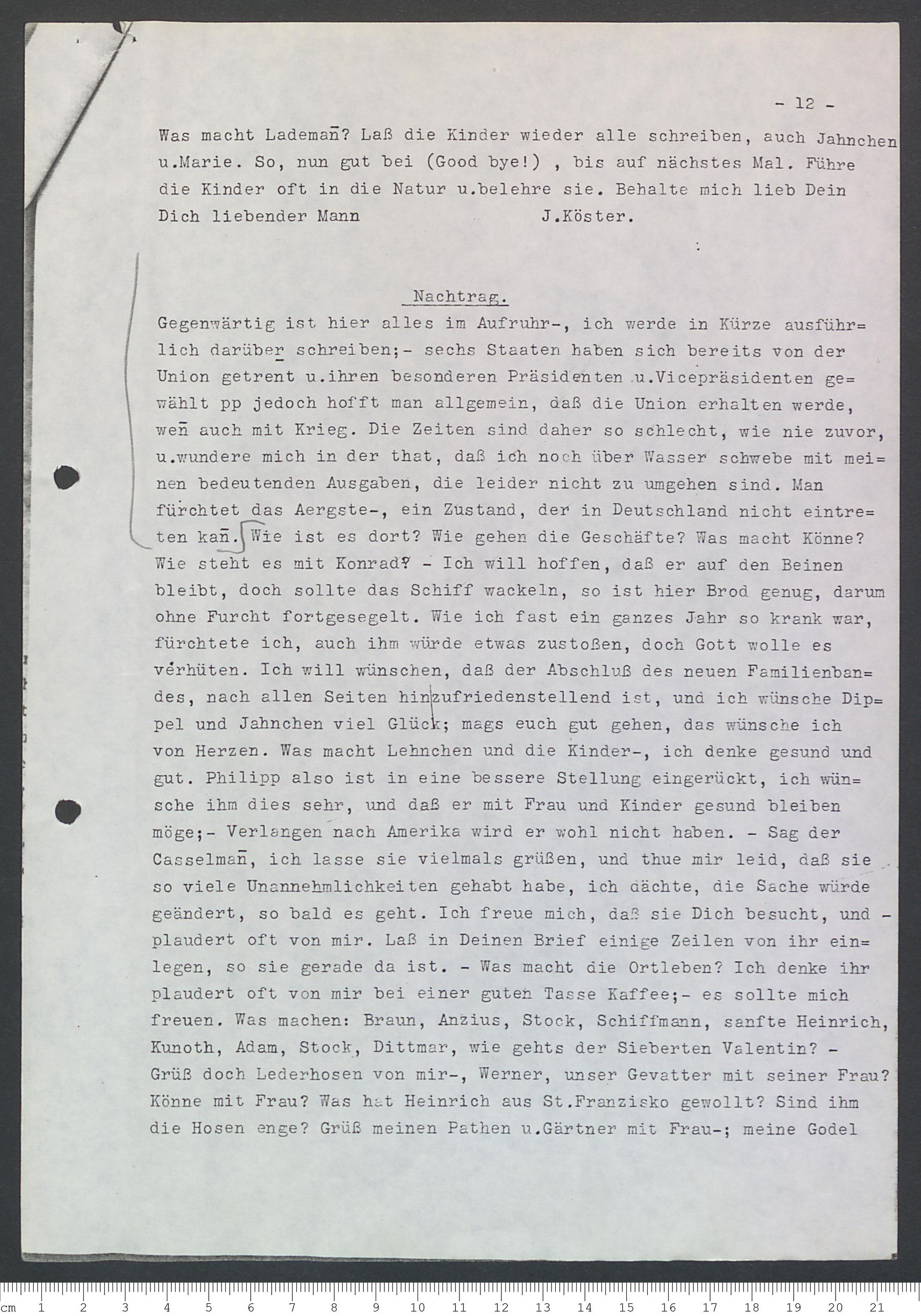
Page header: – 12 – · End of the letter, then a Nachtrag — ⭐ secession, datable to February 1861
Was macht Lademann? Laß die Kinder wieder alle schreiben, auch Jahnchen u. Marie. So, nun gut bei (Good bye!), bis auf nächstes Mal. Führe die Kinder oft in die Natur u. belehre sie. Behalte mich lieb. Dein Dich liebender Mann J. Köster.
Nachtrag.
Gegenwärtig ist hier alles im Aufruhr–, ich werde in Kürze ausführlich darüber schreiben; – sechs Staaten haben sich bereits von der Union getrennt u. ihren besonderen Präsidenten u. Vicepräsidenten gewählt pp jedoch hofft man allgemein, daß die Union erhalten werde, wenn auch mit Krieg. Die Zeiten sind daher so schlecht, wie nie zuvor, u. wundere mich in der that, daß ich noch über Wasser schwebe mit meinen bedeutenden Ausgaben, die leider nicht zu umgehen sind. Man fürchtet das Aergste–, ein Zustand, der in Deutschland nicht eintreten kann.
Wie ist es dort? Wie gehen die Geschäfte? Was macht Könne? Wie steht es mit Konrad? – Ich will hoffen, daß er auf den Beinen bleibt, doch sollte das Schiff wackeln, so ist hier Brod genug, darum ohne Furcht fortgesegelt. Wie ich fast ein ganzes Jahr so krank war, fürchtete ich, auch ihm würde etwas zustoßen, doch Gott wolle es verhüten.
Ich will wünschen, daß der Abschluß des neuen Familienbandes, nach allen Seiten hin zufriedenstellend ist, und ich wünsche Dippel und Jahnchen viel Glück; mags euch gut gehen, das wünsche ich von Herzen. Was macht Lehnchen und die Kinder–, ich denke gesund und gut. Philipp also ist in eine bessere Stellung eingerückt, ich wünsche ihm dies sehr, und daß er mit Frau und Kinder gesund bleiben möge;– Verlangen nach Amerika wird er wohl nicht haben.
Sag der Casselmann, ich lasse sie vielmals grüßen, und thue mir leid, daß sie so viele Unannehmlichkeiten gehabt habe, ich dächte, die Sache würde geändert, so bald es geht. Ich freue mich, daß sie Dich besucht, und plaudert oft von mir. Laß in Deinen Brief einige Zeilen von ihr einlegen, so sie gerade da ist. – Was macht die Ortleben? Ich denke ihr plaudert oft von mir bei einer guten Tasse Kaffee;– es sollte mich freuen.
Was machen: Braun, Anzius, Stock, Schiffmann, sanfte Heinrich, Kunoth, Adam, Stock, Dittmar, wie gehts der Sieberten Valentin? – Grüß doch Lederhosen von mir–, Werner, unser Gevatter mit seiner Frau? Könne mit Frau? Was hat Heinrich aus St. Franzisko gewollt? Sind ihm die Hosen enge? Grüß meinen Pathen u. Gärtner mit Frau–; meine Godel…
How is Lademann? Let all the children write again, Jahnchen and Marie too. So, now good bye, until next time. Take the children often into nature and instruct them. Keep loving me. Your loving husband, J. Köster.
Postscript.
At present everything here is in uproar; I shall write about it at length shortly. Six states have already separated from the Union and elected their own president and vice-president — yet it is generally hoped that the Union will be preserved, even if by war. Times are therefore worse than ever before, and I truly wonder that I still keep my head above water with my considerable outgoings, which unfortunately cannot be avoided. People fear the worst — a state of affairs that could not come about in Germany.
How is it there? How does business go? How is Könne? How do things stand with Konrad? I hope he keeps on his feet; but should the ship rock, there is bread enough here, so let him sail on without fear. When I was so ill for nearly a whole year, I feared something would befall him too, but God forbid it.
I hope the conclusion of the new family tie is satisfactory on all sides, and I wish Dippel and Jahnchen much happiness; may it go well with you, that I wish from my heart. How are Lehnchen and the children — well and good, I trust. So Philipp has moved into a better position; I wish him that very much, and that he may stay well with his wife and children. He will hardly have any longing for America.
Tell Frau Casselmann I send her many greetings, and that I am sorry she has had so many unpleasantnesses; I should have thought the matter would be altered as soon as may be. I am glad she visits you and often chats about me. Enclose a few lines from her in your letter, if she happens to be there. How is Frau Ortleben? I imagine you often talk of me over a good cup of coffee; that would please me.
How are Braun, Anzius, Stock, Schiffmann, gentle Heinrich, Kunoth, Adam, Stock, Dittmar — how does Valentin Siebert's widow do? Do greet Lederhosen from me; Werner, our godfather, and his wife? Könne and his wife? What did Heinrich want from San Francisco? Are his trousers too tight for him? Greet my godson and Gärtner and his wife; my godmother…
⭐⭐ THIS LETTER IS DATABLE TO FEBRUARY 1861 from its own content: six states have seceded and have elected a president and vice-president. Six states had gone by 1 February 1861; Davis and Stephens were elected at Montgomery on 9 February. ⇒ the letter is of c. 9–20 February 1861, and the site's cautious “c. February 1861” is confirmed on internal evidence. ⭐ Corroborates the Könne elimination. Könne is asked after from Missouri, among the home-side circle, twice on this page — he is a Kassel man, not a St. Louis one, exactly as the site concluded. ⭐ He was ill for nearly a whole year (1860), which bears on the collapse narrative of November 1861. ⭐ A Heinrich in San Francisco, picking up the “Antwort aus Californien” he was awaiting on p. 9. ⭐ Twenty-odd names in two paragraphs — Anzius, Dittmar, Kunoth, Adam, Lederhosen (a nickname), Werner, Dippel and Jahnchen (newly married) — run the lot against the 1937 index before adding to the names DB.
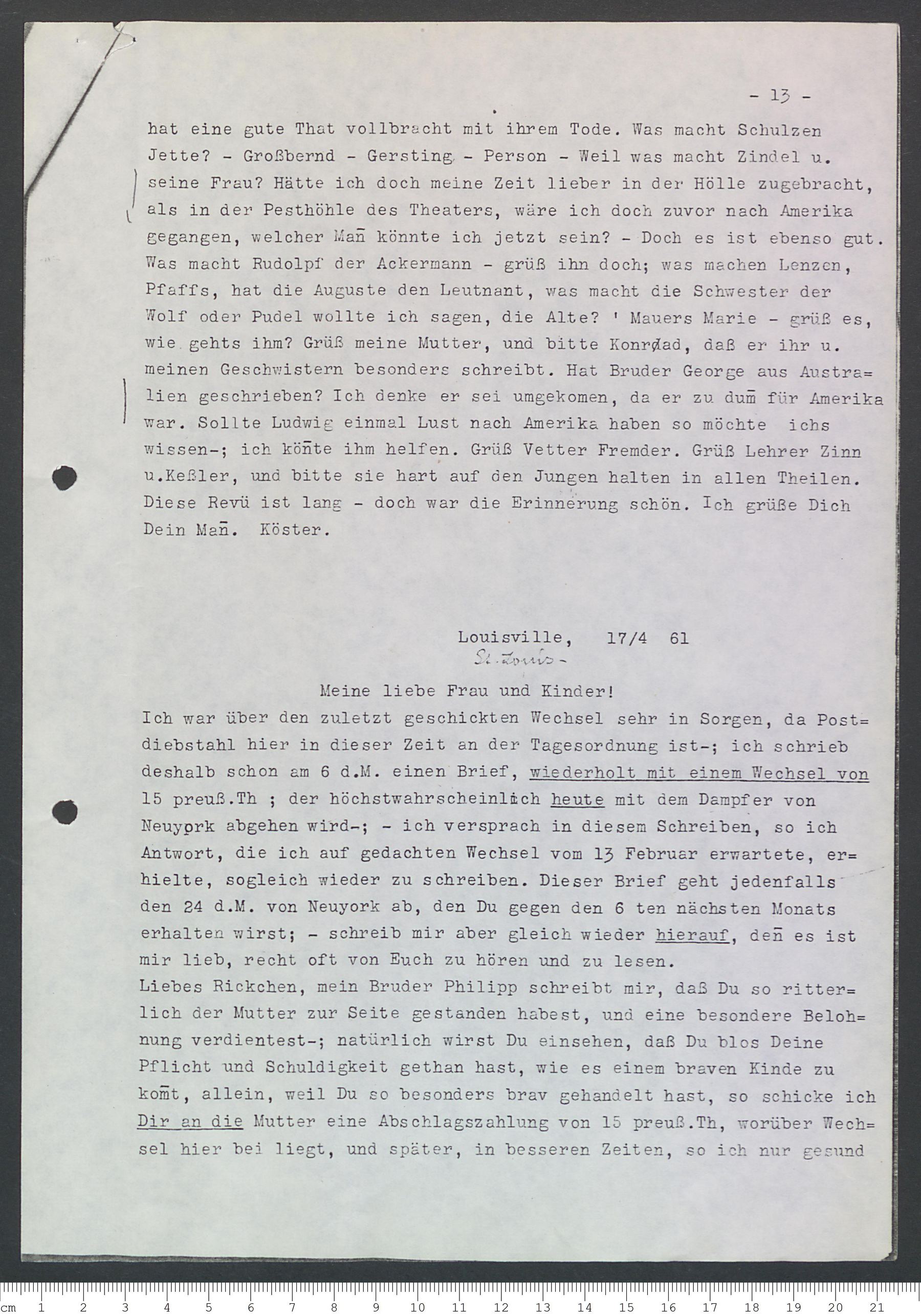
Page header: – 13 – · End of the February 1861 Nachtrag, then the letter headed „Louisville, 17/4 61“ — ⭐ the false dateline caught in use
…hat eine gute That vollbracht mit ihrem Tode. Was macht Schulzen Jette? – Großbernd – Gersting – Person – Weil – was macht Zindel u. seine Frau?
Hätte ich doch meine Zeit lieber in der Hölle zugebracht, als in der Pesthöhle des Theaters, wäre ich doch zuvor nach Amerika gegangen, welcher Mann könnte ich jetzt sein? – Doch es ist ebenso gut.
Was macht Rudolph der Ackermann – grüß ihn doch; was machen Lenzen, Pfaffs, hat die Auguste den Leutnant, was macht die Schwester der Wolf oder Pudel wollte ich sagen, die Alte? Mauers Marie – grüß es, wie gehts ihm? Grüß meine Mutter, und bitte Konrad, daß er ihr u. meinen Geschwistern besonders schreibt.
Hat Bruder George aus Australien geschrieben? Ich denke er sei umgekommen, da er zu dumm für Amerika war. Sollte Ludwig einmal Lust nach Amerika haben so möchte ich's wissen–; ich könnte ihm helfen. Grüß Vetter Fremder. Grüß Lehrer Zinn u. Keßler, und bitte sie hart auf den Jungen halten in allen Theilen. Diese Revü ist lang – doch war die Erinnerung schön. Ich grüße Dich. Dein Mann. Köster.
Louisville, 17/4 61 [pencil annotation beneath the dateline: „St. Louis“]
Meine liebe Frau und Kinder!
Ich war über den zuletzt geschickten Wechsel sehr in Sorgen, da Postdiebstahl hier in dieser Zeit an der Tagesordnung ist–; ich schrieb deshalb schon am 6 d. M. einen Brief, wiederholt mit einem Wechsel von 15 preuß. Th; der höchstwahrscheinlich heute mit dem Dampfer von Neuyork abgehen wird–; – ich versprach in diesem Schreiben, so ich Antwort, die ich auf gedachten Wechsel vom 13 Februar erwartete, erhielte, sogleich wieder zu schreiben. Dieser Brief geht jedenfalls den 24 d. M. von Neuyork ab, den Du gegen den 6ten nächsten Monats erhalten wirst; – schreib mir aber gleich wieder hierauf, denn es ist mir lieb, recht oft von Euch zu hören und zu lesen.
Liebes Rickchen, mein Bruder Philipp schreibt mir, daß Du so ritterlich der Mutter zur Seite gestanden habest, und eine besondere Belohnung verdientest–; natürlich wirst Du einsehen, daß Du blos Deine Pflicht und Schuldigkeit gethan hast, wie es einem braven Kinde zukommt, allein, weil Du so besonders brav gehandelt hast, so schicke ich Dir an die Mutter eine Abschlagszahlung von 15 preuß. Th, worüber Wechsel hier bei liegt, und später, in besseren Zeiten, so ich nur gesund…
…did a good deed with her death. How is Schulze's Jette? Großbernd — Gersting — Person — Weil — how are Zindel and his wife?
Would that I had spent my time in hell rather than in the plague-pit of the theatre; had I only gone to America beforehand, what a man might I now be? — Yet it is just as well.
How is Rudolph the Ackermann — do greet him. How are the Lenzes, the Pfaffs; has Auguste got her lieutenant; how is the Wolf's sister — or Poodle, I meant to say — the old one? Mauer's Marie — greet the child; how does he do? Greet my mother, and ask Konrad to write to her and my brothers and sisters especially.
Has brother George written from Australia? I think he has perished, since he was too stupid for America. Should Ludwig ever have an inclination for America I should like to know it; I could help him. Greet cousin Fremder. Greet the schoolmasters Zinn and Keßler, and ask them to keep a hard hand on the boy in every respect. This review is long — but the remembering was sweet. I greet you. Your husband. Köster.
Louisville, 17/4 61 [pencil annotation beneath: „St. Louis“]
My dear wife and children!
I was very anxious about the bill of exchange sent last, since theft from the post is the order of the day here at this time. I therefore wrote a letter as early as the 6th of this month, repeated with a bill of 15 Prussian Thaler, which will most probably leave New York by steamer today. In that letter I promised to write again at once if I received the answer I was expecting to the said bill of 13 February. This letter will in any case leave New York on the 24th of this month, and you will receive it about the 6th of next; but write back to me immediately on it, for I am glad to hear and read from you very often.
Dear Rickchen, my brother Philipp writes to me that you stood so gallantly by your mother and deserved a particular reward. You will of course understand that you did no more than your duty, as becomes a good child; but because you acted so especially well, I am sending you, care of your mother, an instalment of 15 Prussian Thaler, for which the bill is enclosed — and later, in better times, if only I stay well…
⭐⭐ THE FALSE DATELINE CAUGHT IN USE, AND ANNOTATED. The letter is headed Louisville, 17/4 61, with „St. Louis“ pencilled beneath it in the typescript — the 1930s editor silently correcting the lie his ancestor had confessed to on p. 10. This leaf and 0077 are the two instances; both now verified in-image. ⭐ Postal theft was routine (“Postdiebstahl … an der Tagesordnung”), which is why remittances went as duplicated bills of exchange. ⭐ Transatlantic mail timing, stated exactly: out of New York on the 24th, in Kurhessen about the 6th — roughly a fortnight, useful for dating any letter in the series by its own internal references. ⭐ Remittances of 15 preuß. Thaler, twice on this page, against the 14 Th. 5 Sg instalment on p. 11. ⭐ “Die Pesthöhle des Theaters” — a savage verdict on his years as a chorus singer at the Kurfürstliches Theater in Kassel under Louis Spohr (Lebenslauf, img 0028), and the clearest statement of why he left. ⭐ Brother George in Australia, presumed dead — corroborates the Personalkarte (img 0010).
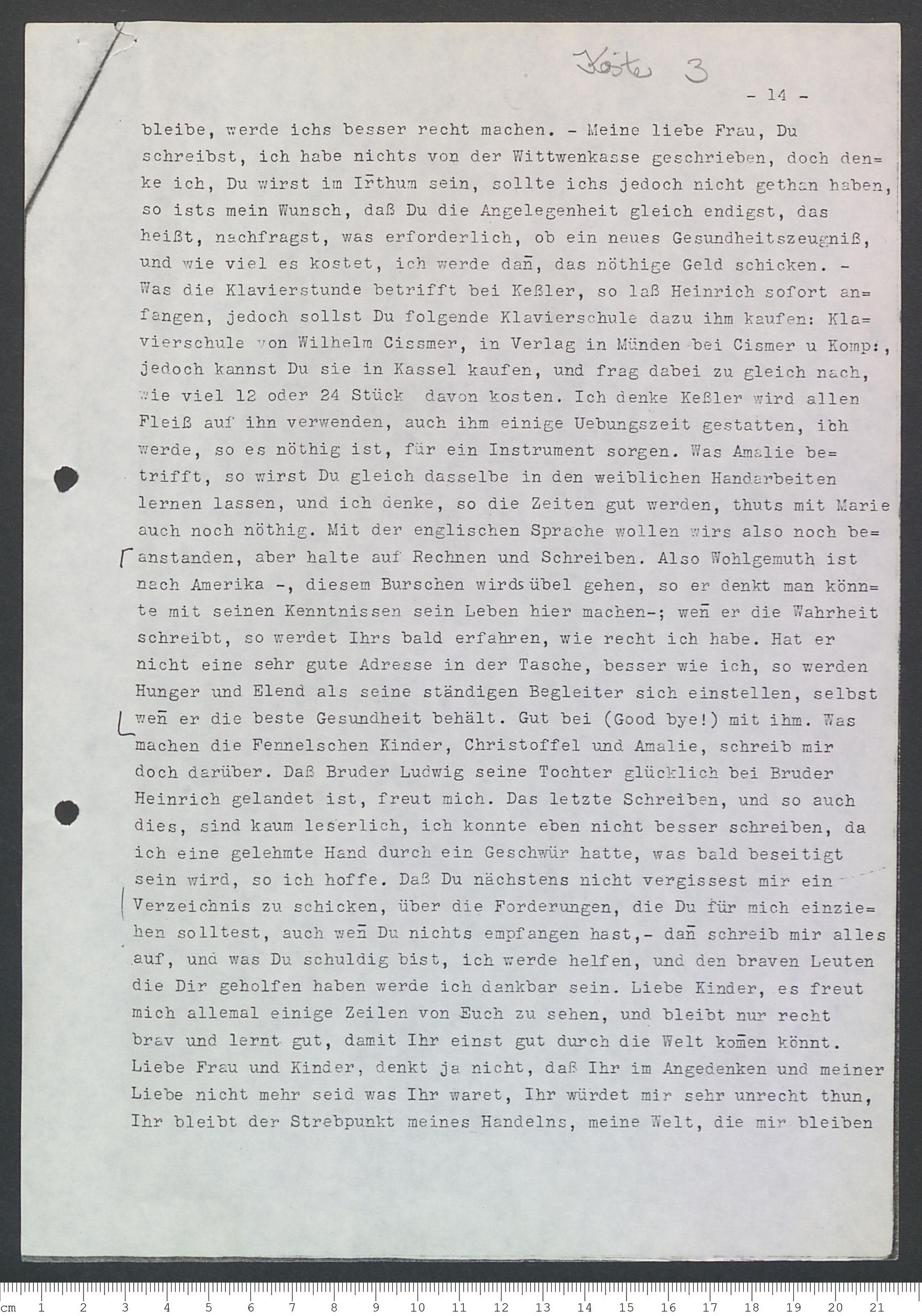
Page header: – 14 – (pencil at head: „Köster 3“) · 17 April 1861, continued — the children's schooling, and English deferred
…bleibe, werde ich's besser recht machen. – Meine liebe Frau, Du schreibst, ich habe nichts von der Wittwenkasse geschrieben, doch denke ich, Du wirst im Irrthum sein, sollte ich's jedoch nicht gethan haben, so ist's mein Wunsch, daß Du die Angelegenheit gleich endigst, das heißt, nachfragst, was erforderlich, ob ein neues Gesundheitszeugniß, und wie viel es kostet, ich werde dann das nöthige Geld schicken.
Was die Klavierstunde betrifft bei Keßler, so laß Heinrich sofort anfangen, jedoch sollst Du folgende Klavierschule dazu ihm kaufen: Klavierschule von Wilhelm Cissmer, in Verlag in Münden bei Cismer u Komp:, jedoch kannst Du sie in Kassel kaufen, und frag dabei zugleich nach, wie viel 12 oder 24 Stück davon kosten. Ich denke Keßler wird allen Fleiß auf ihn verwenden, auch ihm einige Uebungszeit gestatten, ich werde, so es nöthig ist, für ein Instrument sorgen.
Was Amalie betrifft, so wirst Du gleich dasselbe in den weiblichen Handarbeiten lernen lassen, und ich denke, so die Zeiten gut werden, thut's mit Marie auch noch nöthig. Mit der englischen Sprache wollen wir's also noch beanstanden, aber halte auf Rechnen und Schreiben.
Also Wohlgemuth ist nach Amerika –, diesem Burschen wird's übel gehen, so er denkt man könnte mit seinen Kenntnissen sein Leben hier machen–; wenn er die Wahrheit schreibt, so werdet Ihr's bald erfahren, wie recht ich habe. Hat er nicht eine sehr gute Adresse in der Tasche, besser wie ich, so werden Hunger und Elend als seine ständigen Begleiter sich einstellen, selbst wenn er die beste Gesundheit behält. Gut bei (Good bye!) mit ihm.
Was machen die Fennelschen Kinder, Christoffel und Amalie, schreib mir doch darüber. Daß Bruder Ludwig seine Tochter glücklich bei Bruder Heinrich gelandet ist, freut mich.
Das letzte Schreiben, und so auch dies, sind kaum leserlich, ich konnte eben nicht besser schreiben, da ich eine gelehmte Hand durch ein Geschwür hatte, was bald beseitigt sein wird, so ich hoffe.
Daß Du nächstens nicht vergissest mir ein Verzeichnis zu schicken, über die Forderungen, die Du für mich einziehen solltest, auch wenn Du nichts empfangen hast,– dann schreib mir alles auf, und was Du schuldig bist, ich werde helfen, und den braven Leuten die Dir geholfen haben werde ich dankbar sein.
Liebe Kinder, es freut mich allemal einige Zeilen von Euch zu sehen, und bleibt nur recht brav und lernt gut, damit Ihr einst gut durch die Welt kommen könnt. Liebe Frau und Kinder, denkt ja nicht, daß Ihr im Angedenken und meiner Liebe nicht mehr seid was Ihr waret, Ihr würdet mir sehr unrecht thun, Ihr bleibt der Strebpunkt meines Handelns, meine Welt, die mir bleiben…
…stay well, I shall put it right better. — My dear wife, you write that I said nothing about the widows' fund; but I think you are mistaken. Should I not have done so, it is my wish that you settle the matter at once — that is, enquire what is required, whether a new certificate of health, and what it costs; I shall then send the necessary money.
As for the piano lessons with Keßler, let Heinrich begin at once; but you are to buy him the following piano method: the Klavierschule of Wilhelm Cissmer, published at Münden by Cismer & Co. You can buy it in Kassel, though — and while you are about it, ask what 12 or 24 copies of it would cost. I think Keßler will take every pains with him, and allow him some practice time; if need be I shall see to an instrument.
As for Amalie, you will have her learn the same in the way of women's needlework, and I think, once times improve, it will be needful for Marie too. So we will hold off on the English for the present — but keep them at arithmetic and writing.
So Wohlgemuth has gone to America. It will go badly with that fellow if he thinks a man can make his living here on his attainments. If he writes the truth you will soon learn how right I am. Unless he has a very good address in his pocket — better than mine — hunger and misery will attach themselves to him as constant companions, even if he keeps the best of health. Good bye to him.
How are the Fennel children, Christoffel and Amalie? Do write to me about it. That brother Ludwig's daughter has landed safely with brother Heinrich, I am glad of.
My last letter, and this one too, are barely legible; I simply could not write better, having had a hand lamed by an abscess, which will soon be dealt with, I hope.
Do not forget shortly to send me a list of the debts you were to collect for me, even if you have received nothing — write it all down for me, and what you owe; I shall help, and I shall be grateful to the good people who have helped you.
Dear children, it always gladdens me to see a few lines from you; only stay good and learn well, so that you may one day get well through the world. Dear wife and children, do not for a moment think that you are less in my remembrance and my love than you were — you would do me a great wrong. You remain the aim of everything I do, my world, which remains to me…
⭐ English lessons are DEFERRED — „Mit der englischen Sprache wollen wir's also noch beanstanden“. In February 1859 he had urged the girls onto English at once, expecting them out that autumn. Two years on, with war coming, the family's emigration is quietly receding: arithmetic and writing instead. A small, dateable index of the plan collapsing. ⭐ A new emigrant name: Wohlgemuth, gone to America c. spring 1861, whom Köster expects to fail — worth a check against the LAGIS lists and the St. Louis directories. ⭐ He kept up a Wittwenkasse (widows' pension fund) for his wife from Missouri, requiring a fresh health certificate — an unusual and checkable institutional trace back in Kurhessen. ⭐ A specific music book — Klavierschule of Wilhelm Cissmer, Münden — with a query about the price of 12 or 24 copies, i.e. he is ordering for the school, not the boy. ⭐ His writing hand was lamed by an abscess in spring 1861; relevant if the autograph leaves (0113–0119) are ever dated on handwriting.
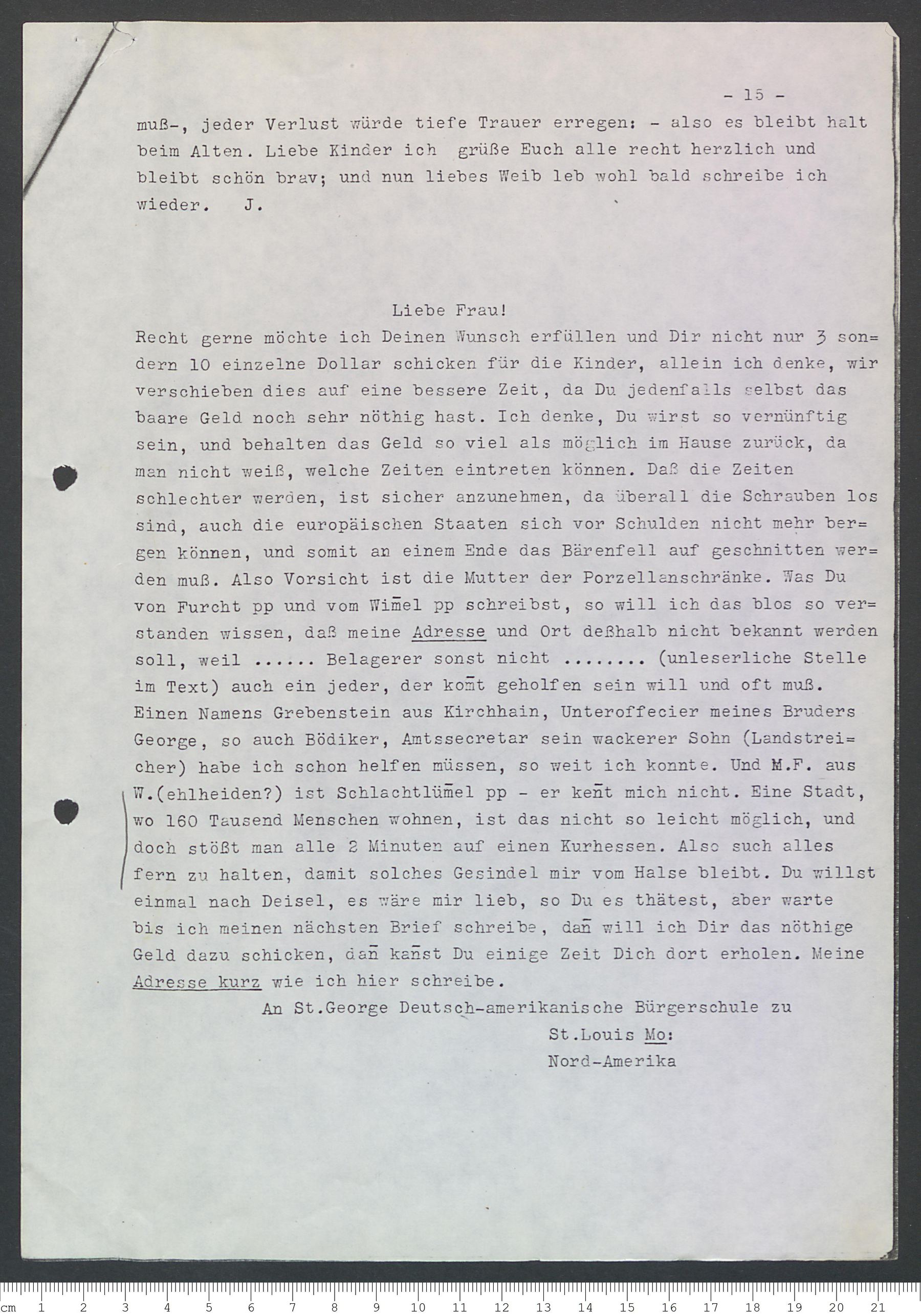
Page header: – 15 – · End of 17 April 1861, then a further sheet — ⭐ „alle 2 Minuten auf einen Kurhessen“
…muß–, jeder Verlust würde tiefe Trauer erregen: – also es bleibt halt beim Alten. Liebe Kinder ich grüße Euch alle recht herzlich und bleibt schön brav; und nun liebes Weib leb wohl bald schreibe ich wieder. J.
Liebe Frau!
Recht gerne möchte ich Deinen Wunsch erfüllen und Dir nicht nur 3 sondern 10 einzelne Dollar schicken für die Kinder, allein ich denke, wir verschieben dies auf eine bessere Zeit, da Du jedenfalls selbst das baare Geld noch sehr nöthig hast. Ich denke, Du wirst so vernünftig sein, und behalten das Geld so viel als möglich im Hause zurück, da man nicht weiß, welche Zeiten eintreten können.
Daß die Zeiten schlechter werden, ist sicher anzunehmen, da überall die Schrauben los sind, auch die europäischen Staaten sich vor Schulden nicht mehr bergen können, und somit an einem Ende das Bärenfell auf geschnitten werden muß. Also Vorsicht ist die Mutter der Porzellanschränke.
Was Du von Furcht pp und vom Wimmel pp schreibst, so will ich das blos so verstanden wissen, daß meine Adresse und Ort deßhalb nicht bekannt werden soll, weil …… Belagerer sonst nicht …….. (unleserliche Stelle im Text) auch ein jeder, der kommt geholfen sein will und oft muß.
Einen Namens Grebenstein aus Kirchhain, Unterofficier meines Bruders George, so auch Bödiker, Amtssecretär sein wackerer Sohn (Landstreicher) habe ich schon helfen müssen, so weit ich konnte. Und M. F. aus W.(ehlheiden?) ist Schlachtlümmel pp – er kennt mich nicht.
Eine Stadt, wo 160 Tausend Menschen wohnen, ist das nicht so leicht möglich, und doch stößt man alle 2 Minuten auf einen Kurhessen. Also such alles fern zu halten, damit solches Gesindel mir vom Halse bleibt.
Du willst einmal nach Deisel, es wäre mir lieb, so Du es thätest, aber warte bis ich meinen nächsten Brief schreibe, dann will ich Dir das nöthige Geld dazu schicken, dann kannst Du einige Zeit Dich dort erholen. Meine Adresse kurz wie ich hier schreibe:
An St. George Deutsch-amerikanische Bürgerschule zu St. Louis Mo: Nord-Amerika
…must; any loss would cause deep grief — so it simply stays as it was. Dear children, I greet you all most warmly, and stay nicely good; and now, dear wife, farewell — I shall write again soon. J.
Dear wife!
I should very gladly meet your wish and send you not 3 but 10 single dollars for the children; but I think we will put this off to a better time, since you certainly still have great need of the ready money yourself. I think you will be sensible enough to keep back as much of the money in the house as possible, since one does not know what times may come.
That times will grow worse may be taken for certain, since everywhere the screws are loose, and the European states too can no longer hide from their debts — so at one end or another the bearskin will have to be cut up. Caution, then, is the mother of the china cupboards.
As to what you write about fear and about the crowd, I would have it understood only thus: my address and whereabouts are not to become known, because otherwise besiegers … [illegible passage in the text] … and also because everyone who comes wants help, and often must have it.
One named Grebenstein of Kirchhain, a non-commissioned officer under my brother George, and likewise Bödiker — the district secretary's worthy son, a vagabond — I have already had to help, so far as I could. And M. F. of W.[ehlheiden?] is a butcher's lout; he does not know me.
In a city where 160 thousand people live, that ought not to be so easily possible — and yet every 2 minutes one runs into a Kurhessian. So try to keep it all at a distance, so that such riff-raff stays off my back.
You want to go to Deisel some time; I should be glad if you did, but wait until I write my next letter, and then I will send you the money needed, and you can recover there for a while. My address, short, as I write it here:
To the St. George German-American Citizens' School at St. Louis, Mo., North America
⭐⭐ CITATION CORRECTION — the „every two minutes a Kurhessian“ line is on IMAGE 0068 (p. 15), not 0066. The memory file and the note of 18–19 Jul 2026 both cite 0066. Fix before it is quoted again. ⭐⭐ And it is far stronger evidence than the bare quotation suggests. Read with the sentence above it — „auch ein jeder, der kommt geholfen sein will und oft muß“ — the picture is of a Kurhessian population in St. Louis dense enough to be met constantly, of which the arriving poor came to Köster specifically for help. In April 1861. This is the second and stronger leg of the argument built on p. 11: the community Charles would have landed into is documented, from inside, by a man trying to escape it. ⭐ Grebenstein was an NCO under brother George — settling the “Georg Husar” question completely — and Bödiker is named as the Amtssekretär's son. ⭐ An illegible passage is flagged by the 1930s editor himself (unleserliche Stelle im Text); kept above rather than smoothed over, since the gap sits exactly where he explains whom he is hiding from. ⚠️ M. F. aus W.(ehlheiden?) — the question mark is the editor's, not ours.
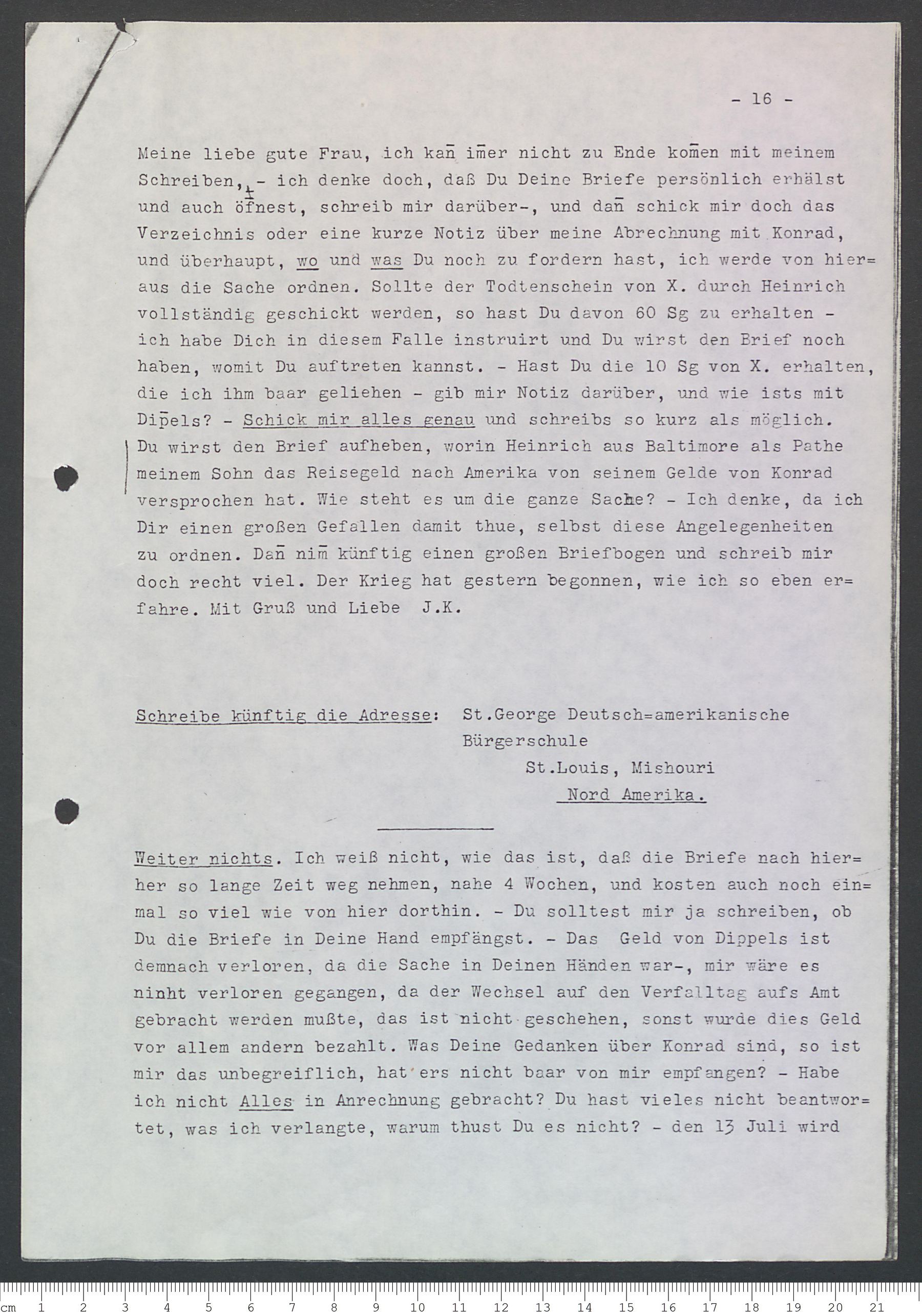
Page header: – 16 – · 17 April 1861, further sheets — ⭐ „Der Krieg hat gestern begonnen“
Meine liebe gute Frau, ich kann immer nicht zu Ende kommen mit meinem Schreiben, – ich denke doch, daß Du Deine Briefe persönlich erhälst und auch öffnest, schreib mir darüber–, und dann schick mir doch das Verzeichnis oder eine kurze Notiz über meine Abrechnung mit Konrad, und überhaupt, wo und was Du noch zu fordern hast, ich werde von hieraus die Sache ordnen.
Sollte der Todtenschein von X. durch Heinrich vollständig geschickt werden, so hast Du davon 60 Sg zu erhalten – ich habe Dich in diesem Falle instruirt und Du wirst den Brief noch haben, womit Du auftreten kannst. – Hast Du die 10 Sg von X. erhalten, die ich ihm baar geliehen – gib mir Notiz darüber, und wie ist's mit Dipels? – Schick mir alles genau und schreib's so kurz als möglich.
Du wirst den Brief aufheben, worin Heinrich aus Baltimore als Pathe meinem Sohn das Reisegeld nach Amerika von seinem Gelde von Konrad versprochen hat. Wie steht es um die ganze Sache? – Ich denke, da ich Dir einen großen Gefallen damit thue, selbst diese Angelegenheiten zu ordnen. Dann nimm künftig einen großen Briefbogen und schreib mir doch recht viel.
Der Krieg hat gestern begonnen, wie ich so eben erfahre. Mit Gruß und Liebe J. K.
Schreibe künftig die Adresse: St. George Deutsch-amerikanische Bürgerschule, St. Louis, Mishouri, Nord Amerika.
Weiter nichts. Ich weiß nicht, wie das ist, daß die Briefe nach hierher so lange Zeit weg nehmen, nahe 4 Wochen, und kosten auch noch einmal so viel wie von hier dorthin. – Du solltest mir ja schreiben, ob Du die Briefe in Deine Hand empfängst.
Das Geld von Dippels ist demnach verloren, da die Sache in Deinen Händen war–, mir wäre es nicht verloren gegangen, da der Wechsel auf den Verfalltag aufs Amt gebracht werden mußte, das ist nicht geschehen, sonst wurde dies Geld vor allem andern bezahlt. Was Deine Gedanken über Konrad sind, so ist mir das unbegreiflich, hat er's nicht baar von mir empfangen? – Habe ich nicht Alles in Anrechnung gebracht? Du hast vieles nicht beantwortet, was ich verlangte, warum thust Du es nicht? – den 13 Juli wird…
My dear good wife, I can never come to an end with my writing. I do think you receive your letters personally and open them yourself — write to me about it. And then do send me the list, or a short note, of my account with Konrad, and generally where and what you still have to claim; I shall put the matter in order from here.
Should the death certificate of X. be sent complete through Heinrich, you are to receive 60 Silbergroschen for it — I instructed you in this case and you will still have the letter with which you can present yourself. Have you received the 10 Sg from X. that I lent him in cash? Send me a note of it — and how do matters stand with the Dipels? Send me everything exactly, and write it as briefly as you can.
You will keep the letter in which Heinrich of Baltimore, as godfather, promised my son the passage money to America out of his money from Konrad. How does the whole business stand? I think I am doing you a great favour by settling these matters myself. In future take a large sheet of letter paper and write me a great deal.
The war began yesterday, as I have just learned. With greetings and love, J. K.
In future write the address: St. George German-American Citizens' School, St. Louis, Mishouri, North America.
Nothing further. I do not know how it is that letters take so long to get here — close on 4 weeks — and cost twice as much as from here to there. You really should write and tell me whether you receive the letters into your own hand.
The Dippels' money is accordingly lost, since the matter was in your hands. It would not have been lost with me, since the bill had to be taken to the office on the day it fell due; that was not done, otherwise this money would have been paid before all else. As for your thoughts about Konrad, they are beyond me — did he not receive it from me in cash? Did I not bring everything to account? You have left much unanswered that I asked; why do you not do it? On 13 July…
⭐⭐ „Der Krieg hat gestern begonnen, wie ich so eben erfahre.“ — a St. Louis German recording the outbreak of the Civil War in a letter home, in real time. ⚠️ Do not over-read the date. The letter is headed 17 April 1861; Fort Sumter was fired on 12–13 April and Lincoln's call for volunteers issued 15 April. “Yesterday” therefore does not match Sumter, and most likely records when the news reached him — or the sheet was added a day or two after the heading. Treat the phrase as evidence of his reaction, not as an independent date for any event. ⭐ Mail asymmetry, stated: Europe→St. Louis took close on 4 weeks and cost twice as much as St. Louis→Europe, which he timed at roughly a fortnight on p. 13. Both figures now come from him directly. ⭐ A plan to bring the son over: brother Heinrich of Baltimore, as godfather, had promised the boy's passage money out of funds held by Konrad. It evidently never happened. ⚠️ Mishouri here against Missouri on p. 15 — his spelling of American place-names is unstable in the same way as Peiks Piek / Piekes Peik, which is worth remembering whenever a German-written American form is used as evidence.
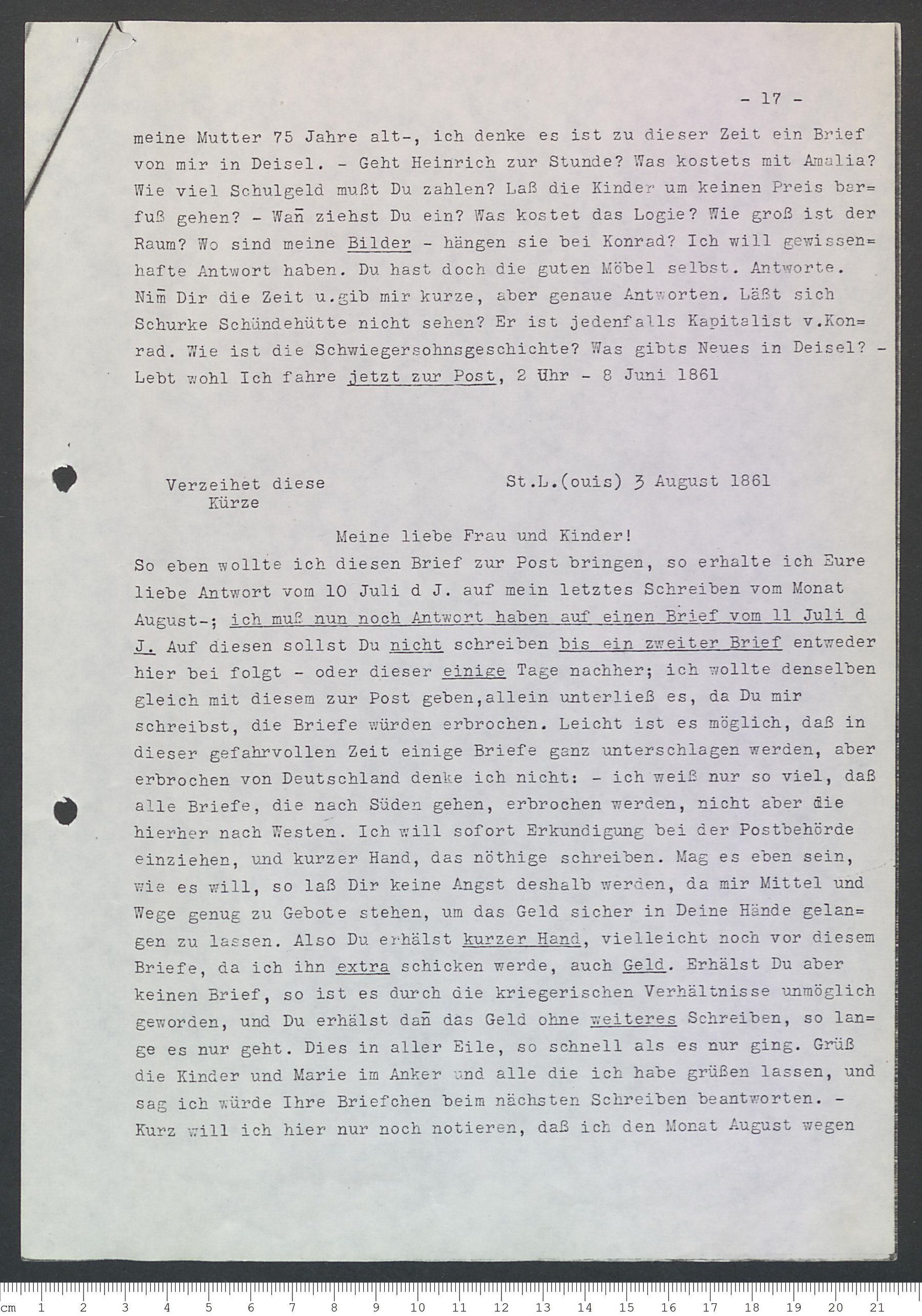
Page header: – 17 – · End of a letter closed 8 June 1861, then St. Louis, 3 August 1861 — ⭐ wartime mail censorship
…meine Mutter 75 Jahre alt–, ich denke es ist zu dieser Zeit ein Brief von mir in Deisel. – Geht Heinrich zur Stunde? Was kostet's mit Amalia? Wie viel Schulgeld mußt Du zahlen? Laß die Kinder um keinen Preis barfuß gehen? – Wann ziehst Du ein? Was kostet das Logie? Wie groß ist der Raum? Wo sind meine Bilder – hängen sie bei Konrad? Ich will gewissenhafte Antwort haben. Du hast doch die guten Möbel selbst. Antworte. Nimm Dir die Zeit u. gib mir kurze, aber genaue Antworten.
Läßt sich Schurke Schündehütte nicht sehen? Er ist jedenfalls Kapitalist v. Konrad. Wie ist die Schwiegersohnsgeschichte? Was gibt's Neues in Deisel? – Lebt wohl. Ich fahre jetzt zur Post, 2 Uhr – 8 Juni 1861
St. L.(ouis) 3 August 1861 [in the margin: Verzeihet diese Kürze]
Meine liebe Frau und Kinder!
So eben wollte ich diesen Brief zur Post bringen, so erhalte ich Eure liebe Antwort vom 10 Juli d. J. auf mein letztes Schreiben vom Monat August–; ich muß nun noch Antwort haben auf einen Brief vom 11 Juli d. J. Auf diesen sollst Du nicht schreiben bis ein zweiter Brief entweder hier bei folgt – oder dieser einige Tage nachher; ich wollte denselben gleich mit diesem zur Post geben, allein unterließ es, da Du mir schreibst, die Briefe würden erbrochen.
Leicht ist es möglich, daß in dieser gefahrvollen Zeit einige Briefe ganz unterschlagen werden, aber erbrochen von Deutschland denke ich nicht: – ich weiß nur so viel, daß alle Briefe, die nach Süden gehen, erbrochen werden, nicht aber die hierher nach Westen. Ich will sofort Erkundigung bei der Postbehörde einziehen, und kurzer Hand, das nöthige schreiben.
Mag es eben sein, wie es will, so laß Dir keine Angst deshalb werden, da mir Mittel und Wege genug zu Gebote stehen, um das Geld sicher in Deine Hände gelangen zu lassen. Also Du erhälst kurzer Hand, vielleicht noch vor diesem Briefe, da ich ihn extra schicken werde, auch Geld. Erhälst Du aber keinen Brief, so ist es durch die kriegerischen Verhältnisse unmöglich geworden, und Du erhälst dann das Geld ohne weiteres Schreiben, so lange es nur geht.
Dies in aller Eile, so schnell als es nur ging. Grüß die Kinder und Marie im Anker und alle die ich habe grüßen lassen, und sag ich würde Ihre Briefchen beim nächsten Schreiben beantworten. – Kurz will ich hier nur notieren, daß ich den Monat August wegen…
…my mother [turns] 75 — I think there is a letter of mine in Deisel about this time. Does Heinrich go to his lesson? What does it cost with Amalia? How much school money must you pay? On no account let the children go barefoot. When do you move in? What does the lodging cost? How large is the room? Where are my pictures — do they hang at Konrad's? I want a conscientious answer. You have the good furniture yourself, surely. Answer. Take your time and give me short but exact replies.
Does that scoundrel Schündehütte not show himself? He is Konrad's financier, no doubt. How stands the son-in-law business? What is the news in Deisel? Farewell. I am driving to the post now, 2 o'clock — 8 June 1861.
St. L[ouis], 3 August 1861 [in the margin: Forgive this brevity]
My dear wife and children!
I was just about to take this letter to the post when I received your dear reply of 10 July of this year to my last letter. I must now still have an answer to a letter of 11 July. You are not to write on that one until a second letter either accompanies this — or follows a few days after; I meant to post it together with this, but refrained, since you write me that the letters are being opened.
It is quite possible that in this dangerous time some letters are suppressed altogether; but opened from Germany I do not think. I know only this much, that all letters going South are opened, but not those coming here to the West. I shall make enquiries at once with the postal authority, and write what is needed without delay.
However it may be, let it cause you no anxiety, since I have means and ways enough at my disposal to get the money safely into your hands. So you will receive money too, without delay, perhaps even before this letter, since I shall send it separately. But if you receive no letter, then it has been made impossible by the conditions of war, and you will then receive the money without any further letter, for as long as it can be managed.
This in all haste, as fast as it could be done. Greet the children and Marie at the Anker, and all those I have sent greetings to, and say I shall answer their little letters next time I write. I will only note here briefly that for the month of August, on account of…
⭐ His mother's birth date is CONFIRMED. Carried over from p. 16 — „den 13 Juli wird meine Mutter 75 Jahre alt“ — which puts her birth at 13 July 1786, exactly matching the Personalkarte (img 0010) for Marie Fremder. An independent check of the card against the letters. ⭐⭐ WARTIME MAIL CENSORSHIP, first-hand: „alle Briefe, die nach Süden gehen, erbrochen werden, nicht aber die hierher nach Westen“. Letters south were opened; westbound ones were not, though outright suppression was possible. He plans to enquire at the post office and to send money separately from letters. This is a concrete, checkable statement about Union postal practice in the summer of 1861 from a man in St. Louis. ⚠️ Possible gap in the site's letter list: this leaf closes a letter at “2 Uhr – 8 Juni 1861”, but `koster-letters-transcription.html` runs 17 April → 3 August with nothing between. Either the June sheet belongs to the April letter (posted seven weeks later) or an 8 June 1861 letter is unlisted. Resolve when pp. 16–17 are read as a unit. ⭐ „Laß die Kinder um keinen Preis barfuß gehen“ — he is anxious the children not be seen barefoot; with the school fees and lodging questions, it sketches how close to the edge the family in Kurhessen was living.
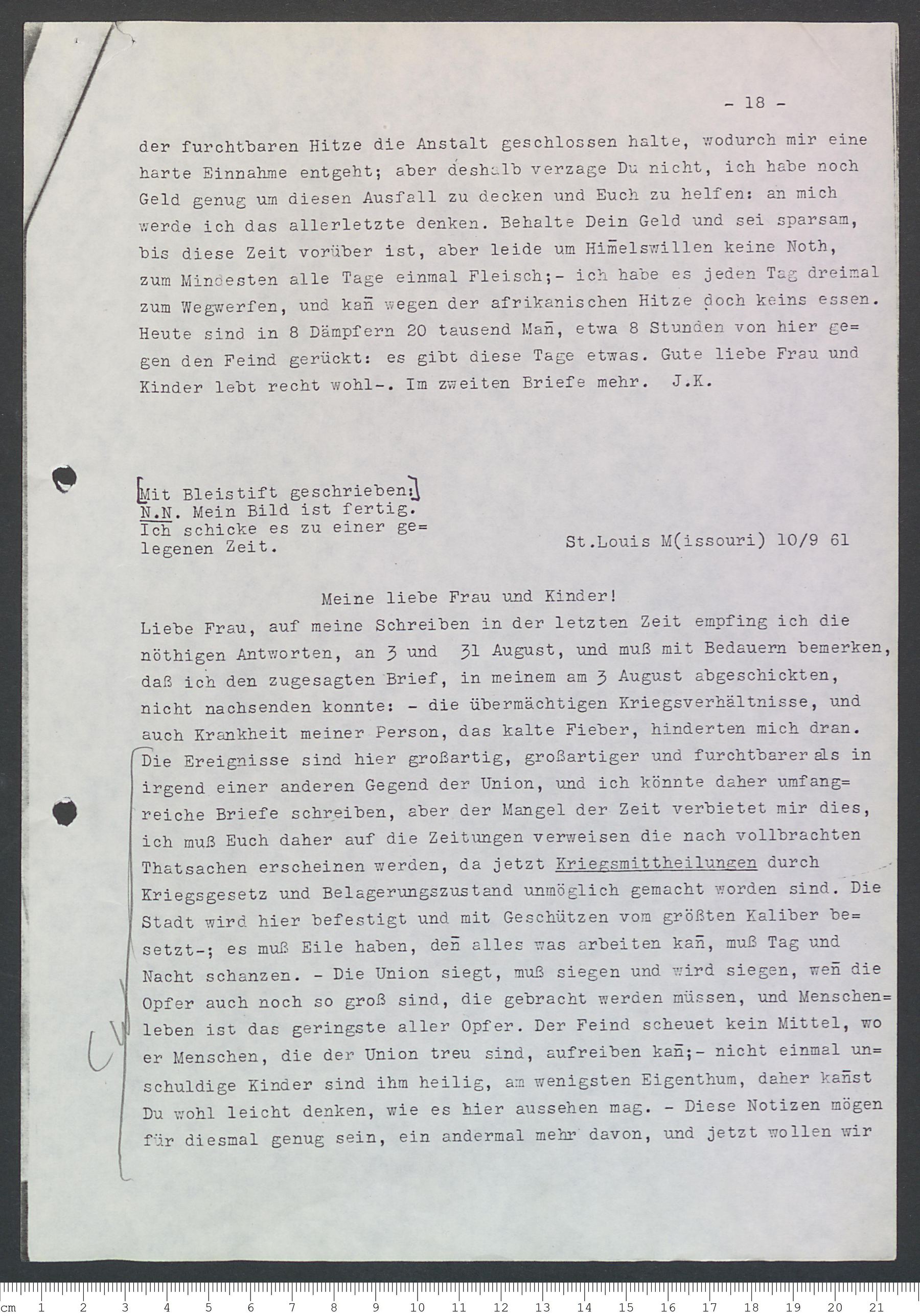
Page header: – 18 – · End of 3 August 1861, then St. Louis, 10 September 1861 — ⭐⭐ martial law, and the city being entrenched
…der furchtbaren Hitze die Anstalt geschlossen halte, wodurch mir eine harte Einnahme entgeht; aber deshalb verzage Du nicht, ich habe noch Geld genug um diesen Ausfall zu decken und Euch zu helfen: an mich werde ich das allerletzte denken. Behalte Dein Geld und sei sparsam, bis diese Zeit vorüber ist, aber leide um Himmelswillen keine Noth, zum Mindesten alle Tage einmal Fleisch;– ich habe es jeden Tag dreimal zum Wegwerfen, und kann wegen der afrikanischen Hitze doch keins essen.
Heute sind in 8 Dämpfern 20 tausend Mann, etwa 8 Stunden von hier gegen den Feind gerückt: es gibt diese Tage etwas. Gute liebe Frau und Kinder lebt recht wohl–. Im zweiten Briefe mehr. J. K.
[Mit Bleistift geschrieben:] N.N. Mein Bild ist fertig. Ich schicke es zu einer gelegenen Zeit.
St. Louis M(issouri) 10/9 61
Meine liebe Frau und Kinder!
Liebe Frau, auf meine Schreiben in der letzten Zeit empfing ich die nöthigen Antworten, an 3 und 31 August, und muß mit Bedauern bemerken, daß ich den zugesagten Brief, in meinem am 3 August abgeschickten, nicht nachsenden konnte: – die übermächtigen Kriegsverhältnisse, und auch Krankheit meiner Person, das kalte Fieber, hinderten mich dran.
Die Ereignisse sind hier großartig, großartiger und furchtbarer als in irgend einer anderen Gegend der Union, und ich könnte daher umfangreiche Briefe schreiben, aber der Mangel der Zeit verbietet mir dies, ich muß Euch daher auf die Zeitungen verweisen die nach vollbrachten Thatsachen erscheinen werden, da jetzt Kriegsmittheilungen durch Kriegsgesetz und Belagerungszustand unmöglich gemacht worden sind.
Die Stadt wird hier befestigt und mit Geschützen vom größten Kaliber besetzt–; es muß Eile haben, denn alles was arbeiten kann, muß Tag und Nacht schanzen.
Die Union siegt, muß siegen und wird siegen, wenn die Opfer auch noch so groß sind, die gebracht werden müssen, und Menschenleben ist das geringste aller Opfer. Der Feind scheuet kein Mittel, wo er Menschen, die der Union treu sind, aufreiben kann;– nicht einmal unschuldige Kinder sind ihm heilig, am wenigsten Eigenthum, daher kannst Du wohl leicht denken, wie es hier aussehen mag. – Diese Notizen mögen für diesmal genug sein, ein andermal mehr davon, und jetzt wollen wir…
…on account of the fearful heat I am keeping the institution closed, by which I lose a hard slice of income; but do not lose heart on that account — I still have money enough to cover the shortfall and to help you. I shall think of myself last of all. Keep your money and be thrifty until this time is over, but for heaven's sake suffer no want — meat at least once every day. I have it three times a day to throw away, and yet can eat none of it for the African heat.
Today 20 thousand men moved in 8 steamers against the enemy, some 8 hours from here: something will come of these days. Good dear wife and children, fare you well. More in the second letter. J. K.
[Written in pencil:] N.N. My picture is finished. I shall send it at a convenient time.
St. Louis, Missouri, 10 September 1861
My dear wife and children!
Dear wife, I received the necessary answers to my recent letters, on 3 and 31 August, and must note with regret that I could not forward the letter promised in the one I sent on 3 August: the overwhelming conditions of war, and also illness on my part — the ague — prevented me.
Events here are tremendous, more tremendous and more terrible than in any other region of the Union, and I could therefore write voluminous letters; but want of time forbids it, and I must refer you to the newspapers, which will appear once the facts are accomplished — since war reports have now been made impossible by martial law and the state of siege.
The city here is being fortified and mounted with guns of the largest calibre; it must be done in haste, for everyone who can work must dig entrenchments day and night.
The Union is winning, must win and will win, however great the sacrifices that have to be made — and human life is the least of all sacrifices. The enemy shrinks from no means where he can destroy people loyal to the Union; not even innocent children are sacred to him, least of all property. So you may easily imagine what things may look like here. These notes may be enough for this time; more of it another time, and now let us…
⭐⭐ THE MOST DIRECTLY CHARLES-RELEVANT PAGE SO FAR. September 1861, St. Louis: „Die Stadt wird hier befestigt … alles was arbeiten kann, muß Tag und Nacht schanzen.“ — the city is being fortified and everyone able to work must dig entrenchments day and night. Charles was an unskilled German labourer in this city at this moment, fifteen months before he enlisted. Whatever else he was doing in autumn 1861, this is what the labour market around him looked like, and it is the likeliest thing his hands were doing. Worth a targeted search: Union fortification payrolls / Quartermaster labour rolls, St. Louis, autumn 1861. ⭐⭐ Martial law and state of siege, dated from inside — Frémont declared martial law in St. Louis on 14 August 1861 and across Missouri on 30 August; Köster confirms it suppressed war news by 10 September. ⭐⭐ A THIRD PHOTOGRAPH. The pencil note „Mein Bild ist fertig“ means a portrait was made c. August–September 1861 — distinct from the 1854 and March 1872 photographs described on img 0109. Three known likenesses, none of them in the Gotha folder. ⭐ His illness is named: das kalte Fieber (ague/malaria), summer 1861 — bearing on the November 1861 collapse. ⭐ Troop movement: 20,000 men in 8 steamers, 3 August 1861, ~8 hours from St. Louis — checkable against Union operational records for early August 1861. ⭐ His Unionism is explicit and unqualified. ⚠️ Note the food contrast he himself draws: meat three times a day to throw away in St. Louis, while he begs his wife in Kurhessen to manage meat once a day.
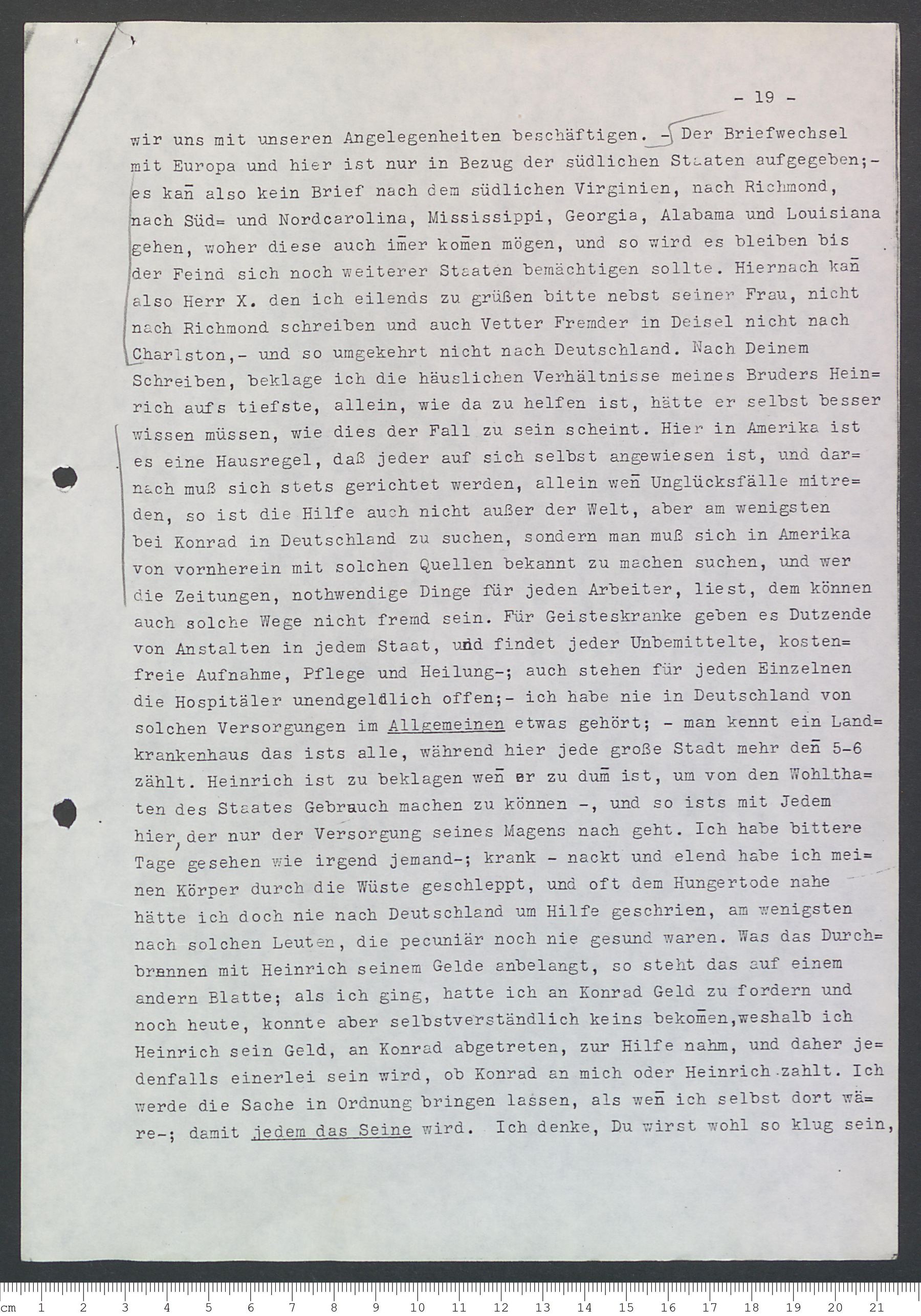
Page header: – 19 – · 10 September 1861, continued — the Southern mail embargo, and American public provision
…wir uns mit unseren Angelegenheiten beschäftigen. – Der Briefwechsel mit Europa und hier ist nur in Bezug der südlichen Staaten aufgegeben;– es kann also kein Brief nach dem südlichen Virginien, nach Richmond, nach Süd- und Nordcarolina, Mississippi, Georgia, Alabama und Louisiana gehen, woher diese auch immer kommen mögen, und so wird es bleiben bis der Feind sich noch weiterer Staaten bemächtigen sollte. Hiernach kann also Herr X. den ich eilends zu grüßen bitte nebst seiner Frau, nicht nach Richmond schreiben und auch Vetter Fremder in Deisel nicht nach Charlston, – und so umgekehrt nicht nach Deutschland.
Nach Deinem Schreiben, beklage ich die häuslichen Verhältnisse meines Bruders Heinrich aufs tiefste, allein, wie da zu helfen ist, hätte er selbst besser wissen müssen, wie dies der Fall zu sein scheint. Hier in Amerika ist es eine Hausregel, daß jeder auf sich selbst angewiesen ist, und darnach muß sich stets gerichtet werden, allein wenn Unglücksfälle mitreden, so ist die Hilfe auch nicht außer der Welt, aber am wenigsten bei Konrad in Deutschland zu suchen, sondern man muß sich in Amerika von vornherein mit solchen Quellen bekannt zu machen suchen, und wer die Zeitungen, nothwendige Dinge für jeden Arbeiter, liest, dem können auch solche Wege nicht fremd sein.
Für Geisteskranke geben es Dutzende von Anstalten in jedem Staat, und findet jeder Unbemittelte kostenfreie Aufnahme, Pflege und Heilung–; auch stehen für jeden Einzelnen die Hospitäler unentgeldlich offen;– ich habe nie in Deutschland von solchen Versorgungen im Allgemeinen etwas gehört; – man kennt ein Landkrankenhaus das ist's alle, während hier jede große Stadt mehr denn 5–6 zählt. Heinrich ist zu beklagen wenn er zu dumm ist, um von den Wohlthaten des Staates Gebrauch machen zu können –, und so ist's mit Jedem hier, der nur der Versorgung seines Magens nach geht.
Ich habe bittere Tage gesehen wie irgend jemand–; krank – nackt und elend habe ich meinen Körper durch die Wüste geschleppt, und oft dem Hungertode nahe hätte ich doch nie nach Deutschland um Hilfe geschrien, am wenigsten nach solchen Leuten, die pecuniär noch nie gesund waren.
Was das Durchbrennen mit Heinrich seinem Gelde anbelangt, so steht das auf einem andern Blatte; als ich ging, hatte ich an Konrad Geld zu fordern und noch heute, konnte aber selbstverständlich keins bekommen, weshalb ich Heinrich sein Geld, an Konrad abgetreten, zur Hilfe nahm, und daher jedenfalls einerlei sein wird, ob Konrad an mich oder Heinrich zahlt. Ich werde die Sache in Ordnung bringen lassen, als wenn ich selbst dort wäre–; damit jedem das Seine wird. Ich denke, Du wirst wohl so klug sein…
…let us turn to our own affairs. Correspondence between Europe and here has been given up only as regards the southern states; so no letter can go to southern Virginia, to Richmond, to South and North Carolina, Mississippi, Georgia, Alabama or Louisiana, wherever they may come from, and so it will remain unless the enemy should seize still further states. Accordingly Herr X., whom with his wife I ask you to greet in haste, cannot write to Richmond, nor can cousin Fremder in Deisel write to Charleston — and likewise not the other way, to Germany.
From your letter, I deplore my brother Heinrich's domestic circumstances most deeply; but how to help there he ought himself to have known better than appears to be the case. Here in America it is a household rule that everyone is thrown on his own resources, and one must always act accordingly; yet when misfortunes have their say, help is not out of the world either — only it is least of all to be sought from Konrad in Germany. Rather, in America one must from the outset make oneself acquainted with such resources; and to anyone who reads the newspapers — necessary things for every working man — such avenues cannot be unfamiliar.
For the mentally ill there are dozens of institutions in every state, and every person without means finds free admission, care and treatment; the hospitals too stand open to each individual without charge. I never heard in Germany of such provision generally — one knows a country infirmary and that is all, whereas here every large city counts more than five or six. Heinrich is to be pitied if he is too stupid to make use of the benefits of the state — and so it is with everyone here who goes no further than filling his stomach.
I have seen bitter days as much as anyone: sick, naked and wretched I dragged my body through the wilderness, and often near death from hunger; yet I would never have cried to Germany for help, least of all to such people as were never financially sound themselves.
As for making off with Heinrich's money, that stands in another account. When I left, I had money owing to me from Konrad, and still have today, but naturally could get none — which is why I took Heinrich's money, made over to Konrad, to help myself; and so it will make no difference whether Konrad pays me or Heinrich. I shall have the matter put in order as though I were there myself, so that each gets his own. I think you will be wise enough…
⭐⭐ A DEISEL–CHARLESTON CONNECTION, previously unknown. „auch Vetter Fremder in Deisel nicht nach Charlston“ — cousin Fremder at Deisel had a correspondent in Charleston, South Carolina, now cut off by the embargo. Fremder is Köster's mother's family and appears on the Deisel emigrant lists. ⇒ a second American destination for the Deisel cohort, outside the St. Louis/Missouri axis this project has assumed. Worth chasing: Charleston German community, 1850s–60s, for Deisel-area surnames. A “Herr X.” likewise had a Richmond correspondent. ⭐ The Southern mail embargo listed state by state — southern Virginia, Richmond, the Carolinas, Mississippi, Georgia, Alabama, Louisiana — a precise, datable statement of what was cut off by 10 September 1861. ⭐⭐ Corroborates the Personalkarte again. The card (img 0010) records brother Heinrich as married to a “geisteskranke” wife; this page is that situation being discussed, which is why it turns into a survey of American asylum provision. Second independent check of the card from the letters, after the mother's birth date on p. 17. ⭐ His own 1859 wandering, described: „krank – nackt und elend habe ich meinen Körper durch die Wüste geschleppt, und oft dem Hungertode nahe“ — the Wanderschaft he set out on from St. Joseph in April 1859 nearly killed him. ⭐ For Chapter 3: free hospitals and asylums as the thing that most struck a German immigrant, and newspapers described as “nothwendige Dinge für jeden Arbeiter” — a working man was expected to read.
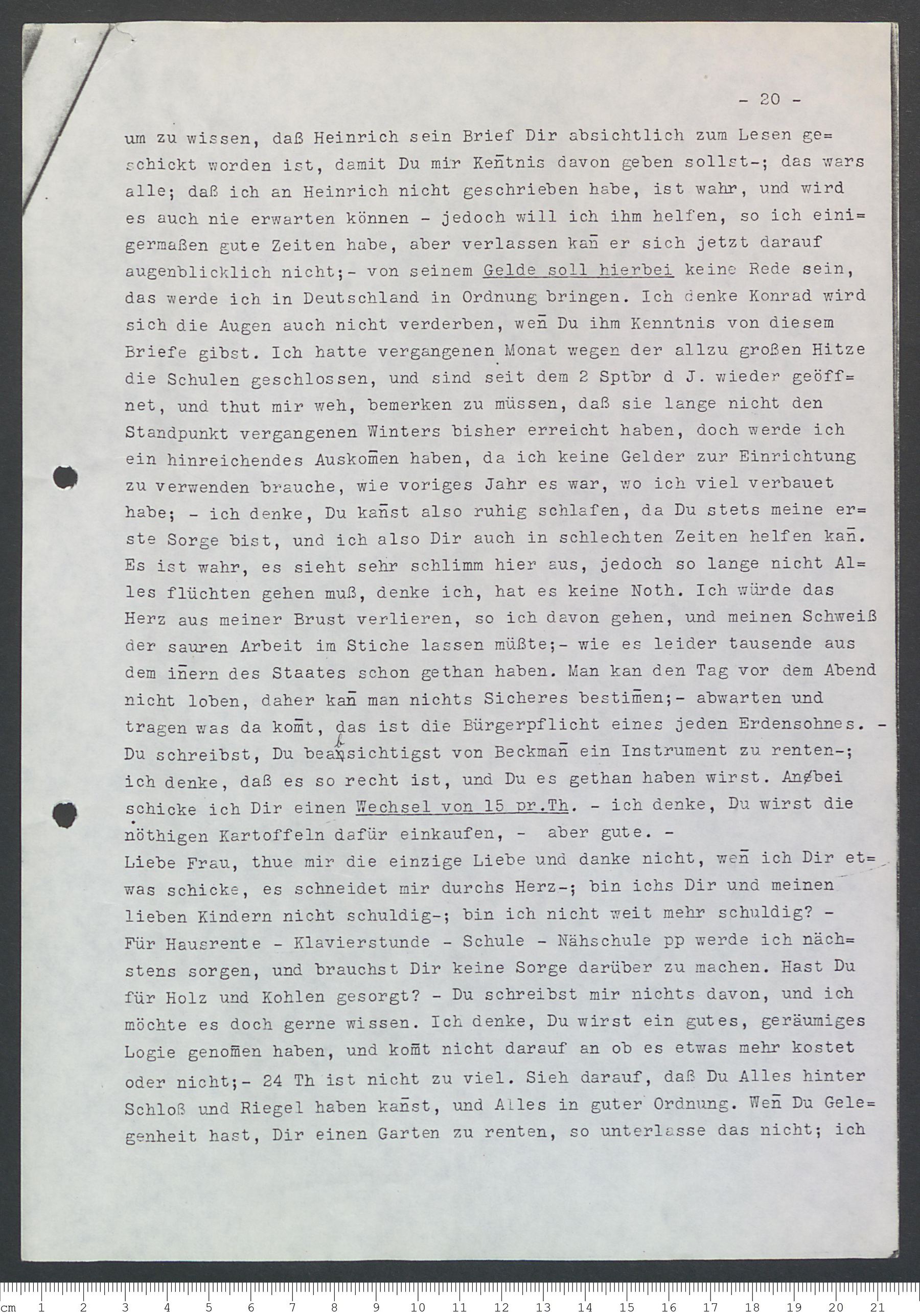
Page header: – 20 – · 10 September 1861, continued — refugees into St. Louis, and a household budget
…um zu wissen, daß Heinrich sein Brief Dir absichtlich zum Lesen geschickt worden ist, damit Du mir Kenntnis davon geben sollst–; das war's alle; daß ich an Heinrich nicht geschrieben habe, ist wahr, und wird es auch nie erwarten können – jedoch will ich ihm helfen, so ich einigermaßen gute Zeiten habe, aber verlassen kann er sich jetzt darauf augenblicklich nicht;– von seinem Gelde soll hierbei keine Rede sein, das werde ich in Deutschland in Ordnung bringen.
Ich hatte vergangenen Monat wegen der allzu großen Hitze die Schulen geschlossen, und sind seit dem 2 Sptbr d. J. wieder geöffnet, und thut mir weh, bemerken zu müssen, daß sie lange nicht den Standpunkt vergangenen Winters bisher erreicht haben, doch werde ich ein hinreichendes Auskommen haben, da ich keine Gelder zur Einrichtung zu verwenden brauche, wie voriges Jahr es war, wo ich viel verbauet habe; – ich denke, Du kannst also ruhig schlafen, da Du stets meine erste Sorge bist, und ich also Dir auch in schlechten Zeiten helfen kann.
Es ist wahr, es sieht sehr schlimm hier aus, jedoch so lange nicht Alles flüchten gehen muß, denke ich, hat es keine Noth. Ich würde das Herz aus meiner Brust verlieren, so ich davon gehen, und meinen Schweiß der sauren Arbeit im Stiche lassen müßte;– wie es leider tausende aus dem innern des Staates schon gethan haben. Man kann den Tag vor dem Abend nicht loben, daher kann man nichts Sicheres bestimmen;– abwarten und tragen was da kommt, das ist die Bürgerpflicht eines jeden Erdensohnes.
Du schreibst, Du beabsichtigst von Beckmann ein Instrument zu renten–; ich denke, daß es so recht ist, und Du es gethan haben wirst. Anbei schicke ich Dir einen Wechsel von 15 pr. Th. – ich denke, Du wirst die nöthigen Kartoffeln dafür einkaufen, – aber gute. –
Liebe Frau, thue mir die einzige Liebe und danke nicht, wenn ich Dir etwas schicke, es schneidet mir durchs Herz–; bin ich's Dir und meinen lieben Kindern nicht schuldig–; bin ich nicht weit mehr schuldig? – Für Hausrente – Klavierstunde – Schule – Nähschule pp werde ich nächstens sorgen, und brauchst Dir keine Sorge darüber zu machen.
Hast Du für Holz und Kohlen gesorgt? – Du schreibst mir nichts davon, und ich möchte es doch gerne wissen. Ich denke, Du wirst ein gutes, geräumiges Logie genommen haben, und kommt nicht darauf an ob es etwas mehr kostet oder nicht;– 24 Th ist nicht zu viel. Sieh darauf, daß Du Alles hinter Schloß und Riegel haben kannst, und Alles in guter Ordnung. Wenn Du Gelegenheit hast, Dir einen Garten zu renten, so unterlasse das nicht; ich…
…to know that Heinrich's letter was deliberately sent for you to read, so that you should let me know of it; that was all. That I have not written to Heinrich is true, and he will never be able to expect it either — yet I mean to help him if I have reasonably good times; but he cannot rely on it at this moment. Of his money there is to be no question here; I shall settle that in Germany.
Last month I had closed the schools on account of the excessive heat; they have been open again since the 2nd of September, and it pains me to have to note that they have by no means yet reached the level of last winter. Still, I shall have a sufficient living, since I need spend no money on fitting out, as I did last year when I built a great deal. So I think you may sleep easy, since you are always my first care, and I can therefore help you even in bad times.
It is true, things look very bad here; but so long as it does not come to everyone having to flee, I think there is no real danger. I should lose the heart out of my breast if I had to go away and abandon the sweat of my hard work — as thousands from the interior of the state have unfortunately already done. One cannot praise the day before evening, and so nothing certain can be settled; to wait and bear what comes is the civic duty of every son of earth.
You write that you intend to rent an instrument from Beckmann; I think that is quite right and that you will have done it. Enclosed I send you a bill for 15 Prussian Thaler — I think you will buy the necessary potatoes with it, but good ones.
Dear wife, do me the one kindness of not thanking me when I send you something; it cuts me to the heart. Do I not owe it to you and my dear children? Do I not owe far more? For house rent, piano lessons, school, sewing school and the rest I shall provide shortly, and you need have no anxiety about it.
Have you seen to wood and coal? You write me nothing of it, and I should very much like to know. I think you will have taken a good, roomy lodging, and it does not matter whether it costs somewhat more or not — 24 Thaler is not too much. See that you can have everything under lock and key, and everything in good order. If you have the chance to rent yourself a garden, do not neglect it; I…
⭐ Refugees into St. Louis, autumn 1861: „wie es leider tausende aus dem innern des Staates schon gethan haben“ — thousands from the interior of Missouri had already fled. Set beside the fortification labour on p. 18, this is the city Charles was living in: martial law, entrenchments dug day and night, and thousands of refugees arriving from the countryside. ⭐ A household budget in Thaler — lodging at 24 Th (“not too much”), a remittance of 15 pr. Th earmarked for potatoes, plus house rent, piano lessons, school, sewing school, wood and coal. With the earlier 14 Th 5 Sg instalments and the 1.4 Th/dollar rate from p. 6, there is now enough to model the household on both sides of the Atlantic. ⭐ The school's finances, precisely: closed for August's heat, reopened 2 September 1861, enrolment well below the previous winter — the war is costing him pupils. He got through it only because he had done his building the year before. ⭐ Note the sentiment that he would rather stay and risk the city than abandon “meinen Schweiß der sauren Arbeit” — the property he had built up.
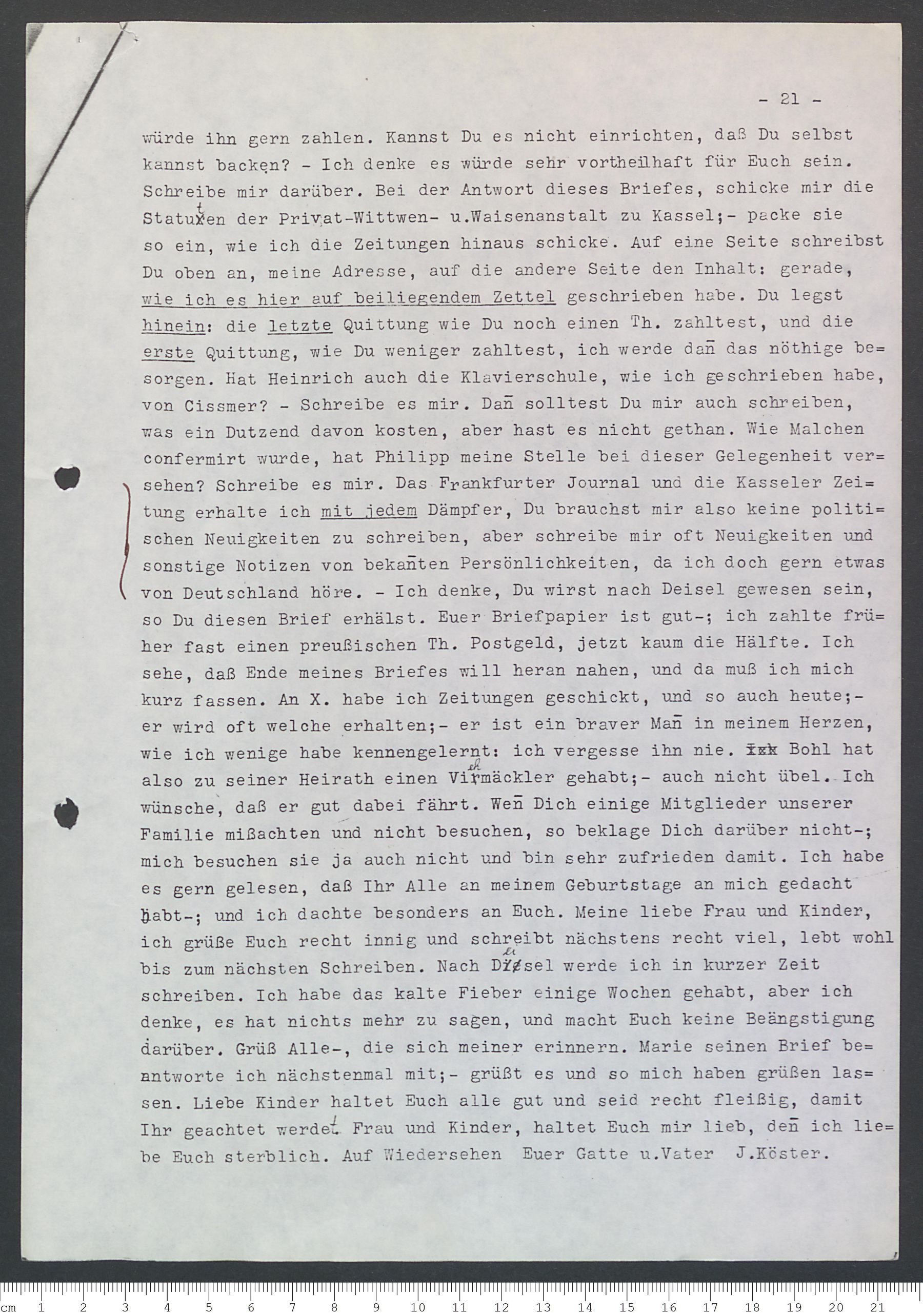
Page header: – 21 – · 10 September 1861, concluded — the Kassel widows' fund named, and German newspapers in St. Louis
…würde ihn gern zahlen. Kannst Du es nicht einrichten, daß Du selbst kannst backen? – Ich denke es würde sehr vortheilhaft für Euch sein. Schreibe mir darüber.
Bei der Antwort dieses Briefes, schicke mir die Statuten der Privat-Wittwen- u. Waisenanstalt zu Kassel;– packe sie so ein, wie ich die Zeitungen hinaus schicke. Auf eine Seite schreibst Du oben an, meine Adresse, auf die andere Seite den Inhalt: gerade, wie ich es hier auf beiliegendem Zettel geschrieben habe. Du legst hinein: die letzte Quittung wie Du noch einen Th. zahltest, und die erste Quittung, wie Du weniger zahltest, ich werde dann das nöthige besorgen.
Hat Heinrich auch die Klavierschule, wie ich geschrieben habe, von Cissmer? – Schreibe es mir. Dann solltest Du mir auch schreiben, was ein Dutzend davon kosten, aber hast es nicht gethan. Wie Malchen confermirt wurde, hat Philipp meine Stelle bei dieser Gelegenheit versehen? Schreibe es mir.
Das Frankfurter Journal und die Kasseler Zeitung erhalte ich mit jedem Dämpfer, Du brauchst mir also keine politischen Neuigkeiten zu schreiben, aber schreibe mir oft Neuigkeiten und sonstige Notizen von bekannten Persönlichkeiten, da ich doch gern etwas von Deutschland höre. – Ich denke, Du wirst nach Deisel gewesen sein, so Du diesen Brief erhälst.
Euer Briefpapier ist gut–; ich zahlte früher fast einen preußischen Th. Postgeld, jetzt kaum die Hälfte. Ich sehe, daß Ende meines Briefes will heran nahen, und da muß ich mich kurz fassen. An X. habe ich Zeitungen geschickt, und so auch heute;– er wird oft welche erhalten;– er ist ein braver Mann in meinem Herzen, wie ich wenige habe kennengelernt: ich vergesse ihn nie.
Bohl hat also zu seiner Heirath einen Vermäckler gehabt;– auch nicht übel. Ich wünsche, daß er gut dabei fährt. Wenn Dich einige Mitglieder unserer Familie mißachten und nicht besuchen, so beklage Dich darüber nicht–; mich besuchen sie ja auch nicht und bin sehr zufrieden damit. Ich habe es gern gelesen, daß Ihr Alle an meinem Geburtstage an mich gedacht habt–; und ich dachte besonders an Euch.
Meine liebe Frau und Kinder, ich grüße Euch recht innig und schreibt nächstens recht viel, lebt wohl bis zum nächsten Schreiben. Nach Deisel werde ich in kurzer Zeit schreiben. Ich habe das kalte Fieber einige Wochen gehabt, aber ich denke, es hat nichts mehr zu sagen, und macht Euch keine Beängstigung darüber. Grüß Alle–, die sich meiner erinnern. Marie seinen Brief beantworte ich nächstenmal mit;– grüßt es und so mich haben grüßen lassen. Liebe Kinder haltet Euch alle gut und seid recht fleißig, damit Ihr geachtet werdet. Frau und Kinder, haltet Euch mir lieb, denn ich liebe Euch sterblich. Auf Wiedersehen. Euer Gatte u. Vater J. Köster.
…would gladly pay it. Can you not arrange to do your own baking? I think it would be much to your advantage. Write to me about it.
With your answer to this letter, send me the statutes of the Private Widows' and Orphans' Institution at Kassel; pack them as I send the newspapers out. On one side write my address at the top, on the other the contents, exactly as I have written it here on the enclosed slip. Put inside: the last receipt where you still paid a Thaler, and the first receipt where you paid less; I shall then see to what is needed.
Has Heinrich also got the piano method by Cissmer, as I wrote? Write and tell me. And you were to write what a dozen of them cost, but have not done it. When Malchen was confirmed, did Philipp take my place on that occasion? Write and tell me.
I receive the Frankfurter Journal and the Kasseler Zeitung by every steamer, so you need write me no political news; but write me often with news and other notes of people we know, since I am glad to hear something of Germany. I think you will have been to Deisel by the time you get this letter.
Your writing paper is good. I used formerly to pay almost a Prussian Thaler in postage, now scarcely half. I see the end of my letter drawing near, so I must be brief. I have sent newspapers to X., and again today; he will often get some. He is a fine man in my heart, such as I have known few of: I shall never forget him.
So Bohl had a marriage-broker for his wedding — not bad either. I hope he does well out of it. If some members of our family slight you and do not visit, do not complain of it; they do not visit me either, and I am well content with that. I was glad to read that you all thought of me on my birthday; and I thought especially of you.
My dear wife and children, I greet you most fondly, and write me plenty next time; farewell until the next letter. I shall write to Deisel shortly. I have had the ague for some weeks, but I think it means nothing more now, and do not let it alarm you. Greet all who remember me. I shall answer Marie's letter next time; greet the child, and those who have sent me greetings. Dear children, all of you keep yourselves well and be diligent, so that you may be respected. Wife and children, hold me dear, for I love you to the death. Until we meet again. Your husband and father, J. Köster.
⭐ The widows' fund is named: the Privat-Wittwen- und Waisenanstalt zu Kassel, and he asks for its statutes and two receipts to check that the premium was correctly reduced. A named Kurhessian institution with its own records — a checkable trace of the family in Kassel, independent of the parish registers. Worth an enquiry to the Kassel city archive / HStAM. ⭐ He read the German press in St. Louis: the Frankfurter Journal and the Kasseler Zeitung reached him „mit jedem Dämpfer“, and he forwarded papers home. A German immigrant in St. Louis was not cut off from home news — worth remembering before assuming Charles was. ⭐ Postage datum: formerly nearly one Prussian Thaler per letter, by 1861 scarcely half. ⭐ His ague lasted some weeks — he plays it down here, two months before the November collapse. ⭐ His birthday (11 July) was remembered at home. Note also the household economy advice: bake your own bread.
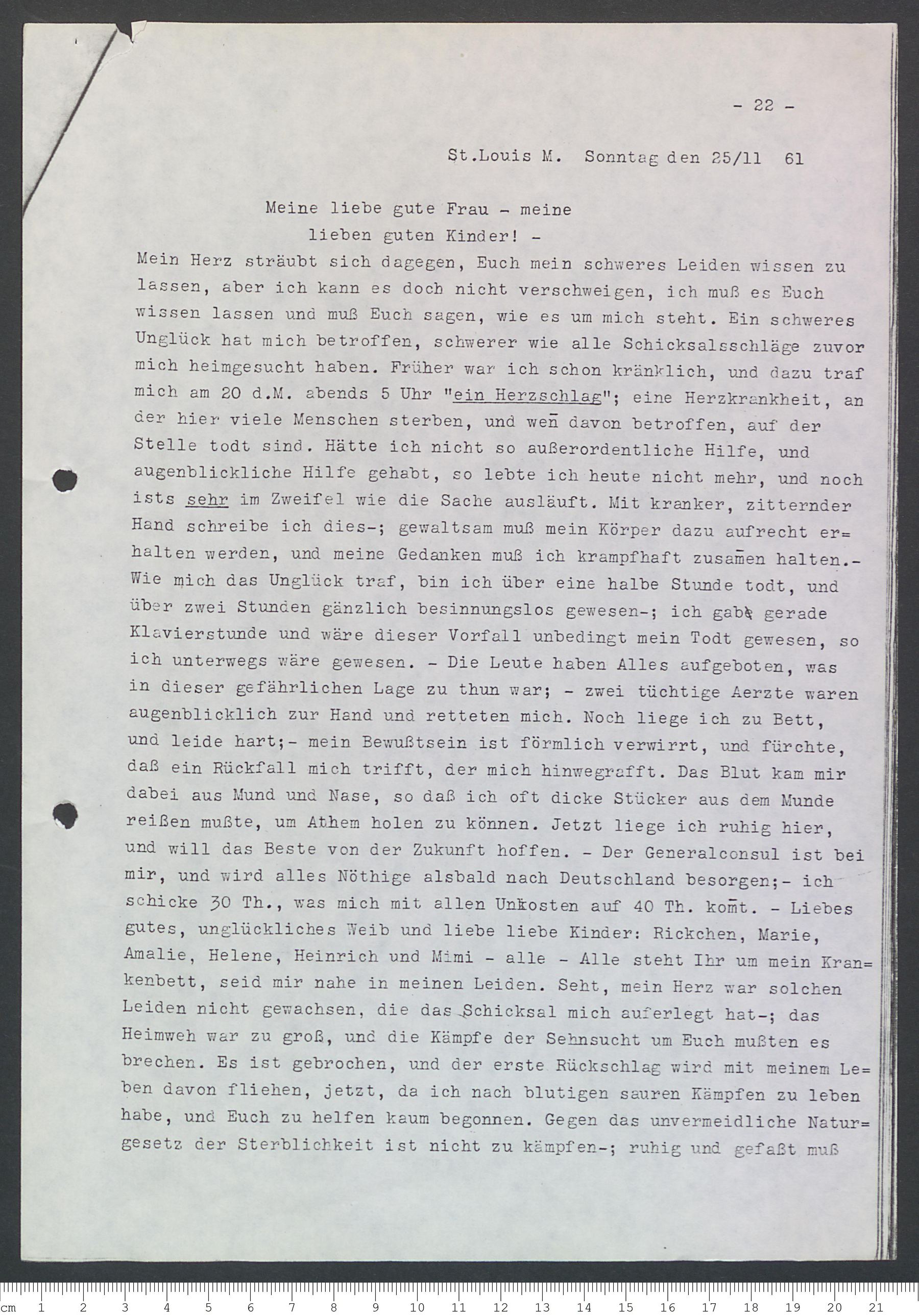
Page header: – 22 – · ⭐⭐ St. Louis, „Sonntag den 25/11 61“ — the collapse, dated to 20 November 1861, 5 p.m.
St. Louis M. Sonntag den 25/11 61
Meine liebe gute Frau – meine lieben guten Kinder! –
Mein Herz sträubt sich dagegen, Euch mein schweres Leiden wissen zu lassen, aber ich kann es doch nicht verschweigen, ich muß es Euch wissen lassen und muß Euch sagen, wie es um mich steht. Ein schweres Unglück hat mich betroffen, schwerer wie alle Schicksalsschläge zuvor mich heimgesucht haben. Früher war ich schon kränklich, und dazu traf mich am 20 d. M. abends 5 Uhr „ein Herzschlag“; eine Herzkrankheit, an der hier viele Menschen sterben, und wenn davon betroffen, auf der Stelle todt sind. Hätte ich nicht so außerordentliche Hilfe, und augenblickliche Hilfe gehabt, so lebte ich heute nicht mehr, und noch ist's sehr im Zweifel wie die Sache ausläuft.
Mit kranker, zitternder Hand schreibe ich dies–; gewaltsam muß mein Körper dazu aufrecht erhalten werden, und meine Gedanken muß ich krampfhaft zusammen halten. – Wie mich das Unglück traf, bin ich über eine halbe Stunde todt, und über zwei Stunden gänzlich besinnungslos gewesen–; ich gab gerade Klavierstunde und wäre dieser Vorfall unbedingt mein Todt gewesen, so ich unterwegs wäre gewesen. – Die Leute haben Alles aufgeboten, was in dieser gefährlichen Lage zu thun war; – zwei tüchtige Aerzte waren augenblicklich zur Hand und retteten mich.
Noch liege ich zu Bett, und leide hart;– mein Bewußtsein ist förmlich verwirrt, und fürchte, daß ein Rückfall mich trifft, der mich hinwegrafft. Das Blut kam mir dabei aus Mund und Nase, so daß ich oft dicke Stücker aus dem Munde reißen mußte, um Athem holen zu können. Jetzt liege ich ruhig hier, und will das Beste von der Zukunft hoffen.
Der Generalconsul ist bei mir, und wird alles Nöthige alsbald nach Deutschland besorgen;– ich schicke 30 Th., was mich mit allen Unkosten auf 40 Th. kommt.
Liebes gutes, unglückliches Weib und liebe liebe Kinder: Rickchen, Marie, Amalie, Helene, Heinrich und Mimi – alle – Alle steht Ihr um mein Krankenbett, seid mir nahe in meinen Leiden. Seht, mein Herz war solchen Leiden nicht gewachsen, die das Schicksal mir auferlegt hat–; das Heimweh war zu groß, und die Kämpfe der Sehnsucht um Euch mußten es brechen. Es ist gebrochen, und der erste Rückschlag wird mit meinem Leben davon fliehen, jetzt, da ich nach blutigen sauren Kämpfen zu leben habe, und Euch zu helfen kaum begonnen. Gegen das unvermeidliche Naturgesetz der Sterblichkeit ist nicht zu kämpfen–; ruhig und gefaßt muß…
St. Louis, Mo., Sunday 25 November 1861
My dear good wife — my dear good children!
My heart resists letting you know of my grave affliction, yet I cannot keep it from you; I must let you know and must tell you how it stands with me. A heavy misfortune has struck me, heavier than all the blows of fate that visited me before. I was already ailing, and on top of that, on the 20th of this month at 5 in the evening, I was struck by "a stroke of the heart" — a heart complaint of which many people die here, and those it strikes are dead on the spot. Had I not had such extraordinary and immediate help, I should not be alive today; and it is still very much in doubt how the matter will end.
With a sick, trembling hand I write this; my body has to be held upright by force, and I must hold my thoughts together by an effort. When the misfortune struck me I was dead for more than half an hour, and wholly unconscious for more than two. I was giving a piano lesson at the time, and the attack would certainly have been my death had I been out on the road.
The people did everything that could be done in so dangerous a situation; two capable doctors were at hand at once and saved me. I am still in bed and suffering hard; my consciousness is positively confused, and I fear a relapse that will carry me off. Blood came from my mouth and nose, so that I often had to tear thick clots out of my mouth in order to draw breath. Now I lie here quietly and will hope the best of the future.
The Consul-General is with me and will see to everything necessary for Germany without delay. I am sending 30 Thaler, which with all the charges comes to 40.
Dear good, unhappy wife, and dear, dear children — Rickchen, Marie, Amalie, Helene, Heinrich and Mimi — all of you, all of you stand about my sickbed; be near me in my sufferings. See, my heart was not equal to the sufferings fate has laid on me; the homesickness was too great, and the struggles of longing for you were bound to break it. It is broken, and the first relapse will fly off with my life — now, when after bloody, bitter struggles I have a living, and have barely begun to help you. Against the inevitable natural law of mortality there is no fighting; calmly and composedly one must…
⭐⭐ THE COLLAPSE, now precisely dated: 20 November 1861, 5 p.m., while he was giving a piano lesson. He reckons himself dead for over half an hour and unconscious for over two; blood from mouth and nose, clots he had to pull clear to breathe; two doctors on the spot saved him. The project has carried this as “the night in November 1861” — it can now be dated and cited. ⚠️ Internal date conflict: the letter is headed „Sonntag den 25/11 61“, but 25 November 1861 was a Monday (Sundays that month fell on the 3rd, 10th, 17th and 24th). Either he wrote on Sunday the 24th and misdated, or the 1930s typist slipped. Cite as “24/25 November 1861” rather than resolving it. ⭐⭐ „Der Generalconsul ist bei mir“ — the German/Prussian Consul-General attended him personally and handled the remittance to Germany. That is a real institutional contact for a schoolmaster of no great standing, and it implies consular records: a St. Louis consulate is a records series worth identifying, both for Köster and, in principle, for other Hessians in the city. ⭐ Six children named together — Rickchen, Marie, Amalie, Helene, Heinrich, Mimi — confirming that Mimi is the Mädelchen of the 1859 letters. ⭐ He blames homesickness for the attack: „das Heimweh war zu groß, und die Kämpfe der Sehnsucht um Euch mußten es brechen.“ Read against the double life the 1860 census exposes, this is the sharpest instance in the series of what he wrote home versus how he was living. ⭐ Remittance: 30 Th. sent, costing 40 Th. with charges — a 33% cost of transmission, worth noting beside the earlier bills of exchange.
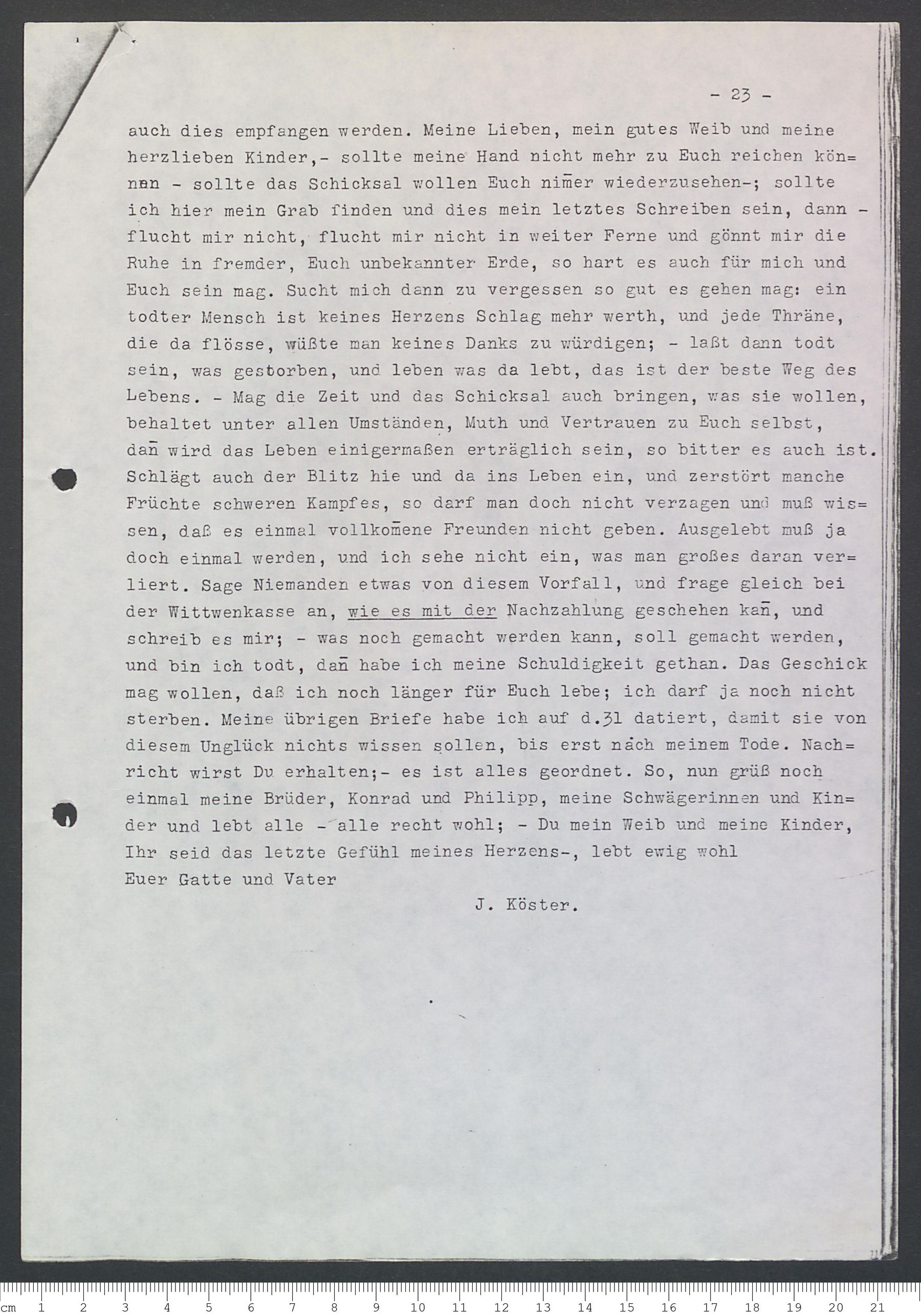
Page header: – 23 – · End of the collapse letter — ⭐ the post-dating confirmed in his own words
…auch dies empfangen werden. Meine Lieben, mein gutes Weib und meine herzlieben Kinder, – sollte meine Hand nicht mehr zu Euch reichen können – sollte das Schicksal wollen Euch nimmer wiederzusehen–; sollte ich hier mein Grab finden und dies mein letztes Schreiben sein, dann – flucht mir nicht, flucht mir nicht in weiter Ferne und gönnt mir die Ruhe in fremder, Euch unbekannter Erde, so hart es auch für mich und Euch sein mag.
Sucht mich dann zu vergessen so gut es gehen mag: ein todter Mensch ist keines Herzens Schlag mehr werth, und jede Thräne, die da flösse, wüßte man keines Danks zu würdigen; – laßt dann todt sein, was gestorben, und leben was da lebt, das ist der beste Weg des Lebens.
Mag die Zeit und das Schicksal auch bringen, was sie wollen, behaltet unter allen Umständen, Muth und Vertrauen zu Euch selbst, dann wird das Leben einigermaßen erträglich sein, so bitter es auch ist. Schlägt auch der Blitz hie und da ins Leben ein, und zerstört manche Früchte schweren Kampfes, so darf man doch nicht verzagen und muß wissen, daß es einmal vollkommene Freuden nicht geben. Ausgelebt muß ja doch einmal werden, und ich sehe nicht ein, was man großes daran verliert.
Sage Niemanden etwas von diesem Vorfall, und frage gleich bei der Wittwenkasse an, wie es mit der Nachzahlung geschehen kann, und schreib es mir; – was noch gemacht werden kann, soll gemacht werden, und bin ich todt, dann habe ich meine Schuldigkeit gethan. Das Geschick mag wollen, daß ich noch länger für Euch lebe; ich darf ja noch nicht sterben.
Meine übrigen Briefe habe ich auf d. 31 datiert, damit sie von diesem Unglück nichts wissen sollen, bis erst nach meinem Tode. Nachricht wirst Du erhalten;– es ist alles geordnet.
So, nun grüß noch einmal meine Brüder, Konrad und Philipp, meine Schwägerinnen und Kinder und lebt alle – alle recht wohl; – Du mein Weib und meine Kinder, Ihr seid das letzte Gefühl meines Herzens–, lebt ewig wohl. Euer Gatte und Vater J. Köster.
…this too will be received. My dear ones, my good wife and my heart's-dear children — should my hand no longer be able to reach you, should fate decree that I never see you again, should I find my grave here and this be my last letter, then: do not curse me. Do not curse me at this distance, and grant me my rest in foreign earth unknown to you, hard as it may be for me and for you.
Then try to forget me as best you can. A dead man is no longer worth a heartbeat, and no tear that might be shed could be thanked as it deserves. Let what has died be dead, and let what lives live — that is the best way of life.
Whatever time and fate may bring, keep your courage and your confidence in yourselves under all circumstances; then life will be tolerable enough, bitter as it is. If lightning strikes into a life here and there and destroys some fruits of hard struggle, one must still not despair, and must know that perfect joys are not to be had. One's life must be lived out sometime, and I cannot see what great thing is lost by it.
Say nothing to anyone about this incident, and enquire at once at the widows' fund how the back-payment can be managed, and write and tell me. What can still be done shall be done; and if I am dead, then I have done my duty. Fate may will that I live longer for you yet — I must not die just now.
I have dated my other letters to the 31st, so that they shall know nothing of this misfortune until after my death. You will receive word; everything is arranged.
So, greet my brothers Konrad and Philipp once more, my sisters-in-law and their children, and fare you all — all — right well. You, my wife and my children, are the last feeling of my heart. Farewell for ever. Your husband and father, J. Köster.
⭐⭐ THE POST-DATING, CONFIRMED IN-IMAGE: „Meine übrigen Briefe habe ich auf d. 31 datiert, damit sie von diesem Unglück nichts wissen sollen, bis erst nach meinem Tode.“ the note of 18–19 Jul 2026 recorded this from OCR; it is now verified against the scan. Taken with the false Louisville dateline (12 Dec 1860, img 0063), it establishes two distinct falsifications in his correspondence — of place and of date — both deliberate, both explained by him in writing. This is the documentary core of the Köster concealment model. ⚠️ But note what the object of this deception is: he is post-dating to spare his family news of his collapse, not to defeat pursuit. The two falsifications have different motives and should not be merged into one. ⭐ He instructs her to tell nobody and, in the same breath, to ask the Wittwenkasse about back-payments — the practical and the fatalistic side by side. ⭐ The burial passage — „gönnt mir die Ruhe in fremder, Euch unbekannter Erde“, and the instruction to forget him — is the emotional peak of the series, and worth setting against the 1872 photograph inscription on img 0109, written eleven years later: „vergib! Die Buße war lang!“
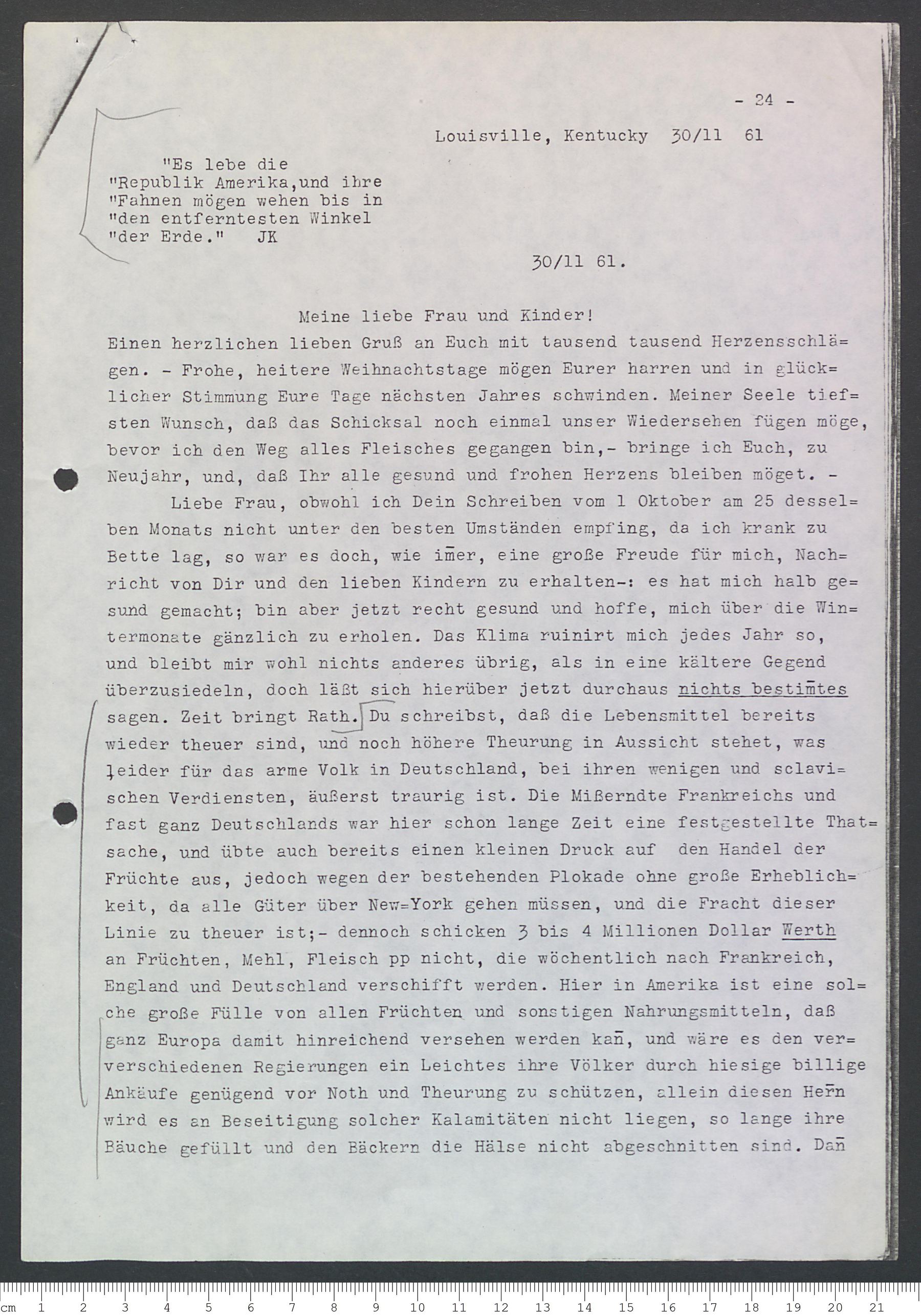
Page header: – 24 – · ⭐⭐ „Louisville, Kentucky 30/11 61“ — the false dateline again, five days after the collapse
Louisville, Kentucky 30/11 61
[motto, top left:] „Es lebe die Republik Amerika, und ihre Fahnen mögen wehen bis in den entferntesten Winkel der Erde.“ JK
30/11 61. — Meine liebe Frau und Kinder!
Einen herzlichen lieben Gruß an Euch mit tausend tausend Herzensschlägen. – Frohe, heitere Weihnachtstage mögen Eurer harren und in glücklicher Stimmung Eure Tage nächsten Jahres schwinden. Meiner Seele tiefsten Wunsch, daß das Schicksal noch einmal unser Wiedersehen fügen möge, bevor ich den Weg alles Fleisches gegangen bin, – bringe ich Euch, zu Neujahr, und, daß Ihr alle gesund und frohen Herzens bleiben möget.
Liebe Frau, obwohl ich Dein Schreiben vom 1 Oktober am 25 desselben Monats nicht unter den besten Umständen empfing, da ich krank zu Bette lag, so war es doch, wie immer, eine große Freude für mich, Nachricht von Dir und den lieben Kindern zu erhalten–: es hat mich halb gesund gemacht; bin aber jetzt recht gesund und hoffe, mich über die Wintermonate gänzlich zu erholen.
Das Klima ruinirt mich jedes Jahr so, und bleibt mir wohl nichts anderes übrig, als in eine kältere Gegend überzusiedeln, doch läßt sich hierüber jetzt durchaus nichts bestimmtes sagen. Zeit bringt Rath.
Du schreibst, daß die Lebensmittel bereits wieder theuer sind, und noch höhere Theurung in Aussicht stehet, was leider für das arme Volk in Deutschland, bei ihren wenigen und sclavischen Verdiensten, äußerst traurig ist. Die Mißerndte Frankreichs und fast ganz Deutschlands war hier schon lange Zeit eine festgestellte Thatsache, und übte auch bereits einen kleinen Druck auf den Handel der Früchte aus, jedoch wegen der bestehenden Plokade ohne große Erheblichkeit, da alle Güter über New-York gehen müssen, und die Fracht dieser Linie zu theuer ist;– dennoch schicken 3 bis 4 Millionen Dollar Werth an Früchten, Mehl, Fleisch pp nicht, die wöchentlich nach Frankreich, England und Deutschland verschifft werden.
Hier in Amerika ist eine solche große Fülle von allen Früchten und sonstigen Nahrungsmitteln, daß ganz Europa damit hinreichend versehen werden kann, und wäre es den verschiedenen Regierungen ein Leichtes ihre Völker durch hiesige billige Ankäufe genügend vor Noth und Theurung zu schützen, allein diesen Herrn wird es an Beseitigung solcher Kalamitäten nicht liegen, so lange ihre Bäuche gefüllt und den Bäckern die Hälse nicht abgeschnitten sind. Dann…
Louisville, Kentucky, 30 November 1861
[motto, top left:] "Long live the Republic of America, and may her flags wave into the remotest corner of the earth." JK
30 November 1861. — My dear wife and children!
A warm, loving greeting to you with a thousand thousand heartbeats. May glad, bright Christmas days await you, and may your days next year pass in happy spirits. My soul's deepest wish — that fate may grant us one more meeting before I have gone the way of all flesh — I bring you at the New Year, together with the wish that you all stay healthy and cheerful of heart.
Dear wife, although I received your letter of 1 October on the 25th of the same month under less than the best circumstances, being ill in bed, it was nonetheless, as always, a great joy to me to have news of you and the dear children: it half made me well. But I am now quite well and hope to recover completely over the winter months.
The climate ruins me like this every year, and I shall probably have no choice but to move to a colder region — though nothing definite whatever can be said about it at present. Time will counsel.
You write that provisions are already dear again, and higher prices still in prospect, which is deeply sad for the poor people in Germany with their meagre and slavish earnings. The failed harvest of France and of almost all Germany has been an established fact here for a long time, and has already put a little pressure on the produce trade — though without great consequence, because of the existing blockade, since all goods have to go by way of New York and the freight on that line is too dear. Even so, three to four million dollars' worth of produce, flour, meat and so on are shipped weekly to France, England and Germany.
Here in America there is such a great abundance of all produce and other foodstuffs that the whole of Europe could be adequately supplied from it; and it would be an easy matter for the various governments to protect their peoples sufficiently from want and dearth by cheap purchases here. But these gentlemen will not trouble themselves about relieving such calamities so long as their own bellies are full and the bakers' throats are not cut.
⭐⭐ THE SECOND FALSE DATELINE, verified in-image — „Louisville, Kentucky 30/11 61“ — and the timing is the point: this is five days after the collapse letter, written from his sickbed in St. Louis. Even half-dead he kept the deception running. With img 0066 this is the second of the two known instances, both now checked against the scan. ⭐⭐ THE MOVE TO BLOOMINGTON IS PREFIGURED HERE, with a reason. „Das Klima ruinirt mich jedes Jahr so, und bleibt mir wohl nichts anderes übrig, als in eine kältere Gegend überzusiedeln.“ The project knew he was in Bloomington, Illinois by about 1870 but not why or when he decided; the intention is stated in November 1861 and the reason is his health, not the fraud of 1862. ⭐ He was an outspoken Unionist — the letter opens with a motto in his own hand: long live the Republic of America. Worth setting beside his silence on American slavery (see p. 8 note). ⭐⭐ A EUROPEAN FOOD CRISIS IN LATE 1861, reported from the American side: failed harvests in France and almost all Germany, prices rising at home, and 3–4 million dollars of produce shipped weekly to Europe despite the blockade forcing everything through New York. This is a live emigration push-factor in exactly Charles's window, and a direct parallel to the 1846–47 famine material in Chapter 1 — worth folding into the Hesse chapter. ⭐ Transit time confirmed again: her letter of 1 October reached him on 25 October (~3½ weeks), matching the ~4 weeks westbound he gives on p. 16.
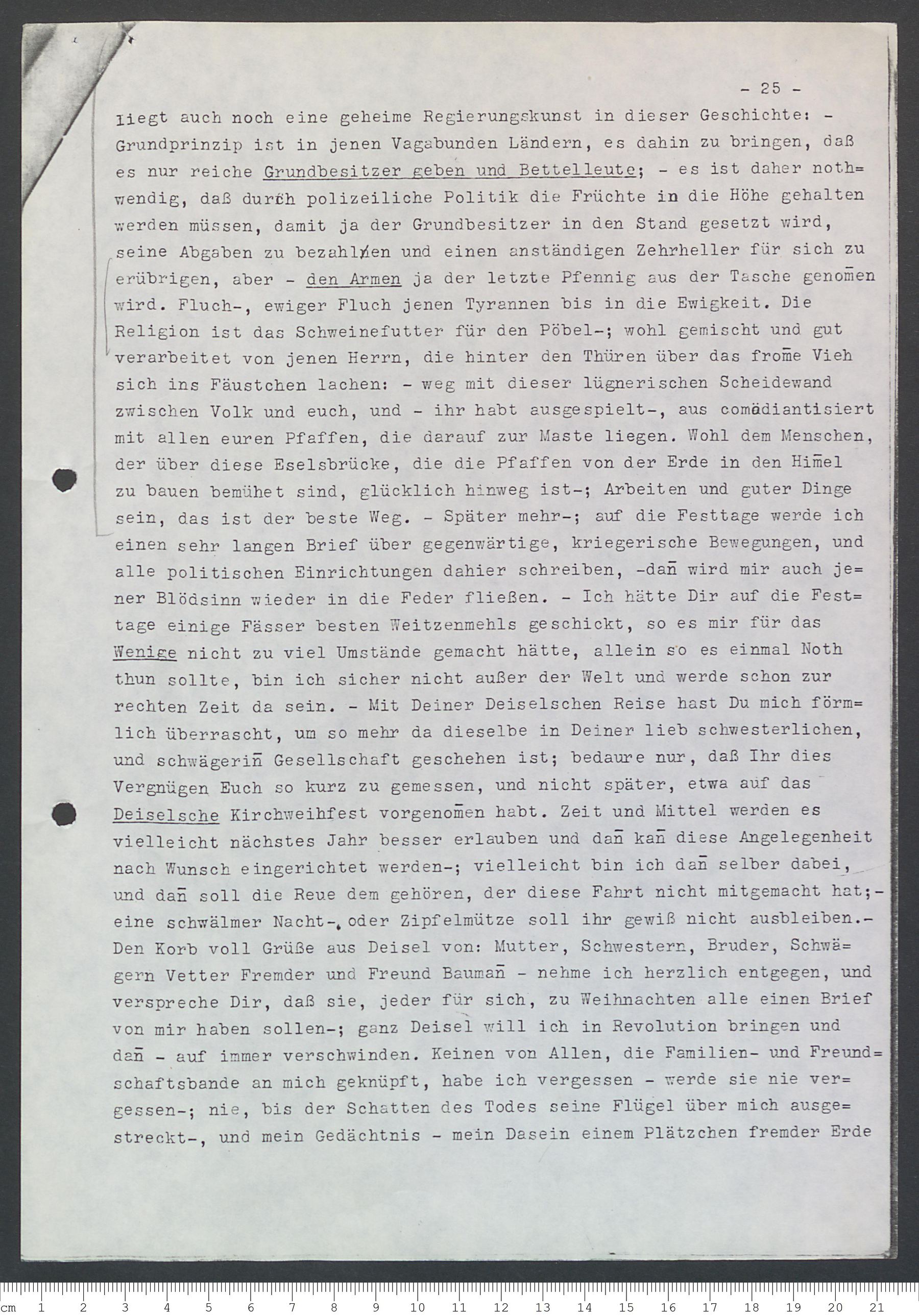
Page header: – 25 – · 30 November 1861, continued — ⭐⭐ the forty-eighter speaking plainly, and a promised Christmas mailing to all Deisel
…liegt auch noch eine geheime Regierungskunst in dieser Geschichte: – Grundprinzip ist in jenen Vagabunden Ländern, es dahin zu bringen, daß es nur reiche Grundbesitzer geben und Bettelleute; – es ist daher nothwendig, daß durch polizeiliche Politik die Früchte in die Höhe gehalten werden müssen, damit ja der Grundbesitzer in den Stand gesetzt wird, seine Abgaben zu bezahlen und einen anständigen Zehrheller für sich zu erübrigen, aber – den Armen ja der letzte Pfennig aus der Tasche genommen wird. Fluch–, ewiger Fluch jenen Tyrannen bis in die Ewigkeit.
Die Religion ist das Schweinefutter für den Pöbel–; wohl gemischt und gut verarbeitet von jenen Herrn, die hinter den Thüren über das fromme Vieh sich ins Fäustchen lachen: – weg mit dieser lügnerischen Scheidewand zwischen Volk und euch, und – ihr habt ausgespielt–, aus comödiantisiert mit allen euren Pfaffen, die darauf zur Maste liegen. Wohl dem Menschen, der über diese Eselsbrücke, die die Pfaffen von der Erde in den Himmel zu bauen bemühet sind, glücklich hinweg ist–; Arbeiten und guter Dinge sein, das ist der beste Weg.
Später mehr–; auf die Festtage werde ich einen sehr langen Brief über gegenwärtige, kriegerische Bewegungen, und alle politischen Einrichtungen dahier schreiben, – dann wird mir auch jener Blödsinn wieder in die Feder fließen. – Ich hätte Dir auf die Festtage einige Fässer besten Weitzenmehls geschickt, so es mir für das Wenige nicht zu viel Umstände gemacht hätte, allein so es einmal Noth thun sollte, bin ich sicher nicht außer der Welt und werde schon zur rechten Zeit da sein.
Mit Deiner Deiselschen Reise hast Du mich förmlich überrascht, um so mehr da dieselbe in Deiner lieb schwesterlichen, und schwägerin Gesellschaft geschehen ist; bedaure nur, daß Ihr dies Vergnügen Euch so kurz zu gemessen, und nicht später, etwa auf das Deiselsche Kirchweihfest vorgenommen habt. Zeit und Mittel werden es vielleicht nächstes Jahr besser erlauben und dann kann diese Angelegenheit nach Wunsch eingerichtet werden–; vielleicht bin ich dann selber dabei, und dann soll die Reue dem gehören, der diese Fahrt nicht mitgemacht hat;– eine schwälmer Nacht-, oder Zipfelmütze soll ihr gewiß nicht ausbleiben.
Den Korb voll Grüße aus Deisel von: Mutter, Schwestern, Bruder, Schwägern, Vetter Fremder und Freund Baumann – nehme ich herzlich entgegen, und verspreche Dir, daß sie, jeder für sich, zu Weihnachten alle einen Brief von mir haben sollen–; ganz Deisel will ich in Revolution bringen und dann – auf immer verschwinden.
Keinen von Allen, die Familien- und Freundschaftsbande an mich geknüpft, habe ich vergessen – werde sie nie vergessen–; nie, bis der Schatten des Todes seine Flügel über mich ausgestreckt–, und mein Gedächtnis – mein Dasein einem Plätzchen fremder Erde…
…there is also a secret art of government in this business. The basic principle in those vagabond countries is to bring it about that there shall be nothing but rich landowners and beggars. It is therefore necessary that produce be kept high by police policy, so that the landowner is put in a position to pay his dues and to spare a decent penny for himself — but the poor have the last penny taken out of their pockets. A curse, an eternal curse on those tyrants to all eternity.
Religion is the pig-swill for the mob — well mixed and well worked up by those gentlemen who laugh up their sleeves behind closed doors at the pious cattle. Away with this lying partition wall between the people and you, and you are finished, played out, along with all your priests who lie fattening on it. Well for the man who has got safely over that donkey-bridge which the priests take such pains to build from earth to heaven. To work, and to be of good cheer — that is the best way.
More later. For the holidays I shall write a very long letter about the present military movements and all the political arrangements here — and then that nonsense will flow from my pen again. I would have sent you a few barrels of the best wheat flour for the holidays, if it had not been too much trouble for so little; but if it should ever come to real need, I am certainly not out of the world and shall be there at the right time.
Your journey to Deisel took me quite by surprise, the more so as it was made in the company of your dear sister and sister-in-law. I only regret that you allowed yourselves so short a pleasure, and did not undertake it later, at the Deisel church-dedication feast. Time and means may allow it better next year, and then the thing can be arranged as one would wish — perhaps I shall be there myself, and then let the regret belong to whoever did not come on the trip. A Schwalm nightcap will certainly not be wanting to her.
The basketful of greetings from Deisel — from mother, sisters, brother, brothers-in-law, cousin Fremder and friend Baumann — I accept warmly, and I promise you that every one of them shall have a letter from me, each for himself, at Christmas. I mean to bring the whole of Deisel into revolution, and then — vanish for ever.
None of all those bound to me by family and friendship have I forgotten — I shall never forget them; never, until the shadow of death has stretched its wings over me, and my memory, my existence, [is committed] to a little patch of foreign earth…
⭐⭐ THE FORTY-EIGHTER, UNMISTAKABLE. The Personalkarte (img 0010) records that Köster was „von 48er Revolution beeinflusst“ and nicht kirchlich. This page is that record's evidence, in his own words: a class analysis of Hessian government (keep grain dear so landlords can pay their dues while the poor are stripped), an eternal curse on jene Tyrannen, and an anticlericalism of real ferocity — religion as swill for the mob, priests fattening on a lying partition wall. Third independent corroboration of the Personalkarte, after the mother's birth date (p. 17) and brother Heinrich's wife (p. 19). ⭐⭐ A LEAD WORTH CHASING: a batch of letters to Deisel at Christmas 1861. „sie, jeder für sich, zu Weihnachten alle einen Brief von mir haben sollen – ganz Deisel will ich in Revolution bringen und dann – auf immer verschwinden.“ ⇒ He intended to write individually to mother, sisters, brother, brothers-in-law, Vetter Fremder and Freund Baumann at Christmas 1861. Those letters would have gone into Deisel households, not into the Köster family archive at Gotha — so if any survive they are in Deisel/Hessian family hands or a local collection. This should go into the Heimatverein Deisel enquiry that is already drafted and unsent. ⚠️ Note the phrase „auf immer verschwinden“ — vanish for ever — used lightly here, but it is the same vocabulary as the concealment. ⭐ His wife made a short trip to Deisel in autumn 1861 with her sister and sister-in-law; he wishes it had been at the Deiselsche Kirchweihfest. A dated village festival and a dated family visit, both usable in the Hesse chapter. ⭐ „eine schwälmer Nacht- oder Zipfelmütze“ — a Schwalm nightcap, a regional costume reference.
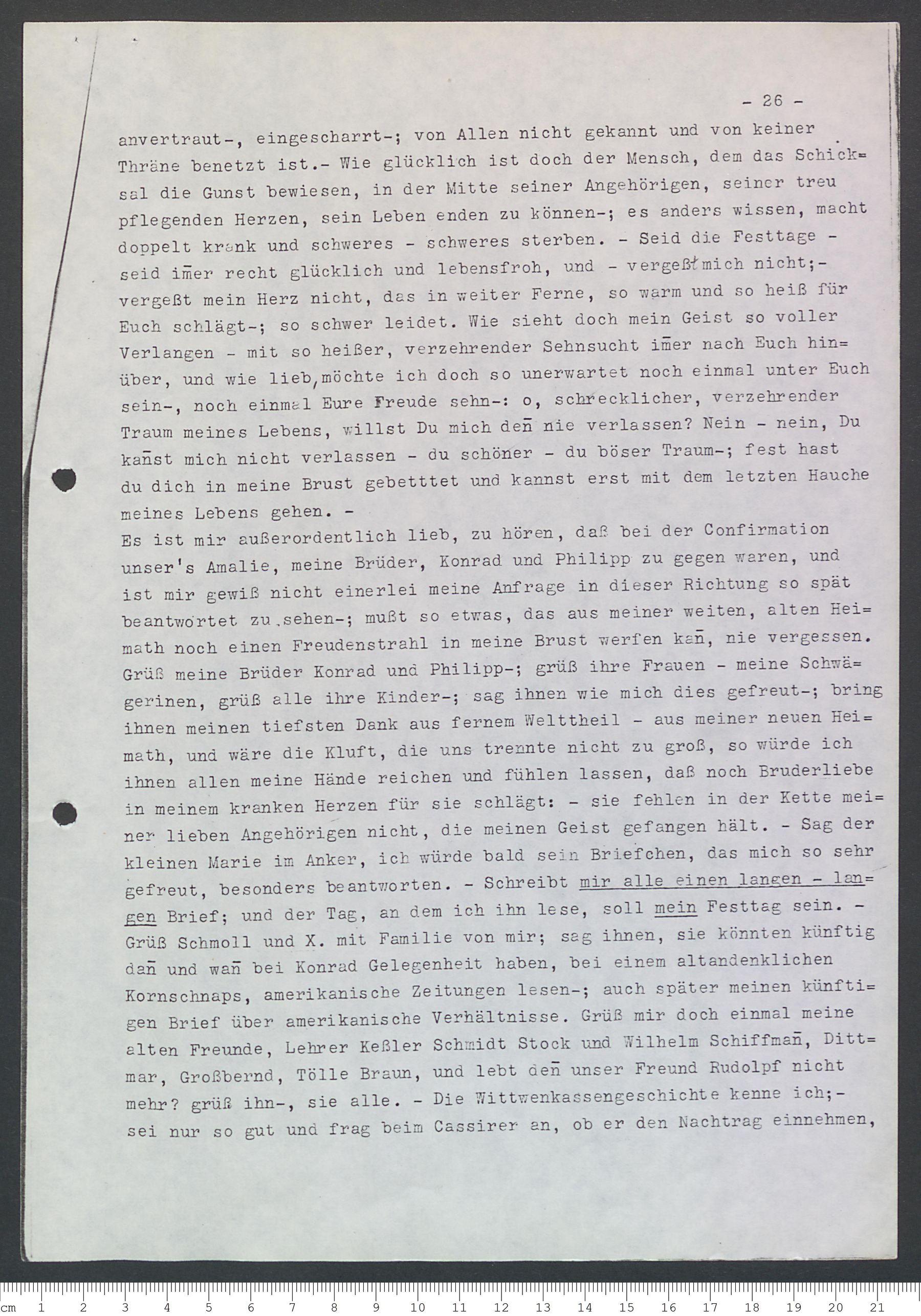
Page header: – 26 – · 30 November 1861, continued — Amalie's confirmation, and a long greeting list
…anvertraut–, eingescharrt–; von Allen nicht gekannt und von keiner Thräne benetzt ist. – Wie glücklich ist doch der Mensch, dem das Schicksal die Gunst bewiesen, in der Mitte seiner Angehörigen, seiner treu pflegenden Herzen, sein Leben enden zu können–; es anders wissen, macht doppelt krank und schweres – schweres sterben.
Seid die Festtage – seid immer recht glücklich und lebensfroh, und – vergeßt mich nicht;– vergeßt mein Herz nicht, das in weiter Ferne, so warm und so heiß für Euch schlägt–; so schwer leidet. Wie sieht doch mein Geist so voller Verlangen – mit so heißer, verzehrender Sehnsucht immer nach Euch hinüber, und wie lieb möchte ich doch so unerwartet noch einmal unter Euch sein–, noch einmal Eure Freude sehn–: o, schrecklicher, verzehrender Traum meines Lebens, willst Du mich denn nie verlassen? Nein – nein, Du kannst mich nicht verlassen – du schöner – du böser Traum–; fest hast du dich in meine Brust gebettet und kannst erst mit dem letzten Hauche meines Lebens gehen.
Es ist mir außerordentlich lieb, zu hören, daß bei der Confirmation unser's Amalie, meine Brüder, Konrad und Philipp zugegen waren, und ist mir gewiß nicht einerlei meine Anfrage in dieser Richtung so spät beantwortet zu sehen–; mußt so etwas, das aus meiner weiten, alten Heimath noch einen Freudenstrahl in meine Brust werfen kann, nie vergessen.
Grüß meine Brüder Konrad und Philipp–; grüß ihre Frauen – meine Schwägerinen, grüß alle ihre Kinder–; sag ihnen wie mich dies gefreut–; bring ihnen meinen tiefsten Dank aus fernem Welttheil – aus meiner neuen Heimath, und wäre die Kluft, die uns trennte nicht zu groß, so würde ich ihnen allen meine Hände reichen und fühlen lassen, daß noch Bruderliebe in meinem kranken Herzen für sie schlägt: – sie fehlen in der Kette meiner lieben Angehörigen nicht, die meinen Geist gefangen hält.
Sag der kleinen Marie im Anker, ich würde bald sein Briefchen, das mich so sehr gefreut, besonders beantworten. – Schreibt mir alle einen langen – langen Brief; und der Tag, an dem ich ihn lese, soll mein Festtag sein.
Grüß Schmoll und X. mit Familie von mir; sag ihnen, sie könnten künftig dann und wann bei Konrad Gelegenheit haben, bei einem altandenklichen Kornschnaps, amerikanische Zeitungen lesen–; auch später meinen künftigen Brief über amerikanische Verhältnisse. Grüß mir doch einmal meine alten Freunde, Lehrer Keßler, Schmidt, Stock und Wilhelm Schiffmann, Dittmar, Großbernd, Tölle, Braun, und lebt denn unser Freund Rudolph nicht mehr? grüß ihn–, sie alle.
Die Wittwenkassengeschichte kenne ich;– sei nur so gut und frag beim Cassirer an, ob er den Nachtrag einnehmen…
…committed, shovelled under, known by none and wetted by no tear. How happy is the man to whom fate has shown the favour of being able to end his life in the midst of his own people, of hearts that faithfully tend him; to know it otherwise makes a man doubly ill, and dying hard — hard.
Be happy at the holidays, be always happy and glad of life — and do not forget me. Do not forget my heart, which beats for you so warm and so hot at this great distance, and suffers so hard. How full of longing my spirit looks across to you, with such a burning, consuming yearning; and how I should love to be among you once more, all unexpected, and see your joy once more. O terrible, consuming dream of my life, will you never leave me? No — no, you cannot leave me, you lovely, you wicked dream; you have bedded yourself fast in my breast and can only go with the last breath of my life.
It is extraordinarily dear to me to hear that my brothers Konrad and Philipp were present at our Amalie's confirmation — and it is certainly not a matter of indifference to me to see my enquiry on that point answered so late. You must never forget such a thing, which can still throw a ray of joy into my breast out of my far-off old homeland.
Greet my brothers Konrad and Philipp; greet their wives, my sisters-in-law, greet all their children. Tell them how this gladdened me; bring them my deepest thanks from a distant quarter of the world, from my new homeland. And were the gulf that divides us not too great, I would reach out my hands to them all and let them feel that a brother's love still beats for them in my sick heart: they are not missing from the chain of dear kindred that holds my spirit captive.
Tell little Marie at the Anker that I shall soon answer her little letter specially — it gave me such pleasure. Write me all of you a long — long letter; and the day I read it shall be my feast day.
Greet Schmoll and X. and their families from me; tell them that in future they may now and then have the chance, at Konrad's over a good old-fashioned corn-brandy, to read American newspapers — and later my coming letter on American conditions too. Do greet my old friends for me: schoolmaster Keßler, Schmidt, Stock and Wilhelm Schiffmann, Dittmar, Großbernd, Tölle, Braun — and is our friend Rudolph no longer living? Greet him, greet them all.
I know the business with the widows' fund. Only be so good as to ask the cashier whether he can take the supplementary payment…
⭐ Amalie was confirmed in 1861, with uncles Konrad and Philipp standing in for the absent father — a dated family event, and a reminder that this is a man whose brothers deputised for him at his children's rites while he kept a second household in St. Louis. ⭐ American newspapers went home too, to be read at Konrad's over a Kornschnaps — the traffic in print ran both ways across the Atlantic, which is worth remembering before assuming Deisel was uninformed about America. ⭐ Greeting list adds Schmidt and Tölle to the corpus. ⚠️ Tölle is a surname already in this project's register work (the Tölle widow's burial, Gottsbüren 1852) — note the coincidence but do not infer a connection; these are common Hessian names and Köster's circle is Wehlheiden/Kassel as much as Deisel.
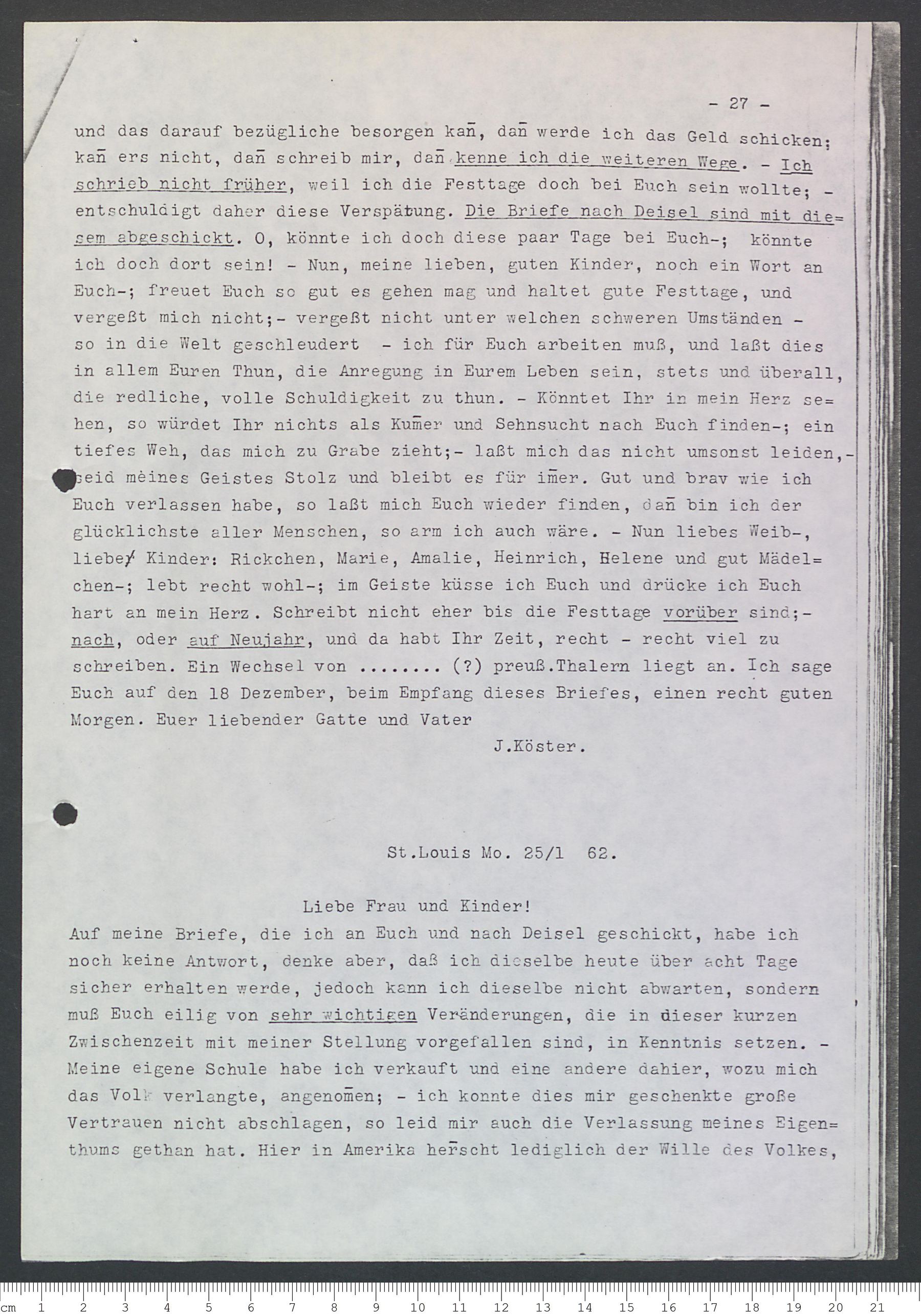
Page header: – 27 – · ⭐⭐ „Die Briefe nach Deisel sind mit diesem abgeschickt“, then St. Louis, 25 January 1862 — the school sold
…und das darauf bezügliche besorgen kann, dann werde ich das Geld schicken; kann er's nicht, dann schreib mir, dann kenne ich die weiteren Wege. – Ich schrieb nicht früher, weil ich die Festtage doch bei Euch sein wollte;– entschuldigt daher diese Verspätung. Die Briefe nach Deisel sind mit diesem abgeschickt. O, könnte ich doch diese paar Tage bei Euch–; könnte ich doch dort sein!
Nun, meine lieben, guten Kinder, noch ein Wort an Euch–; freuet Euch so gut es gehen mag und haltet gute Festtage, und vergeßt mich nicht;– vergeßt nicht unter welchen schweren Umständen – so in die Welt geschleudert – ich für Euch arbeiten muß, und laßt dies in allem Euren Thun, die Anregung in Eurem Leben sein, stets und überall, die redliche, volle Schuldigkeit zu thun.
Könntet Ihr in mein Herz sehen, so würdet Ihr nichts als Kummer und Sehnsucht nach Euch finden–; ein tiefes Weh, das mich zu Grabe zieht;– laßt mich das nicht umsonst leiden,– seid meines Geistes Stolz und bleibt es für immer. Gut und brav wie ich Euch verlassen habe, so laßt mich Euch wieder finden, dann bin ich der glücklichste aller Menschen, so arm ich auch wäre.
Nun liebes Weib–, liebe Kinder: Rickchen, Marie, Amalie, Heinrich, Helene und gut Mädelchen–; lebt recht wohl–; im Geiste küsse ich Euch und drücke ich Euch hart an mein Herz. Schreibt nicht eher bis die Festtage vorüber sind;– nach, oder auf Neujahr, und da habt Ihr Zeit, recht – recht viel zu schreiben. Ein Wechsel von …… (?) preuß. Thalern liegt an. Ich sage Euch auf den 18 Dezember, beim Empfang dieses Briefes, einen recht guten Morgen. Euer liebender Gatte und Vater J. Köster.
St. Louis Mo. 25/1 62.
Liebe Frau und Kinder!
Auf meine Briefe, die ich an Euch und nach Deisel geschickt, habe ich noch keine Antwort, denke aber, daß ich dieselbe heute über acht Tage sicher erhalten werde, jedoch kann ich dieselbe nicht abwarten, sondern muß Euch eilig von sehr wichtigen Veränderungen, die in dieser kurzen Zwischenzeit mit meiner Stellung vorgefallen sind, in Kenntnis setzen.
Meine eigene Schule habe ich verkauft und eine andere dahier, wozu mich das Volk verlangte, angenommen;– ich konnte dies mir geschenkte große Vertrauen nicht abschlagen, so leid mir auch die Verlassung meines Eigenthums gethan hat. Hier in Amerika herrscht lediglich der Wille des Volkes,…
…and can see to what relates to it, then I shall send the money; if he cannot, then write to me, and I know the other ways. I did not write sooner because I wanted after all to be with you for the holidays; forgive the delay therefore. The letters to Deisel have been sent off with this one. Oh, if only I could be with you these few days — if only I could be there!
Now, my dear good children, one more word to you: be as glad as you can, keep a good Christmas, and do not forget me. Do not forget under what hard circumstances — flung out into the world like this — I must work for you; and let this be, in everything you do, the spur of your lives, always and everywhere, to do your honest, full duty.
Could you see into my heart, you would find nothing but sorrow and longing for you — a deep ache that draws me to the grave. Do not let me suffer it for nothing: be the pride of my spirit and remain so for ever. Let me find you again as good and decent as I left you, and I shall be the happiest of men, however poor I may be.
Now, dear wife, dear children — Rickchen, Marie, Amalie, Heinrich, Helene and good little one — fare you well. In spirit I kiss you and press you hard to my heart. Do not write until the holidays are over — after, or at New Year — and then you will have time to write a great deal. A bill for …… (?) Prussian Thaler is enclosed. I wish you a very good morning on 18 December, when this letter reaches you. Your loving husband and father, J. Köster.
St. Louis, Mo., 25 January 1862.
Dear wife and children!
I have as yet no answer to the letters I sent to you and to Deisel, but think I shall certainly have it a week from today. However, I cannot wait for it, and must inform you urgently of very important changes that have occurred in my position in this short interval.
I have sold my own school and taken another here, to which the people called me. I could not refuse so great a trust bestowed on me, sorry as I was to give up my own property. Here in America nothing rules but the will of the people…
⭐⭐ THE DEISEL LETTERS WERE ACTUALLY SENT. „Die Briefe nach Deisel sind mit diesem abgeschickt.“ On p. 25 he only promised to write to each Deisel household at Christmas; here, in the same letter posted for 18 December 1861, he confirms they went out with it. And on 25 January 1862 he is still waiting on replies to „meine Briefe, die ich an Euch und nach Deisel geschickt“. ⇒ A batch of Köster letters demonstrably reached Deisel households in December 1861. This lifts the Heimatverein Deisel ask from a speculative hope to a documented dispatch — say so in the enquiry. ⭐⭐ THE SCHOOL SALE, dated 25 January 1862, and in his own framing it is not a misfortune: he sold his own school and accepted another „wozu mich das Volk verlangte“, unable to refuse the trust placed in him. The Gutberlet fraud — the buyer secretly reselling and absconding — comes later; at this point he presents the sale as a promotion by popular call. ⭐ The letter was timed to arrive 18 December 1861, a further datum on transatlantic post.
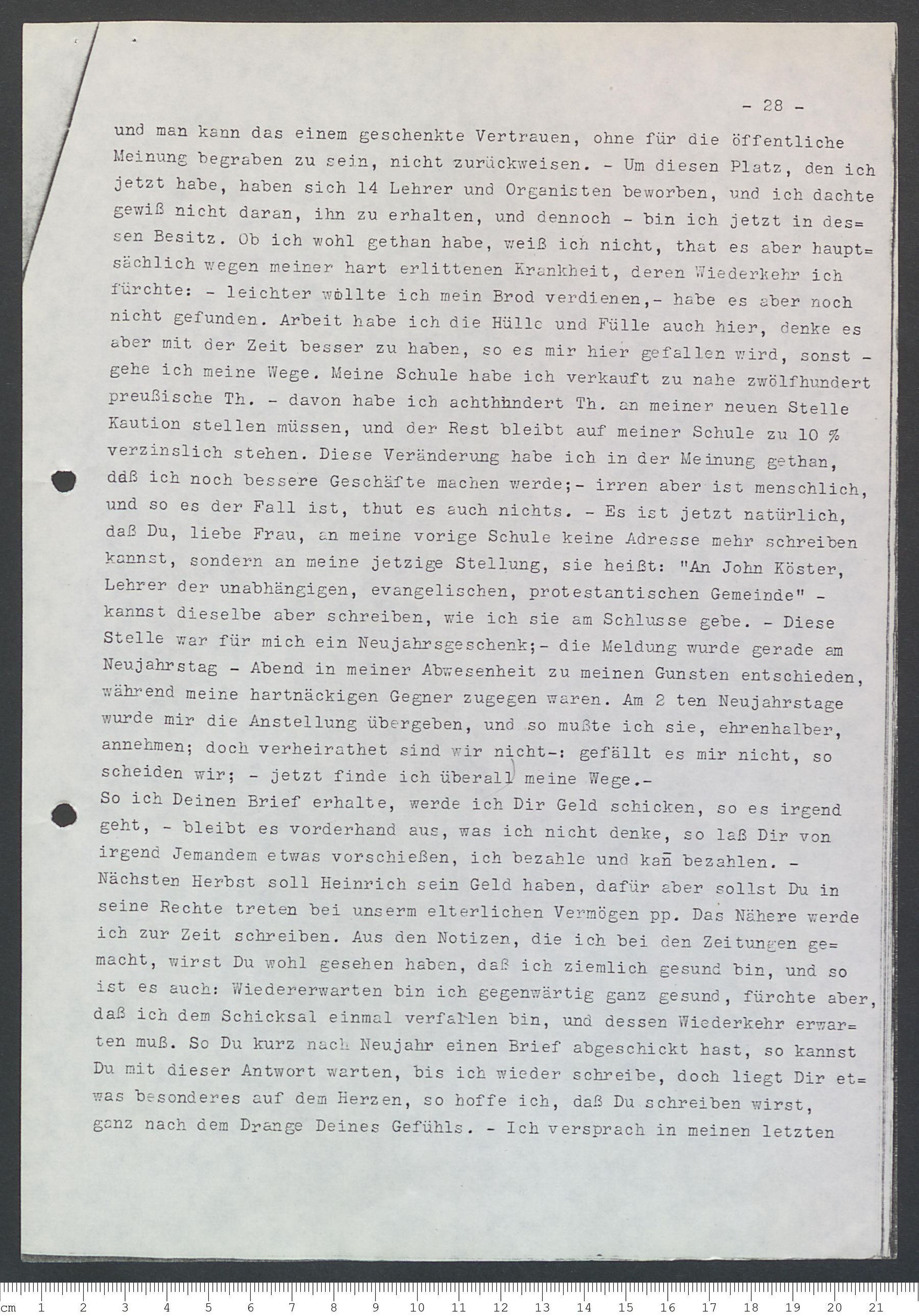
Page – 28 – · 25 January 1862, continued — the new post, and the terms of the sale
/// — 28 -
und man kann das einem geschenkte Vertrauen, ohne für die öffentliche
Meinung begraben zu sein, nicht zurückweisen. - Um diesen Platz, den ich
jetzt habe, haben sich 14 Lehrer und Organisten beworben, und ich dachte
gewiß nicht daran, ihn zu erhalten, und dennoch - bin ich jetzt in des=
sen Besitz, Ob ich wohl gethan habe, weiß ich nicht, that es aber haupt=
sächlich wegen meiner hart erlittenen ÄKrankheit, deren Wiederkehr ich
fürchte: - leichter wöllte ich mein Brod verdienen,- habe es aber noch
nicht gefunden. Arbeit habe ich die Hüllc und Fülle auch hier, denke es
äber mit der Zeit besser zu haben, so es mir hier e Lallenwıird ASsonst =
gehe ich meine Wege, Meine Schule habe ich verkauft zu nahe zwölfhundert
preußische Th. - davon habe ich achthindert Th. an meiner neuen Stelle
Kaution stellen müssen, und der Rest bleibt auf meiner Schule zu 10 %
verzinslich stehen. Diese Veränderung habe ich in der Meinung gethan, |
" daß ich noch bessere Geschäfte machen werde;- irren aber ist menschlich, |{|
und so es der Fall ist, thut es such nichts. - Es ist jetzt natürlich, !
daß Du, liebe Frau, &n meine vorige Schule keine Adresse mehr schreiben d
kannst, sondern an meine jetzige Stellung, sie heißt: "An John Köster, :
Lehrer der unabhängigen, evangelischen, protestantischen Gemeinde" _ /
kannst dieselbe aber Sschreiben, wie ich sie am Schlusse gebe. - Diese Y
Stelle war für mich ein Neujahrsgeschenk;- die Meldung wurde gerade am “
Neujahrstag - Abend in meiner Abwesenheit zu meinen Gunsten entschieden, p
während meine hartnäckigen Gegner zugegen wären. Am 2 ten Neujahrstage I%
wurde mir die Anstellung übergeben, und ‚so mußte ich sie, ehrenhalber, Ié
annehmen; doch verheirathet sind wir nicht-:; gefällt es mir nicht, so Ä
scheiden wir;z - jetzt finde ich überall meine Wege.- i
So ich Deinen Brief erhalte, werde ich Dir Geld schicken, so es irgend
. geht, - bleibt es vorderhand aus, was ich nicht denke, so 188 Dir von
irgend Jemandem etwas vorschießen, ich bezahle und kan bezahlen. —- 8
Nächsten Herbst soll Heinrich sein Geld haben, dafür aber sollst Du in ‘j
seine Rechte treten bei unserm elterlichen Vermögen pp. Das Nähere werde il
ich zur Zeit schreiben. Aus den Notizen, die ich bei den Zeitungen ge= {M
macht, wirst Du wohl gesehen haben, daß ich ziemlich gesund bin, und so ‘5
ist es auch: Wiedererwarten bin ich gegenwärtig ganz gesund, fürchte aber‚%
daß ich dem Schicksal einmal verfamMen bin, und dessen Wicderkehr erwar=- ‘„
ten muß. So Du kurz nach Neujahr einen Brief abgeschickt hast, so kannst |
Du mit dieser Antwort warten, bis ich wieder Schreibe, doch liegt Dir et= X
was besonderes auf dem Herzen, so hoffe ich, daß Du schreiben wirst, {
ganz nach dem Drange Deines Gefühls. - Ich versprach in meinen letzten ;
n 2 3 4 5 6 0 8 9 10 11 12 13 . 14 15 16 17 18 19 20 21
One cannot refuse a trust bestowed on one without being buried so far as public opinion goes. Fourteen teachers and organists applied for the place I now hold, and I certainly never thought to get it — yet I am now in possession of it.
Whether I have done well I do not know; but I did it chiefly on account of the severe illness I suffered, whose return I fear. I would rather earn my bread more easily — but I have not yet found how. Work I have in abundance here too, though I think to have it better in time; and if not, I go my own way.
I sold my school for close on twelve hundred Prussian Thaler. Of that I have had to lodge eight hundred Thaler as security at my new post, and the remainder stays on my school at 10 per cent interest. I made this change in the belief that I shall do better business still; but to err is human, and if that is the case, it does no harm either.
It follows of course that you, dear wife, can no longer write any address to my former school, but to my present position, which is called: "To John Köster, teacher of the independent evangelical protestant congregation." You can write it as I give it at the end.
This place was a New Year's gift: the announcement came on New Year's Day itself, in the evening, during my absence…
⭐ The terms of the school sale: sold for close on 1,200 preuß. Thaler; 800 Th. lodged as Kaution at the new post; the balance left on the school at 10% interest. That 800 Th. bond is what the Gutberlet fraud later put at risk. ⭐ Fourteen applicants for the new post, and he attributes taking it to fear of another collapse. ⭐ New title and address: Lehrer der unabhängigen evangelischen protestantischen Gemeinde — a congregational school, not the St. George Bürgerschule.
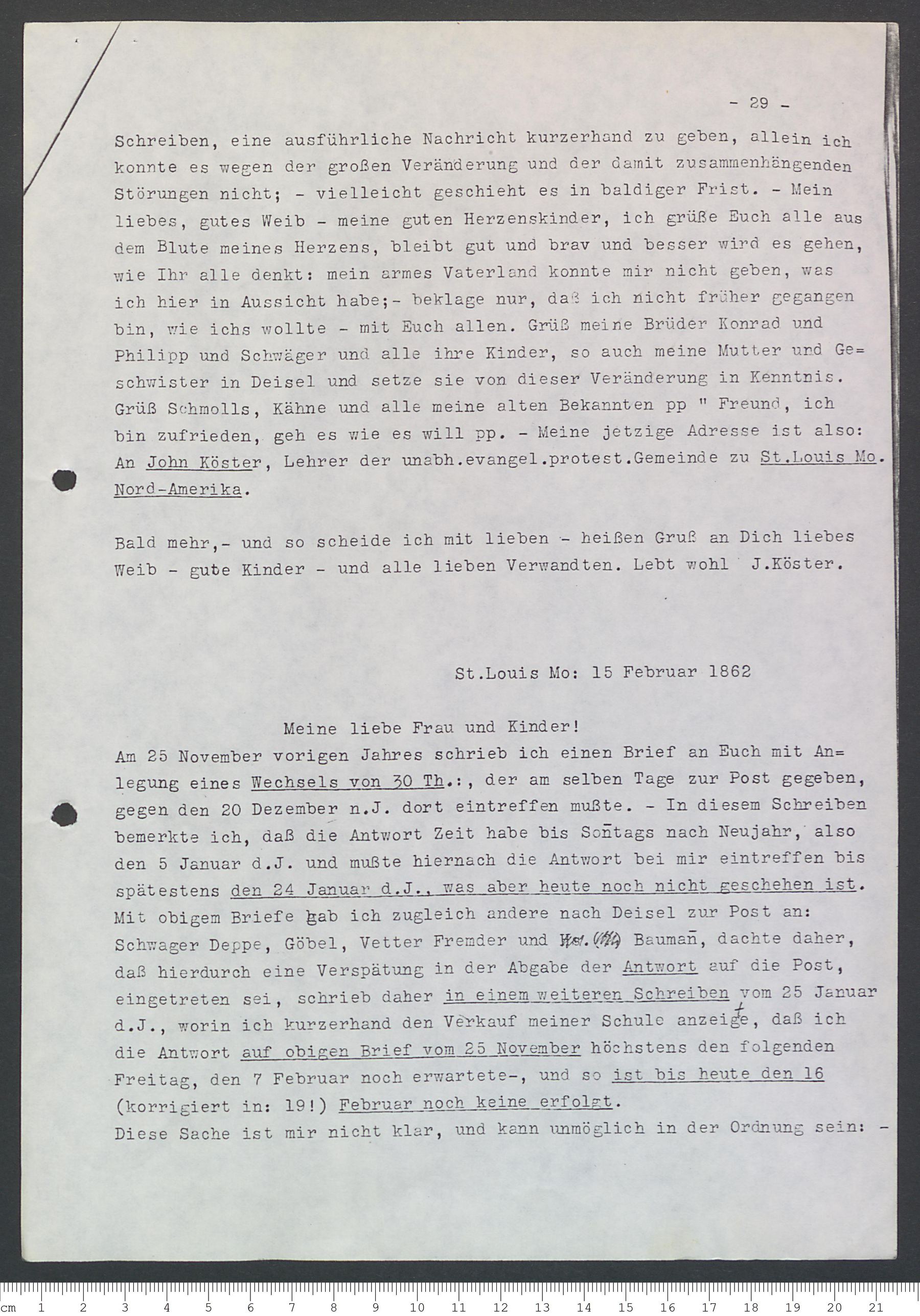
Page – 29 – · End of 25 January 1862, then St. Louis, 15 February 1862
Schreiben, eine ausführliche Nachricht kurzerhand zu geben, ällein ich _]
konnte es wegen der großen Veränderung und der damit zusammenhängenden |
Störungen nicht; - vielleicht geschieht es in baldiger Frist. - Mein
liebes, gutes Weib - meine guten Herzenskinder, ich grüße Euch alle aus
dem Blute meines Herzens, bleibt gut und brav und besser wird es gehen,
wie Ihr alle denkt: mein armes Vaterland konnte mir nicht geben, was J
ich hier in Aussicht habe;j- beklage nur, da® ich nicht früher gegangen I
bin, wie ichs wollte - mit Euch allen. Grüß meine Brüder Konrad und %
Philipp und Schwäger und alle ihre Kinder, so auch meine Mutter und ce= MM
schwister in Deisel und setze sie von dieser Veränderung in Kenntnis. i
Grüß Schmolls, Kähne und alle meine alten Bekannten pp " Freund, ich |
bin zufrieden,. geh es wie es will pp. - Meine jetzige Adresse ist also: 3
An John Köster, Lehrer der unabh.evangel.protest.Gemeinde zu St.Louis xo. f
@O |
Bald mehr,- und so scheide ich mit lieben - heißen Gruß an Dich 1liebes ä
Weib - gube Kinder - und alle lieben Verwandten. Lebt wohl J.Köster, i
St.Louis Mo: 15 Februar 1862
Meine liebe Frau und Kinder!
Am 25 November vorigen Jahres schrieb ich einen Brief an Euch mit An=
legung eines Wechsels von 30 Th.:, der am selben Tage zur Post gegeben,
. gegen den 20 Dezember n.J. dort eintreffen mußte. - In diesem Schreiben
bemerkte ich, daß die Antwort Zeit habe bis Sontags nach Neujahr, also
den 5 Januar d.J. und mußte hiernach die Antwort bei mir eintreffen bis
spätestens den 24 Januar d.J., was aber heute noch nicht geschehen ist,.
Mit obigem Briefe kab ich zugleich andere nach Deisel zur Post an:
Schwager Deppe, Göbel, Vetter Fremder und Ye/. (@%) Bauman, dachte daher,
daß hierdurch eine Verspätung in der Abgabe der Antwort auf die Post,
eingetreten sei, schrieb daher in einem;gg;ggggg_ßchreiben_Zom 25 Jamnuar
d.J., worin ich kurzerhand den Verkauf meiner Schule anzeige, daß ich
die Antwort auf_obigen Brief vom 25 _ November höchstens den folgenden
Freitag, den 7 Februar noch erwartete-, und so ist _bis _heute den 16
(korrigiert in: 19!) Februar noch _keine_erfolgt.
Diese Sache ist mir nicht klar, und kann unmöglich in der Ordnung sein: —
cm 1 Z 8 4 5 6 7 8 8 120 11 1% 13 14 15 4146 17 18. d9 260 @1
…to give you a full account at once, but because of the great change and the disturbances bound up with it I could not; perhaps it will happen before long.
My dear, good wife — my good children of my heart, I greet you all out of the blood of my heart. Stay good and decent, and things will go better than you all think: my poor fatherland could not give me what I have in prospect here. I only lament that I did not go earlier, as I wanted to — with you all.
Greet my brothers Konrad and Philipp and my brothers-in-law and all their children, and my mother and brothers and sisters in Deisel too, and let them know of this change. Greet the Schmolls, the Kähnes and all my old acquaintances. Friend, I am content, come what may.
My present address is therefore: To John Köster, teacher of the independent evangelical protestant congregation at St. Louis, Mo.
More soon — and so I part with a loving, warm greeting to you, dear wife, good children, and all dear relatives. Farewell. J. Köster.
St. Louis, Mo., 15 February 1862 — My dear wife and children!
On 25 November last year I wrote you a letter enclosing a bill for 30 Thaler, which, posted the same day, must have arrived there about 20 December. In that letter I noted that the answer might take until the Sunday after New Year, that is 5 January this year, and accordingly the answer should have reached me…
⭐ „mein armes Vaterland konnte mir nicht geben, was ich hier in Aussicht habe“ — my poor fatherland could not give me what I have in prospect here; and he regrets only that he did not go sooner, with the whole family. As clear a statement of the emigrant's calculus as the series contains. ⚠️ Name Kähne is OCR-derived and unchecked.
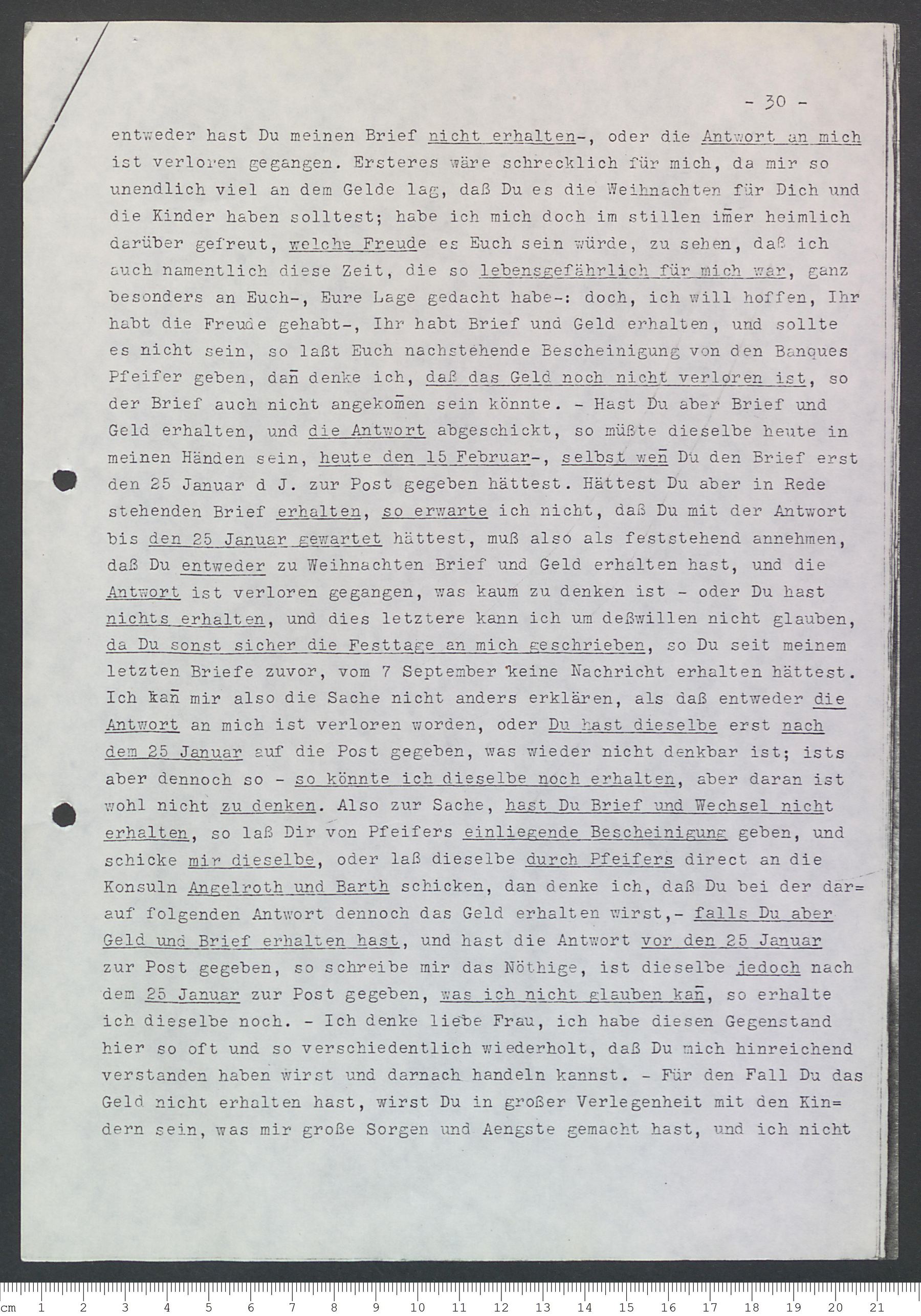
Page – 30 – · 15 February 1862 — the lost remittance
entweder hast Du meinen Brief nicht erhalten-, oder die Antwort an _mich ]
ist verloren gegangen. Ersteres wäre schrecklich für mich, da mir so
unendlich viel an dem Gelde lag, daß Du es die Weihnachten für Dich und
die Kinder haäben solltest; habe ich mich doch im stillen imer heimlich
darüber gefreut, welche Freude es Euch sein würde, zu sehen, daß ich {
äauch namentlich diese Zeit, die so lebensgefährlich für mich wär, ganz %!
besonders an Euch-, Eure Läge gedacht habe-: doch, ich will hoffen, Ihr
habt die Freuie gehabt-, Ihr habt Brief und Geld erhalten, und sollte |
es nicht sein, so laßt Euch nachstehende Bescheinigung von den Banaoues |
Pfeifer geben, dan denke ich, daß das Geld noch nicht verloren ist, so '
der Brief auch nicht angekomen sein könnte. - Hast Du aber Brief und L
Geld erhalten, und die Antwort abgeschickt, so müßte dieselbe heute in ‘j
meinen Händen sein, heute den 15 Februar-, selbst wen Du den Brief erst H
. den 25 Januvar d J. zur Post gegeben hättest. Hättest Du aber in Rede l
stehenden Brief erhalten, so _erwarte ich nicht, daß Du mit der Antwort }
bis den 25 _ Januar_gewartet hättest, muß also als feststehend annehmen, f
daß Du entweder zu Weihnachten Brief und Geld erhalten hast, und die i$
Antwort ist verloren gegangen, was kaum zu denken ist - oder Du hast
nNichts erhalten, und dies letztere kann ich um deßwillen nicht glauben,
da _ Du _ sonst sicher die Festtage an mich geschrieben, so Du seit meinem W
letzten Briefe zuvor, vom 7 September keine Nachricht erhalten hättest. }
Ich kan mir also die Sache nicht anders erklären, als daß entweder ö }
Antwort an mich ist verloren worden, oder Du _hast _dieselbe erst nach i
dem 25 _ Januar auf die Post gegeben, was wieder nicht denkbar ist; ists ä
aber dennoch so - so_könnte ich dieselbe noch erhalten, aber daran ist €
. wohl nicht zu _ denken. Also zur Sache, hast _ Du Brief und Wechsel nicht I$
erhalten, so laß Dir von Pfeifers einliegende Bescheinigung geben, und M
schicke mir dieselbe, oder laß dieselbe durch Pfeifers direct an die ;
Konsuln Angelroth und Barth schicken, dan denke ich, daß Du bei der dar= !
auf folgenden Antwort dennoch das Geld erhalten wirst,- falls Du aber ?
Geld und Brief erhalten hast, und hast die Antwort vor _ den 25 Januar ]
zur Post gegeben, so schreibe mir das Nöthige, ist dieselbe jedoch nach z
dem 25 Januar zur Post gegeben, was _ ich nicht glauben kan, so erhalte %
ich dieselbe noch. - Ich denke liebe Frau, ich habe diesen Gegenstand :
hier so oft und so verschiedentlich wiederholt, daß Du mich hinreichend ;#
verstanden haben wirst und darnach handeln kannst. - Für den Fall Du das ]
Geld nicht erhalten hast, wirst Du in großer Verlegenheit mit den Kin= ;;
dern sein, was mir große Sorgen und Aengste gemacht hast, und ich nicht /{
cm 1 2 3 4 5 6 7 8 9 210 11 12 13 14 15 16 17 18 19 20 21
…either you have not received my letter, or the answer to me has gone astray. The former would be dreadful for me, since it mattered to me beyond measure that you should have the money for yourself and the children at Christmas. I had quietly and secretly rejoiced all along at what a joy it would be to you to see that even at that season — so dangerous to my life — I had thought quite particularly of you and of your situation. Yet I will hope you had that joy, that you received letter and money.
And if not, then have the following certificate given you by the banker Pfeifer; then I think the money is not yet lost, even if the letter should not have arrived.
But if you did receive letter and money and sent the answer off, then it should be in my hands today, today the 15th of February — even if you had not posted the letter until 25 January. Yet had you received the letter in question, I do not expect you would have waited until 25 January to answer.
So I must take it as established that either you received letter and money at Christmas and the answer has gone astray — which is scarcely thinkable — or you received nothing at all. And this last I cannot believe, since you would otherwise certainly have written to me at the holidays, having had no letter from me since my previous one of 7 September…
⭐ The remittance crisis, worked through step by step: a 30 Th. bill posted 25 November 1861, due at Kassel about 20 December, with no acknowledgement by 15 February 1862. He reasons from postal timings rather than assuming theft. ⚠️ Banker Pfeifer and all dates on this page are OCR-derived — check against the scan before citing.
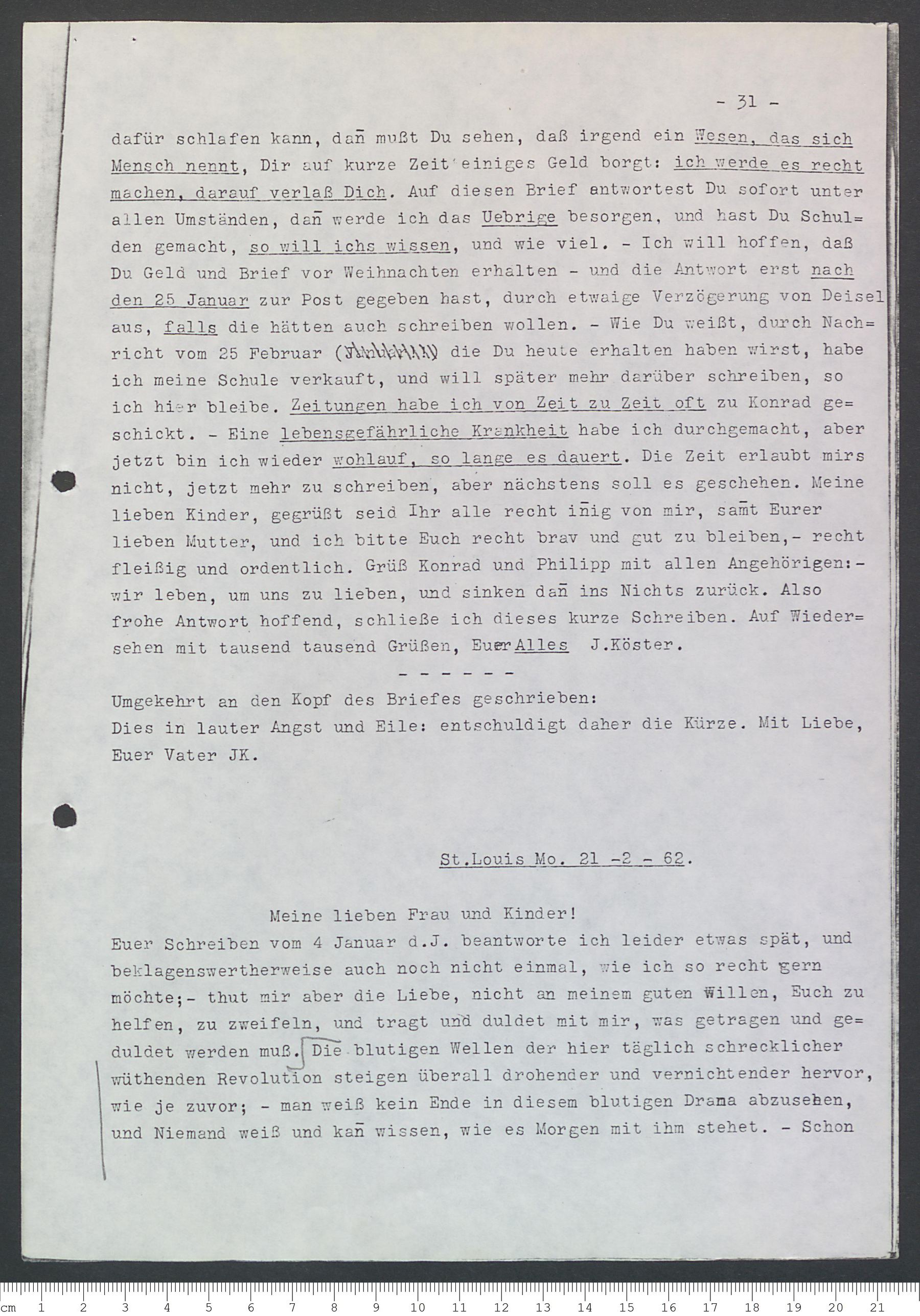
Page – 31 – · End of 15 February 1862, then a further letter
1
dafür schlafen kann, dan mvßt Du sehen, daß irgend ein Wesen, das _ sich i
Mensch nennt, Dir auf kurze Zeit‘einiges Geld borgt: ich werde _ es recht
machen, darauf verlaß Dich. Auf diesen Brief antwortest Du sofort unter
allen Umständen, dan werde ich das Uebrige besorgen, und hast Du Schul=
; den gemacht, so will ichs wissen, und wie viel. - Ich will hoffen, daß
} Du Geld und Brief vor Weihnachten erhälten - und die Antwort erst nach
} den 25 Januar zur Post gegeben hast, durch etwaige Verzögerung von Deisel
! aus, falls die hätten auch schreiben wollen. - Wie Du weißt, durch Nach= E
richt vom 25 Februar (YNAMAMN) die Du heute erhalten haben wirst, habe M}
} ich meine Schule verkauft, und will später mehr darüber schreiben, so é
j ich hirer bleibe, Zeitungen habe ich von Zeit zu Zeit _ oft zu Konrad ge= €
; schickt. - Eine lebensgefährliche Krenkheit habe ich durchgemacht, aber i
ß jetzt bin ich wieder wohlauf, so lange_es dauert. Die Zeit erlaubt mirs fi
; "’ nicht, jetzt mehr zu schreiben, aber nächstens soll es geschehen. Meine i
lieben Kinder, gegrüßt seid Ihr alle recht inig von mir, samt Eurer L
lieben Mutter, und ich bitte Euch recht brav und gut zu bleiben,- recht „
! fleißig und ordentlich. Grüß Konrad und Philipp mit allen Angehörigen: - V
ß wir leben, um uns zu lieben, und sinken dan ins Nichts zurück. Also £
i frohe Antwort hoffend, schließe ich dieses kurze Schreiben. Auf Wieder=
sehen mit tausend tausend Grüßen, EuerAlles J.Köster. J
Ea |!
| Umgekehrt an den Kopf des Briefes geschrieben: I
Dies in lauter Angst und Eile: entschuldigt daher die Kürze. Mit Liebe, ü
Euer Vater JK. @
4
StEMOUSEMO S 21 o 62) {
Meine lieben Frau und Kinder! ‚
Euer Schreiben vom 4 Januar d.J. beantworte ich leider etwas spät ‚“ und ‚4
beklagenswertherweise auch noch nicht einmal, wie ich so recht gern L
möchte;- thut mir aber die Liebe, nicht an meinem guten Wwillen, Euch zu E
helfen, zu zweifeln, und tragt umü duldet mit mir, was getragen und ge= |
duldet werden muß.{5{5 blutigen Wellen der hier täglich schrecklicher
wüthenden Revolution steigen überall drohender und vernichtender hervor,
wie je zuvor; - man weiß kein Ende in diesem blutigen Drama abzusehen,
und Niemand weiß und kan wissen, wie es Morgen mit ihm stehet. - Schon
cm 1 2 3 4 5 6 7 8 % 10° II 17 23 94 145 416 17 18 9 20 21
…if you cannot sleep for it, then you must see that some being calling itself human lends you a little money for a short time: I shall put it right, depend on that. Answer this letter at once, whatever happens, and I shall see to the rest; and if you have run into debt, I want to know it, and how much.
I will hope that you received money and letter before Christmas, and only posted the answer after 25 January, through some delay from Deisel, in case they had wanted to write too.
As you know from the news of 25 [January], which you will have received today, I have sold my school, and will write more about it later if I stay here. I have sent newspapers to Konrad often, from time to time. I have been through a life-threatening illness, but am now well again — for as long as it lasts.
Time does not allow me to write more now, but it shall be done shortly. My dear children, you are all most warmly greeted by me, together with your dear mother, and I beg you to stay good and decent, diligent and orderly. Greet Konrad and Philipp and all their households: we live in order to love one another, and then sink back into nothing. So, hoping for a glad answer, I close this short letter. Until we meet again, with a thousand thousand greetings, your everything, J. Köster.
[Written upside down at the head of the letter:] This in sheer anxiety and haste — forgive the brevity therefore. With love, your father, JK.
⚠️ Dates and the second letter's dateline on this page are OCR-derived and garbled in places; check the scan before citing any of them.
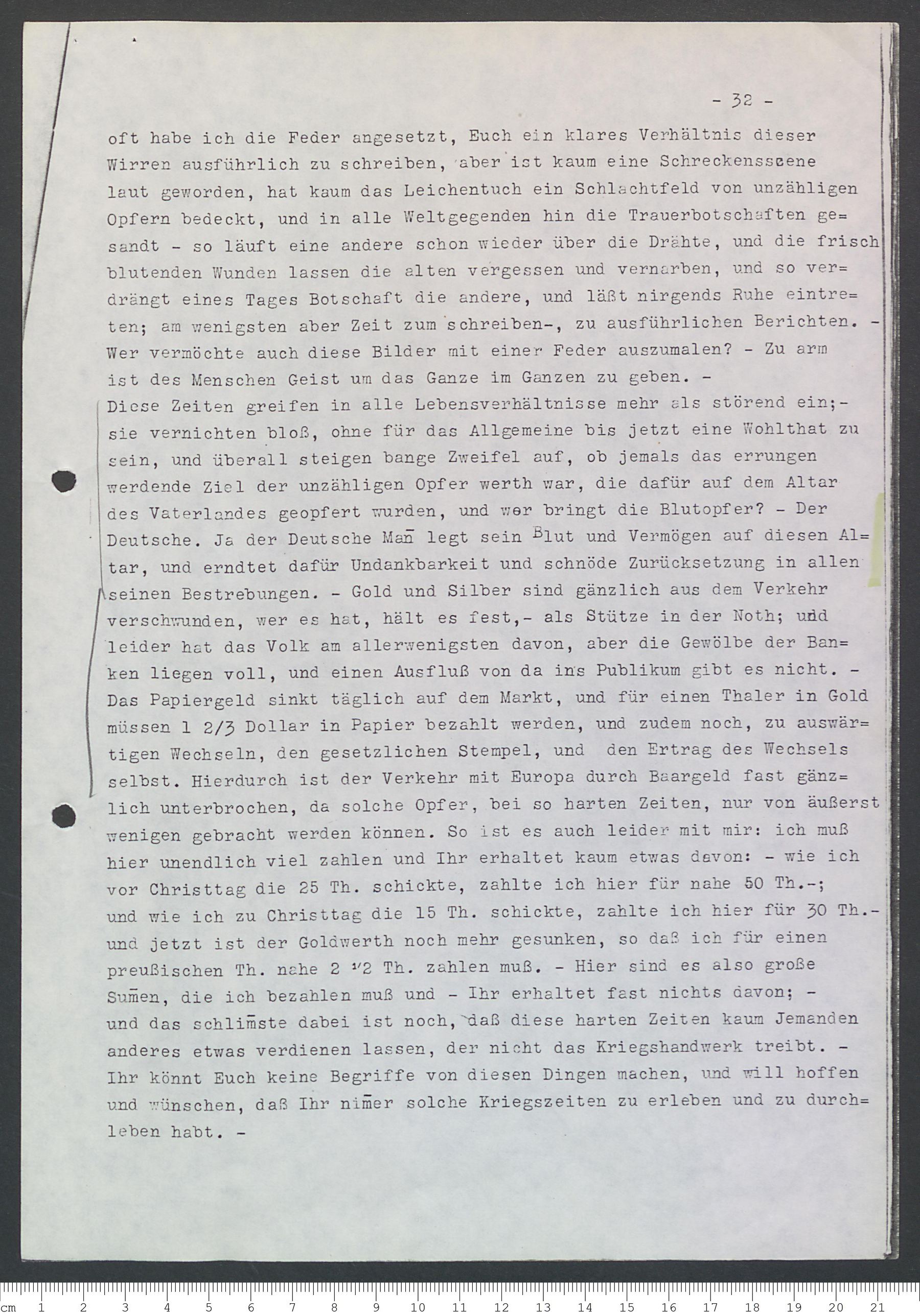
Page – 32 – · Spring 1862 — ⭐⭐ the war, and who pays for it
K a 3h
/ A ‘g
oft habe ich die Feder angesetzt, Euch ein klares Verhältnis dieser l
Wirren ausführlich zu schreiben, 'aber ist kaum eine Schreckensseene \
laut geworden, hat kaum das Leichentuch ein Schlachtfeld von unzähligen li
Opfern bedeckt, und in alle Weltgegenden hin die Trauerbotschaften ge= f
sandt - so läuft eine andere schon wieder über die Drähte, und die frisch M
blutenden Wunden lassen die alten vergessen und vernarben, und so ver= t
drängt eines Tages Botschaft die andere, und 1äßt nirgends Ruhe eintre= \
f ten; am wenigsten aber Zeit zum schreiben-, zu ausführlichen Berichten. - £
Wer vermöchte auch diese Bilder mit einer Feder auszumalen? - Zu arın {
ist des Menschen Geist um das Ganze im Ganzen zu geben. - |E
Diese Zeiten greifen in alle Lebensverhältnisse mehr &1s störend ein;- \
;sie vernichten_bloß, ohne für das Allgemeine bis jetzt eine Wohlthat zu !}
!sein‚ und überall steigen bange Zweifel auf, ob jemals das errungen E\
" äwerdende Ziel der unzähligen Opfer werth war, die dafür auf dem Altar &'
&des Vaterlandes geopfert wurden, und wer bringt die Blutopfer? — Der ;é
“|Deutsche. Ja der Deutsche Man legt sein Blut und Vermögen auf diesen Al= it
‘tar‚ und erndtet dafür Undankbarkeit und schnöde Zurücksetzung in allen ;H
\seinen Bestrebungen. - Gold und Silber sind gänzlich aus dem Verkehr '
verschwunden, wer es hst, hält es Test,- als Stütze in der Noth; undd ‘j
leider hat das Volk am allerwenigsten davon, aber die Gewölbe der Ban= ‘H
ken liegen voll, und einen Ausfluß von da ims Publikum gibt es Hicht e S ä
Das Papiergeld sinkt täglich auf dem Markt, und für einen Thaler in Gold ‘ä
müssen l 2/3 Dollar in Papier bezahlt werden, und zudem noch, zu auswär= |
tigen Wechseln, den gesetzlichen Stempel, und den Ertrag des Wechsels ]
selbst. Hierdurch ist der Verkehr mit Europa durch Baargeld fast gänz= {
'. lich unterbrochen, da solche Opfer, bei so harten Zeiten, nur von äußerst ;
wenigen gebracht werden können. So ist es auch leider mit mir: ich muß 3
hier unendlich viel zahlen und Ihr erhaltet kaum etwas devon: - wie ich ä
vor Christtag die 25 Th. schickte, zahlte ich hier für nahe 50 TH.-—; 8
und wie ich zu Christtag die 15 Th. schickte, zahlte ich hier für 30 Th. [corrected from the image, 10 Oct 2026]
und jetzt ist der Goldwerth noch mehr gesunken, so daß ich für einen i'
preußischen Th. nehe 2 ”2 Th. zahlen muß. - Hier sind es also große 5f
Sumen, die ich bezahlen muß und - Ihr erhaltet fast nichts davon; —- iä
und das schlimste dabei ist noch, daß diese harten Zeiten kaum Jemanden if
anderes etwas verdienen lassen, der nicht das Kriegshandwerk treibt. - är
Ihr könnt Euch keine Begriffe von diesen Dingen machen, und will hoffen iä
und wünschen, daß Ihr nimer solche Kriegszeiten zu erleben und zu durch= i
leben habt. -
7
cm 1 2 3 4 5 6 7 8 % 10 4I 12 23 14 145 16 2927 18 2a9 20 21
Often I have set pen to paper to write you a clear account of these confusions in detail. But scarcely has one scene of horror been noised abroad, scarcely has the shroud covered a battlefield of countless victims and the tidings of mourning been sent into every quarter of the world, than another is already running over the wires; and the freshly bleeding wounds make the old ones forgotten and scarred over. So one day's news drives out the last and lets no quiet settle anywhere — and least of all leaves time for writing, for detailed reports. And who could paint these pictures with a pen? Man's spirit is too poor to give the whole as a whole.
These times cut into every relation of life as more than a disturbance: they merely destroy, without so far being a benefit to the general good; and everywhere anxious doubts arise as to whether the goal being won was ever worth the countless victims sacrificed for it on the altar of the fatherland. And who brings the blood-sacrifice? The German. Yes, the German. He lays his blood and his property on that altar, and reaps for it ingratitude and contemptuous neglect in all his strivings.
Gold and silver have vanished entirely from circulation; whoever has it holds it fast, as a prop in time of need — and unhappily the people have least of it of all, while the vaults of the banks lie full and there is no outflow from them into the public. Paper money sinks daily on the market, and for one Thaler in gold one must pay 1⅔ dollars in paper…
⭐⭐ THE PASSAGE THAT BEARS MOST DIRECTLY ON CHARLES'S ENLISTMENT. „wer bringt die Blutopfer? — Der Deutsche. Ja der Deutsche.“ — a German in St. Louis, in 1862, saying that Germans lay blood and property on the altar and reap ingratitude and contemptuous neglect. Charles enlisted that December. This is the mood in the German community of the city in the months before he did, from inside it. ⭐⭐ HARD MONETARY DATUM: the specie premium. Gold and silver out of circulation, paper falling daily, and 1⅔ paper dollars to one gold Thaler. Directly usable in the Chapter 3 wages-and-prices work — it means every dollar figure in the 1862 letters must be read as depreciated paper, not the 1859 dollars. ⚠️ Figure is OCR-derived — verify 1 2/3 against the scan before publishing it.
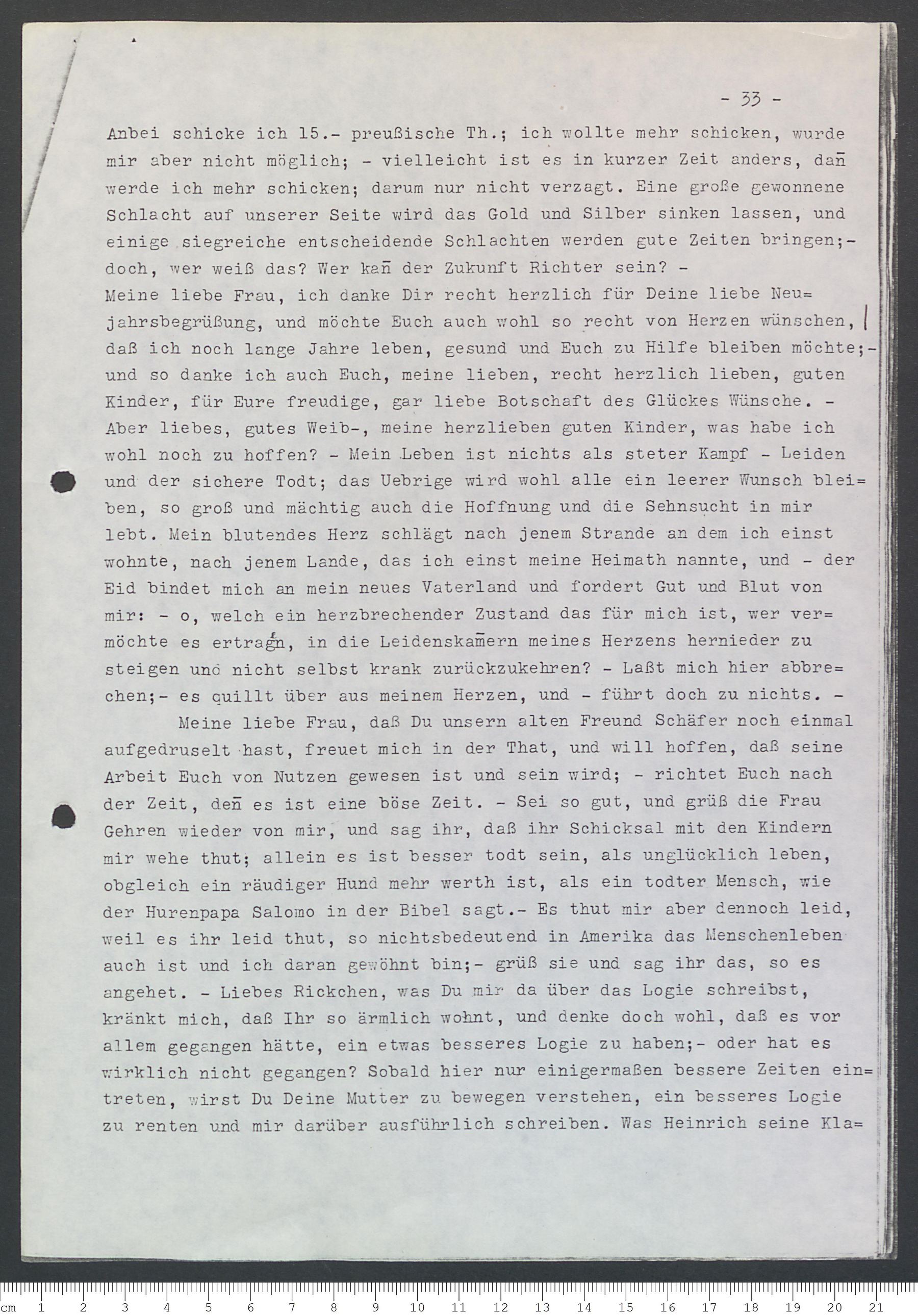
Page – 33 – · Spring 1862, continued — ⭐ the oath, and a remittance of 15 Th.
{ 3D %'
f Anbei schicke ich 15.- preußische Th.; ich wollte mehr schicken, wurde 3-
/ mir aber nicht möglich; - vielleicht ist es in kurzer Zeit anders, dan |
f werde ich mehr schicken; darum nur nicht verzagt. Eine große gewonnene
f Schlacht auf unserer Seite wird das Gold und Silber sinken lassen, und }
einige ‚siegreiche entscheidende Schlachten werden gute Zeiten bringen;-
doch, wer weiß das? Wer kan der Zukunft Richter sein? —- 8
Meine liebe Frau, ich danke Dir recht herzlich für Deine liebe Neu= E
jahrsbegrüßung, und möchte Euch auch wohl so recht von Herzen wünschen,l 3%
daß ich noch lange Jahre leben, gesund und Euch zu Hilfe bleiben möchte;-
und so danke ich auch Euch, meine lieben, recht herzlich lieben, guten !!
Kinder, für Eure freudige, gar liebe Botschaft des Glückes Wünsche. - !Ä
Aber liebes, gutes Weib-, meine herzlieben guten Kinder, was habe ich ‘j
wohl noch zu hoffen? - Mein Leben ist nichts als steter Kampf - Leiden “
. und der sichere Todt; das Uebrige wird wohl alle ein leerer Wunsch blei= | |
ben, so groß und mächtig auch die Hoffnung und die Sehnsucht in mir ;i
lebt. Mein blutendes Herz schlägt nach jenem Strande an dem ich einst i„
wohnte, nach jenem Lande, das ich einst meine Heimath nannte, und - der ÄE
Eid bindet mich an mein neues Vaterland und fordert Gut und Blut von 5L
mir: - 0, welch ein herzbrechender Zustand das für mich ist, wer ver= Ä‘
möchte es ertragn, in die Leidenskamern meines Herzens hernieder zu \i
steigen unc nicht selbst krank zurückzukehren? - Laßt mich hier abbre= ;F
chen;- es auillt über aus meinem Herzen, und - führt doch zu nichts. — Ä*
Meine liebe Frau, daß Du unsern alten Freund Schäfer noch einmal :k
aufgedruselt -:hast, freuet mich in der That, und will hoffen, daß seine ;r
Arbeit Euch von Nutzen gewesen ist und sein wird; - richtet Euch nach 1F
der Zeit, den es ist eine böse Zeit. —- Sei so gut, und grüß die Frau 1
l' Gehren wieder von mir, und sag ihr, daß ihr Schicksal mit den Kindern jf
mir wehe thut;z allein es ist besser todt sein, als unglücklich Heben? .Ü
obgleich ein räudiger Hund mehr werth ist, als ein todter Mensch, wie I
der Hurenpapa Salomo in der Bibel sagt.- Es thut mir aber dennoch Jyeixd; ?
weil es ihr leid thut, so nichtsbedeutend in Amerika das Menschenleben ?‘
auch ist und ich daran gewöhnt binz- grüß sie und sag ihr das, so es lä
angehet. - Liebes Rickchen, was Du mir da über das Logie schreibst, {l
kränkt mich, daß Ihr so ärmlich wohnt, und denke doch wohl, daß es vor |
allem gegengen hätte, ein etwas besseres Logie zu haben;- oder hat es 1i
wirklich nicht gegangen? Sobald hier nur einigermaßen bessere Zeiten eine)
treten, wirst Du Deine Mutter zu bewegen verstehen, ein besseres Logie
zu renten und mir darüber ausführlich schreiben. Was Heinrich seine Kla= H
cm 1 3 3 4 5 6 T 8 9 10 11 12 13 . 14 15 16 17 18 19 20 21
Enclosed I send 15 Prussian Thaler. I wanted to send more but it was not possible for me; perhaps it will be otherwise before long, and then I shall send more — so do not lose heart. One great battle won on our side will bring gold and silver down, and a few victorious, decisive battles will bring good times. Yet who knows? Who can be judge of the future?
My dear wife, I thank you most warmly for your loving New Year's greeting, and would wish you too, from the heart, that I might live many years yet, stay healthy and remain a help to you. And so I thank you also, my dear, heartily dear, good children, for your joyful and most loving message of good wishes.
But dear, good wife, my heart's-dear good children, what have I left to hope for? My life is nothing but constant struggle, suffering, and certain death; the rest will all remain an empty wish, however great and powerful the hope and the longing that live in me.
My bleeding heart beats towards that shore where I once lived, towards that land I once called my home — and the oath binds me to my new fatherland and demands goods and blood of me. Oh, what a heart-breaking condition that is for me; who could bear to climb down into the chambers of suffering in my heart and not come back sick himself? Let me break off here; it wells over out of my heart, and leads to nothing after all.
⭐⭐ „der Eid bindet mich an mein neues Vaterland und fordert Gut und Blut von mir“ — the oath binds me to my new fatherland and demands goods and blood of me. He had evidently taken the citizenship oath, and read it in 1862 as a claim on his life. For a project tracing a man who enlisted in December 1862, this is the clearest statement in the series of what naturalisation was understood to oblige. ⭐ He expects a decisive Union victory to break the specie premium — the war and the household budget in one sentence.
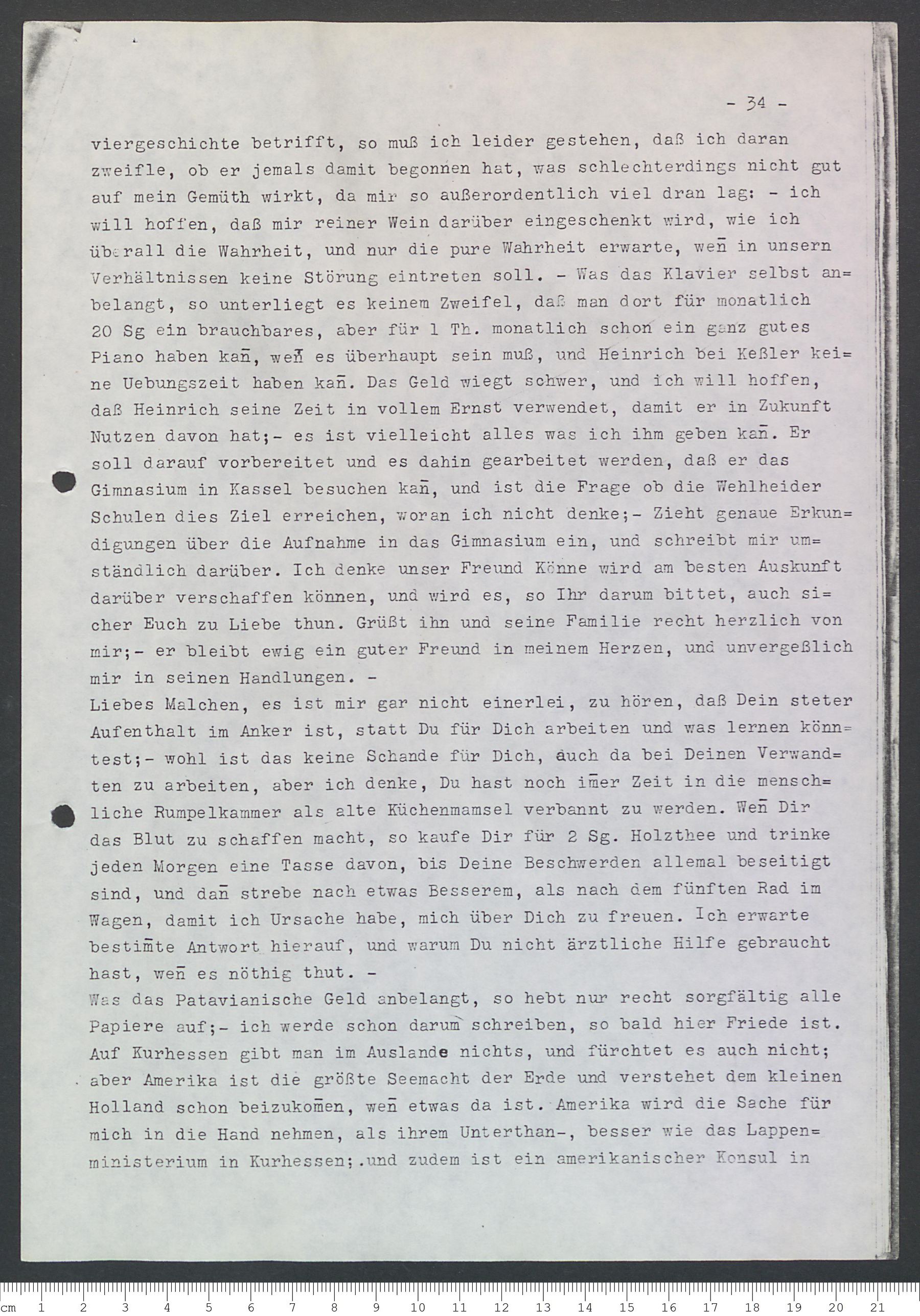
Page – 34 – · Spring 1862, continued — piano hire, and Heinrich's schooling
7
SE 44
viergeschichte betrifft, so muß ich leider gestehen, daß ich daran 4 i
zweifle, ob er jemals damit begonnen hat, was schlechterdings nicht gut E%1
auf mein Gemüth wirkt, da mir so außerordentlich viel dran lag: - ich ; ;
will hoffen, daß mir reiner Wein darüber eingeschenkt wird, wie ich } f
überall die Wahrheit, und nur die pure Wahrheit erwarte, wen in unsern i
Verhältnissen keine Störung eintreten soll. - Was das Klavier selbst an= l
belangt, so unterliegt es keinem Zweifel, daß man dort für monatlich „
20 Sg ein brauchbares, aber für 1l Th. monatlich schon ein genz gutes 1£'
Piano haben kan, weä es überhaupt sein muß, und Heinrich bei Keßler Keis f
ne Uebungszeit haben kan. Das Geld wiegt schwer, und ich will hoffen, Q {
daß Heinrich seine Zeit in vollem Ernst verwendet, damit er in Zukunft 8
Nutzen davon hat;- es ist vielleicht alles was ich ihm geben kan. Er !j
soll darauf vorbereitet und es dahin gearbeitet werden, daß er das i”
. Gimnasium in Kassel besuchen kafi‚ und ist die Frage ob die Wehlheider
Schulen dies Ziel erreichen, woran ich nicht denke;- Zieht genaue Srkun= $}
digungen über die Aufnahme in das Gimnasium ein, und schreibt mir um= ä
ständlich darüber. Ich denke unser Freund Könne wird am besten Auskunft Äf
darüber verschaffen können, und wird es, so Ihr darum bittet, auch Si= $
cher Euch zu Liebe thun. Grüßt ihn und seine Familie recht herzlich von Q
mir;- er bleibt ewig ein guter Freund in meinem Herzen, und unvergeßlich {{
mir in seinen Handlungen. - 1
Liebes Malchen, es ist mir gar nicht einerlei, zu hören, daß Dein steter
Aufenthalt im Anker ist, statt Du für Dich arbeiten und was lernen könn=
test;- wohl ist das keine Schande für Dich, äauch da bei Deinen Verwand= 1
ten zu arbeiten, aber ich denke, Du hast noch imer Zeit in die mensch= {
'. liche Rumpelkammer als alte Küchenmamsel verbannt zu werden. Wen Dir |
das Blut zu schaffen macht, so kaufe Dir für 2 Sg. Holzthee und trinke }
jeden Morgen eine Tasse davon, bis Deine Beschwerden allemal beseitigt 1
sind, und danm strebe nach etwas Besserem, als nach dem fünften Rad im ,
Wagen, damit ich Ursache habe, mich über Dich zu freuen. Ich erwarte %
bestimte Antwort hierauf, und warum Du nicht ärztliche Hilfe gebraucht g
hast, wen es nöthig thut. - ä
Was das Patavianische Geld anbelangt, so hebt nur recht sorgfältig alle ‘f
Papiere auf;- ich werde schon darum schreiben, so bald hier Friede ist. ;
Auf Kurhessen gibt man im Auslande nichts, und fürchtet es auch nicht; %
. aber Amerika ist die größte Seemacht der Erde und verstehet dem kleinen :
Holland schon beizukomen, wen etwas da ist. Amerika wird die Sache für 3
mich in die Hand nehmen, als ihrem Unterthan-, besser wie das Lappen= i
ministerium in Kurhessen;z.und zudem ist ein amerikanischer Konsul in ;
cm 1 2 3 4 5 6 7 8 % 10 4I 12 23 14 145 16 2927 18 2a9 20 21
…as regards that business, I must unfortunately confess that I doubt whether he ever began it at all, which does my spirits no good, since it mattered so extraordinarily much to me. I will hope that I am given the plain truth about it, as I expect the truth and nothing but the pure truth everywhere, if no disturbance is to enter into our relations.
As for the piano itself, there is no doubt that for 20 Silbergroschen a month one can have a serviceable instrument there, and for 1 Thaler a month already quite a good piano — if it must be at all, and since Heinrich can have no practice time at Keßler's. The money weighs heavy, and I will hope Heinrich uses his time in full earnest, so that he has the benefit of it in future; it is perhaps all I can give him.
He should be prepared, and it should be worked towards, that he can attend the Gymnasium in Kassel; and the question is whether the Wehlheiden schools reach that standard, which I do not think. Make exact enquiries about admission to the Gymnasium and write to me circumstantially about it. I think our friend Könne will be best able to obtain information about it, and if you ask him he will certainly do it for your sake too. Greet him and his family most warmly from me; he remains for ever a good friend in my heart, and unforgettable to me in his dealings.
Dear Malchen, it is by no means a matter of indifference to me to hear that you are permanently staying at the Anker, instead of being able to work for yourself and learn something; it is no disgrace to you…
⭐ Piano hire prices, Kassel 1862: a serviceable instrument 20 Sg a month, a good one 1 Th a month — small but concrete domestic prices. ⭐ He is aiming his son at the Kassel Gymnasium and doubts the Wehlheiden schools can get him there. An emigrant labourer's world this is not: Köster's ambitions for his children are professional, which is worth remembering when using him as a proxy for Charles. ⭐ Könne is confirmed again as a Kassel figure — asked to advise on Gymnasium admission — corroborating this project's elimination of him as a St. Louis person.
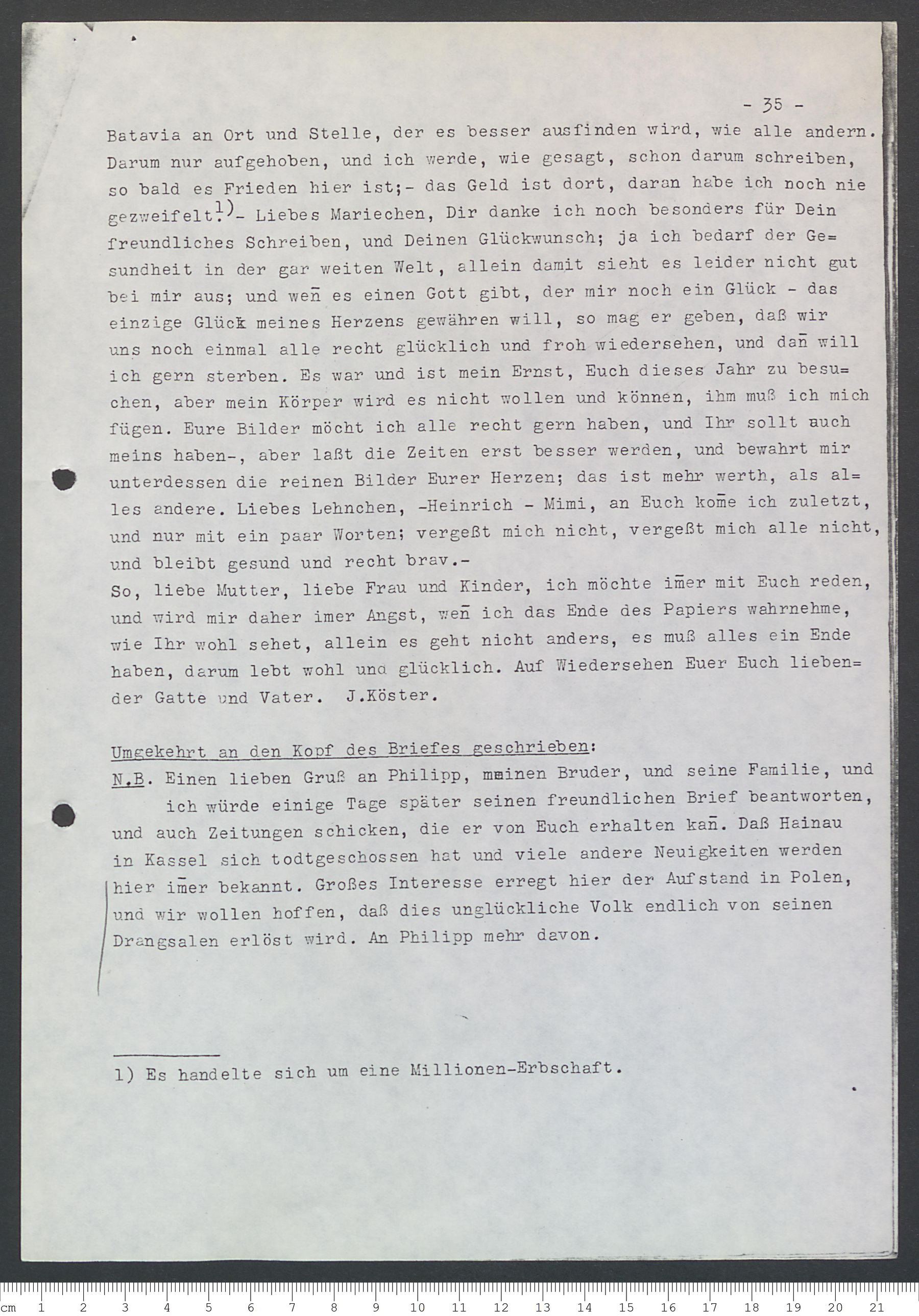
Page – 35 – · Spring 1862, continued — photographs, and a visit he cannot make
€ E » ä
Batavia an Ort und Stelle, der es besser ausfinden wird, wie alle andern. |
Darum nur aufgehoben, und ich werde, wie gesagt, schon darum schreiben, 3
o bald es Frieden hier ist;z- das Geld ist dort, daran häbe ich noch nie |
f gezweifelt%)— Liebes Mariechen, Dir danke ich noch besonders für Dein i
freundliches Schreiben, und Deinen Glückwunsch; ja ich bedarf der Ge= i
sundheit in der gar weiten Welt, allein damit sieht es leider nicht gut l
bei mir aus; und wen es einen Gott gibt, der mir noch ein Glück - das i}
einzige Glück meines Herzens gewähren will, so mag er geben, daß wir ]
uns noch einmal alle recht glücklich und froh wiedersehen, und dan will 4
ich gern sterben. Es war und ist mein Ernst, Euch dieses Jahr zu besu= A
chen, aber mein Körper wird es nicht wollen und können, ihm muß ich mich E
fügen. Eure Bilder möcht ich alle recht gern haben, und Ihr sollt auch f
meins haben-, aber laßt die Zeiten erst besser werden, und bewahrt mir b
" unterdessen die reinen Bilder Eurer Herzen; das ist mehr werth, als alz |
les andere. Liebes Lehnchen, -Heinrich - Mimi, an Euch kome ich zuletzt,
und nur mit ein paar Worten; vergeßt mich nicht, vergeßt mich alle nicht,
und bleibt gesund und recht brav.- i
So, liebe Mutter, liebe Frau und Kinder, ich möchte imer mit Euch reden,
und wird mir daher imer Angst, wen ich das Ende des Papiers wahrnehme, \
wie Ihr wohl sehet, allein es geht nicht anders, es muß alles ein Ende N
haben, darum lebt wohl und glücklich. Auf Wiedersehen Euer Euch lieben= {
der Gatte und Vater. J.Köster. F
Umgekehrt an den Kopf des Briefes geschrieben: [
N.B. Einen lieben Gruß an Philipp, mminen Bruder, und seine Familie, und W
. ich würde einige Tage später seinen freundlichen Brief beantworten,
und auch Zeitungen schicken, die er von Euch erhalten kan. Daß Hainau M
in Kassel sich todtgeschossen hat und viele andere Neuigkeiten werden ä
hier imer bekannt. Großes Interesse erregt hier der Aufstand in Polen, H
und wir wollen hoffen, daß dies unglückliche Volk endlich von seinen f
Drengsalen erlöst wird. An Philipp mehr davon. 4
1l) Es handelte sich um eine Millionen-Erbschaft. !
cm 1 Z 3 4 5 6 7 8 9 100 41 42 13 W4 45 16 37% 218 39 20 2ı
…Batavia on the spot, who will find it out better than all the others. So it is only deferred, and I shall write about it, as I said, as soon as there is peace here; the money is there, of that I have never doubted.
Dear little Marie, I thank you especially for your friendly letter and your good wishes. Yes, I have need of health in this wide world — but unhappily it does not look good with me in that respect. And if there is a God who will grant me one more happiness, the only happiness of my heart, then may he grant that we all see one another again, right happy and glad; and then I will gladly die.
It was and is my earnest intention to visit you this year, but my body will not have it and cannot, and I must submit to it. I should very much like to have all your pictures, and you shall have mine too — but let the times get better first, and meanwhile keep for me the pure pictures of your hearts; that is worth more than anything else.
Dear Lehnchen, Heinrich, Mimi — I come to you last, and only with a few words: do not forget me, none of you forget me, and stay healthy and right good.
So, dear mother, dear wife and children, I should like to go on talking with you always, and it always makes me anxious when I see the end of the paper coming, as you can well see; but it cannot be otherwise, everything must have an end. So farewell and be happy. Until we meet again, your loving husband and father, J. Köster.
⭐ He intended to visit Germany in 1862 and gave it up on health grounds. ⭐ Exchange of photographs proposed but deferred until the times improve — consistent with the three portraits described elsewhere in the series.
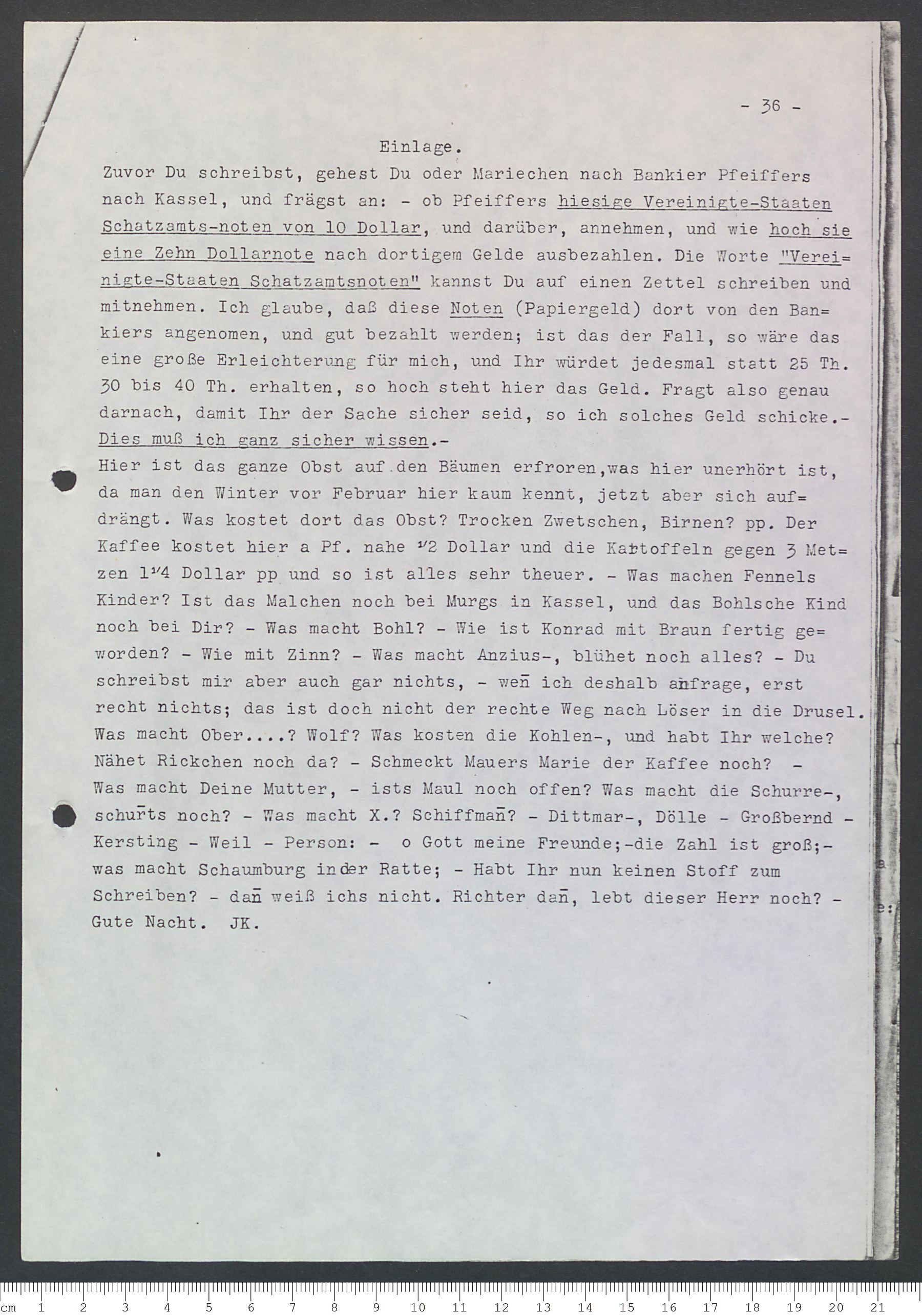
Page – 36 – · An enclosure — ⭐⭐ US Treasury notes, and American prices
/ } K
Einlage. [
Zuvor Du schreibst, gehest Du oder Mariechen nach Bankier Pfeiffers !
nach Kassel, und frägst an: - ob Pfeiffers hiesige Vereinigte-Staaten |
Schatzamts-noten von 10 Dollar, und darüber, annehmen, und wie hoch sie ;
eine Zehn Dollarnote nach dortigem Gelde ausbezahlen. Die Worte "Verei=
nigte-Staaten Schatzamtsnoten" kannst Du auf einen Zettel schreiben und
mitnehmen. Ich glaube, daß diese Noten (Papiergeld) dort von den Ban= '
kiers angenomen, und gut bezahlt werden; ist das der Fall, so wäre das : A
eine große Erleichterung für mich, und Ihr würdet jedesmal statt 25 Th. E
30 bis 40 Th. erhalten, so hoch steht hier das Geld. Fragt also genau |
darnach, damit Ihr der Sache sicher seid, so ich solches Geld schicke.- N
Dies muß ich ganz _ _sicher wissen.- UB
Hier ist das ganze Obst auf.den Bäumen erfroren,was hier unerhört ist, ;
" da män den Winter vor Februar hier kaum kennt, jetzt aber sich auf= 3
drängt. Was kostet dort das Obst? Trocken Zwetschen, Birnen? pp. Der }
Kaffee kostet hier a Pf. nahe ½ Dollar und die Kartoffeln gegen 3 Met=
zen 1¼ Dollar pp und so ist alles sehr theuer. - Was machen Fennels ‘
Kinder? Ist das Malchen noch bei Murgs in Kassel, und das Bohlsche Kind
noch bei Dir? - Was macht Bohl? - Wie ist Konrad mit Braun fertig ge= | :
worden? —- Wie mit Zinn? - Was macht Anzius-, blühet noch alles? - Du ll;
schreibst mir aber auch gar nichts, - wen ich deshalb anfrage, erst 4
recht nichts; das ist doch nicht der rechte Weg nach Löser in die Drusel.||
Was macht Ober....? Wolf? Was kosten die Kohlen-, und habt Ihr welche? 8
Nähet Rickchen noch da? - Schmeckt Mauers Marie der Kaffee noch? - Ä \
Was macht Deine Mutter, - ists Maul noch offen? Was macht die Schurre-, ( :
.. schurts noch? - Was macht X.? Schiffman? - Dittmar-, Dölle - Großbernd - || %
Kersting - Weil - Person: - O Gott meine Freunde;-die Zahl ist groß;- } g
was macht Schaumburg inder Ratte; - Habt Ihr nun keinen Stoff zum ;?
Schreiben? - dan weiß ichs nicht. Richter dan, lebt dieser Herr noch? - ‘4*
Gute Nacht. JK. j-i
» p f
1
cm 1 2 3 4 5 6 D 8 9 10 11 12 13 14 15 16 17 18 19 20 21
Enclosure. — Before you write, you or little Marie are to go to banker Pfeiffer's at Kassel and ask: whether Pfeiffer's accept United States Treasury notes of 10 dollars and upwards, and at what rate they pay out a ten-dollar note in the money there. You can write the words "United States Treasury notes" on a slip and take it with you.
I believe these notes (paper money) are accepted there by the bankers and well paid; if that is so it would be a great relief to me, and you would receive 30 to 40 Thaler each time instead of 25 — so high does the money stand here. So ask about it exactly, so that you are sure of the matter if I send such money. This I must know quite certainly.
Here all the fruit has frozen on the trees, which is unheard of here, since one scarcely knows winter before February — but now it forces itself on us. What does fruit cost there? Dried plums, pears, and so on? Coffee here costs nearly ½ dollar a pound, and potatoes about 1¼ dollars for three Metzen, and everything is very dear.
How are Fennel's children? Is Malchen still at Murg's in Kassel, and the Bohl child still with you? How is Bohl? How did Konrad settle with Braun? And with Zinn? How is Anzius — is everything still flourishing? But you write me nothing at all — and when I ask about it, all the less; that is surely not the right road to Löser in the Drusel. How is Ober…? Wolf? What do the coals cost, and have you any? Is Rickchen still sewing…
⭐⭐ He was trying to remit in US Treasury notes ('greenbacks') rather than bills of exchange, and asks his wife to establish the Kassel rate. His own estimate: 30–40 Th. instead of 25 for the same outlay. Taken with the 1⅔ specie premium on p. 32, this is a working picture of how a St. Louis German moved money to Kurhessen in wartime. ⭐ American prices, spring 1862: potatoes about 1¼ dollars per 3 Metzen; coffee nearly ½ dollar a pound (both read from the image, 10 Oct 2026; the OCR had “174” and “”2”). A hard frost destroyed the whole fruit crop — unheard of, he says, in a place that scarcely knows winter before February. ⚠️ All figures and every name on this page are OCR-derived (Murg, Löser, Drusel, Ober…, Anzius) — verify against the scan before citing.
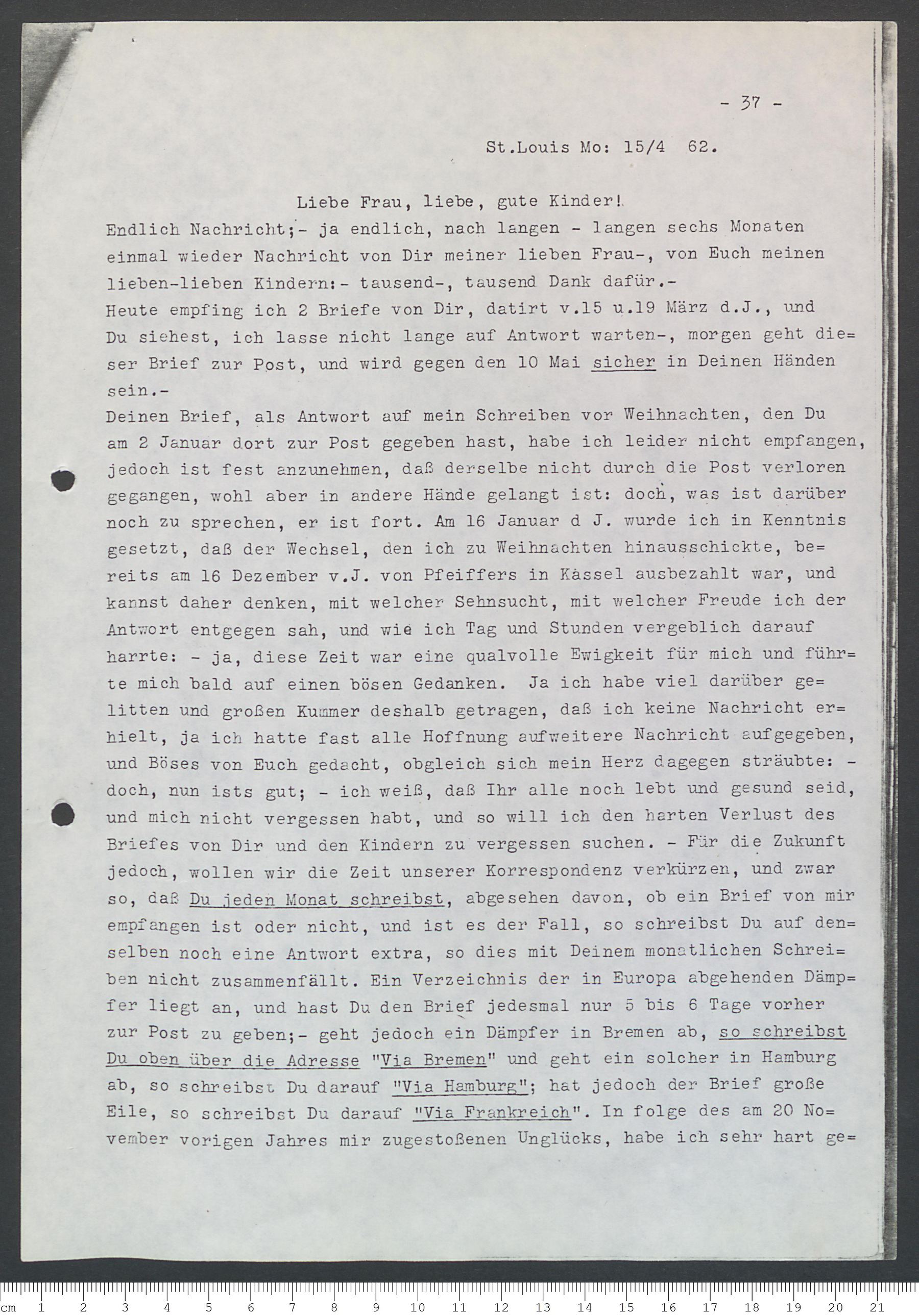
Page – 37 – · ⭐ St. Louis, 15 April 1862 — news at last after six months
Z ; i;
| S (}
St.Louis Mo: 15/4 62.
Liebe Frau, liebe, gute Kinder! ‚B
Endlich Nachricht;z- ja endlich, nach langen - langen sechs Monaten
einmal wieder Nachricht von Dir meiner lieben Frau-, von Euch meinen
lieben-lieben Kindern:- tausend-, tausend Dank dafür.-
Heute empfing ich 2 Briefe von Dir, datirt v.15 u.19 März d.J., und H
Du siehest, ich lasse nicht lange auf Antwort warten-, morgen geht die= i
ser Brief zur Post, und wird gegen den 10 Mai sicher in Deinen Händen
SeibnL=
Deinen Brief, als Antwort auf mein Schreiben vor Weihnachten, den Du
am 2 Januar dort zur Post gegeben hast, habe ich leider nicht empfangen,
" jedoch ist fest anzunehmen, daß derselbe nicht durch die Post verloren
gegangen, wohl aber in andere Hände gelangt ist: docfi, was ist darüber |%
noch zu sprechen, er ist fort. Am 16 Januar d J. wurde ich in Kenntnis }%
gesetzt, daß der Wechsel, den ich zu Weihnachten hinausschickte, be= ‘j
reits am 16 Dezember v.J. von Pfeiffers in Kässel ausbezahlt war, und !1
kannst daher denken, mit welcher Sehnsucht, mit welcher Freude ich der £:
Antwort entgegen sah, und wie ich Tag und Stunden vergeblich darauf i&
harrte: - ja, diese Zeit war eine qualvolle Ewigkeit für mich und führ= ä
te mich bald auf einen bösen Gedanken. Ja ich habe viel darüber ge= I?
litten und großen Kummer deshalb getragen, daß ich keine Nachricht er= i‚
hielt, ja ich hatte fast alle Hoffnung aufweitere Nachricht sufgegeben, ;i
und Böses von Euch gedacht, obgleich sich mein Herz dagegen sträubte: - M
doch, nun ists gut;z - ich weiß, daß Ihr alle noch lebt und gesund seid, ?L
. und mich nicht vergessen habt, und so will ich den harten Verlust des '
Briefes von Dir und den Kindern zu vergessen suchen. - Für die Zukunft 8
jedoch, wollen wir die Zeit unserer Korrespondenz verkürzen, und zwar 3H
so, daß Du jeden Monat _ schreibst, abgesehen davon, ob ein Brief von mir f%
empfangen ist oder nicht, und ist es der Fall, so schreibst Du auf den= 'E
selben noch eine Antwort extra, so dies mit Deinem monstlichen Schrei= ;
ben nicht zusammenfällt. Ein Verzeichnis der in Europa abgehenden Dämp= %
fer liegt an, und hast Du den Brief jedesmal nur 5 bis 6 Tage vorher g
zur Post zu geben;- geht jedoch ein Dämpfer in Bremen ab, so_schreibst |
Du_oben über die Adresse "Via_Bremen" und geht ein solcher in Hamburg ;
ab, so schreibst Du darauf "Via Hamburg"; hat jedoch der Brief große f
Eile, so schreibst Du darauf "Via _ Frankreich". In folge des am 20 No= %
vember vorigen Jahres mir zugestoßenen Unglücks, habe ich sehr hart ge= j
4
cm 1 3 3 4 5 6 7 8 9 10 11 12 13 . 14 15 16 17 18 19 20 21
St. Louis, Mo., 15 April 1862. — Dear wife, dear good children!
News at last; yes, at last, after long — long six months, news once more from you, my dear wife, from you my dear, dear children: a thousand, thousand thanks for it.
Today I received 2 letters from you, dated 15 and 19 March this year; and you see, I do not keep you waiting long for an answer — this letter goes to the post tomorrow and will certainly be in your hands about 10 May.
Your letter in answer to my writing before Christmas, which you posted there on 2 January, I unfortunately did not receive; but it is firmly to be assumed that it was not lost by the post, but rather came into other hands. Yet what more is there to say about it — it is gone.
On 16 January this year I was informed that the bill I sent out at Christmas had already been paid out on 16 December last year by Pfeiffer's at Kassel; and you can imagine with what longing, with what joy I looked for the answer, and how I waited for it in vain, day and hour. Yes, that time was a tormenting eternity for me and soon led me to an evil thought. I suffered much over it and bore great grief that I received no news; indeed I had almost given up all hope of further news, and thought ill of you, though my heart rebelled against it. But now it is well: I know that you are all still alive and healthy, and do not…
⭐ A six-month silence, and he believed his letter had been intercepted — „wohl aber in andere Hände gelangt“, rather than lost by the post. Set beside the censorship he describes on p. 17, a plausible reading rather than paranoia. ⭐ The Christmas bill was cashed at Kassel on 16 December 1861, and he learned it on 16 January 1862 — so the money did arrive, and it was the reply that went missing. ⭐ Postal timing again: written 15 April, expected in Kurhessen about 10 May.
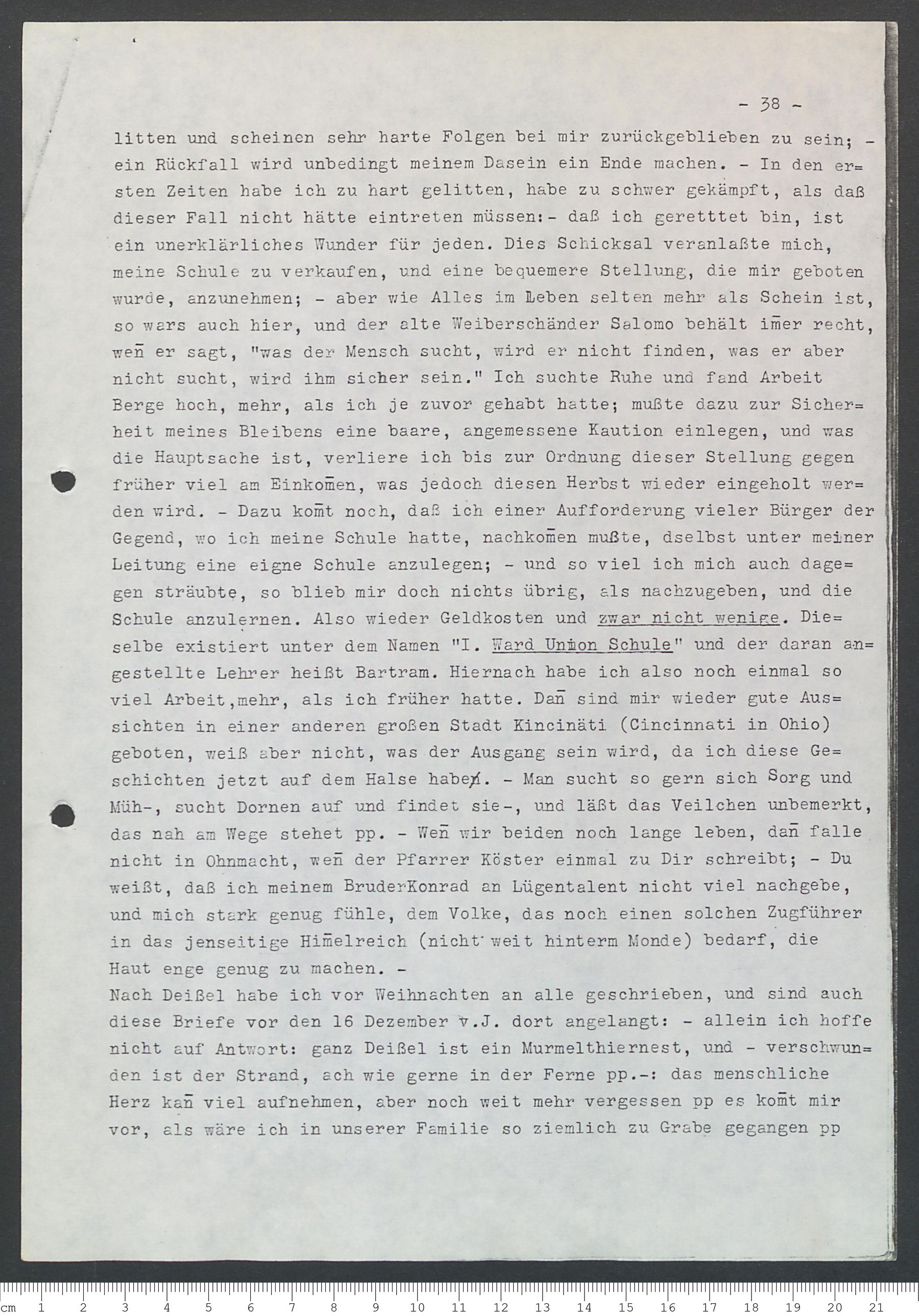
Page – 38 – · 15 April 1862, continued — ⭐⭐ the new post sours, and a second school
p litten und scheinen sehr harte Folgen bei mir zurückgeblieben zu seinz; - ;
ein Rückfall wird unbedingt meinem Dasein ein Ende machen. - In den er= |
sten Zeiten habe ich zu hart gelitten, haäbe zu schwer gekämpft, als daß Ä
dieser Fall nicht hätte eintreten müssen:- daß ich geretttet bin, ist
ein unerklärliches Wunder für jeden. Dies Schicksal veranlaßte mich, ‘
meine Schule zu verkaufen, und eine bequemere Stellung, die mir geboten Ä
wurde, anzunehmen; - aber wie Alles im Leben selten mehr als Schein ist,
so wars auch hier, und der alte Weiberschänder Salomo behält imer recht, |
wen er sagt, "was der Mensch sucht, wird er nicht finden, was er aber {
nicht sucht, wird ihm sicher sein." Ich suchte Ruhe und fand Arbeit M
Berge hoch, mehr, als ich je zuvor gehabt hatte; mußte dazu zur Sicher= 1
heit meines Bleibens eine baare, angemessene Kaution einlegen, und was fi
die Hauptsache ist, verliere ich bis zur Ordnung dieser Stellung gegen }
" früher viel am Einkomen, was jedoch diesen Herbst wieder eingeholt wer= |
den wird. - Dazu komt noch, daß ich einer Aufforderung vieler Bürger der b
Gegend, wo ich meine Schule hatte, nachkomen mußte, dselbst unter meiner
Leitung eine eigne Schule anzulegen; - und so viel ich mich auch dage= i
gen sträubte, so blieb mir doch nichts übrig, &ls nachzugeben, und die ä
Schule anzulernen. Also wieder Geldkosten und zwar nicht wenige, DYe= fi
selbe existiert unter dem Namen "I., Ward _ Unäon Schule" und der daran an=
gestellte Lehrer heißt Bartram. Hiernach habe ich also noch einmal so IM
viel Arbeit,mehr, als ich früher hatte. Dan sind mir wieder gute Aus= H
sichten in einer anderen großen Stadt Kincinäti (Cincinnati in Ohio) M
geboten, weiß sber nicht, was der Ausgang sein wird, da ich diese Ge= J
schichten jetzt auf dem Halse habe. - Man sucht so gern sich Sorg und ?
. Müh-, sucht Dornen auf und findet sie-, und 1äßt das Veilchen unbemerkt, ‘
das nah am Wege stehet pp. - Wen wir beiden noch lange leben, dan falle
nicht in Ohnmacht, wen der Pfarrer Köster einmal zu Dir schreibt; - Du i
weißt, daß ich meinem BruderKonrad an Lügentalent nicht viel nachgebe,
und mich stark genug fühle, dem Volke, das noch einen solchen Zugführer
in das jenseitige Himelreich (nicht‘ weit hinterm Monde) bedarf, die ;
Haut enge genug zu machen. -
Nach Deißel habe ich vor Weihnaschten an alle geschrieben, und sind auch
diese Briefe vor den 16 Dezember v.J. dort angelangt: - allein ich hoffe
nicht auf Antwort: ganz Deißel ist ein Murmelthiernest, und - verschwun=
den ist der Strand, ach wie gerne in der Ferne pp.-: das menschliche i
Herz kan viel aufnehmen, aber noch weit mehr vergessen pp es komt mir
vor, als wäre ich in unserer Familie so ziemlich zu Grabe gegangen pp H
cm 1 D 3 4 5 6 7 8 9 210 11 12 13 14 15 16 17 18 19 20 21
…suffered, and very hard consequences seem to have remained with me; a relapse will unquestionably put an end to my existence. In the early days I suffered too hard, struggled too heavily, for this to have been avoidable; that I was saved is an inexplicable miracle to everyone.
This misfortune moved me to sell my school and accept a more comfortable position that was offered me. But as everything in life is seldom more than appearance, so it was here too, and that old slanderer of women, Solomon, is always right when he says that what a man seeks he will not find, but what he does not seek will surely be his. I sought rest and found work mountains high — more than I had ever had before. On top of that I had to lodge a suitable cash security to guarantee my remaining, and, what is the main thing, until this position is regulated I lose a great deal of income compared with before — though that will be made up again this autumn.
Added to that, I had to comply with a request from many citizens of the district where I had my school, to found a school of my own there under my direction; and however much I resisted it, nothing was left me but to give way and get the school going. So again expense, and not a little of it. The same exists under the name "I. Ward Union School", and the teacher appointed to it is called Bartram. So I now have twice as much work as I had before.
⭐⭐ The 'promotion' was a mistake, and he says so within three months. He sought rest and found „Arbeit Berge hoch“; the cash bond is tied up; income is down until the post settles. ⭐⭐ He founded a SECOND school at the request of citizens of his old district — the “I. Ward Union School”, with an appointed teacher Bartram. This corroborates the 1961 Lebenslauf (img 0028), which records “I. Ward Union Schule St. Louis mit Lehrer Betram” — note the spelling differs (Bartram here, Betram there); neither is verified against a St. Louis source. A named teacher at a named St. Louis school in 1862 is checkable in the city directories.
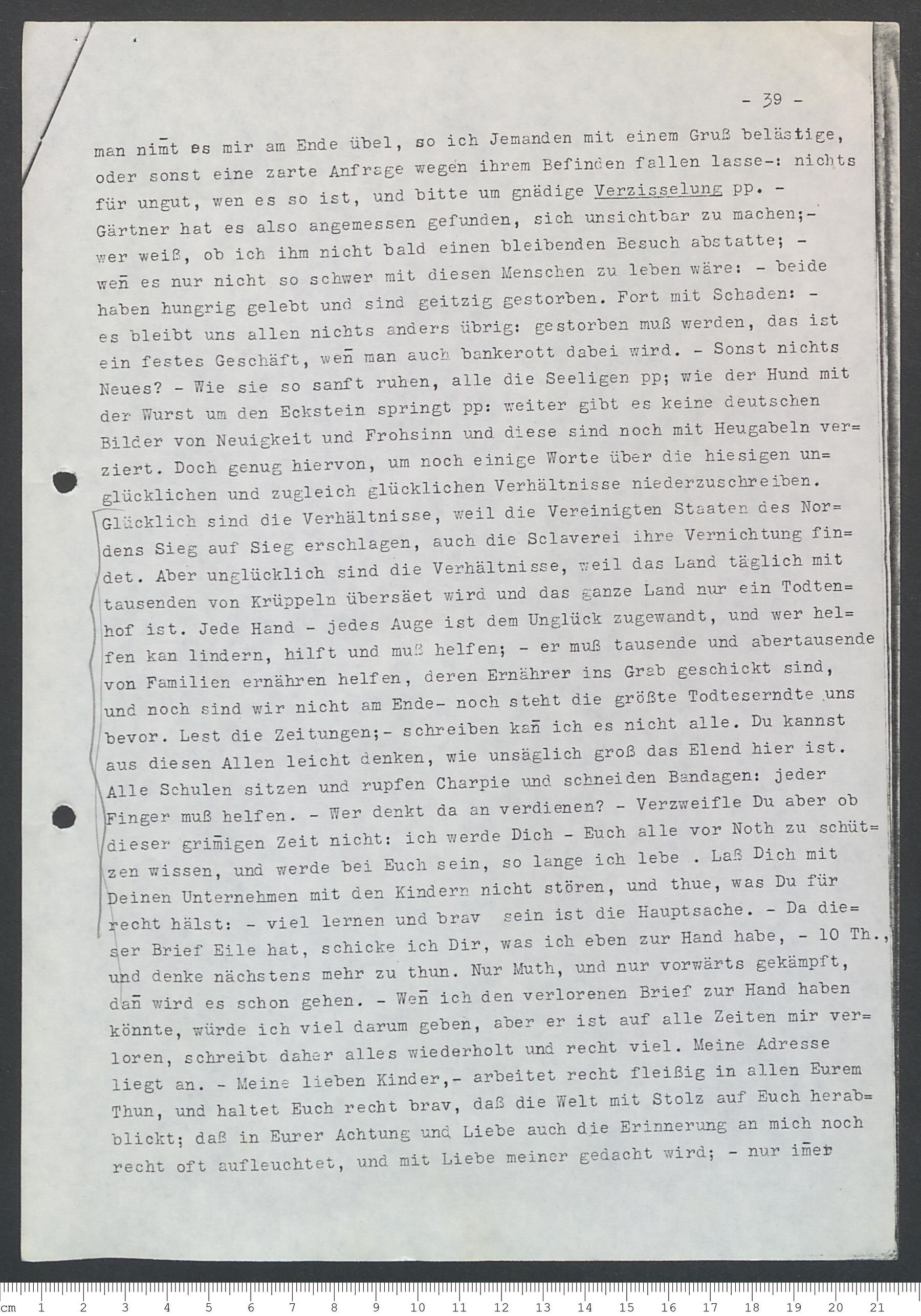
Page – 39 – · 15 April 1862, continued — ⭐⭐ on the war, and on slavery
S0 '
man nimt es mir am Ende übel, so ich Jemanden mit einem Gruß belästige, -
oder sonst eine zarte Anfrsage wegen ihrem Befinden fallen lasse-: nichts F
für ungut, wen es so ist, und bitte um gnädige Verzisselung PP. -
Gärtner hat es also angemessen gefunden, sich unsichtbar zu machen;-
wer weiß, ob ich ihm nicht bald einen bleibenden Besuch abstatte; —- ß
wen es nur nicht so schwer mit diesen Menschen zu leben wäre: - beide |
haben hungrig gelebt und sind geitzig gestorben. Fort mit Schaden: - {
es bleibt uns allen nichts anders übrig: gestorben muß werden, das ist |
ein festes Geschäft, wen man äuch bankerott dabei wird. - Sonst nichts
Neues? - Wie sie so sanft ruhen, alle die Seeligen pp; wie der Hund mit .
der Wurst um den Eckstein springt pp: weiter gibt es keine deutschen
Bilder von Neuigkeit und Frohsinn und diese sind noch mit Heugabeln ver=
. ziert. Doch genug hiervon, um noch einige Worte über die hiesigen un= r
glücklichen und zugleich glücklichen Verhältnisse niederzuschreiben.
Yélicklich sind die Verhältnisse, weil die Vereinigten Staaten des Nor=
|dens Sieg auf Sieg erschlagen, auch die Sclaverei ihre Vernichtung fin=
jdet. Aber unglücklich sind die Verhältnisse, weil das Land täglich mit
(tausenden von Krüppeln übersäet wird und das ganze Land nur ein Todten= ?
}hof ist. Jede Hand - jedes Auge ist dem Unglück zugewandt, und wer hel=
(|£en kan lindern, hilft und muß helfen; - er muß tausende und abertausende\l
\ von Familien ernähren helfen, deren Ernährer ins Graeb geschickt sind,
|und noch sind wir nicht am Ende- noch steht die größte Todteserndte uns
; bevor. Lest die Zeitungen;- Schreiben kan ich es nicht alle. Du kannst
\ aus diesen Allen leicht denken, wie unsäglich groß das Elend hier ist. !
\Alle Schulen sitzen und rupfen Charpie und schneiden Bandagen: jeder |
. ‘Finger‘ muß helfen. - Wer denkt da an verdienen? - Verzweifle Du aber ob ‘
)dieser grimigen Zeit nicht: ich werde Dich - Euch alle vor Noth zu schüt=
Ezen wissen, und werde bei Euch sein, so lange ich lebe . Laß Dich mit )i
iDeinen Unternehmen mit den Kindern nicht stören, und thue, Was Du für :
frecht hälst: — viel lernen und brav sein ist die Hauptsache. - Da die= %
der Brief Eile hat, schicke ich Dir, was ich eben zur Hand habe, - 10 Th.‚&
und denke nächstens mehr zu thun. Nur Muth, und nur vorwärts gekämpft,
dan wird es schon gehen. - Wen ich den verlorenen Brief zur Hand haben
könnte, würde ich viel darum geben, aber er ist auf alle Zeiten mir ver= &
loren, schreibt daher alles wiederholt und recht viel. Meine Adresse ]
jiegt an: —- Meine lieben Kinder,- arbeitet recht fleißig in allen Eurem
Thun, und haltet Euch recht brav, daß die Welt mit Stolz auf Euch herab=
blickt; daß in Eurer Achtung und Liebe auch die Erinnerung än mich noch
yecht oft aufleuchtet, und mit Liebe meiner gedacht wird; - nur imer
cm 1 2 3 4 5 6 % 8 9 210 11 12 13 14 15 16 17 18 19 20 21
…in the end it is taken amiss of me if I trouble anyone with a greeting, or let fall some delicate enquiry after their health. No offence meant if that is how it is, and I beg gracious pardon.
So Gärtner has thought fit to make himself invisible; who knows whether I shall not soon pay him a lasting visit. If only it were not so hard to live with these people: both lived hungry and died miserly. Away with the loss — nothing else is left to any of us. Die we must; that is a firm business, even if one goes bankrupt at it.
Nothing else new? Beyond a few stock pieces of German sentiment and jollity, there is nothing — and even those come garnished with pitchforks. But enough of this, to set down a few words about the unhappy and at the same time happy conditions here.
The conditions are happy, because the United States of the North strike victory upon victory, and slavery too is finding its destruction. But the conditions are unhappy, because the land is daily strewn with thousands of cripples and the whole country is nothing but a graveyard. Every hand, every eye is turned towards the misfortune, and whoever can help to relieve it helps and must help; he must help feed thousands upon thousands of families whose breadwinners are [in the field]…
⭐⭐ HE DOES ADDRESS AMERICAN SLAVERY — and this closes an open question. On p. 8 I flagged that Köster called Germany a Sclavenstaat and a Hessian mayor a Sclavenhälter while writing from Missouri without mentioning the institution around him, and warned against assuming either answer. Here, in April 1862, he does: the conditions are happy „weil die Vereinigten Staaten des Nordens Sieg auf Sieg erschlagen, auch die Sclaverei ihre Vernichtung findet“ — because the North wins victory upon victory and slavery too is finding its destruction. He welcomes emancipation, and does so months before the Preliminary Proclamation. The earlier silence was of the moment, not of principle. ⭐ And immediately beside it, the cost: the land strewn with thousands of cripples, the whole country a graveyard, and thousands of families needing to be fed because their breadwinners are gone. This is the war as a German civilian in St. Louis saw it eight months before Charles enlisted.
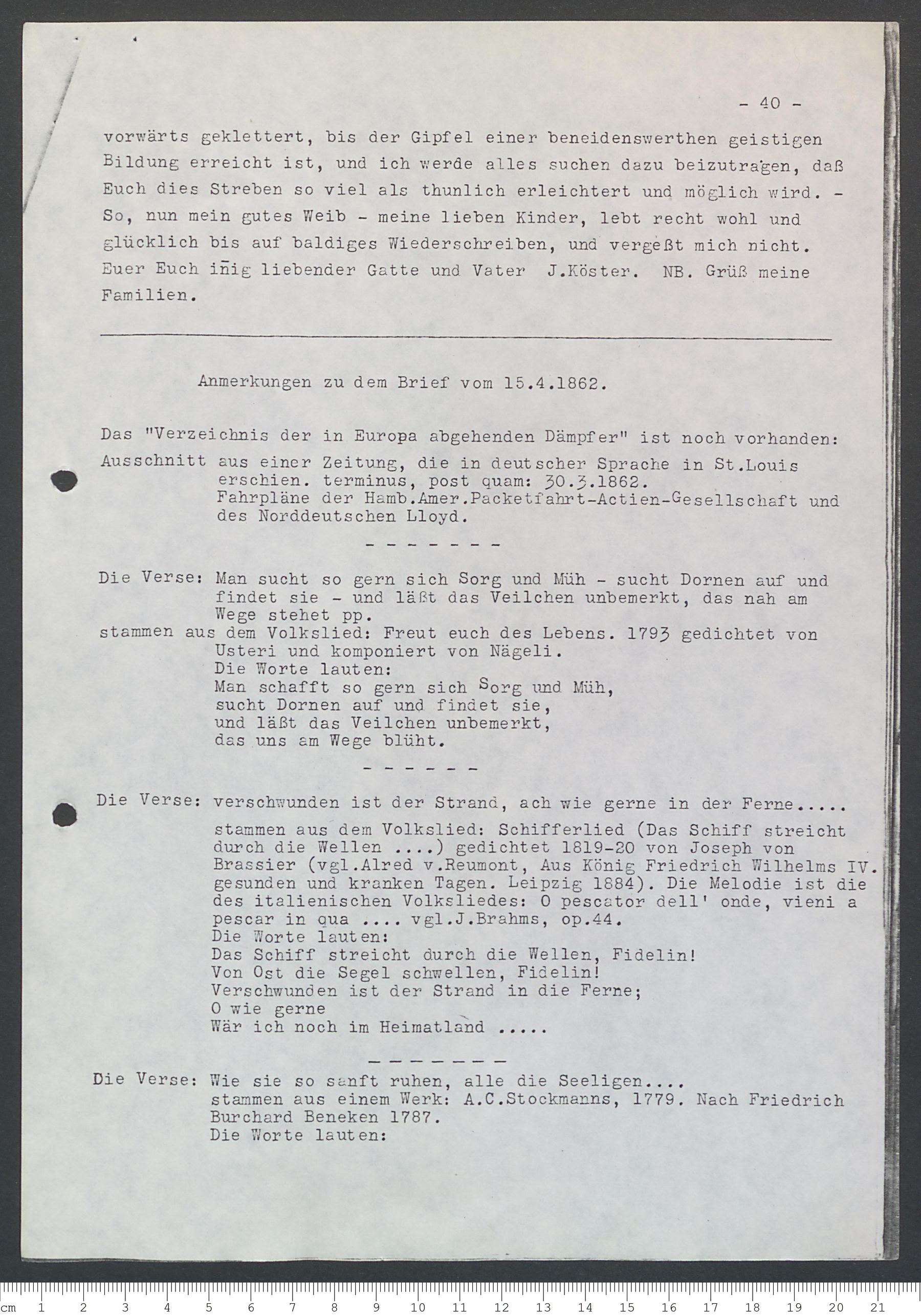
Page – 40 – · End of 15 April 1862, then the editor's notes to that letter
f —- 40 - fi
7
4 vorwärts geklettert, bis der Gipfel einer beneidenswerthen geistigen i
Bildung erreicht ist, und ich werde alles suchen dazu beizutragen, daß }
/ Euch dies Streben so viel als thunlich erleichtert und möglich wird. - „i
So, nun mein gutes Weib - meine lieben Kinder, lebt recht wohl und té
glücklich bis auf baldiges Wiederschreiben, und vergeßt mich nicht. »i
Euer Euch inig liebender Gatte und Vater J.Köster. NB. Grüß meine E;
Familien. %"
; S E O M
Anmerkungen zu dem Brief vom 15.4.1862. IM
Das "Verzeichnis der in Europa abgehenden Dämpfer" ist noch vorhanden: f
Ausschnitt aus einer Zeitung, die in deutscher Sprache in St,Louis i
. erschien. terminus, post quam: 30.2.1862. |
Fahrpläne der Hamb.Amer.Packetfahrt-Actien-Gesellschaft und ]
des Norddeutschen Lloyd. r
Die Verse: Man sucht so gern sich Sorg und Müh - sucht Dornen auf und l
findet sie - und 1äßt das Veilchen unbemerkt, das nah am {
Wege stehet pp.
stammen aus dem Volkslied: Freut euch des Lebens. 1793 gedichtet von
Usteri und komponiert von Nägeli.
Die Worte lauten:
Man schafft so gern sich Sorg und Müh,
sucht Dornen auf und findet sie,
und 1äßt das Veilchen unbemerkt, [
das uns am Wege blüht. |
. P !
. Die Verse; verschwunden ist der Strand, ach wie gerne in der Ferne..... {
stammen aus dem Volkslied: Schifferlied (Das Schiff streicht {
durch die Wellen ....) gedichtet 1819-20 von Joseph von S
Brassier (vgl.Alred v.Reumont, Aus König Friedrich Wilhelms IV.i
gesunden und kranken Tagen. Leipzig 1884). Die Melodie ist die {
des italienischen Volksliedes: O0 pescator dell' onde, vieni a L
pescar in aua :... vg1.J:Brahms,y opD:44; L;
Die Worte lauten: 44
Das Schiff streicht durch die Wellen, Fidelin! 41
Von Ost die Segel schwellen, Fidelin! $
Verschwunden ist der Strand in die Ferne; f
O wie gerne e 44
Wär ich noch im Heimatland ..... }
Die Verse: Wie sie so senft ruhen, alle die Seeligen.... i
stammen aus einem Werk: A.C.Stockmanns, 1779, Nach Friedrich A
Burchard Beneken 1787. ;
Die Worte lauten: 7
cm 1 Z 3 4 5 6 Y 8 9 10 11 12 13 14 15 16 17 18 19 20 21
…climbed forward until the summit of an enviable intellectual cultivation is reached; and I shall seek to contribute everything I can to making that striving as easy and as possible for you as may be. So now, my good wife, my dear children, fare right well and happily until I write again soon, and do not forget me. Your fondly loving husband and father, J. Köster. NB. Greet my families.
[Editor's notes to the letter of 15 April 1862:]
The "List of steamers departing for Europe" is still extant: a cutting from a newspaper published in the German language in St. Louis. Terminus post quem: [date as given, evidently corrupt]. With it, sailing schedules of the Hamburg-Amerikanische Packetfahrt-Actien-Gesellschaft and of the Norddeutscher Lloyd.
[The editor then identifies the verses Köster had quoted: two lines about seeking out thorns and overlooking the violet by the wayside come from Usteri's song of 1793 set by Nägeli; another about the vanished shore comes from a boatman's song written 1819–20 by Joseph von Brassier.]
⭐⭐ A GERMAN-LANGUAGE ST. LOUIS NEWSPAPER CUTTING SURVIVES IN THIS FOLDER — a “List of steamers departing for Europe”, together with HAPAG and Norddeutscher Lloyd sailing schedules. That is a physical St. Louis German-press artefact of 1862 in the Gotha material, and it should be identifiable to a specific paper by its typography and shipping columns. Worth locating in the facsimile and putting to the Missouri Historical Society's German-press holdings — a standing lead on this project's list. ⚠️ The editor's terminus post quem is transcribed as an impossible date (a 30 February); treat as corrupt and read from the image. ⭐ Köster quoted popular songs from memory in his letters, and the 1930s editor took the trouble to identify them — a small measure of how literary his self-presentation was.
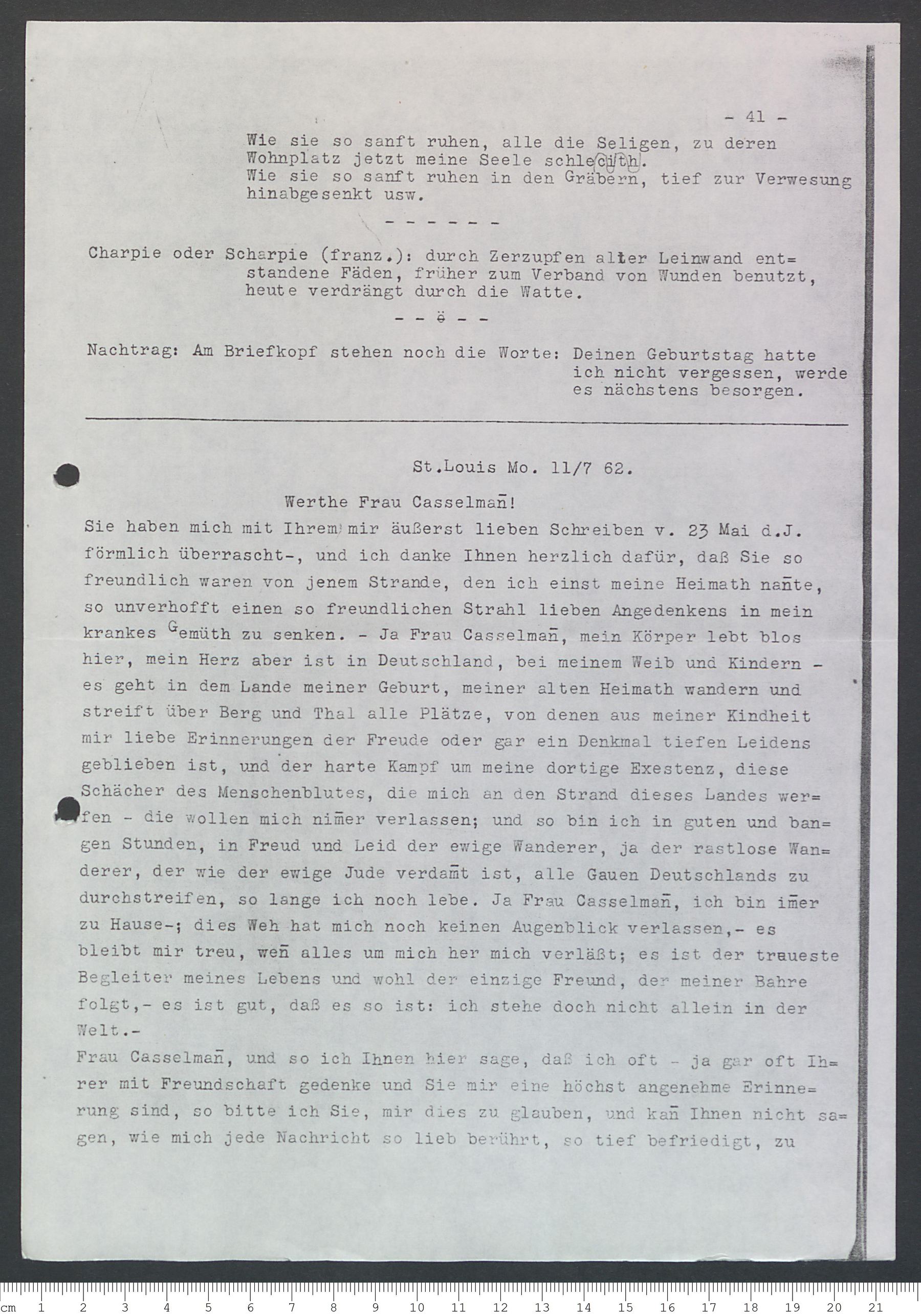
Page – 41 – · More editor's notes, then St. Louis, 11 July 1862 — the letter to Frau Casselman
Wie sie so sanft ruhen, alle die Seligen, zu deren
] Wohnplatz jetzt meine Seele schlecW®hl.
Wie sie so sanft ruhen in den Gräbern, tief zur Verwesung
hinabgesenkt usw.
Charpie oder Scharpie (franz,): durch Zerzupfen alter Leinwand ent=
standene Fäden, früher zum Verband von Wunden benutzt,
heute verdrängt durch die Watte,
Nachtrag: Am Briefkopf stehen noch die Worte; Deinen Geburtstag hatte
ich nicht vergessen, werde
es nächstens besorgen.
LE RZE LA E E ET E SE
. St,Louis Mo. 11/7 62.
Werthe Frau Casselman!
. Sie haben mich mit Ihrem}mir äußerst lieben Schreiben v. 23 Mai d.J.
förmlich überrascht-, und ich danke Ihnen herzlich dafür, daß Sie so
freundlich waren von jenem Strande, den ich einst meine Heimath nante,
so unverhofft einen so freundlichen Strahl lieben Angedenkens in mein
krankes Gemüth zu senken. - Ja Frau Casselman, mein Körper lebt blos
hier, mein Herz aber ist in Deutschland, bei meinem Weib und Kindern —
es geht in dem Lande meiner Geburt, meiner alten Heimath wandern und }
streift über Berg und Thal alle Plätze, von denen aus meiner Kindheit
mir liebe Erinnerungen der Freude oder gar ein Denkmal tiefen Leidens
geblieben ist, und der harte Kampf um meine dortige Exestenz, diese
Schächer des Menschenblutes, die mich an den Strand dieses Landes wer=
!.i‘cn - die wollen mich nimer verlassen; und so bin ich in guten und ban=
gen Stunden, in Freud und Leid der ewige Wanderer, ja der rastlose Wan=
derer, der wie der ewige Jude verdamt ist, alle Gauen Deutschlands zu
durchstreifen, so lange ich noch lebe. Ja Frau Casselman, ich bin imer
zu Hause-; dies Weh hat mich noch keinen Augenblick verlassen,- es
bleibt mir treu, wen alles um mich her mich verläßt; es ist der traueste
Begleiter meines Lebens und wohl der einzige Freund, der meiner Bahre
folgt,- es ist gut, daß es so ist: ich stehe doch nicht allein in der
Welt.-
Frau Casselman, und so ich Ihnen hier Säge, daß ACh/Ooft ja gar oft Ih=
rer mit Freundschaft gedenke und Sie mir eine höchst angenehme Zrinne=
rung sind, so bitte& ich Sie, mir dies zu glauben, und kan Ihnen nicht sa=
gen, wie mich jede Nachricht so lieb berührt, so tief befriedigt, zu
3
bm % Z 3 4 5 6 7 8 9 10 11 12 13 . 14 15 16 17 18 19 20 21
[Editor's notes continued: the source of a further quotation about the blessed dead resting softly in their graves; and a gloss on <em>Charpie</em> — lint teased from old linen, formerly used for dressing wounds, now displaced by cotton wool. Postscript: at the head of the letter stand the words, "I had not forgotten your birthday, and shall see to it shortly."]
St. Louis, Mo., 11 July 1862. — Esteemed Frau Casselman!
You have quite taken me by surprise with your letter of 23 May this year, so extremely dear to me, and I thank you warmly for being so kind as to send, so unexpectedly, from that shore I once called my home, so friendly a ray of loving remembrance down into my sick spirit.
Yes, Frau Casselman, my body merely lives here; my heart is in Germany, with my wife and children. It goes wandering in the land of my birth, my old home, and roams over hill and valley to all the places from which some dear memory of joy, or even a monument of deep suffering, has remained to me out of my childhood. And the hard struggle for my existence there — those robbers of human blood who cast me onto the shore of this country — these will never leave me. And so, in good hours and anxious ones, in joy and sorrow, I am the eternal wanderer; yes, the restless wanderer, condemned like the Wandering Jew to [roam] all the regions of Germany…
⭐ The letter to Frau Casselman is a different register from the family letters — more literary, more self-dramatising, and franker about what drove him out: „der harte Kampf um meine dortige Existenz, diese Schächer des Menschenblutes, die mich an den Strand dieses Landes werfen“. He is writing to a sympathetic outsider rather than to the wife he is deceiving, and the account of the emigration is correspondingly less guarded. ⚠️ Casselman / Casselmann both appear in the series; spelling unsettled.
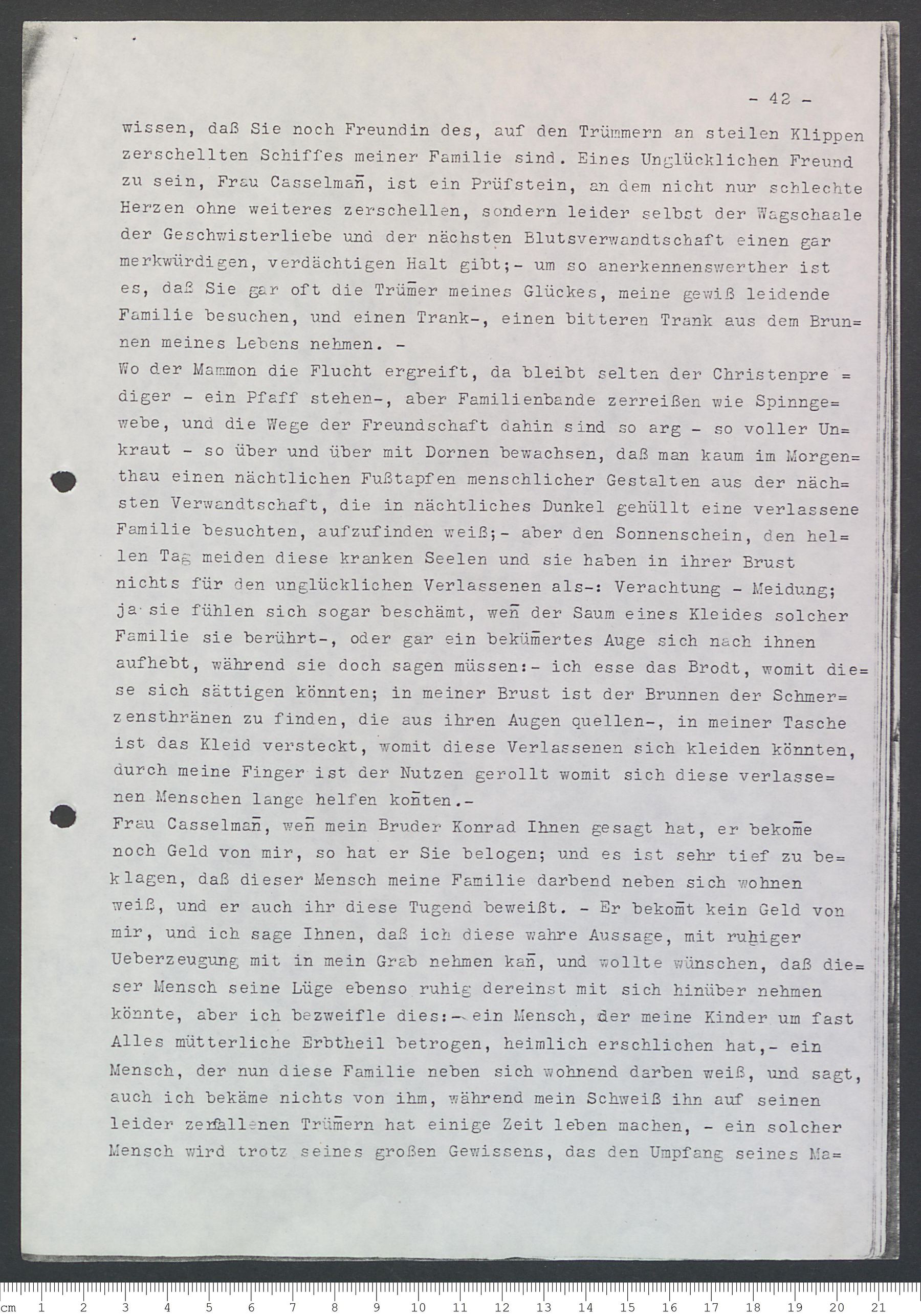
Page – 42 – · 11 July 1862, continued — the family that abandoned them
S . ; FE
: —42 -
wissen, daß Sie noch Freundin des, auf den Trümmern an steilen Klippen
zerschellten Schiffes meiner Familie sind. Eines Unglücklichen Freund ;
zu sein, Frau Casselman, ist ein Prüfstein, an dem nicht nur schlechte ä
Herzen ohne weiteres zerschellen, sondern leider selbst der Wagschaale {A
der Geschwisterliebe und der nächsten Blutsverwandtschaft einen gar
merkwürdigen, verdächtigen Halt gibt;- um so anerkennenswerther ist ;
es, daß Sie gar oft die Trümer meines Glückes, meine gewiß leidende %
Familie besuchen, und einen Trank-, einen bitteren Trank aus dem Brun= [
nen meines Lebens nehmen. - {
Wo der Mammon die Flucht ergreift, da bleibt selten der Christenpre = |
diger —- ein. Pfäff stehen-, aber Familienbande zerreißen wie Spinnge= l;y
webe, und die Wege der Freundschaft dahin sind so arg - so voller Un= l
kraut - so über und über mit Dornen bewachsen, daß man kaum im Morgen= !
. thau einen nächtlichen Fußtapfen menschlicher Gestalten aus der näch= {
sten Verwandtschaft, die in nächtliches Dunkel gehüllt eine verlassene
Familie besuchten, aufzufinden weiß;- aber den Sonnenschein, den hel= l
len Tag meiden diese kranken Seelen und sie haben in ihrer Brust UN
nichts für den unglücklichen Verlassenen als-: Verachtung - Meidung; |
ja sie fühlen sich sogar beschämt, wen der Saum eines Kleides solcher i
Familie sie berührt-, oder gar ein bekümertes Auge sich naäch ihnen |
aufhebt, während sie doch sagen müssen:- ich esse das Brodt, womit die= i
se sich sättigen könnten; in meiner Brust ist der Brunnen der Schmer= 1i
zensthränen zu finden, die aus ihren Augen quellen-, in meiner Tasche ‘]Ä
ist das Kleid versteckt, womit diese Verlassenen sich kleiden könnten, 7
durch meine Finger ist der Nutzen gerollt womit sich diese verlasse=
nen Menschen lange helfen konten.- !
. Fraäu Casselman, wen mein Bruder Konrad Ihnen gesagt hat, er bekome M
noch Geld von mir, so hat er Sie belogen; und es ist sehr tief zu be= ‚f
klagen, daß dieser Mensch meine Familie darbend neben sich wohnen !f
weiß, und er auch ihr diese Tugend beweißt. - Er bekomt kein Geld von ‘;Ä
mir, und ich sage Ihnen, daß ich diese wahre Aussage, mit ruhiger ‘@
VUeberzeugung mit in mein Greb nehmen kan, und wollte wünschen, daß die= ;é
ser Mensch seine Lüge ebenso ruhig dereinst mit sich hinüber nehmen f”
könnte, aber ich bezweifle dies:- ein Mensch, der meine Kinder um fast 1
Alles mütterliche Erbtheil betrogen, heimlich erschlichen hat,- ein ?'
Mensch, der nun diese Familie neben sich wohnend darben weiß, und sagt, W
auch ich bekäme nichts von ihm, während mein Schweiß ihn auf seinen ‘E
leider zermall:nen Trümern hat einige Zeit leben machen, - ein solcher ä
Mensch wird trotz seines großen Gewissens, das den Umpfang seines Ma= i
Lm 1 Z 3 4 5 6 7 8 g 16 11 12 13 14 15 56 47 18 99 60 1
…to know that you are still a friend to the shipwreck of my family, dashed on the rubble of steep cliffs. To be the friend of an unfortunate, Frau Casselman, is a touchstone on which not only bad hearts are dashed to pieces outright, but on which even the scales of a brother's or sister's love and of the nearest blood-kinship come to a very remarkable and suspicious halt. The more creditable is it that you so often visit the ruins of my happiness, my certainly suffering family, and take a draught — a bitter draught — from the well of my life.
Where Mammon takes flight, the Christian preacher — a priest — seldom stays standing; but family bonds tear like cobwebs. And the paths of friendship there are so bad, so full of weeds, so overgrown through and through with thorns, that one can scarcely find in the morning dew a nocturnal footprint of human shapes from the nearest kindred, who wrapped in the dark of night had visited a forsaken family. But the sunshine, the bright day, these sick souls avoid; and they have nothing in their breasts for the unfortunate and forsaken but contempt and avoidance. Indeed they even feel ashamed if the hem of such a family's dress touches them, or if a troubled eye is so much as raised towards them — while they must nevertheless admit: I eat the bread on which these sustain themselves…
⭐ The clearest statement of what the family's position in Kurhessen actually was. Relatives who visited only after dark; contempt and avoidance in daylight; family bonds tearing “wie Spinngewebe”. This is the social cost of the husband's emigration falling on those left behind — directly relevant to the Hesse chapter, and a corrective to any assumption that an emigrant's family simply waited comfortably. ⚠️ Written to a third party, and rhetorically heightened; treat as his account of the family's standing, not as established fact.
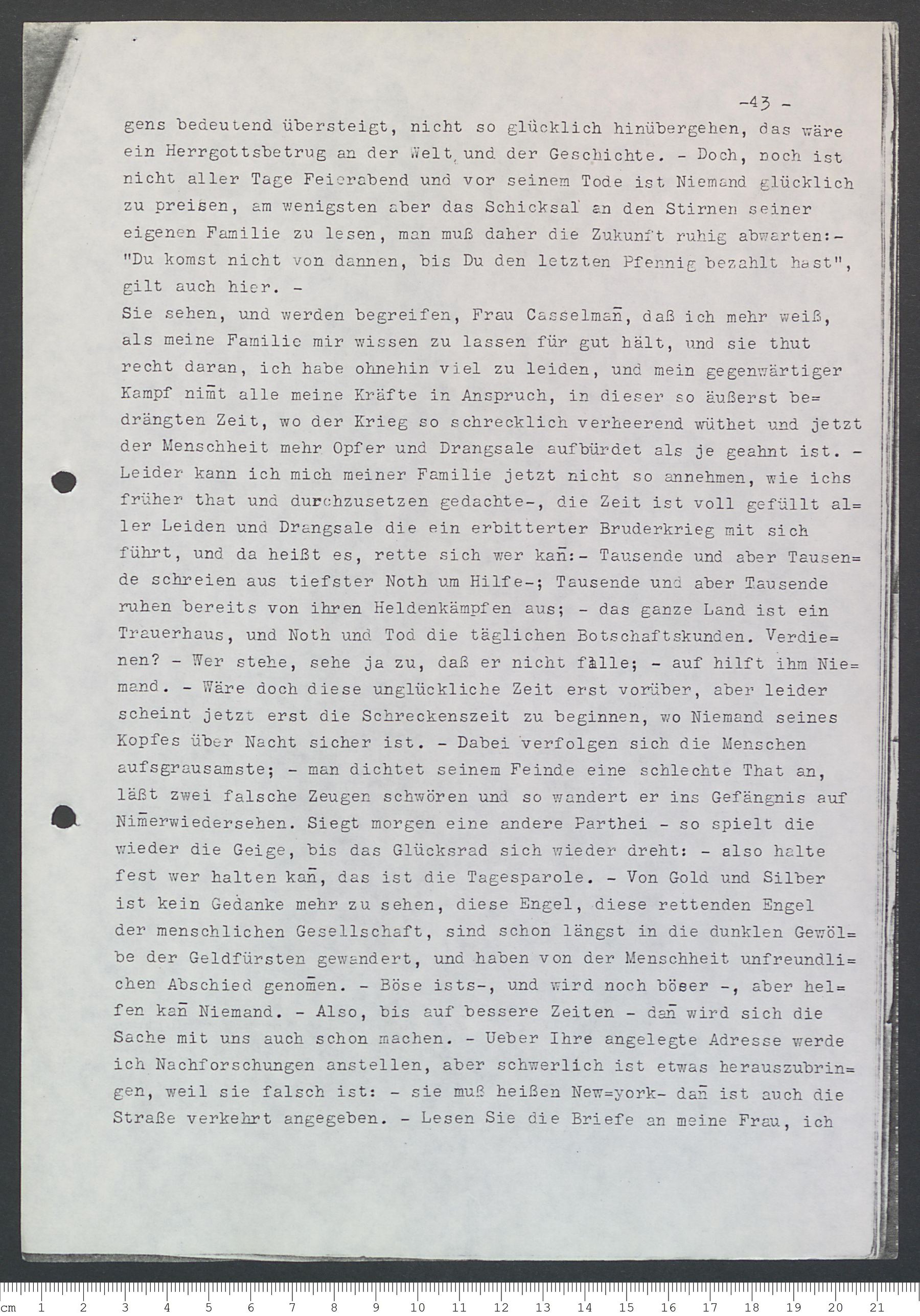
Page – 43 – · 11 July 1862, continued — to Frau Casselman
l _45 z M
; gens bedeutend übersteigt, nicht so glücklich hinübergehen, das wäre }
| ein Herrgottsbetrug an der Welt, und der Geschichte. - Doch, noch äst |
nicht aller Tage Feierabend und vor seinem Tode ist Niemand glücklich
zu preisen, am wenigsten aber das Schicksal an den Stirnen seiner a
eigenen Familie zu lesen, man muß daher die Zukunft ruhig abwarten:- äf
"Du komst nicht von danmnen, bis Du den letzten Pfennig bezahlt hast", ;
gilt auch hier. —- Z!
Sie sehen, und werden begreifen, Frau Casselman, daß ich mehr weiß, :*
als meine Familie mir wissen zu lassen für gut hält, und sie thut !i
recht daran, ich habe ohnehin viel zu leiden, und mein gegenwärtiger |
Kampf nimt alle meine Kräfte in Anspruch, in dieser so äußerst be= I„
drängten Zeit, wo der Krieg so schrecklich verheerend wüthet und jetzt gp
der Menschheit mehr Opfer und Drangsale aufbürdet als je geahnt ist. - ;£
. Leider kann ich mich meiner Familie jetzt nicht so annehmen, wie ichs ‘i
früher that und durchzusetzen gedachte-, die Zeit ist voll gefüllt al= ä}
ler Leiden und Drangsale die ein erbitterter Bruderkrieg mit sich |
führt, und da heißt es, rette sich wer kan:- Tausende und aber Tausen= %
de schreien aus tiefster Noth um Hilfe-; Tausende und aber Tausende 1:
yuhen bereits von ihren Heldenkämpfen aus; - das ganze Land ist ein g
Trauerhaus, und Noth und Tod die täglichen Botschaftskunden. Verdie= 3
nen? - Wer stehe, sehe ja zu, daß er nicht fälle; - auf hilft ihm Nie= }
mand. - Wäre doch diese unglückliche Zeit erst vorüber, aber leider f
scheint jetzt erst die Schreckenszeit zu beginnen, wo Niemand seines p
Kopfes über Nacht sicher ist. - Dabei verfolgen sich die Menschen Ü
aufsgrausamste; - man dichtet seinem Feinde eine schlechte That an, Il
l1läßt zwei falsche Zeugen schwören und so wandert er ins Gefängnis auf j
.. Nimerwiedersehen. Siegt morgen eine andere Parthei - so spielt die ! ;
wieder die Geige, bis das Glücksrad sich wieder dreht: - also halte j;
fest wer halten kan, das ist die Tagesparole. - Von Gold und Silber ;'5
ist kein Gedanke mehr zu sehen, diese Engel, diese rettenden Engel 1‚
der menschlichen Gesellschaft, sind schon längst in die dunklen Gewöl=
be der Geldfürsten gewsndert, und haben von der Menschheit unfreundli= 1ä
chen Abschied genomen. - Böse ists-, und wird noch böser -, aber hel= HB
fen kan Niemand. - Also, bis auf bessere Zeiten - dan wird sich die VE
Sache mit uns auch schon machen. - Ueber Ihre angelegte Adresse werde '!j
ich Nachforschungen anstellen, aber schwerlich ist etwas herauszubrin- IM#
gen, weil sie falsch ist: - sie muß heißen New=york- dan ist auch die f
Straße verkehrt angegeben. - Lesen Sie die Briefe an meine Frau, ich 4
cm 1 2 8 4 5 6 7 8 5 10 41 123 3 14 15 ä6 97 I& d9 20 21
…considerably exceeds, should not pass over so happily, that would be a fraud of God Almighty upon the world and upon history. Yet the day's work is not over yet, and no one is to be called happy before his death — least of all to read fate on the brows of his own family. One must therefore quietly await the future: "You shall not come thence until you have paid the last penny" holds good here too.
You see, and will understand, Frau Casselman, that I know more than my family think it good to let me know — and they do right in that. I have much to suffer in any case, and my present struggle takes all my strength, in this most sorely pressed time, when the war rages so terribly devastating and now lays more victims and tribulations on mankind than was ever guessed at.
Unfortunately I cannot take up my family's cause now as I once did and intended to carry through. The time is filled full of all the sufferings and tribulations that an embittered war of brothers brings with it, and then it is a case of let him save himself who can. Thousands upon thousands cry out of the deepest need for help; thousands upon thousands are already resting from their heroic struggles; the whole land is a house of mourning, and want and death are the daily tidings. Earn? Let him who stands take heed lest he fall — nobody will help him up.
⭐ „ein erbitterter Bruderkrieg“ — an embittered war of brothers — and “das ganze Land ist ein Trauerhaus”. Written July 1862, five months before Charles enlisted. ⭐ Note the admission that his family in Kurhessen were keeping things from him, and that he knew it and thought them right to.
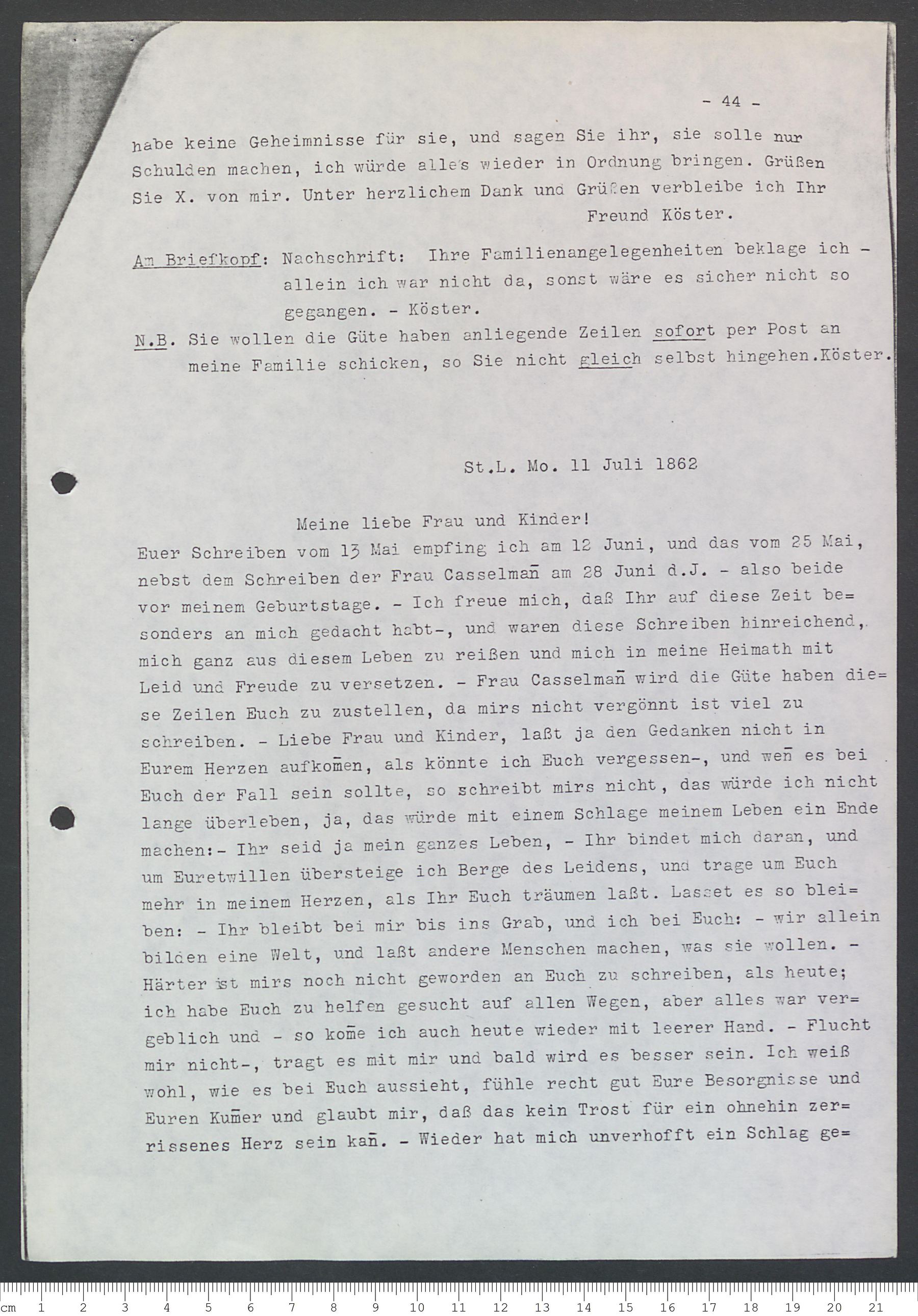
Page – 44 – · End of the Casselman letter, then a letter to the family, July 1862
*- 55 6 T
E S |
k B —- 44 —
'?i a habe keine Geheimnisse für sie, und sagen Sie ihr, sie solle nur f
j“: i‚_ Schulden machen, ich würde alle’s wieder in Ordnung bringen. Grüßen {
S Sie XOn mır. UntEer herzlichem Dank und Grüßen verbleibe ich Ihr
S Freund Köster.
B An Briefkopf: Nachschrift: Ihre Familienangelegenheiten beklage ich —
;I allein ich war nicht da, sonst wäre es sicher nicht so %
gegangen. - Köster.
N.B. Sie wollen die Güte haben anliegende Zeilen sofort per Post an
d meine Familie schicken, so Sie nicht gleich selbst hingehen.Köster.
. SCa MOS 1362
j Meine liebe Frau und Kinder!
Euer Schreiben vom 13 Mai empfing ich am 12 Juni, und das vom 25 Mai,
nebst dem Schreiben der Frau Casselman am 28 Juni d.J. - also beide
vor meinem Geburtstage. - Ich freue mich, daß Ihr auf diese Zeit be=
] sonders an mich gedacht habt-, und waren diese Schreiben hinreichend,
mich ganz aus diesem Leben zv reißen und mich in meine Heimath mit
Leid und Freude zu versetzen. - Frau Casselman wird die Güte haben die=
f se Zeilen Euch zu zustellen, da mirs nicht vergönnt ist viel zu
j schreiben. —- Liebe Frau und Kinder, laßt ja den Gedanken nicht in
Eurem Herzen aufkomen, als könnte ich Euch vergessen-, und wen es bei _
Euch der Fall sein sollte, so schreibt mirs nicht, das würde ich nicht
. lange überleben, ja, das würde mit einem Schlage meinem Leben ein Ende
\ machen:- Ihr seid ja mein ganzes Leben, - Ihr bindet mich daran, und
um Euretwillen übersteige ich Berge des Leidens, und trage um Euch
mehr in meinem Herzen, als Ihr Euch träumen laßt. Lasset es so blei=
ben: — Ihr bleibt bei mir bis ins Grab, und ich bei Euch: - wir allein
bilcen eine Welt, und laßt andere Menschen machen, was sie wollen. -
\ Härter @t mirs noch nicht geworden an Euch zu schreiben, als heute;
| ich habe Euch zu helfen gesucht auf allen Wegen, aber alles war ver=
geblich und - SO kxome ich auch heute wieder mit leerer Hand. - Flucht
mir nicht-, tragt es mit mir und bald wird es besser sein. Ich weiß
wohl, wie es bei Euch aussieht, fühle recht gut Eure Besorgnisse und
Euren Kumer und glaubt mir, daß das kein Trost für ein ohnehin zer=
' rissenes Herz sein kan. - Wieder hat mich unverhofft ein Schlag ge=
cm 1 ä 3 4 5 6 7 8 9 10 11 12 13 . 14 15 16 17 18 19 20 21
…I have no secrets from her, and tell her she should just run into debt; I would put it all in order again. Greet her from me. With warm thanks and greetings I remain your friend, Köster.
[At the head of the letter, postscript:] I deplore your family affairs — but I was not there, otherwise it would certainly not have gone so. Köster.
N.B. Would you have the goodness to send the enclosed lines to my family by post at once, if you do not go there yourself directly. Köster.
[St. Louis, Mo., July 1862.] — My dear wife and children!
I received your letter of 13 May on 12 June, and that of 25 May, together with Frau Casselman's letter, on 28 June this year — so both before my birthday. I am glad that you thought of me particularly at that season, and these letters were enough to tear me quite out of this life and transport me, with sorrow and joy, into my homeland.
Frau Casselman will have the goodness to deliver these lines to you, since it is not granted me to write much. Dear wife and children, never let the thought arise in your hearts that I could forget you; and if it should be so with you, do not write it to me — I should not long survive it; indeed it would put an end to my life at a stroke. You are my whole life; you bind me to it, and for your sake I climb mountains of suffering…
⭐ Frau Casselman was being used as a courier — he encloses letters to his family inside letters to her, and asks her to deliver them by hand or post. Another channel around the ordinary mail, alongside the false dateline and the separate remittances. ⚠️ The dateline of the second letter is OCR-corrupt; read it from the scan.
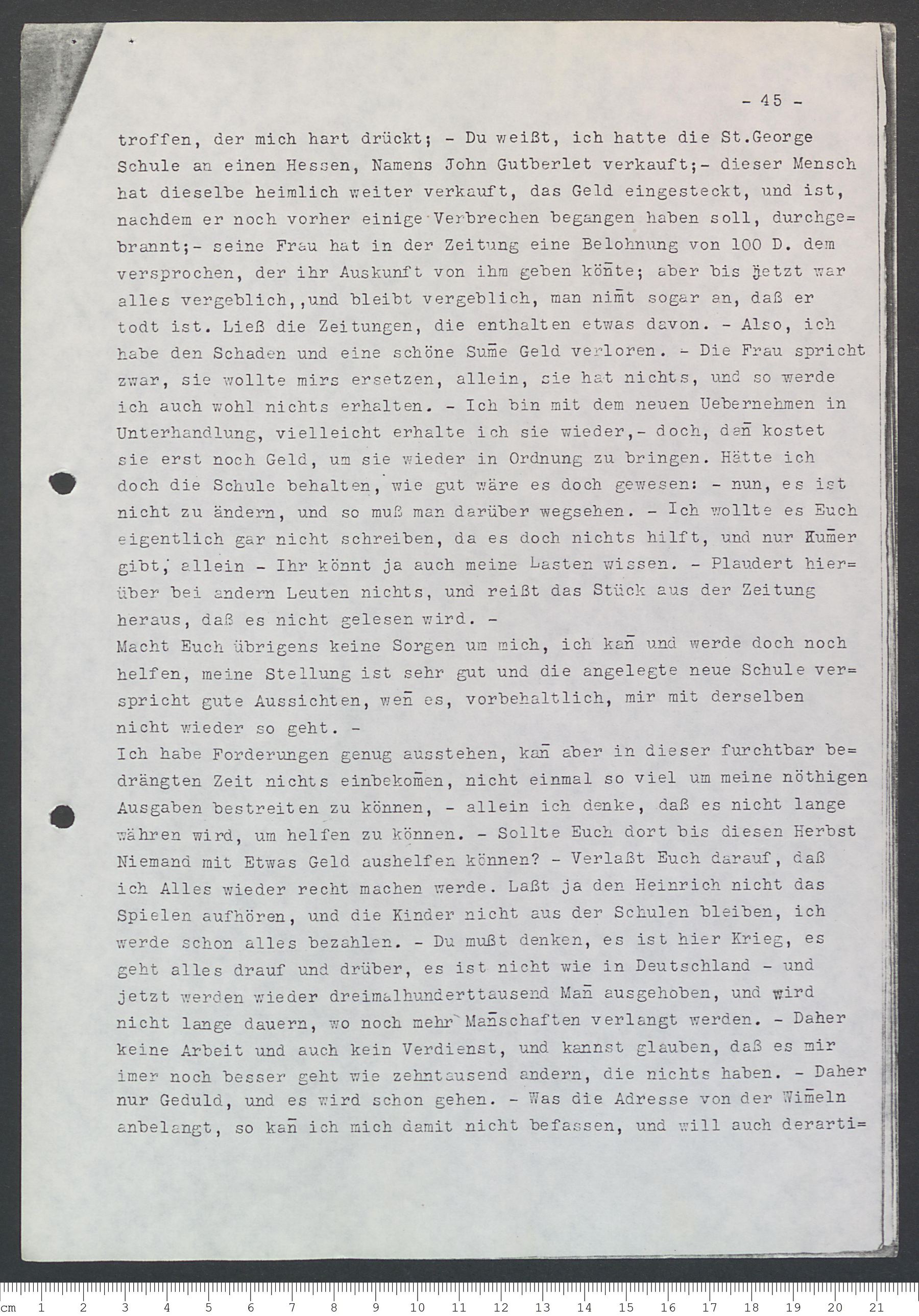
Page – 45 – · ⭐⭐⭐ The Gutberlet fraud
-Q;Qg£f + A
- 45 -
E“ |
- jf troffen, der mich hart drückt; - Du weißt, ich hatte die St.George %
? f Schule an einen Hessen, Namens John Gutberlet verkauft;- dieser Mensch ]
d hat dieselbe heimlich weiter verkauft, das Geld eingesteckt, und ist,
nachdem er noch vorher einige: Verbrechen begangen haben soll, durchge=
brannt;- seine Frau hat in der Zeitung eine Belohnung von 100 D. dem
versprochen, der ihr Auskunft von ihm geben könte; aber bis 3etzt war
alles vergeblich, ,und bleibt vergeblich, man nimt sogar an, daß er !
todt ist. Ließ die Zeitungen, die enthalten etwas davon. - Also, ich !
habe den Schaden und eine schöne Sume Geld verloren. - Die Frau spricht
zwar, sie wollte mirs ersetzen, allein, sie hat nichts, uni so werde
ich auch wohl nichts erhalten. - Ich bin mit dem neuen Uebernehmen in ä-
Unterhandlung, vielleicht erhalte ich sie wieder,- doch, den kostet
sie erst noch Geld, um sie wieder in Ordnung zu bringen. Hätte ich OM
. doch die Schule behaltenfv:ie gut wäre es doch gewesen: - nun, es ist i
nicht zu ändern, und so muß man darüber wegsehen. - Ich wollte es Euch b
esigentlich gar nicht schreiben, da es doch nichts hilft, und nur Humer 4;
gibt, allein - Ihr könnt ja auch meine Lasten wissen. - Plaudert hier= l
über bei andern Leuten nichts, und reißt das Stück aus der Zeitung
heraus, daß es nicht gelesen wird. -
Macht Euch übrigens keine Sorgen um mich, ich kan und werde doch noch
helfen, meine Stellung ist sehr gut und die angelegte neue Schule ver= l
spricht gute Aussichten, wen es, vorbehaltlich, mir mit derselben ;5
nicht wieder so geht. - |
Ich habe Forderungen genug ausstehen, kan aber in dieser furchtbar be= &ä
drängten Zeit nichts einbekofien, nicht einmal so viel um meine nöthigen r.
. Ausgaben bestreiten zu können, - allein ich denke, daß es nicht lange ‘!
währen wird, um helfen zu können. - Sollte Euch dort bis diesen Herbst {l
Niemand mit Etwas Geld aushelfen können? - Verlaßt Euch darauf, daß |
ich Alles wieder recht machen werde. Laßt ja den Heinrich nicht das
Spielen aufhören, und die Kinder nicht aus der Schulen bleiben, ich
werde schon alles bezahlen. - Du mußt denken, es ist hier Krieg, es 1
geht alles drauf und drüber, es ist nicht wie in Deutschland - und ‘H
jetzt werden wieder dreim&lhunderttausend Man ausgehoben, und wird !I
nicht lange dauern, wo noch mehr” Manschaften verlangt werden. - Daher 31
keine Arbeit und auch kein Verdienst, und kannst glauben, daß es mir %i
imer noch besser geht wie zehntausend andern, die nichts haben. - Daher é
nur Geduld, und es wird schon gehen. - Was die Adresse von der Wimeln }
anbelangt, so kan ich mich damit nicht befassen, und will auch derarti= %;
cm 1 B 3 4 5 6 * 8 9 10 11 12 13 14 15 16 17 18 19 20 21
…struck me, which presses me hard. You know I had sold the St. George school to a Hessian named John Gutberlet. This man secretly sold it on, pocketed the money, and — after, it is said, first committing some crimes — absconded. His wife promised a reward of 100 dollars in the newspaper to anyone who could give her information of him; but so far everything has been in vain, and remains in vain. It is even supposed that he is dead. Read the newspapers, they contain something of it.
So I have the loss, and a fine sum of money gone. The wife says indeed that she means to make it good to me, but she has nothing, and so I shall probably get nothing either. I am in negotiation with the new taker-over; perhaps I shall get the school back — but then it will cost money again to put it in order. If only I had kept the school, how good it would have been. Well, it cannot be altered, and so one must look past it.
I really did not want to write it to you at all, since it does not help and only causes grief — but you may as well know my burdens too. Do not chatter about this to other people, and tear the piece out of the newspaper so that it is not read.
For the rest, do not worry about me; I can and shall still help. My position is very good and the newly established school promises…
⭐⭐⭐ THE GUTBERLET FRAUD IN FULL. The buyer of the St. George school was a fellow Hessian, John Gutberlet, who resold it secretly, pocketed the proceeds, allegedly committed further crimes, and absconded; his wife advertised a 100-dollar reward in the press for information; he was never found and was presumed dead. ⭐ Two checkable things follow. (1) A $100 reward advertisement ran in a St. Louis paper in 1862 — findable, and it would name and describe Gutberlet. (2) The name John Gutberlet is searchable in St. Louis directories, court records and the provost marshal papers. ⚠️ Both name and figure are OCR-derived; verify against the scan first. ⭐ Note the instruction: tell nobody, and tear the piece out of the newspaper — he was managing his reputation at home even in disaster, which is of a piece with the false dateline.
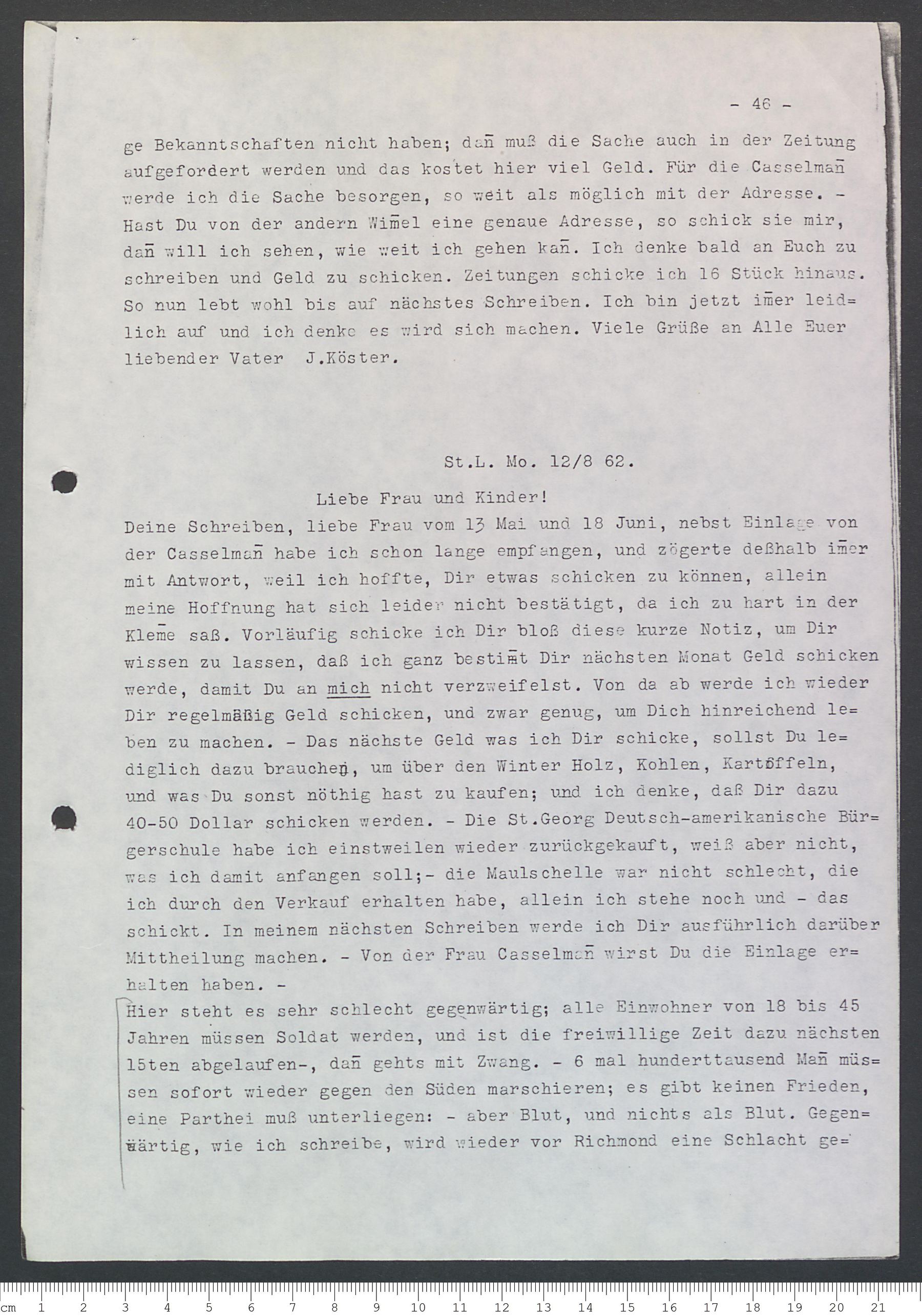
Page – 46 – · End of the July letter; 12 August 1862 — winter money and the conscription notice
| 70 |
ge Bekanntschaften nicht haben; dan muß die Sache auch in der Zeitung :
aufgefordert werden und das kostet hier viel Geld. Für die Casselman
werde ich die Sache besorgen, so weit als möglich mit der Adresse, —
Hast Du von der andern Wimel eine genaue Adresse, so schick sie mir,
dan will ich sehen, wie weit ich gehen kan. Ich denke bald an Euch zu
schreiben und Geld zu schicken. Zeitungen schicke ich 16 Stück hinäus.
So nun lebt wohl bis auf nächstes Schreiben. Ich bin jetzt imer leid=
lich auf und ich denke es wird sich mächen. Viele Grüße an Alle Zuer
liebender Vater J.Köster. }
St.L. Mo. 12/8 62. [dateline read from the image, 10 Oct 2026]
Liebe Frau und Kinder! ü
Deine Schreiben, liebe Frau vom 13 Mai und 18 Juni, nebst Einläse von L
der Casselman habe ich schon lange empfaängen, und zögerte deßhalb imer &
mit Antwort, weil ich hoffte, Dir etwas schicken zu können, altein H
meine Hoffnung hat sich leider nicht bestätigt, da ich zu hart ın der h
Kleme saß. Vorläufig schicke ich Dir bloß diese®e kurze Notiz, um Dir 1
wissen zu lassen, daß ich ganz bestimt Dir nächsten Monat Geld schicken
werde, damit Du an mich nicht verzweifelst. Von da ab werde ich wieder
Dir regelmäßig Geld schicken, und zwar genug, um Dich hinreichend 1le=
ben zu machen. - Das nächste Geld was ich Dir schicke, sollst Du le=
diglich dazu brauchej, um über den Winter Holz, Kohlen, KartSffeln,
und was:ıDu sonst nöthig hast zu kaufen; und ich denke, daß Dir dazu
. 40-50 Dollar schicken werden. - Die St.Georg Deutsch-amerikanische Bür= {
gerschule habe ich einstweilen wieder zurückgekauft, weiß aber nicht, {
wes ich damit anfangen soll;- die Maulschelle war nicht schlecht, die |
ich durch den Verkauf erhalten habe, allein ich stehe noch und — das !
schickt. In meinem nächsten Schreiben werde ich Dir ausführlich darüber
Mittheilung machen., - Von der Frau Casselmen wirst Du die Einlage er=
halten haben. -
rHier steht es sehr schlecht gegenwärtig; alle Einwohner von 18 bis 45
iJahren müssen Soldat werden, und ist die freiwillige Zeit dazu nächsten
|15ten abgelaufen-, dan gehts mit Zwang. - 6 mal hunderttausend Man müs=
?sen sofort wieder gegen den Süden marschieren; es gibt keinen Frieden,
|eine Parthei muß unterliegen: - aber Blut, und nichts als Blut. Gegen=
Eäärtig‚ wie ich schreibe, wird wieder vor Richmond eine Schlacht ge=
cm 1 2 3 4 5 6 7 8 9 210 11 12 13 14 15 16 17 18 19 20 21
…do not have such acquaintances; then the matter must also be advertised in the newspaper, and that costs a great deal of money here. For Frau Casselman I shall see to the matter as far as possible, with the address. If you have an exact address for the other [Wimel?], send it to me and I will see how far I can go. I think to write to you soon and to send money. I am sending out 16 newspapers. So now farewell until the next letter. I am tolerably up and about now and think it will do. Many greetings to all. Your loving father, J. Köster.
St. L[ouis], Mo., 12/8 62 [12 August 1862]. — Dear wife and children!
Your letters, dear wife, of 13 May and 18 June, together with the enclosure from Frau Casselman, I received long ago, and kept putting off my answer because I hoped to be able to send you something; but my hope has unfortunately not been fulfilled, since I was sitting too hard in the pinch.
For the present I send you only this short note, to let you know that I shall quite certainly send you money next month, so that you do not despair of me. From then on I shall again send you money regularly, and enough to let you live sufficiently. The next money I send you, you are to use solely to buy wood, coal, potatoes and whatever else you need for the winter; and I think 40 to 50 dollars will be sent you for it. The St. George German-American Citizens' School…
⭐ He shipped 16 newspapers home in one packet — the print traffic to Kurhessen was substantial and regular. ⭐ A winter budget: 40–50 dollars for wood, coal and potatoes. ⚠️ Note this is dollars, where earlier remittances were in Prussian Thaler — and by 1862 those are depreciated paper (see the 1⅔ specie premium, p. 32). Do not convert these figures without allowing for that. ✓ Checked against the image, 10 Oct 2026: the letter that begins on this leaf is datelined “St.L. Mo. 12/8 62.” (12 August 1862), and the conscription notice (“alle Einwohner von 18 bis 45 Jahren müssen Soldat werden”) is on this leaf, at the foot of the page. The earlier note doubting the 0099 citation was wrong.
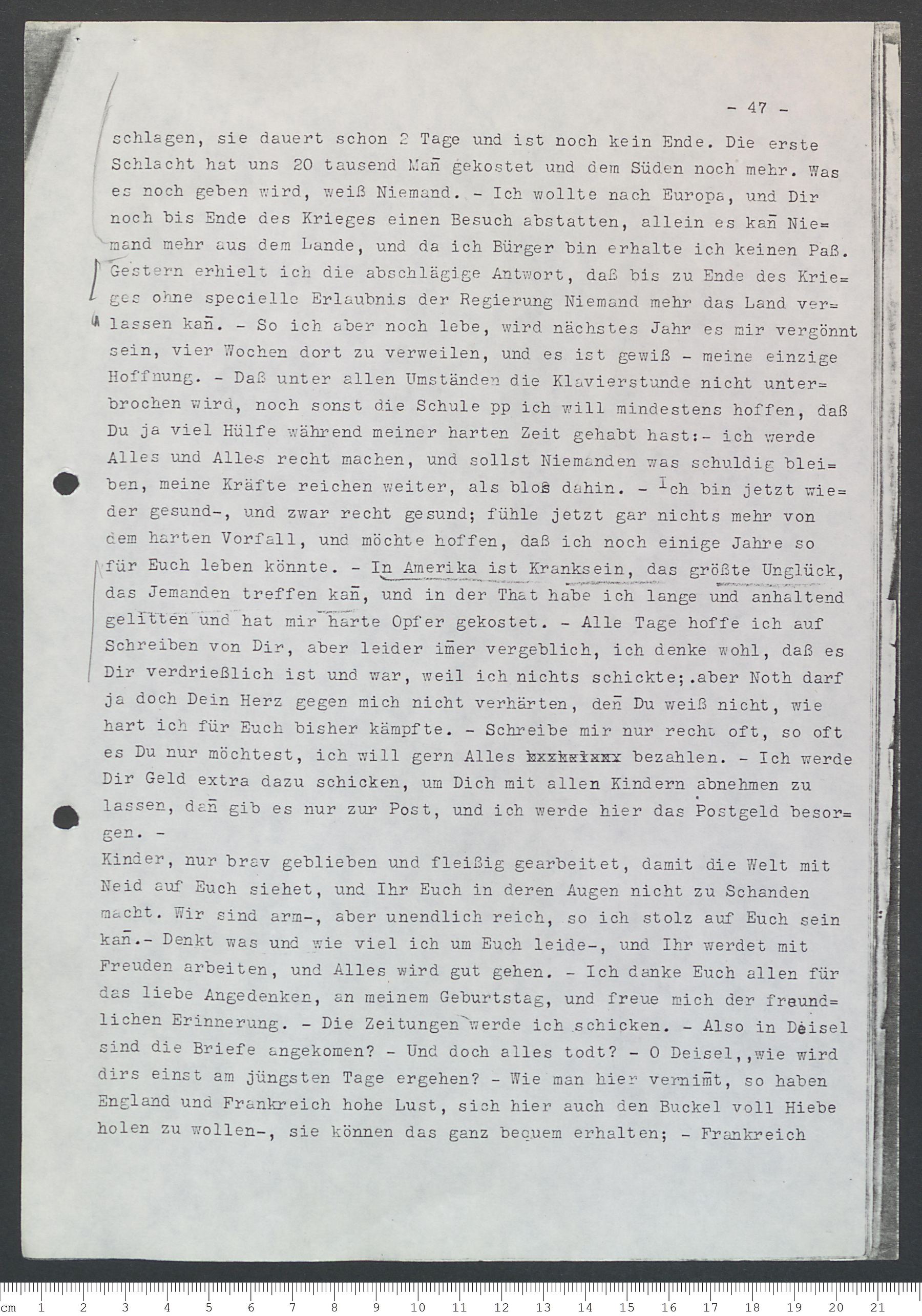
Page – 47 – · ⭐⭐⭐ Refused a passport: no one may leave the country
; . . 'i V\
] Z AT ! ;
F schlagen, sie dauert schon 2 Tage und ist noch kein Ende, Die erste >b
' Schlacht hat uns 20 tausend Man gekostet und dem Süden noch mehr., Was H
es noch geben wird, weiß Niemand..- Ich wollte nach Europs, und Dir J
noch bis Ende des Krieges einen Besuch abstatten, allein es kan Nie= N
mand mehr aus dem Lande, und da ich Bürger bin erhalte ich keinen Paß. €
[ Gestern erhielt ich die abschlägige Antwort, daß bis zu Ende des Krie= }
ges ohne specielle Erlaubnis der Regierung Niemand mehr das Land ver= ‘
4 lassen kan. - So ich aber noch lebe, wird nächstes Jahr es mir vergönnt ;‘
sein, vier Wochen dort zu verweilen, und es ist gewiß —- meine einzige äZ
Hoffnung. - Daß unter allen Umständen die Klavierstunde nicht unter=
brochen wird, noch sonst die Schule pp ich will mindestens hoffen, daß ‘cÜ
Du ja viel Hülfe während meiner harten Zeit gehabt hast:- ich werde ?‘!
Alles und Alles recht machen, und sollst Niemenden was schuldig blei= ? i
@® v°n, meine Kräfte reichen weiter, als bloß dahin. - Ich bin jetzt wie= \ i
der gesund-, und zwar recht gesund; fühle jetzt gar nichts mehr von *
dem harten Vorfall, und möchte hoffen, daß ich noch einige Jahre so d
\für Euch leben könnte. - Ig_éyg;;%a_?;ä.Krankfgäg‚wgas grö%pe Un;l@ck‚ | '
f das Jemanden treffen kan, und in der That habe ich lange dhd’äfihaltend ä;
jgelitten und hat mir harte Opfer gekostet. - Alle Tage hoffe ich auf = !
| Schreiben von Dir, aber leider imer vergeblich, ich denke wohl, daß es / j
| Dir verdrießlich ist und war, weil ich nichts schickte;.aber Noth darf i |
ja doch Dein Herz gegen mich nicht verhärten, den Du weiß nicht, wie 1
hart ich für Euch bisher kämpfte. - Schreibe mir nur recht oft, so oft / ;
es Du nur möchtest, ich will gern Alles kxxkswi1zmx bezahlen. - Ich werde l ;
Dir Geld extra dazu schicken, um Dich mit allen Kindern abnehmen zu ]
. lassen, den gib es nur zur Post, und ich werde hier das Postgeld besor= [ 3
men. - f !
Kinder, nur brav geblieben und fleißig gearbeitet, damit die Welt mit €
Neid auf Euch siehet, und Ihr Euch in deren Augen nicht zu Schanden 'f
macht. Wir sind arm-, aber unendlich reich, so ich stolz auf Euch sein i
kan.- Denkt was und wie viel ich um Euch leide-, und Ihr werdet mit ; £:
Freuden arbeiten, und Alles wird gut gehen. - Ich danke Euch allen für B
das liebe Angedenken, an meinem Geburtstag, und freve mich der fraund&- {R
lichen Erinnerung. - Die Zeitungen werde ich schicken. - Also in Deisel ; ä
sind die Briefe angekomen? - Und doch alles todt? - 0 Deisel,,wie wird 1?3€
dirs einst am jüngsten Tage ergehen? - Wie man hier vernimt, so haben { J;
England und Fraänkreich hohe Lust, sich hier auch den Buckel voll Hiebe f %
holen zu wollen-, sie können das ganz becuem erhalten; - Frankreich ;‚ i
—.. ) S]
cm 1 ä 3 4 5 6 W 8 9 10 11 12 13 14 15 16 17 18 19 20 21
…a battle, it has already lasted 2 days and there is still no end. The first battle cost us 20 thousand men and the South still more. What is still to come, nobody knows.
I wanted to go to Europe and pay you a visit before the end of the war — but nobody can leave the country any more, and since I am a citizen I get no passport. Yesterday I received the refusal: that until the end of the war nobody may leave the country without special permission from the government.
But if I am still alive, next year it will be granted me to stay there four weeks, and it is certain — my one hope.
That the piano lessons are on no account to be interrupted, nor the schooling; I will at least hope that you have had much help during my hard time. I shall put everything, everything right, and you shall owe nobody anything; my powers reach further than that.
I am well again now, and quite well at that; I feel nothing at all now of that hard attack, and would hope that I might live some years yet for you. [Illness is] the greatest misfortune that can strike anyone, and in truth I have suffered long and persistently and it has cost me hard sacrifices.
⭐⭐⭐ HE APPLIED FOR A PASSPORT AND WAS REFUSED — because he was a US citizen and the war was on. „es kann Niemand mehr aus dem Lande, und da ich Bürger bin erhalte ich keinen Paß … bis zu Ende des Krieges ohne specielle Erlaubnis der Regierung.“ ⚠️⚠️ THIS MAY CORRECT THE MEMORY FILE. The Köster concealment model cites “img 0099: Kurhessian men 18–45 conscripted, no one may leave, passport refused” and uses it to argue that a Hessian leaving irregularly would generate no exit paper. But the exit ban and passport refusal described here are AMERICAN, not Kurhessian — a wartime US restriction on citizens leaving. Verify against the scan before relying on either reading; if this is the passage the model rests on, that argument needs re-examining. ⭐ A two-day battle costing 20,000 on the Union side — checkable against operations in the relevant month once the letter is firmly dated.
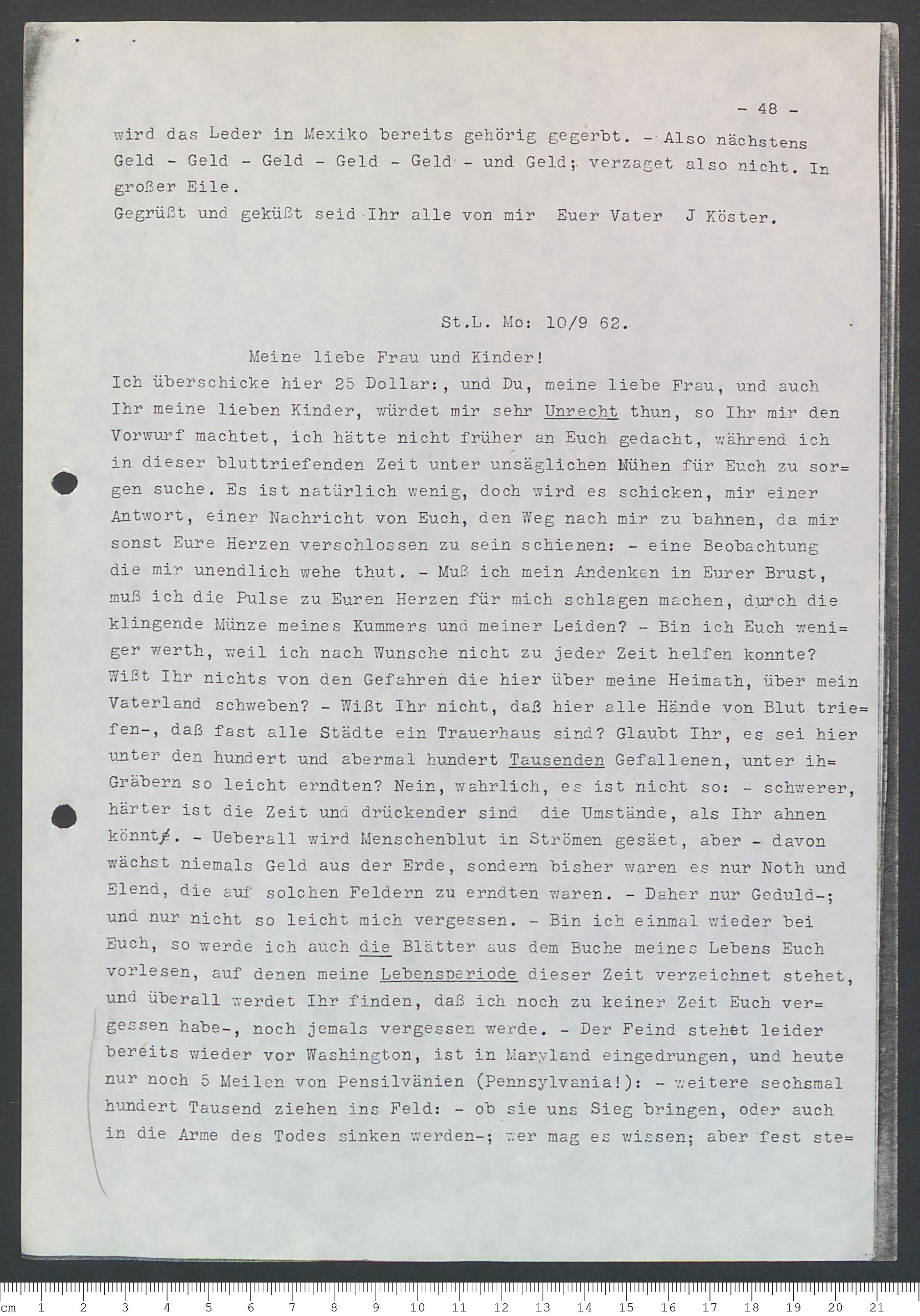
Page – 48 – · St. Louis, 10 September 1862 — 25 dollars, and a reproach
S « 6
. He }
wird das Leder in Mexiko bereits gehörig gegerbt. - Also Nächstens |
Geld - Geld - Geld - Geld - Geld‘- und Geld; verzaget also DA CcH CIM
großer Eile. ]
Gegrüßt und geküßt seid.Ihr alle von mir Euer Vater J Köster, €
St.L. Mo: 10/9 62. - MM
Meine liebe Frau und Kinder! ?f
Ich überschicke hier 25 Dollar:, und Du, meine liebe Frau, und auch ii
Ihr meine lieben Kinder, würdet mir sehr Unrecht thun, so Ihr mir den if
Vorwurf machtet, ich hätte nicht früher an Euch gedacht, während ich ;j
in dieser bluttriefenden Zeit unter unéägliohen Nühen für Euch zu sor= Fg
. gen suche, Es ist natürlich wenig, doch wird es schicken, mir einer |
Antwort, einer Nachricht von Euch, den Weg nach mir zu bahnen, da mir gf
sonst Eure Herzen verschlossen zu sein schienen: - eine Beobachtung $l%
die mir unendlich wehe thut. - Muß ich mein Andenken in Eurer Brust, !;
muß ich die Pulse zu Euren Herzen für mich schlagen machen, durch die i;
klingende Münze meines Kummers und meiner Leiden? - Bin ich Euch weni= Ej
ger werth, weil ich nach Wunsche nicht zu jeder Zeit helfen konnte? :‚
Wißt Ihr nichts von den Gefahren die hier über meine Heimath, über mein ijä
Vaterland schweben? - Wißt Ihr nicht, daß hier alle Hände von Blut trie= W
fen-, daß fast alle Städte ein Trauerhaus sind? Glaubt An es s Hen Hj
unter den hundert und abermal hundert Tausenden Gefallenen, unter ih= Lii
Gräbern so leicht erndten? Nein, wahrlich, es ist nicht so: - schwerer, Üf
. härter ist die Zeit und drückender sind die Umstände, als Ihr ahnen . |
könntg. - Ueberall wird Menschenblut in Strömen gesäet, aber - davon E'f
wächst niemals Geld aus der Erde, sondern bisher waren es nur Noth und Ü;
Elend, die suf solchen Feldern zu erndten waren. - Daher nur Geduld-; 4
und nur nicht so leicht mich vergessen. - Bin ich einmal wieder bei | ;
Euch, so werde ich auch die Blätter aus dem Buche meines Lebens Euch ; !
vorlesen, auf denen meine Lebensperiode dieser Zeit verzeichnet stehet, ;|
und überall werdet Ihr finden, daß ich noch zu keiner Zeit Euch ver= E
gessen habe-, noch jemals vergessen werde, - Der Feind stehet leider E
bereits wieder vor Washington, ist in Maryland eingedrungen, und heute }'€
nur noch 5 Meilen von Pensilvänien (Pennsylvania!): - weitere sechsmal 5 ä
hundert Tausend ziehen ins Feld: - ob sie uns Sieg bringen, oder auch | }
in die Arme des Todes sinken werden-; wer mag es wissen; aber fest ste= ifif
cm 1 2 3 4 5 6 7 8 9 120 41 12 3 44 15 46 147 186 9 %0 21
…the leather is already being properly tanned in Mexico. So: shortly money — money — money — money — money — and money; do not despair then. In great haste. Greeted and kissed you all are by me, your father, J. Köster.
St. Louis, Mo., 10 September 1862. — My dear wife and children!
I send over 25 dollars here; and you, my dear wife, and you too my dear children, would do me great wrong if you reproached me with not having thought of you sooner, while in this blood-dripping time I try under unspeakable difficulties to provide for you.
It is little, of course, yet it will serve to open the way to me for an answer, some news from you — since otherwise your hearts seemed closed to me: an observation that hurts me infinitely. Must I make my memory in your breast, must I make the pulses of your hearts beat for me, through the ringing coin of my grief and my sufferings? Am I worth less to you because I could not help at every moment as I wished?
Do you know nothing of the dangers hovering here over my home, over my fatherland? Do you not know that here all hands drip with blood, that almost every city is a house of mourning?
⭐ A remittance of 25 dollars, 10 September 1862, and a bitter suspicion that his family write only when money comes. ⭐ Note he now calls America “mein Vaterland” without qualification.
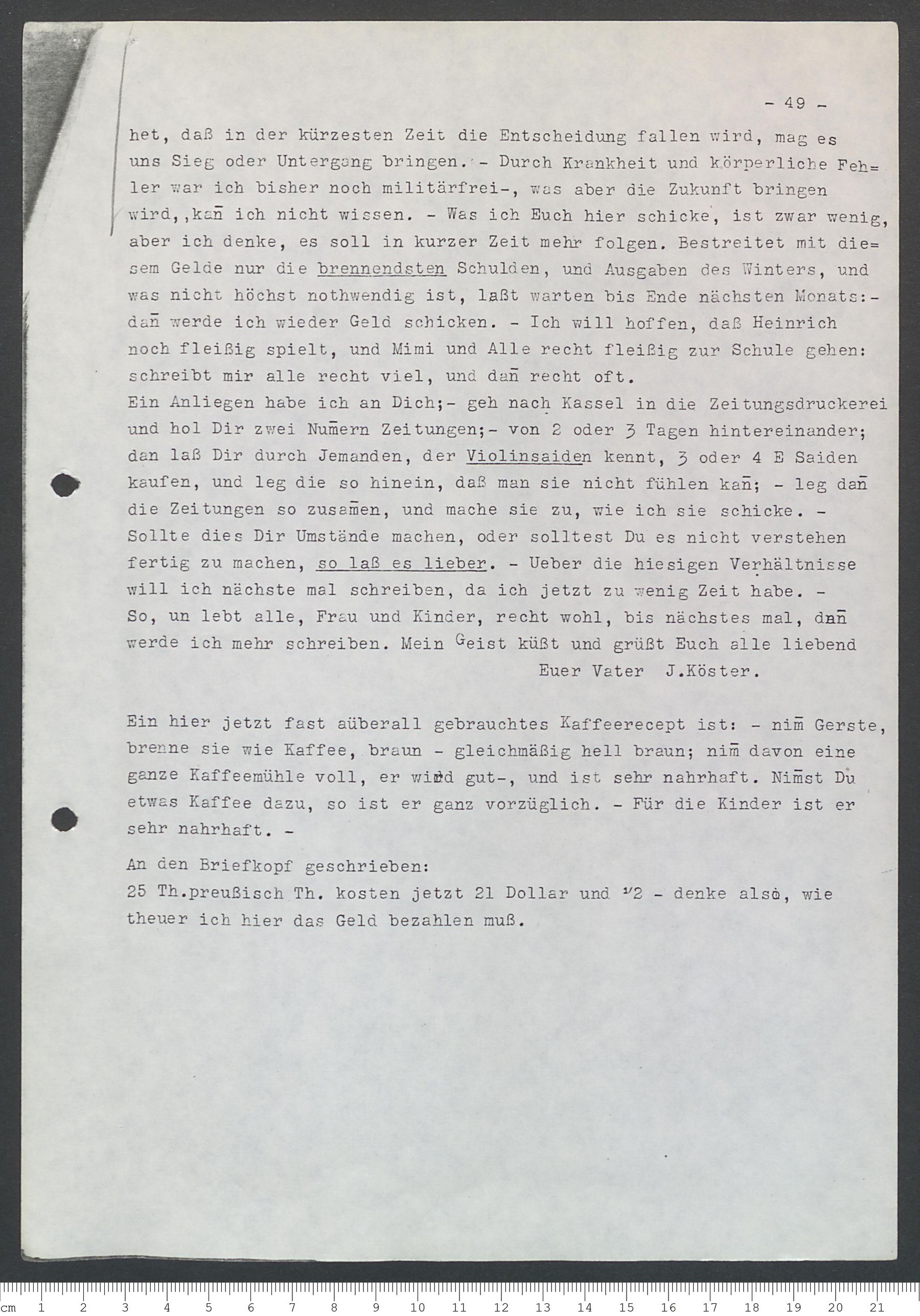
Page – 49 – · Autumn 1862 — ⭐⭐ exempt from military service, and violin strings hidden in newspapers
?Y | S
%ä | het, daß in der kürzesten Zeit die Entscheidung fallen wird, mag es
S ; uns Sieg oder Untergang bringen.:- Durch Krankheit und körperliche Feh=
| ler war ich bisher noch militärfrei-, was aber die Zukunft bringen
5 V wird, ‚kan ich nicht wissen. - Was ich Euch hier schicke, ist zwar wenig,
/ aber ich denke, es soll in kurzer Zeit mehr folgen. Bestreitet mit die=
sem Gelde nur die brennendsten Schulden, und Ausgaben des Winters, und
/ waäs nicht höchst nothwendig ist, 1aßt warten bis Ende nächsten Monats:-
} dan werde ich wieder Geld schicken. - Ich will hoffen, daß Heinrich
| noch fleißig spielt, und Mimi und Alle recht fleißig zur Schule gehen:
| 5 schreibt mir alle recht viel, und dan recht oft.
E Ein Anliegen habe ich an Dich;- geh nach Kassel in die Zeitungsdruckerei
! und hol Dir zwei Numern Zeitungen;- von 2 oder 3 Tagen hintereinander;
| dan laß Dir durch Jemanden, der Violinsaiden kennt, 3 oder 4 E Saiden
8 . kaufen, und leg die so hinein, daß man sie nicht fühlen kan; - leg dan
; die Zeitungen so zusamen, und mache sie zu, wie ich sie schicke. -
Sollte dies Dir Umstände machen, oder solltest Du es nicht verstehen
d fertig zu machen, so _ laß es _ lieber, - VUeber die hiesigen Verhältnisse
will ich nächste mal schreiben, da ich jetzt zu wenig Zeit habe. -
So, un lebt alle, Frau und Kinder, recht wohl, bis nächstes mal, dan
werde ich mehr schreiben. Mein Geist küßt und grüßt Euch alle liebend
Euer Vater J.Köster.
Ein hier jetzt fast aüberall gebrauchtes Kaffeerecept ist: - nim Gerste,
brenne sie wie Kaffee, braun - gleichmäßig hell braun;z nim davon eine
ganze Kaffeemühle voll, er wi@md gut-, und ist sehr nahrhaft. Nimst Du
etwas Kaffee dazu, so ist er ganz vorzüglich. - Für die Kinder ist er
. sSchr nahrhaft: —
An den Briefkopf geschrieben:
25 Th.preußisch Th. kosten jetzt 21 Dollar und ”2 - denke alsü, wie
theuer ich hier das Geld bezahlen muß.
cm 1 Z 3 4 5 6 % 8 9 10 4i 12 3 da 15 16 147 18 d9 %20 21
…that the decision will fall in the shortest time, whether it brings us victory or ruin. Through illness and physical defects I have so far been exempt from military service — but what the future will bring I cannot know.
What I send you here is little, but I think more shall follow shortly. Meet only the most burning debts and the winter's expenses with this money, and let whatever is not absolutely necessary wait until the end of next month; then I shall send money again.
I will hope that Heinrich still plays diligently, and that Mimi and all of them go to school diligently. Write me all of you a great deal, and then often.
I have a request to make of you. Go to the newspaper printing house in Kassel and get yourself two numbers of the paper — from two or three consecutive days. Then have somebody who knows violin strings buy you 3 or 4 E strings, and lay them in so that they cannot be felt. Then fold the newspapers together and close them up as I send them. If this makes difficulties for you, or if you do not understand how to make it up, then rather leave it.
About conditions here I will write next time, as I have too little time now. So, live well all of you, wife and children, until next time, and then I shall write more.
⭐⭐ „Durch Krankheit und körperliche Fehler war ich bisher noch militärfrei“ — through illness and physical defects he had so far been exempt from military service, and did not know what was coming. Autumn 1862 is exactly when the militia draft closed over Missouri; three months later Charles enlisted. The pressure is documented from inside the same German community. ⭐ Violin strings to be smuggled inside folded newspapers, laid in so they cannot be felt — small goods moved under cover of the press packets, and one more instance of Köster routing things around ordinary channels.
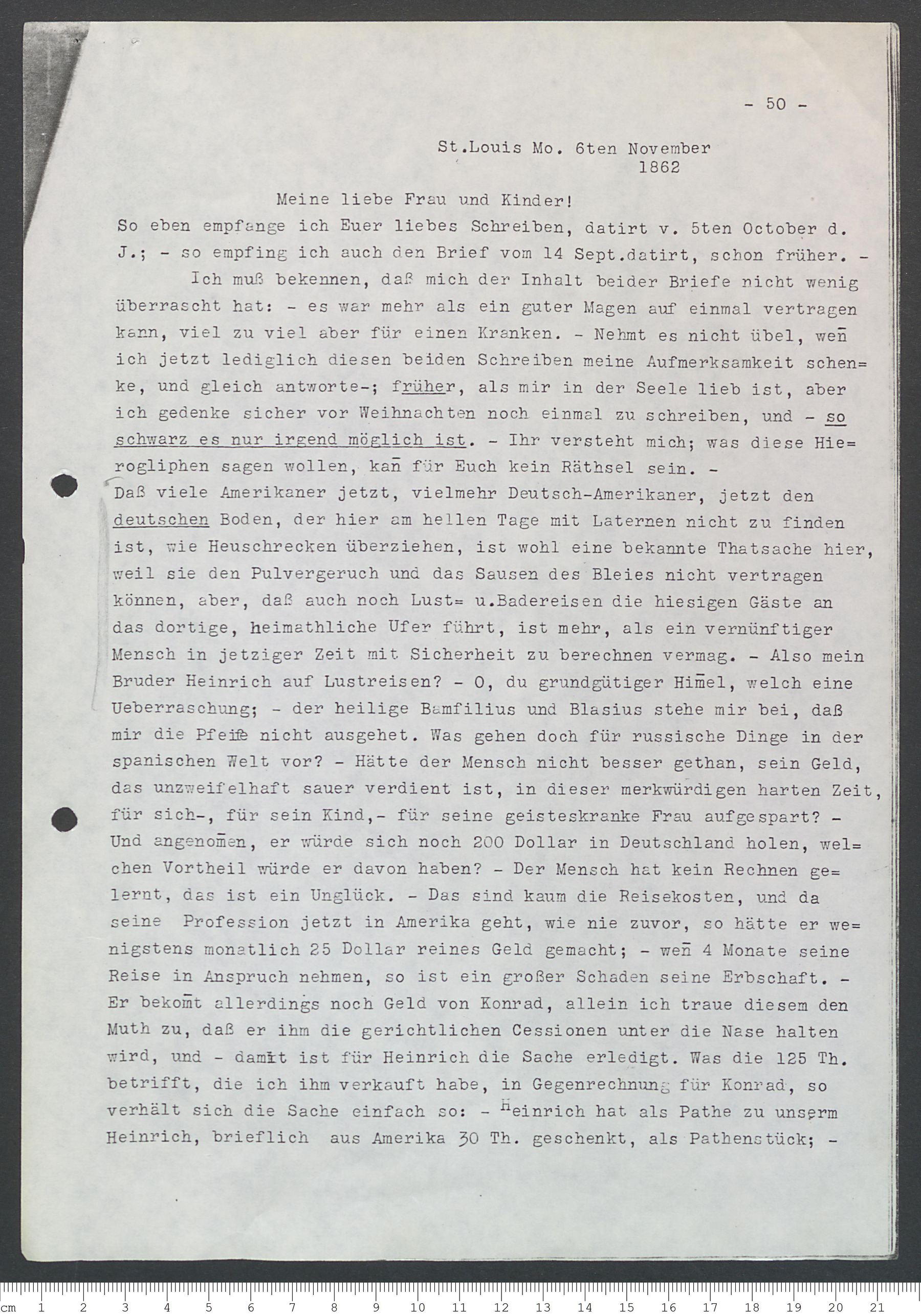
Page – 50 – · ⭐⭐ St. Louis, 6 November 1862 — German-Americans fleeing the draft
BF |
> - 50 - !
;; St.Louis Mo. 6ten November |
E 1862 |
} Meine liebe Frau und Kinder! {
| So eben empfange ich Euer liebes Schreiben, datirt v. 5ten October d. %1
J.; - so empfing ich auch den Brief vom 14 Sept.datirt, schon früher. - F}
Ich muß bekenmnen, daß mich der Inhalt beider Briefe nicht wenig |
überrascht hat: - es war mehr als ein guter Magen auf einmal vertragen
kann, viel zu viel aber für einen Kranken. - Nehmt es nicht übel, wen
ich jetzt lediglich diesen beiden Schreiben meine Aufmerksamkeit schen= |
ke, und gleich antworte-; früher, als mir in der Seele lieb ist, aber fi
ich gedenke sicher vor Weihnachten noch einmeal zu schreiben, und - so %
schwarz es nur irgend möglich ist. - Ihr versteht mich; was diese Hie= f
rogliphen sagen wollen, kan für Euch kein Räthsel sein. -
. V>Daß viele Amerikaner jetzt, vielmehr Deutsch-Amerikaner, jetzt den |
deutschen Boden, der hier am hellen Tage mit Laternen nicht zu finden »
ist, wie Heuschrecken überziehen, ist wohl eine bekannte Thatsache hier, '
weil sie den Pulvergeruch und das Sausen des Bleies nicht vertragen /
können, aber, daß auch noch Lust= u.Badereisen die hiesigen Gäste an |
das dortige, heimathliche Ufer führt, ist mehr, als ein vernünftiger ä
Mensch in jetziger Zeit mit Sicherheit zu berechnen vermag. - Also mein i
Bruder Heinrich auf Lustreisen? - 0, du grundgütiger Himel, welch eine %
Ueberraschung; - der heilige Bamfilius und Blasius stehe mir bei, daß “
mir die Pfeiß nicht ausgehet. Was gehen doch für russische Dinge in der ü
spanischen Welt vor? - Hätte der Mensch nicht besser gethan, sein Geld, i
das unzweifelhaft sauer verdient ist, in dieser merkwürdigen harten Zeit‚“
. für sich-, für sein Kind,- für seine geisteskranke Frau aufgespart? — [|
Und angenomen, er würde sich noch 200 Dollar in Deutschland holen, wel= |
chen Vortheil würde er davon haben? - Der Mensch hat kein Rechnen ge= |
lernt, das ist ein Unglück. - Das sind kaum die Reisekosten, und da !
seine Profession jetzt in Amerika geht, wie nie zuvor, so hätte er we= fl
nigstens monatlich 25 Dollar reines Geld gemacht; - wen 4 Monate seine Ä
Reise in Anspruch nehmen, so ist ein großer Schaden seine Erbschaft. - |
Er bekomt allerdings noch Geld von Konrad, allein ich traue diesem den l
Muth zu, daß er ihm die gerichtlichen Cessionen unter die Nase halten f
wird, und - damit ist für Heinrich die Sache erledigt. Was die 125 Th. |
betrifft, die ich ihm verkauft habe, in Gegenrechnung für Konrad, so H
verhält sich die Sache einfach so: - %Meinrich hat als Pathe zu unserm ß
Heinrich, brieflich aus Amerika 30 Th. geschenkt, als Pathenstück; - 4
$ ° |
cm 1 3 3 4 5 6 7 8 9 26 11 13 13 14 45 4146 17 18 186 20 21
St. Louis, Mo., 6 November 1862. — My dear wife and children!
I have just received your dear letter dated 5 October this year; and I received the letter dated 14 September earlier. I must confess that the contents of both letters surprised me not a little: it was more than a good stomach can bear at once, and far too much for a sick man.
Do not take it amiss if I now give my attention solely to these two letters and answer at once — sooner than is dear to my soul; but I certainly intend to write once more before Christmas, and as black as it is possibly possible. You understand me; what these hieroglyphs mean can be no riddle to you.
That many Americans now — or rather German-Americans — are now overrunning German soil like locusts, though German soil is not to be found here with lanterns in broad daylight, is a well-known fact here, because they cannot stand the smell of powder and the whistling of lead. But that pleasure trips and spa journeys should also be carrying the guests from here to that home shore is more than a reasonable man can reckon on with any certainty in these times. So my brother Heinrich on a pleasure trip? O gracious heaven, what a surprise…
⭐⭐ GERMAN-AMERICANS WERE LEAVING THE UNITED STATES TO ESCAPE THE DRAFT, autumn 1862, in numbers Köster calls a well-known fact and likens to locusts: „weil sie den Pulvergeruch und das Sausen des Bleies nicht vertragen können.“ This is a documented counter-current in Charles's exact window and from inside his community. It matters two ways for this project: it is a reason a German man might vanish from the American record in 1862 without dying, and it sharpens by contrast what Charles did in December 1862. ⭐ Note also that he writes in deliberate code — “so schwarz es nur irgend möglich ist … was diese Hieroglyphen sagen wollen, kann für Euch kein Räthsel sein” — a third concealment device alongside the false dateline and the post-dating.
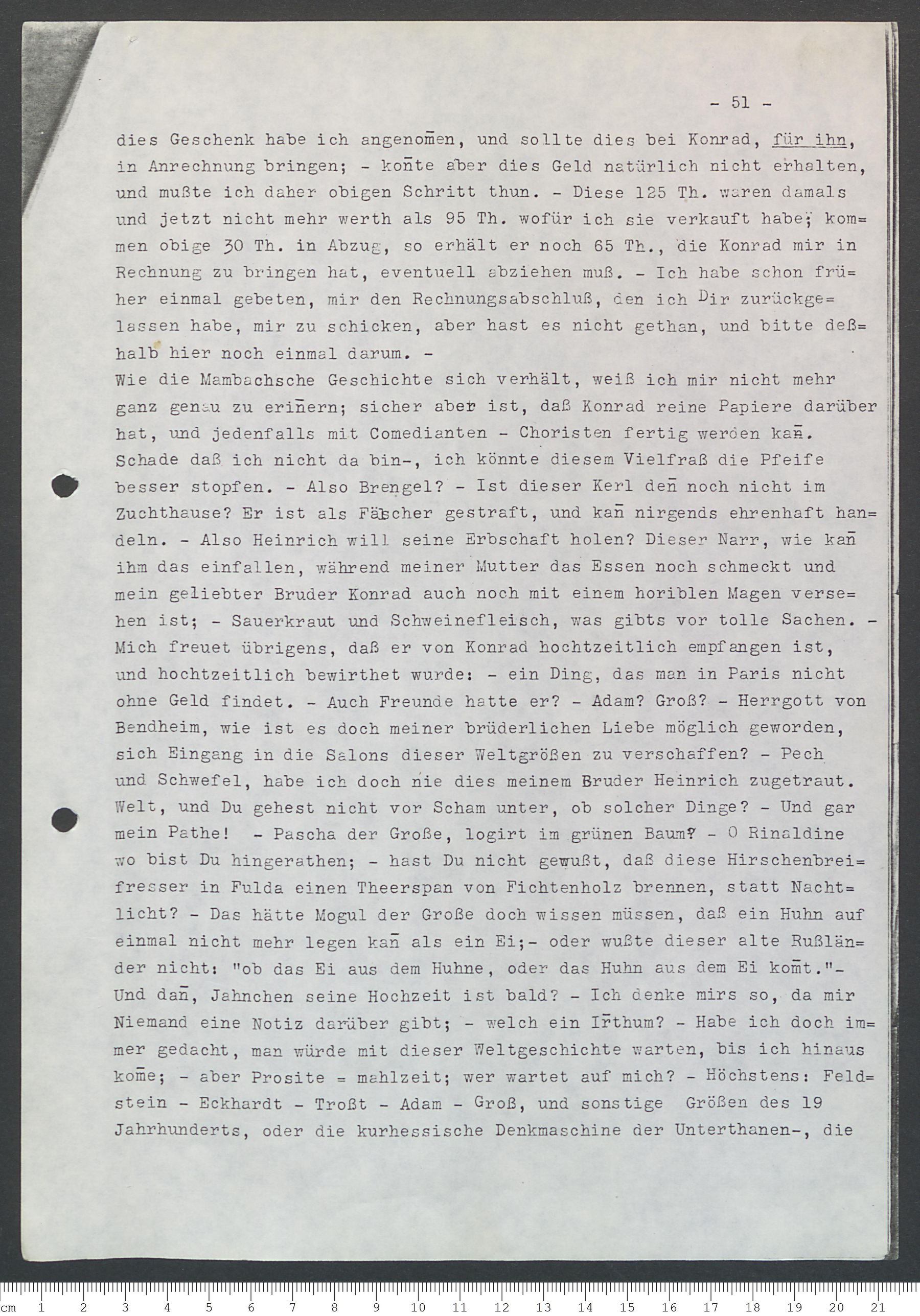
Page – 51 – · 6 November 1862, continued — family accounts and quarrels
m f }
}£?Ü-' f
C - . a
E dies Geschenk habe ich angenomen, und sollte dies bei Konrad, für_ihn,
; in Anrechnung bringen; - konte aber dies Geld natürlich nicht erhalten,
| und mußte ich daher obigen Schritt thun. - Diese 125 Th. waren damals
und jetzt nicht mehr werth als 95 Th. wofür ich sie verkauft habe} kom=
men obige 30 Th. in Abzug, so erhält er noch 65 Th.;, die Konrad mirn in
Rechnung zu bringen hat, eventuell sbziehen muß. - Ich habe schon frü=
her einmal gebeten, mir den Rechnungsabschluß, den ich Dir zurückge=
lassen habe, mir zu schicken, aber hast es nicht gethan, und bitte deß= @
halb hier noch einmal darum. - s |
Wie die Mambachsche Geschichte sich verhält, weiß ich mir nicht mehr
ganz genzu zu erinern; sicher aber ist, daß Konrad reine Papiere darüber
hat, und jedenfalls mit Comedianten - Choristen fertig werden kan. i
Schade daß ich nicht da bin-, ich könnte diesem Vielfraß die Pfeife {
. besser stopfen. - Also Brengel? - Ist dieser Kerl den noch nicht im !
Zuchthause? Er ist als Fäscher gestraft, und kan nirgends ehrenhaft han=
deln. - Also Heinrich will seine Erbschaft holen? Dieser Narr, wie kan
ihm das einfallen, während meiner Mutter das Essen noch schmeckt und !
mein geliebter Bruder Konrad auch noch mit einem horiblen Magen verse= |
hen ist; - Sauerkraut und Schweinefleisch, was gibts vor tolle Sachen. —'
Mich freuet übrigens, daß er von Konrad hochtzeitlich empfangen ist,
und hochtzeitlich bewirthet wurde: - ein Ding, das man in Paris nicht
ohne Geld findet., - Auch Freunde hatte er? - Adam? Groß? - Herrgott von
Bendheim, wie ist es doch meiner brüderlichen Liebe möglich geworden,
sich Eingang in die Salons dieser Weltgrößen zu verschaffen? - Pech
und Schwefel, habe ich doch nie dies meinem B8ruder Heinrich zugetraut.
Welt, und Du gehest nicht vor Scham unter, ob solcher Dinge? - Und gar
. mein Pathe! — Pascha der Große, logirt im grünen Baum? - 0 Rinaldine
wo bist Du hingerathen; - hast Du nicht gewußt, daß diese Hirschenbrei= ]
fresser in Fulda einen Theerspan von Fichtenholz brennen, statt Nacht=
licht? - Das hätte Mogul der Große doch wissen müssen, daß ein Huhn auf MM
einmal nicht mehr legen kan als ein Ei;- oder wußte dieser alte Rußlän= fä
der nicht: "ob das Ei aus dem Huhne, oder das Huhn aus dem Ei komt."-_
Und dan, Jahnchen seine Hochzeit ist bald? - Ich denke mirs so, da mir 3
Niemand eine Notiz darüber gibt; - welch ein Irthum? - Habe ich doch im= F
mer gedacht, man würde mit dieser Weltgeschichte warten, bis ich hinaus M
kome; - aber Prosite = mehlzeit; wer wartet auf mich? - Höchstens: Feld=
stein - Eckhardt - Troßt - Adam - Groß, und sonstige Größen des 19 ®
Jahrhunderts, oder die kurhessische Denkmaschine der Unterthanen-, die
cm 1 Z B 4 5 6 7 8 9 100 41 12 13 44 45 16 47 98 9ı 260 22
…I accepted this gift, and was to bring it into account with Konrad, for him; but naturally I could not obtain this money, and therefore had to take the above step. These 125 Thaler were then, and are now, worth no more than the 95 Thaler for which I sold them. If the above 30 Thaler are deducted, he still receives 65 Thaler, which Konrad has to bring into account for me, or deduct as the case may be.
I have asked once before that you send me the statement of account I left behind with you, but you have not done it, and so I ask for it here once more.
How the Mambach business stands I can no longer remember quite exactly; but it is certain that Konrad has clean papers about it, and can in any case deal with actors and choristers. A pity I am not there — I could stop that glutton's pipe better.
So, Brengel? Is that fellow not in the penitentiary yet? He has been punished as a forger and can deal honourably nowhere.
So Heinrich wants to fetch his inheritance? The fool, how can it occur to him, while my mother still enjoys her food and my beloved brother Konrad is also still provided with a horrible stomach.
⭐ A discount on paper: 125 Th. sold for 95 Th. — a 24% loss, another wartime money datum. ⚠️ All figures here are OCR-derived. ⭐ Names Mambach and Brengel (the latter described as a convicted forger) enter the corpus — both unverified spellings.
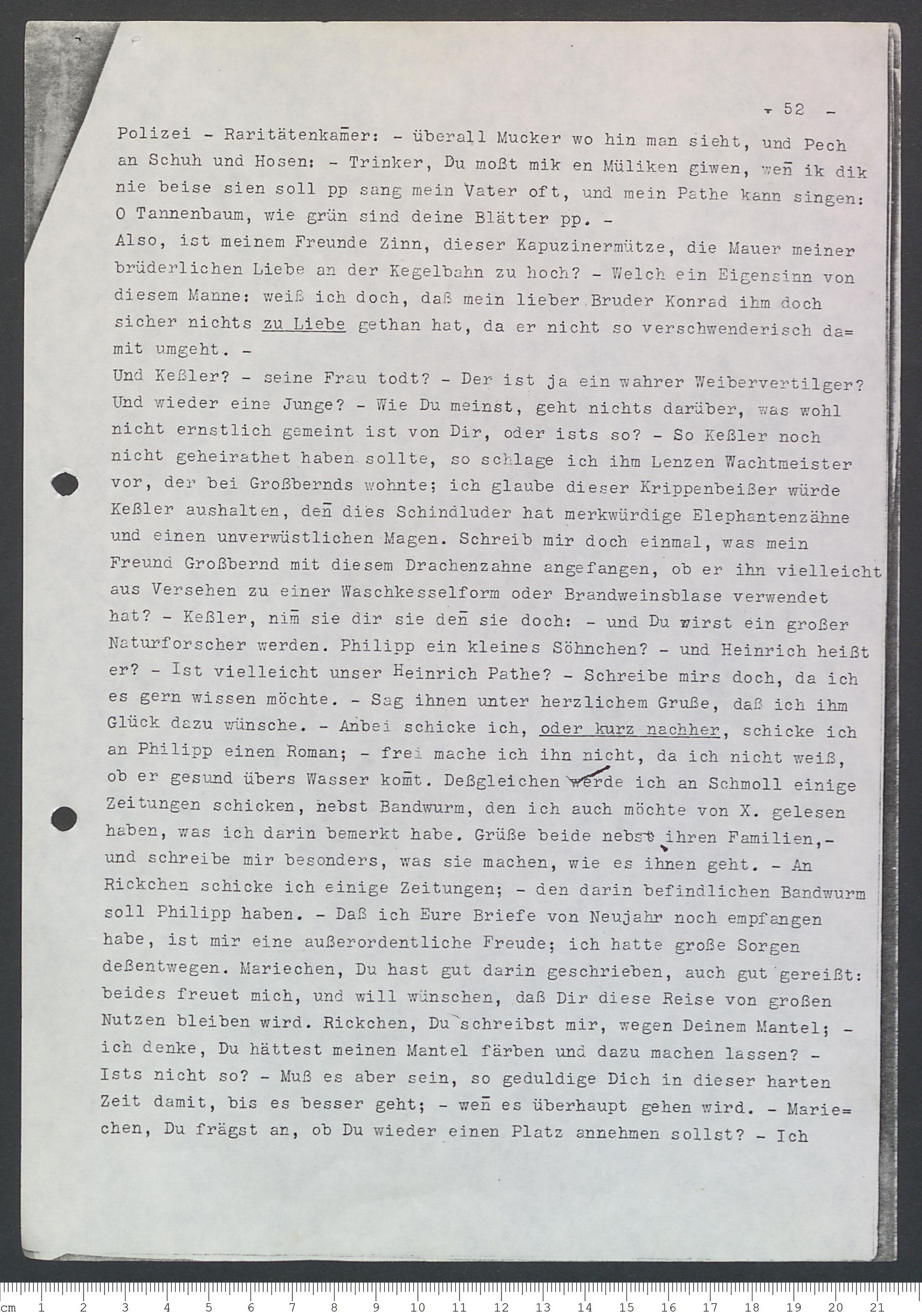
Page – 52 – · 6 November 1862, continued — village gossip, answered in kind
H& a ‚ )
%5':; Polizei - Raritätenkamer: - überall Mucker wo hin man sieht, und Pech i
S:} an Schuh und Hosen:; - Trinker, Du moßt mik en Müliken giwen, wen ik dik
F_ nie beise sien soll pp sang mein Vater oft, und mein Pathe kann singen: |M
é; O Tannenbaum, wie grün sind deine Blätter PP. -
L Also, ist meinem Freunde Zinn, dieser Kapuzinermütze, die Mauer meiner
brüderlichen Liebe an der Kegelbahn zu hoch? - Welch ein Eigensinn von
diesem Manne; weiß ich doch, daß mein lieber.Bruder Konrad ihm doch |
sicher nichts zu _ Liebe gethan hat, da er nicht so Vverschwenderisch da=
mit umgeht. — E
Und Keßler? - seine Frau todt? - Der ist ja ein wahrer Weibervertilger?
Und wieder eine Junge? - Wie Du meinst, geht nichts darüber, was wohl
nicht ernstlich gemeint ist von Dir, oder ists so? - So Keßler noch 13
nicht geheirathet haben. sollte, so schlage ich ihm Lenzen Wachtmeister fé
. vor, der bei Großbernds wohnte; ich glaube dieser Krippenbeißer würde }
Keßler aushalten, den dies Schindluder hat merkwürdige Elephantenzähne i
und einen unverwüstlichen Magen. Schreib mir doch einmal, was mein
Freund Großbernd mit diesem Drachenzahne angefangen, ob er ihn vielleicht
aus Versehen zu einer Waschkesselform oder Brandweinsblase Verwendet
hat? - Keßler, nim sie dir sie den sie doch: - und Du wirst ein großer
Naturforscher werden. Philipp ein kleines Söhnchen? - und Heinrich heißt
er? - Ist vielleicht unser Heinrich Pathe? - Schreibe mirs doch, da ich
es gern wissen möchte. - Sag ihnen unter herzlichem Gruße, daß ich ihm
Glück dazu wünsche. - Anbei schicke ich, oder _kurz nachher, schicke ich {
an Philipp einen Roman; - frei mache ich ihn nicht, da ich nicht weiß, !
ob er gesund übers Wasser komt. Deßgleichen*w@?äe ich an Schmoll einige ‘%
Zeitungen schicken, nebst Bandwurm, den ich auch möchte von X. gelesen F;
. haben, was ich darin bemerkt habe, Grüße beide nebst ‘ihren Familien,- .
und schreibe mir besonders, was sie machen, wie es ihnen geht. —- An fi
Rickchen schicke ich einige Zeitungen; - den darin befindlichen Bandwurm i
soll Philipp haben. - Daß ich Eure Briefe von Neujahr noch empfangen ;
habe, ist mir eine außerordentliche Freude; ich hatte große Sorgen i
deßentwegen. Mariechen, Du hast gut darin geschrieben, auch gut gereißt: A
beides freuet mich, und will wünschen, daß Dir diese Reise von großen ?
Nutzen bleiben wird. Rickchen, Du schreibst mir, wegen Deinem Mantel; — g
ich denke, Du hättest meinen Mantel färben und dazu machen lassen? — ä
Ists nicht so? - Muß es aber sein, so geduldige Dich in dieser harten £
Zeit damit, bis es besser geht; - wen es überhaupt gehen wird. - Marie= %
chen, Du frägst an, ob Du wieder einen Platz annehmen sollst? — Ich _ä
2
3
3
3
Lm f: B 3 4 5 6 D 8 9 10 11 12 13 14 125 146 17 128 19 20 21
[A run of heavy joking about people at home. He pictures the place as a cabinet of curiosities full of sanctimonious hypocrites, recalls in passing a Low German drinking rhyme his father used to sing and a Christmas carol his godfather could manage, and then works through the news his wife had sent.]
So the wall of my brotherly love at the skittle alley is too high for my friend Zinn, that Capuchin hood? What obstinacy in the man; though I know well that my dear brother Konrad has certainly done him no favours, since he is not so lavish with them.
And Keßler? His wife dead? He is a true exterminator of wives. And another young one? Nothing beats your view of it — which is surely not seriously meant by you, or is it? If Keßler should not yet have married, I propose Lenzen the sergeant to him, who lodged at the Großbernds'.
Write and tell me sometime what my friend Großbernd has done with that dragon's tooth — whether he has perhaps used him by mistake for a wash-copper mould or a brandy still.
Philipp has a little son? And he is called Heinrich? Is our Heinrich perhaps his godfather? Do write and tell me, since I should like to know.
⭐ A nephew: Philipp's son Heinrich, born c. 1862, possibly with Köster's own son as godfather. ⚠️ Every name here (Zinn, Keßler, Lenzen, Großbernd) is OCR-derived. ⭐ The tone is worth noting for anyone quoting Köster: to his wife he is elegiac and dying; two pages later he is doing broad comic patter about the neighbours. The self-dramatisation in the sad passages should be read with that in view.
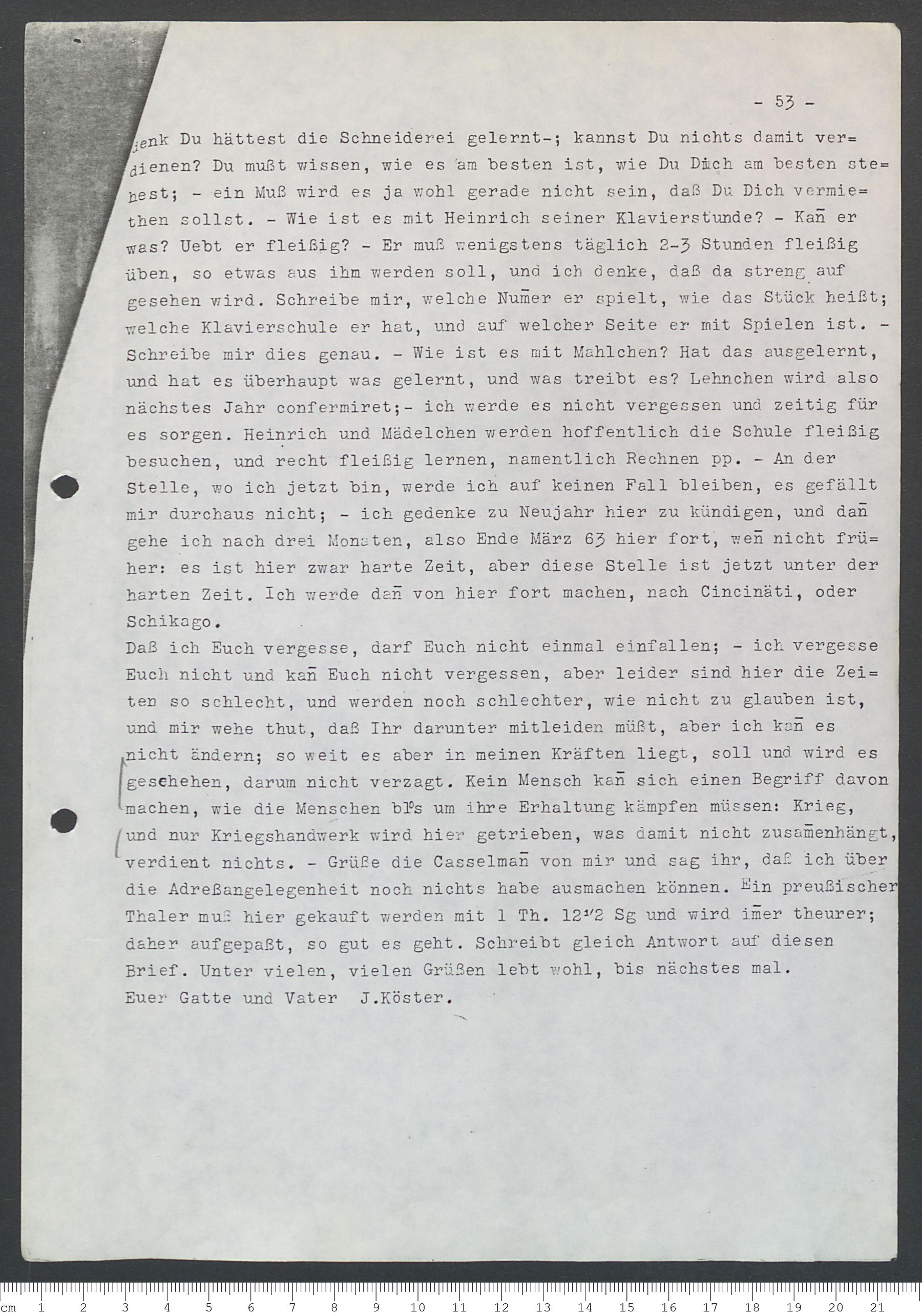
Page – 53 – · ⭐⭐ 6 November 1862 — he plans to leave St. Louis
£"fff;;1; ßnk Du hättest die Schneiderei gelernt-; kannst Du nichts damit ver=
ä*;jg?;f ajenen? Du mußt wissen, wie es am besten ist, wie Du Düäch am besten ste=
£ Ü?Ü%f?‘ pest;z - ein Muß wird es ja wohl gerade nicht sein, daß Du Dich vermie=
T2%%;35f then sollst. - Wie ist es mit Heinrich seiner Klavierstunde? - Kan er
€1%% was? Uebt er fleißig? - Er muß wenigstens täglich 2-3 Stunden fleißig
H £%‘ üben, so etwas aus ihm werden soll, und ich denke, daß da streng auvf
5: 3 gesehen wird. Schreibe mir, welche Numer er spielt, wie das Stück heißt;
; r welche Klavierschule er hat, und auf welcher Seite er mit Spielen ist. -
ä{;f Schreibe mir dies genau. - Wie ist es mit Mahlchen? Hat das ausgelernt,
S und hat es überhaupt was gelernt, und was treibt es? Lehnchen wird also
F; nächstes Jahr confermiret;- ich werde es nicht vergessen und zeitig für
d es sorgen. Heinrich und Mädelchen werden hoffentlich die Schule fleißig
; besuchen, und recht fleißig lernen, namentlich Rechnen pp. - An der
| . Stelle, wo ich jetzt bin, werde ich auf keinen Fall bleiben, es gefällt
i mir durchaus nicht; - ich gedenke zu Neujahr hier zu kündigen, und dan
i gehe ich nach drei Monsten, also Ende März 63 hier fort, wen nicht frü=
; her: es ist hier zwar harte Zeit, aber diese Stelle ist jetzt unter der
harten Zeit. Ich werde dean von hier fort machen, nach Cincinäti, oder
Schikago,.
} Daß ich Euch vergesse, darf Euch nicht einmal einfallen; - ich vergesse
Euch nicht und kan Euch nicht vergessen, aber leider sind hier die Zei=
ten so schlecht, und werden noch schlechter, wie nicht zu glauben ist,
und mir wehe thut, daß Ihr darunter mitleiden müßt, aber ich kan es
nicht ändern; so weit es aber in meinen Kräften liegt, soll und wird es
fges€hehen, darum nicht verzagt. Kein Mensch kan sich einen Begriff davon
. (machen, wie die Menschen bl®s um ihre Erhaltung kämpfen müssen: Krieg,
{und nur Kriegshandwerk wird hier getrieben, was damit nicht zusamenhängt,
“verdient nichts. - Grüße die Casselman von mir und sag ihr, daß® ich über
die Adreßangelegenheit noch nichts habe ausmachen können. Ein preußische
Thaler muß hier gekauft werden mit 1 Th. 12!2 Sg und wird imer theurer;
daher aufgepaßt, so gut es geht. Schreibt gleich Antwort auf diesen
Brief. Unter vielen, vielen Grüßen lebt wohl, bis nächstes mal.
Euer Gatte und Vater J.Köster. {
cm 1 3 3 4 5 6 7 8 9 10 11 12 13 14 15 16 17 18 19 20 21
…you had learned dressmaking; can you not earn something by it? You must know how it is best, how you are best placed; it will surely not be an absolute necessity that you should have to hire yourself out.
How is it with Heinrich's piano lesson? Can he do anything? Does he practise diligently? He must practise at least 2–3 hours a day if anything is to come of him, and I think that is being strictly seen to. Write and tell me which number he plays, what the piece is called, which piano method he has, and what page he has got to in his playing. Write me this exactly.
How is it with Malchen? Has she finished her apprenticeship, and has she learned anything at all, and what is she doing? So Lehnchen is to be confirmed next year; I shall not forget it and shall provide for her in good time. Heinrich and the little one will, I hope, attend school diligently and learn diligently, arithmetic especially.
In the place where I now am I shall on no account remain; it does not suit me at all. I intend to give notice here at the New Year, and then I go from here after three months — so at the end of March [1863] — if not sooner. Times are hard here, certainly, but this post is now below even the hard times. I shall then make off from here, to Cincinnati or Chicago.
⭐⭐ A CONCRETE PLAN TO LEAVE ST. LOUIS: notice at New Year 1863, gone by the end of March, to CINCINNATI OR CHICAGO. He names neither Bloomington nor Illinois, but this is the decision point — and he is in Bloomington, Illinois by about 1870. Combined with the health reason given in November 1861, the departure from St. Louis is now dated and motivated. ⚠️ The OCR renders the year as “65”; context (notice at New Year, three months on) makes 1863 the only sensible reading — verify against the scan. ⭐ Lehnchen to be confirmed in 1863; Malchen finishing an apprenticeship — dateable family events.
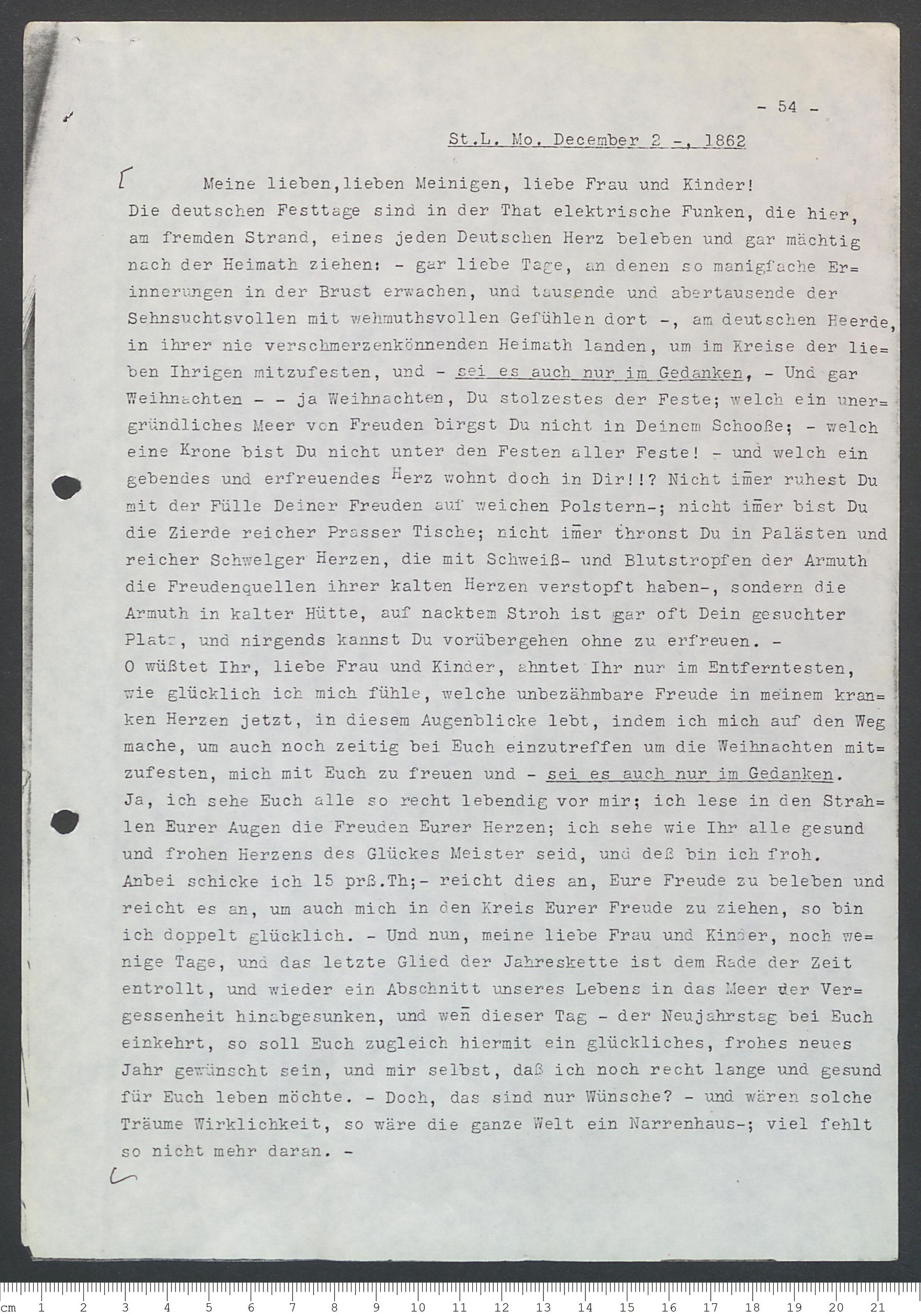
Page – 54 – · ⭐⭐⭐ St. Louis, 2 December 1862 — the last letter, written the day Charles enlisted
1 @ = DAn
[ St.L. Mo, December 2 _—-, 1862
f Meine lieben,lieben Meinigen, liebe Frau und Kinder!
Die deutschen Festtage sind in der That elektrische Funken, die HEL
am fremden Strand, eines jeden Deutschen Herz beleben und gar mächtig
nNnach der Heimath ziehen: - gar liebe Tage, an denen so manigfache Er=
innerungen in der Brust erwachen, und tausende und abertausende der
V' Sehnsuchtsvollen mit wehmuthsvollen Gefühlen dort -, am deutschen Feerde‚
in ihrer nie verschmerzenkönnenden Heimath landen, um im Kreise der lie=
ben Ihrigen mitzufesten, und - sei es _ auch nur im Gedanken, - Und -gar
S Weihnschten —- - ja Weihnachten, Du stolzestes der Feste; welch ein uner=
3 gründliches Meer von Freuden birgst Du nicht in Deinem Schooße;z - welch
] eine Krone bist Du nicht unter den Festen aller Feste! - und welch ein
. . gebendes und erfreuendes Herz wohnt doch in Dir!!? Nicht imer ruhest Du
7 mit der Fülle Deiner Freuden aäuf weichen Polstern-; nicht imer bist Du
S die Zierde reicher Prasser Tische; nicht imer thronst Du in Palästen und
E reicher Schwelger Herzen, die mit Schweiß- und Blutstropfen der Armuth
die Freudenquellen ihrer kalten Herzen verstopft haben-, sondern die
Armuth in kalter Hütte, auf nacktem Stroh ist gar oft Dein gesuchter
( Platz, und nirgends kannst Du vorübergehen ohne zu erfreuen. -
Ä O wüßtet Ihr, liebe Frau und Kinder, ahntet Ihr nur im Entferntesten, }
é wie glücklich ich mich fühle, welche unbezähmbare Freude in meinem kran=?
f ken Herzen jetzt, in diesem Augenblicke lebt, indem ich mich auf den Wegl
{ mache, um auch noch zeitig bei Euch einzutreffen um die Weihnachten mit=
zufesten, mich mit Euch zu freuen und - sei es _ auch nur im Gedanken. %
@ Ja, ich sehe Euch alle so recht lebendig vor mir3z ich lese in den Strah=
i . len Eurer Augen die Freuden Eurer Herzen; ich sehe wie Ihr alle gesund
£ und frohen Herzens des Glückes Meister seid, und deß bin ich froh.
{ Anbei schicke ich 15 prß.Th;- reicht dies an, Eure Freude zu beleben und
reicht es an, um auch mich in den Kreis Eurer Freude zu ziehen, so bin
ich doppelt glücklich. - Und nun, meine liebe Frau und Kinier, noch we=
\ nige Tage, und das letzte Glied der Jahreskette ist dem Rade der Zeit
entrollt, und wieder ein Abschnitt unseres Lebens in das Meer der Ver=
gessenheit hinabgesunken, und wen dieser Tag - der Neujahrsteg bei Euch
einkehrt, so soll Euch zugleich hiermit ein glückliches, frohes neues
\ Jahr gewünscht sein, und mir selbst, daß ich noch recht lange und gesund
\ für Euch leben möchte. - Doch, das sind nur Wünsche? - und wären solche
Träume Wirklichkeit, so wäre die ganze Welt ein Narrenhaus-; viel fehlt
so nicht mehr daran. -
cm 1 @ 3 4 5 6 7 8 S 10 11 12 43 14 15 16 17 18 19 20 21
St. L. Mo., December 2, 1862. — My dear, dear people, dear wife and children!
The German feast days are indeed electric sparks which, on a foreign shore, quicken every German's heart and draw it mightily homeward: dear days on which so many memories awake in the breast, and thousands upon thousands of the longing land there in spirit, with melancholy feelings, at the German hearth, in the homeland they can never cease to grieve for — to keep the feast in the circle of their own people, if only in thought.
And Christmas — yes, Christmas, proudest of festivals; what an unfathomable sea of joys do you not hide in your lap; what a crown you are among the feasts of all feasts, and what a giving and gladdening heart dwells in you!
Not always do you rest with the fullness of your joys on soft cushions; not always are you the ornament of rich gluttons' tables; not always do you throne in palaces and in the hearts of wealthy revellers, who have stopped up the springs of joy in their cold hearts with the sweat and blood-drops of the poor. Rather, poverty in a cold hut, on bare straw, is very often your sought-out place, and nowhere can you pass by without bringing gladness.
Oh, if you knew, dear wife and children, if you guessed even in the remotest degree how happy I feel, what untameable joy is now in my sick heart…
⭐⭐⭐ THE LAST LETTER IN THE SERIES, datelined St. Louis, 2 December 1862 — the very day Charles Gannsen swore his Volunteer Enlistment in the same city. It is a Christmas letter, and its subject is exactly homesickness: the German feast days as electric sparks quickening every German heart on a foreign shore and drawing it homeward. Whatever Charles felt as he put his name to that form, a countryman from his own village was a few streets away that day, writing about precisely this. ⭐ Note the passage on Christmas belonging to poverty on bare straw rather than to rich men's tables — the forty-eighter's politics surviving into the sentiment.
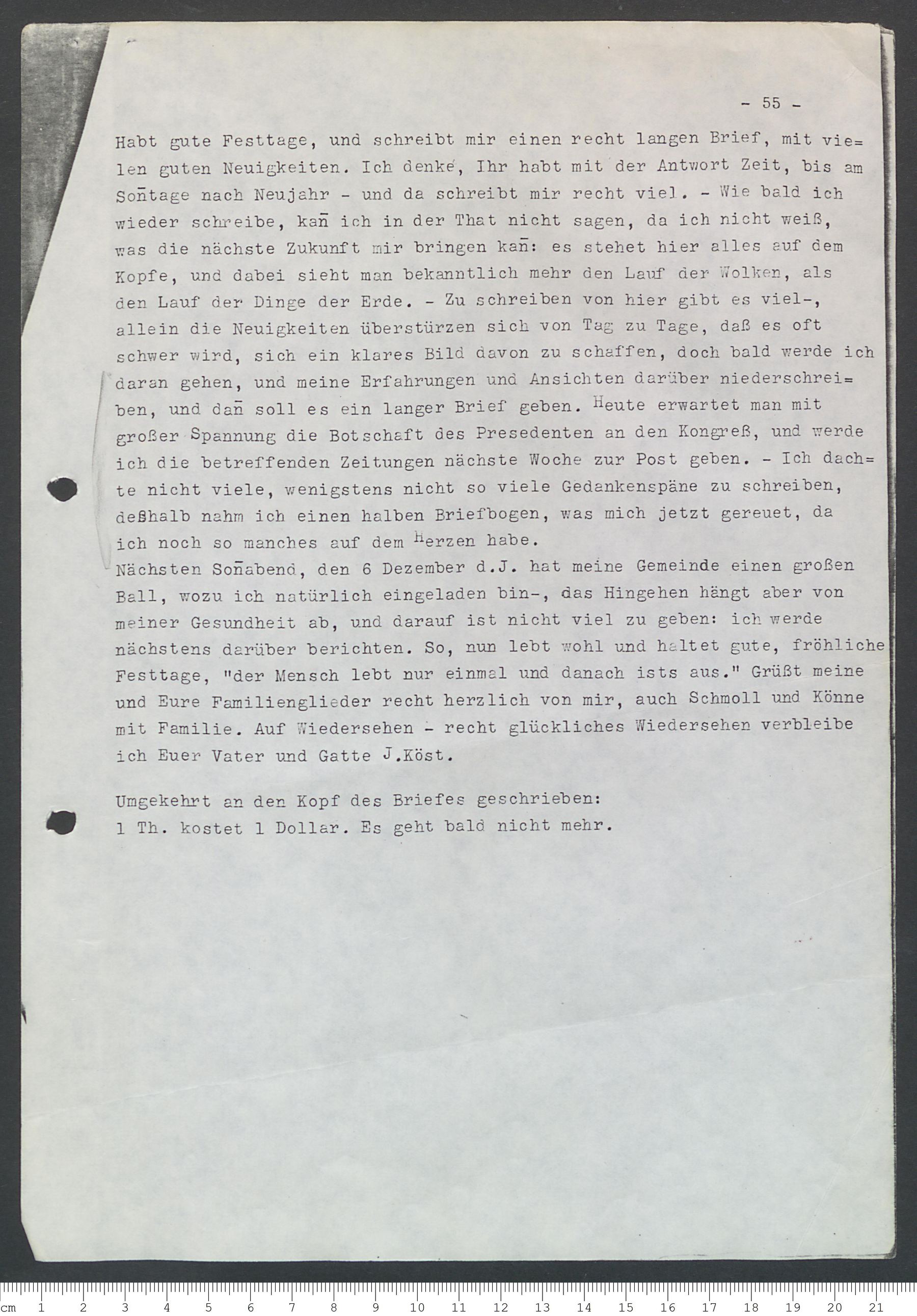
Page – 55 – · End of the last letter, 2 December 1862
\ g B
v‘iiä? Habt gute Festtage, und schreibt mir einen Yrecht langen Br ma e
.äég lef guten Neuigkeiten. Ich denke, Ihr habt mit der Antwort Zeit, bis am
5 Sontage nach Neujahr - und da schreibt mir recht viel. - Wie bald ich
a wieder schreibe, kan ich in der That nicht sagen, da ich nicht weiß,
; was die nächste Zukunft mir bringen kan: es stehet hier alles esvf dem
K Kopfe, und dabei sieht man bekanntlich mehr den Lauf der Wolken, als
den Lauf der Dinge der Erde, - Zu schreiben von hier gibt es viel-,
' allein die Neuigkeiten überstürzen sich von Tag zu Tage, daß es oft
schwer wird, sich ein klares Bild davon zu schaffen, doch bald werde ich
daran gehen, und meine Erfahrungen und Ansichten darüber niederschrei=
ben, und dal soll es ein langer Brief geben. HMeute erwartet man mit
großer Spannung die Botscheft des Presedenten an den Kongreß, und werde
ich die betreffenden Zeitungen nächste Woche zur Post geben. - Ich dach=
. te nicht viele, wenigstens nicht so viele Gedankenspäne zu schreiben, |
deßhalb nahm ich einen halben Briefbogen, was mich jetzt gereuet, da ‘
ich noch so manches auf dem %erzen habe. ;
Nächsten Sonabend, den 6 Dezember d.J. hat meine Gemeinde einen großen {
Ball, wozu ich natürlich eingeladen bin-, das Hingehen hängt aber von ]
meiner Gesundheit ab, und darauf ist nicht viel zu geben: ich werde ]
nächstens darüber berichten. So, nun lebt wohl und haltet gute, fröhliche
Festtage, "der Mensch lebt nur einmal und danach ists aus." Grüßt meine
und Eure Familienglieder recht herzlich von mir, auch Schmoll und Könne
mit Familie. Auf Wiedersehen - recht glückliches Wiedersehen verbleibe
ich Euer Vater und Gatte J.Köst. \
Umgekehrt an den Kopf des Briefes geschrieben: l
. l Th. kostet 1l Dollar. Es geht bald nicht mehr. l
1
cm 1 3 3 4 5 6 7 8 9 10 41 12 13 14 15 16 47 128 129 20 2%
Have good holidays, and write me a good long letter with good news. I think you have time to answer until the Sunday after New Year — and then write me a great deal.
How soon I shall write again I really cannot say, since I do not know what the near future can bring me: everything here stands on its head, and in that state one sees, as is well known, more of the course of the clouds than of the course of earthly things. There is much to write of from here, but the news overturns itself from day to day, so that it is often hard to form a clear picture of it. Yet soon I shall set about it and write down my experiences and views, and then it shall be a long letter.
Today the President's message to Congress is awaited with great suspense, and I shall put the relevant newspapers in the post next week. I did not think to write many — at least not so many — shavings of thought, and so I took half a sheet of letter paper, which I now regret, since I have so much still on my heart.
Next Saturday, 6 December this year, my congregation holds a great ball, to which I am of course invited; but going depends on my health, and not much is to be counted on there. I shall report on it shortly. So now farewell and keep good, cheerful holidays. Greet my family and yours.
⭐ Dating corroboration: he awaits the President's annual message to Congress — Lincoln's was delivered 1 December 1862 — which fits a letter written on the 2nd. ⭐ The series ends mid-life, not at an ending: a congregational ball on 6 December, more letters promised, a long account of American conditions planned. Whatever happened to the correspondence after this, it was not that he stopped having things to say. ⭐ „es stehet hier alles auf dem Kopfe“ — everything standing on its head — is the last description of St. Louis in the series, written the day Charles enlisted there.
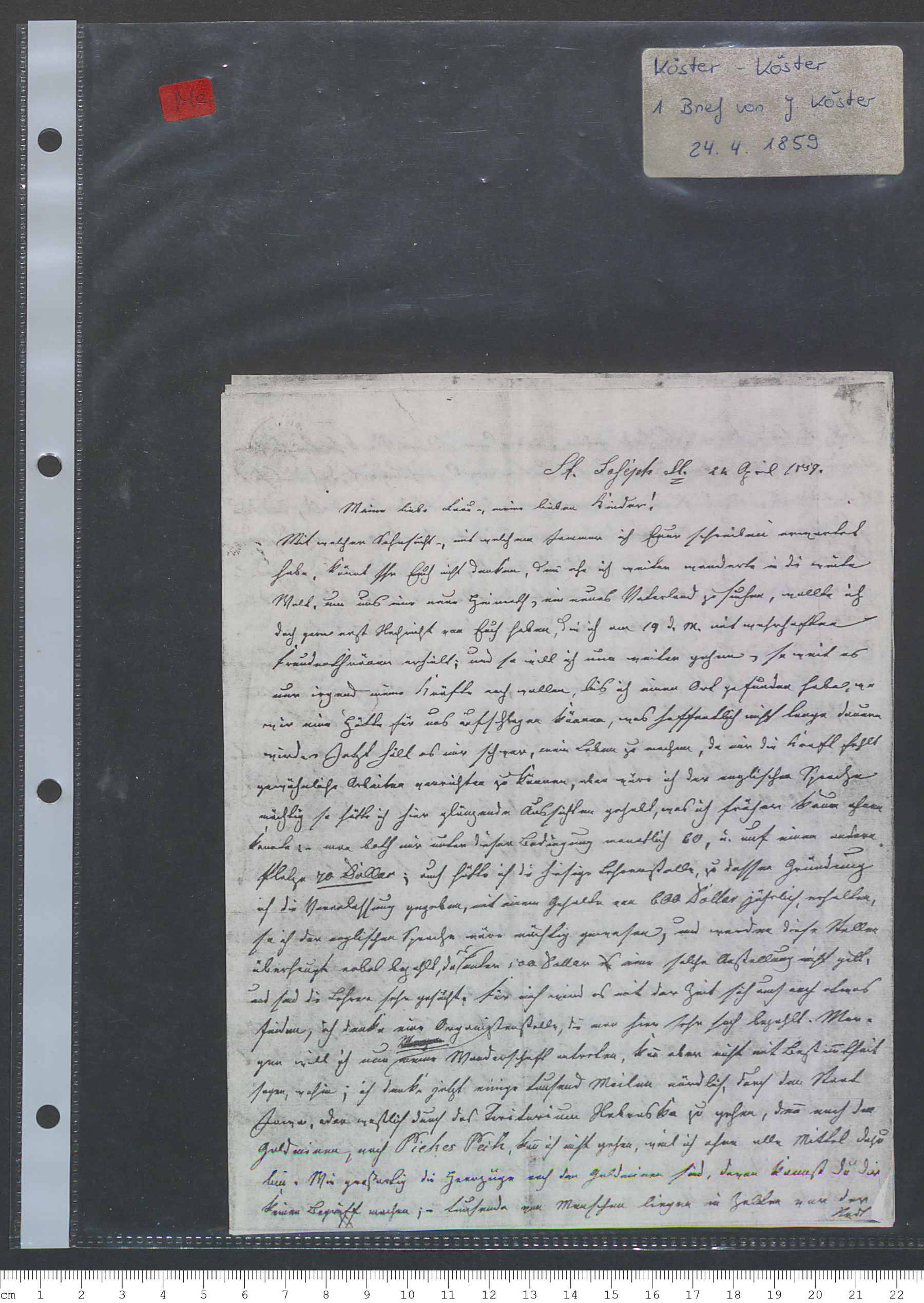
Autograph leaf 0113 — original of the 24 April 1859 St. Joseph letter (typescript pp. 5–9)
Not yet transcribed.
Not yet translated.
⭐⭐ IDENTIFIED, 21 July 2026 — this is NOT unread new content. Read against the high-resolution scan, the seven autograph leaves 0113–0119 are the original manuscript of the letter of 24 April 1859 from St. Joseph — the same letter this project already has in verified typescript at images 0058–0062 (pp. 5–9). The opening of 0113/0114 is word-for-word the opening of p. 5 („St. Joseph M. 24 April 1859 … Mit welcher Sehnsucht, mit welchem Jammer ich Euer Schreiben erwartet habe“), and leaf 0119 carries the „Deißel“ greeting passage of p. 9 („Kommst Du nach Deißel, so grüße Schwager Teme, Deppe, Göbel, Meinbresse, Pathe Köster … namentlich aber meine Mutter, Sophie, auch Lud[wig]“). ⚠️ This is a Kurrent reading from a photograph and must be confirmed by a paleographer — but the identification is secure on the matching dateline, opening and the distinctive Deißel/Teme/Meinbresse greeting list. Three consequences: (1) the archival label on 0113 reading „24.4.1853“ is a MISREAD of 1859 — the open date conflict is resolved; (2) the „Deißel“ spelling this project cites can now be checked in Köster's own hand, not only the 1930s typist's — and it holds; (3) the earlier site claim that an autograph was „a long meditation on America as freie Bewegung, freier Wille“ is doubly wrong — that passage is on typescript p. 6, and these leaves are the St. Joseph letter, not a meditation. A full line-by-line Kurrent transcription is still worth commissioning, but the CONTENT is already known from the typescript.
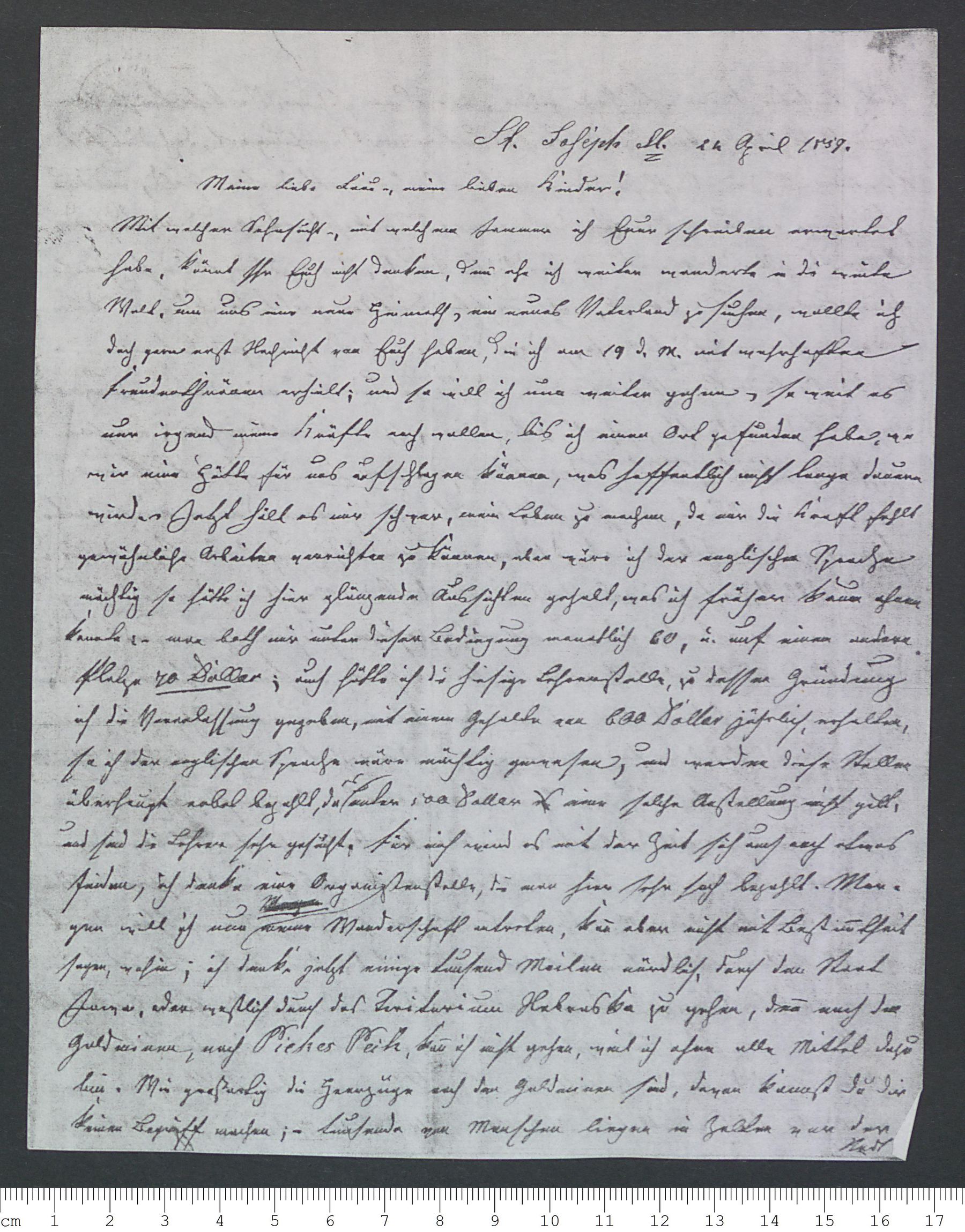
Autograph leaf 0114 — original of the 24 April 1859 St. Joseph letter (typescript pp. 5–9)
Not yet transcribed.
Not yet translated.
⭐⭐ IDENTIFIED, 21 July 2026 — this is NOT unread new content. Read against the high-resolution scan, the seven autograph leaves 0113–0119 are the original manuscript of the letter of 24 April 1859 from St. Joseph — the same letter this project already has in verified typescript at images 0058–0062 (pp. 5–9). The opening of 0113/0114 is word-for-word the opening of p. 5 („St. Joseph M. 24 April 1859 … Mit welcher Sehnsucht, mit welchem Jammer ich Euer Schreiben erwartet habe“), and leaf 0119 carries the „Deißel“ greeting passage of p. 9 („Kommst Du nach Deißel, so grüße Schwager Teme, Deppe, Göbel, Meinbresse, Pathe Köster … namentlich aber meine Mutter, Sophie, auch Lud[wig]“). ⚠️ This is a Kurrent reading from a photograph and must be confirmed by a paleographer — but the identification is secure on the matching dateline, opening and the distinctive Deißel/Teme/Meinbresse greeting list. Three consequences: (1) the archival label on 0113 reading „24.4.1853“ is a MISREAD of 1859 — the open date conflict is resolved; (2) the „Deißel“ spelling this project cites can now be checked in Köster's own hand, not only the 1930s typist's — and it holds; (3) the earlier site claim that an autograph was „a long meditation on America as freie Bewegung, freier Wille“ is doubly wrong — that passage is on typescript p. 6, and these leaves are the St. Joseph letter, not a meditation. A full line-by-line Kurrent transcription is still worth commissioning, but the CONTENT is already known from the typescript.
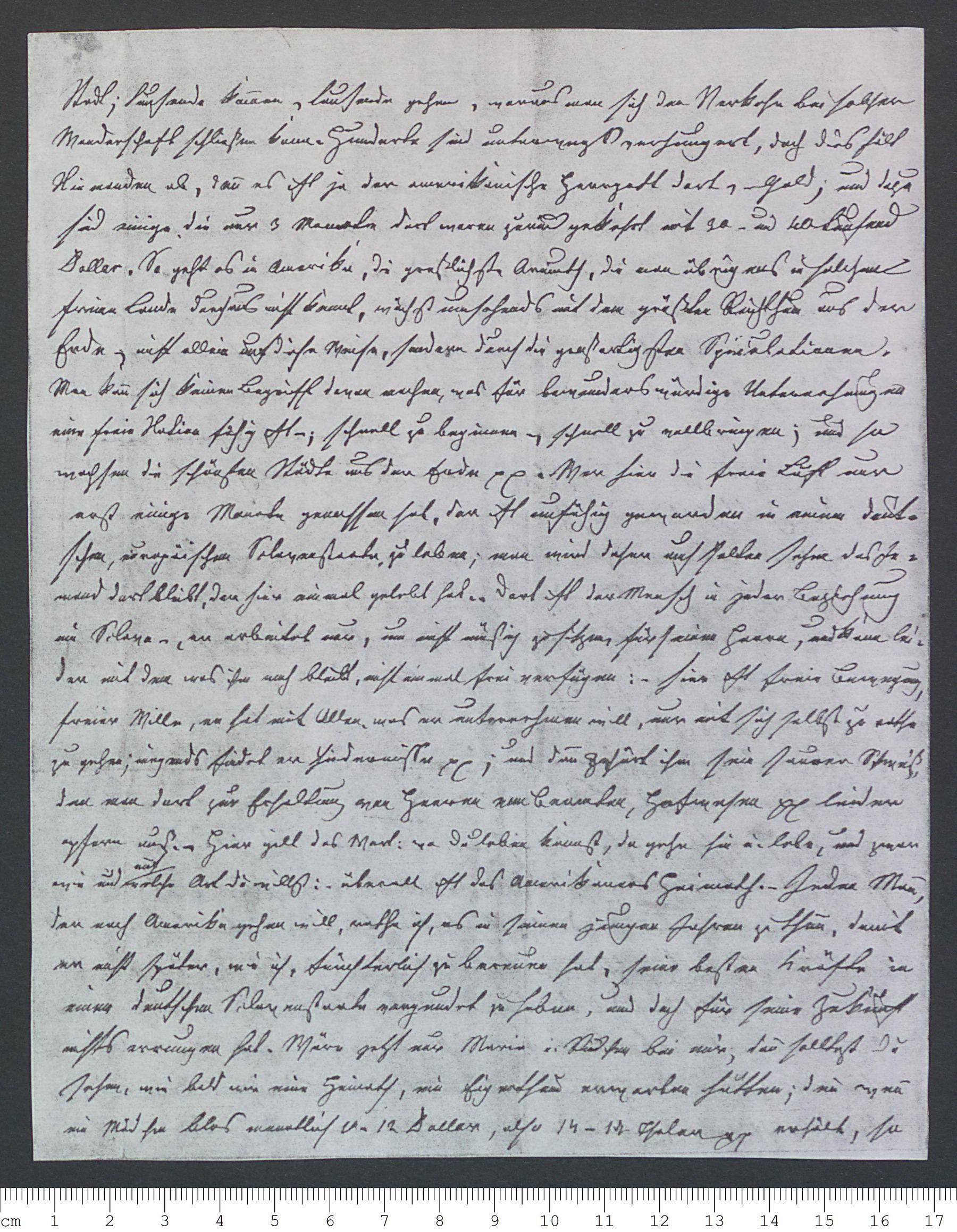
Autograph leaf 0115 — original of the 24 April 1859 St. Joseph letter (typescript pp. 5–9)
Not yet transcribed.
Not yet translated.
⭐⭐ IDENTIFIED, 21 July 2026 — this is NOT unread new content. Read against the high-resolution scan, the seven autograph leaves 0113–0119 are the original manuscript of the letter of 24 April 1859 from St. Joseph — the same letter this project already has in verified typescript at images 0058–0062 (pp. 5–9). The opening of 0113/0114 is word-for-word the opening of p. 5 („St. Joseph M. 24 April 1859 … Mit welcher Sehnsucht, mit welchem Jammer ich Euer Schreiben erwartet habe“), and leaf 0119 carries the „Deißel“ greeting passage of p. 9 („Kommst Du nach Deißel, so grüße Schwager Teme, Deppe, Göbel, Meinbresse, Pathe Köster … namentlich aber meine Mutter, Sophie, auch Lud[wig]“). ⚠️ This is a Kurrent reading from a photograph and must be confirmed by a paleographer — but the identification is secure on the matching dateline, opening and the distinctive Deißel/Teme/Meinbresse greeting list. Three consequences: (1) the archival label on 0113 reading „24.4.1853“ is a MISREAD of 1859 — the open date conflict is resolved; (2) the „Deißel“ spelling this project cites can now be checked in Köster's own hand, not only the 1930s typist's — and it holds; (3) the earlier site claim that an autograph was „a long meditation on America as freie Bewegung, freier Wille“ is doubly wrong — that passage is on typescript p. 6, and these leaves are the St. Joseph letter, not a meditation. A full line-by-line Kurrent transcription is still worth commissioning, but the CONTENT is already known from the typescript.
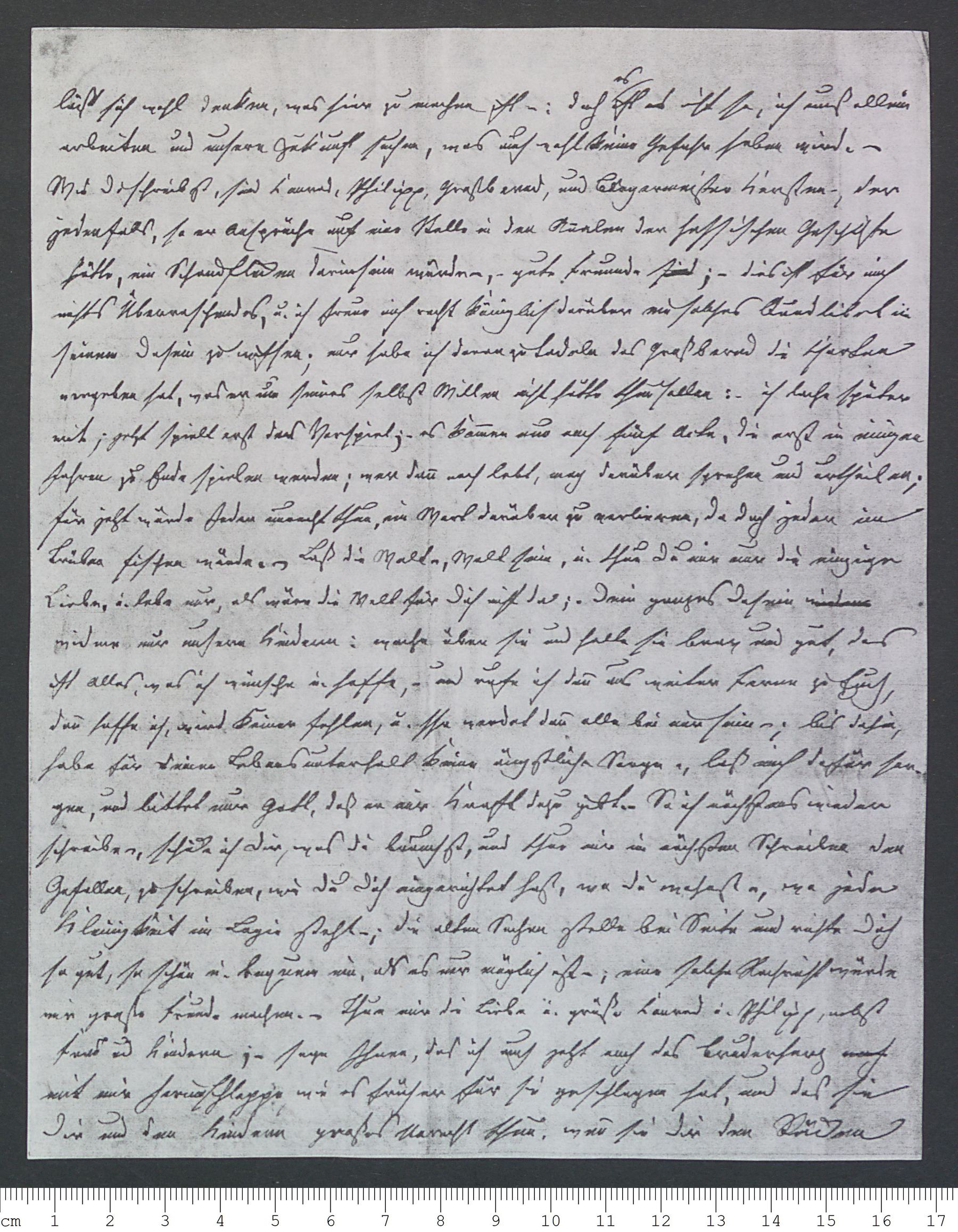
Autograph leaf 0116 — original of the 24 April 1859 St. Joseph letter (typescript pp. 5–9)
Not yet transcribed.
Not yet translated.
⭐⭐ IDENTIFIED, 21 July 2026 — this is NOT unread new content. Read against the high-resolution scan, the seven autograph leaves 0113–0119 are the original manuscript of the letter of 24 April 1859 from St. Joseph — the same letter this project already has in verified typescript at images 0058–0062 (pp. 5–9). The opening of 0113/0114 is word-for-word the opening of p. 5 („St. Joseph M. 24 April 1859 … Mit welcher Sehnsucht, mit welchem Jammer ich Euer Schreiben erwartet habe“), and leaf 0119 carries the „Deißel“ greeting passage of p. 9 („Kommst Du nach Deißel, so grüße Schwager Teme, Deppe, Göbel, Meinbresse, Pathe Köster … namentlich aber meine Mutter, Sophie, auch Lud[wig]“). ⚠️ This is a Kurrent reading from a photograph and must be confirmed by a paleographer — but the identification is secure on the matching dateline, opening and the distinctive Deißel/Teme/Meinbresse greeting list. Three consequences: (1) the archival label on 0113 reading „24.4.1853“ is a MISREAD of 1859 — the open date conflict is resolved; (2) the „Deißel“ spelling this project cites can now be checked in Köster's own hand, not only the 1930s typist's — and it holds; (3) the earlier site claim that an autograph was „a long meditation on America as freie Bewegung, freier Wille“ is doubly wrong — that passage is on typescript p. 6, and these leaves are the St. Joseph letter, not a meditation. A full line-by-line Kurrent transcription is still worth commissioning, but the CONTENT is already known from the typescript.
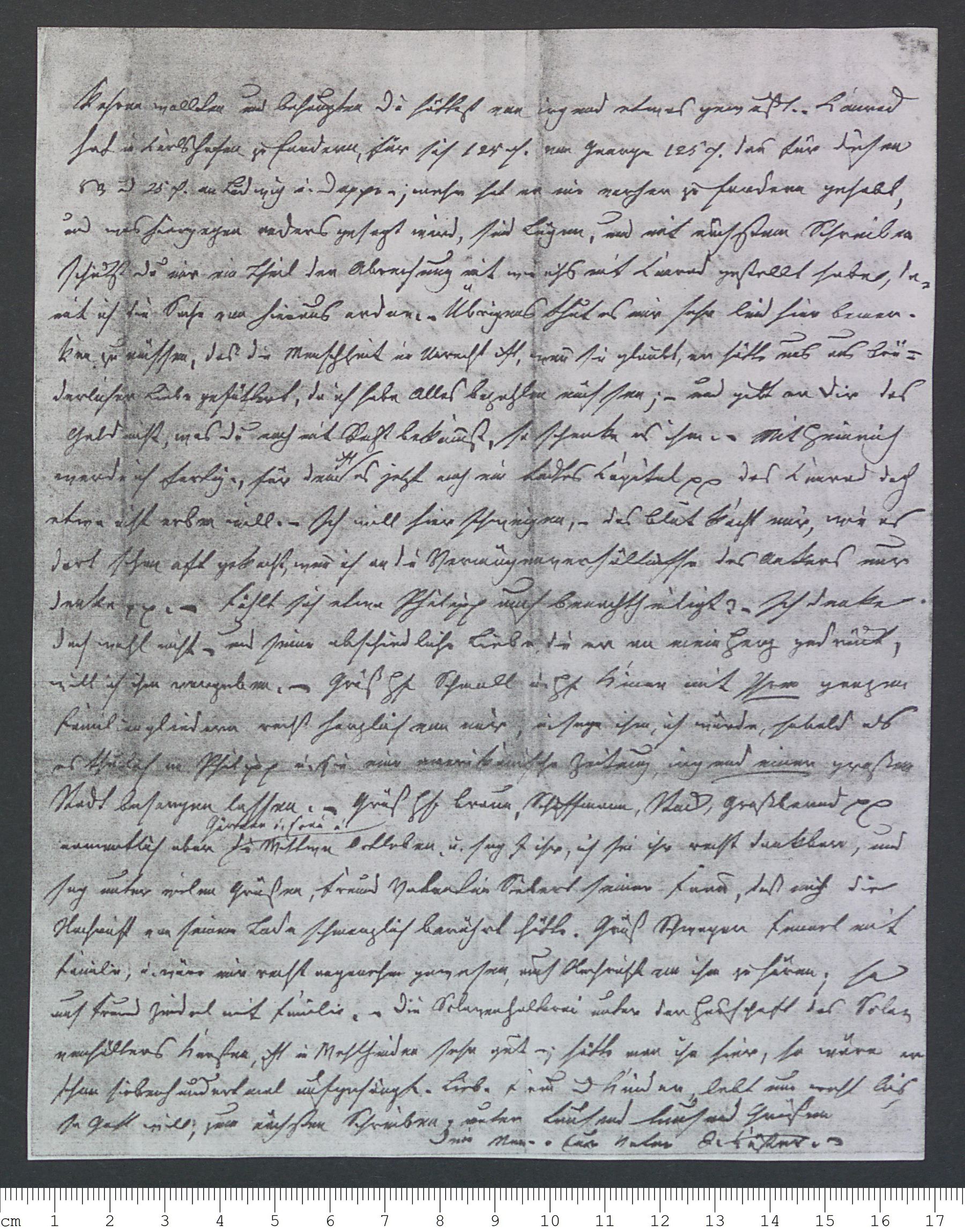
Autograph leaf 0117 — original of the 24 April 1859 St. Joseph letter (typescript pp. 5–9)
Not yet transcribed.
Not yet translated.
⭐⭐ IDENTIFIED, 21 July 2026 — this is NOT unread new content. Read against the high-resolution scan, the seven autograph leaves 0113–0119 are the original manuscript of the letter of 24 April 1859 from St. Joseph — the same letter this project already has in verified typescript at images 0058–0062 (pp. 5–9). The opening of 0113/0114 is word-for-word the opening of p. 5 („St. Joseph M. 24 April 1859 … Mit welcher Sehnsucht, mit welchem Jammer ich Euer Schreiben erwartet habe“), and leaf 0119 carries the „Deißel“ greeting passage of p. 9 („Kommst Du nach Deißel, so grüße Schwager Teme, Deppe, Göbel, Meinbresse, Pathe Köster … namentlich aber meine Mutter, Sophie, auch Lud[wig]“). ⚠️ This is a Kurrent reading from a photograph and must be confirmed by a paleographer — but the identification is secure on the matching dateline, opening and the distinctive Deißel/Teme/Meinbresse greeting list. Three consequences: (1) the archival label on 0113 reading „24.4.1853“ is a MISREAD of 1859 — the open date conflict is resolved; (2) the „Deißel“ spelling this project cites can now be checked in Köster's own hand, not only the 1930s typist's — and it holds; (3) the earlier site claim that an autograph was „a long meditation on America as freie Bewegung, freier Wille“ is doubly wrong — that passage is on typescript p. 6, and these leaves are the St. Joseph letter, not a meditation. A full line-by-line Kurrent transcription is still worth commissioning, but the CONTENT is already known from the typescript.
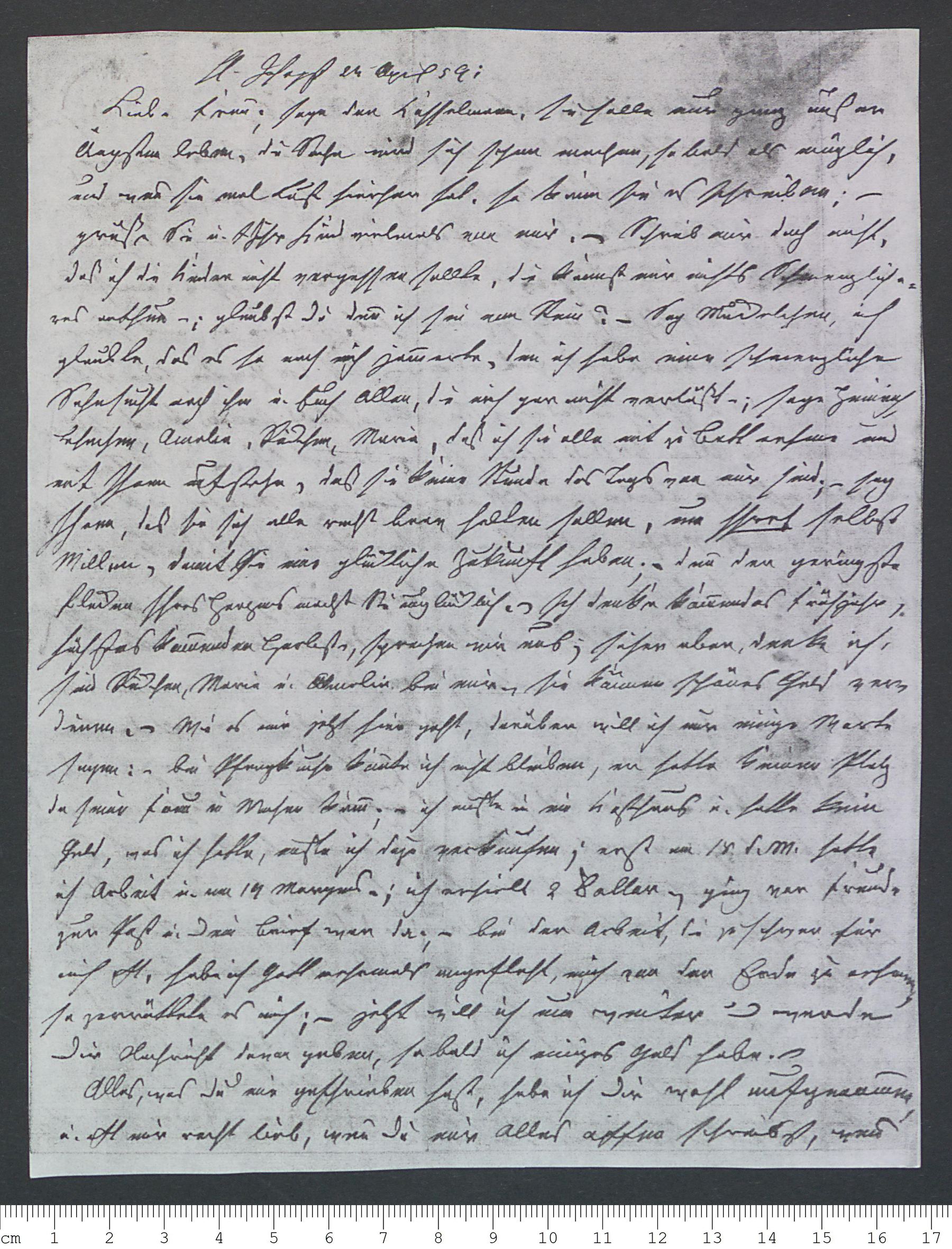
Autograph leaf 0118 — original of the 24 April 1859 St. Joseph letter (typescript pp. 5–9)
Not yet transcribed.
Not yet translated.
⭐⭐ IDENTIFIED, 21 July 2026 — this is NOT unread new content. Read against the high-resolution scan, the seven autograph leaves 0113–0119 are the original manuscript of the letter of 24 April 1859 from St. Joseph — the same letter this project already has in verified typescript at images 0058–0062 (pp. 5–9). The opening of 0113/0114 is word-for-word the opening of p. 5 („St. Joseph M. 24 April 1859 … Mit welcher Sehnsucht, mit welchem Jammer ich Euer Schreiben erwartet habe“), and leaf 0119 carries the „Deißel“ greeting passage of p. 9 („Kommst Du nach Deißel, so grüße Schwager Teme, Deppe, Göbel, Meinbresse, Pathe Köster … namentlich aber meine Mutter, Sophie, auch Lud[wig]“). ⚠️ This is a Kurrent reading from a photograph and must be confirmed by a paleographer — but the identification is secure on the matching dateline, opening and the distinctive Deißel/Teme/Meinbresse greeting list. Three consequences: (1) the archival label on 0113 reading „24.4.1853“ is a MISREAD of 1859 — the open date conflict is resolved; (2) the „Deißel“ spelling this project cites can now be checked in Köster's own hand, not only the 1930s typist's — and it holds; (3) the earlier site claim that an autograph was „a long meditation on America as freie Bewegung, freier Wille“ is doubly wrong — that passage is on typescript p. 6, and these leaves are the St. Joseph letter, not a meditation. A full line-by-line Kurrent transcription is still worth commissioning, but the CONTENT is already known from the typescript.
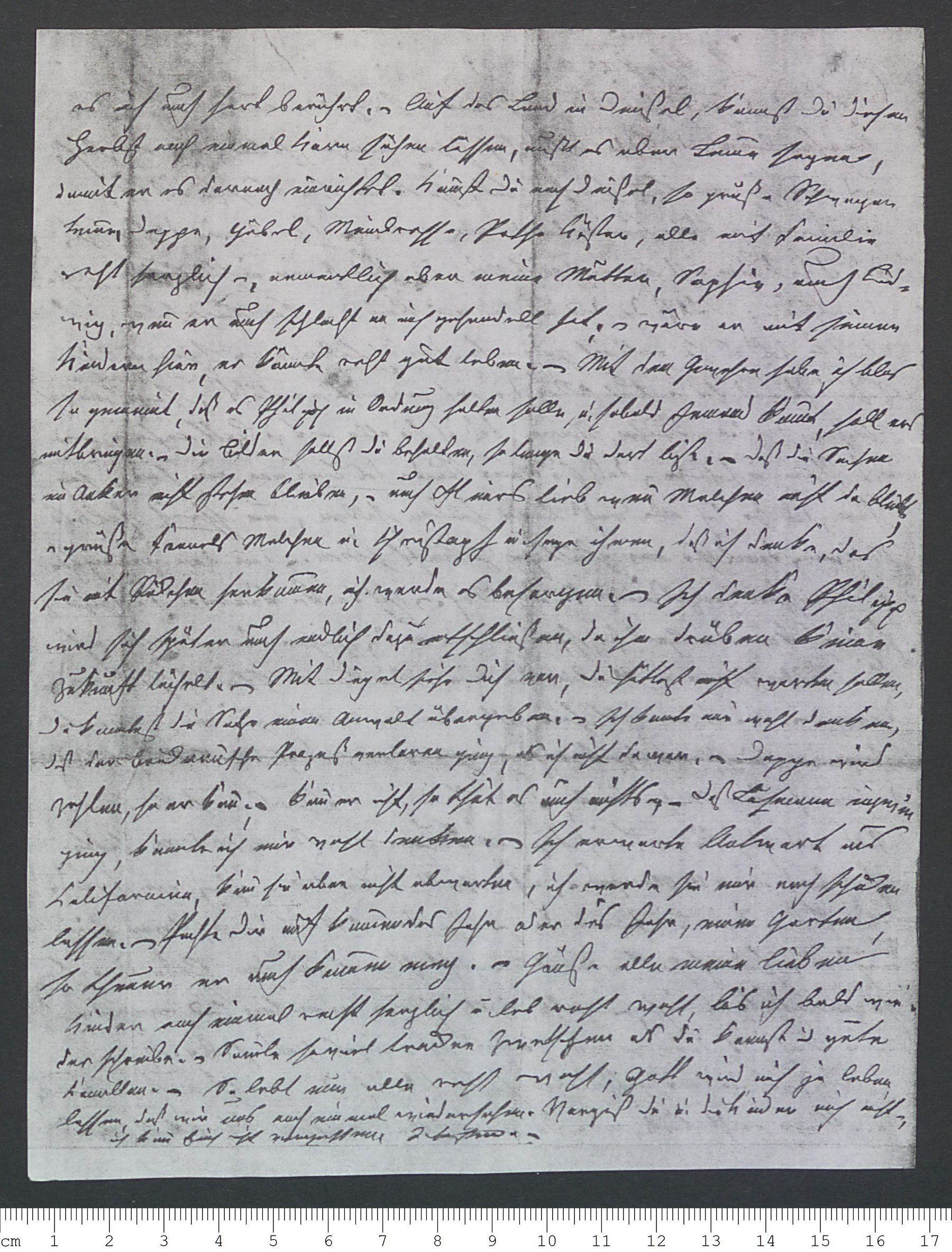
Autograph leaf 0119 — original of the 24 April 1859 St. Joseph letter (typescript pp. 5–9)
Not yet transcribed.
Not yet translated.
⭐⭐ IDENTIFIED, 21 July 2026 — this is NOT unread new content. Read against the high-resolution scan, the seven autograph leaves 0113–0119 are the original manuscript of the letter of 24 April 1859 from St. Joseph — the same letter this project already has in verified typescript at images 0058–0062 (pp. 5–9). The opening of 0113/0114 is word-for-word the opening of p. 5 („St. Joseph M. 24 April 1859 … Mit welcher Sehnsucht, mit welchem Jammer ich Euer Schreiben erwartet habe“), and leaf 0119 carries the „Deißel“ greeting passage of p. 9 („Kommst Du nach Deißel, so grüße Schwager Teme, Deppe, Göbel, Meinbresse, Pathe Köster … namentlich aber meine Mutter, Sophie, auch Lud[wig]“). ⚠️ This is a Kurrent reading from a photograph and must be confirmed by a paleographer — but the identification is secure on the matching dateline, opening and the distinctive Deißel/Teme/Meinbresse greeting list. Three consequences: (1) the archival label on 0113 reading „24.4.1853“ is a MISREAD of 1859 — the open date conflict is resolved; (2) the „Deißel“ spelling this project cites can now be checked in Köster's own hand, not only the 1930s typist's — and it holds; (3) the earlier site claim that an autograph was „a long meditation on America as freie Bewegung, freier Wille“ is doubly wrong — that passage is on typescript p. 6, and these leaves are the St. Joseph letter, not a meditation. A full line-by-line Kurrent transcription is still worth commissioning, but the CONTENT is already known from the typescript.
Images: Forschungsbibliothek Gotha der Universität Erfurt, Deutsche Auswandererbriefsammlung, Serie Köster/Köster (NABS Ordner 74). Public domain; credited as provenance, not as a licence condition.