★ At a Glance
In July 2026 the Forschungsbibliothek Gotha released the Köster/Köster series — twenty-two letters written 1858–1862 by Johannes Köster, schoolteacher of Deisel, home to his wife from St. Joseph and St. Louis. Charles's 1866 marriage entry names his origin as “Deisse” — on the project's reading, this same village. This is the only known letter series from that village, written across the exact years he arrived. A full sweep of the letters, their 1937 name index and the appendices is negative for every name in the pool — but Köster explains that silence himself: he refused to know countrymen he saw “in Lumpen.” What the letters do establish is a Hessian countryman network in wartime St. Louis, a second Deisel emigrant who left no exit record either, and a datable crossing — and on 19 July 2026 that crossing was identified. Köster sailed on the Bremen ship Rubens, Capt. Johann Seiler, into New Orleans on 3 January 1859. The manifest is transcribed and in hand. Charles is not on it. Wilhelmine is — and that single line rewrites the double life.
Who Johannes Köster was
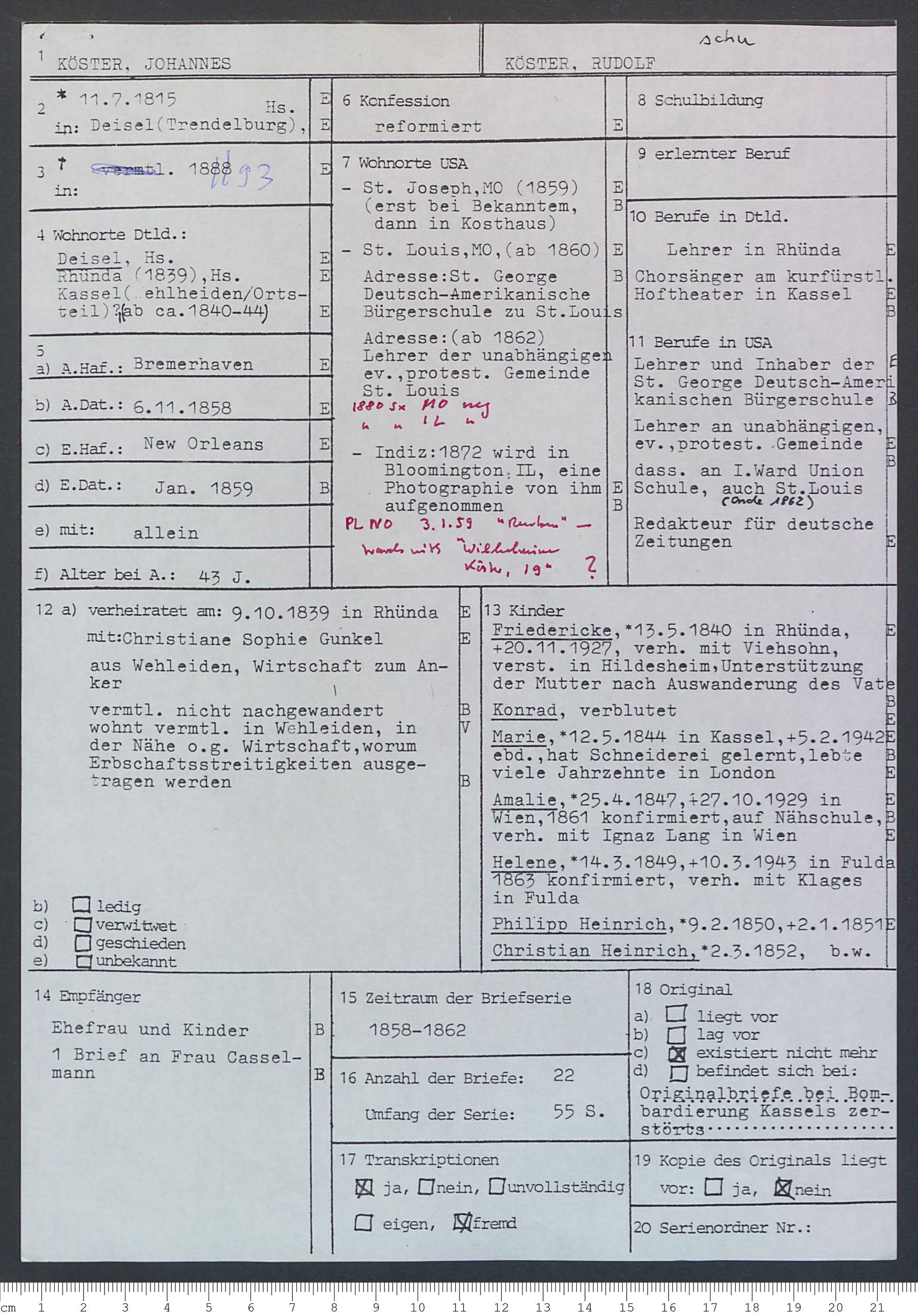
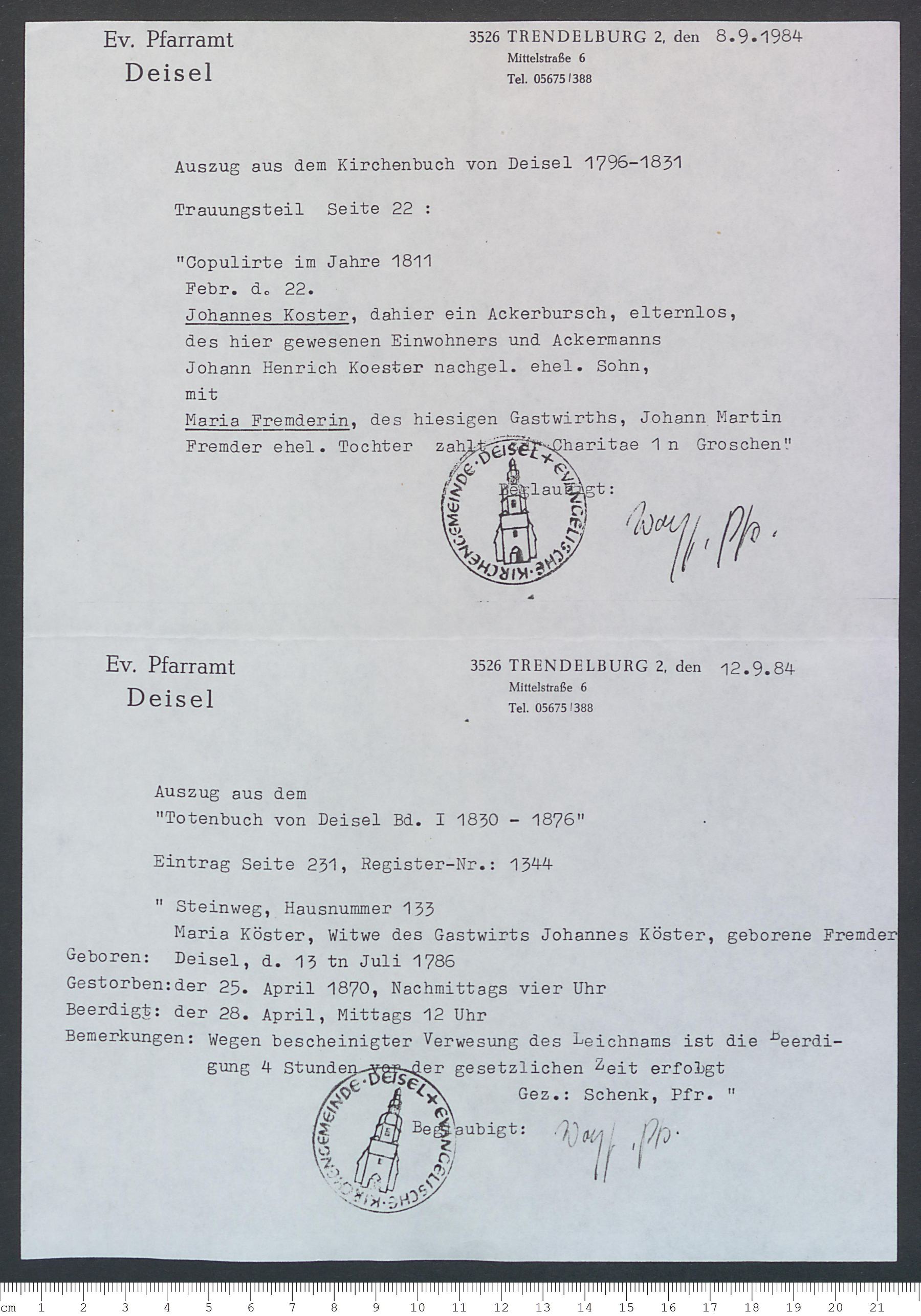
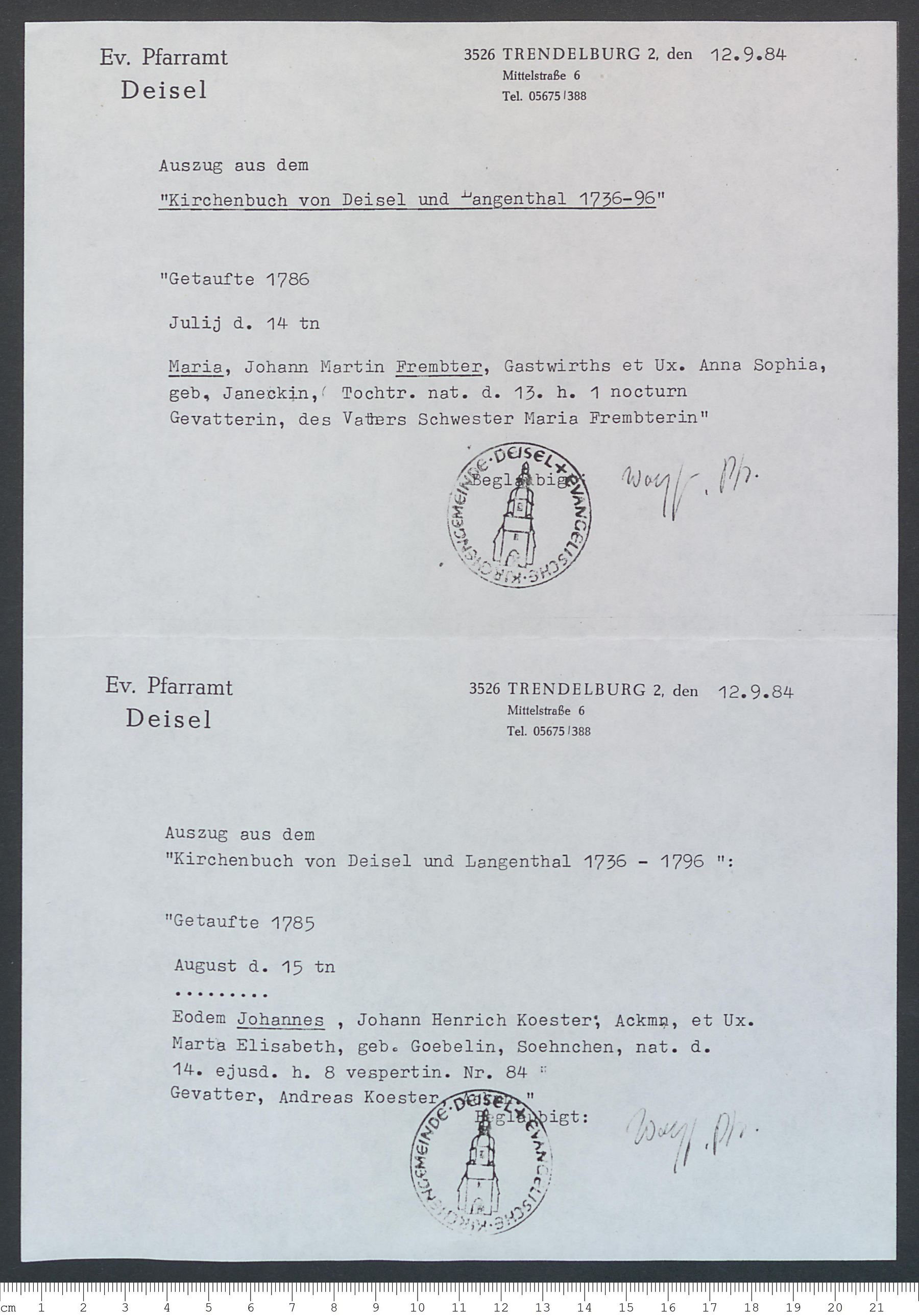
Born in Deisel on 11 July 1815, son of the Gastwirt Johannes Köster (1785–1838) and Marie Fremder (1786–1870), he was the village schoolmaster — a literate, respectable man of forty-three when he left. That matters for what the letters are: not a laborer's scrawl but a schoolteacher's correspondence, written fluently and at length, with a teacher's eye for detail. He is the best-documented person ever to leave Deisel for St. Louis in Charles's window.
He is on FamilySearch as Johannes Koester, GHDS-1GW — identified 19 July 2026 and matching the Gotha Lebenslauf on five independent points: born 11 July 1815 at Deisel, Hofgeismar; died “after 1858, United States”; father Johannes Koester, 1785–1838; mother Maria Frembder, 1786–1870. (A different Johannes Koester of Deisel — b. about 1810, son of Johann Christoph — sits directly above him in the search results; the two should not be conflated.)
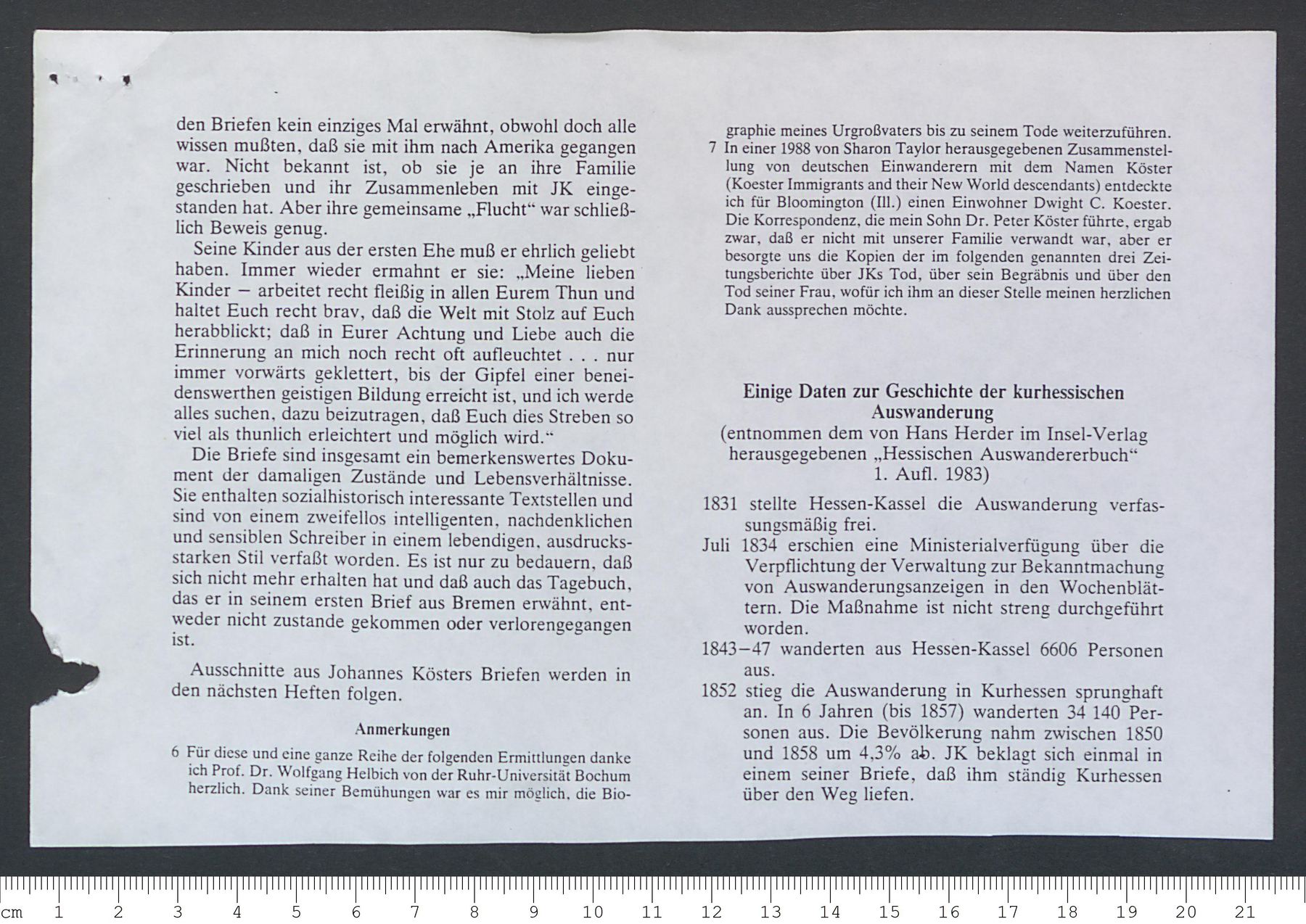
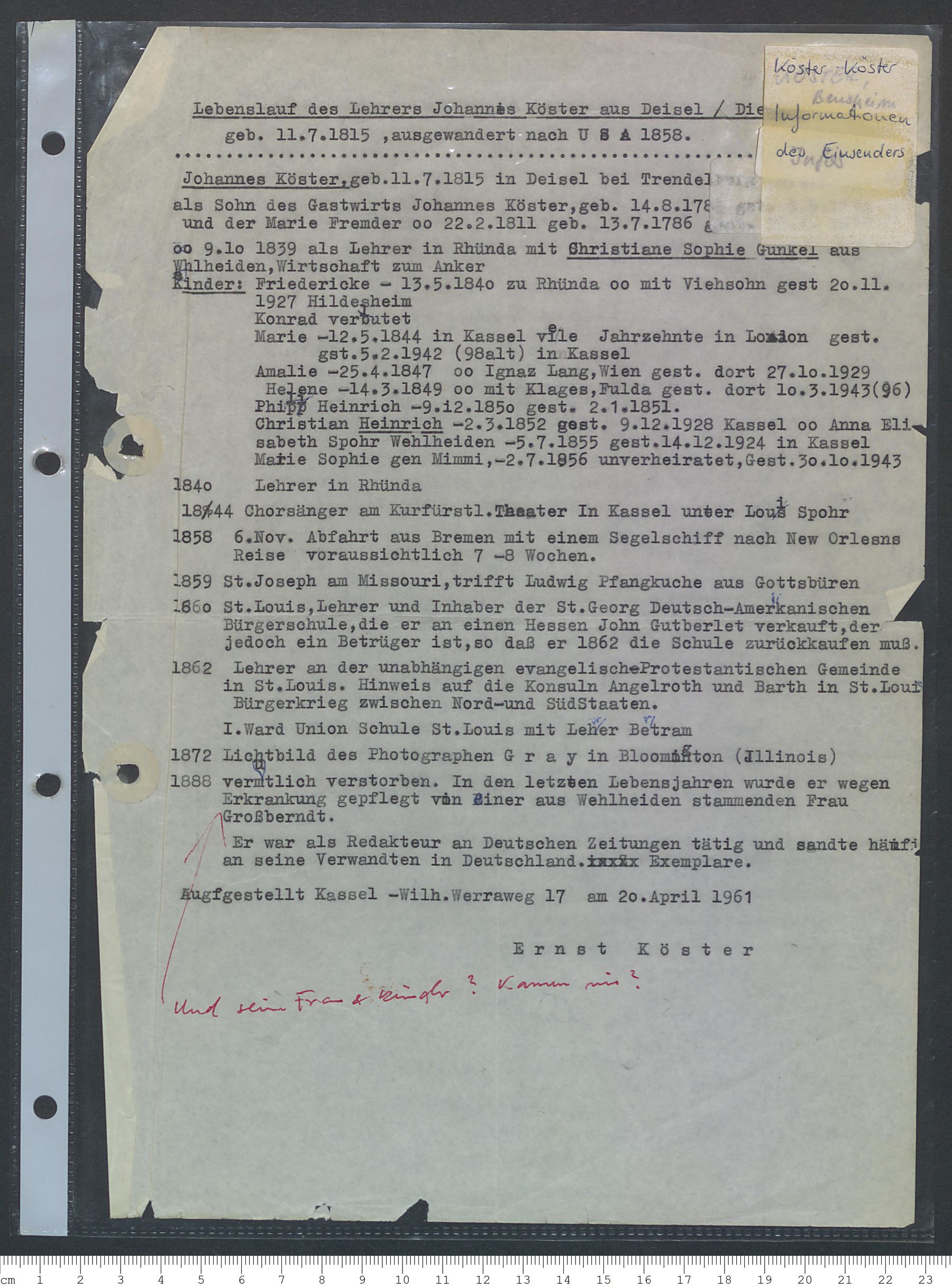
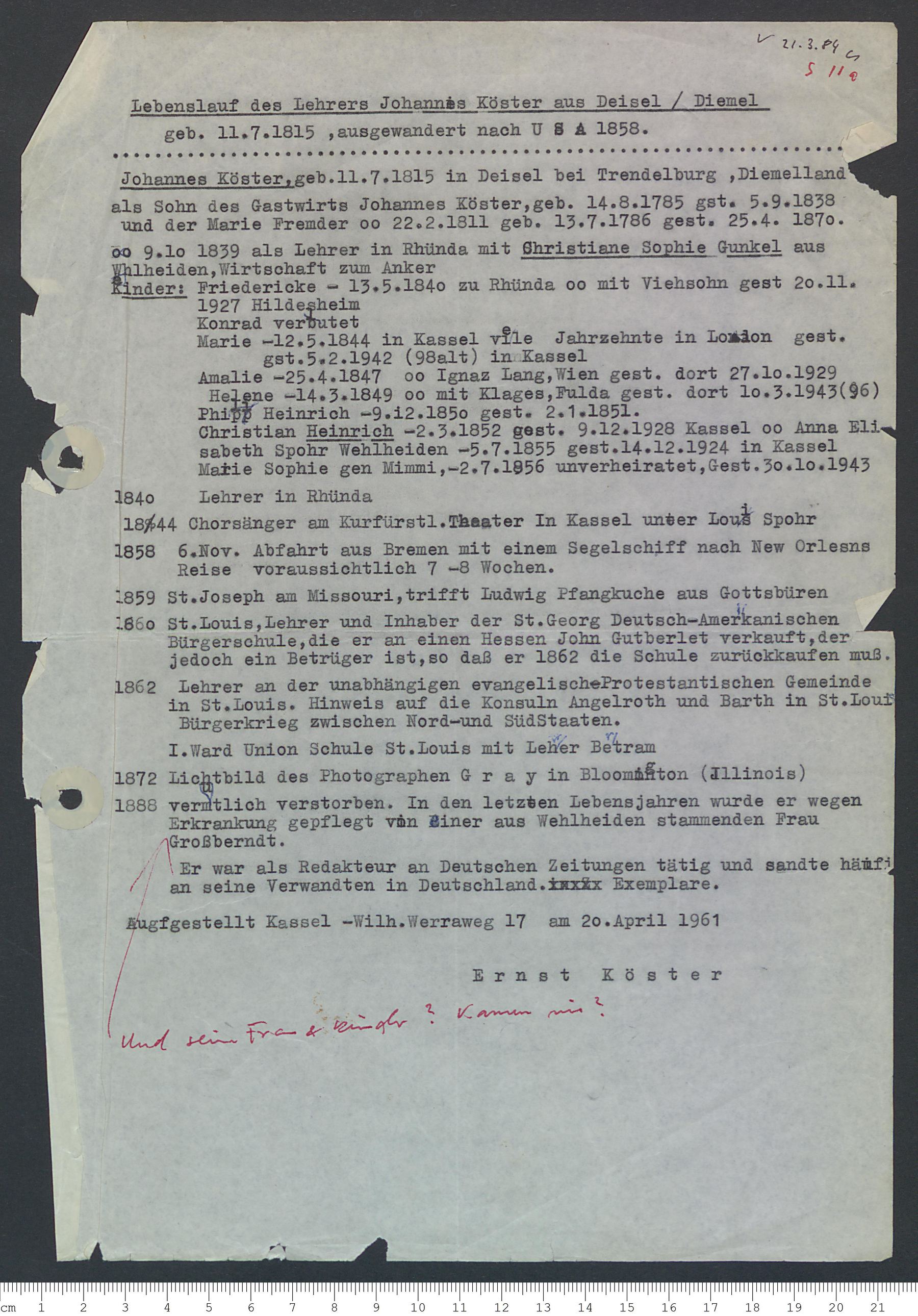
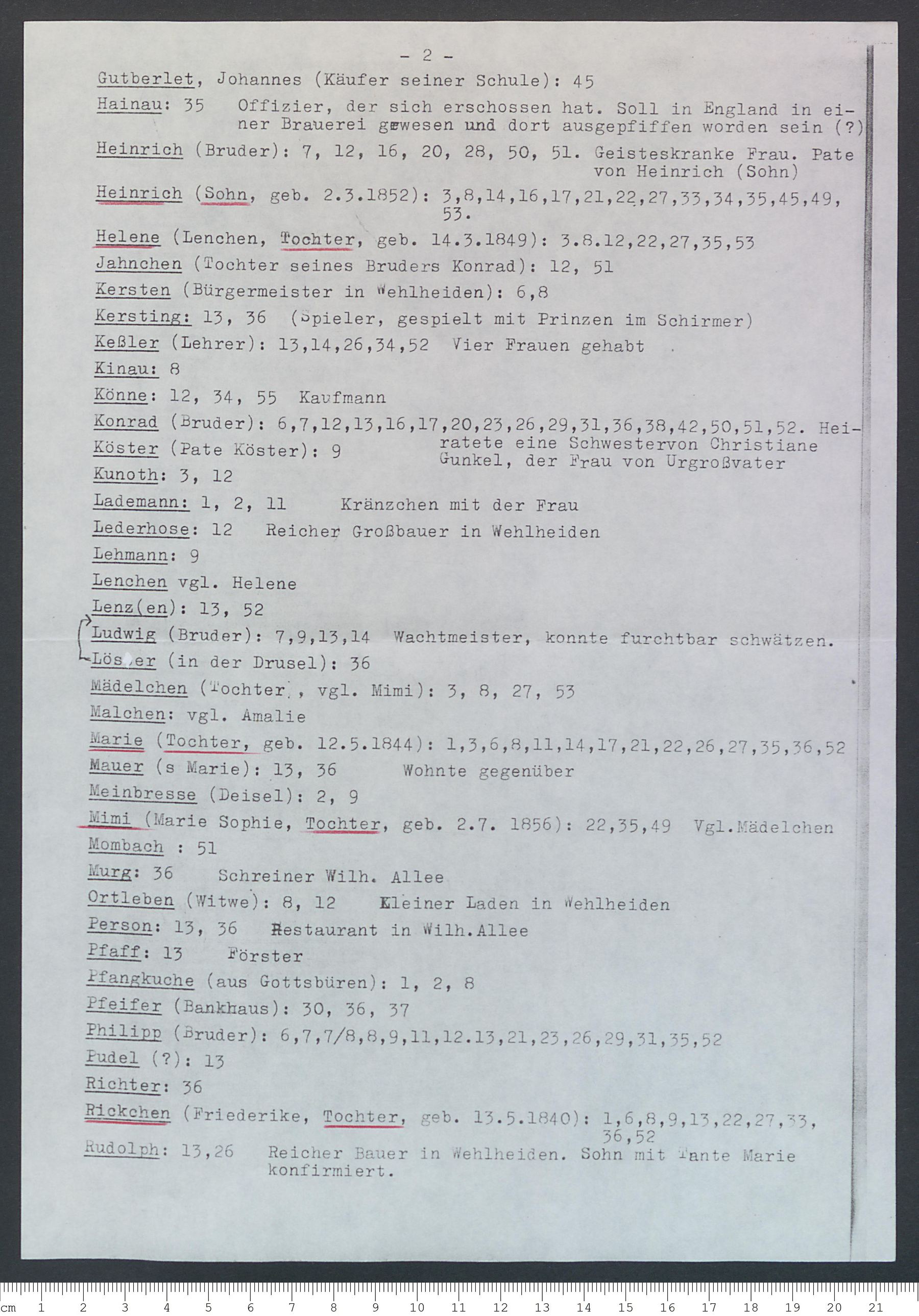
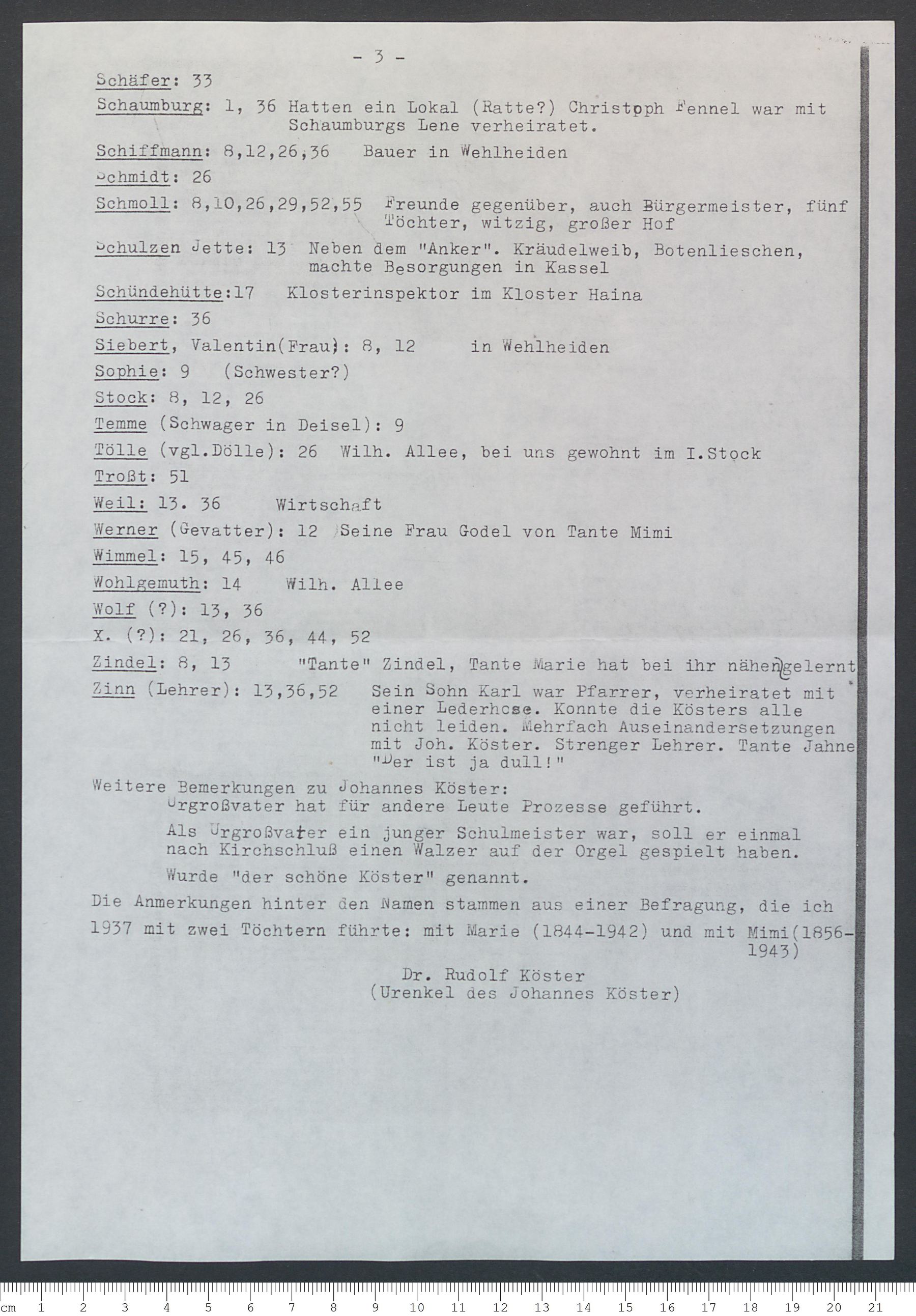
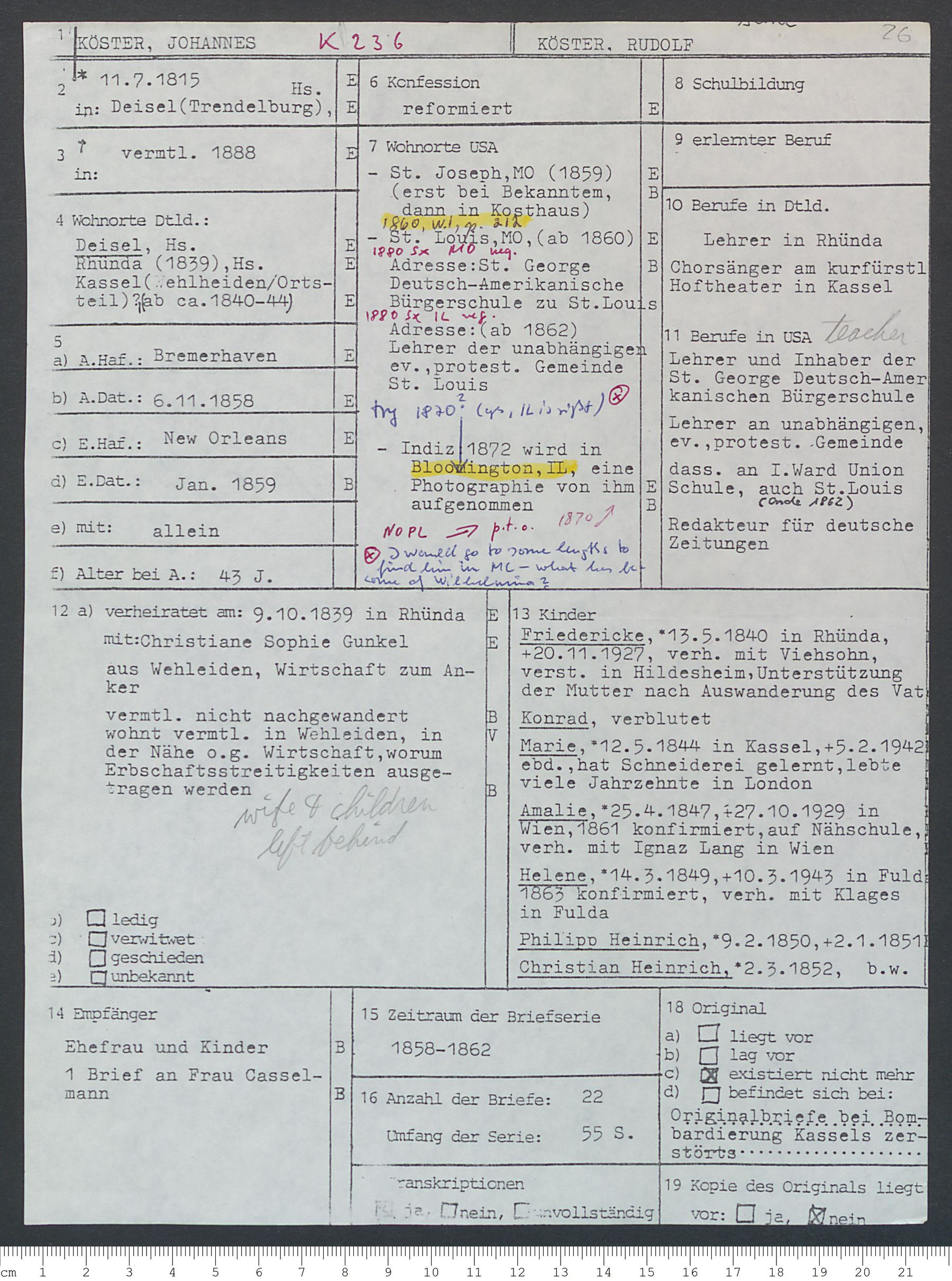
The series includes his Lebenslauf (image 0028), which fills the life in. He married Christiane Sophie Gunkel of Wehlheiden at Rhünda on 9 October 1839 and taught there from 1840; in 1844 he was a chorister at the Kurfürstliches Theater in Kassel under Louis Spohr. Eight children followed, two of whom — Marie (1844–1942) and Marie Sophie “Mimi” (1856–1943) — lived long enough to be interviewed in 1937 for the name index that makes this collection searchable.
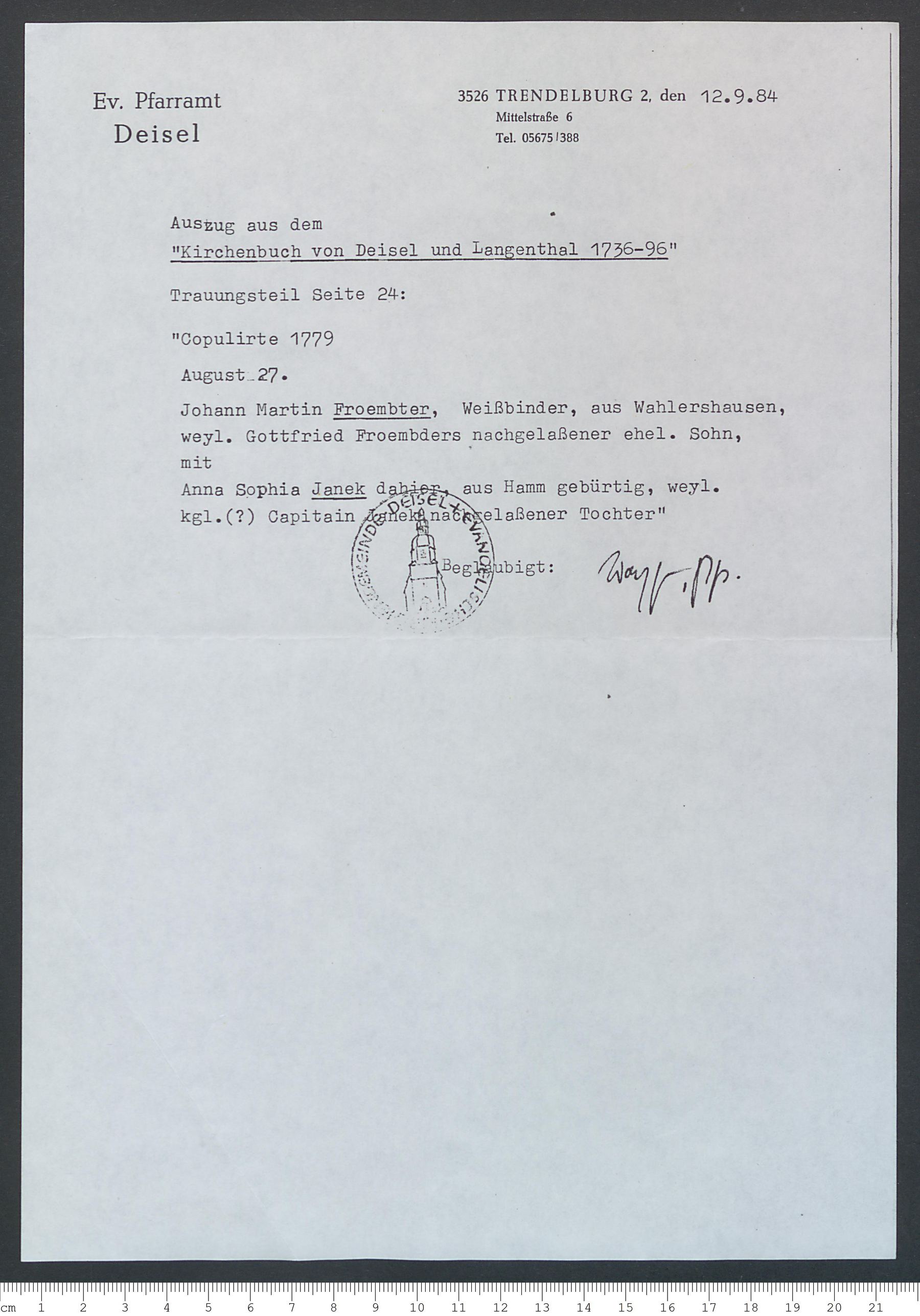
His mother's maiden name is worth pausing on. Fremder is one of the surnames on the Deisel emigrant lists, and it recurs in the letters as “Fremder, Vetter in Deisel” — so the Köster–Fremder tie is blood, not just neighborhood. The Deisel families who show up in the emigration record are, repeatedly, the same few interrelated households.
The road he took
6 November 1858 · Bremen
He sails. His own Lebenslauf records it precisely: “1858 6. Nov. Abfahrt aus Bremen mit einem Segelschiff nach New Orleans, Reise voraussichtlich 7–8 Wochen” — a sailing ship, not a steamer, with a seven-to-eight-week crossing expected. His first letter home is written from the ship in harbor on the day of departure. The letters never name the vessel — but the manifest does. She was the Bremen ship Rubens, master Johann (“John”) Seiler. He did not board alone.
3 January 1859 · New Orleans
Documented, not inferred. The Rubens cleared the Port of New Orleans on 3 January 1859, Seiler swearing his passenger list before Collector J. M. Hunt that day — eighty-five passengers, none dead on the voyage. Fifty-eight days out of Bremen, against the captain's promised “seven to eight weeks, because the ship sails fast.” Entry 16 reads “Johann Köster, 43y5m, male, Kurhessen” — his age to the month, and his territory. NARA Film M259, Reel 47, List 2; transcribed ISTG Vol. 21.
25 February 1859 · St. Joseph, Missouri
Letter two is datelined St. Joseph, where he is taken in by Ludwig Pfangkuche of Gottsbüren and meets Bade of Hümme — the Trendelburg-parish network already active in St. Joseph by early 1859. The countryman network is already visible in the second letter.
From 1860 · St. Louis
He settles and founds the St. George Deutsch-amerikanische Bürgerschule, which doubles as his mailing address — “An St. George Deutsch-amerikanische Bürgerschule zu St. Louis, Staat Missouri, Nord Amerika.” He judges it “eine der besten”, with “nur reiche Kinder, die in drei Schulen zerfallen” — none but rich children, across three classes — and plans a larger building. He then sold the school to a fellow Hessian, John Gutberlet, who proved a fraud, forcing Köster to buy it back in 1862. By 1862 he was also teaching at the independent Evangelical Protestant congregation in St. Louis. Charles enlisted in St. Louis in December 1862 and married at St. Marcus Evangelical in January 1866.
★ The ship — identified 19 July 2026
The chapter-two research lead the project had been carrying as its most important open question — identify Köster's ship — is closed. He crossed on the Bremen ship Rubens (spelled Reubens on the master's sworn statement, Rubens on the manifest and in the New Orleans dailies), under Capt. Johann Seiler, arriving at the Port of New Orleans on 3 January 1859 with eighty-five passengers aboard and no deaths on the voyage.
The identification rests on five independent points of fit, not one:
- The name. Passenger 16 is entered as Johann Köster.
- The age, to the month. The manifest gives 43y5m. Born 11 July 1815, Köster was 43 years, 5 months and 23 days old on 3 January 1859.
- The territory. The origin column reads Kurhessen — not Hannover, not Preussen, both of which appear elsewhere on the same page.
- The route. Bremen to New Orleans, exactly as the Lebenslauf states.
- The passage length. 6 November to 3 January is fifty-eight days — a shade over the captain's promised seven to eight weeks, which is what a slightly slow crossing on a fast ship looks like.
The arrival month, which this page previously carried as arithmetic inferred from the seven-to-eight-week estimate, is now documented to the day. The Bremen Chamber of Commerce and Staatsarchiv departures database independently records the Rubens under the same master, “Seiler, J”, on a Bombay run in October 1857 — the same ship in the general trade a year earlier.
★★ Wilhelmine was on the boat
Directly beneath Köster on the manifest:
17 · Wilhelmine Köster · 19y4m · female · Kurhessen · Louisiana
— List of passengers of the Bremen ship Rubens, New Orleans, 3 January 1859. NARA M259, Reel 47, List 2.
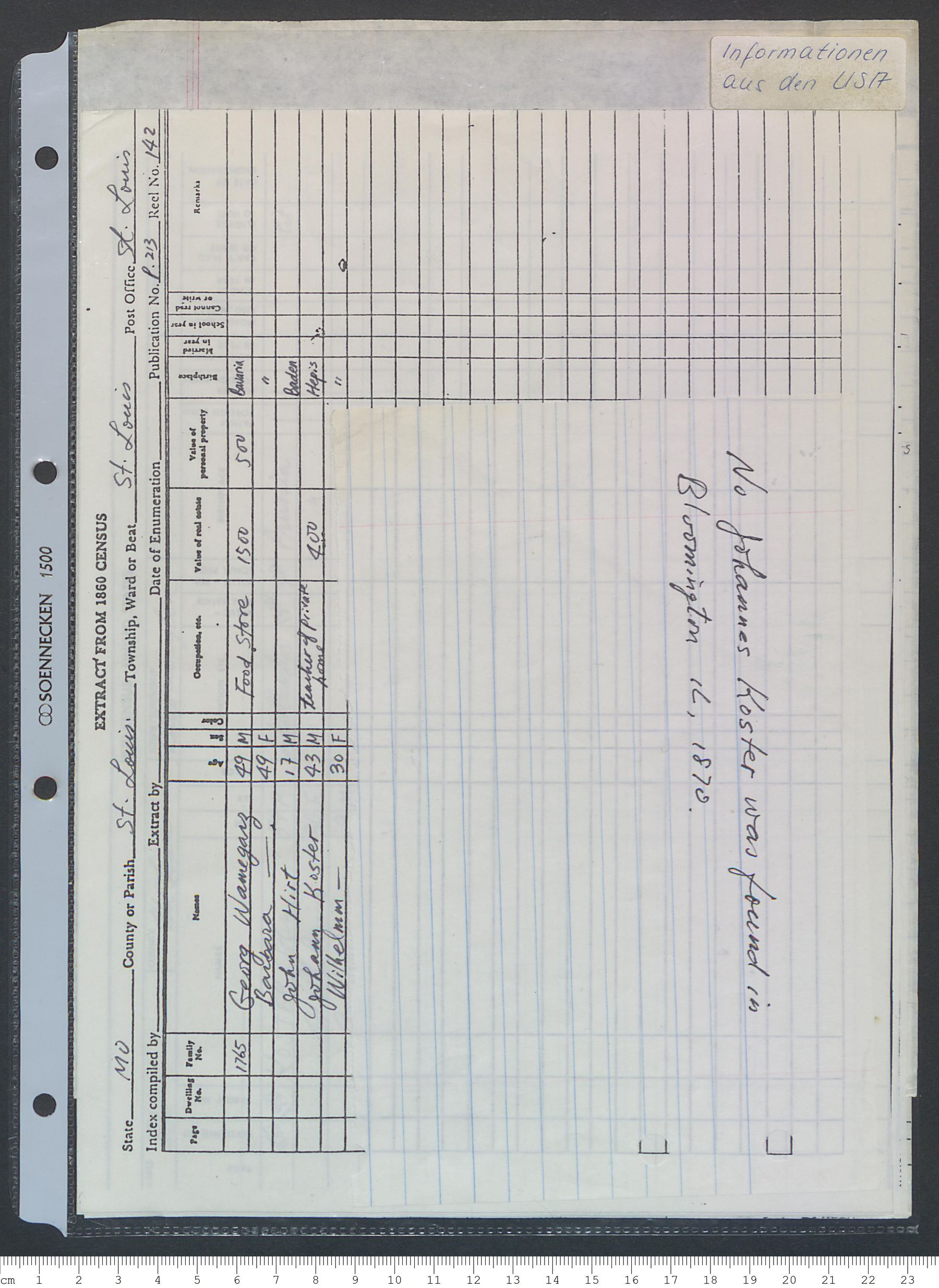
Nineteen years and four months old in January 1859 puts her birth at about September 1839 — which makes her twenty in 1860. That is precisely the age Rudolf Köster gives for the Wilhelmine in the 1860 St. Louis census: entered as thirty, “she was in fact twenty.” Same age, same territory, and already traveling under the surname Köster.
This is the same woman — Wilhelmine Grosbernd, of the Kassel family whose name runs seven times through the letters in quite another connection.
The consequence is not a small one. Rudolf Köster's careful phrasing was that his ancestor “had been living with her, as man and wife, since his arrival.” The manifest sharpens that considerably: she did not meet him in America. She boarded with him at Bremen, and they were presenting as husband and wife — she under his surname — before the ship left German water. He was forty-three and married. She was nineteen.
Everything the letters do makes better sense in this light. The instruction to his wife to keep his address to herself; the refusal to know countrymen; the false Louisville dateline written “absichtlich, da es niemand wissen soll, wo ich bin”; the two years shaved off his own census age. This was not a proud schoolmaster avoiding spongers. He had left Deisel with a nineteen-year-old and spent four years writing his wife letters of longing from a city he would not name.
She outlived him. Wilhelmine died at Bloomington, Illinois, on 5 December 1907.
Still open: her parentage and her Deisel or Kassel baptism. Kassel's parish registers for 1839–40 are among the war losses, which may mean the record does not survive. Whether she appears in any Kurhessen exit register — a nineteen-year-old woman would have needed a permit as much as Köster did, and he has none — is unsearched.
What else the manifest carries
The reason for wanting this ship was never Köster. It was the hypothesis that villagers traveled together, and that any male of eighteen to twenty-five on his list with a K- or G- surname would be a Charles candidate.
Charles is not aboard. All eighty-five names were read line by line against the ten tracked variants and the C-cluster test spellings. There is no Konze, Kontze, Konzen, Konsen, Gans, Gansen, Gannsen, Gonnson, Gonsen, Gunnsen or Hansen. The nearest surface hits — Carl Kessler (32, Preussen), Carl Edward Carl (37, Sachsen), Wilhelm Wintelmann (25, Preussen) — fail on suffix, age and territory alike. No male of the right age on this manifest carries a surname of the right shape.
What the list does carry is a Hessen-origin, Missouri-bound block traveling the same corridor in the same season — the first concrete cohort the project has for Charles's crossing window:
| 25 | Wilhelm Vetter · 29y2m · chimney-sweep · Hessen → Missouri |
| 27 | Johanne Staul · 49 · widow · Hessen → Missouri |
| 28 | Heinrich Staul · 18 · joiner · Hessen → Missouri |
| 29 | Ludwig Staul · 16 · Hessen → Missouri |
| 30 | Elisabeth Staul · 10 · Hessen → Missouri |
| 31 | Christine Müller · 19y7m · Hessen → Missouri |
| 32 | Margarethe Dahmer · 25 · servant · Hessen → Missouri |
| 69 | Margarethe Wagner · 17y4m · servant · Hessen → Louisiana |
Vetter, Staul, Müller, Dahmer, Wagner were run against the godparent names on the seven St. Marcus baptisms on 19 July 2026. No match. The fourteen named sponsors — Pillmann (×2: Friedr. Wm and Wilhelmine née Ebeling), Kreichelt (×5 of that family), Reck, von Delien, Götz, Albrecht, Münke, Spraul — share no surname with any Rubens passenger. One caution for future readers: Wilhelm Vetter is a passenger's surname, and coincides with the ordinary German word Vetter (“cousin”) as Köster uses it in his greetings (“Fremder, Vetter in Deisel”). The two are unrelated.
★ The negative that matters most
The whole reason for wanting this manifest was the premise that villagers traveled together. The Rubens is the first and only chance this project has had to test that premise against a documented Deisel departure. It fails it.
The full eighty-five-name list was swept against the Deisel and Trendelburg surname pool as the project has assembled it — Hildebrand, Pfannkuche, Bade, Fremder, Meimbresse, Temme, Deppe, Göbel, Lauterbach, Dettmar, Casselmann, Grosbernd, Jungkonze, Martini, Friedrichs, Schenk, Merkamm, Birbe, Villmer, Bornemann, Baumann, Gutberlet, Tölle, Thöne, Köhler, Bonhagen, Grabe, Kunze and the rest.
The only match on the entire manifest is Köster himself — and Wilhelmine.
The sharpest form of this: LAGIS records four Deisel departures in 1858 — Fremder, Koester (Ludwig), Birbe and Villmer — the same year, from the same village. Not one of them is on this ship. Johannes Köster, leaving Deisel in the peak emigration year, sailed with no fellow villager aboard except the young woman he was leaving with.
That is a real result and it cuts against the model. It does not prove chain migration was absent from Deisel — Pfangkuche and Bade were plainly waiting at the far end, and the chain caught Köster within days of landing. But it separates two things this project has been treating as one. The network operated on arrival, not on departure. Deisel people did not book the same sailings; they converged afterwards, in Missouri.
The practical consequence for Charles is unwelcome but clarifying. Finding a Deisel name on a manifest is not a reliable way to find Charles's crossing, because the one Deisel crossing we can observe carries no Deisel names at all. Manifest work has to go on identifying Charles himself, under his own variants, rather than hoping to spot him in company.
A second negative worth recording: Grosbernd does not appear anywhere on the manifest. Wilhelmine is entered under Köster's surname, not her own — which is the documentary form the concealment took, and the reason no one looking for a Grosbernd would ever have found her.
A discrepancy worth keeping
Both Kösters declared their intended state of inhabitance as Louisiana. Seven weeks later he is in St. Joseph, Missouri, recognized in the street on his third day by Ludwig Pfangkuche of Gottsbüren.
Either the Louisiana entry was port-of-entry boilerplate, or — more interesting, and better fitting the letters, which describe Pfangkuche's recognition as chance — Missouri was not the plan when he boarded. The chain caught him after he landed rather than pulling him across.
That matters for how this project argues Charles's route. The reasoning has been that a St. Louis-bound Hessian would choose New Orleans because of the Mississippi. Köster took that route while declaring Louisiana and reached Missouri anyway. The route does not require the intention — which widens rather than narrows the set of manifests worth reading.
His occupation column, incidentally, is illegible: the transcriber records it as a question mark. The schoolmaster's trade never made it onto the list.
What the sweep found — and what it doesn't mean
Every page was OCR'd and read: the twenty-two letters, the ~55 pages of typed transcription, the three-page alphabetical name index, and the appendices. The result is unambiguous. No Konze, Kontze, Contze or Konzen. No Gans, Gansen, Ganson, Gannsen or Gonnson. No Carl used as a surname.
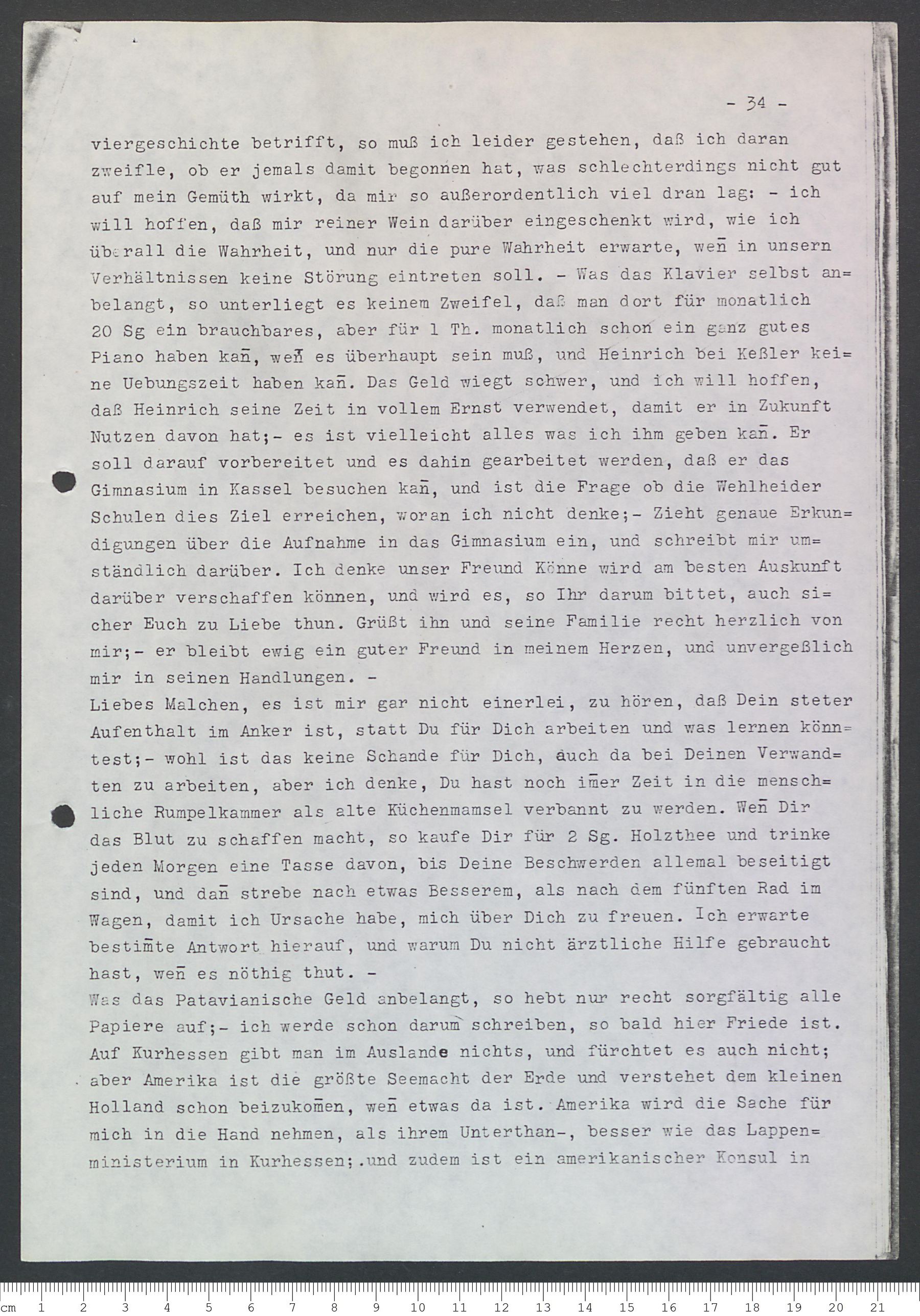
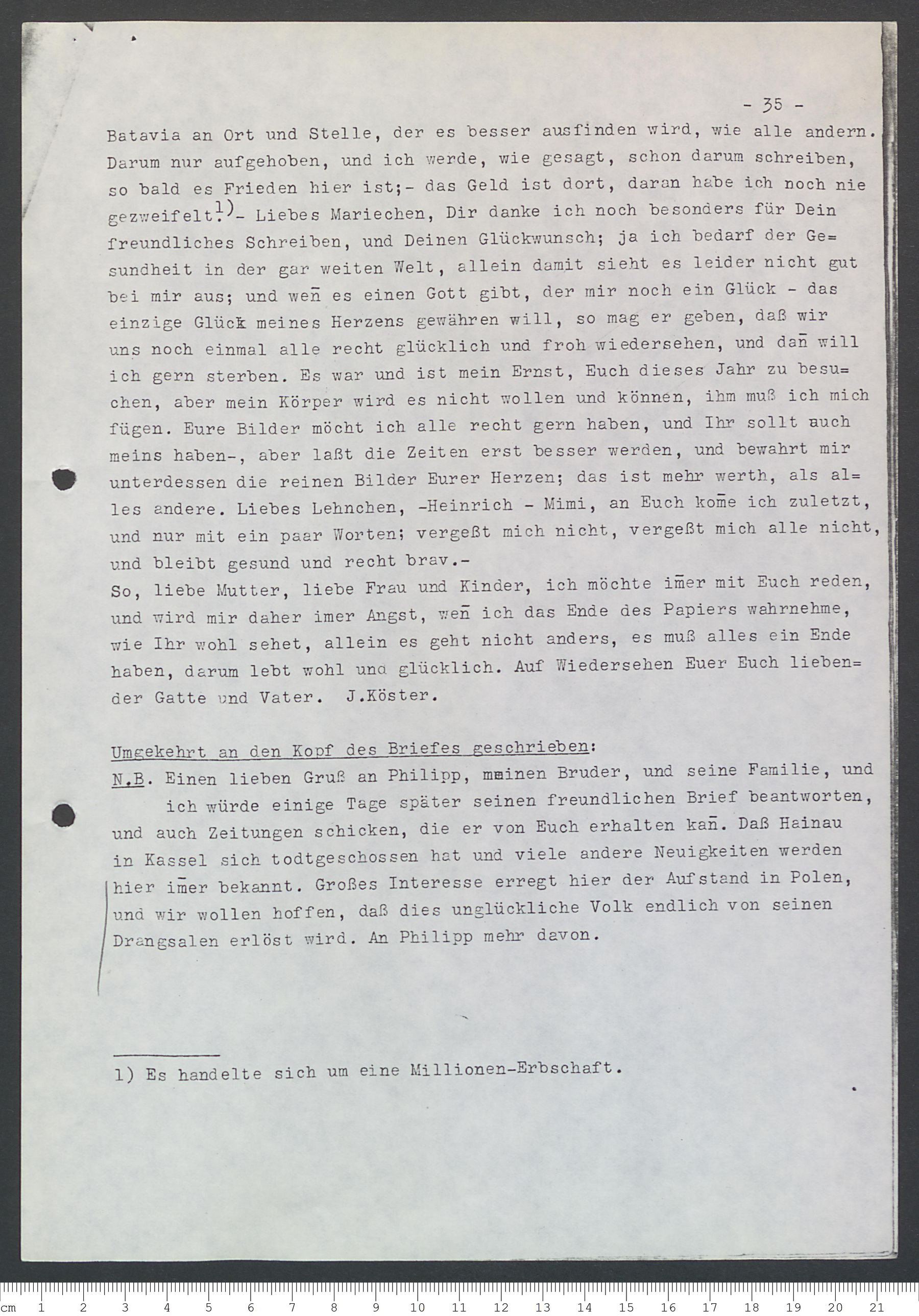
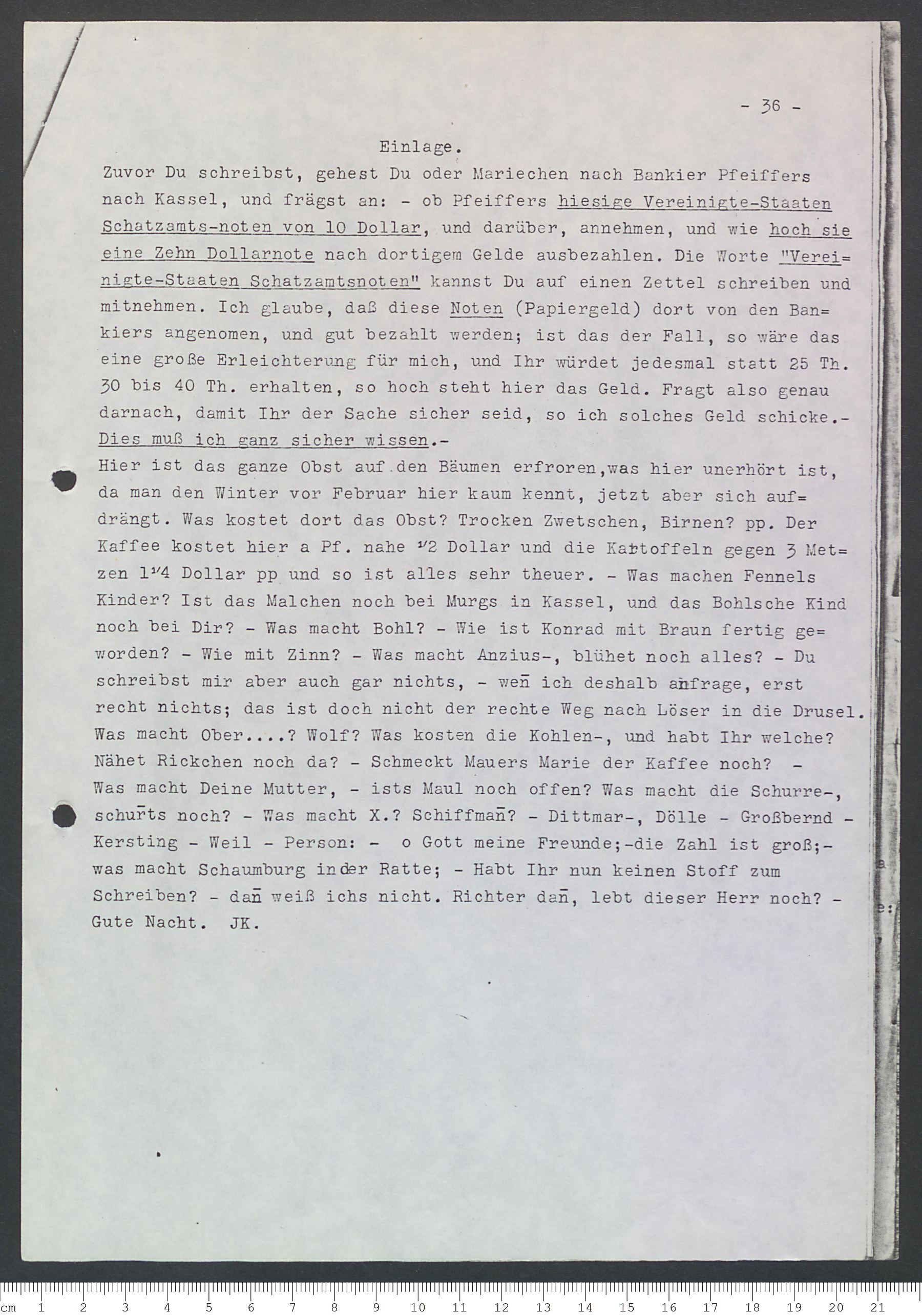
One name was flagged and then eliminated. “Könne”, appearing on transcription pages 12, 34 and 55, proved on reading the surrounding sentences to be a merchant in Kassel, asked after alongside the Schmoll neighbors — “Was macht Könne?”, “grüße… auch Schmoll und Könne”. Not a St. Louis person, and not a variant of anything in the pool.
A negative from a source this close to the target would ordinarily carry real evidentiary weight. This one does not — and the reason is in Köster's own hand:
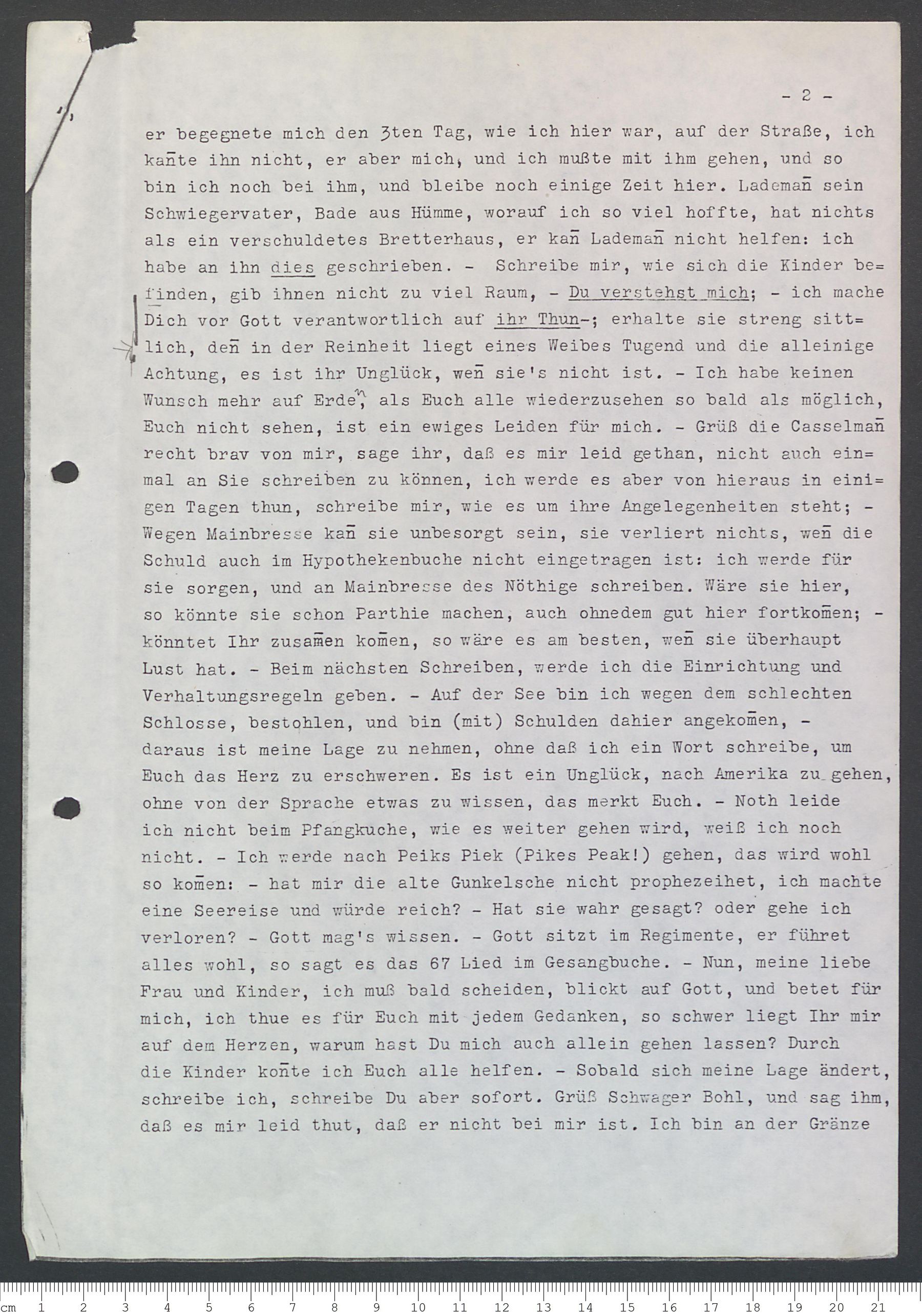
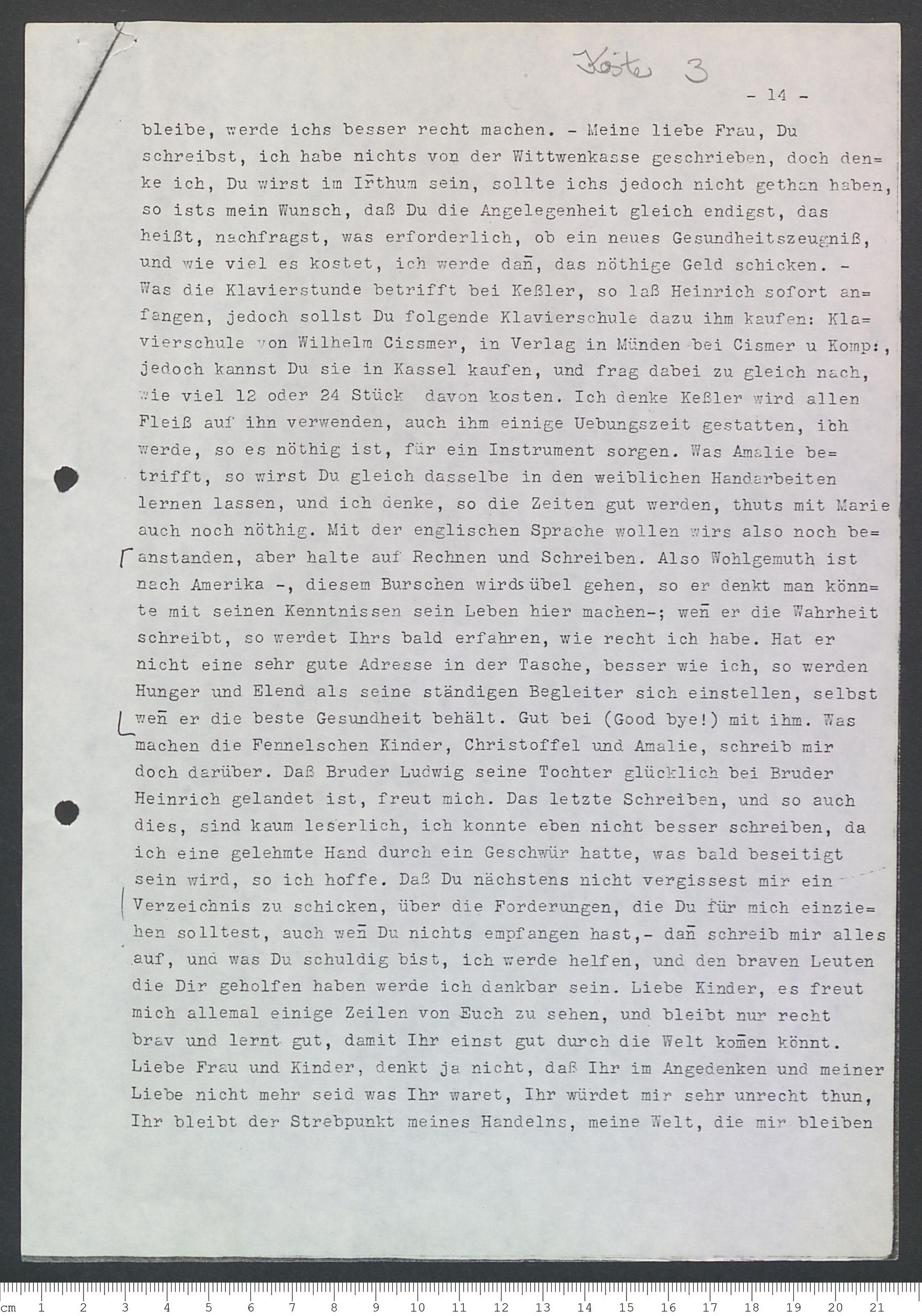
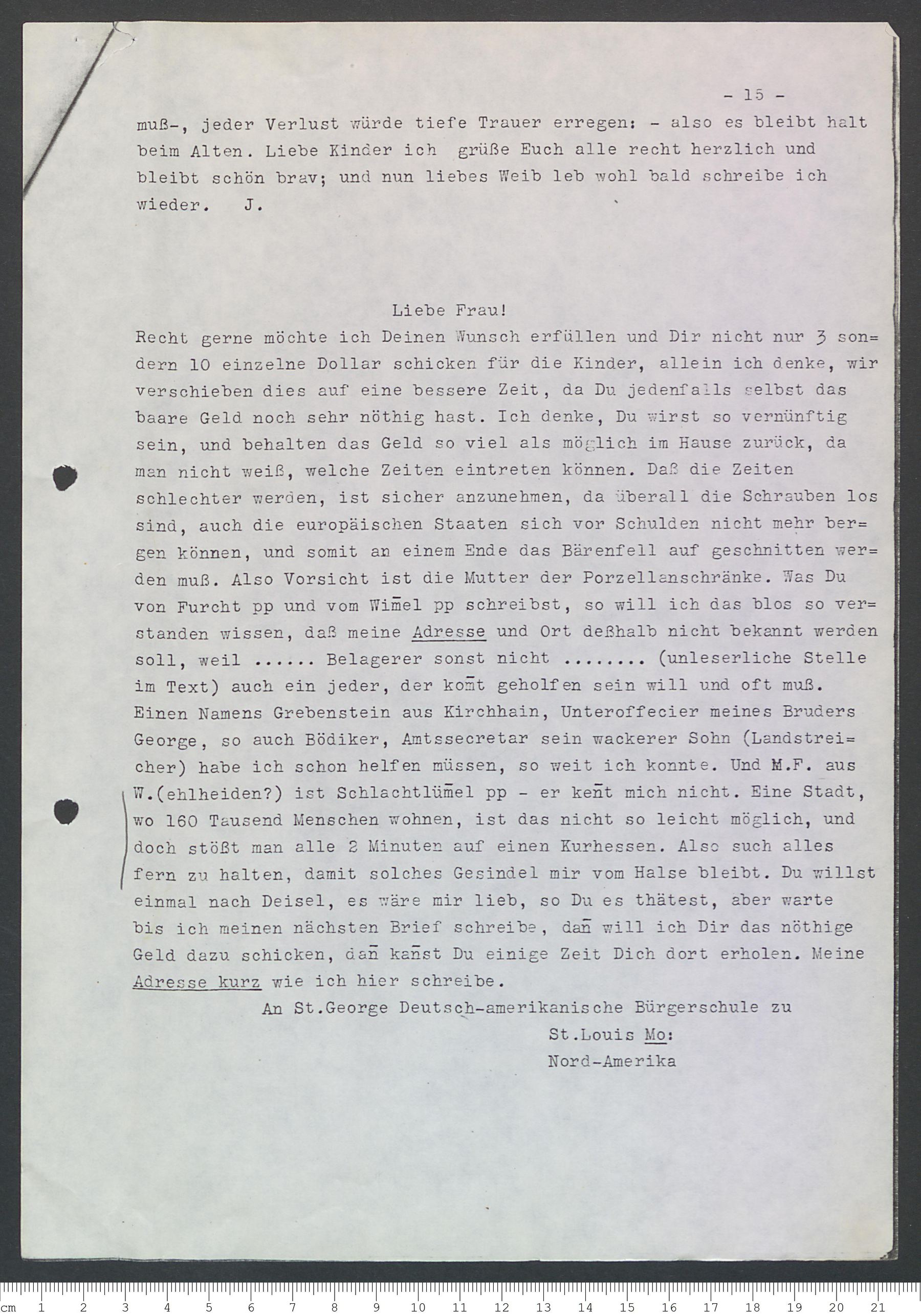
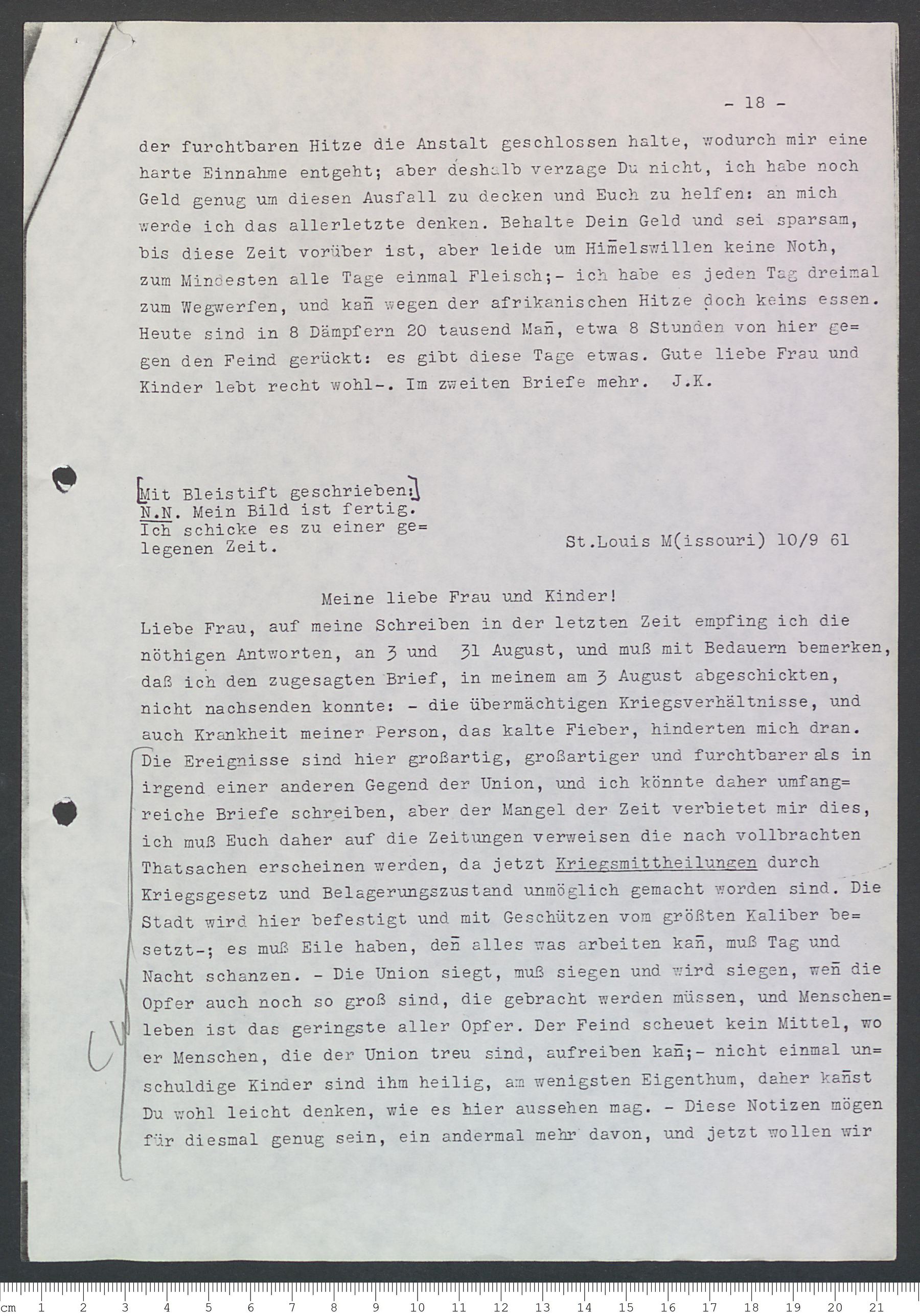
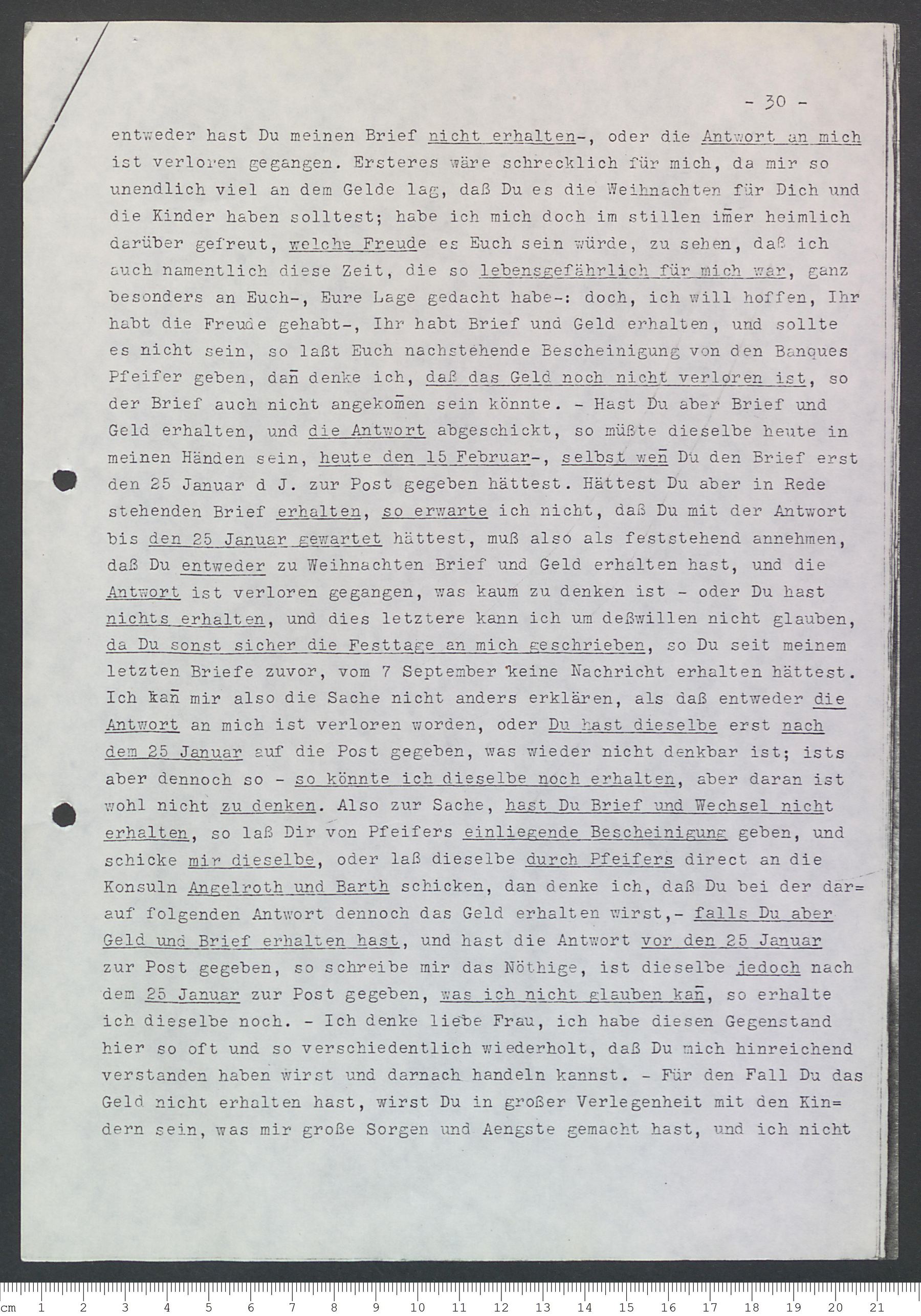
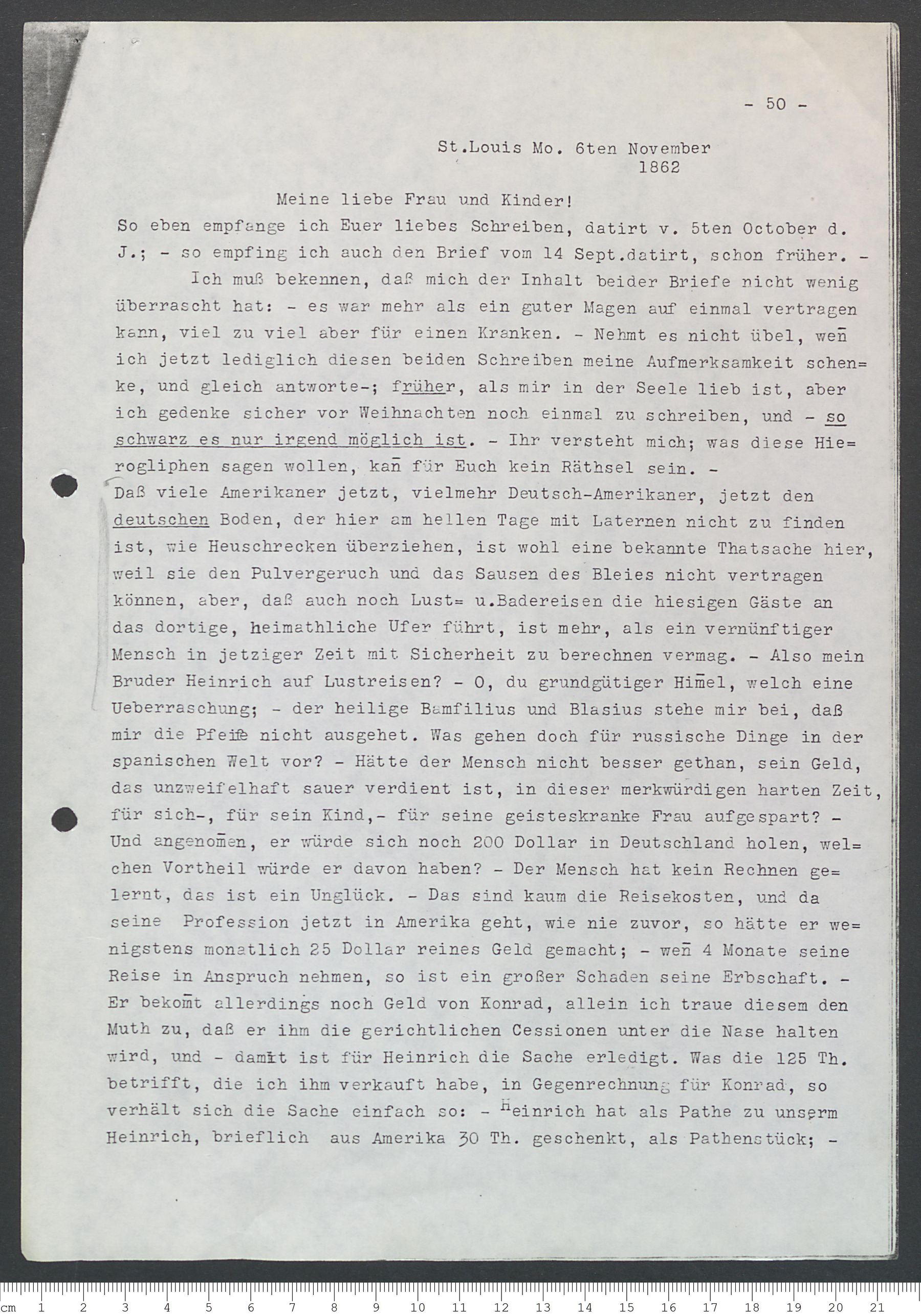
“Ich denke meine liebe Frau, daß Du so vernünftig bist und meine Adresse für dich behälst, da hier zu viel meiner Landsleute sind, von denen ich aber nichts wissen will-, so auch von keinen Fremden, mich hat auch keiner geholfen;- daher werde ich dahier auch Niemanden kennen… was will man dē am Ende thun, wē man einen Landsmann in Lumpen sieht pp.”
— Johannes Köster, St. Louis, to his wife in Deisel. “I trust, my dear wife, that you are sensible enough to keep my address to yourself, since there are too many of my countrymen here, of whom I want to know nothing — nor of any strangers; no one has helped me either, so I shall know nobody here… what is one finally to do, when one sees a countryman in rags.” Transcribed from the original image, 19 July 2026: Gotha transcription p. 11 = image 0064 (earlier project citations said p. 9 — the page header reads 11). Spelling and punctuation as typed; dē / wē carry the overbar the typescript uses for denn / wenn — the same n-doubling convention argued for Charles’s own signature.
He names two he paid off to be rid of — Grebenstein of Kirchhain and Bödiker, the Kommissar's brother — and instructs his wife to keep his address secret from anyone back home. A young unattached laboring man newly off the boat — which is what Charles was in 1859 — is precisely the countryman Köster shut his door on. The letters were never going to name Charles. Their silence is the silence of a man protecting his standing, not the silence of an empty street.
What the letters conceal
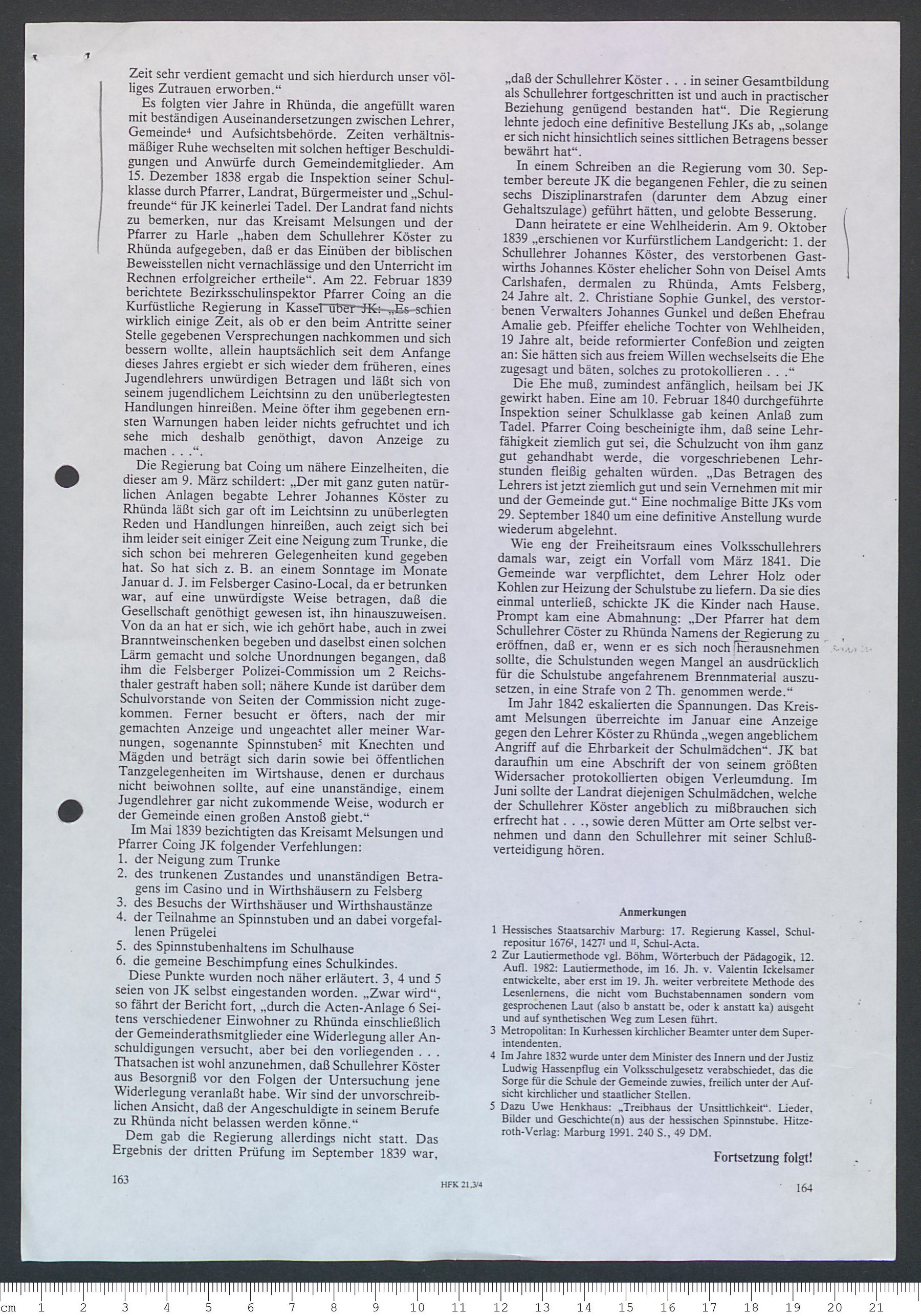
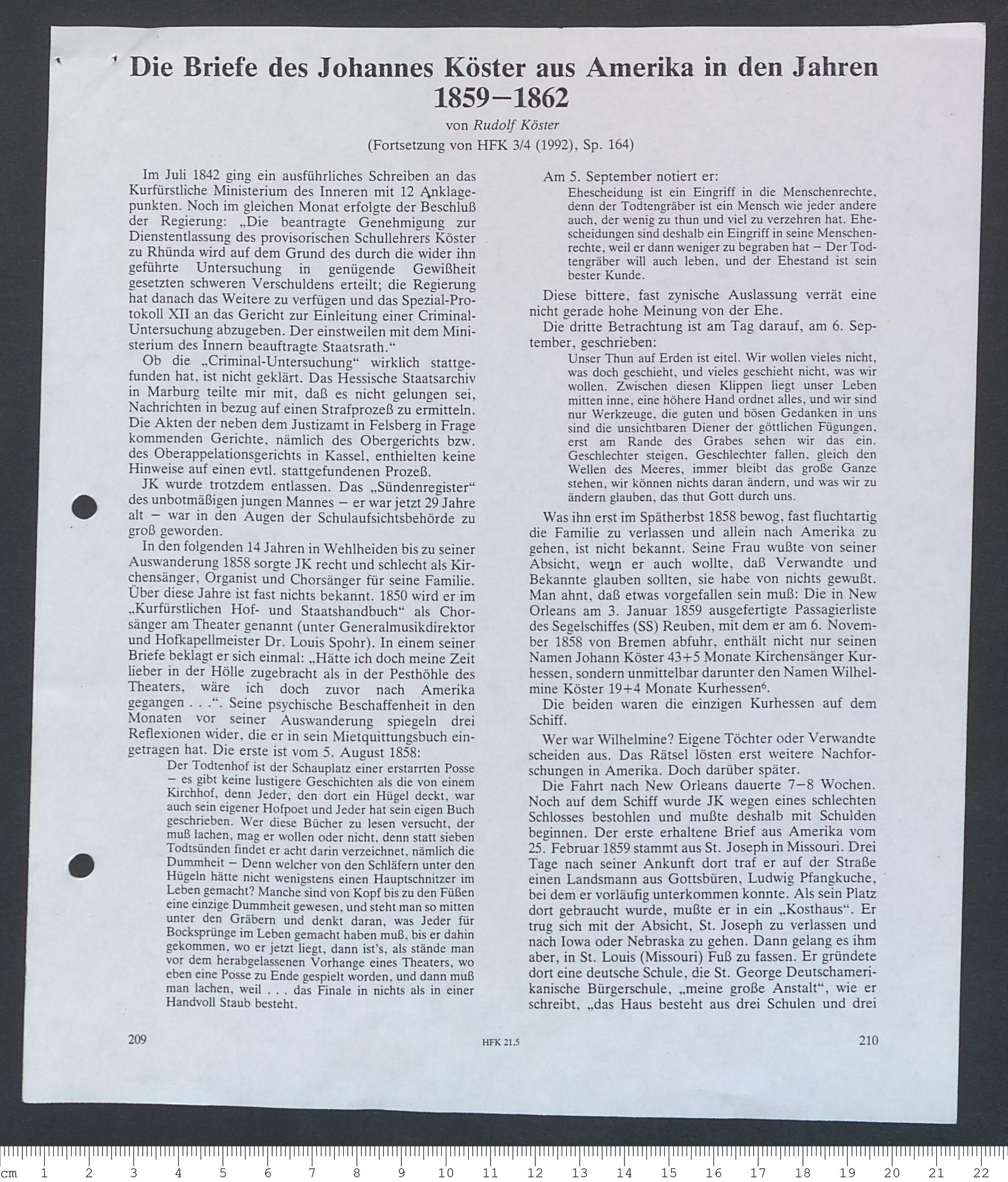
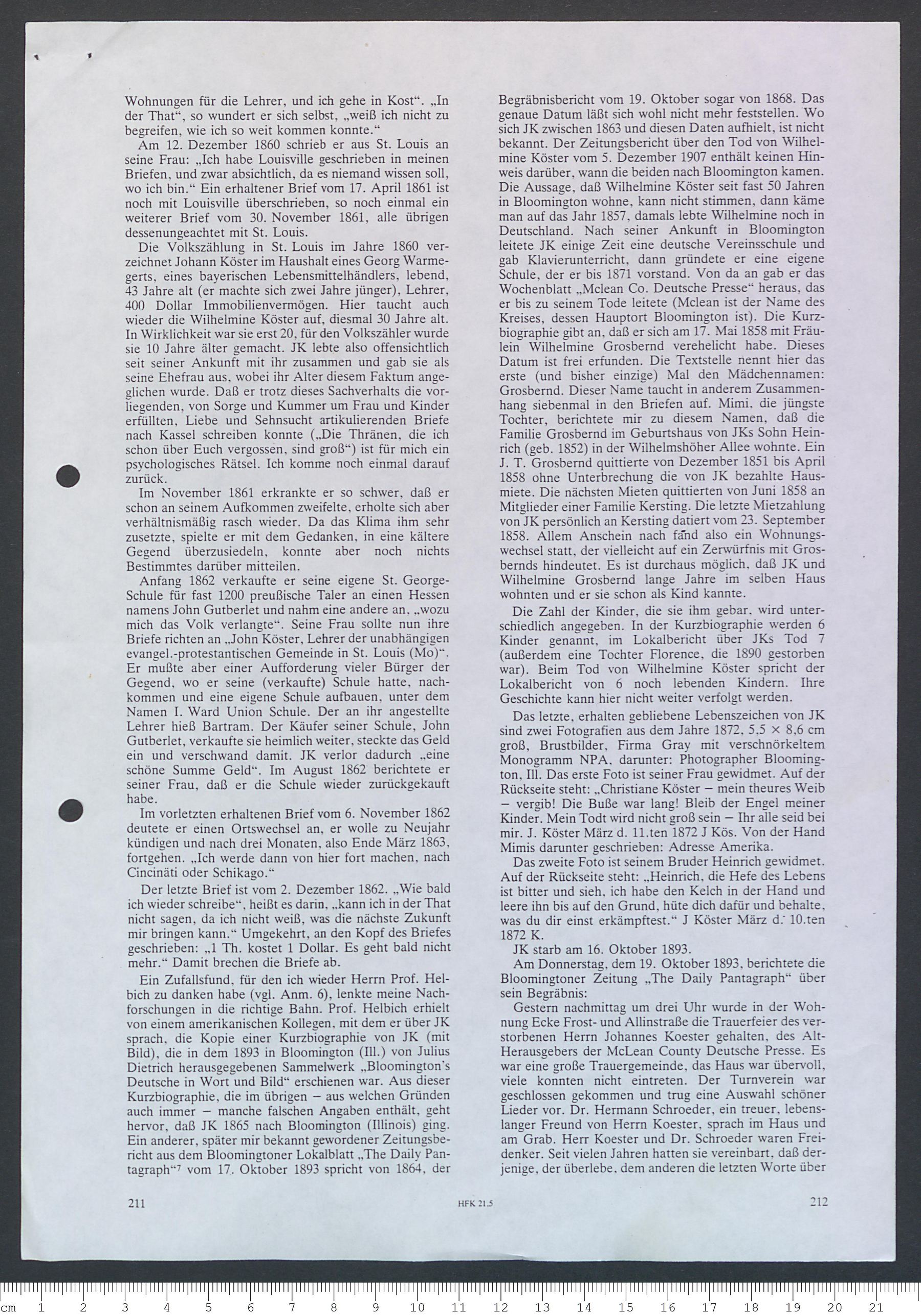
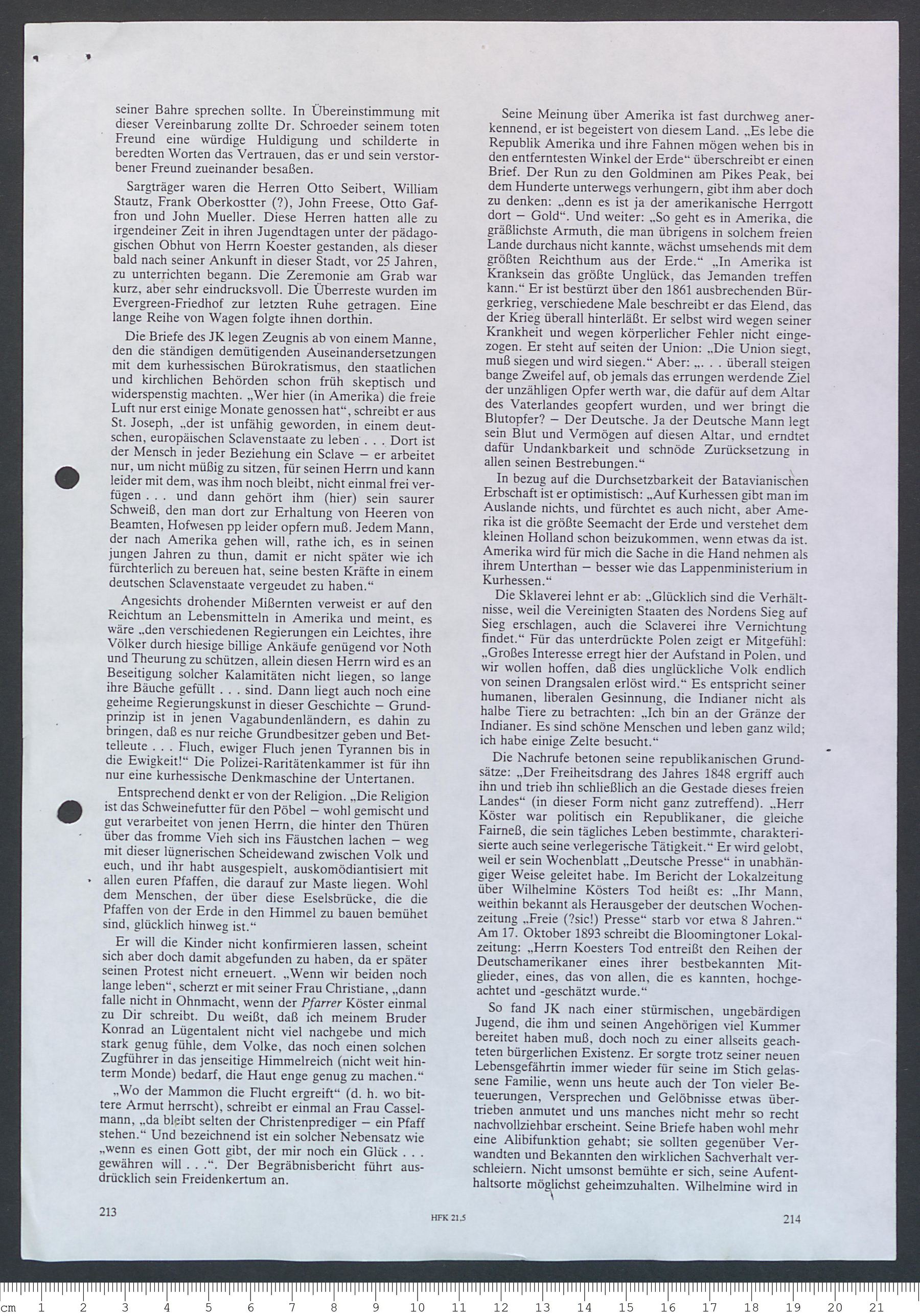
The series contains Dr. Rudolf Köster's own scholarly article on his ancestor (images 0013–0018). Read alongside the letters, it produces the single most important thing this collection has to say — and it is not what anyone expected.
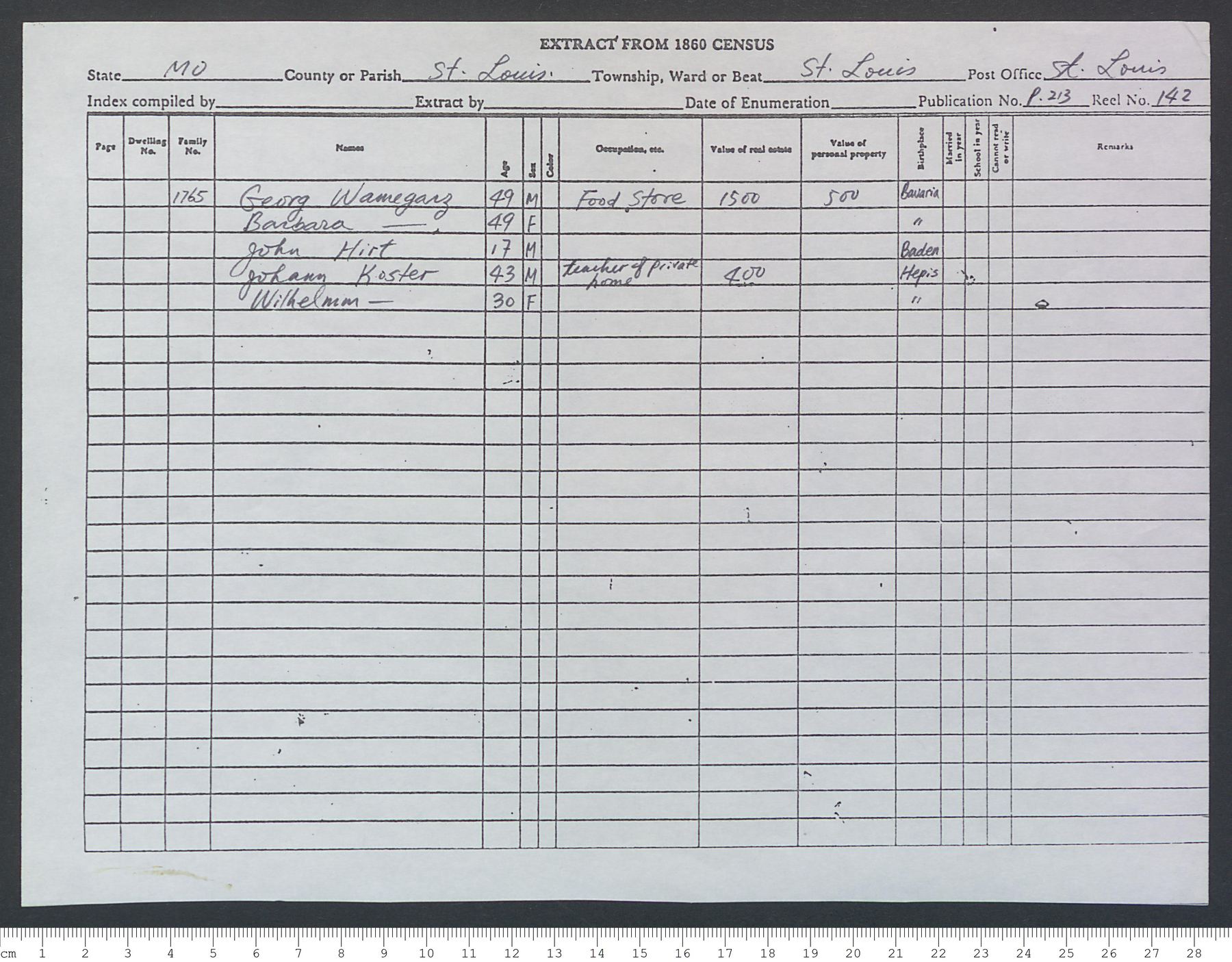
Johannes Köster was living a double life in America. The 1860 St. Louis census records him in the household of Georg Warmegert, a Bavarian grocer: teacher, 43 years old (he shaved two years off), $400 in real estate. In the same household is a Wilhelmine Köster, entered as 30. She was in fact twenty. Her maiden name, which surfaces exactly once in the record, was Grosbernd — a Kassel family who had lived in the very house where Köster's son Heinrich was born, and whose name appears seven times in the letters in quite another connection. He had been living with her, as man and wife, since his arrival.
Since before his arrival, in fact. The Rubens manifest of 3 January 1859, identified on 19 July 2026, lists her at entry 17 — Wilhelmine Köster, 19y4m, Kurhessen — immediately below him, already under his surname. She crossed the Atlantic with him. See the ship, above.
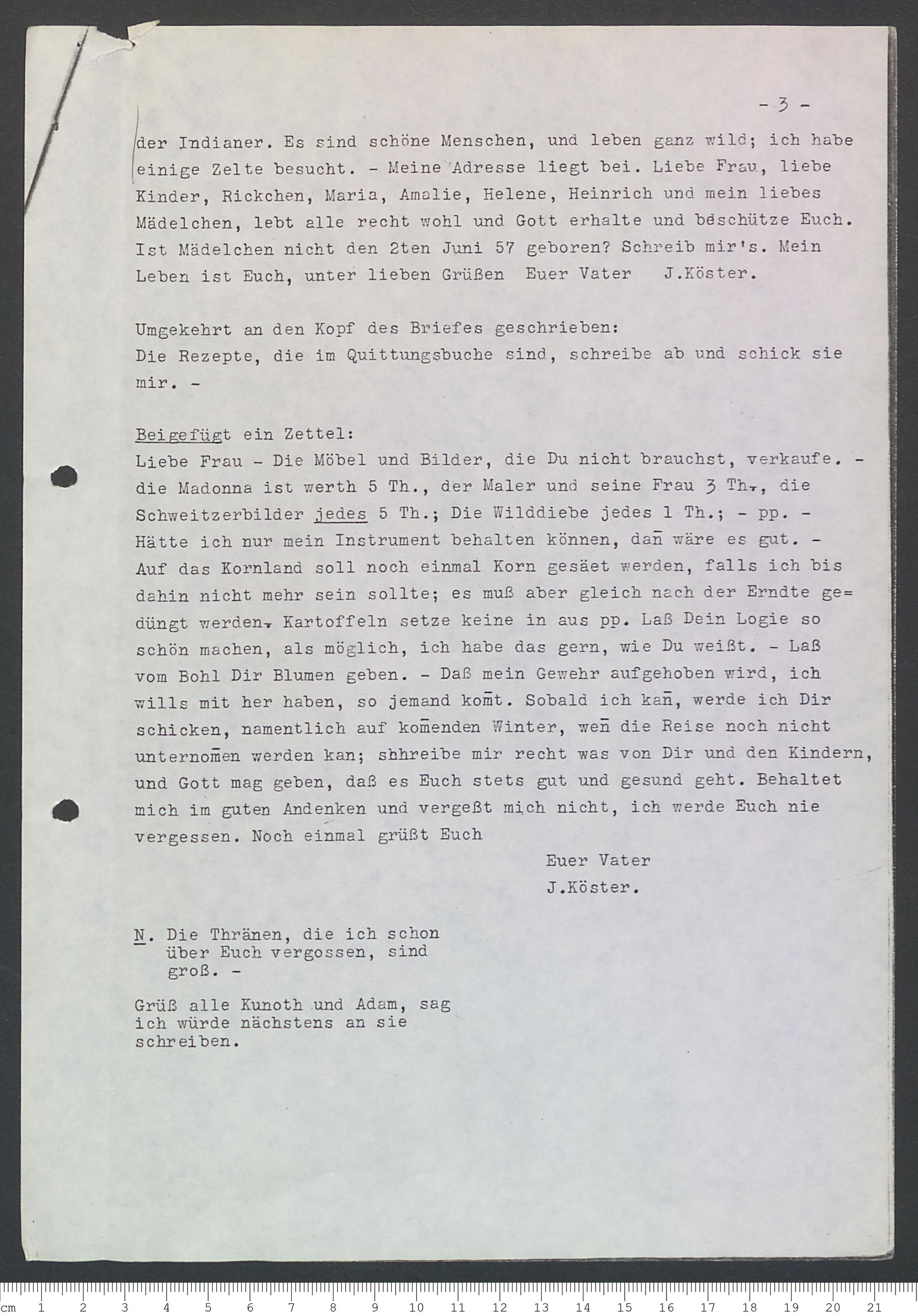
Meanwhile he was writing home to Christiane Sophie in Kassel — letters of longing, tenderness and guilt. “Die Thränen, die ich schon über Euch vergossen, sind groß”, the tears I have shed over you are great. His descendant, editing the correspondence in the 1930s, could not reconcile the two and said so plainly: it was for him “ein psychologisches Rätsel” — a psychological riddle.
And it reframes the passage this project has leaned on hardest. When Köster tells his wife to keep his address to herself and to let nobody write to him, we read that as a proud man protecting his standing from spongers. It was also something else. On 12 December 1860 he wrote: “Ich habe Louisville geschrieben in meinen Briefen, und zwar absichtlich, da es niemand wissen soll, wo ich bin” — I have written Louisville in my letters, and deliberately so, because no one is to know where I am. He was falsifying his own dateline. Two surviving letters, 17 April and 30 November 1861, still carry the false Louisville heading; the rest say St. Louis.
What this does to the negative result
It strengthens the caveat considerably. We already knew Köster shunned countrymen he thought beneath him. We now know he was actively concealing his whereabouts and his household from everyone in Hesse, to the point of writing a false city at the head of his letters. A man doing that does not fill his correspondence with the names of Deisel people he has run into in St. Louis. The absence of Charles from these letters carries almost no evidential weight at all — considerably less than this project assumed when the collection was first summarized.
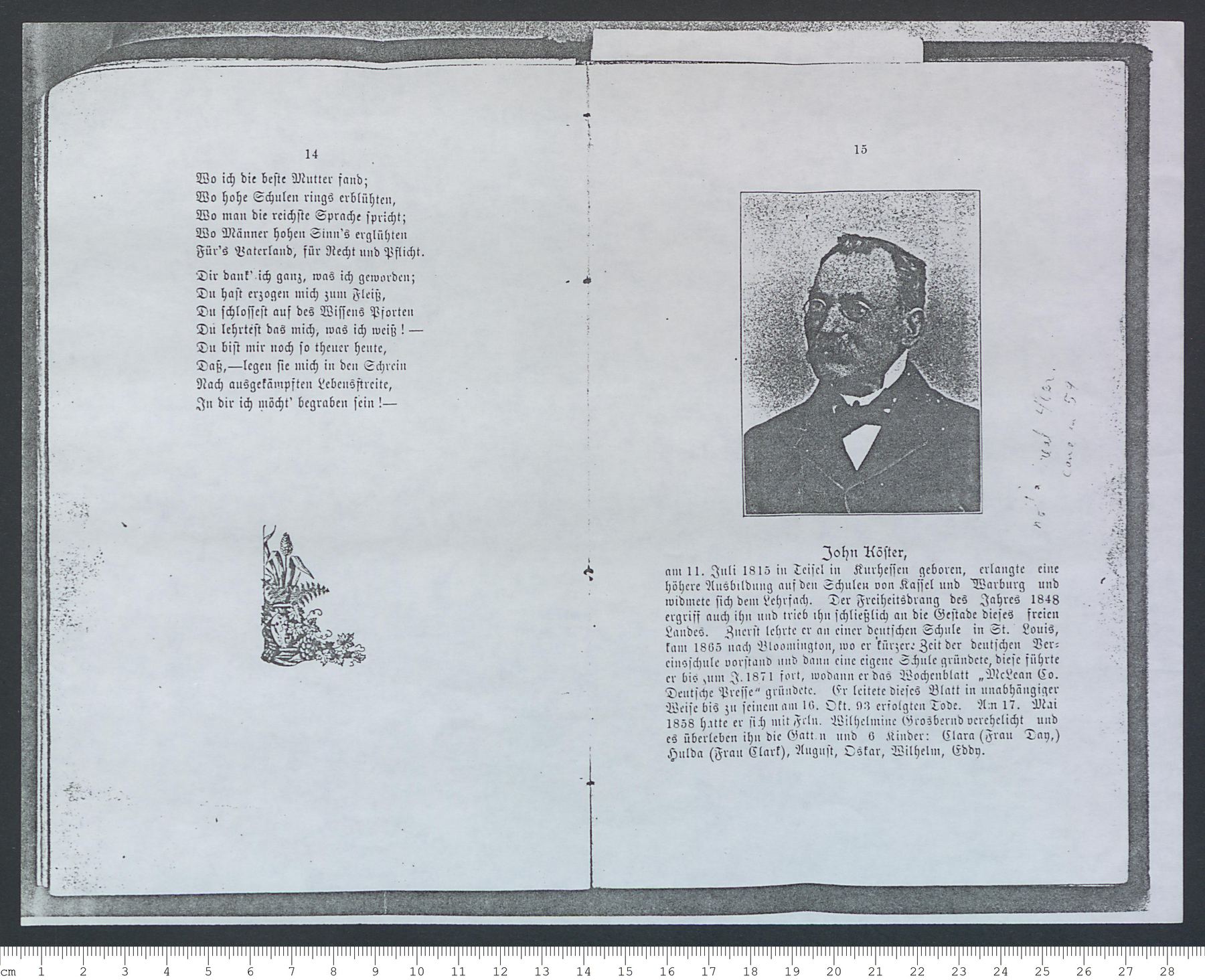
The rest of his American life, from the same article: in early 1862 he sold the St. George school for nearly 1,200 Prussian Thaler to John Gutberlet, took another post, and was then pressed by local citizens into building a school of his own again; his assistant teacher was named Bartram. He later moved to Bloomington, Illinois, ran a German society school, gave piano lessons, founded his own school which he led until 1871, and then published the weekly McLean Co. Deutsche Presse until his death. Wilhelmine died at Bloomington on 5 December 1907. The last surviving trace of him is a pair of photographs from 1872.
The letters themselves
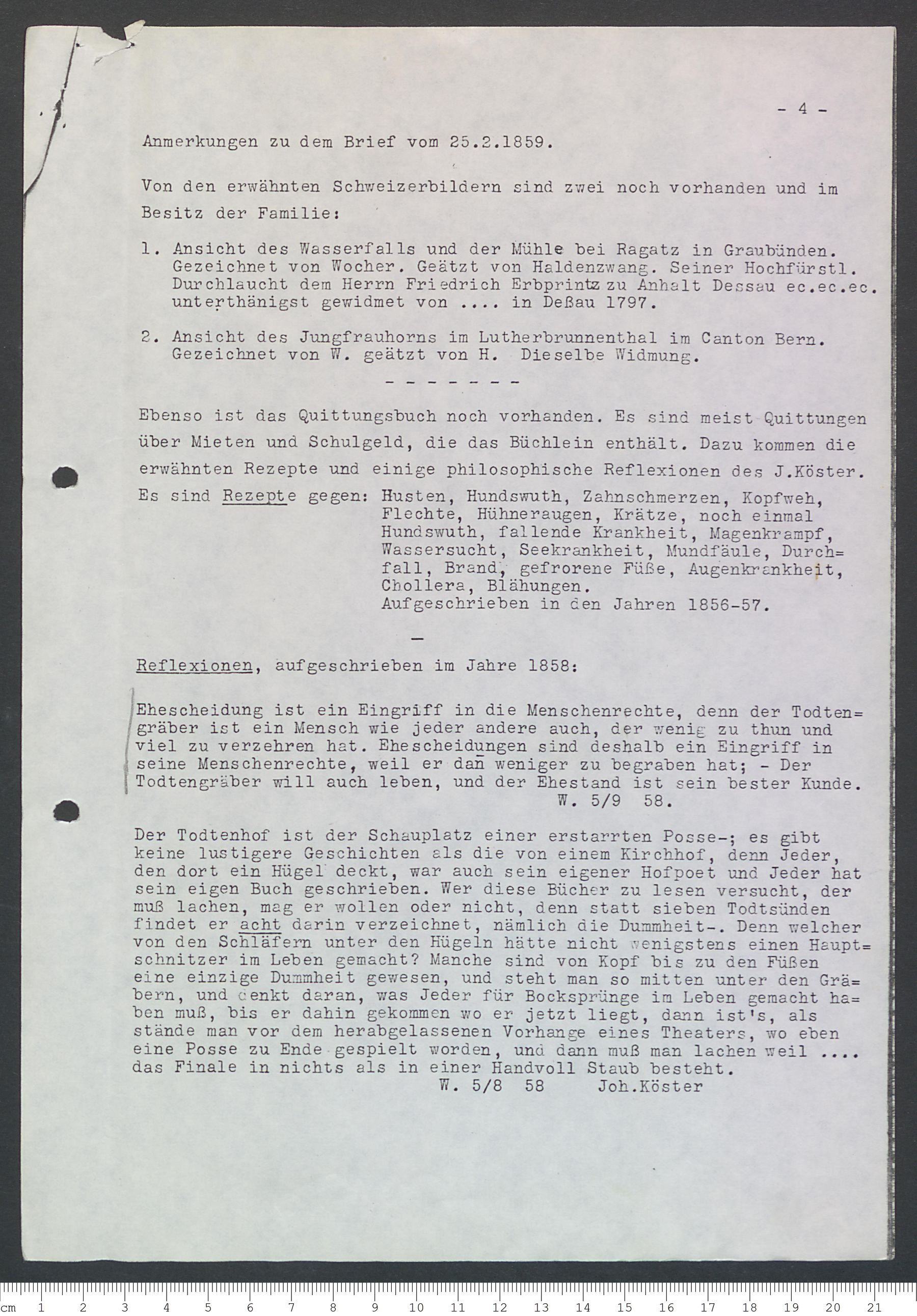
The typed transcription runs to some fifty-five pages across images 0053–0108, letter by letter, several of them followed by Rudolf Köster's Anmerkungen — annotated notes identifying the people named. Dates recoverable so far from the transcription and the article:
- 6 November 1858 — written aboard ship in harbor, the day he sailed from Bremen
- 25 February 1859 — St. Joseph, Missouri (with Anmerkungen, image 0057)
- 12 December 1860 — St. Louis; the “no one is to know where I am” letter
- 17 April 1861 — headed Louisville (falsely); original survives
- 30 November 1861 — headed Louisville (falsely); original survives
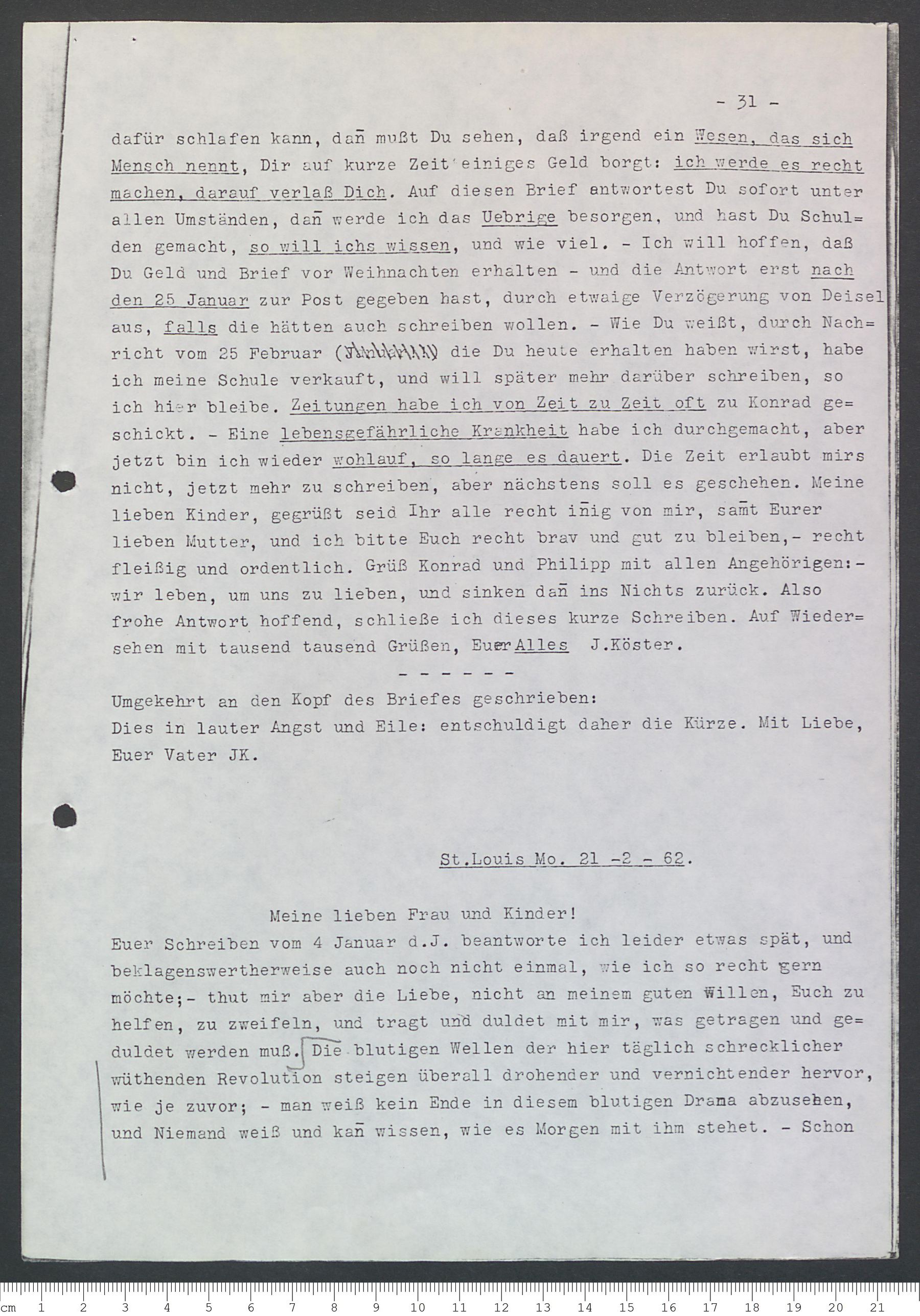
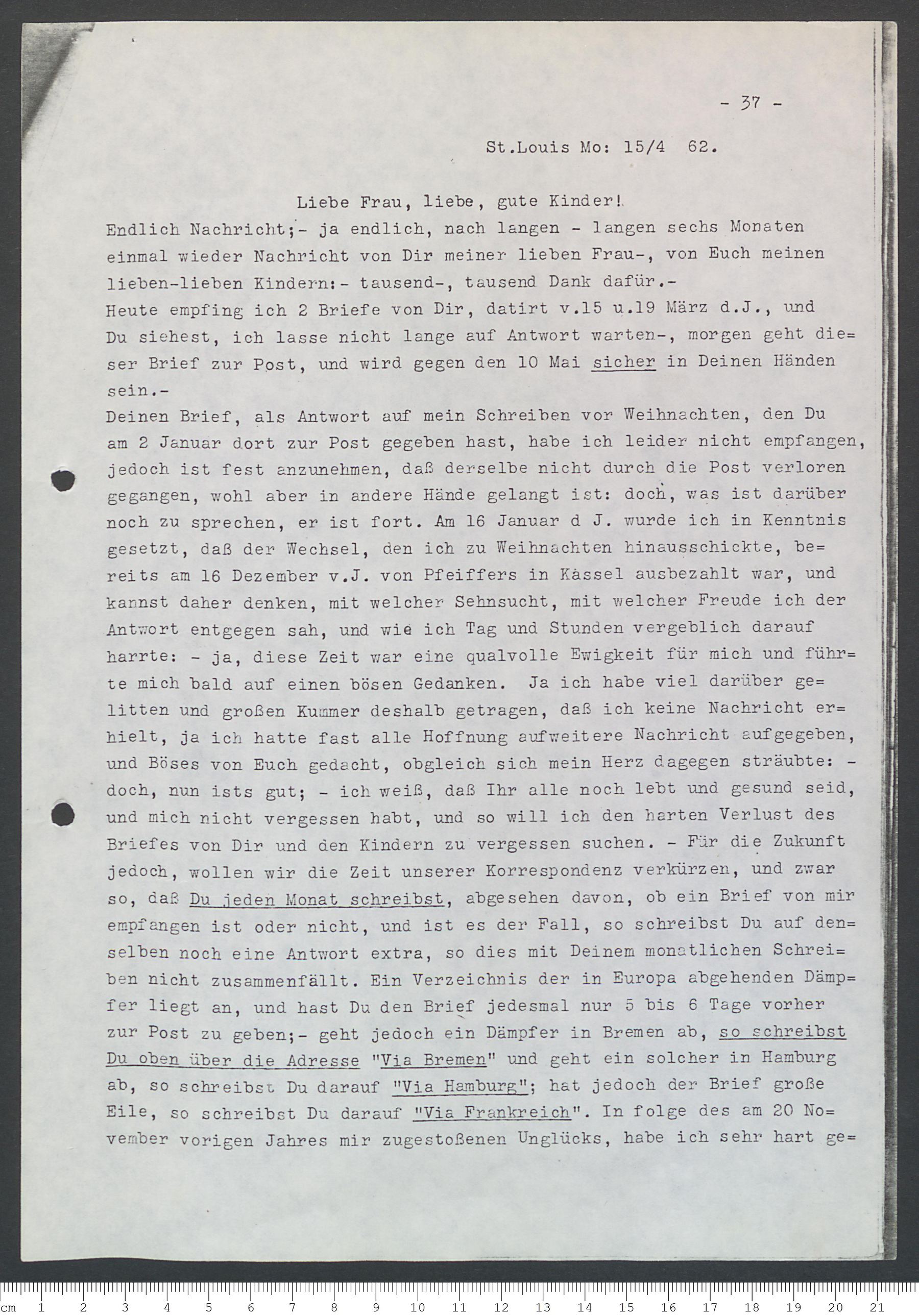
- 15 February 1862 — St. Louis, Mo. (image 0082)
- 15 April 1862 — with Anmerkungen, image 0093
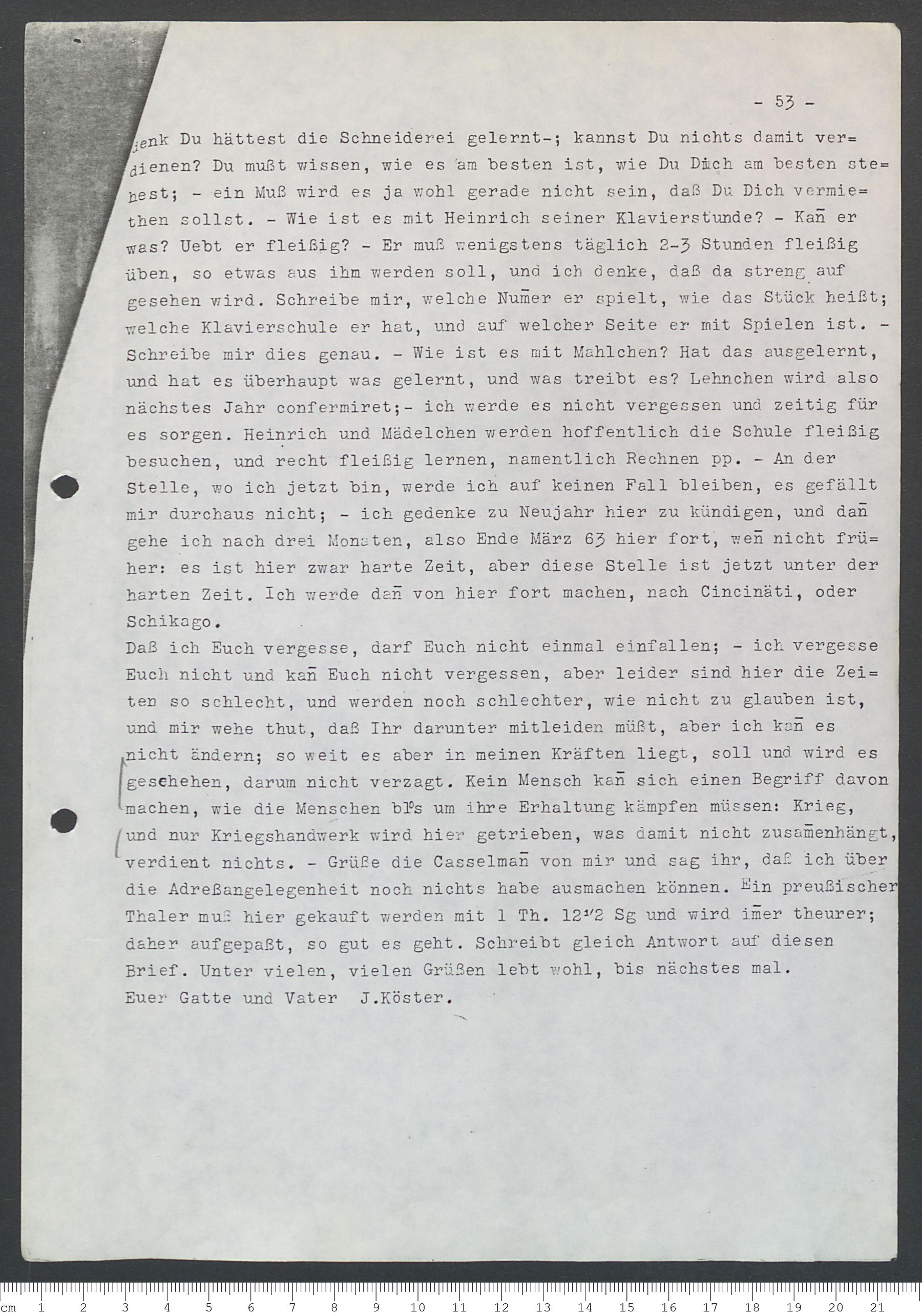
- 6 November 1862 — the penultimate surviving letter
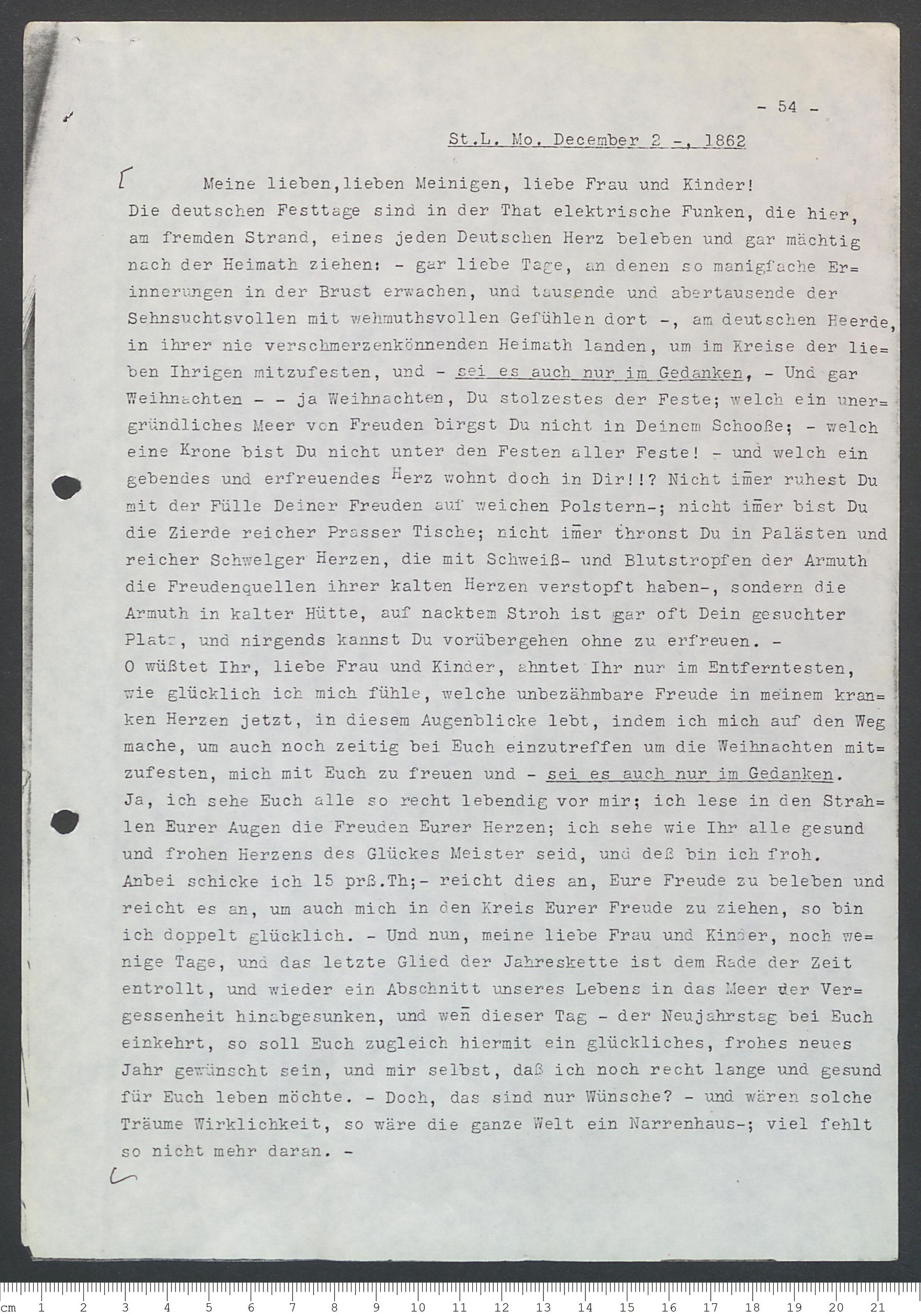
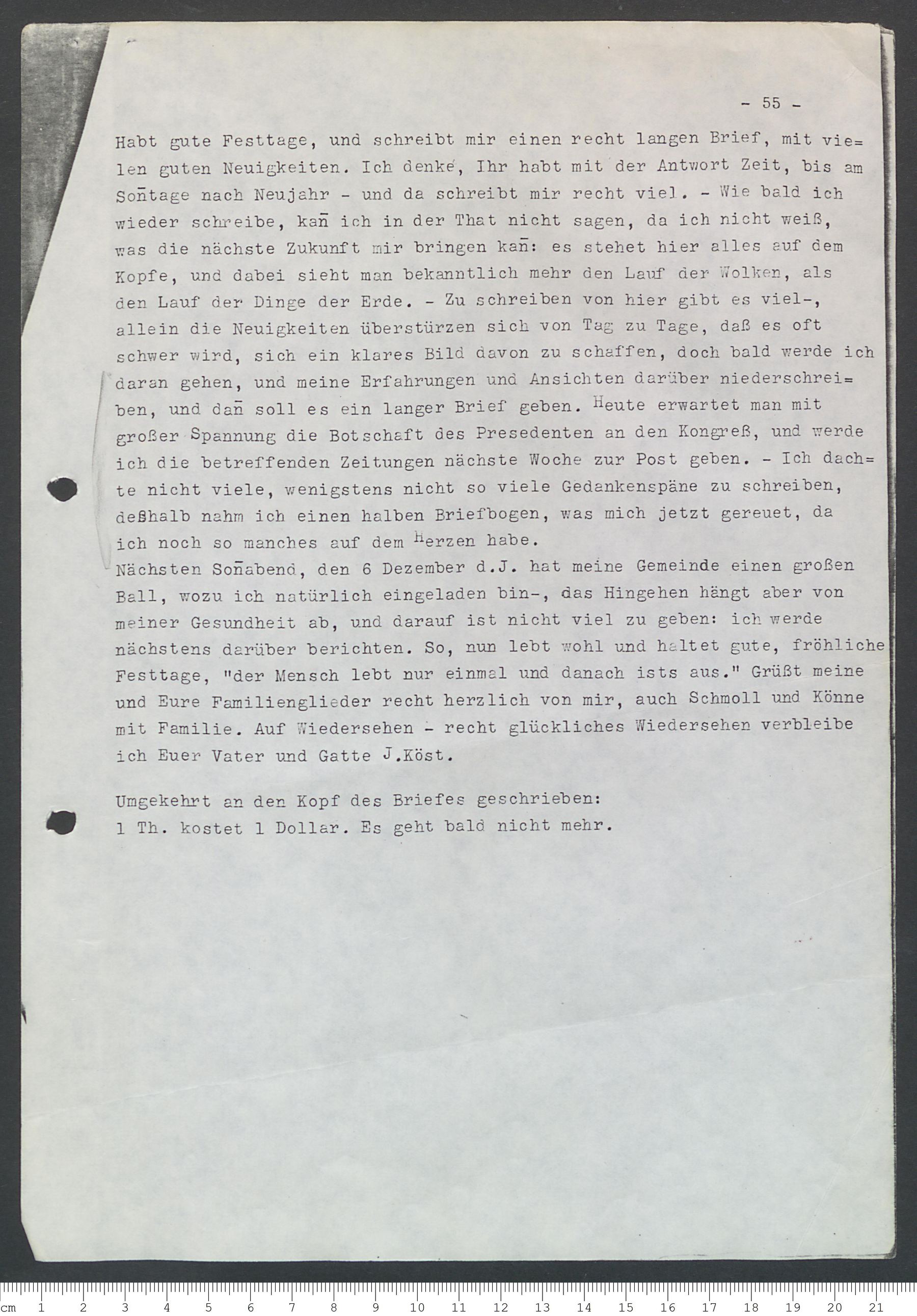
- 2 December 1862 — St. L. Mo.; the last, written the day Charles enlisted
Read the letters → · Page by page →
Two ways in. The letter-by-letter page gives an English summary of each of the twenty-two letters with the key passages quoted in German and translated. The page-by-page transcription puts each scan beside its full German text and English translation. All fifty-five typescript leaves now carry English — but they are not equally reliable, and every leaf says which it is: 27 verified against the scan by eye, 28 translated from machine OCR. On typed pages the OCR renders the sense of the prose reliably; where it is not safe is names, place-names, dates and money figures, where a slip is invisible and self-correcting nowhere. Do not cite a name or a number from an OCR-translated page without checking the scan. Of the eleven handwritten leaves, the seven autographs (0113–0119) have now been identified — they are the original manuscript of the 24 April 1859 letter we already hold in typescript (see below) — while the four Briefliste cards remain unread.
What the page-by-page verification has changed
A leaf-by-leaf reading of the typescript against the scans began on 20 July 2026. The first twenty-two pages are done — the whole 1858–59 sequence and the St. Louis run to the November 1861 collapse. It has produced four corrections to this project’s own published statements and several findings the earlier summary read had missed. Details and full text: page by page →
Corrections to what this site said
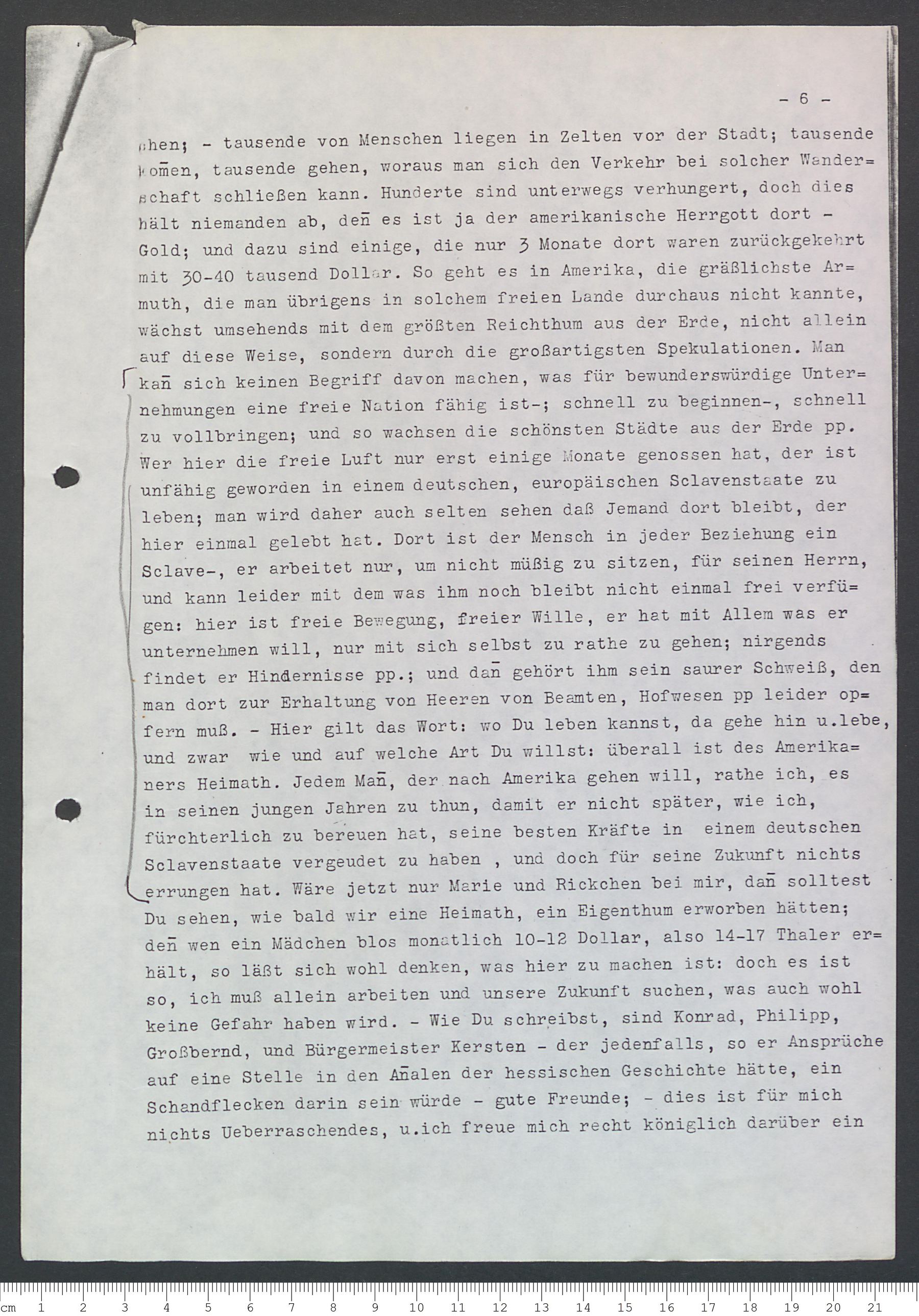
- “freie Bewegung, freier Wille” is not in the autograph letters. It is on typescript p. 6 (image 0059), in the letter of 24 April 1859. And the autograph leaves themselves are now identified — they are the original of that very letter (see below), not separate content.
- The “every two minutes a Kurhessian” passage is image 0068, not 0066.
- The false-dateline confession is dated — 12 December 1860, not an undated slip.
- The “Landsleute” passage is transcription p. 11, not p. 9 — confirmed by the printed header on the preceding leaf.
★ The strongest new finding — and it cuts for Charles
This project has used the Köster letters defensively: because he shunned his countrymen, his silence about the K/G name pool proves nothing. The verified pages carry a positive finding as well, in two places.
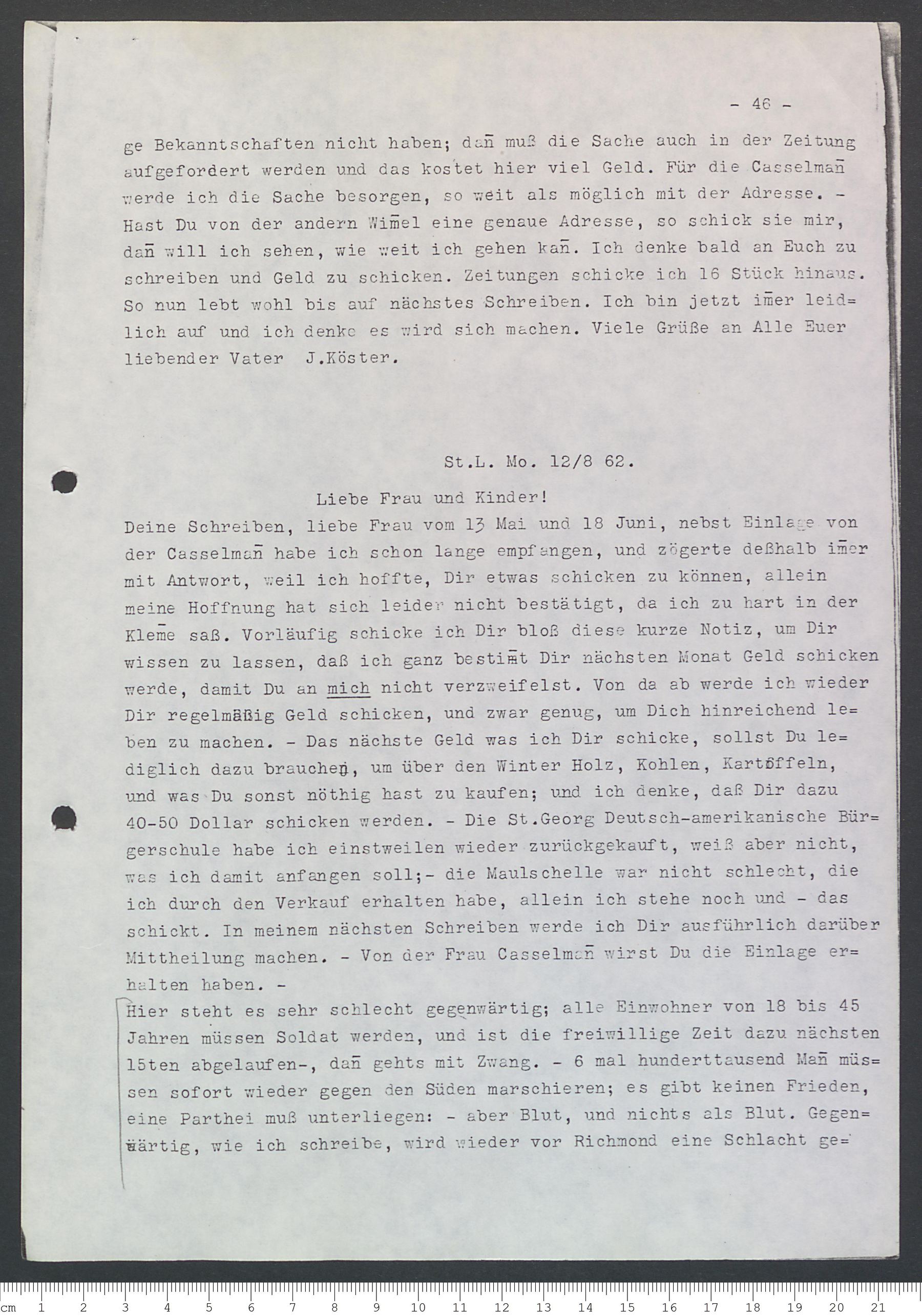
On p. 11 (image 0064), immediately after the famous complaint about too many Landsleute, comes the sentence the summaries had passed over: “was will man denn am Ende thun, wenn man einen Landsmann in Lumpen sieht?” — what is one to do, in the end, when one sees a countryman in rags? He is begging his wife not to give out his address because destitute Hessians keep arriving at his door, and he itemizes what two of them cost him. On p. 15 (image 0068) the same point again: “auch ein jeder, der kommt geholfen sein will und oft muß” — everyone who comes wants help, and often must have it.
So the immigrant community Charles would have landed into is now documented from the inside, by a hostile witness trying to escape it — a stream of poor Hessians reaching St. Louis across exactly his window, in 1861. This does not place Charles in the city. It removes the ground for reading the name-pool silence as absence.
The St. Louis Charles was living in, autumn 1861
Three leaves of September 1861 describe the city in the year before Charles enlisted: it was under martial law and a state of siege, which suppressed war news; it was being fortified, and “alles was arbeiten kann, muß Tag und Nacht schanzen” — everyone able to work had to dig entrenchments day and night; and thousands of refugees from the interior of Missouri had already fled into it.
Charles was an unskilled German laborer in that city at that moment. Nothing here names him, but it is the labor market he was standing in, and it opens a records series this project has never examined — Union Quartermaster civilian labor rolls. See the research plan for what survives and how it would have to be searched.
New leads the verification opened
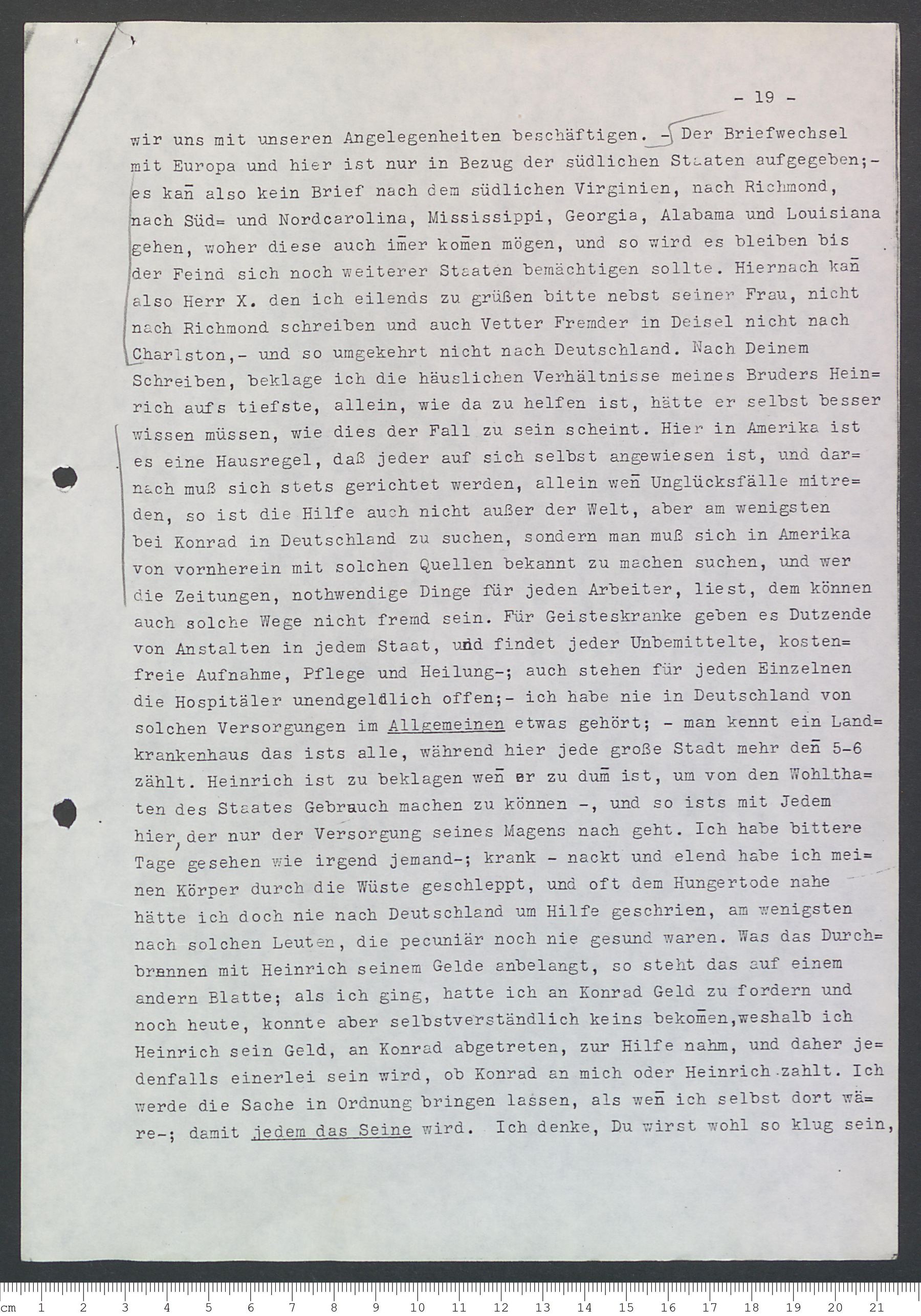
- A Deisel–Charleston connection. Cousin Fremder at Deisel had a correspondent in Charleston, South Carolina, cut off by the Southern mail embargo (p. 19) — a second American destination for the Deisel cohort, outside the Missouri axis this project has assumed.
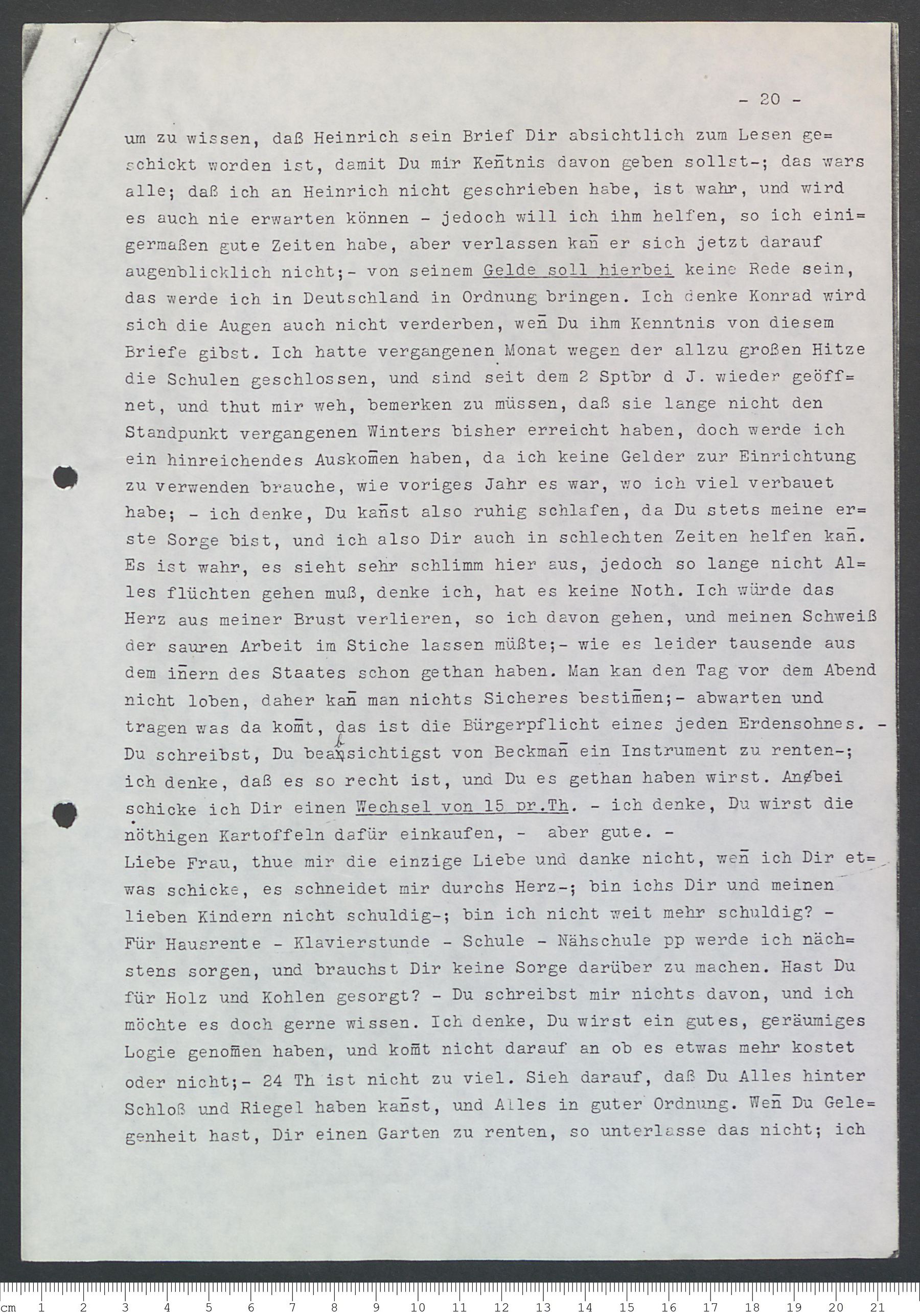
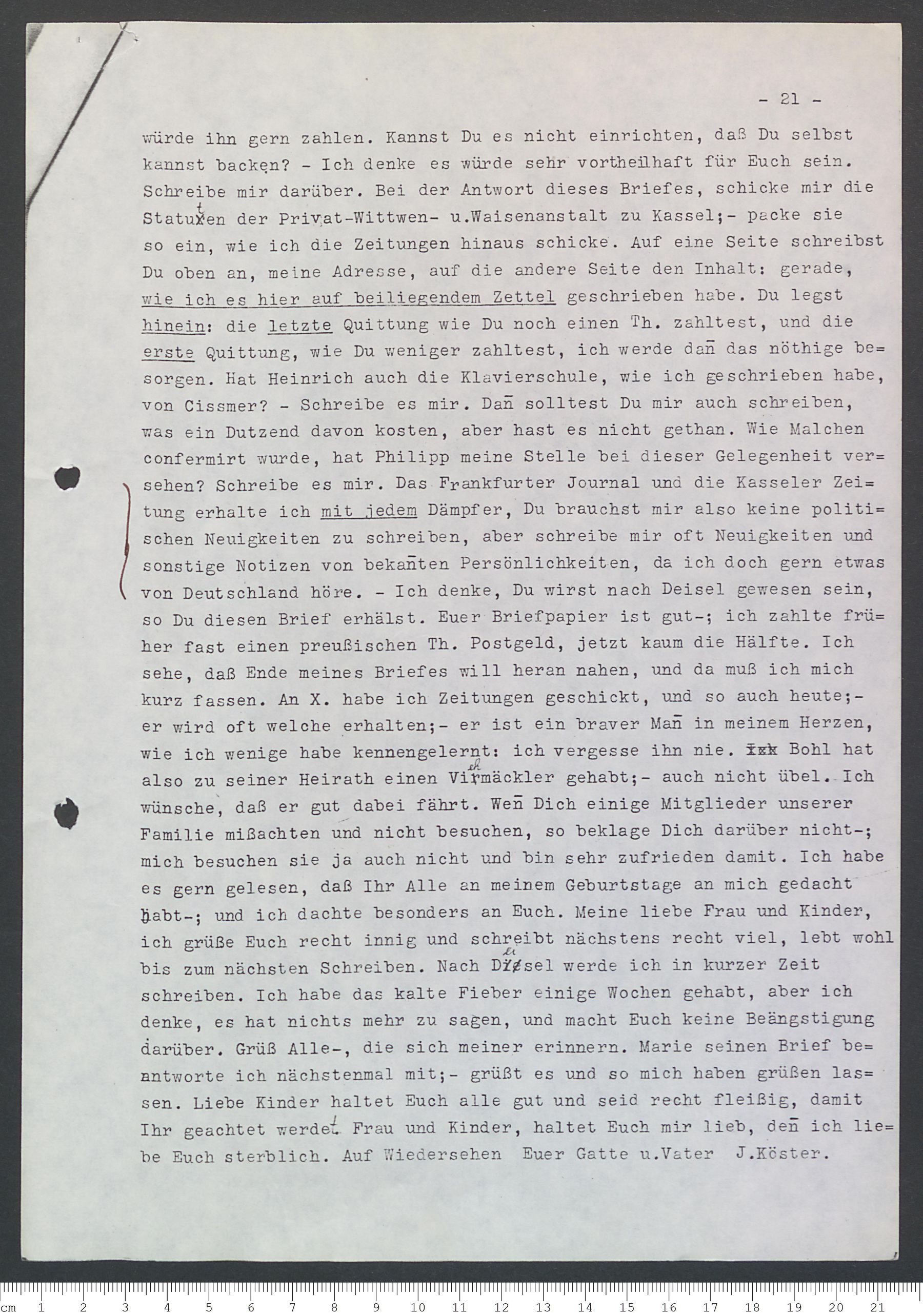
- The Privat-Wittwen- und Waisenanstalt zu Kassel (p. 21) — a named Kurhessian institution the family paid into, with records independent of the parish registers.
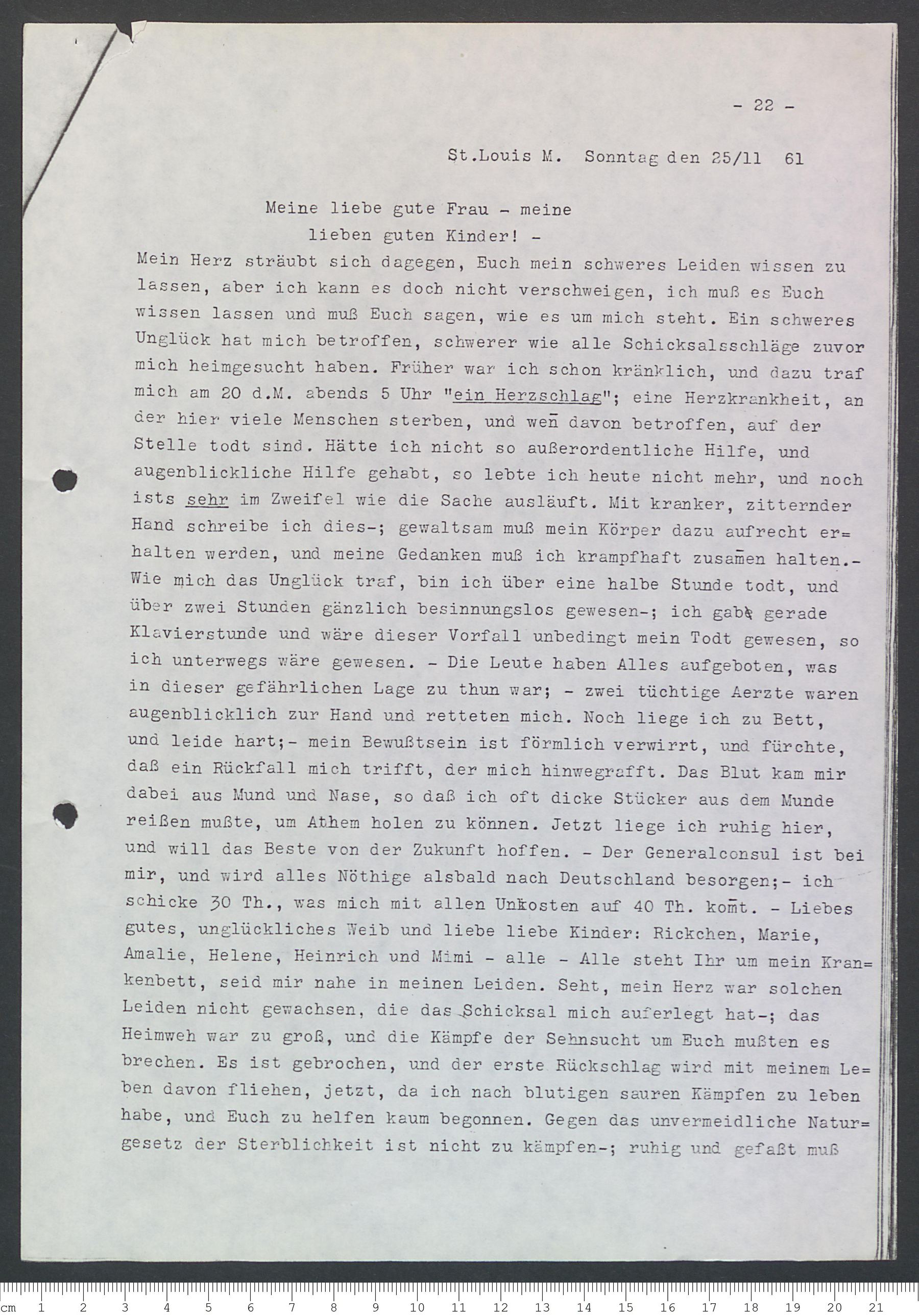
- The German Consul-General in St. Louis attended Köster at his sickbed and handled his remittance home (p. 22). Consular records for the city may bear on other Hessians too.
- A new surname variant, Mainbresse (p. 2), absent from our Meimbresse/Meinbresse/Merkam query set.
- Three photographs of Köster are described — 1854, c. August 1861 and March 1872 — none of them in the Gotha folder.
Two findings that bear on the wider story
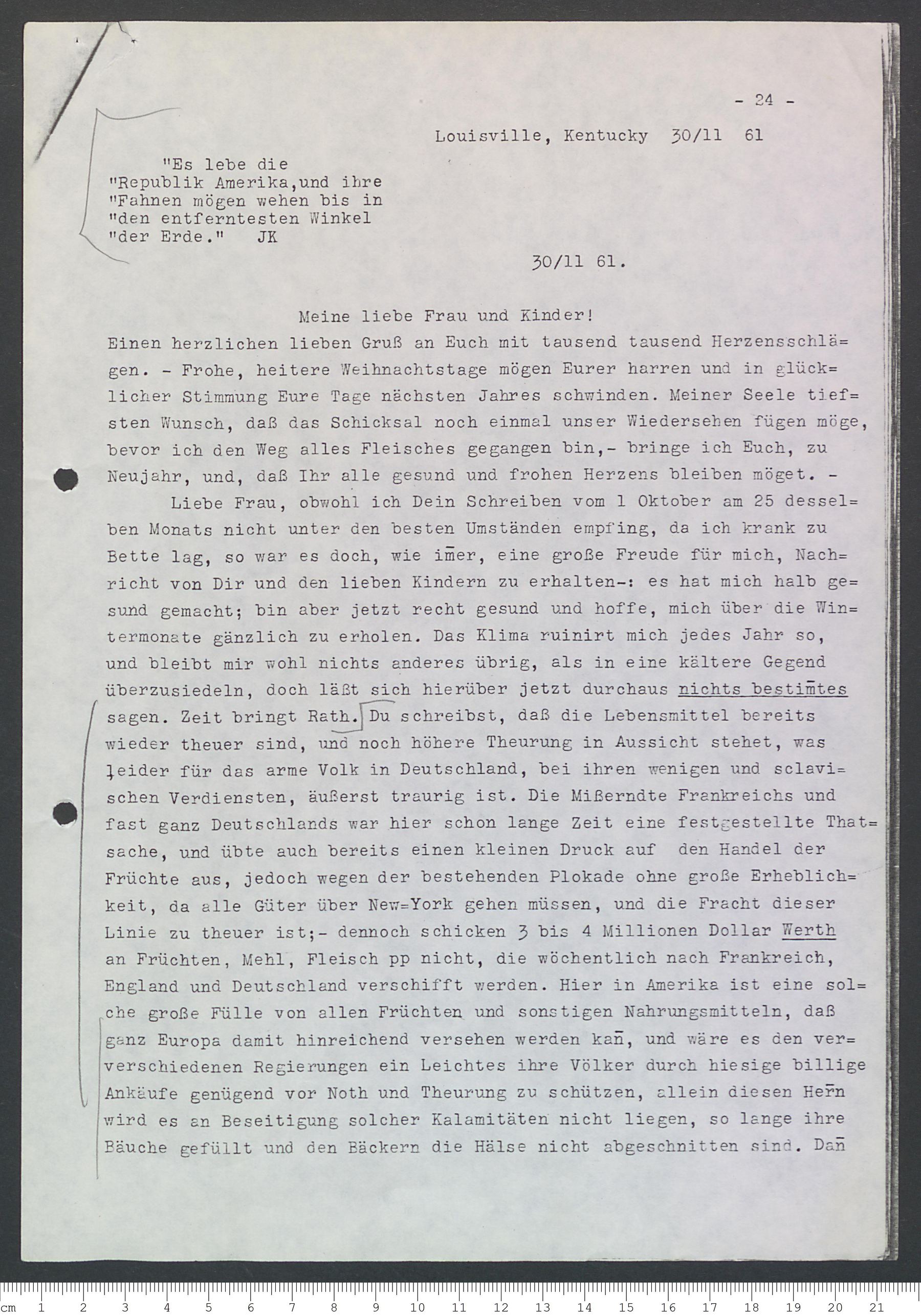
The move to Bloomington is prefigured, with a reason. This project knew Köster was in Bloomington, Illinois by about 1870, but not when or why he decided to go. On 30 November 1861 — five days after the collapse — he writes: “Das Klima ruinirt mich jedes Jahr so, und bleibt mir wohl nichts anderes übrig, als in eine kältere Gegend überzusiedeln.” The intention is stated eight years early, and the reason is his health, not the school fraud of 1862.
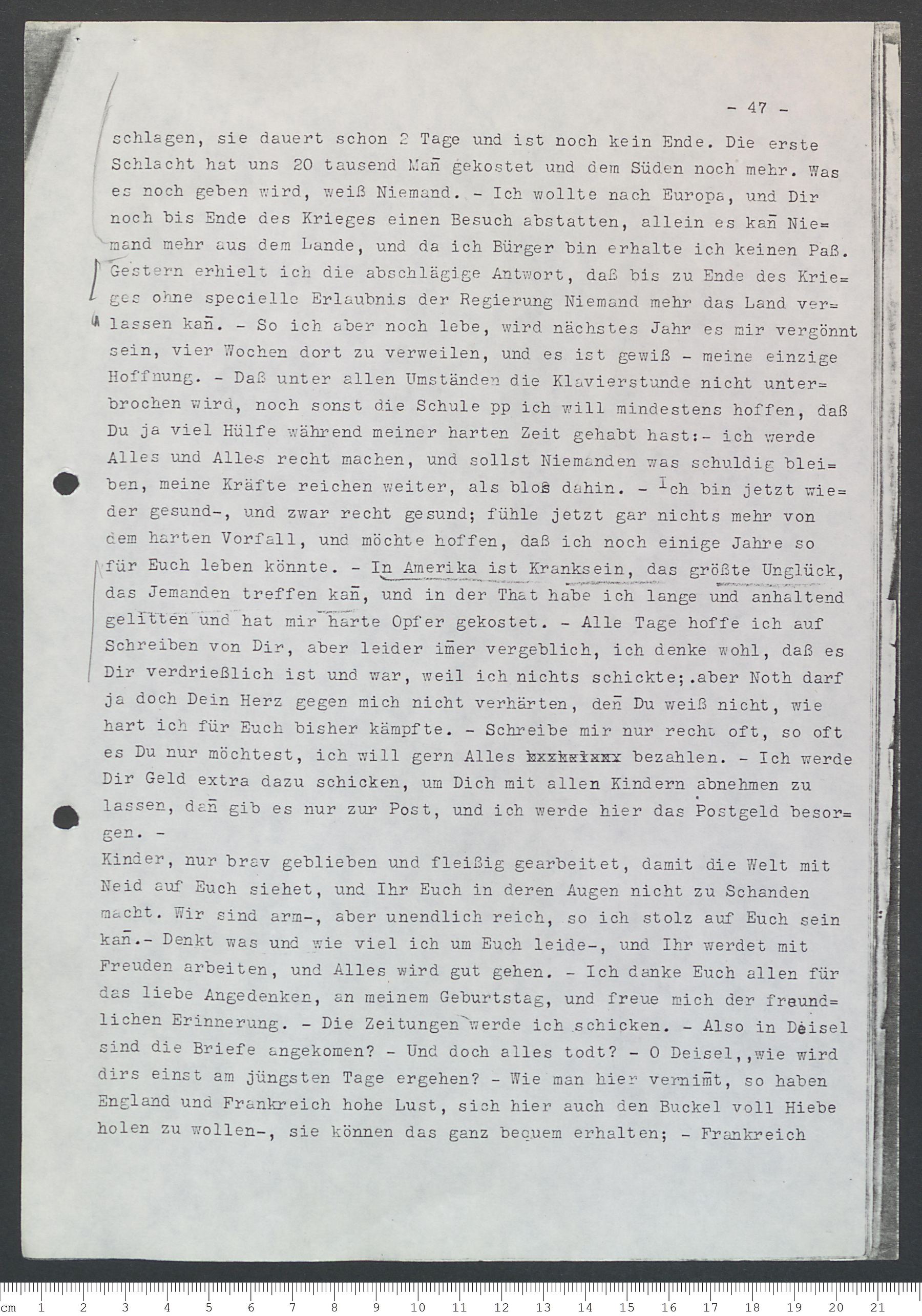
★ He was refused a passport, and German-Americans were leaving. In 1862 Köster applied to visit Germany and was turned down: “es kann Niemand mehr aus dem Lande, und da ich Bürger bin erhalte ich keinen Paß” — no one might leave until the war ended without special government permission, and as a citizen he could get no passport. In the same months he reports German-Americans going back to Germany “like locusts” because they could not stand “den Pulvergeruch und das Sausen des Bleies”. He himself was exempt from service through illness and physical defects — “was aber die Zukunft bringen wird, kann ich nicht wissen.” That is the pressure inside the German community in the autumn before Charles enlisted, described from within it. (OCR-translated pages — verify wording against the scans before quoting.)
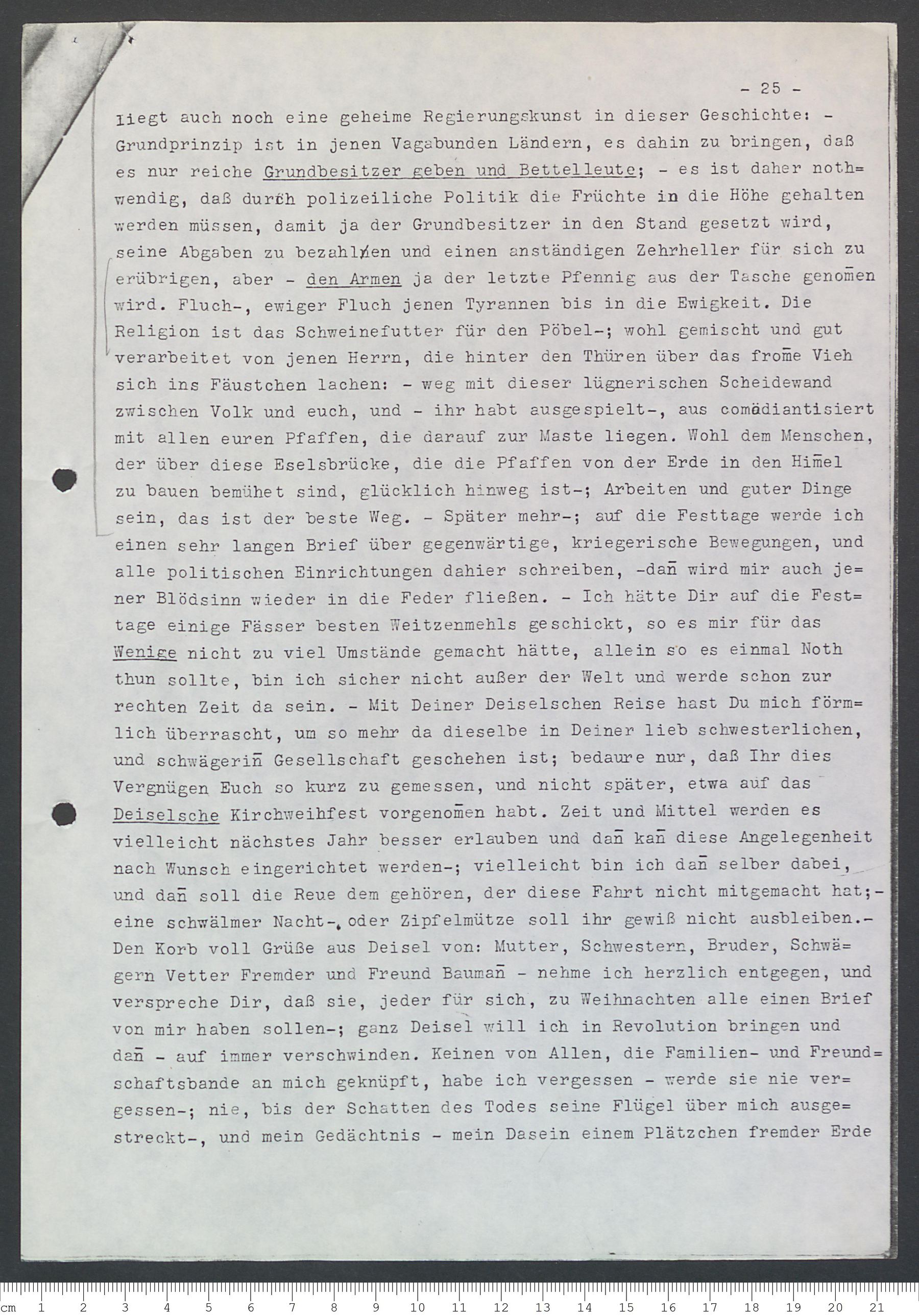
★ The Gutberlet fraud, and a findable advertisement. The buyer of the St. George school was a fellow Hessian, John Gutberlet, who resold it secretly, pocketed the money, and absconded; his wife advertised a 100-dollar reward in a St. Louis paper for information, and he was never found. That advertisement is a locatable 1862 newspaper item that would name and describe him — and the name itself is searchable in the city directories and court records.
★ There may be more Köster letters — in Deisel. On 30 November 1861 he promises that his mother, sisters, brother, brothers-in-law, cousin Fremder and friend Baumann shall each have a letter from him at Christmas: “ganz Deisel will ich in Revolution bringen und dann — auf immer verschwinden.” Those letters would have gone into Deisel households, not into the family archive that reached Gotha. If any survive they are in Hessian family hands or a local collection — which makes this a question for the Heimatverein Deisel, and it has been added to the inquiry.
A European food crisis in late 1861, reported from the American side. The same letter records failed harvests in France and almost all Germany, prices rising at home, and three to four million dollars’ worth of produce shipped weekly to Europe despite the blockade forcing everything through New York. That is a live emigration push-factor inside Charles’s own window, and a direct parallel to the 1846–47 famine material in the Hesse chapter.
What the earlier summary read established
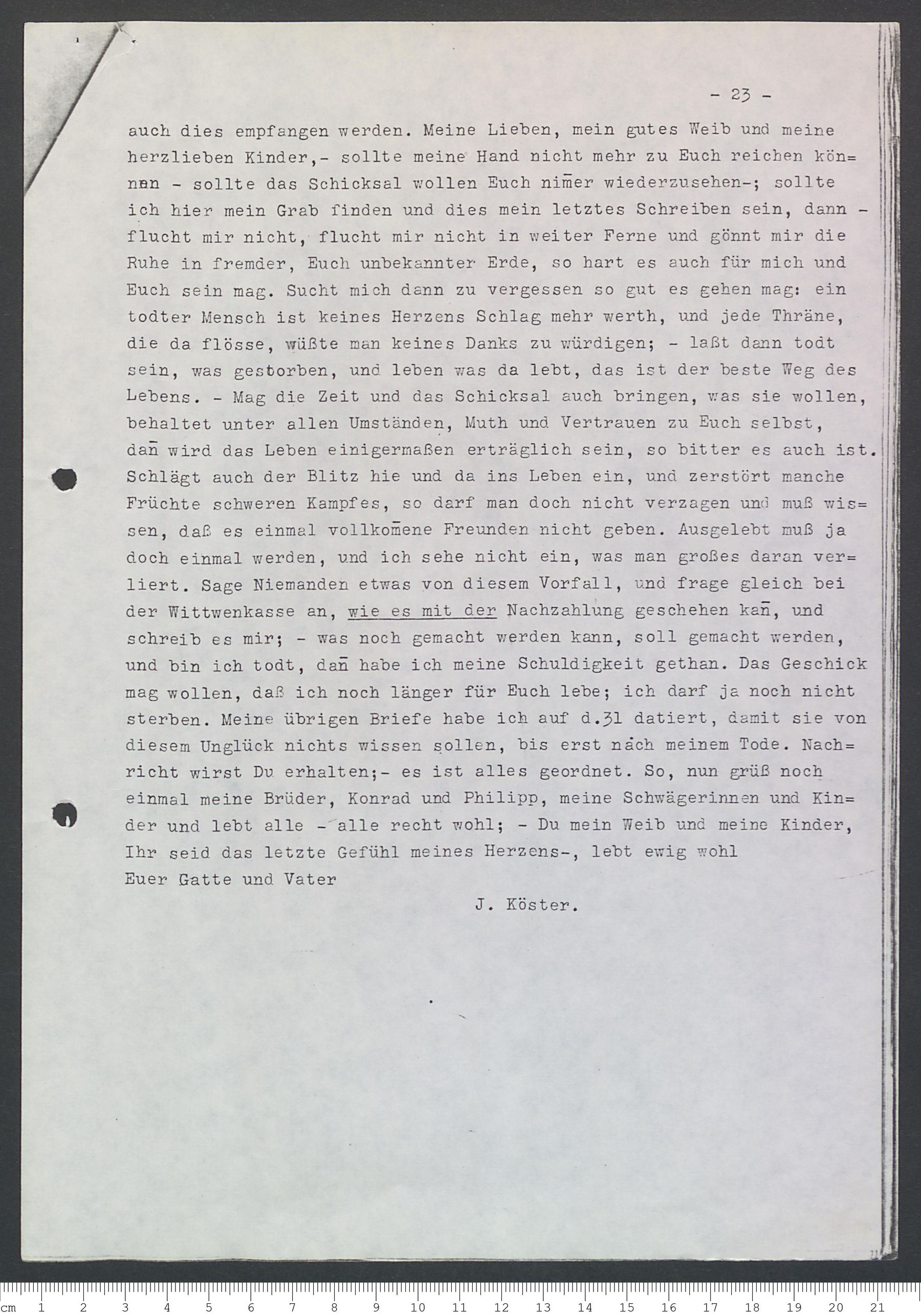
All fifty-five transcription pages have been read in summary — twenty-two surviving letters and slips, 6 November 1858 to 2 December 1862, the principal ones summarized in English and the passages that matter in Köster's own words. Among them: the false Louisville dateline confessed in writing; the night in November 1861 he was “dead for over half an hour” at a piano lesson; the Hessian who bought his school, resold it in secret and absconded; and the August 1862 conscription notice that closed over St. Louis four months before Charles enlisted.
The letter text is public domain and the transcription and translation here are our own work. The scans are public domain — the Forschungsbibliothek Gotha confirmed on 20 July 2026 that its digitisates need no publication permission at all — and all 119 are reproduced in the full facsimile below.
“Deißel” — a small spelling that matters
Charles's 1866 marriage register gives his origin as “aus Deisse, Kreis Cassel, Churhessen”. The project has always read that as a clerk's rendering of Deisel — a reasonable inference, but an inference.
Köster, writing home from St. Louis, does not spell his own village “Deisel”. He spells it “Deißel”:
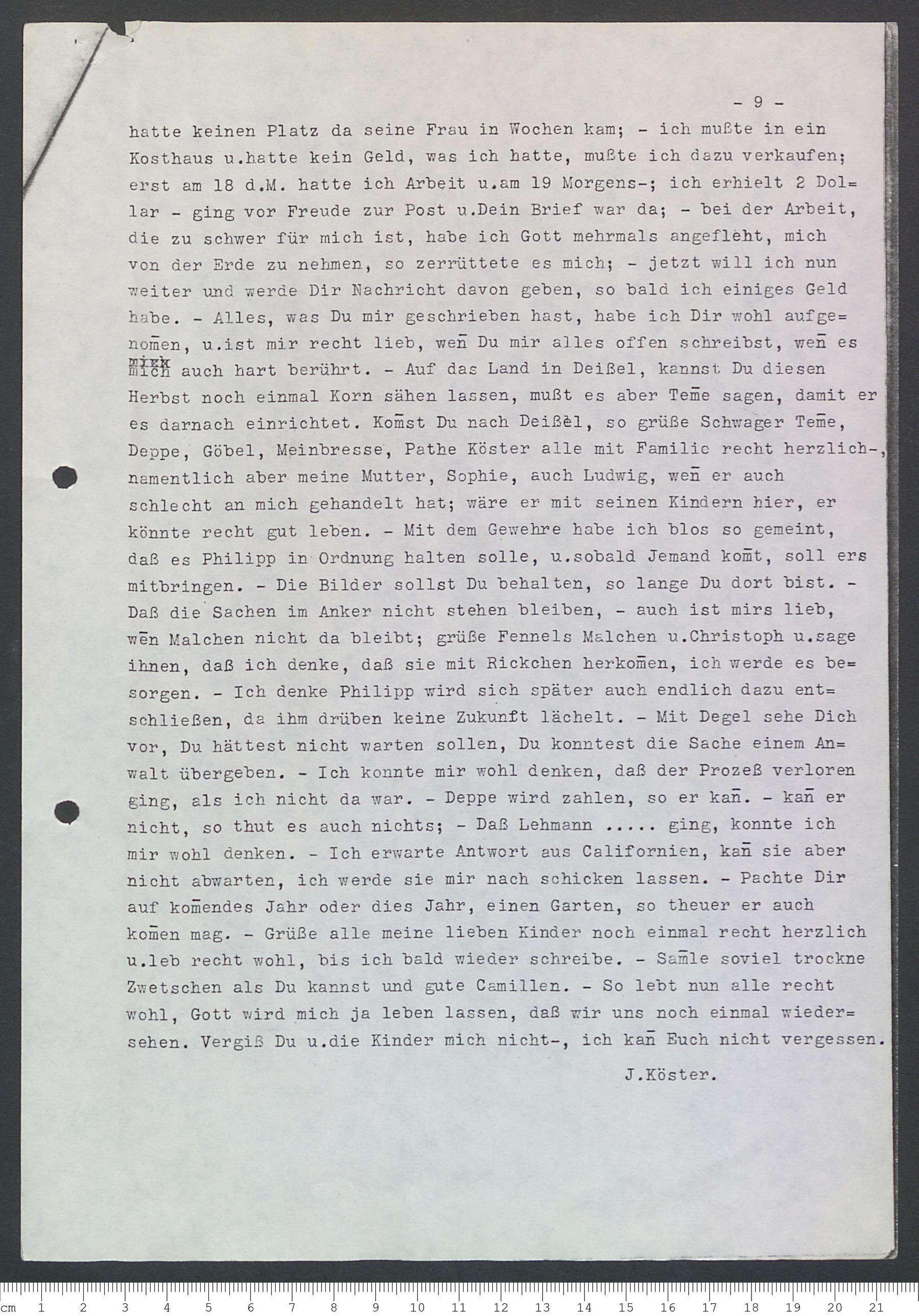
“Auf das Land in Deißel, kannst Du diesen Herbst noch einmal Korn sähen lassen, mußt es aber Teme sagen… Komst Du nach Deißel, so grüße Schwager Teme, Deppe, Göbel, Meinbresse, Pathe Köster alle mit Familie recht herzlich”
— Johannes Köster to his wife · “On the land in Deißel you can have corn sown once more this autumn, but you must tell Teme… If you go to Deißel, give my warm greetings to brother-in-law Teme, Deppe, Göbel, Meinbresse, Godfather Köster and all their families.” Gotha transcription image 0062, read 19 July 2026.
A native of the village, writing its name from memory, here produces a form with the ß sound in the middle — though the same typescript also spells it Deisel elsewhere, so this is a live variant rather than his fixed usage. An American clerk hearing that spoken, from a man with the region's accent, would plausibly write Deisse. The identification was never in serious doubt — and it is now supported by how a Deisel man actually wrote his own village, rather than resting only on our assumption about a clerk's ear. The same passage also shows Köster still owning land in Deisel and directing its sowing from Missouri, and greets the identical circle of families — Temme, Deppe, Göbel, Meinbresse, Köster — that fills the emigration lists.
What the letters do establish
- A Hessian countryman network in St. Louis, in exactly those years. “Zu viel meiner Landsleute” is a complaint about volume. Charles's 1866 marriage entry — “aus Deisse, Kreis Cassel, Churhessen” — has until now been a lone assertion about a distant village. It now sits inside a documented community.
- A second Deisel departure with no exit record. Köster does not appear in the LAGIS/HESAUS emigration index, which carries Koester entries from Deisel across 1833–1866 but not the schoolmaster who actually left in 1858. Charles's missing exit paper has looked like a gap in the research; it looks increasingly like the normal condition of a Deisel departure.
- The village's address book. Köster's greetings home run through Schwager Deppe, Göbel, Vetter Fremder, Freund Baumann, Schwager Temme and Meinbresse — two of which — Fremder and Meimbresse — also appear in the Deisel legal-emigrant list of 1857–61. His St. Louis letters also document a Casselmann divorce case he handled, and one letter is addressed to Frau Casselmann.
- A German school as an institutional node. The St. George Deutsch-amerikanische Bürgerschule, Deisel-run, operating in St. Louis from 1860. The letters break off in 1862; by about 1870 he was in Bloomington, Illinois.
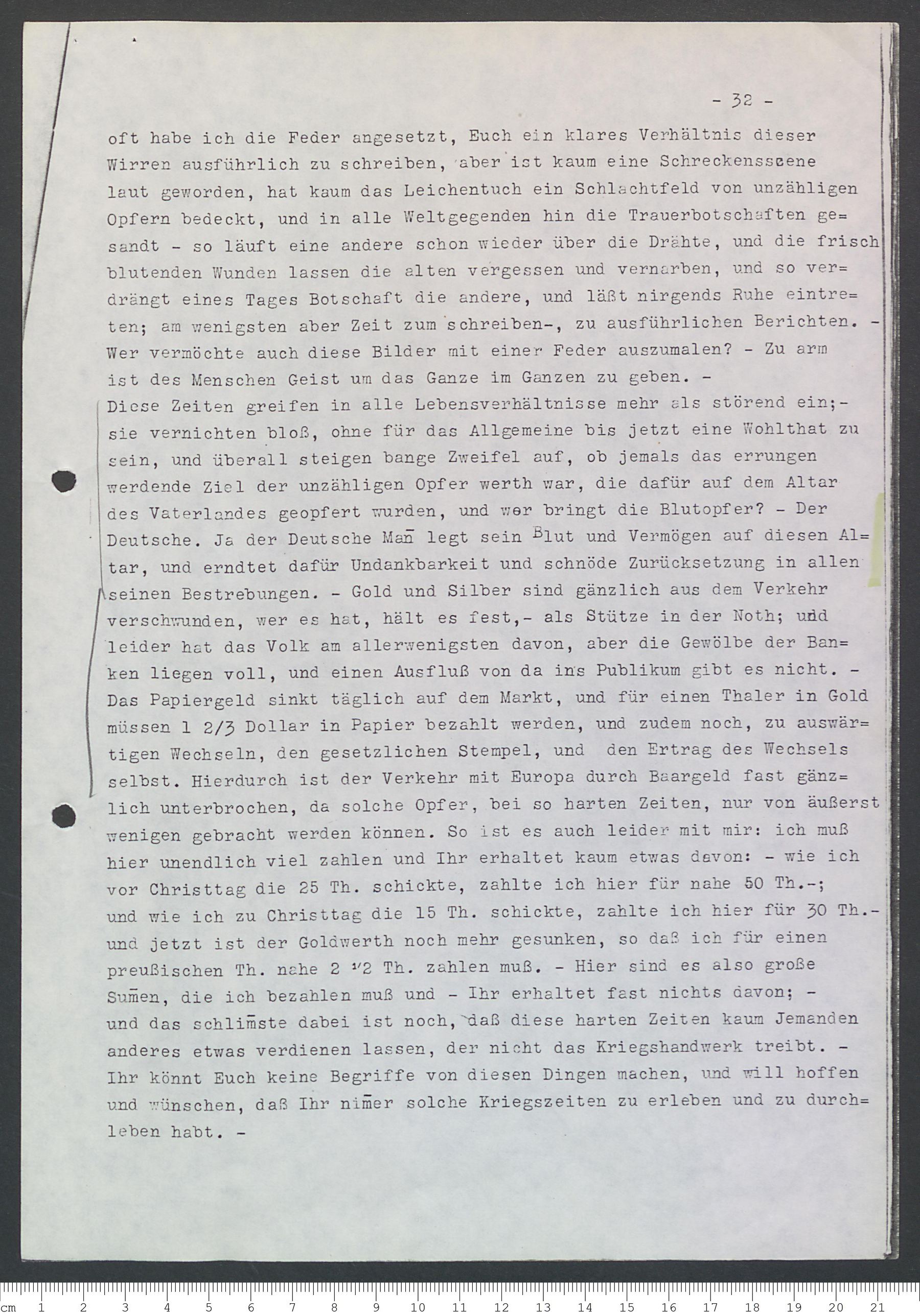
- Wartime St. Louis, first-hand. “Nur Kriegshandwerk wird hier getrieben” — nothing is practiced here but the trade of war. Charles enlisted in December 1862, while that sentence was still true.
- A letter written on the day Charles enlisted. The last letter in the series is datelined “St. L. Mo, December 2, 1862” — the very day Charles swore his Volunteer Enlistment in the same city. It is a Christmas letter, enclosing fifteen Prussian Thaler, and it turns entirely on homesickness: the German feast days are “elektrische Funken, die am fremden Strand eines jeden Deutschen Herz beleben” — electric sparks that quicken every German heart on a foreign shore and draw it powerfully homeward. Whatever Charles felt as he put his name to that form, a countryman from his own village was, that same day, a few streets away, writing about exactly this.
The leads that follow
Köster was a findable man, and he has now been found: a schoolmaster of forty-three, out of Bremen on 6 November 1858 by sailing ship, into New Orleans on 3 January 1859 aboard the Rubens. The manifest has been read and it does not contain Charles. What it did produce — Wilhelmine on the boat, and a Hessen-to-Missouri cohort of eight — opens four narrower threads:
- Wilhelmine Grosbernd's baptism and parentage. Born about September 1839, Kurhessen. The Kassel registers for 1839–40 are among the war losses, so Deisel and the Trendelburg parishes are the realistic targets. Also: does she appear in a Kurhessen exit register? A nineteen-year-old woman needed a permit as much as Köster did, and he has none.
- The Rubens cohort against the St. Marcus godparents. Vetter, Staul, Müller, Dahmer, Wagner — run against the godparent names on Charles's seven baptisms.
- The New Orleans marine column for 3–4 January 1859. The Daily Picayune and Daily Crescent printed days-out for every arrival. That would confirm the 6 November departure independently of Köster's own Lebenslauf — the only date in this reconstruction still resting on a single source.
- Köster's shipboard diary. The harbor letter of 6 November 1858 (image 0054) promises to send home a diary “from which everything daily can be seen.” It is not in the Gotha folder and has never been chased. If it survives anywhere, it is the closest thing that exists to an eyewitness account of the crossing Charles made a year later.
Two older avenues still run alongside: the published Assion index of Hessian emigrants in the Hamburg ship lists 1855–1866, never yet searched for this name pool, and the Missouri Historical Society's German-press holdings for traces of the Bürgerschule. The wider sweep of all New Orleans arrivals 1858–60 — NARA M259 reels 47–50, roll by roll — remains the standing task; reel 47 has now paid out once.
The other three letter series in the same Gotha delivery — Rädeker–Schmelzer, Fischer–Barthel and the American Jewish Archives Hagedorn–Stern papers, 996 images between them — have been swept in full and are closed: no name from the pool appears in any of them. Gotha's collection head confirmed on 10 July 2026 that no other Deisel, Trendelburg or Altkreis-Hofgeismar letters exist in the collection.
The series itself
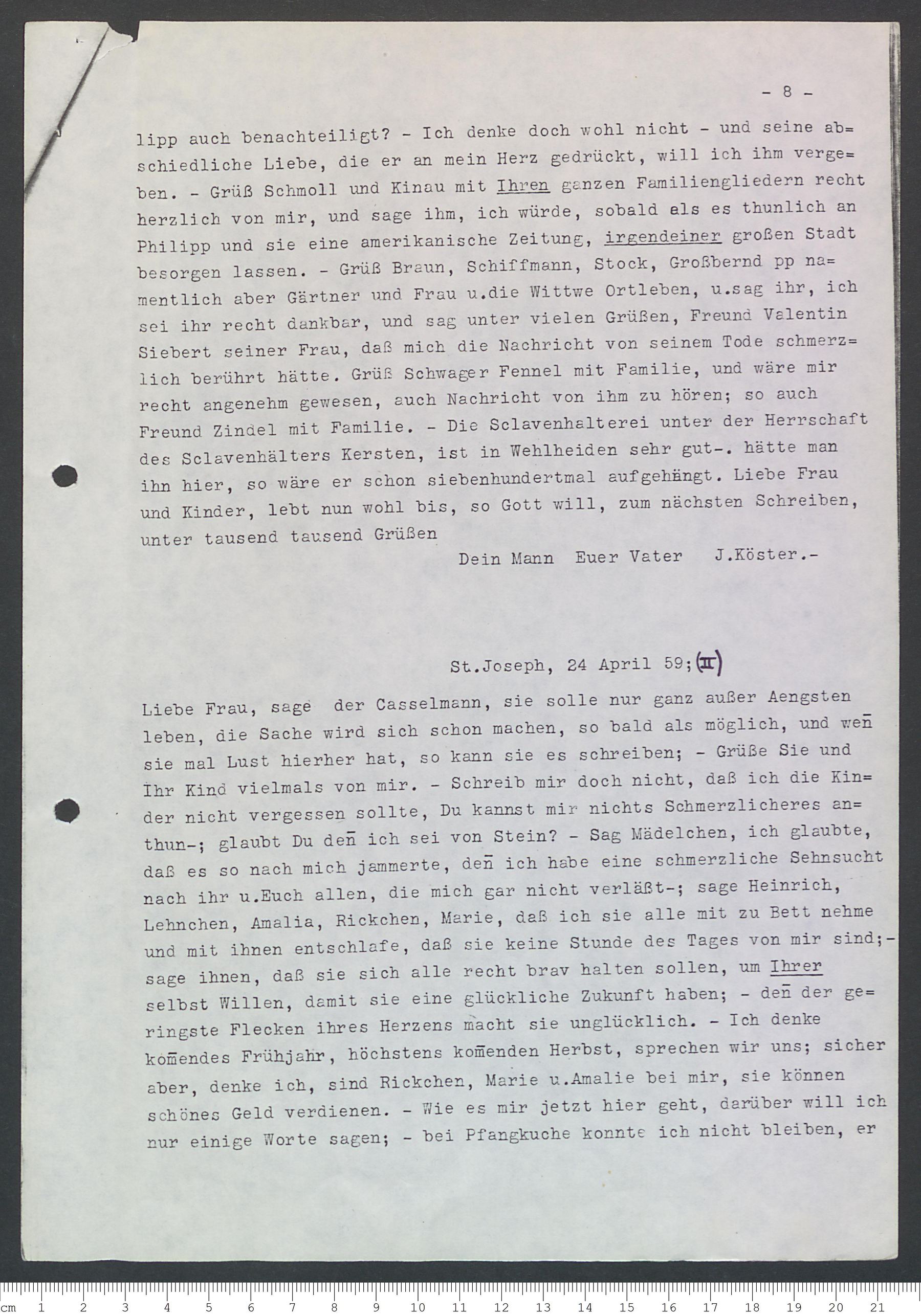
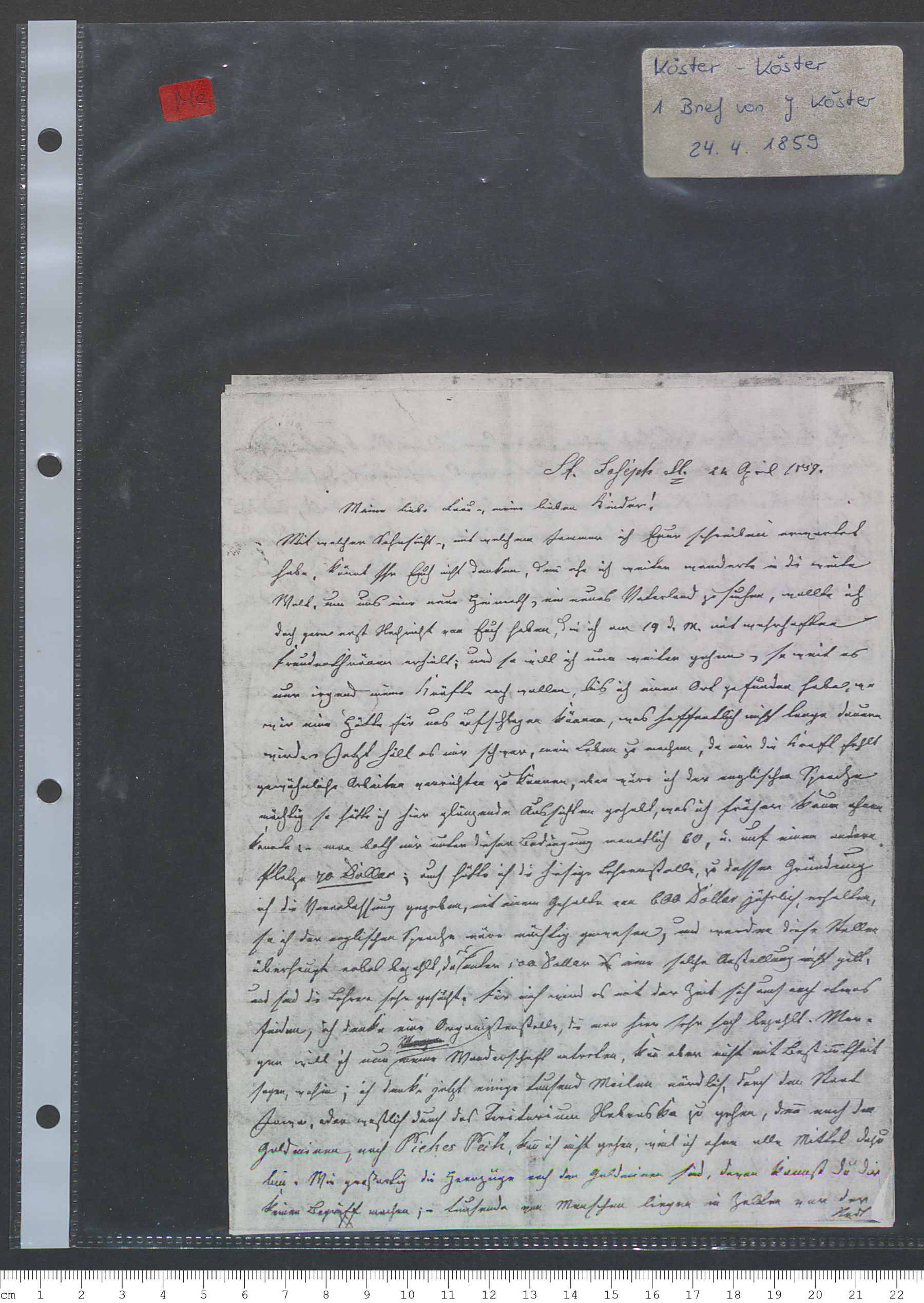
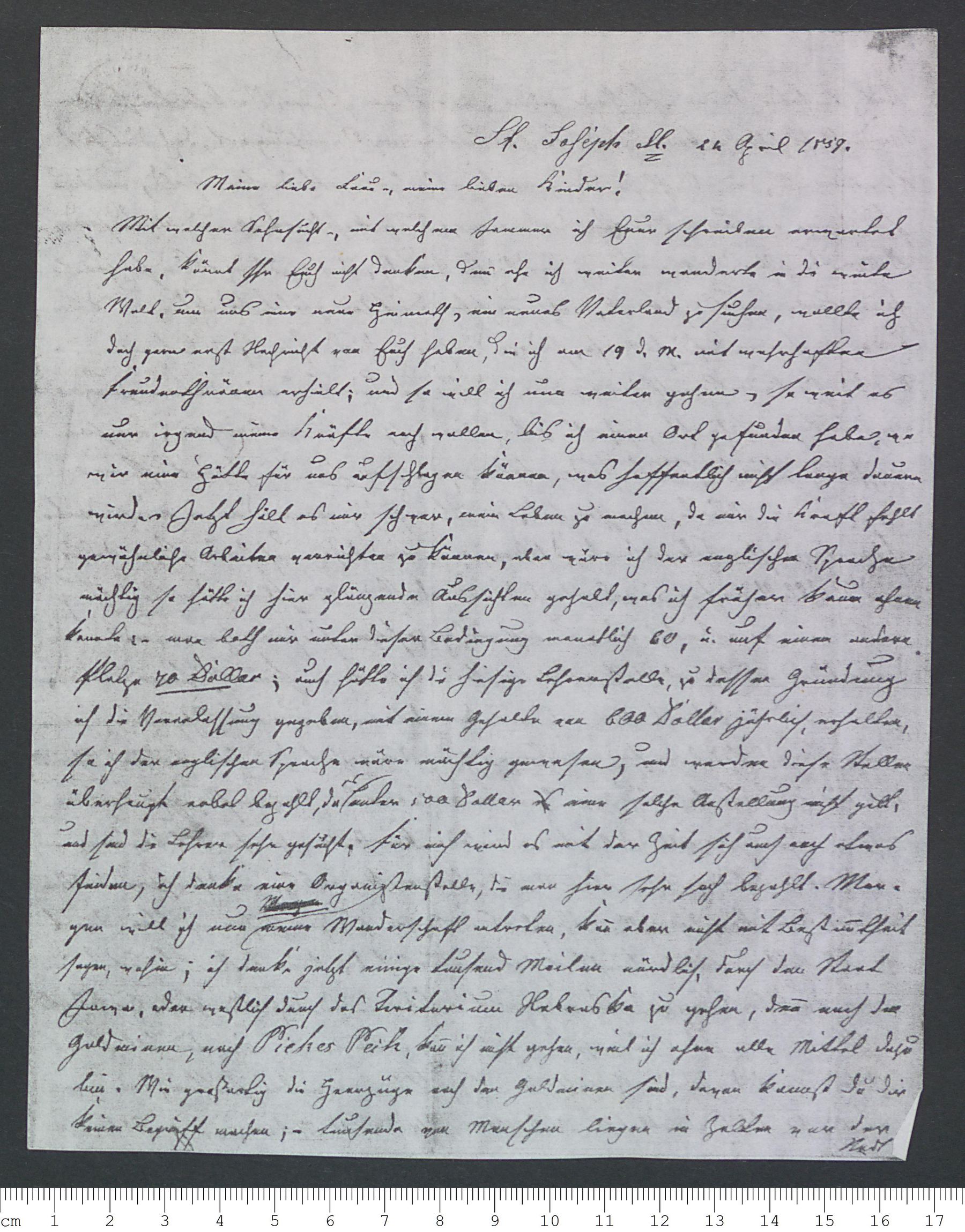
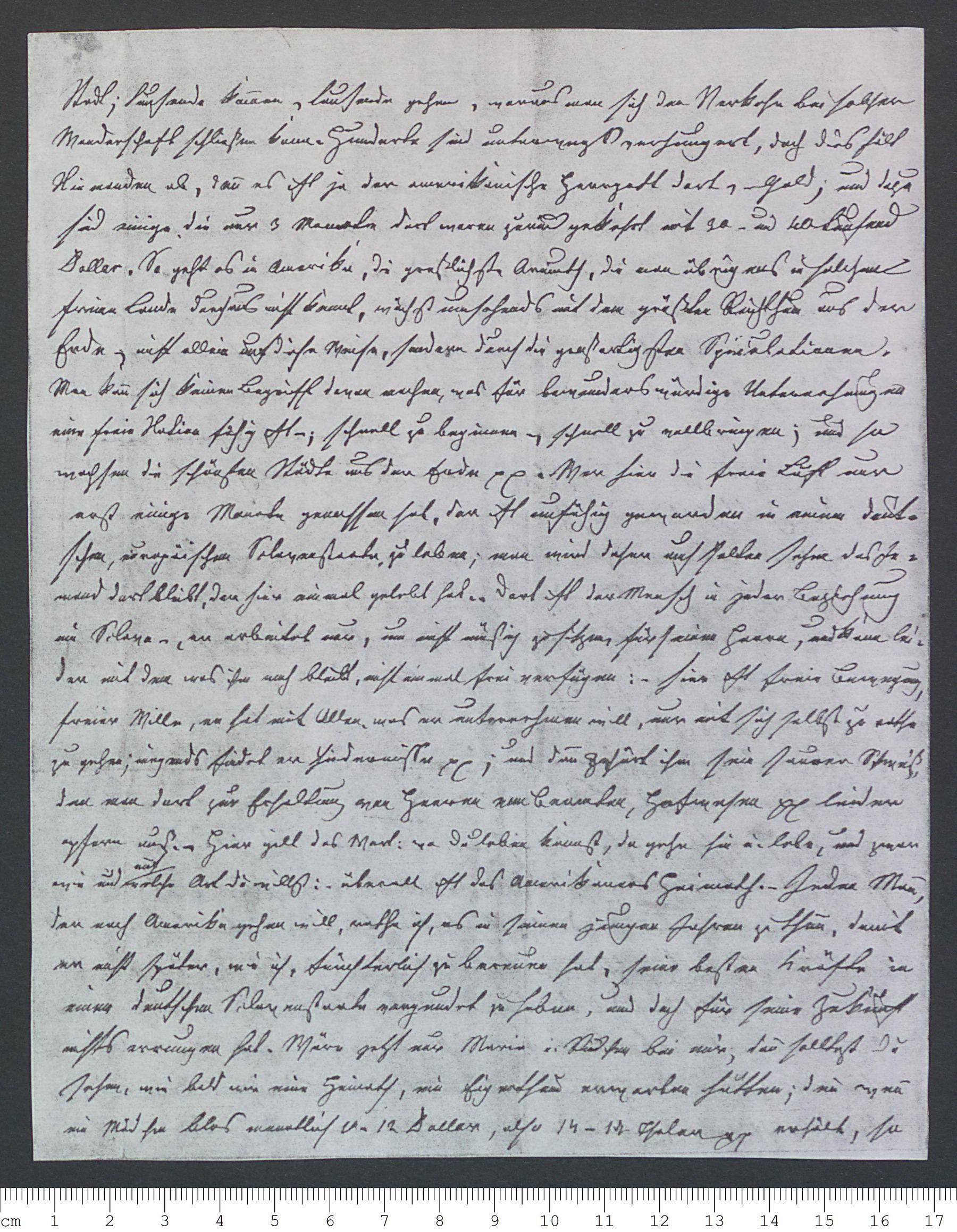
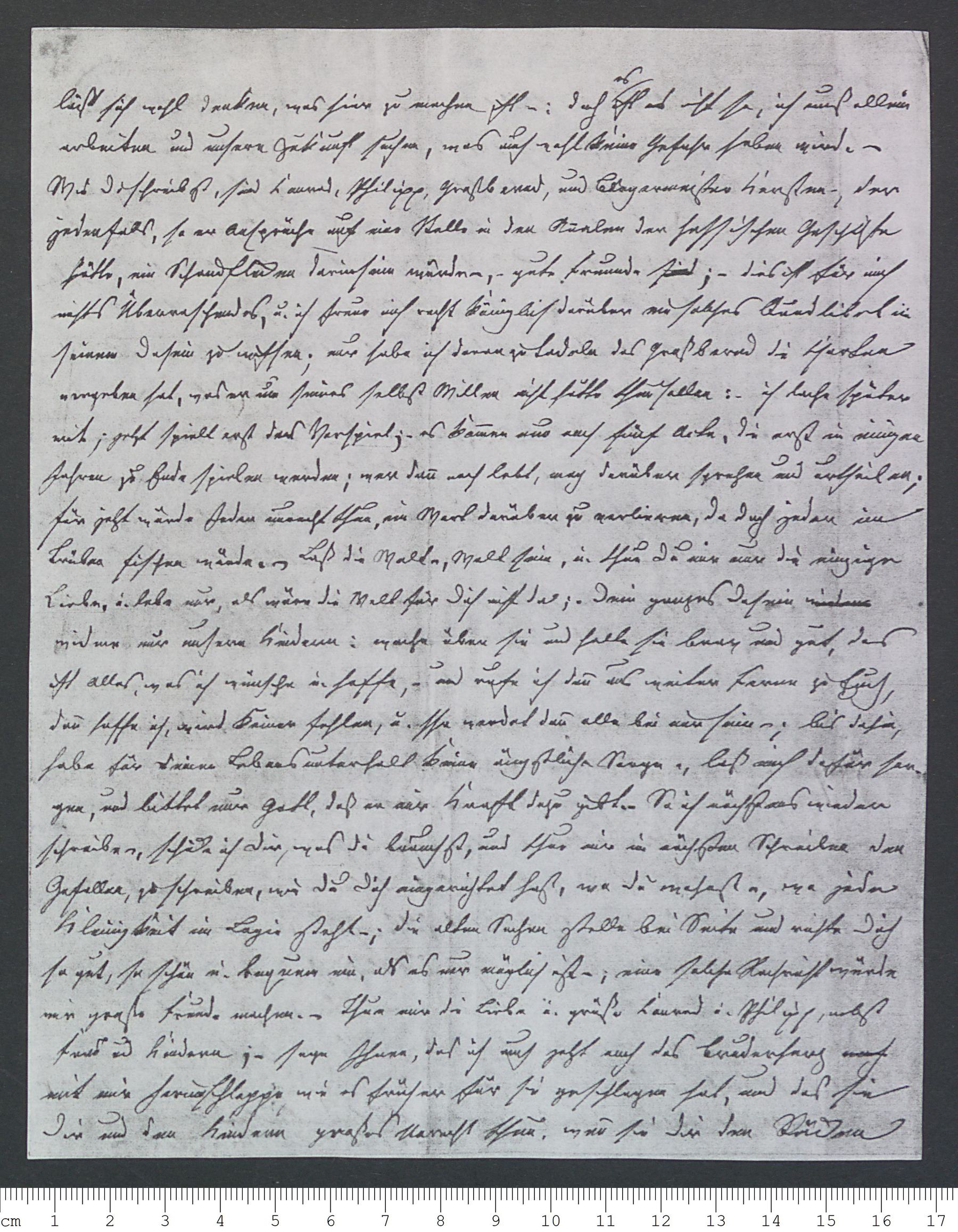
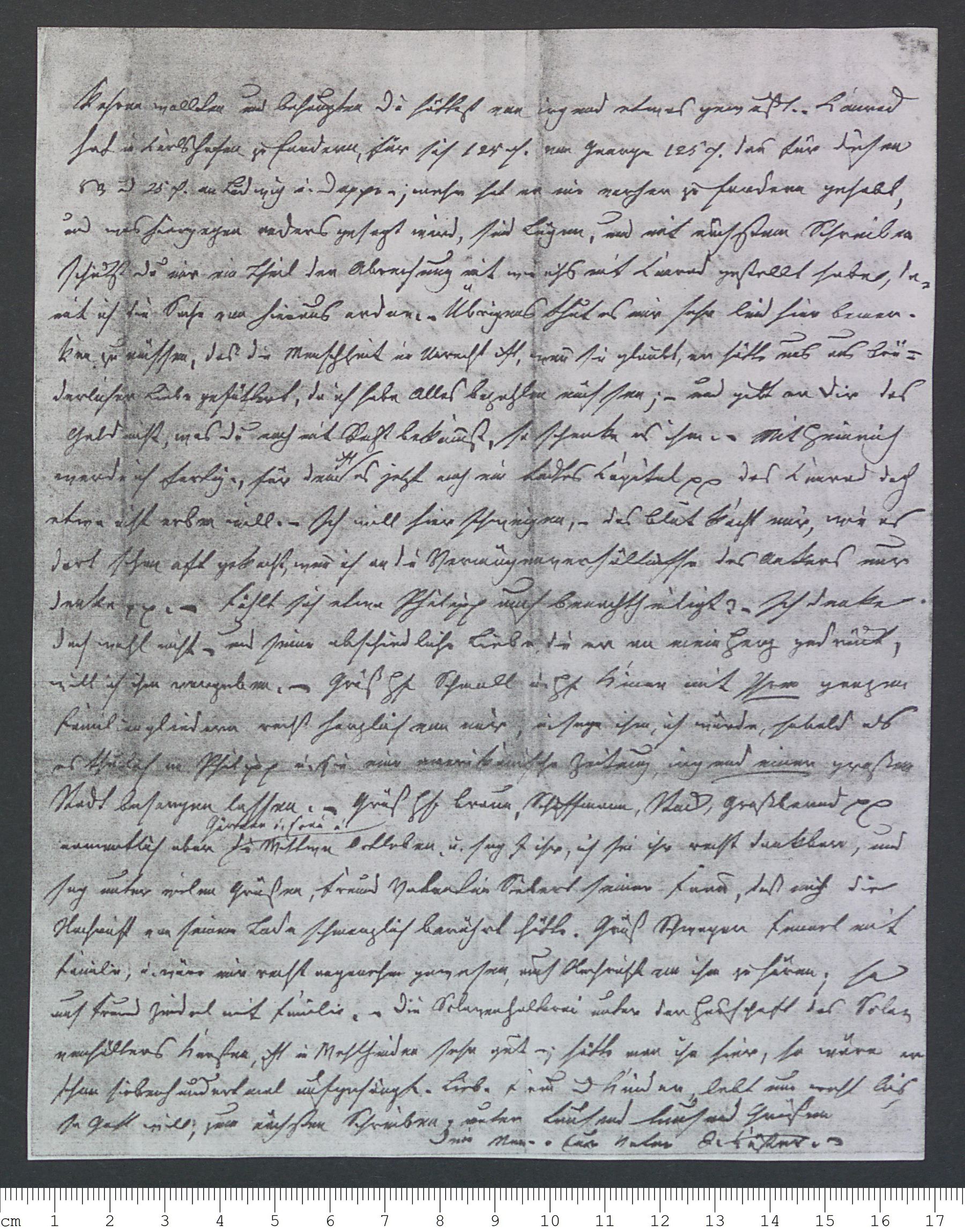
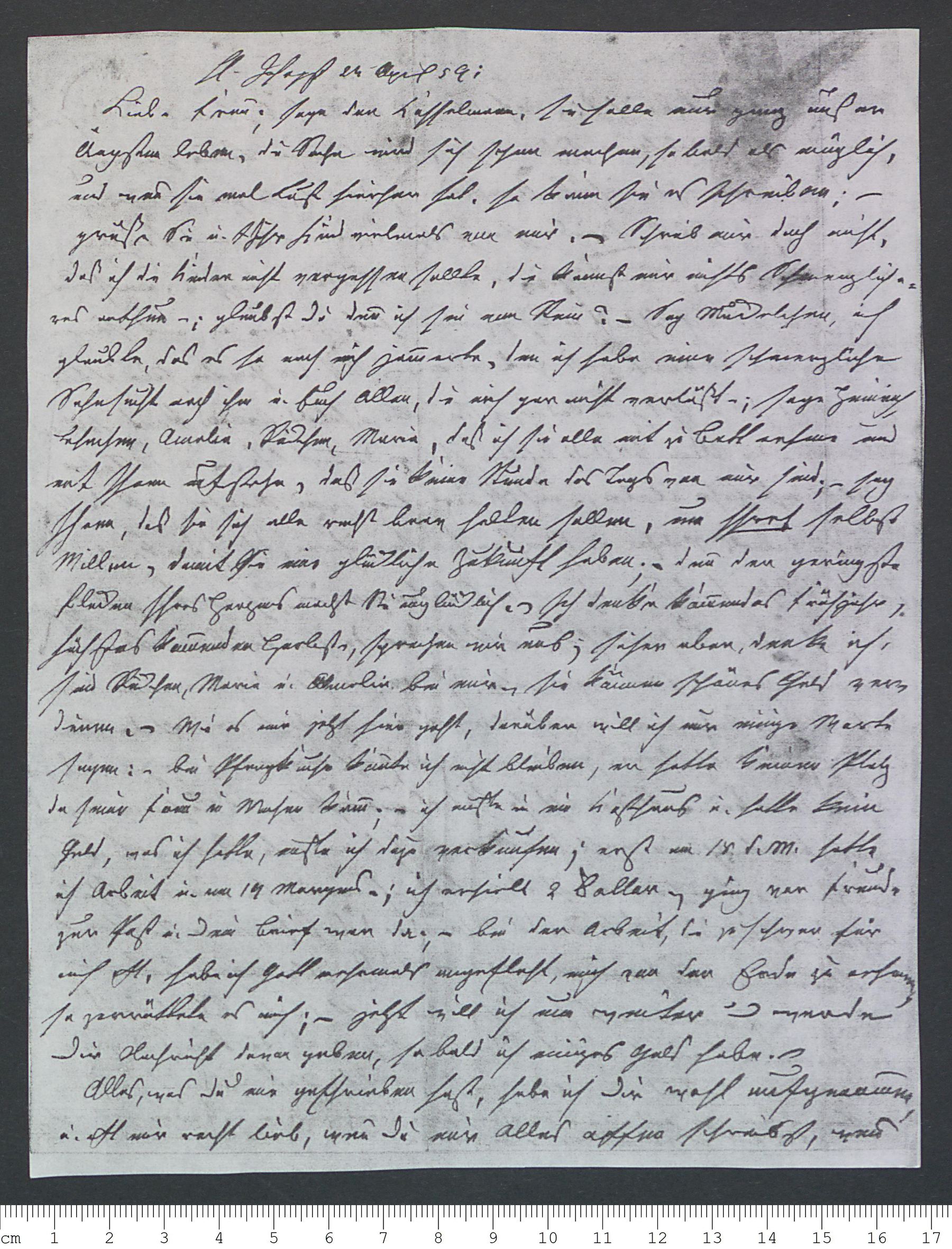
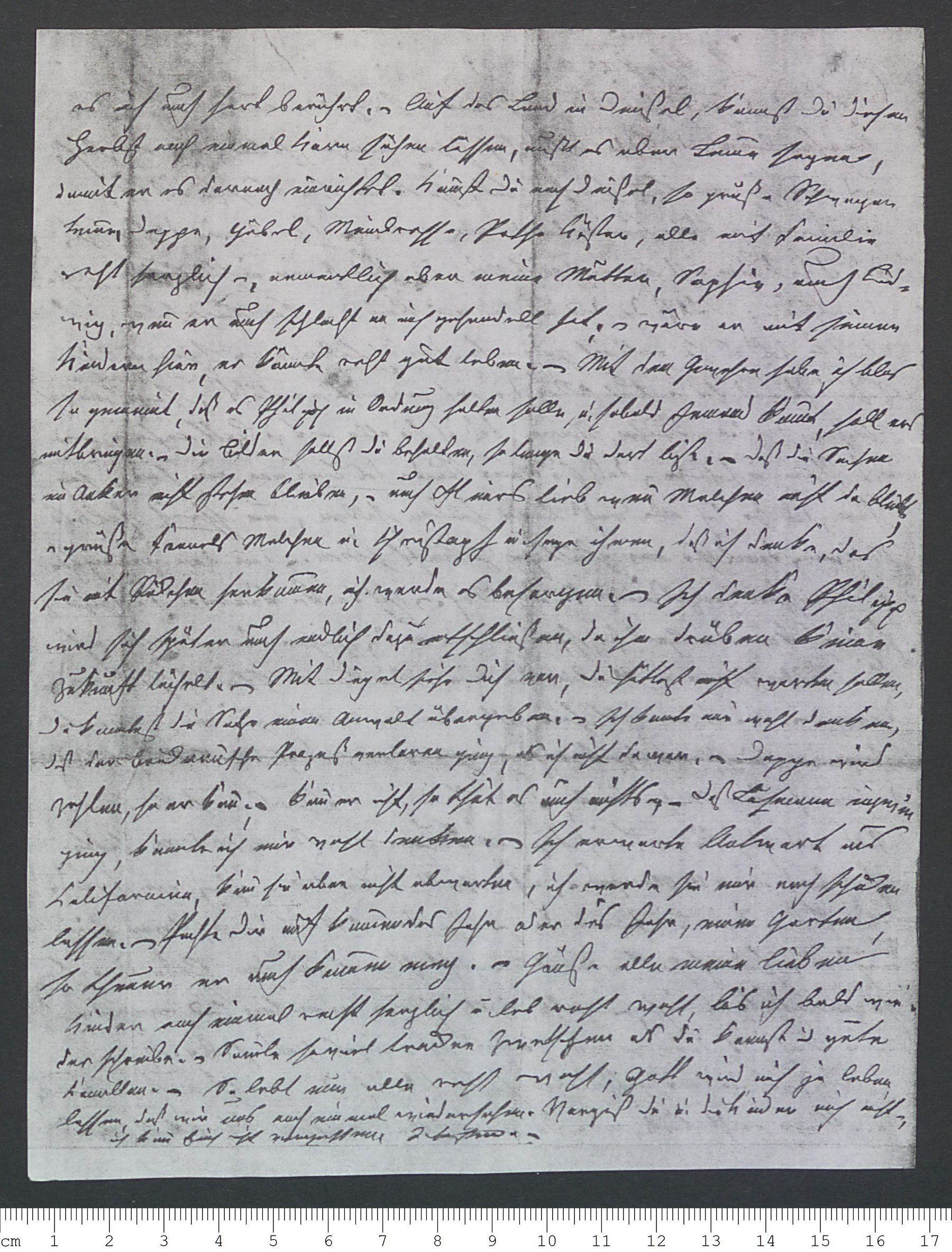
The autograph leaves. Most of the series is the typed transcription, and most of the originals may well have been lost, but not all of them burned in the bombing of Kassel: images 0113–0119 are seven original leaves in Köster's own hand, written in Kurrent on folded sheets and photographed against a centimeter rule. They are the original manuscript of the 24 April 1859 St. Joseph letter, the same letter held in verified typescript at images 0058–0062. The opening of 0113/0114 matches typescript p. 5 word for word, and leaf 0119 carries the “Deißel” greeting passage of p. 9, so the village spelling this project relies on can be read in Köster's own hand, not only the 1930s typist's. The archival label on 0113 reading “24.4.1853” is a misread of 1859. This is a Kurrent reading from a photograph and should be confirmed by a paleographer, but the identification is secure on the matching dateline, opening and greeting list, and the text of the autographs is already known from the typescript. All seven are reproduced below. Verified pages →
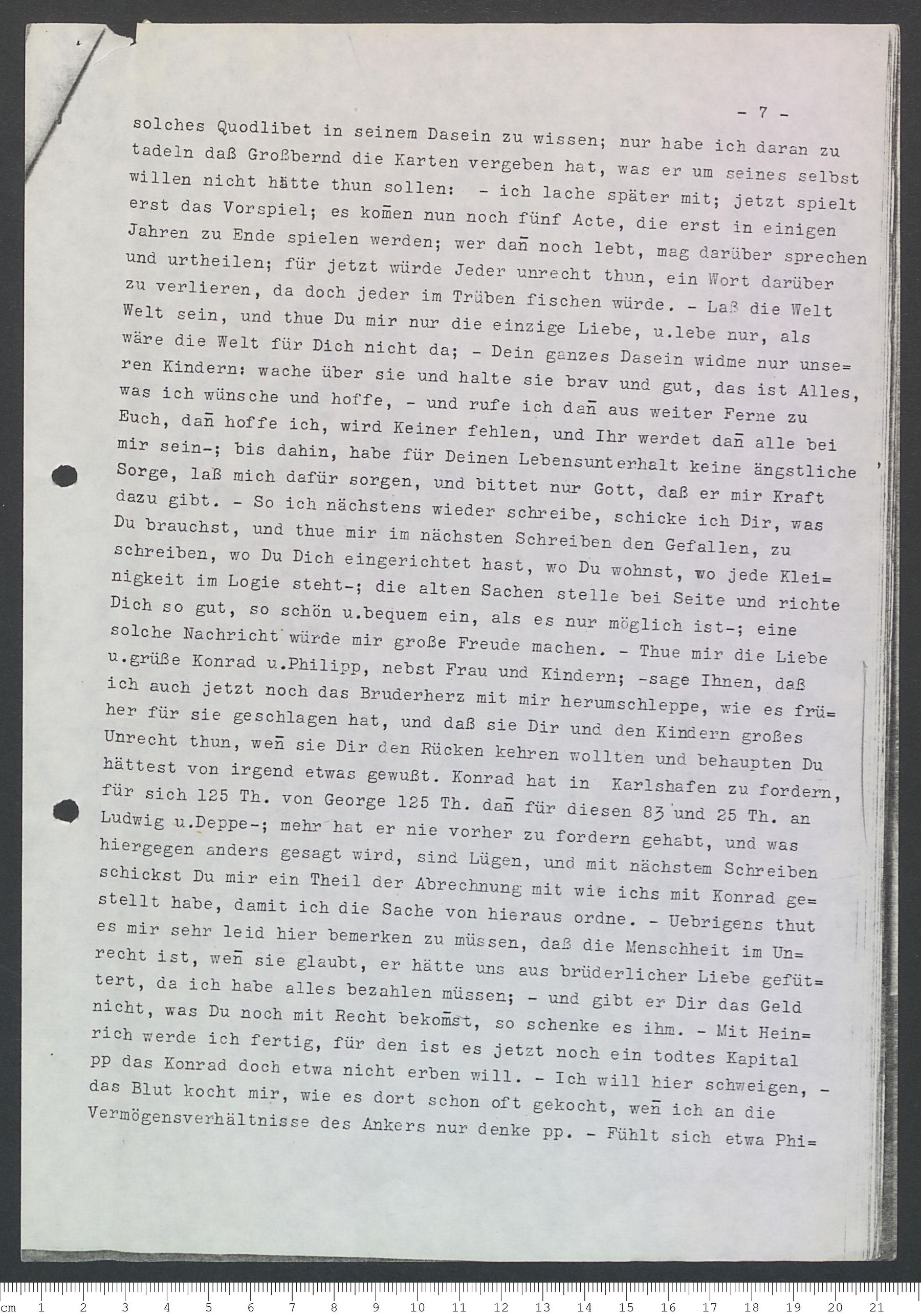
The same letter carries a sustained political argument contrasting America, a place of freie Bewegung, freier Wille with wages of twelve dollars a month, with what Köster calls a German Sclavenstaat. That passage stands on typescript p. 6 (image 0059), not on the surviving autograph leaves. Verified page →
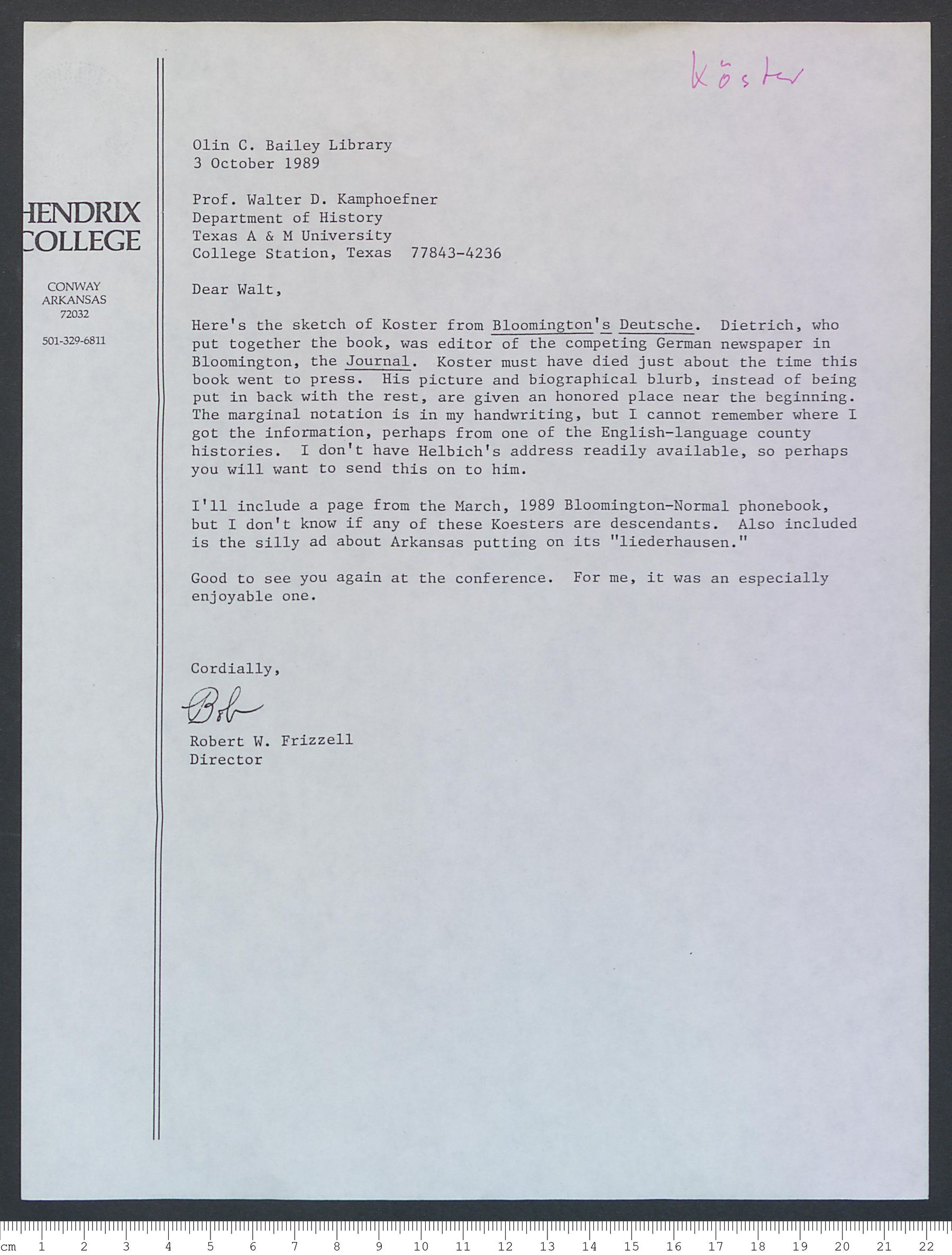
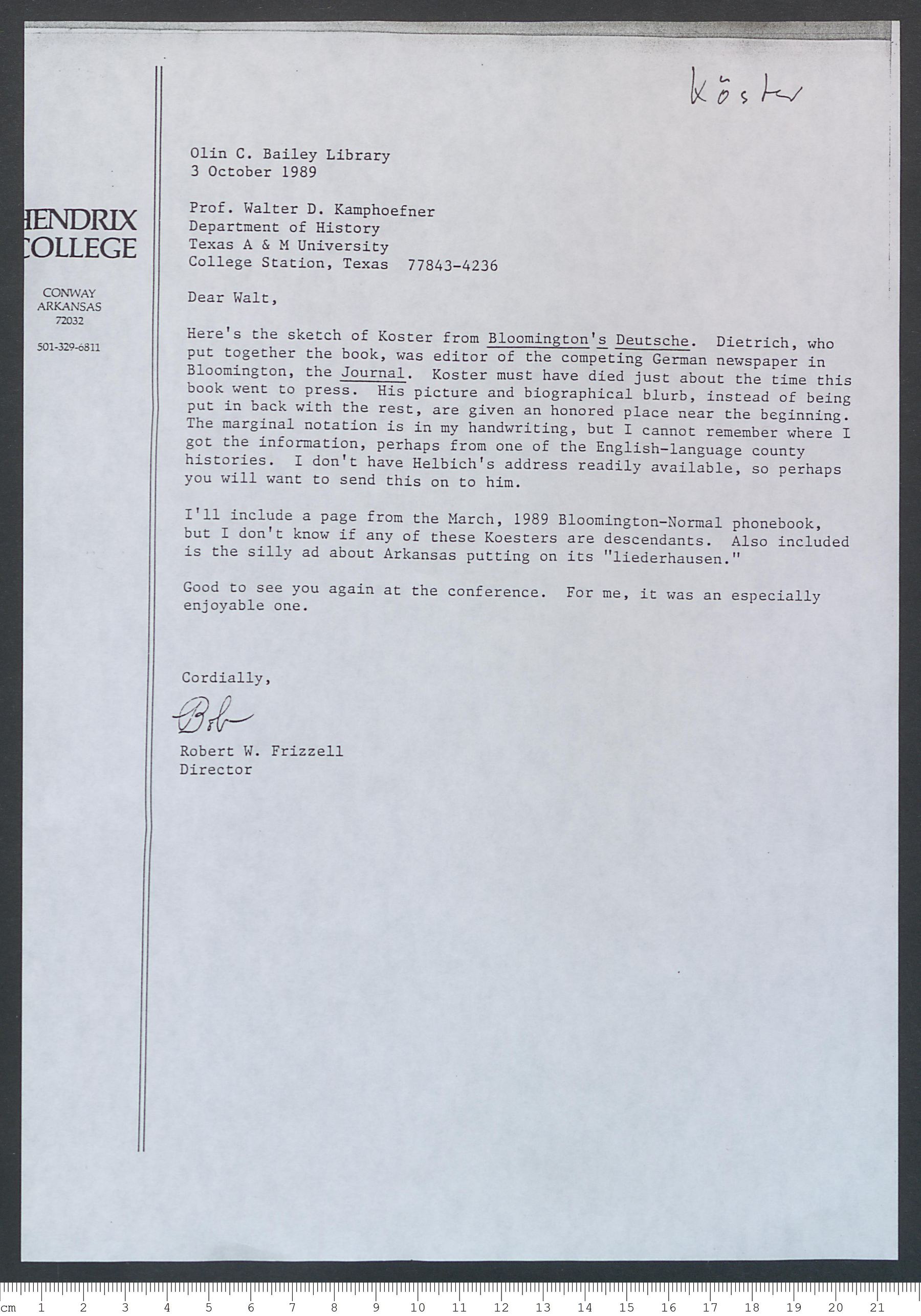
What Gotha holds is the archive assembled by Köster's descendant Dr. Rudolf Köster: a complete typed transcription, a Briefliste, Personalkarten, an alphabetical index of every name the letters mention (annotated from 1937 interviews with Johannes's surviving daughters, Marie and Mimi), Pfarramt Deisel register extracts, US census extracts for 1860/1870/1880, city-directory research, a Hendrix College letter concerning a German pocket-book from Bloomington, Illinois, where Köster later lived, and Rudolf Köster's printed article “Die Briefe des Johannes Köster aus Amerika in den Jahren 1859–1862.”
Full facsimile — the complete series
All 119 scans of the Köster–Köster series (NABS Ordner 74), 300 dpi color, published here in full — and free of any restriction. On 20 July 2026 an archivist of the Forschungsbibliothek Gotha confirmed that the library's digitisates are public domain and require no publication permission whatever: “Unsere Digitalisate sind inzwischen public domain und bedürfen keiner Druckgenehmigung mehr. Sie dürfen sie also nach Belieben veröffentlichen.” The restrictive terms printed on the 2026 order form are out of date — “Unsere Formulare sind noch nicht aktualisiert.”
So far as this project can establish, this is the only Deisel emigrant correspondence in existence, and it is now openly readable rather than sitting on one researcher's hard drive. Click any leaf for the full-size scan. Take them and use them — no permission needed from Gotha and none from us.
Provenance of every image: Forschungsbibliothek Gotha der Universität Erfurt, Deutsche Auswandererbriefsammlung, Serie Köster/Köster (NABS Ordner 74) · Forschungsbibliothek Gotha. Credited as a courtesy and as provenance, not as a licence condition: these are public-domain digitisates and carry no re-use restriction. If you do use them, crediting the library that preserved and scanned them is the decent thing.
Section headings below are anchored on leaves that were individually opened and read; leaves between anchors are grouped by inference. Per-leaf captions remain to be written.
Archival apparatus and the Briefliste
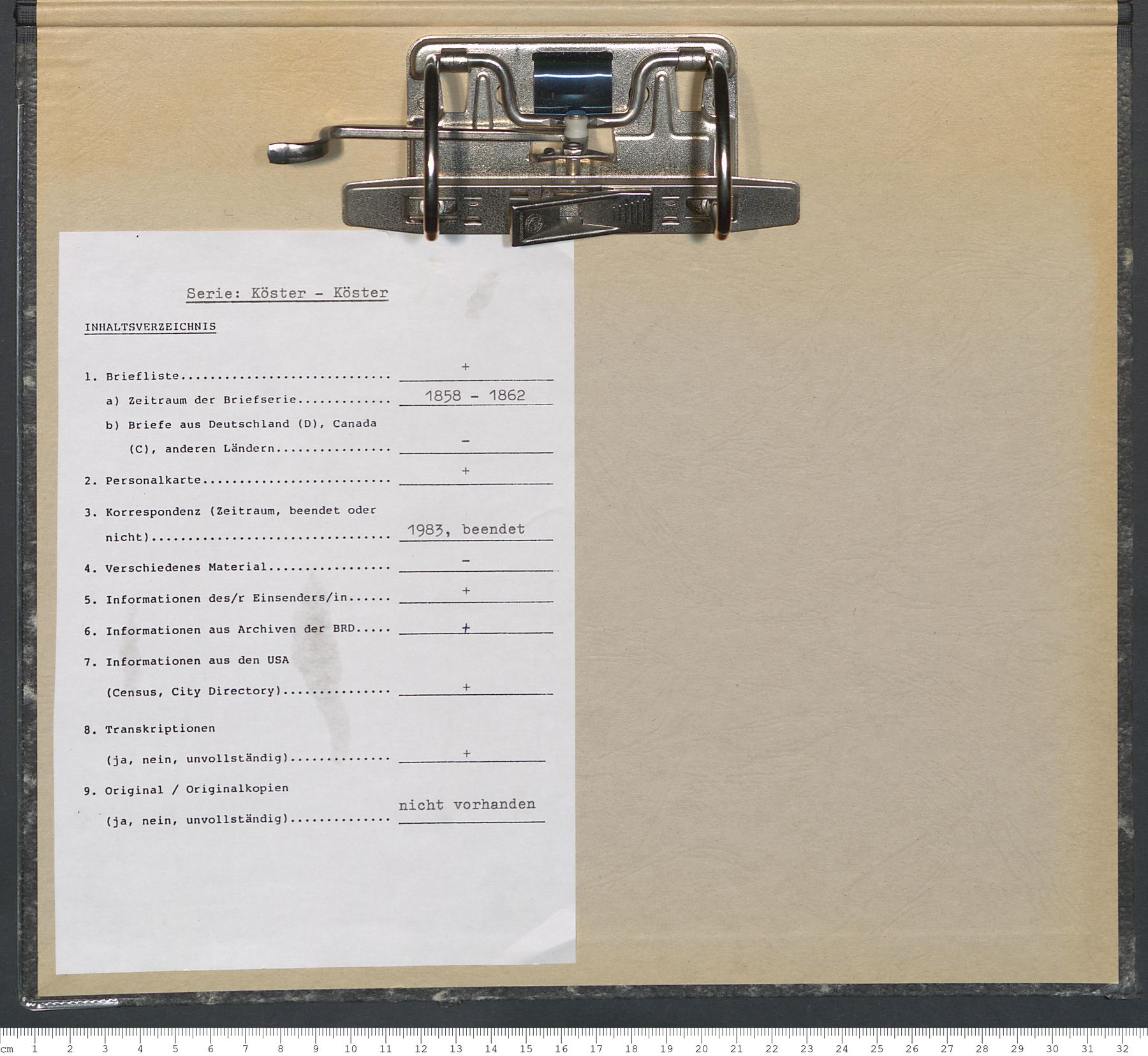
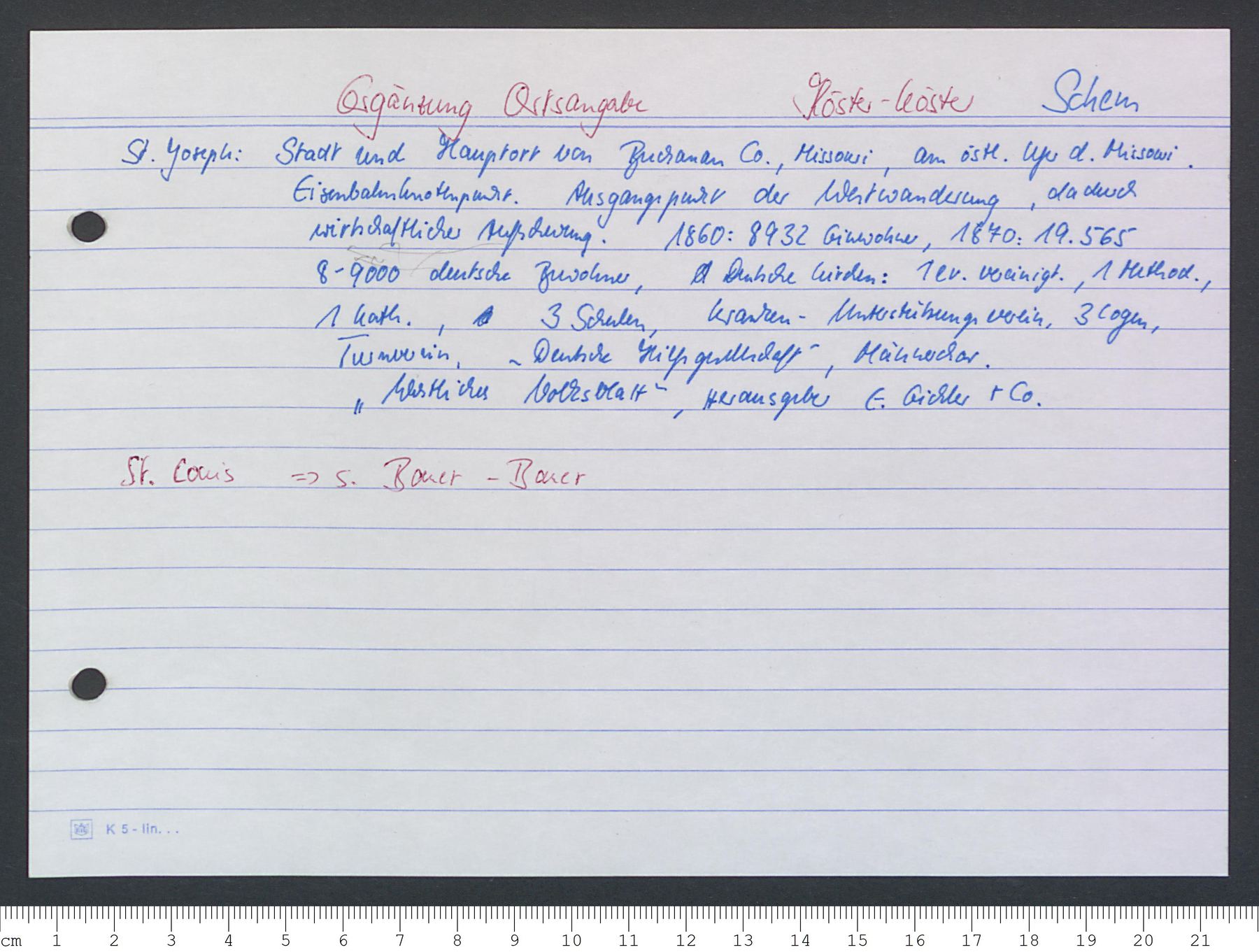
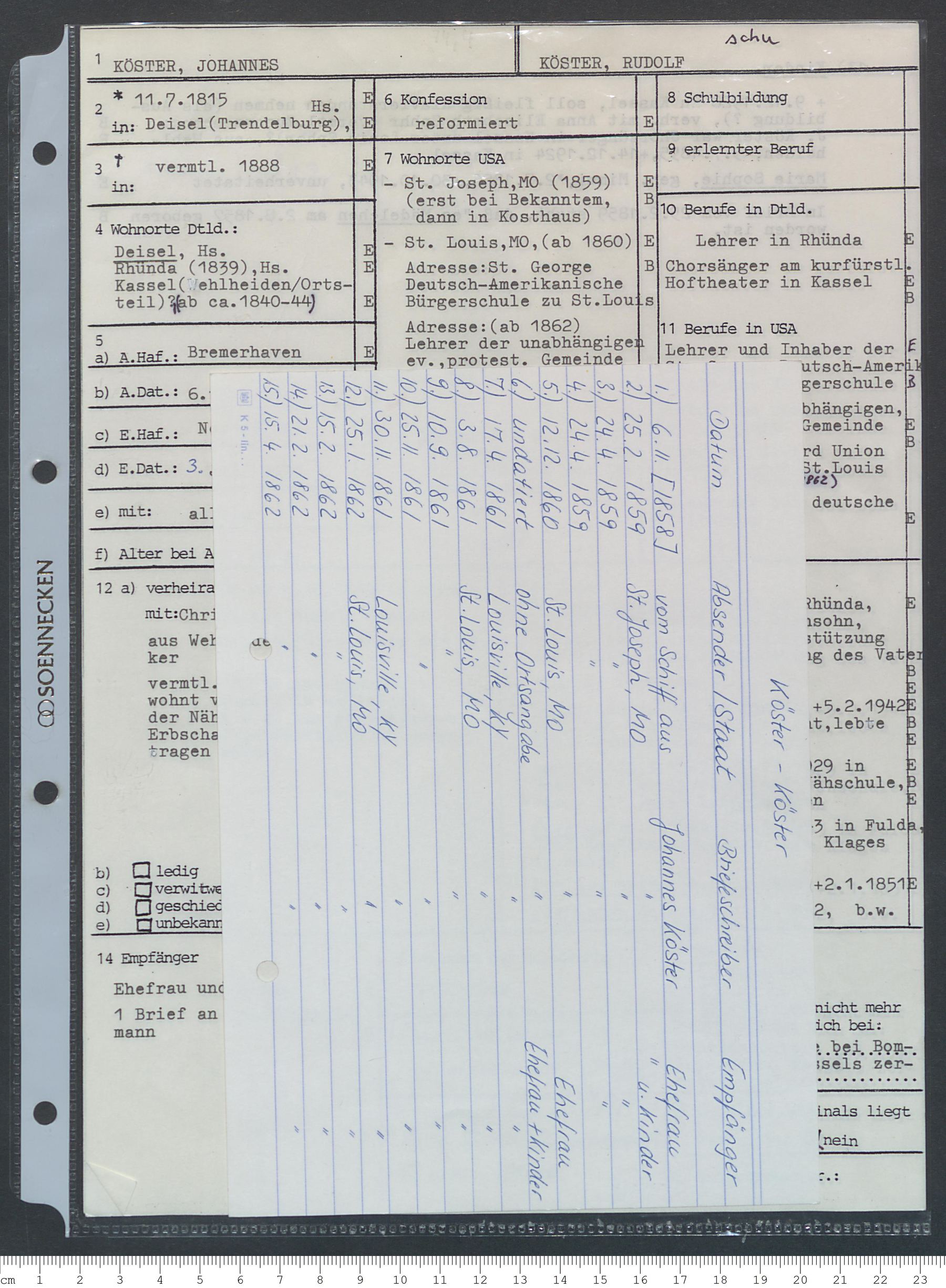
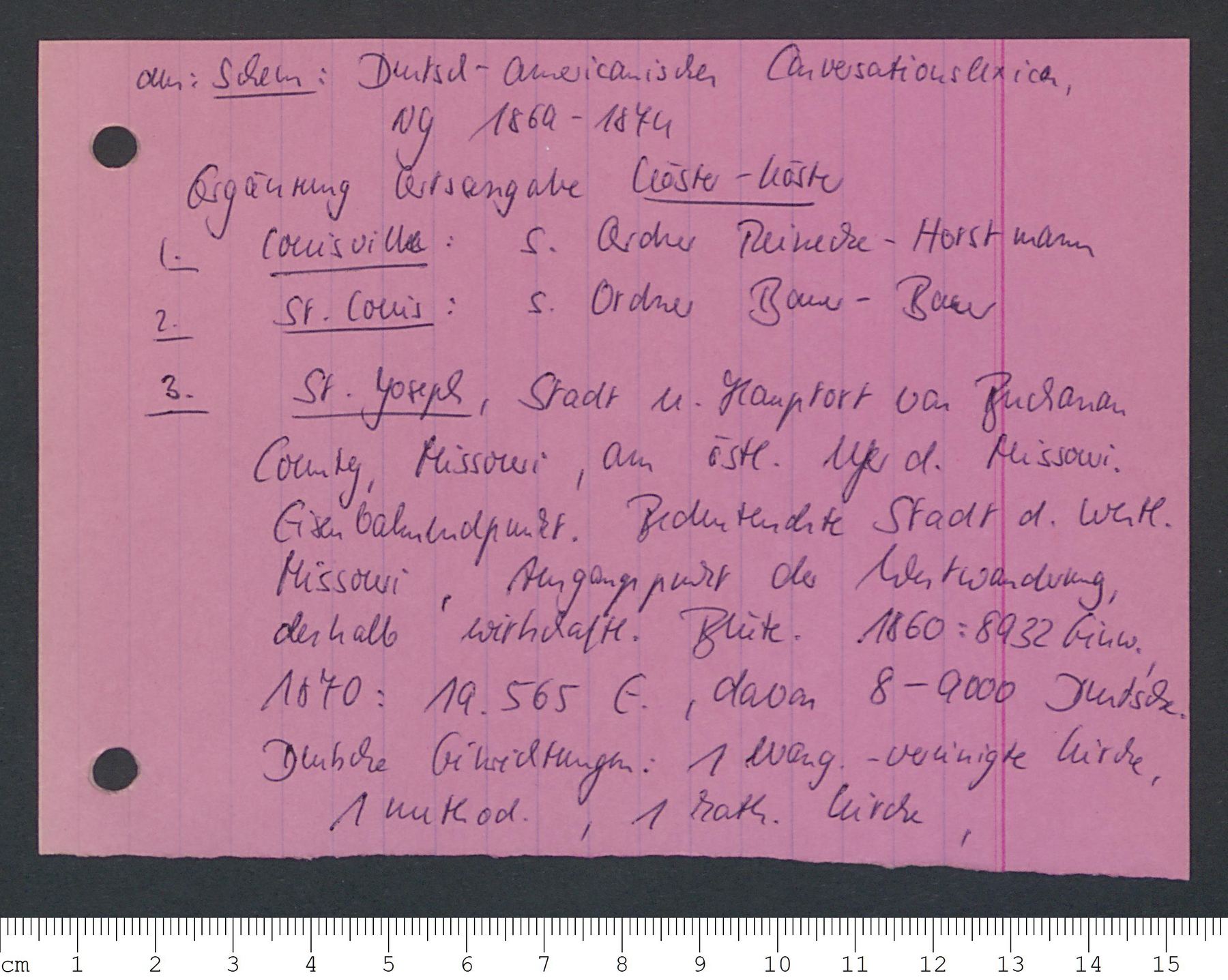
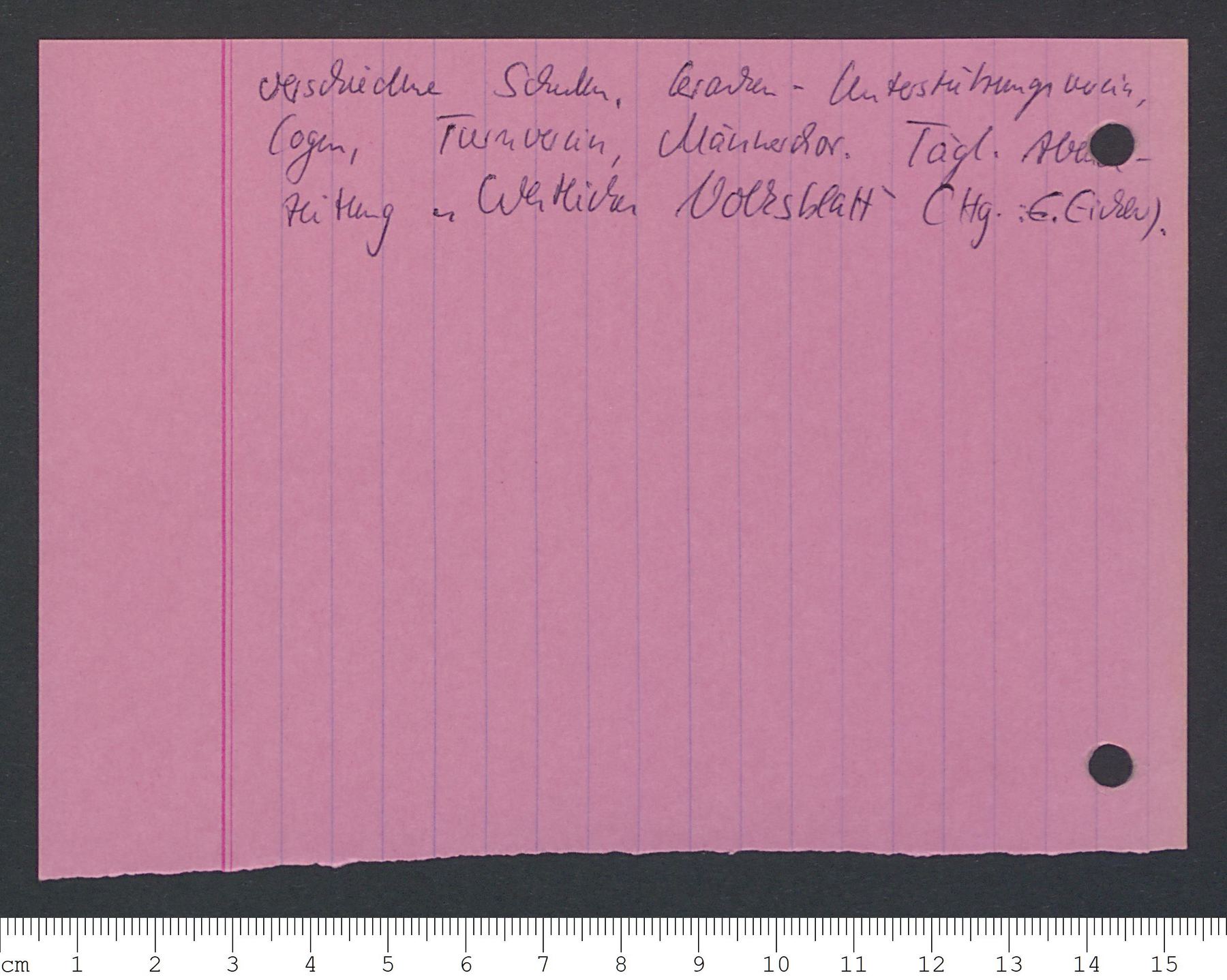
Gotha's own cover sheet for the series (0001), a divider leaf, and the handwritten Briefliste registering each letter by date, place and addressee. Image 0006 lists the last five: 11 July, 12 August, 10 September, 6 November and 2 December 1862 — all “St. Louis, MO, Johannes Köster, Frau + Kinder.”
Images 0001–0009 · 9 leaves · read: 0001, 0003, 0006
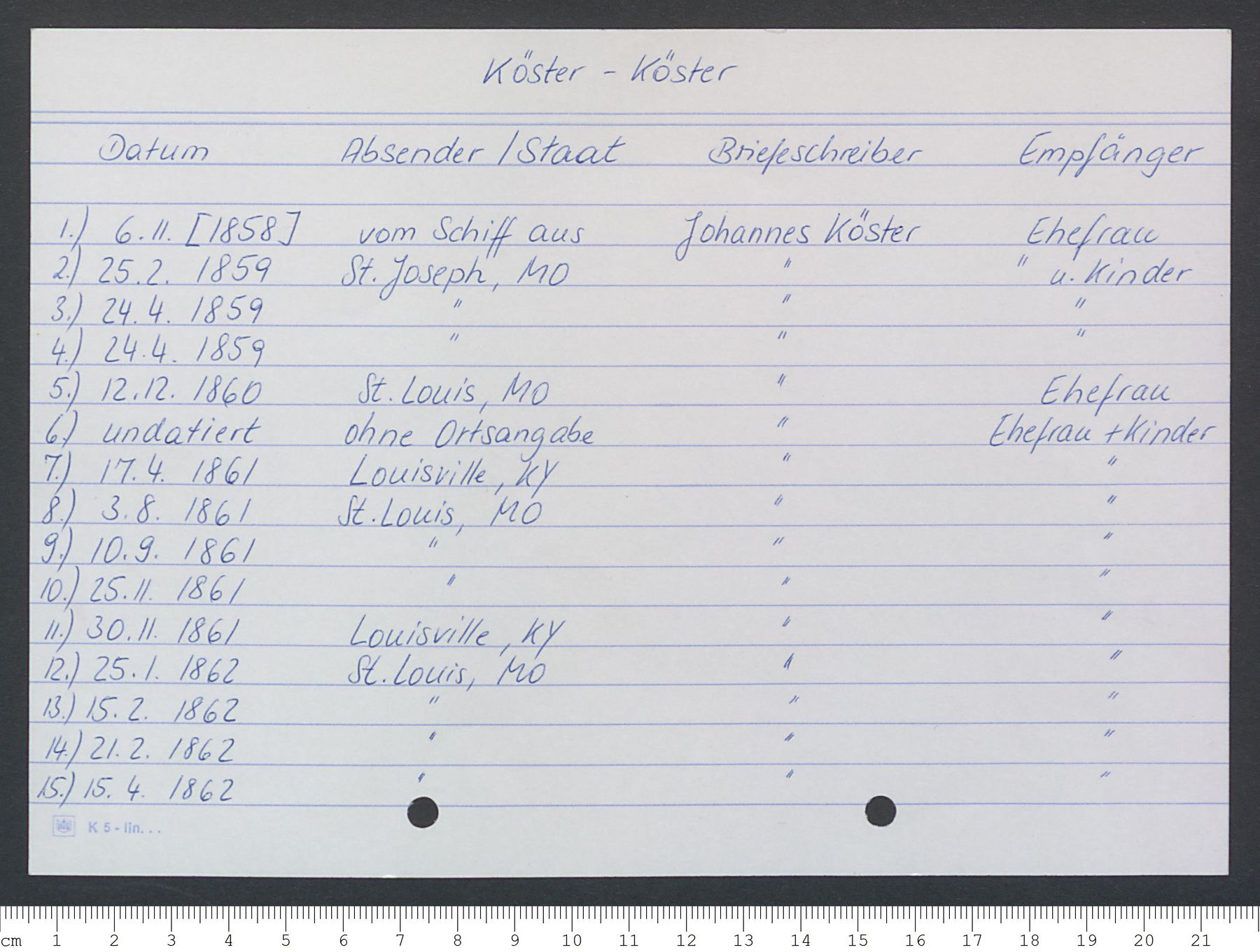
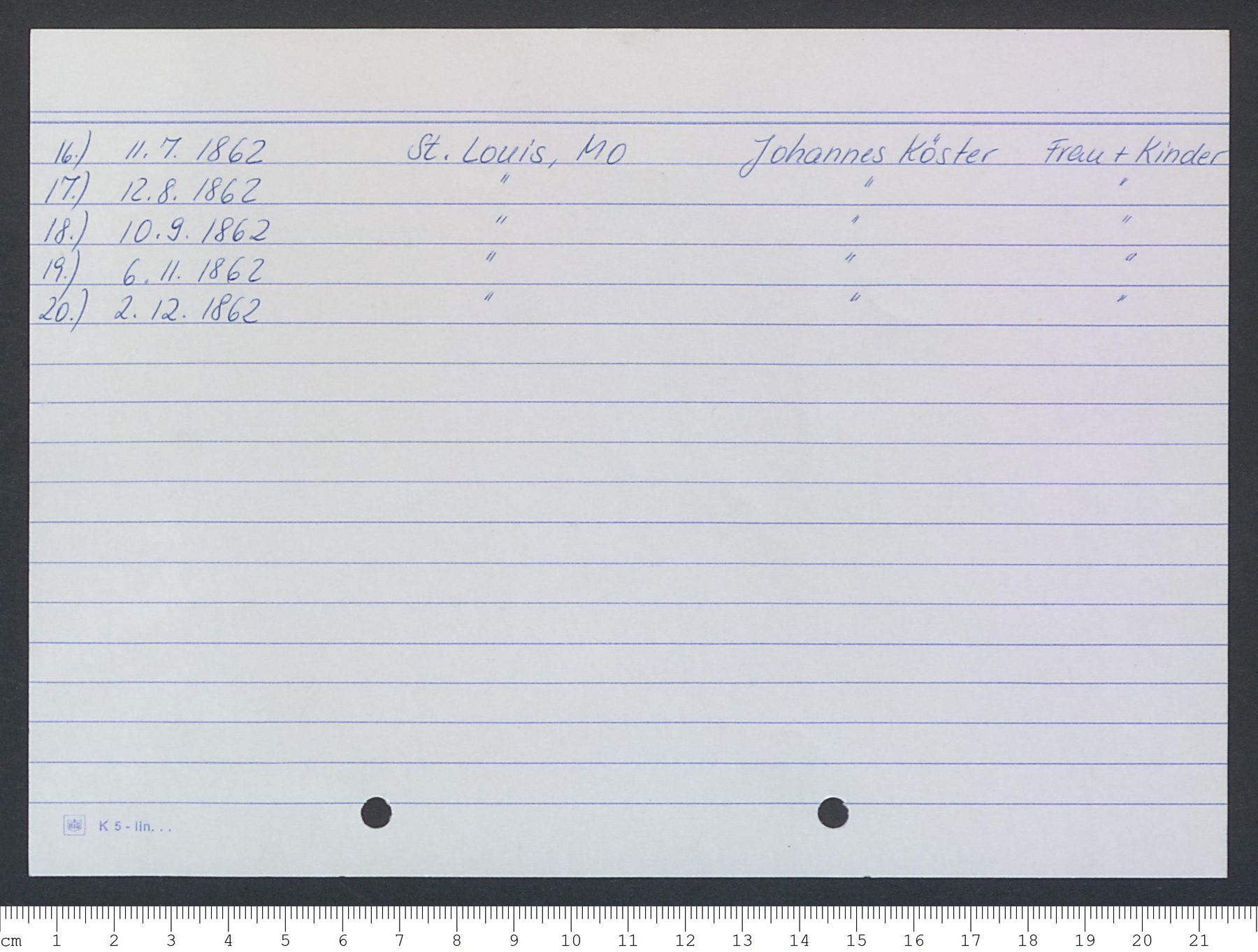
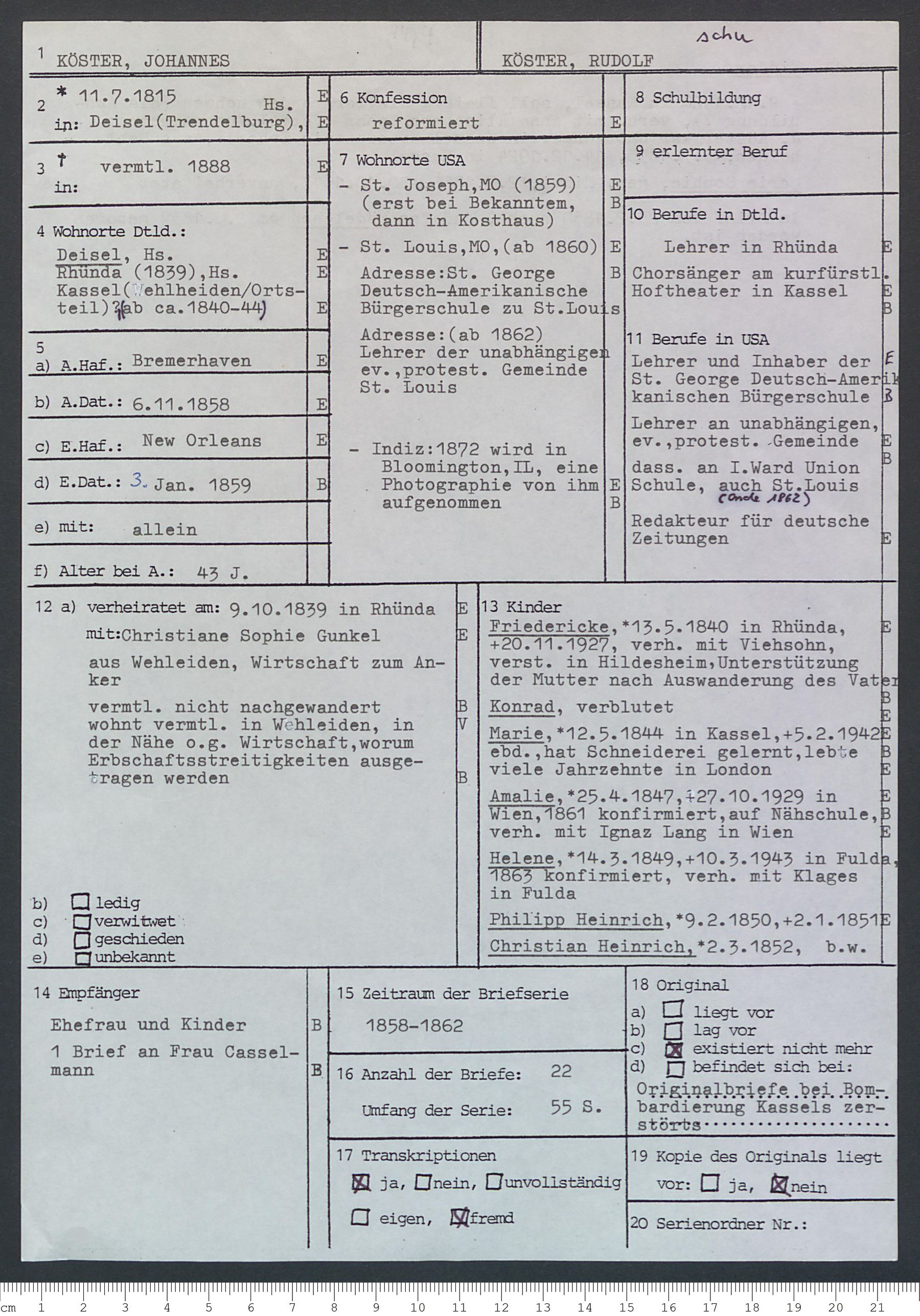
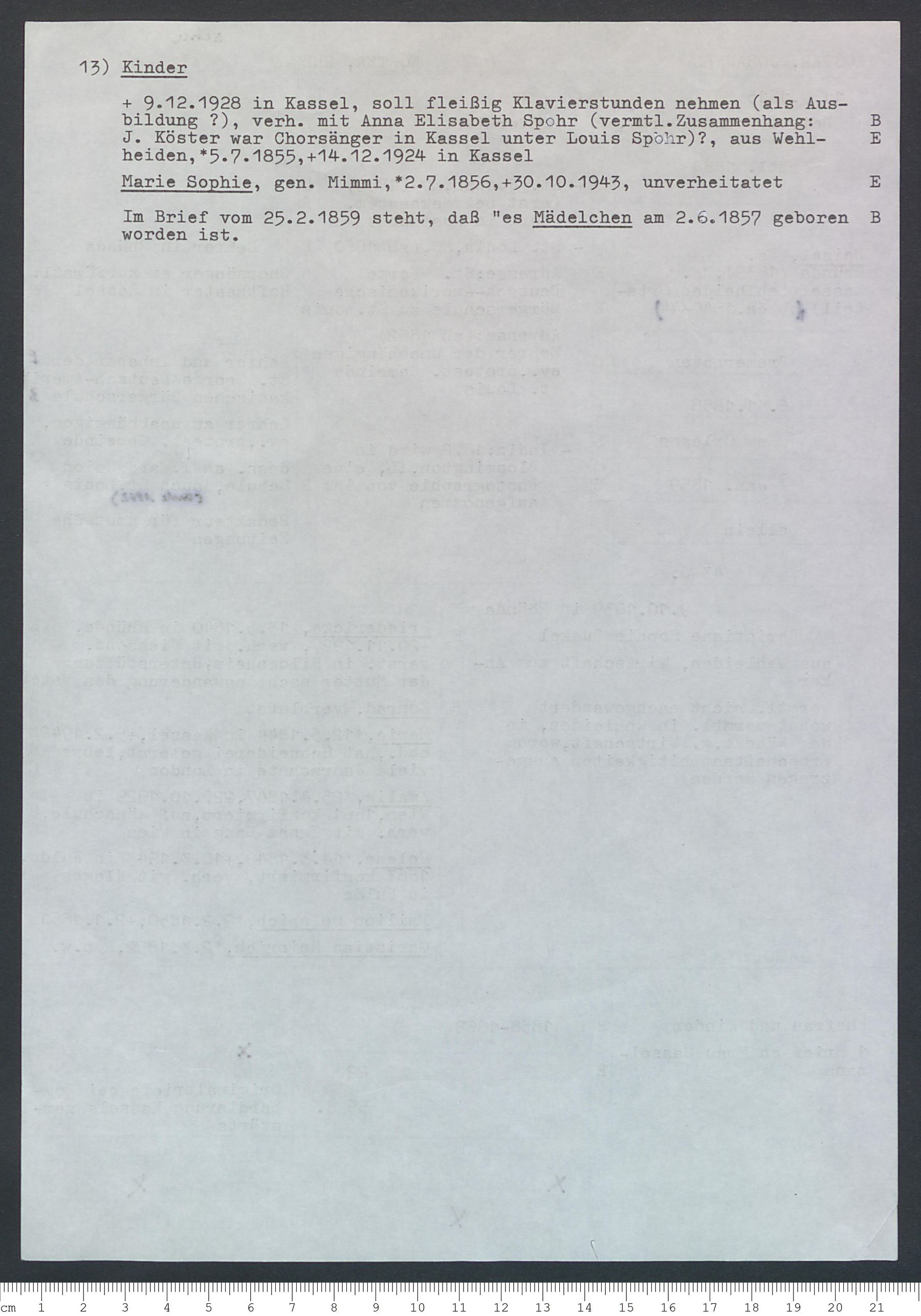
The NABS Personalkarte
The collection's structured analysis card, and the densest single leaf in the series. Parents Johannes Köster, Gastwirt (1785–1838) and Marie Fremder (1786–1870), married 22 February 1811. Siblings Konrad, Philipp, Ludwig (to Holland), Heinrich (Baltimore) and Georg, “war Husar, 1860 in Australien.” Emigration cause: “Politischer Druck”. The card also records the chain that met him — Pfangkuche of Gottsbüren at St. Joseph in 1859, Bade of Hümme, Grebenstein, Bödicker — and notes he was known in Kassel as “der schöne Köster”.
Images 0010–0012 · 3 leaves · read: 0010
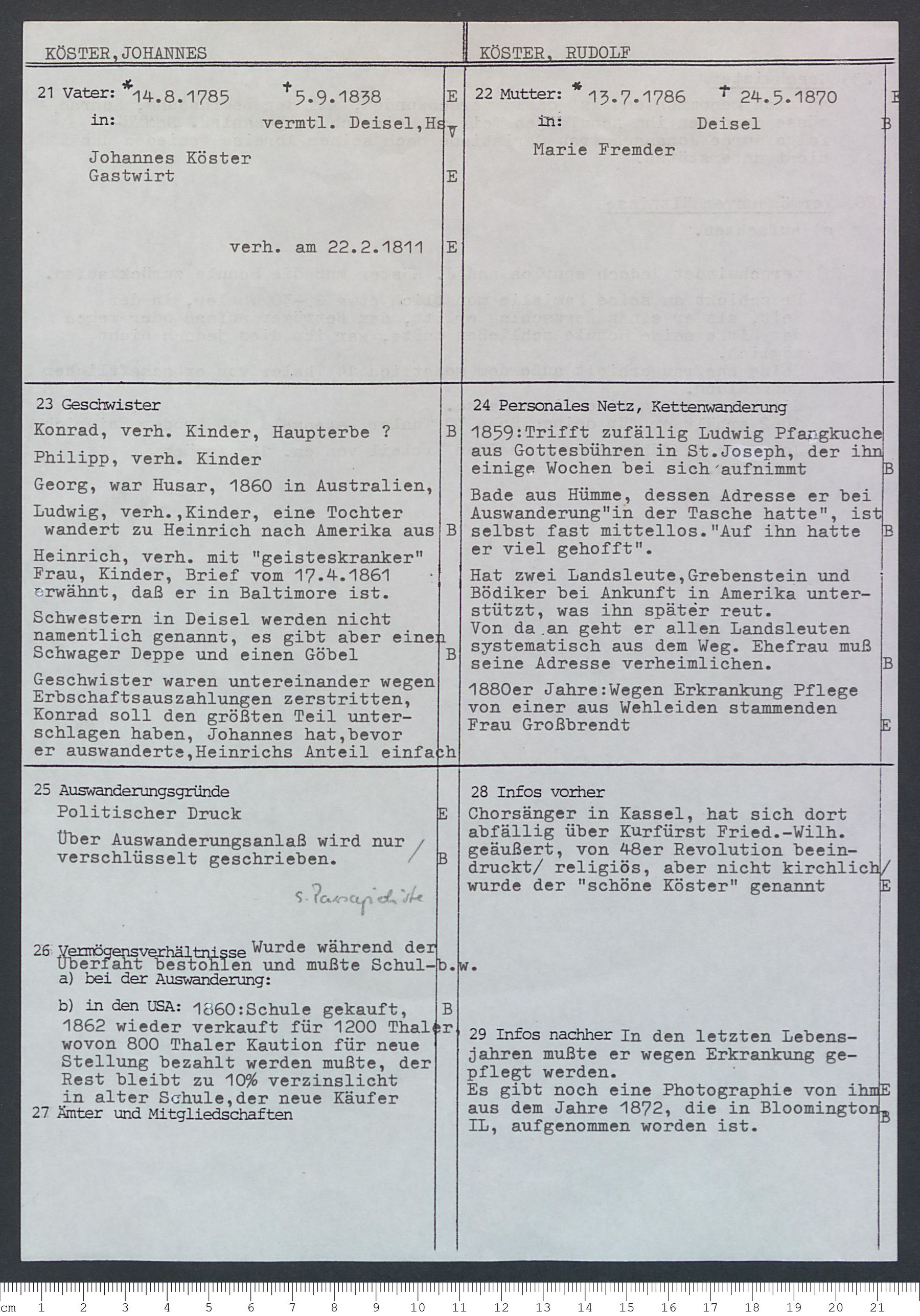
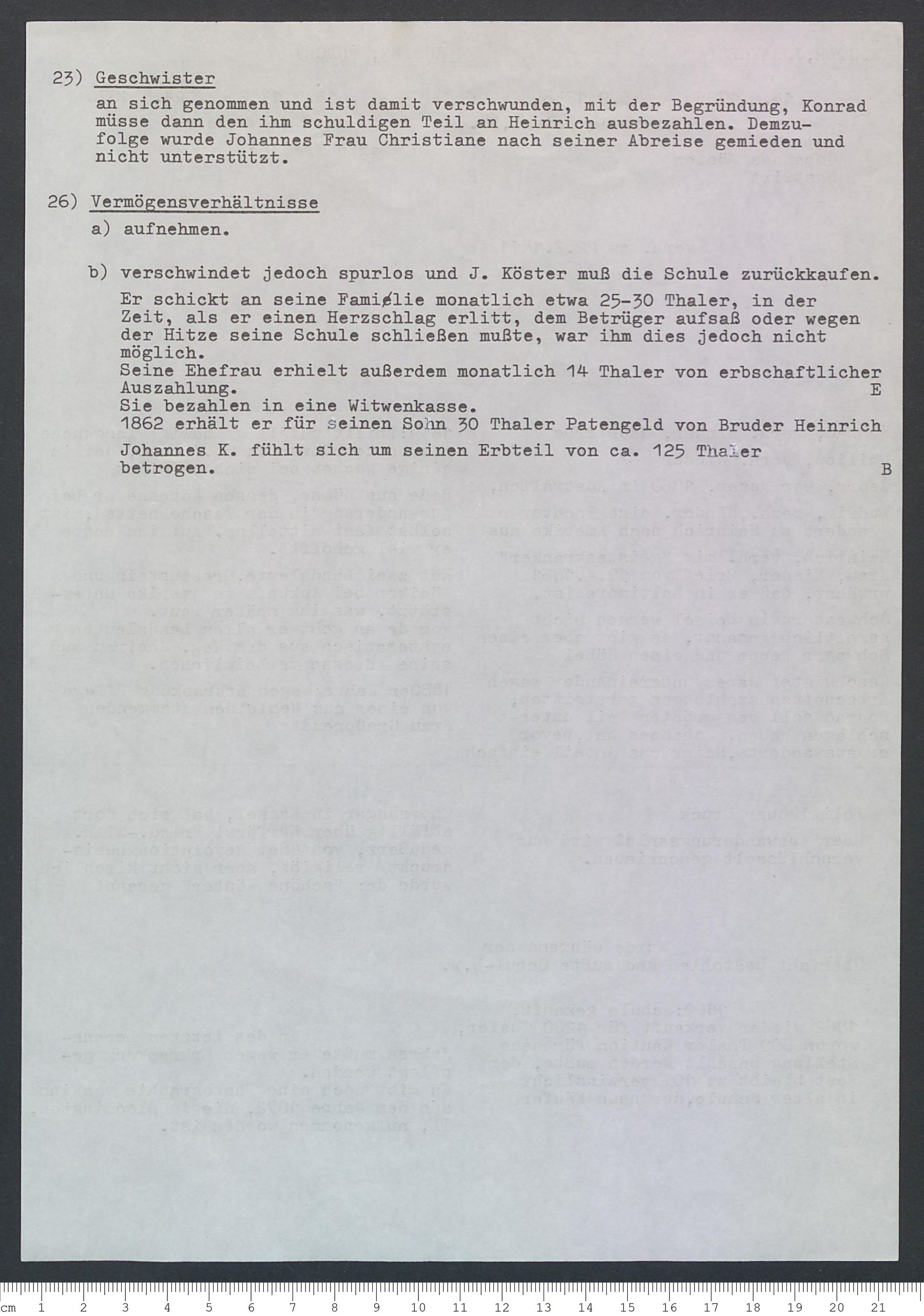
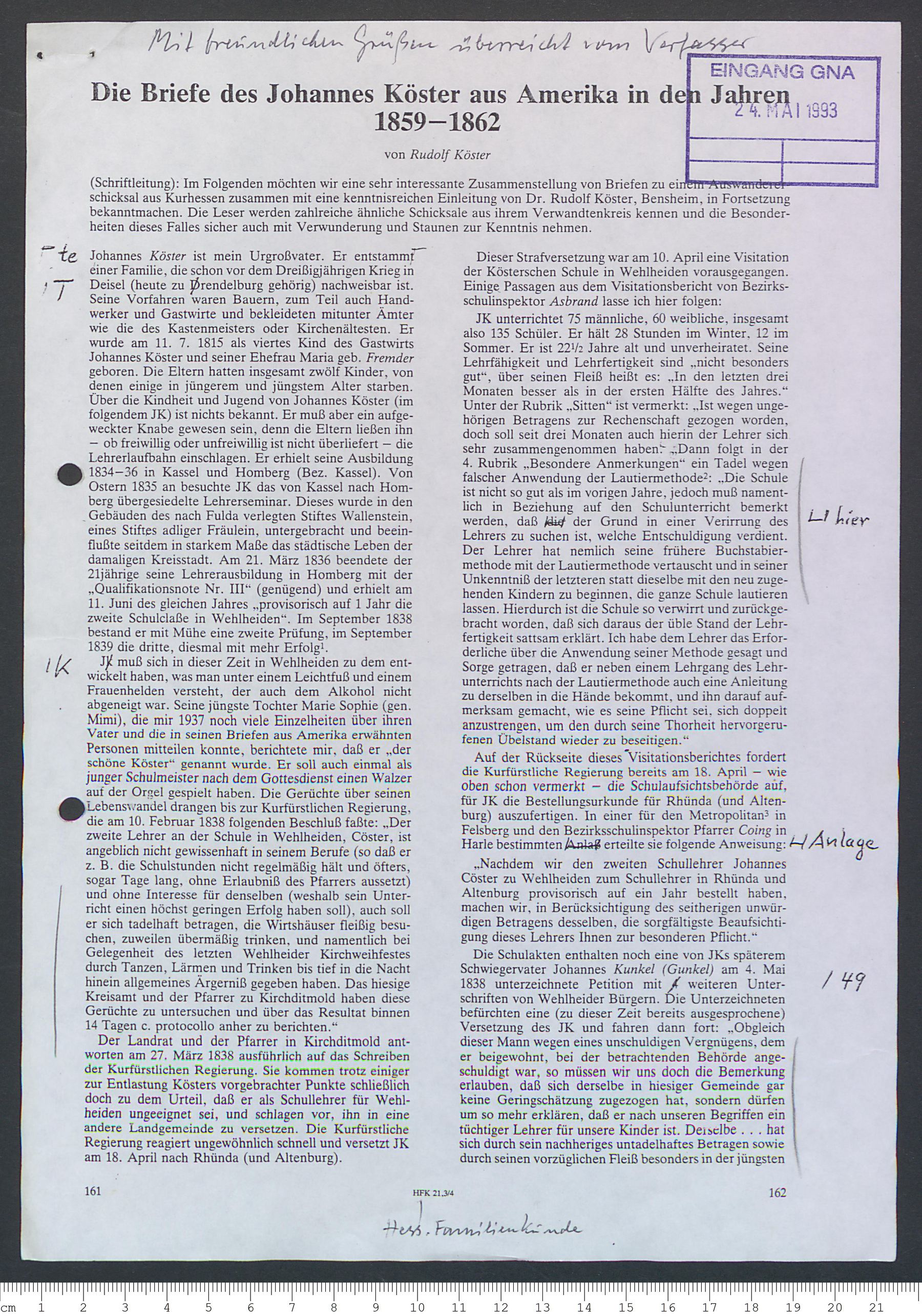
Rudolf Köster's article
The printed article by the descendant who assembled this archive: “Die Briefe des Johannes Köster aus Amerika in den Jahren 1859–1862.” It is where the 1860 census household — and with it the second Wilhelmine — is set out, and where the editor calls his ancestor's conduct “ein psychologisches Rätsel.”
Images 0013–0018 · 6 leaves · read: the whole range (July 2026)
The Bloomington book — and his face
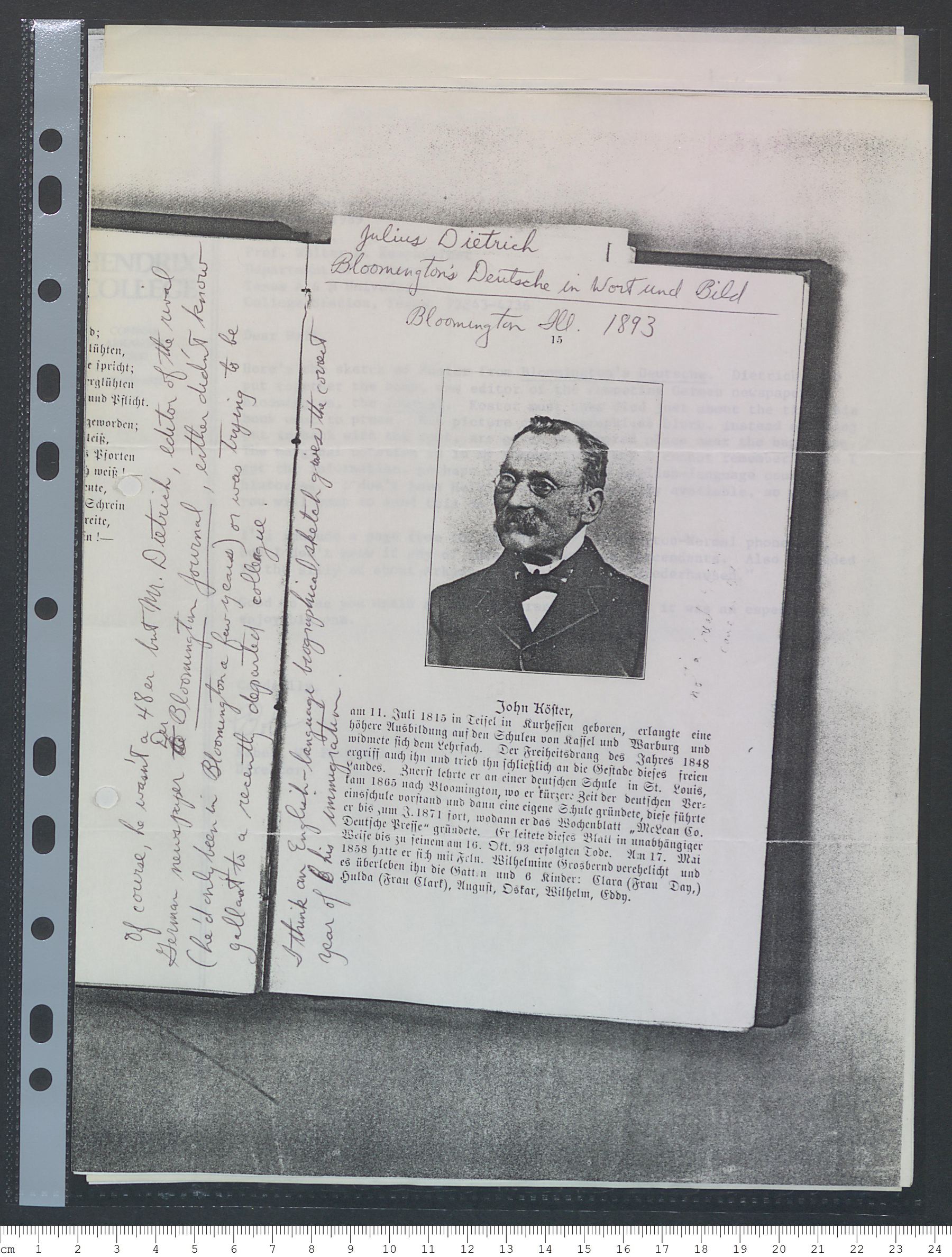
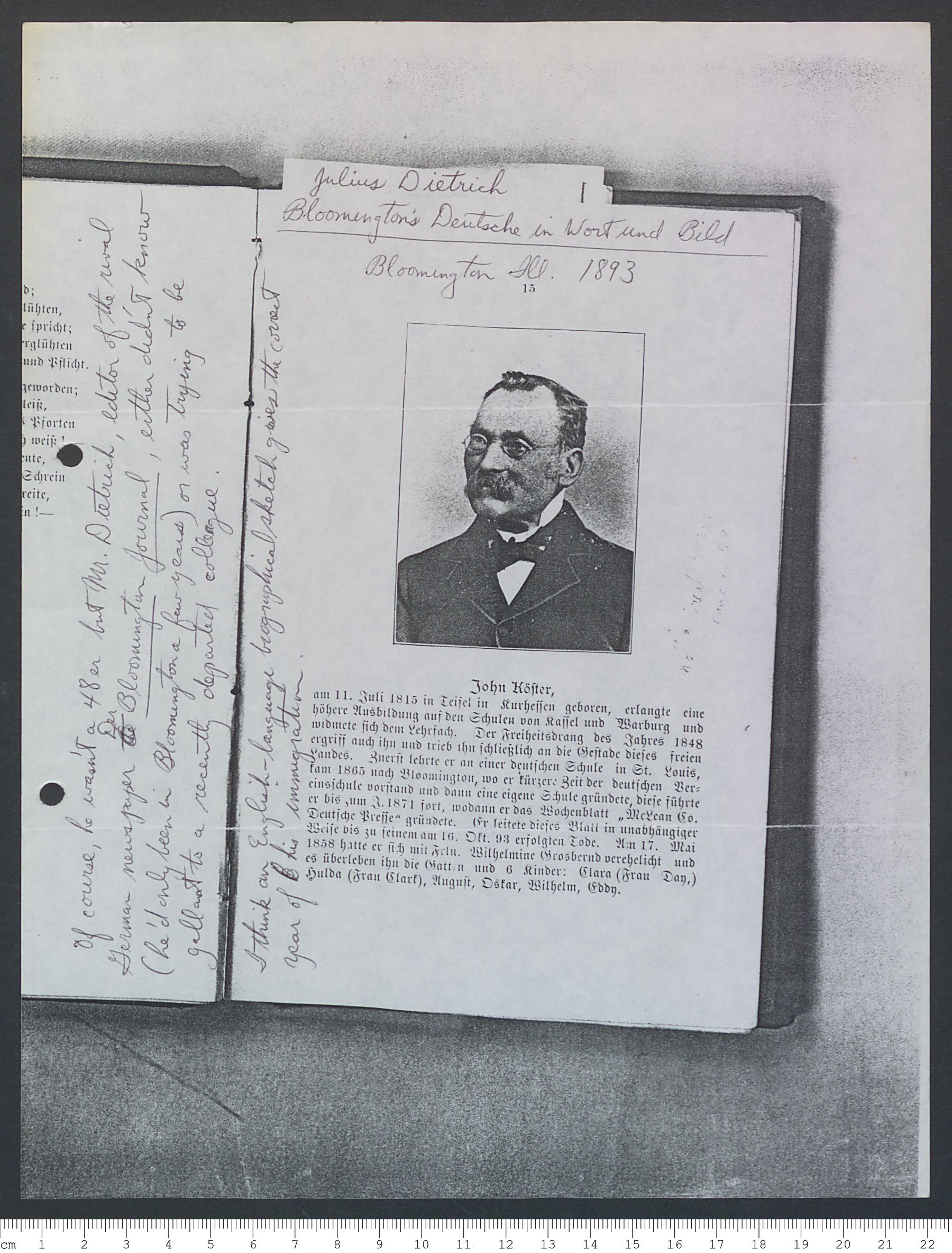
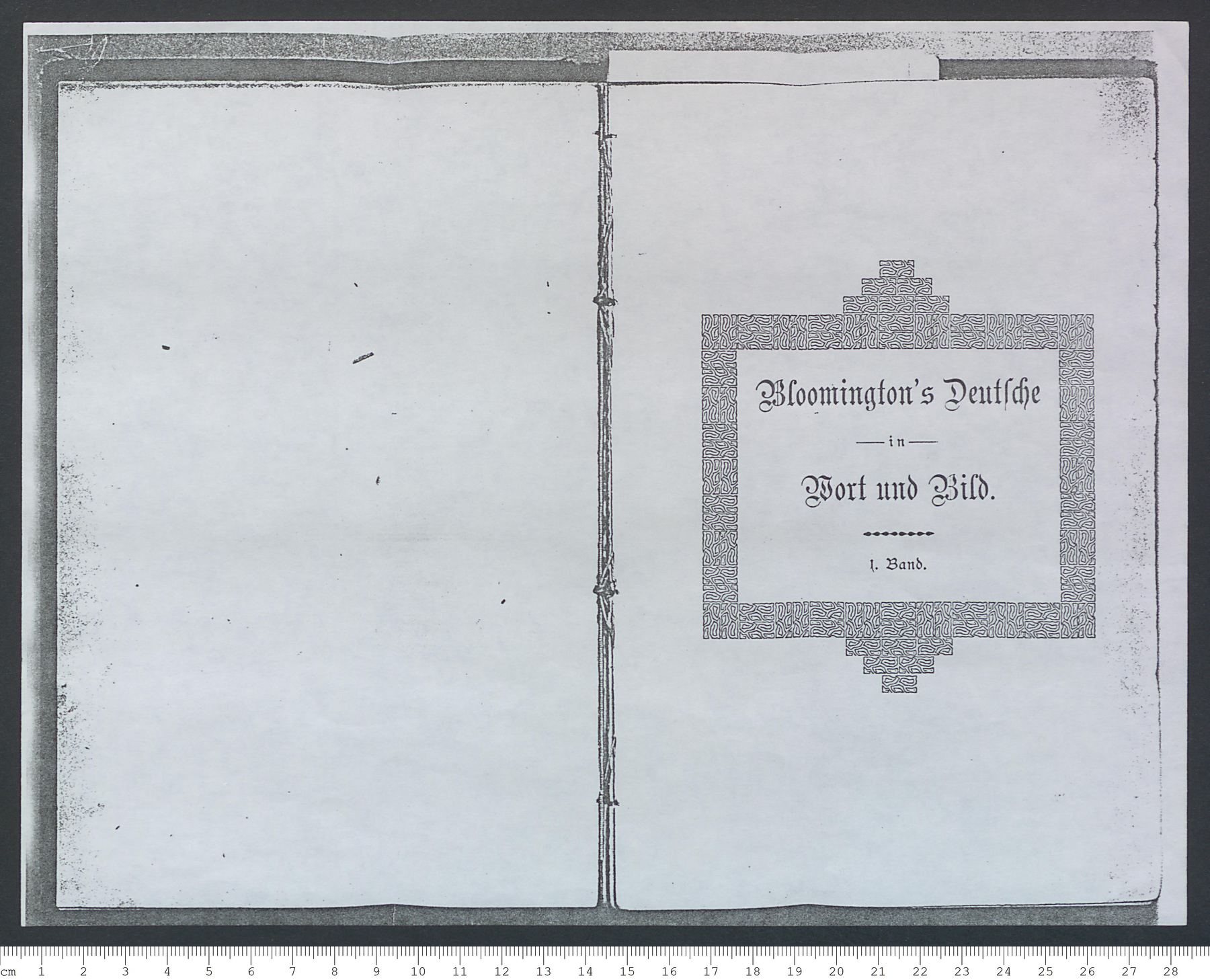
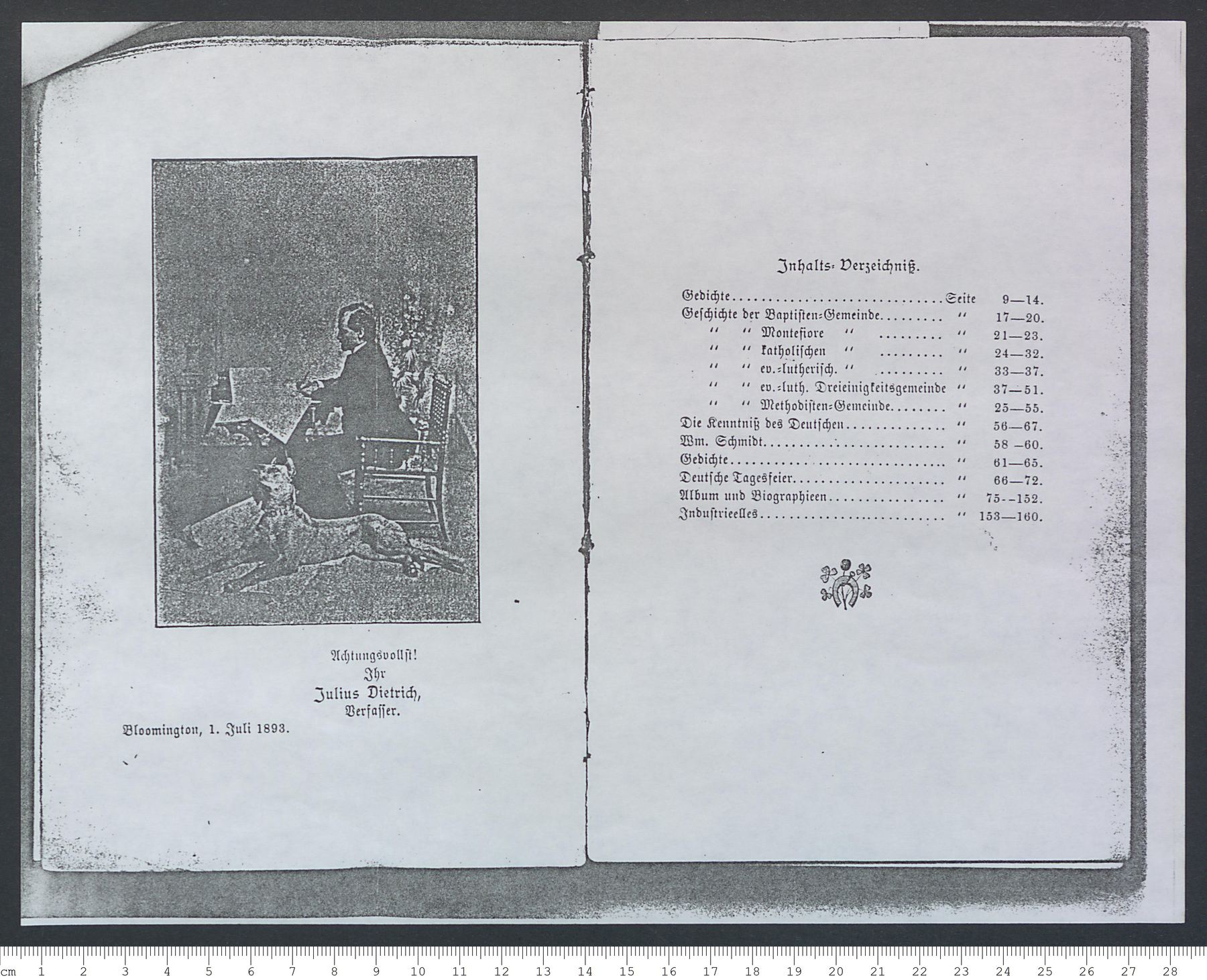
Julius Dietrich, Bloomingtons Deutsche in Wort und Bild (Bloomington, Ill., 1893), photographed open. It carries an engraved portrait of John Köster above a biographical notice — so far as this project knows, the only likeness of any of the Deisel emigrants, and a near neighbor to the face Charles would have known.
Images 0019–0027 · 9 leaves · read: 0019, 0023
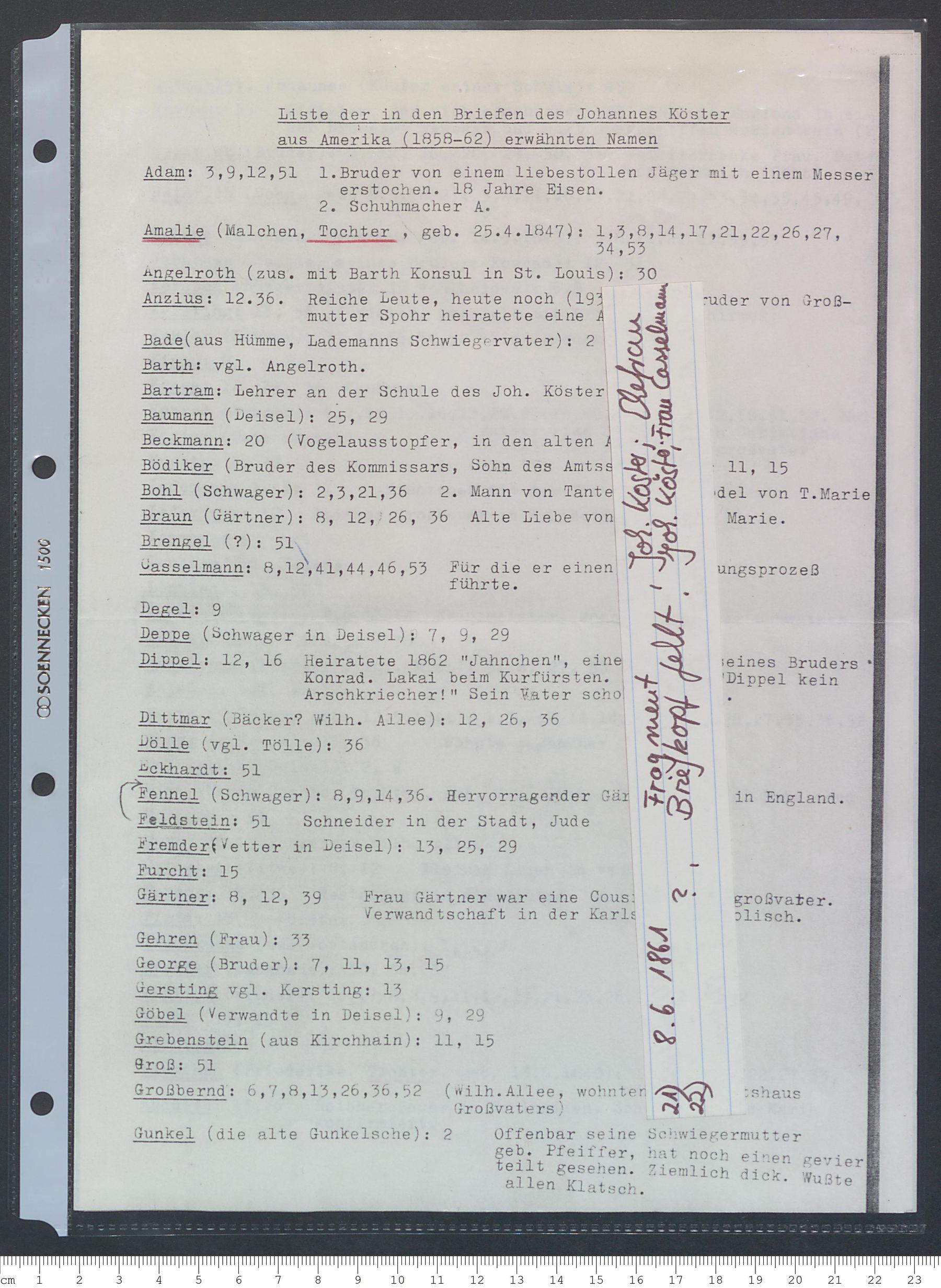
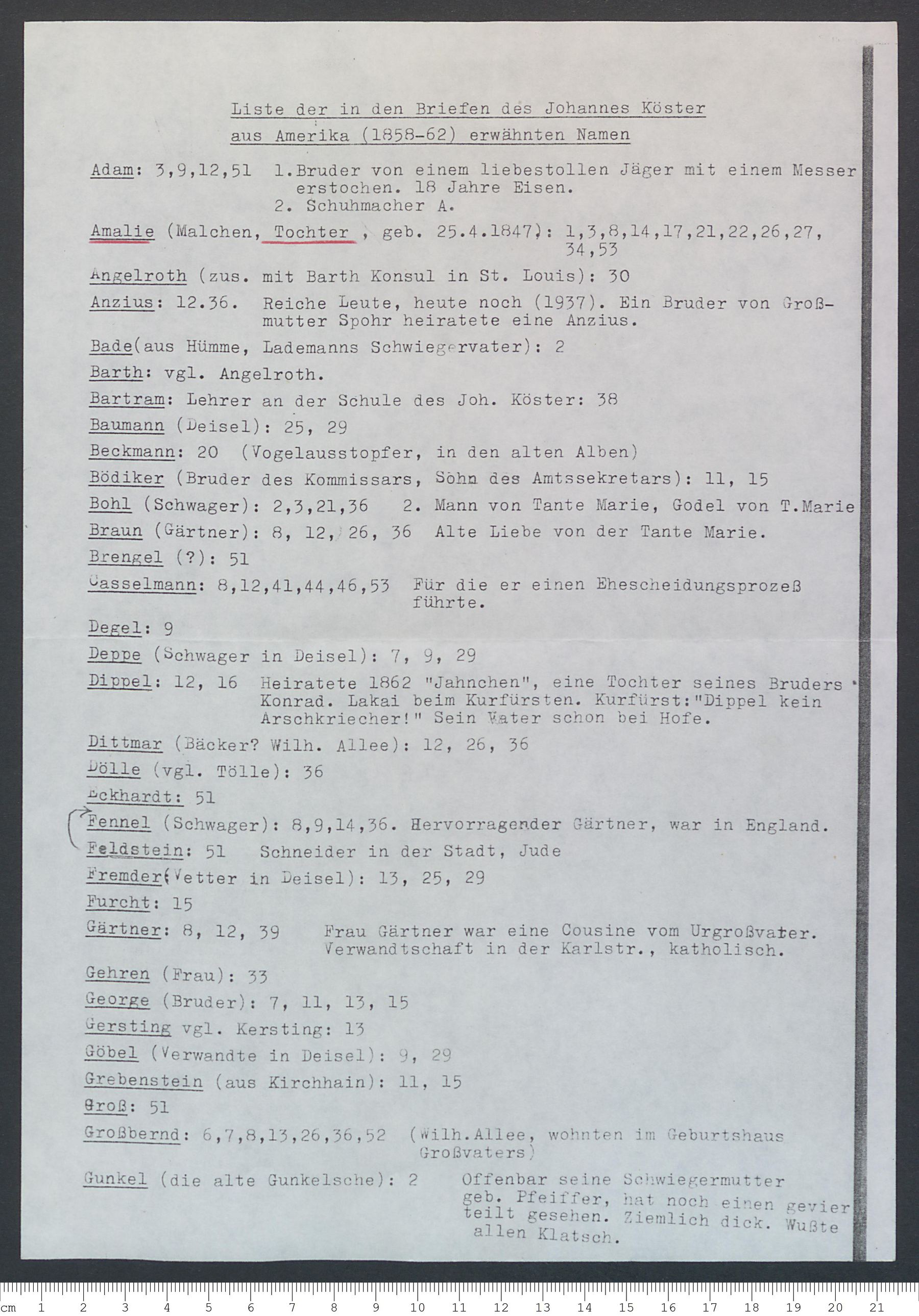
The Lebenslauf and the 1937 name index
The typed life compiled by Ernst Köster at Kassel on 20 April 1961 — the single source for the departure from Bremen on 6 November 1858 by sailing ship, seven to eight weeks out. It is followed by the alphabetical index of every person the letters name, annotated in 1937 from interviews with Johannes's surviving daughters Marie and Mimi. Because images 0113–0119 resist OCR, that index remains the evidence for the autograph leaves.
Images 0028–0035 · 8 leaves · read: 0028, 0033

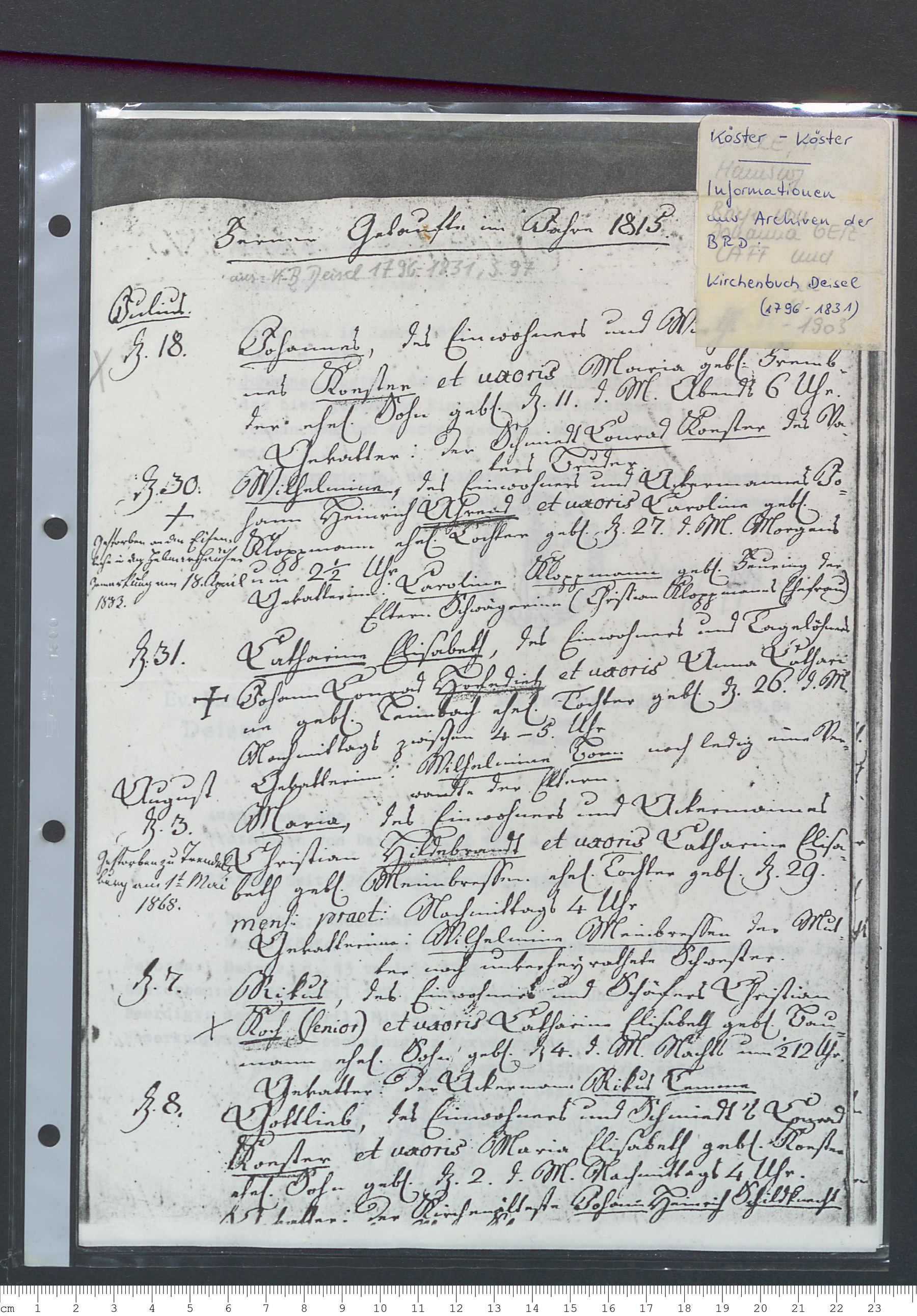
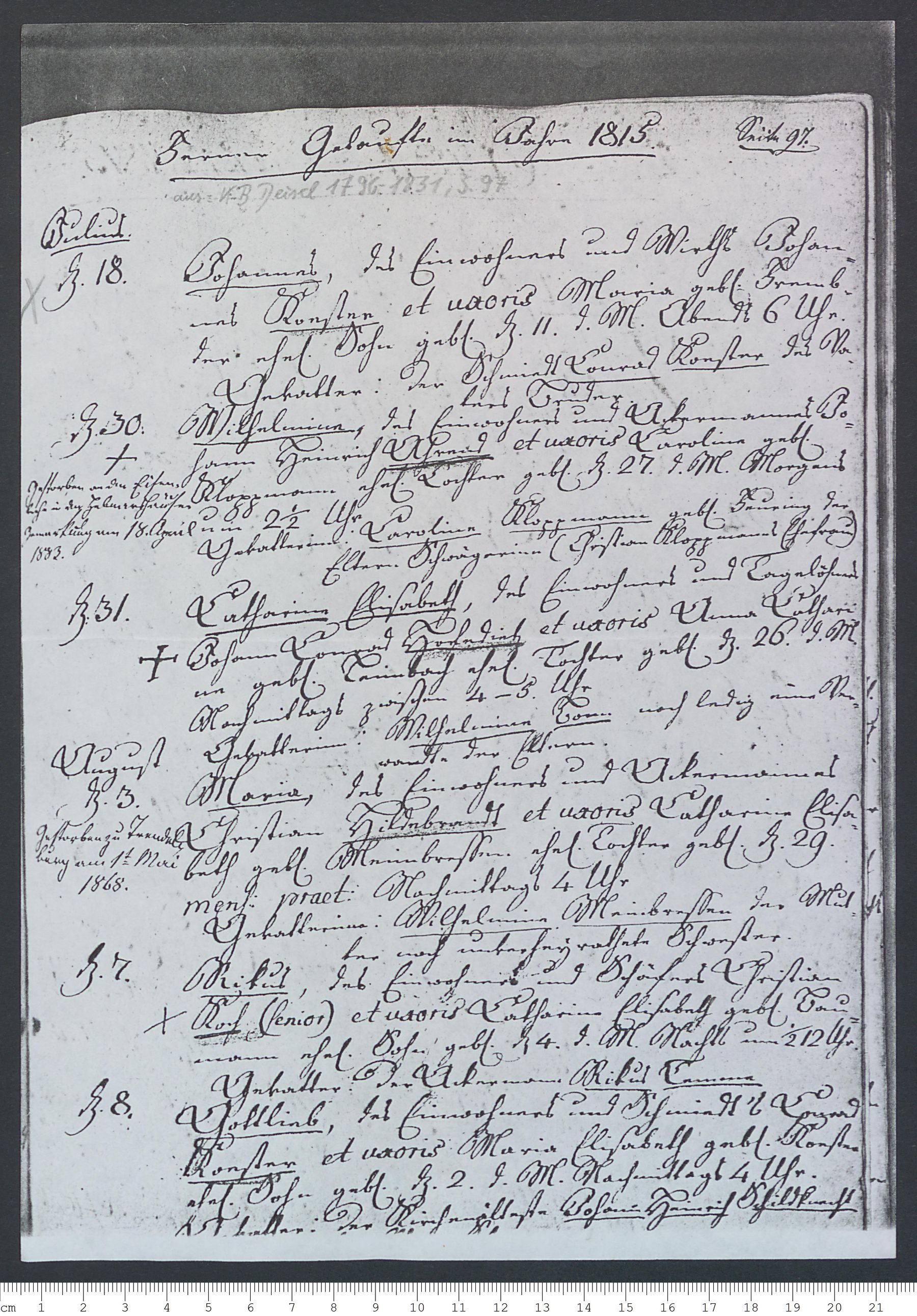
Parish, census and passenger-list research
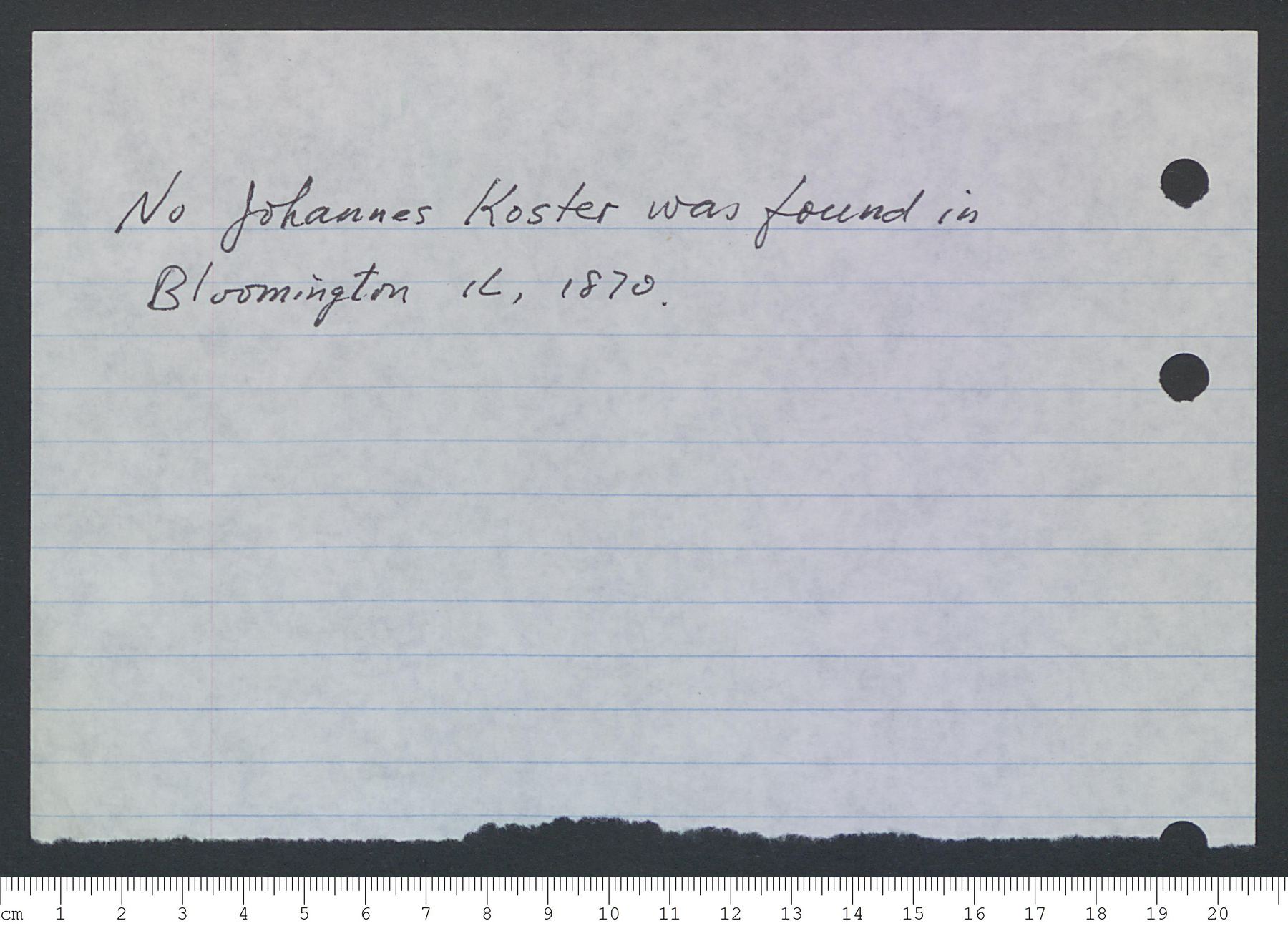
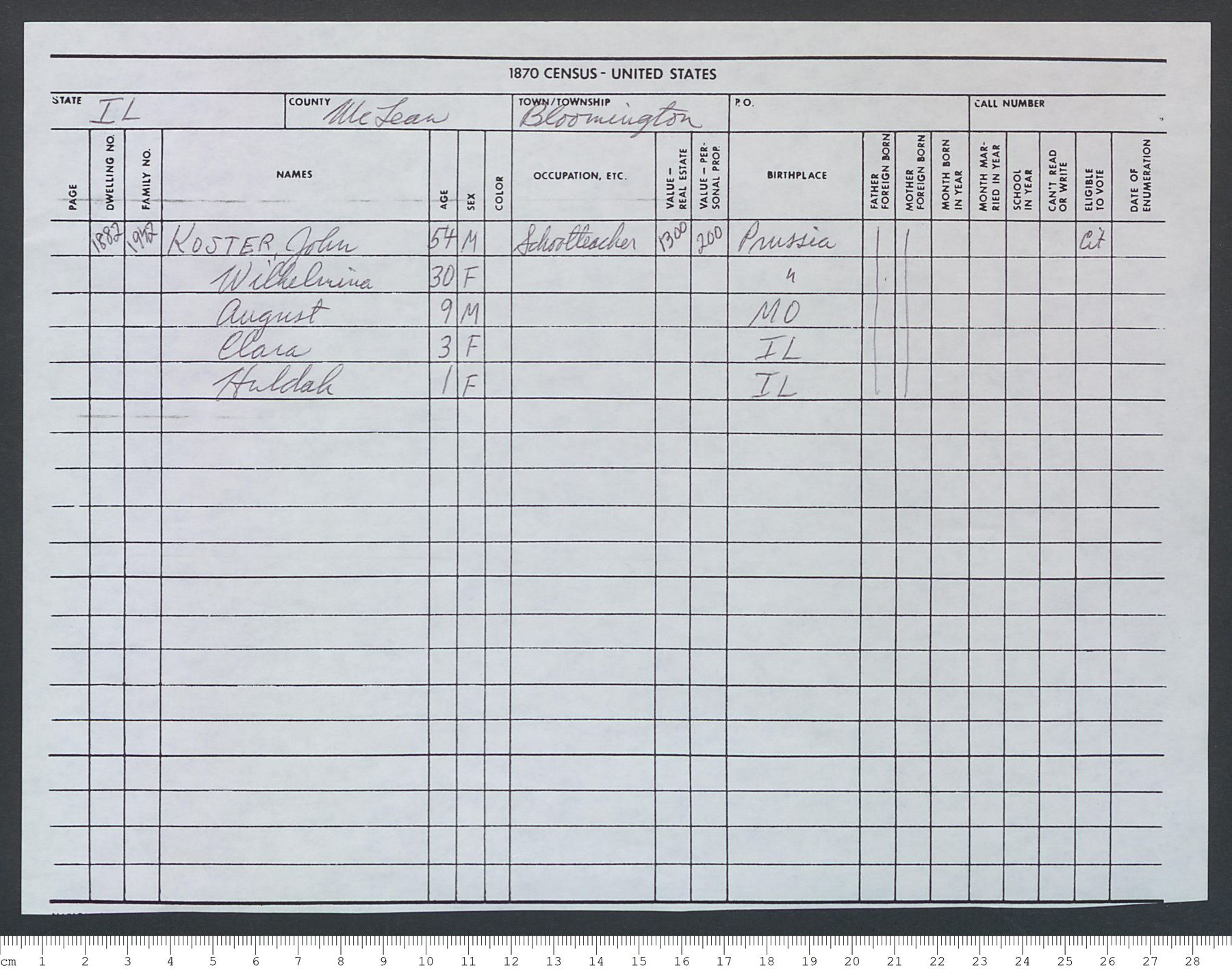
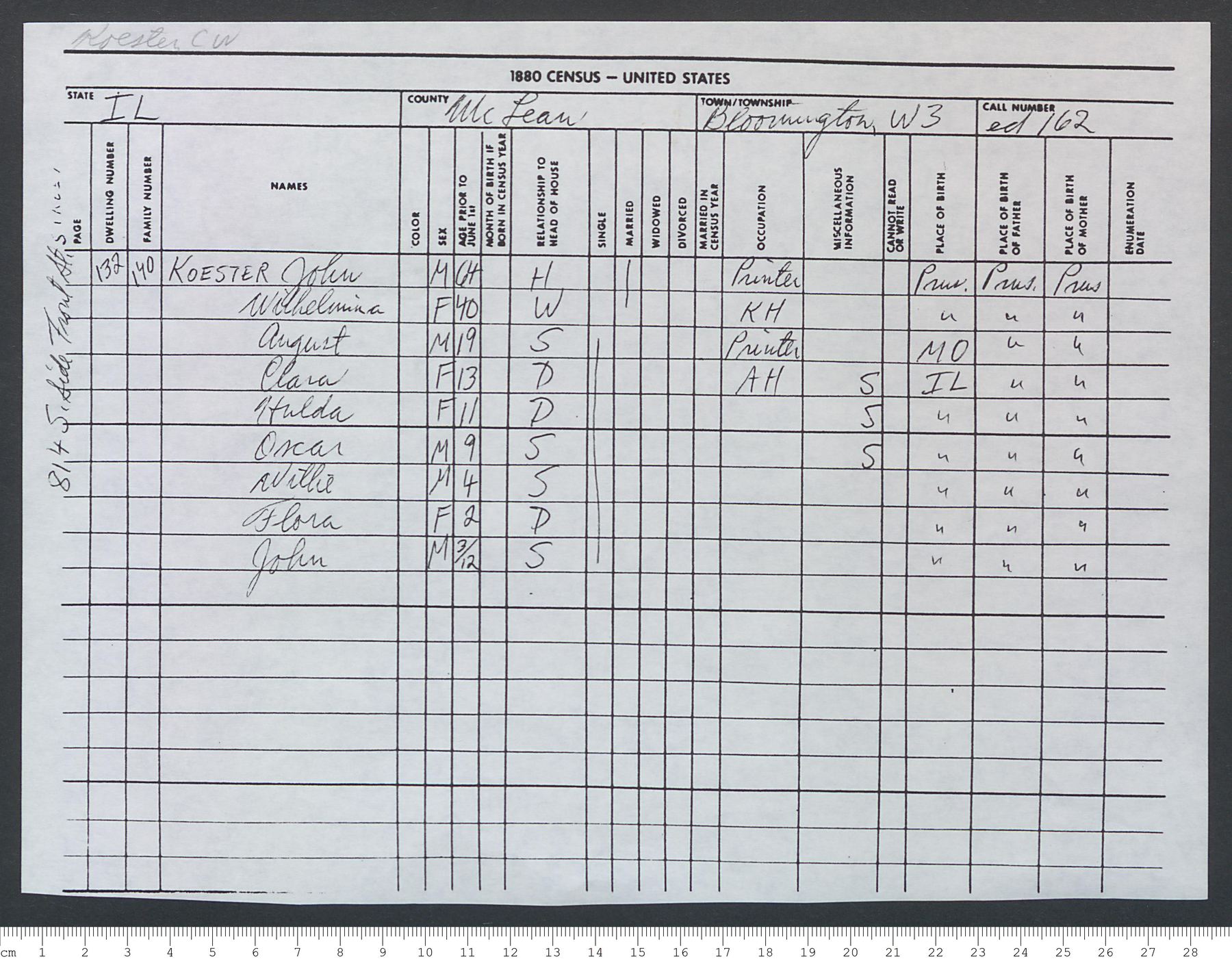
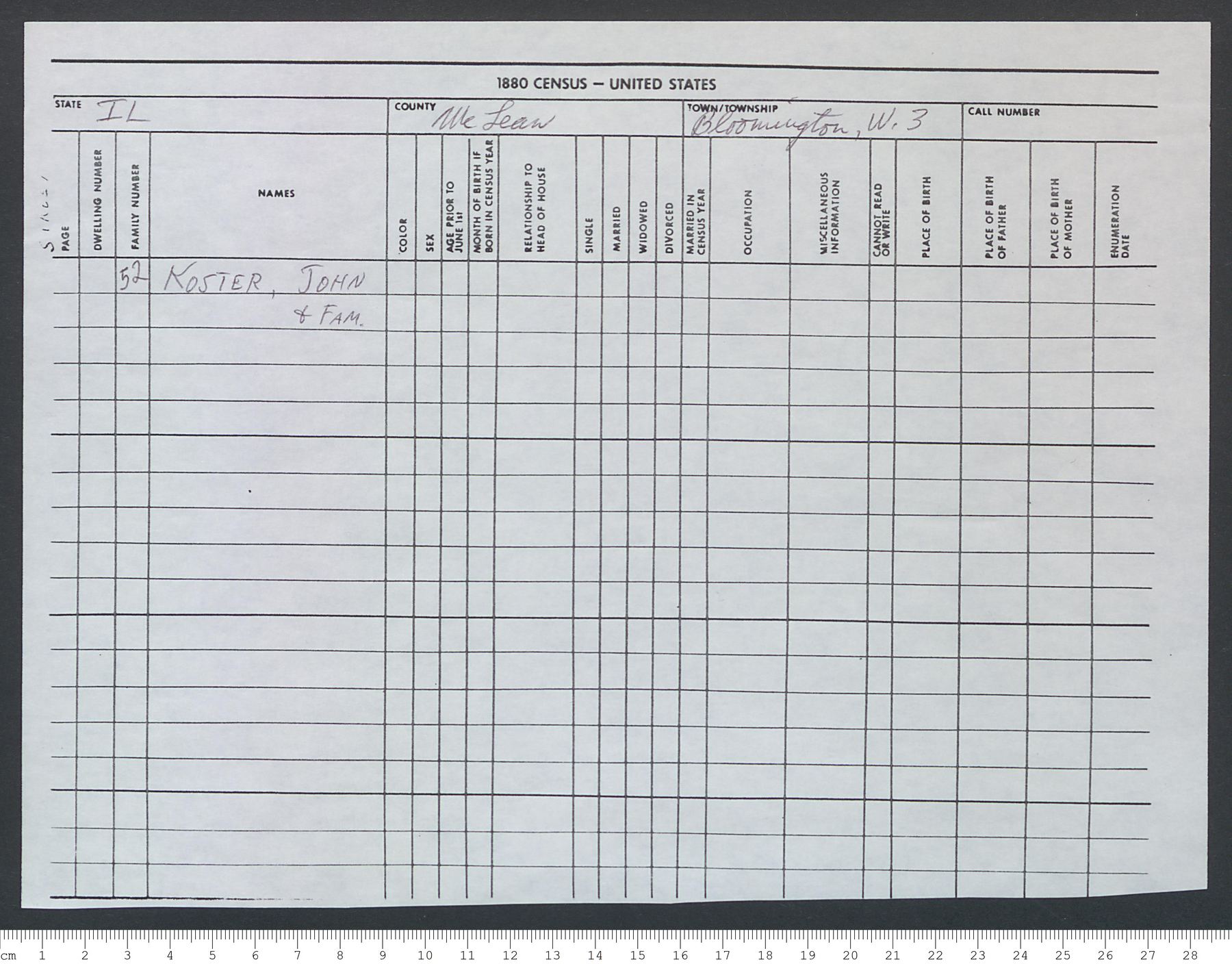
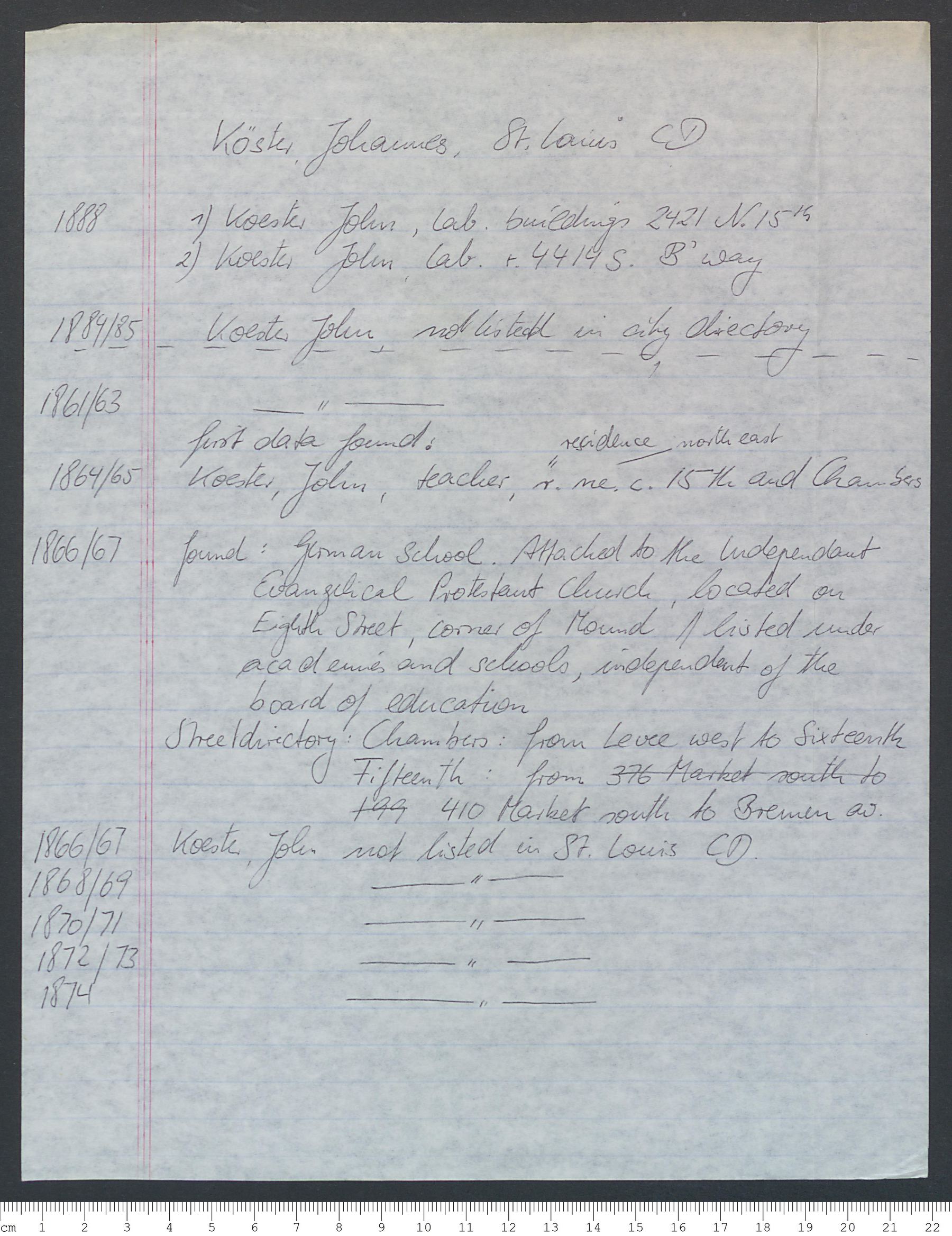
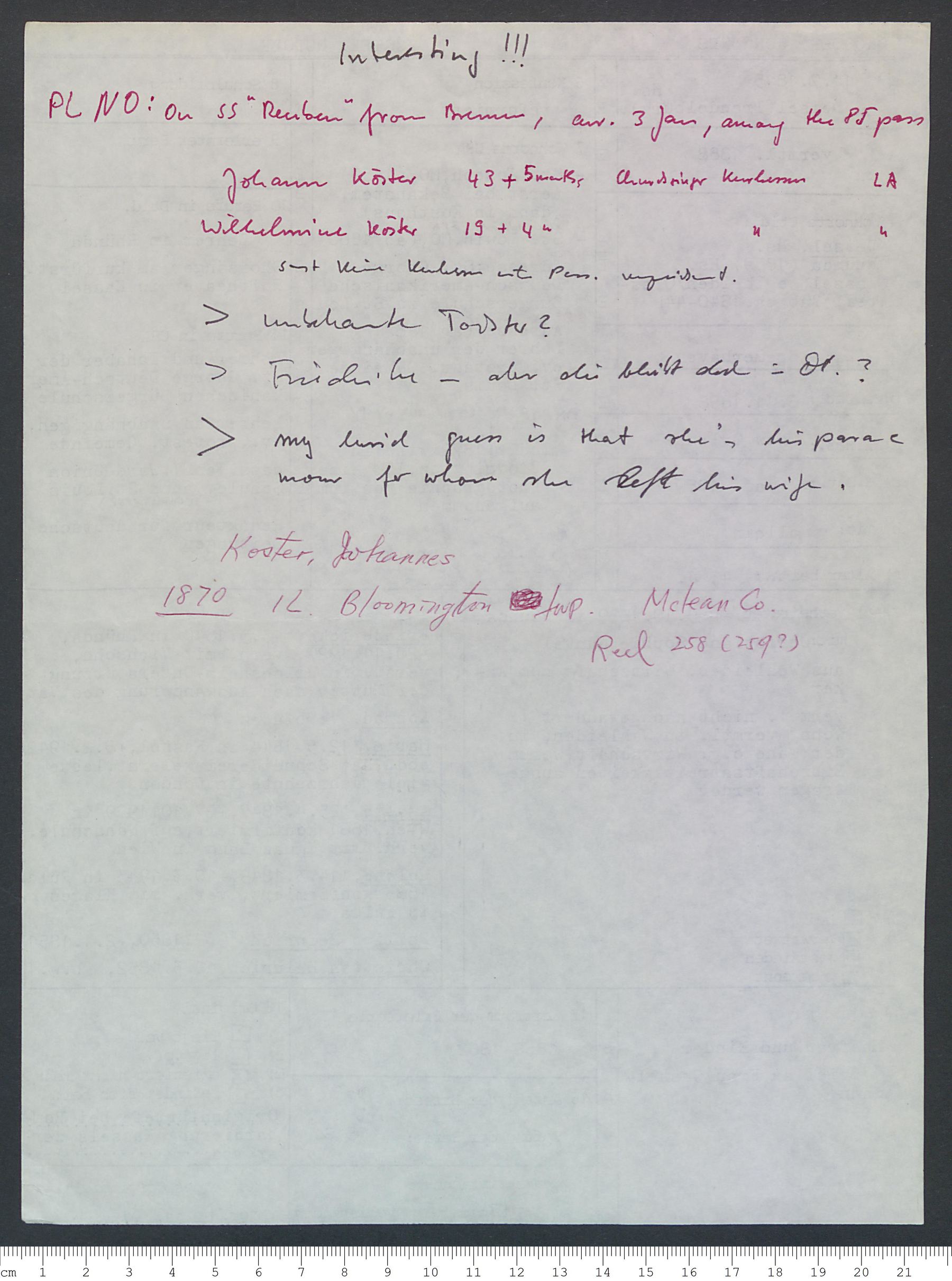
The research file behind the archive: a photograph of the Deisel Kirchenbuch birth entries, US census extracts for 1860, 1870 and 1880, and city-directory work. Image 0046 is the 1880 census for Bloomington Ward 3 — John Köster, teacher, with Wilhelmine as “KH” and seven children. Image 0050 is a later researcher's pencilled note that reaches the Rubens manifest independently — “arr. 3 Jan, among the 85 pass: Johann Köster 43+5 mnths” — and guesses, correctly, at what the young Wilhelmine was.
Images 0036–0051 · 16 leaves · read: 0036, 0041, 0046, 0050

The typed transcription — 55 pages
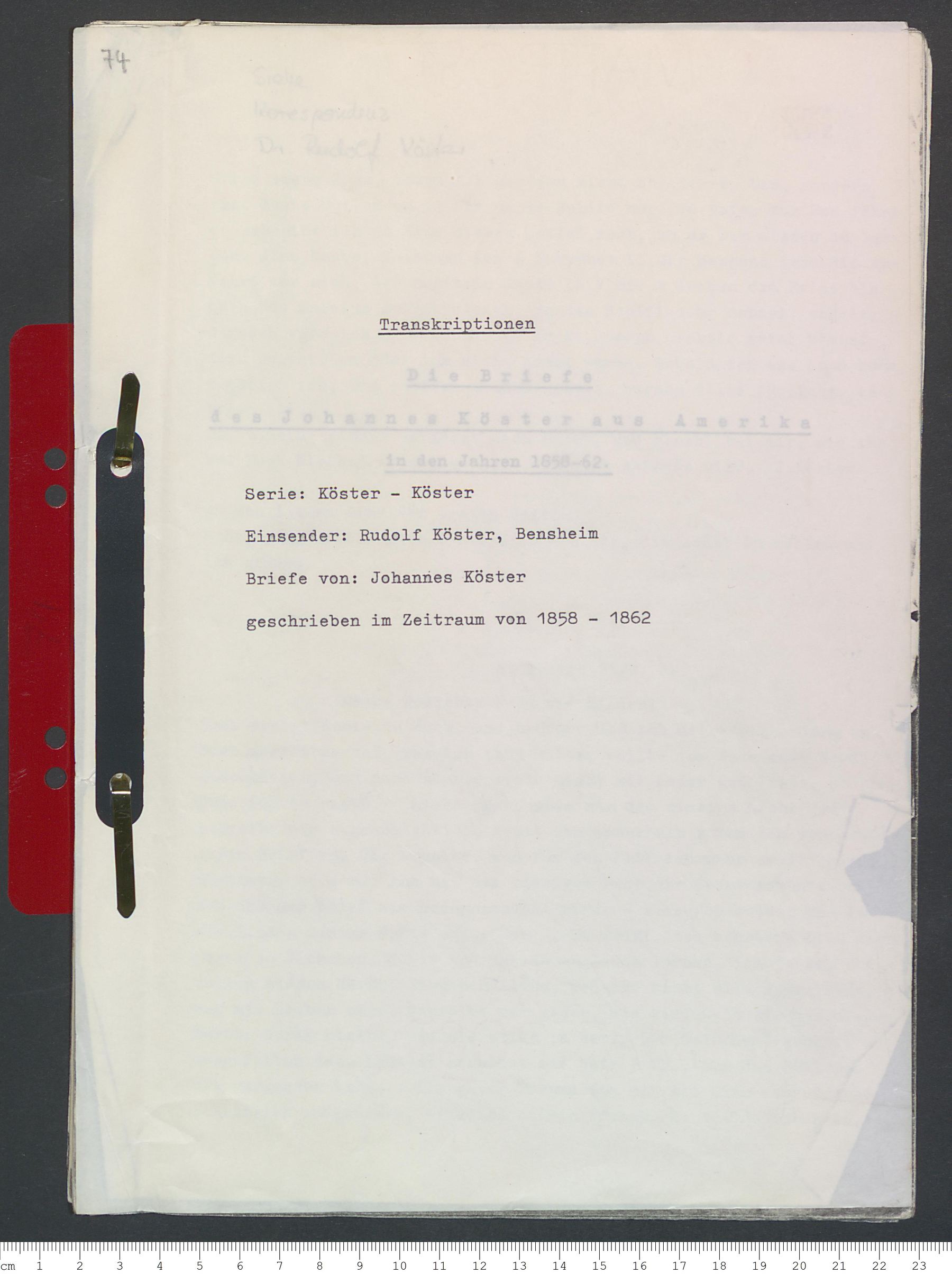
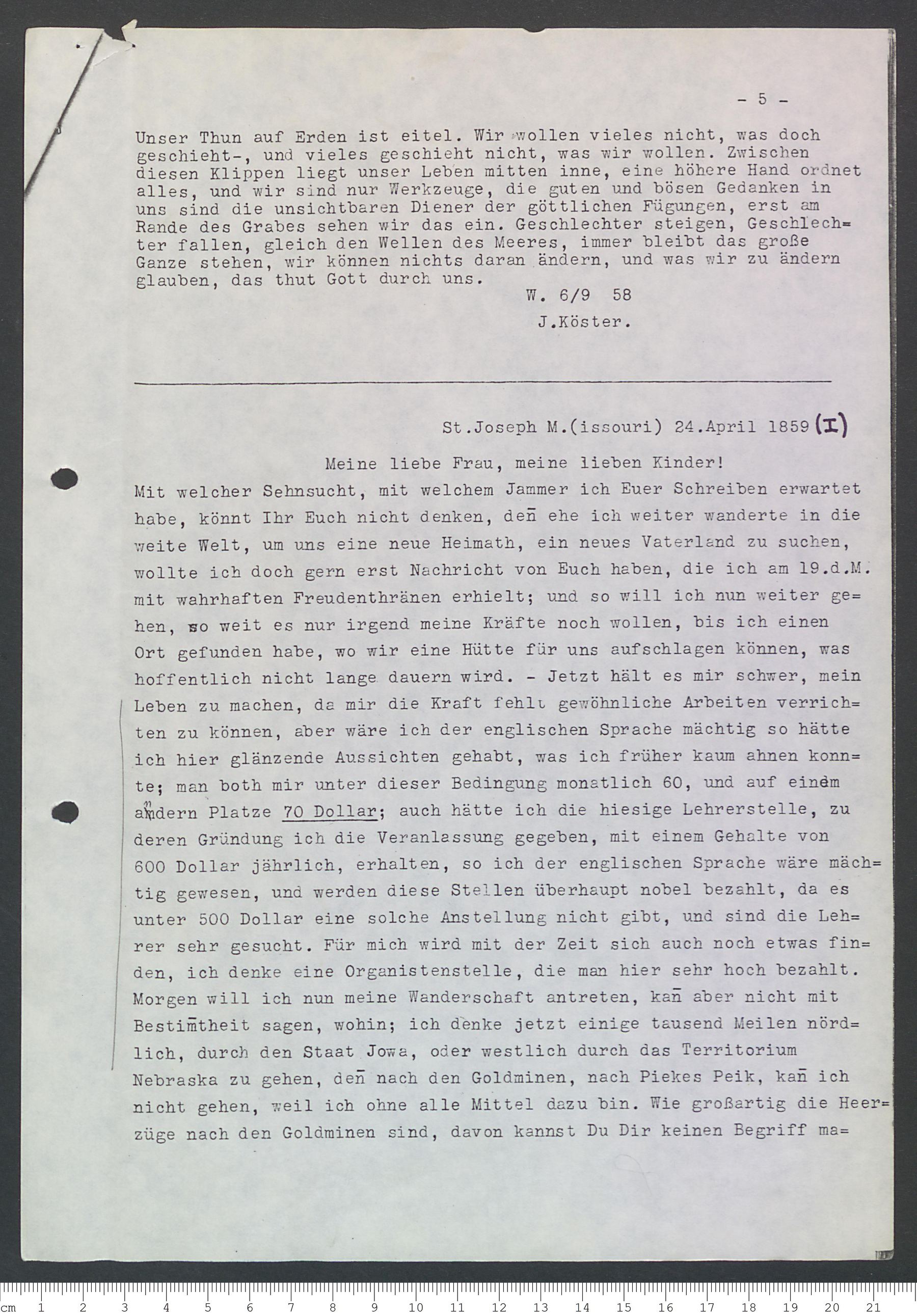
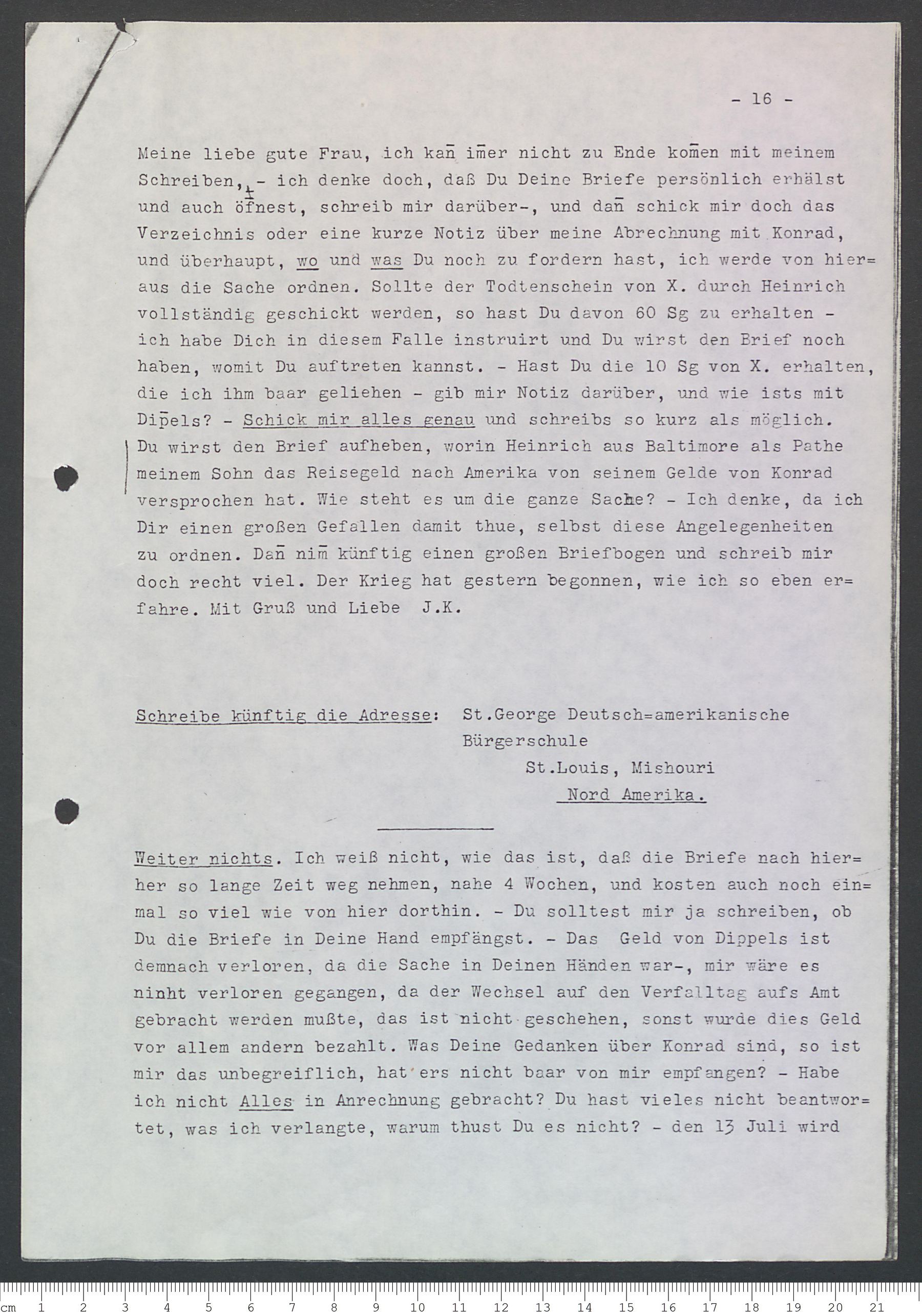
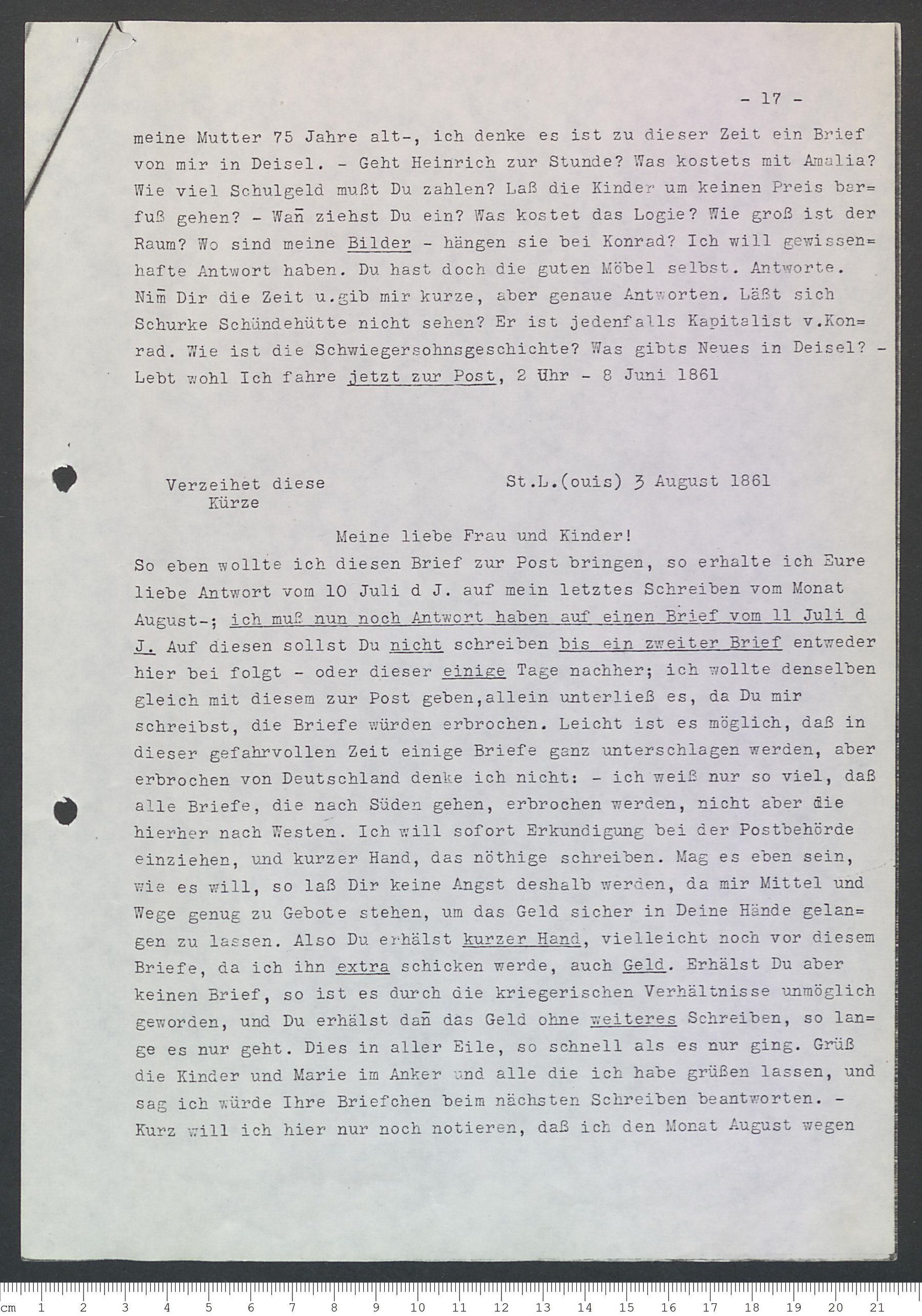
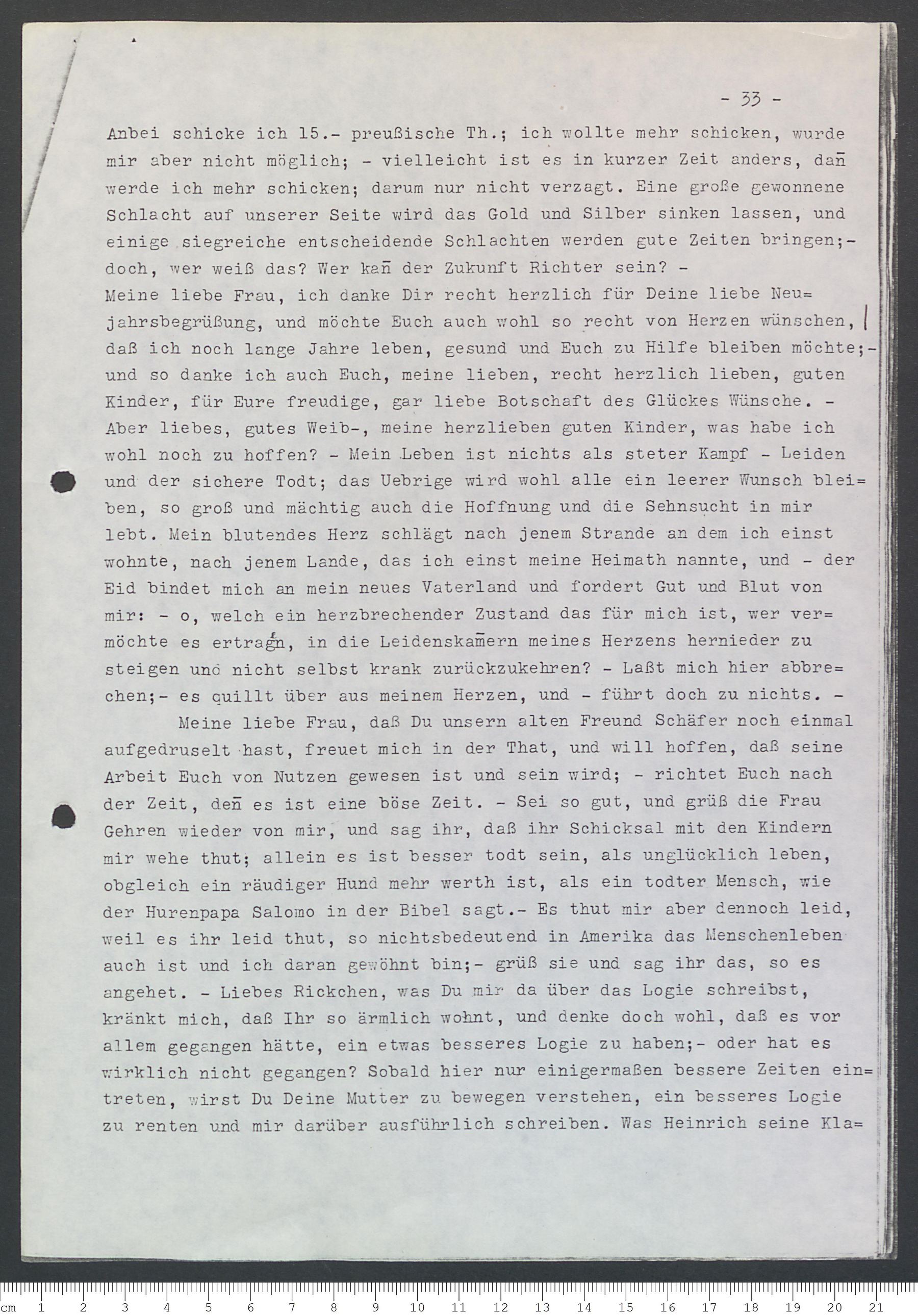
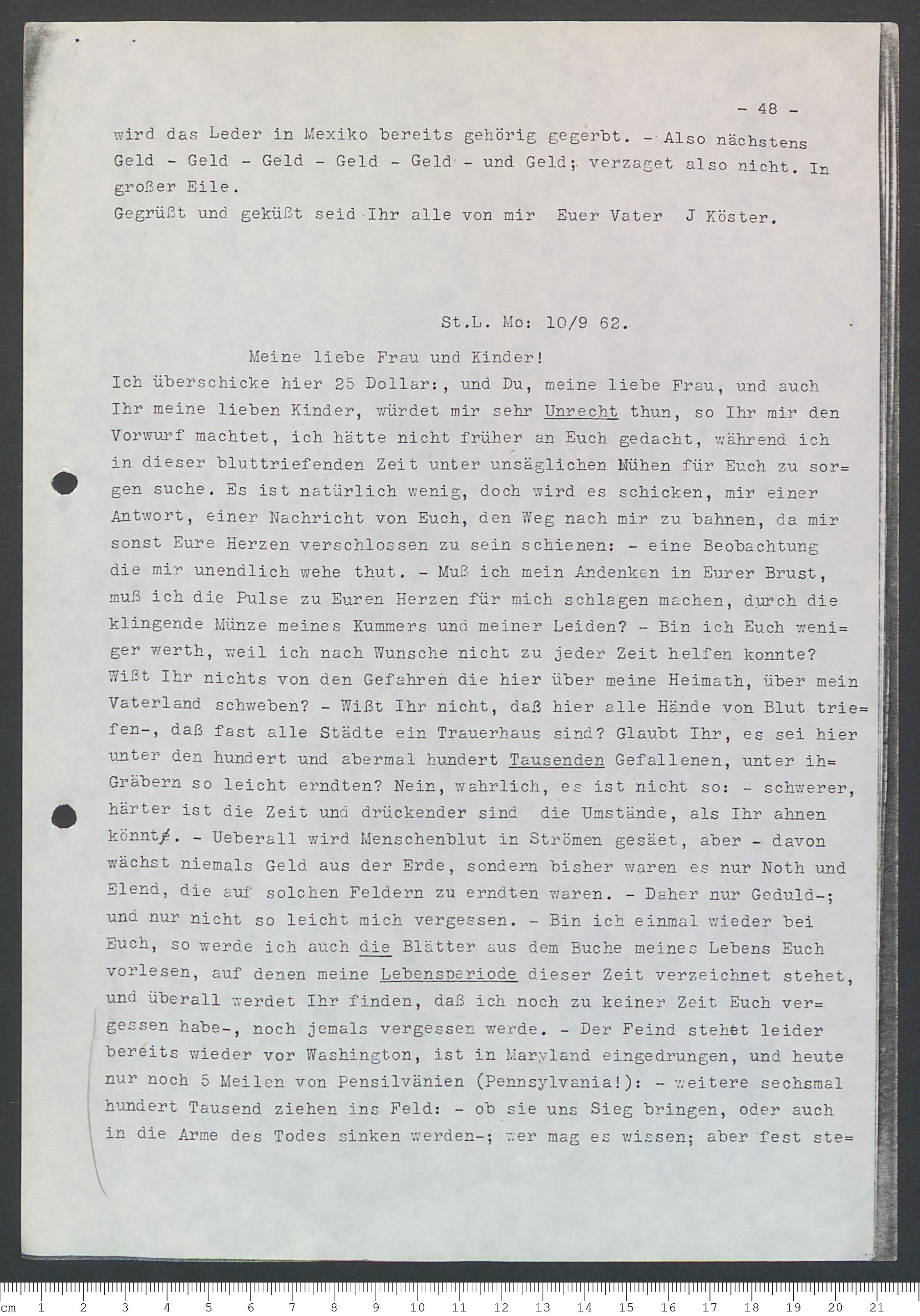
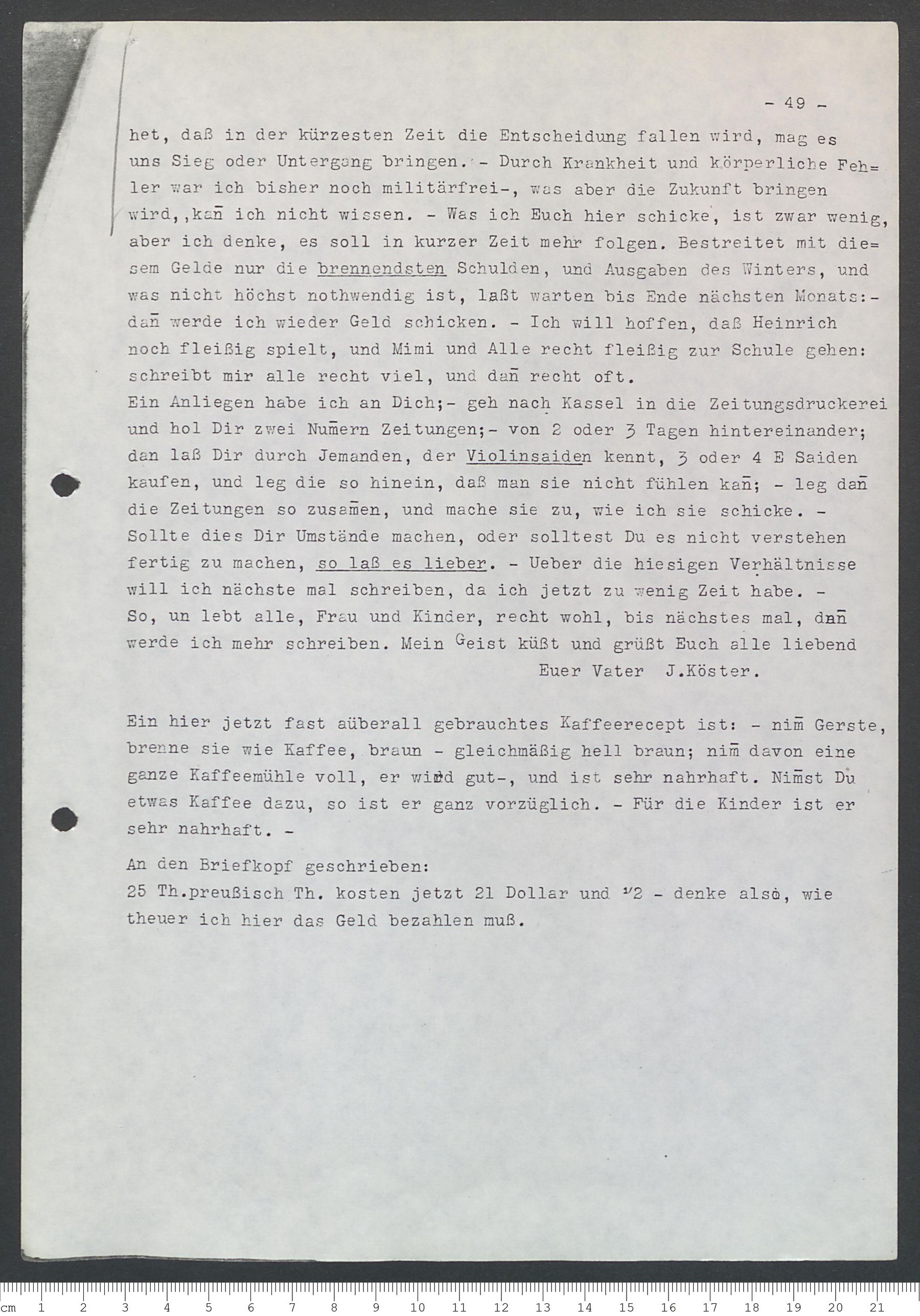
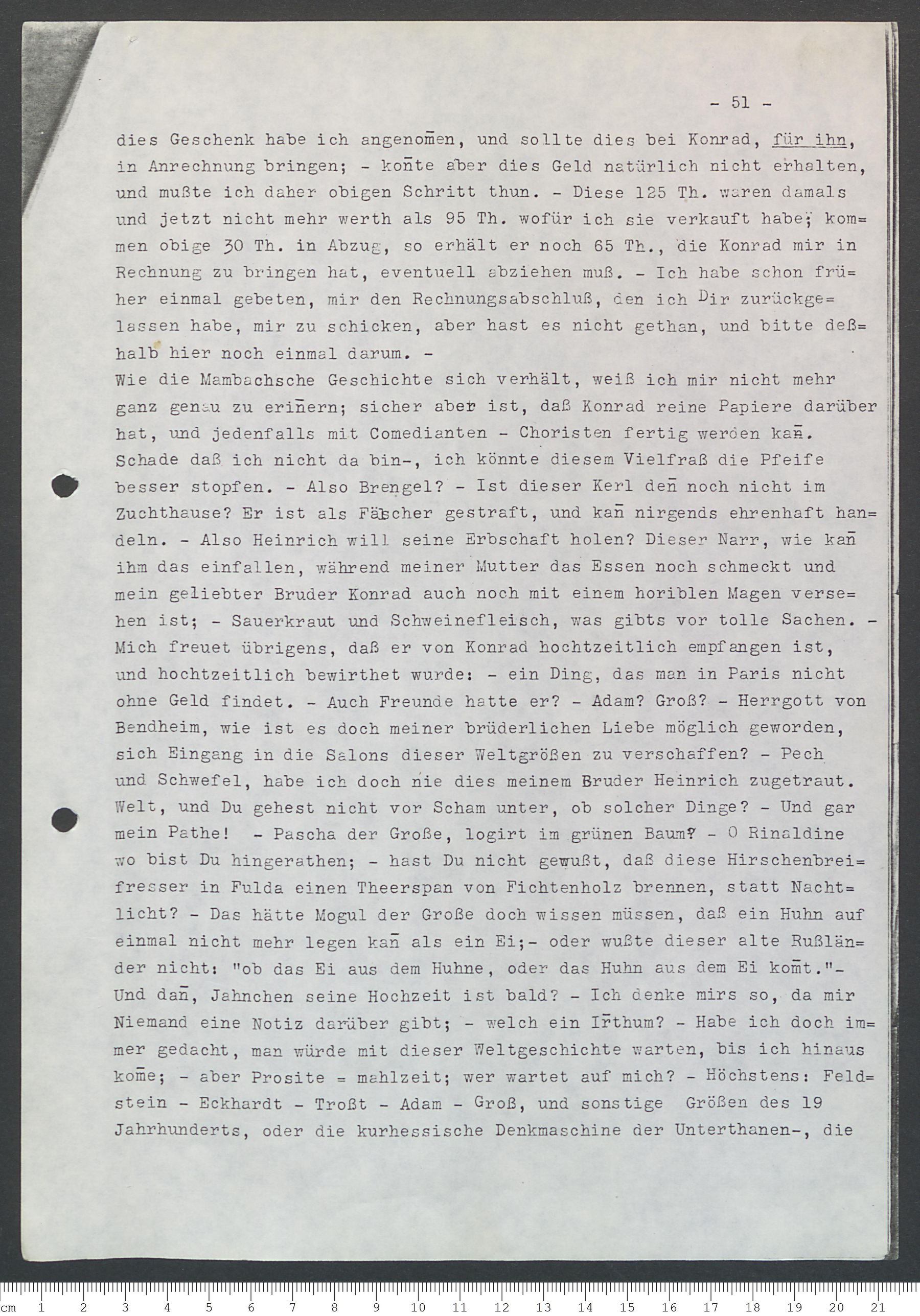
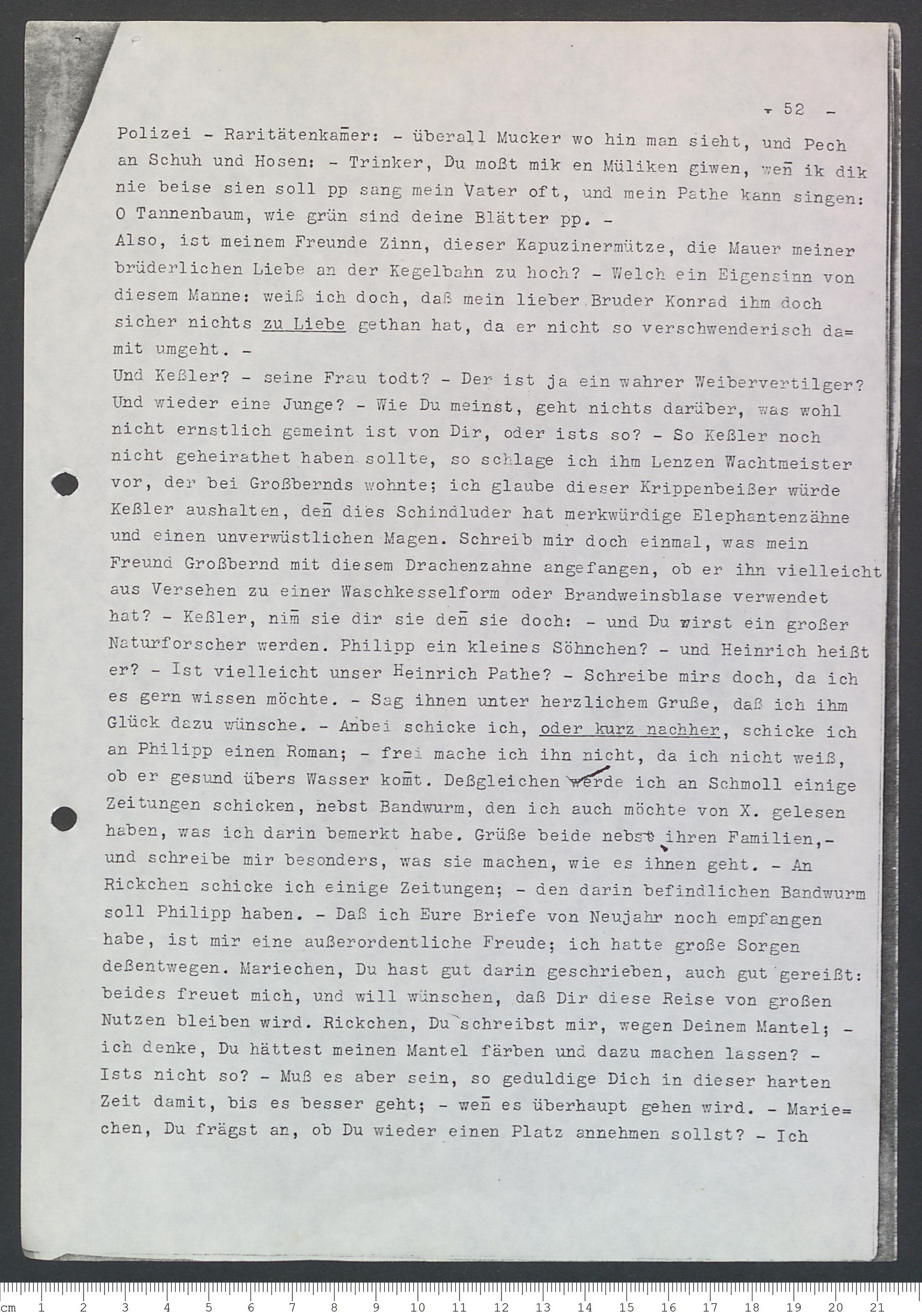
The body of the archive: Rudolf Köster's complete typescript of twenty-two letters and slips, 6 November 1858 to 2 December 1862, behind a divider naming him as Einsender at Bensheim. These are the pages read in full in July 2026 — the false Louisville dateline at 0063, the “Landsleute” passage at 0064, the collapse at 0075, the Gutberlet fraud at 0098, the conscription notice of 12 August 1862 at 0099. Read them page by page →
Images 0052–0108 · 57 leaves · read: 0052, 0053, 0060
 0052
 0053
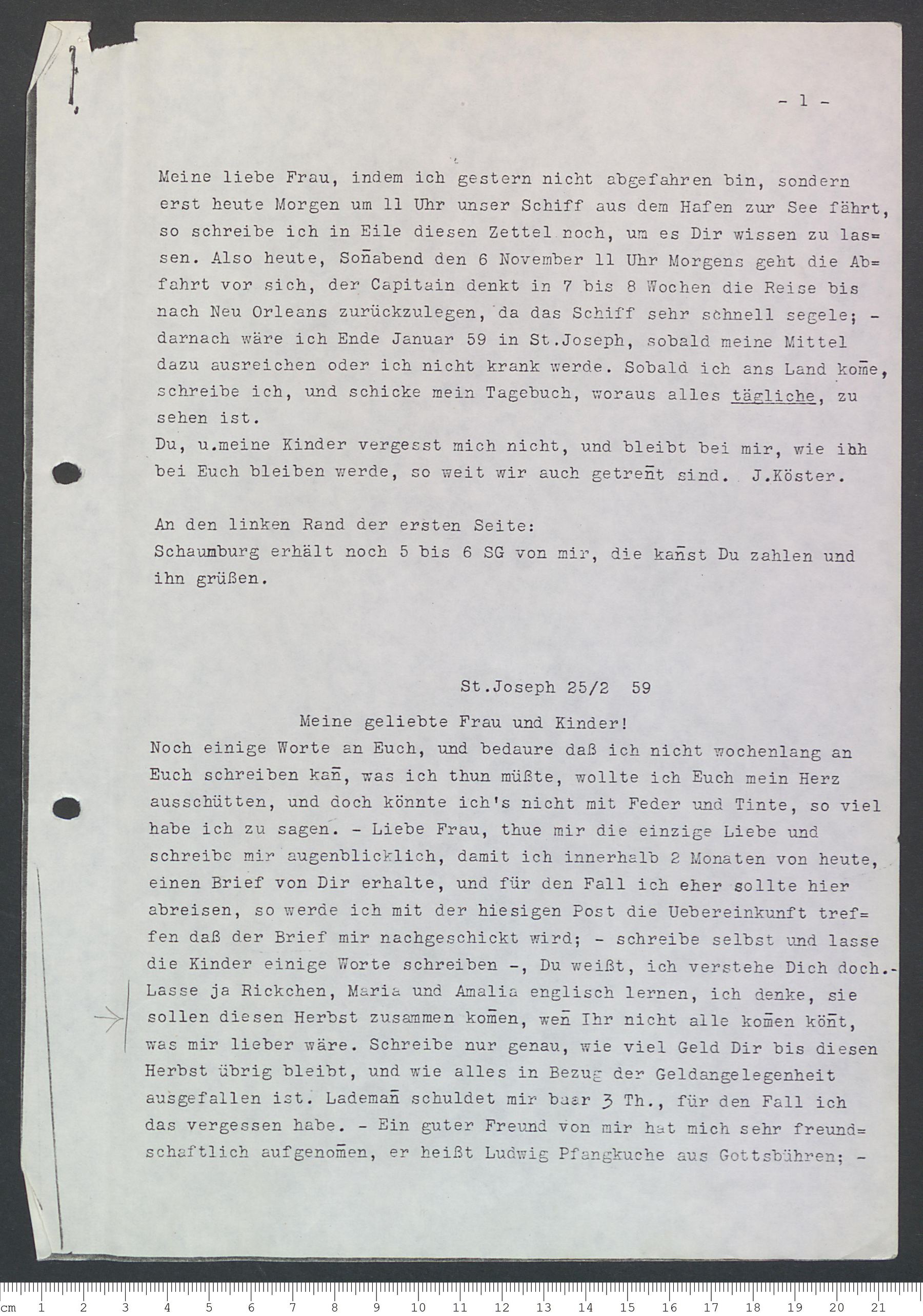 0054
 0055
 0056
 0057
 0058
 0059
 0060
 0061
 0062
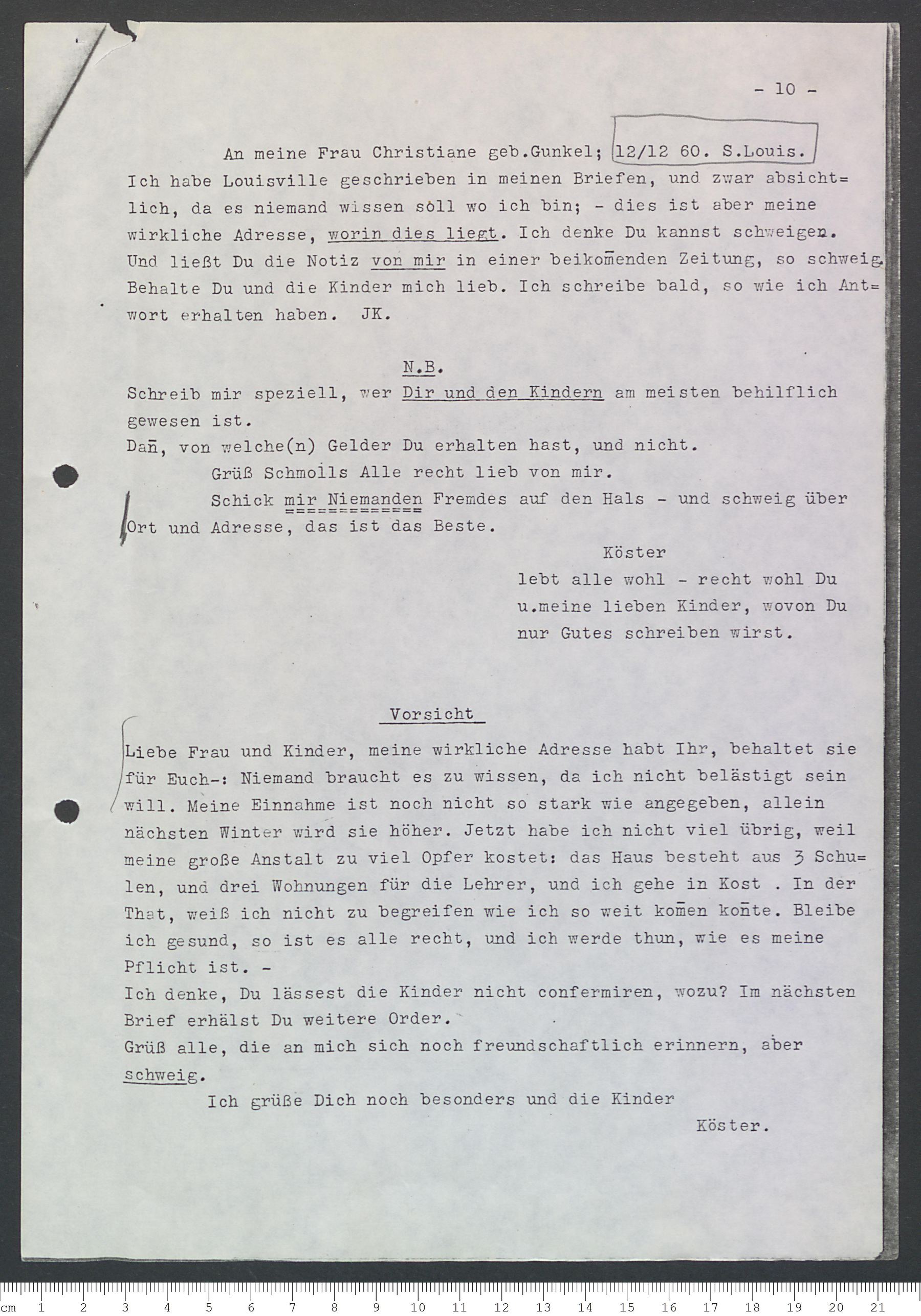 0063
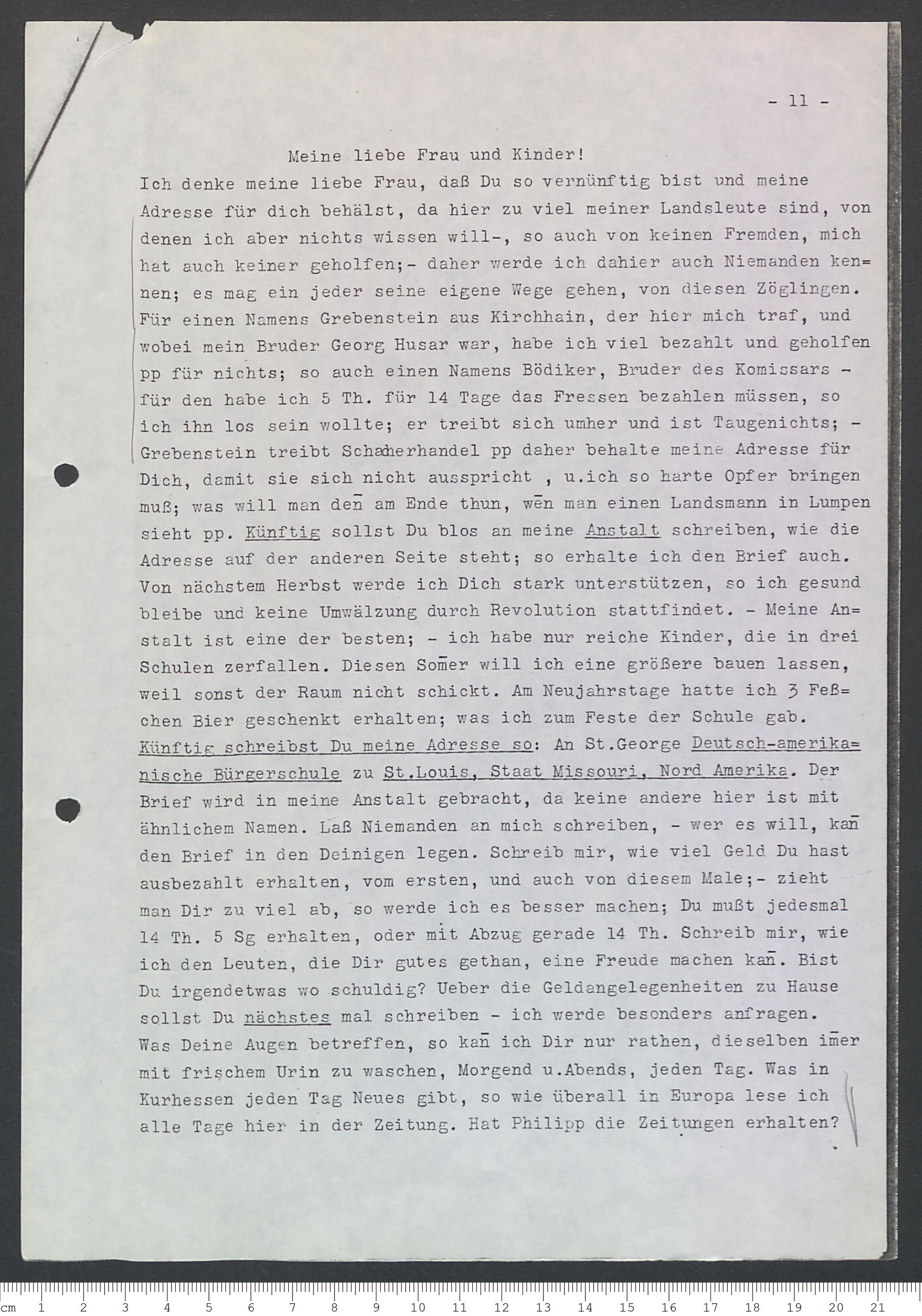 0064
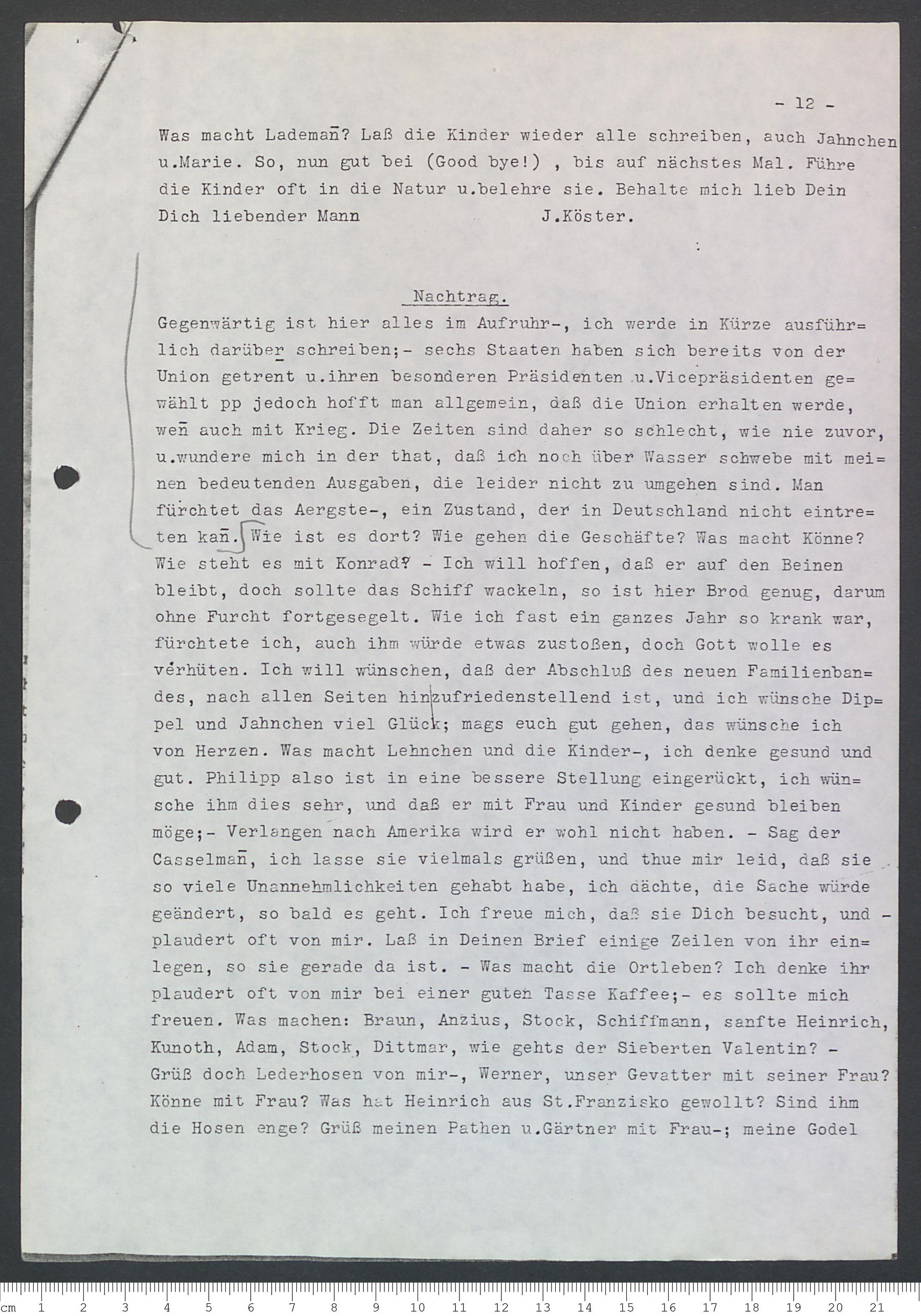 0065
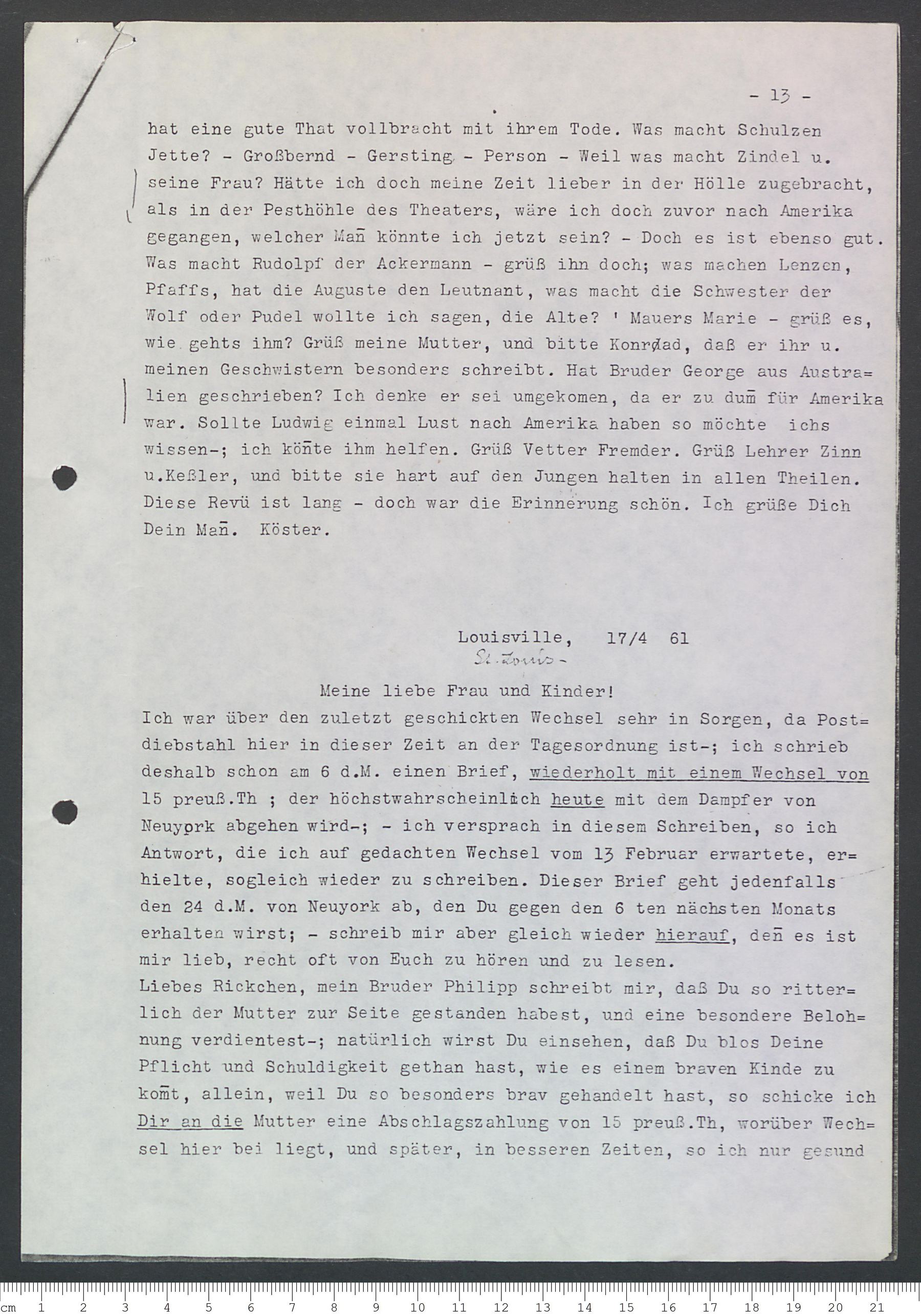 0066
 0067
 0068
 0069
 0070
 0071
 0072
 0073
 0074
 0075
 0076
 0077
 0078
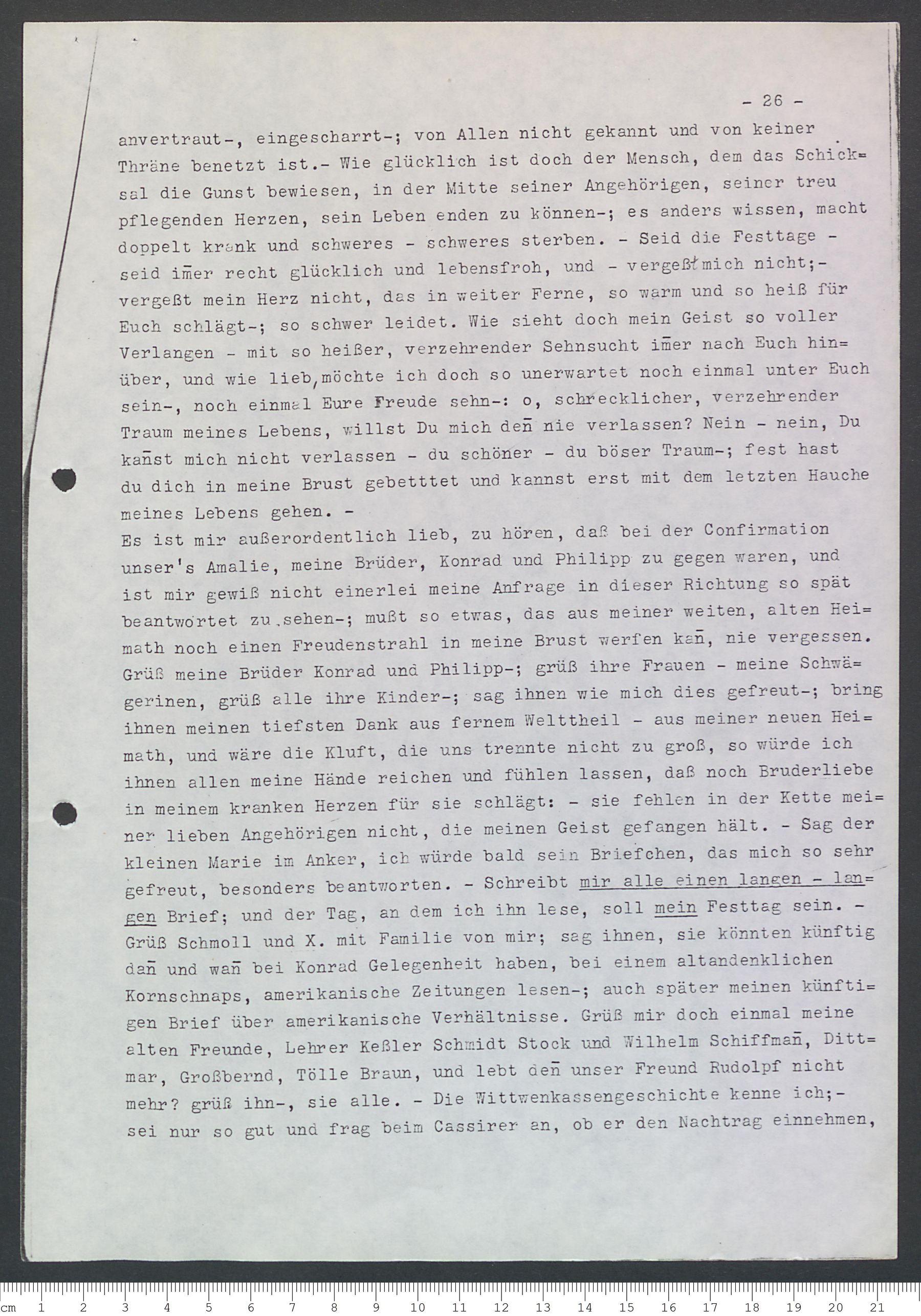 0079
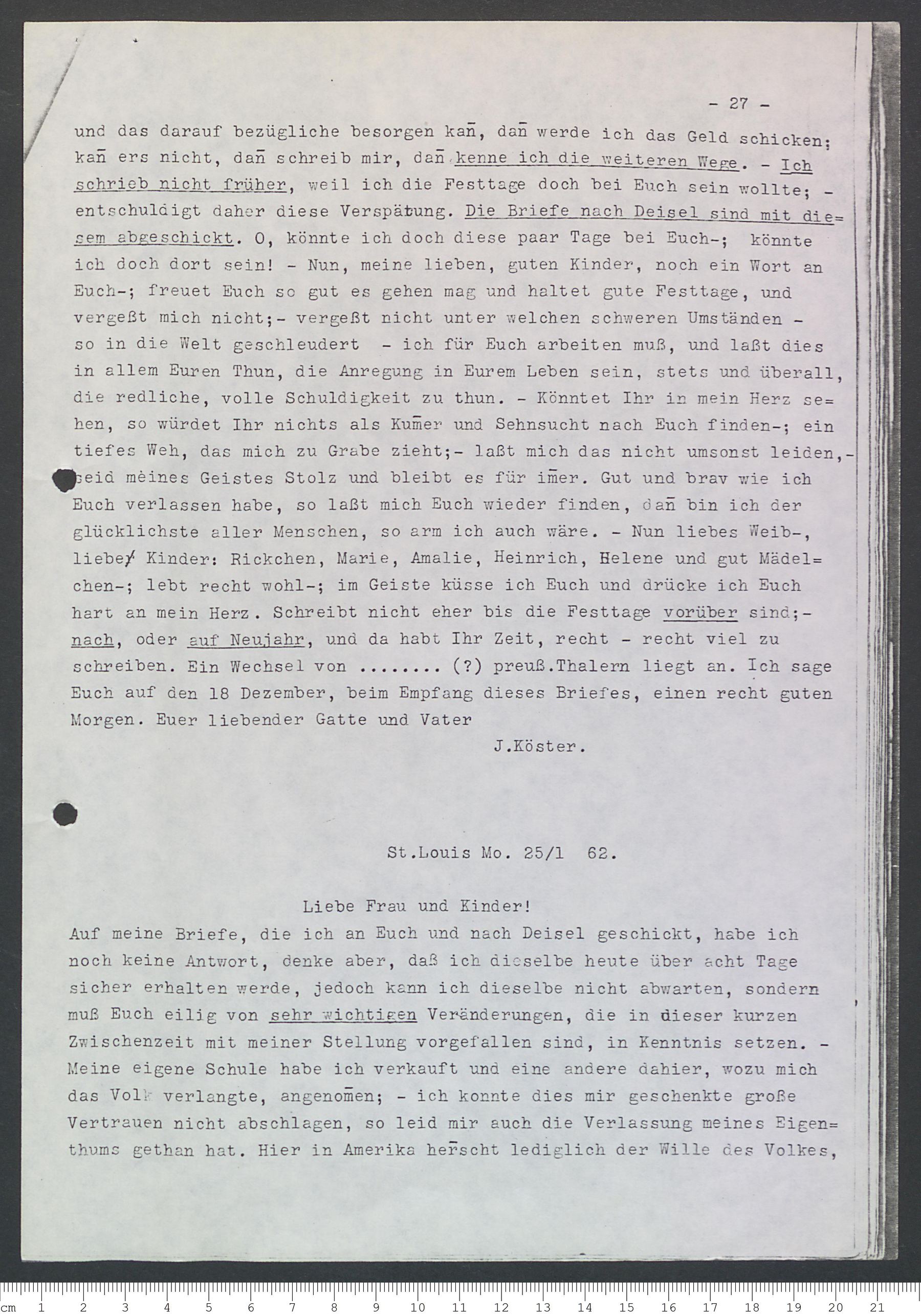 0080
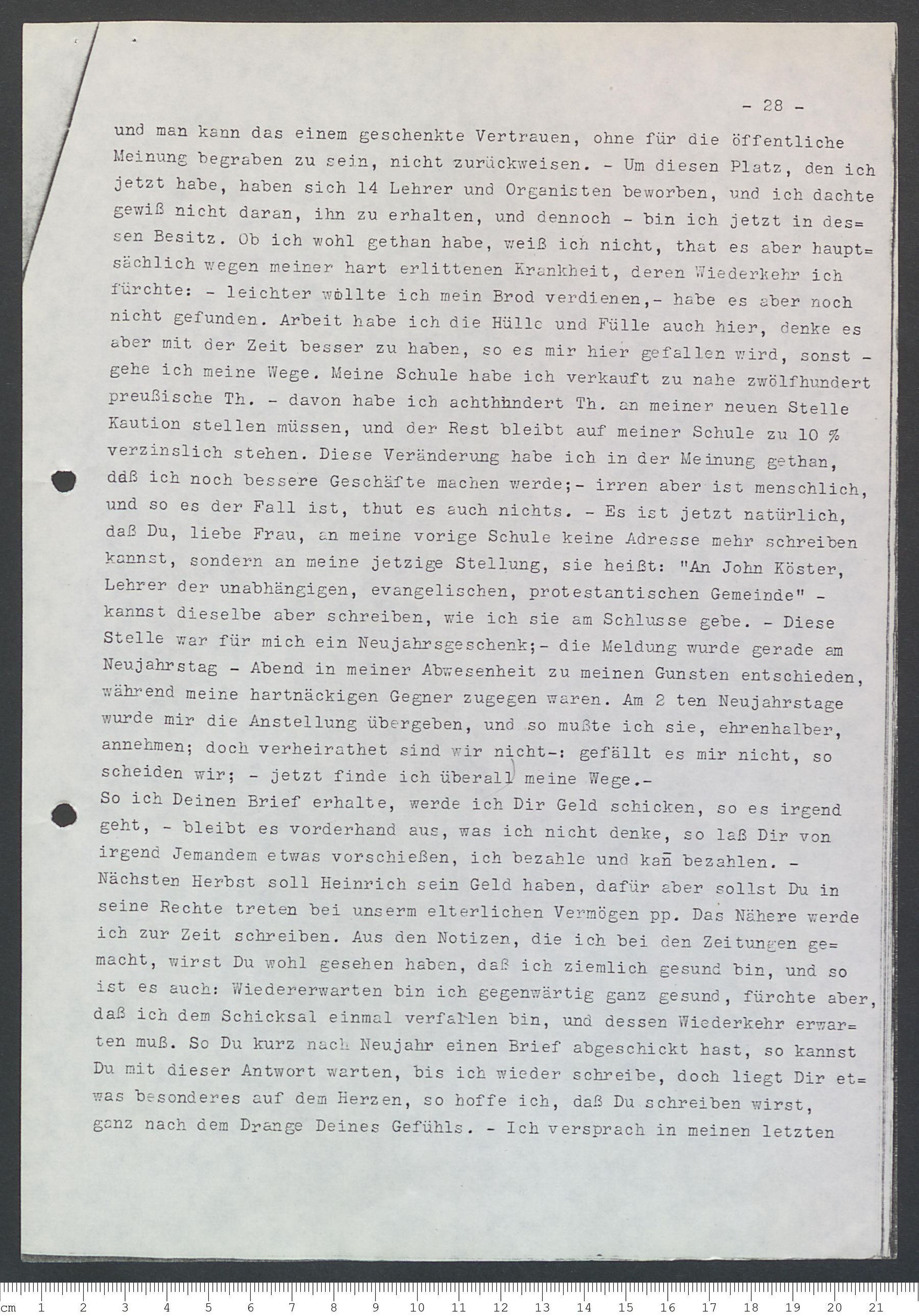 0081
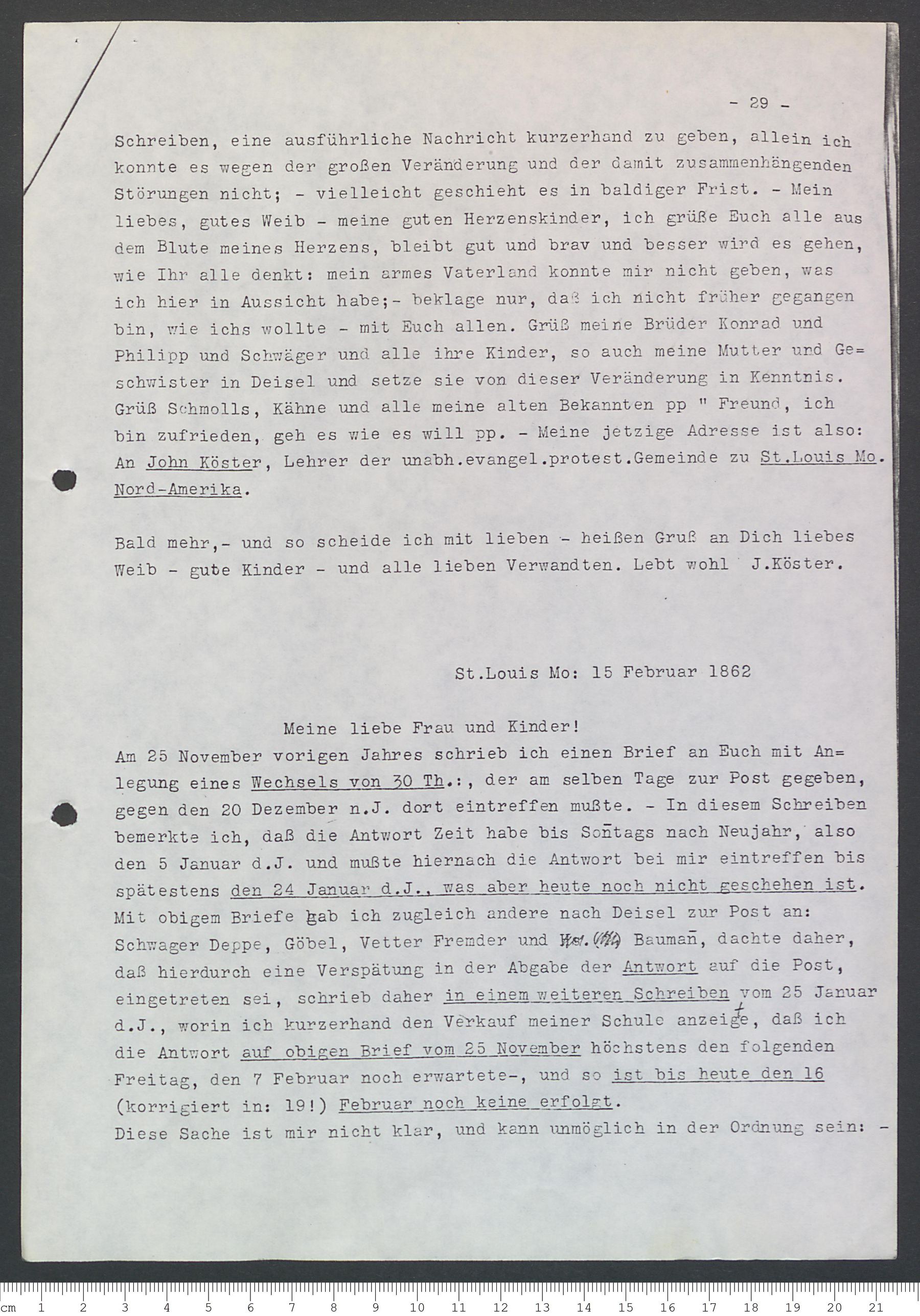 0082
 0083
 0084
 0085
 0086
 0087
 0088
 0089
 0090
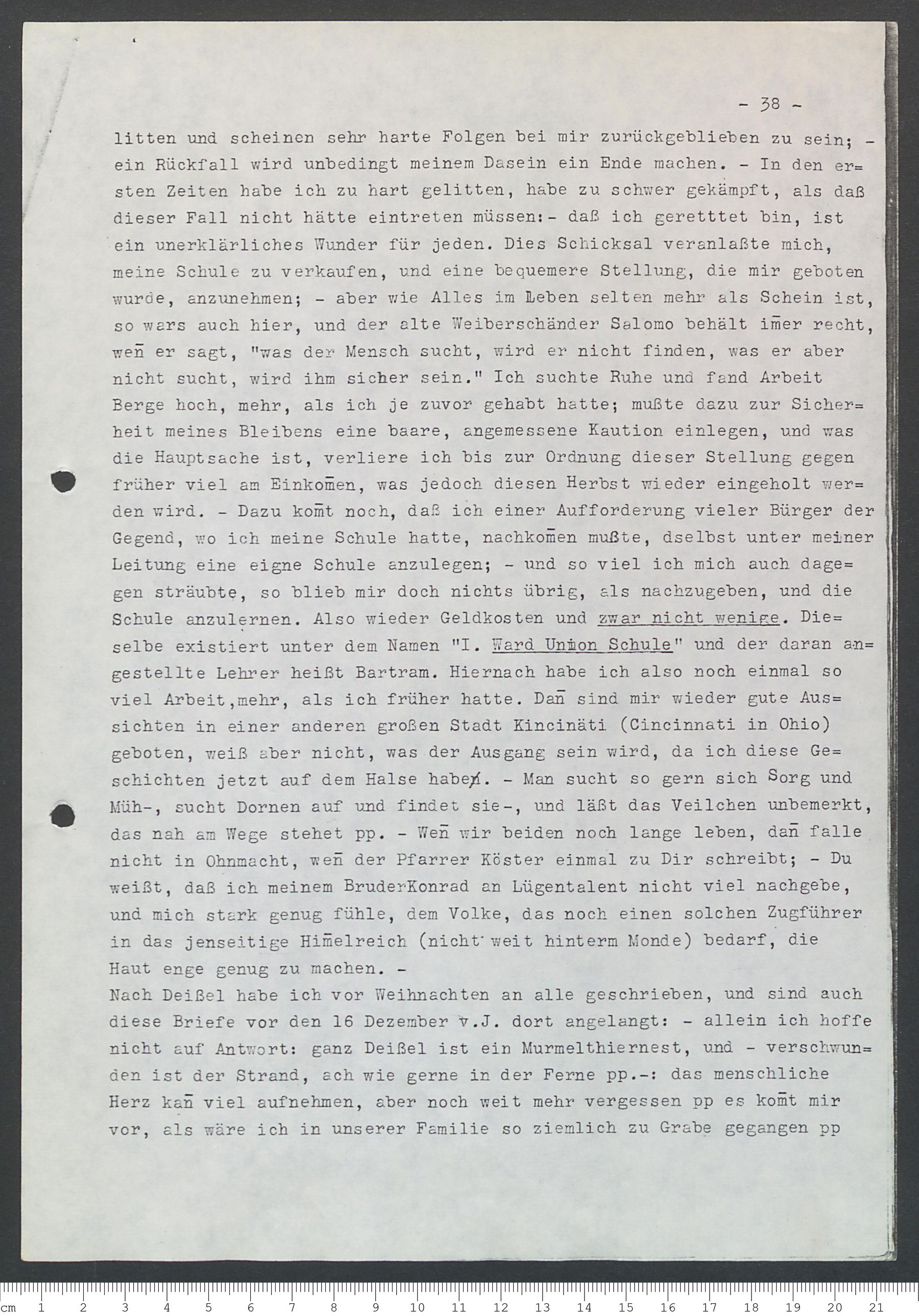 0091
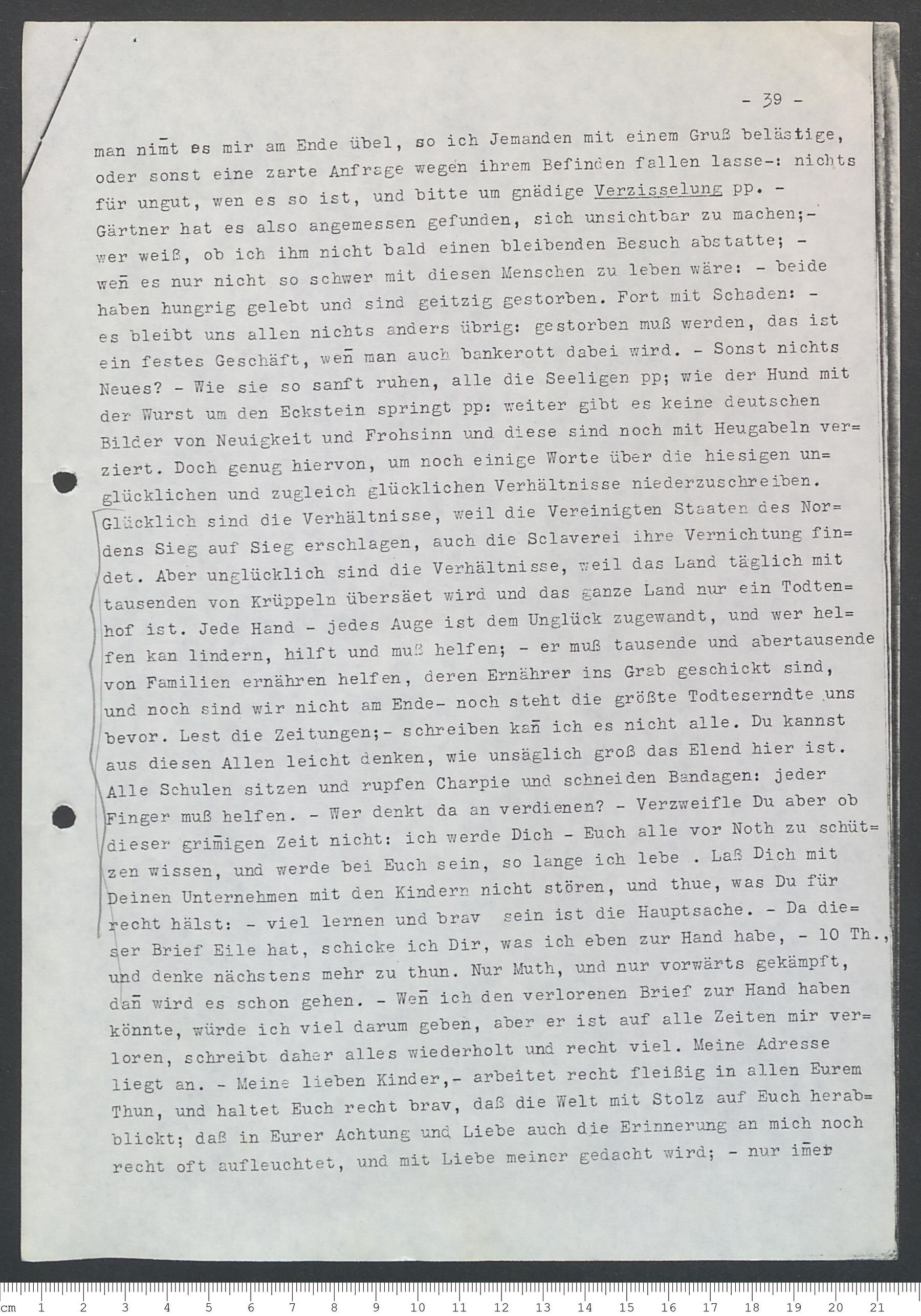 0092
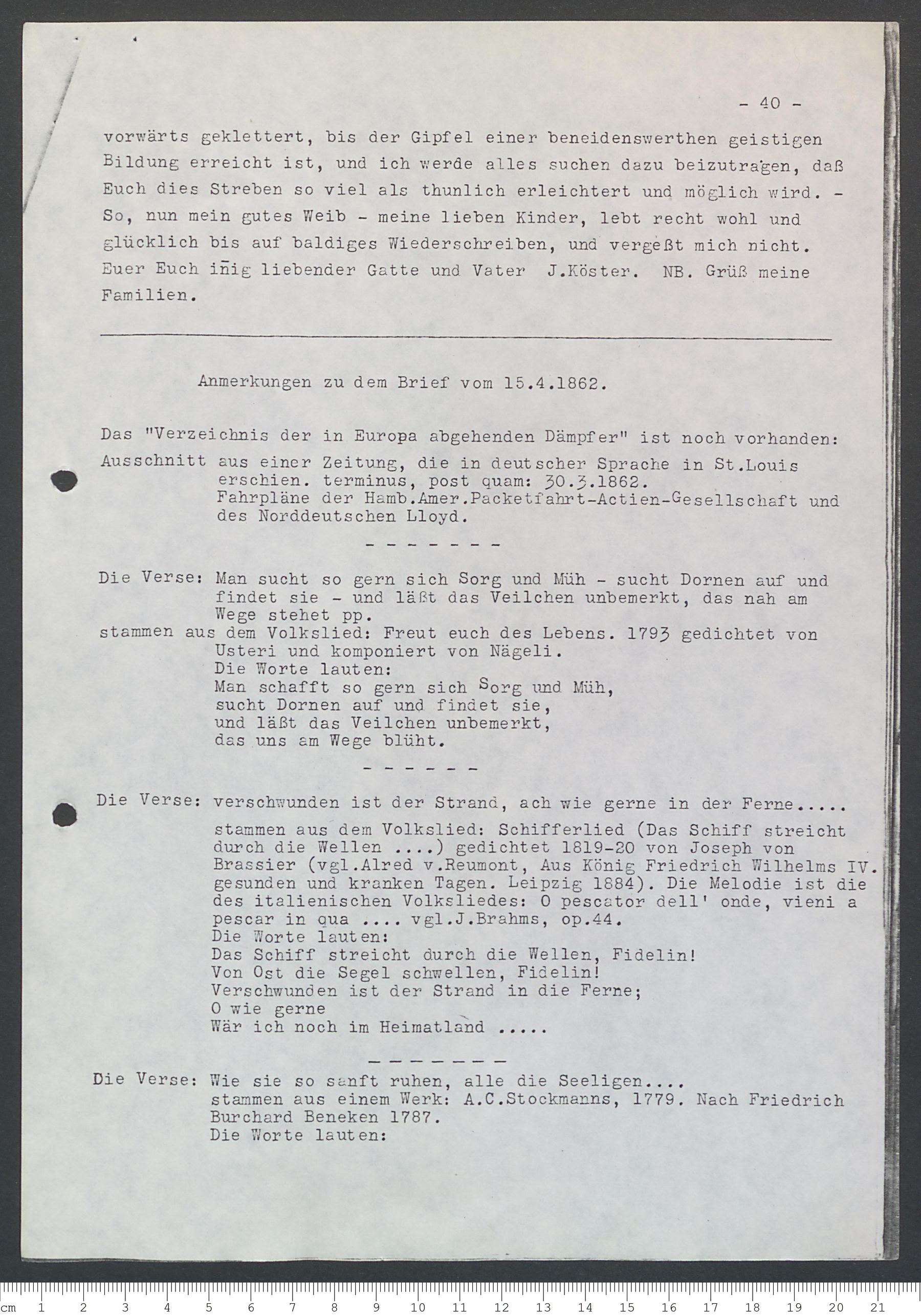 0093
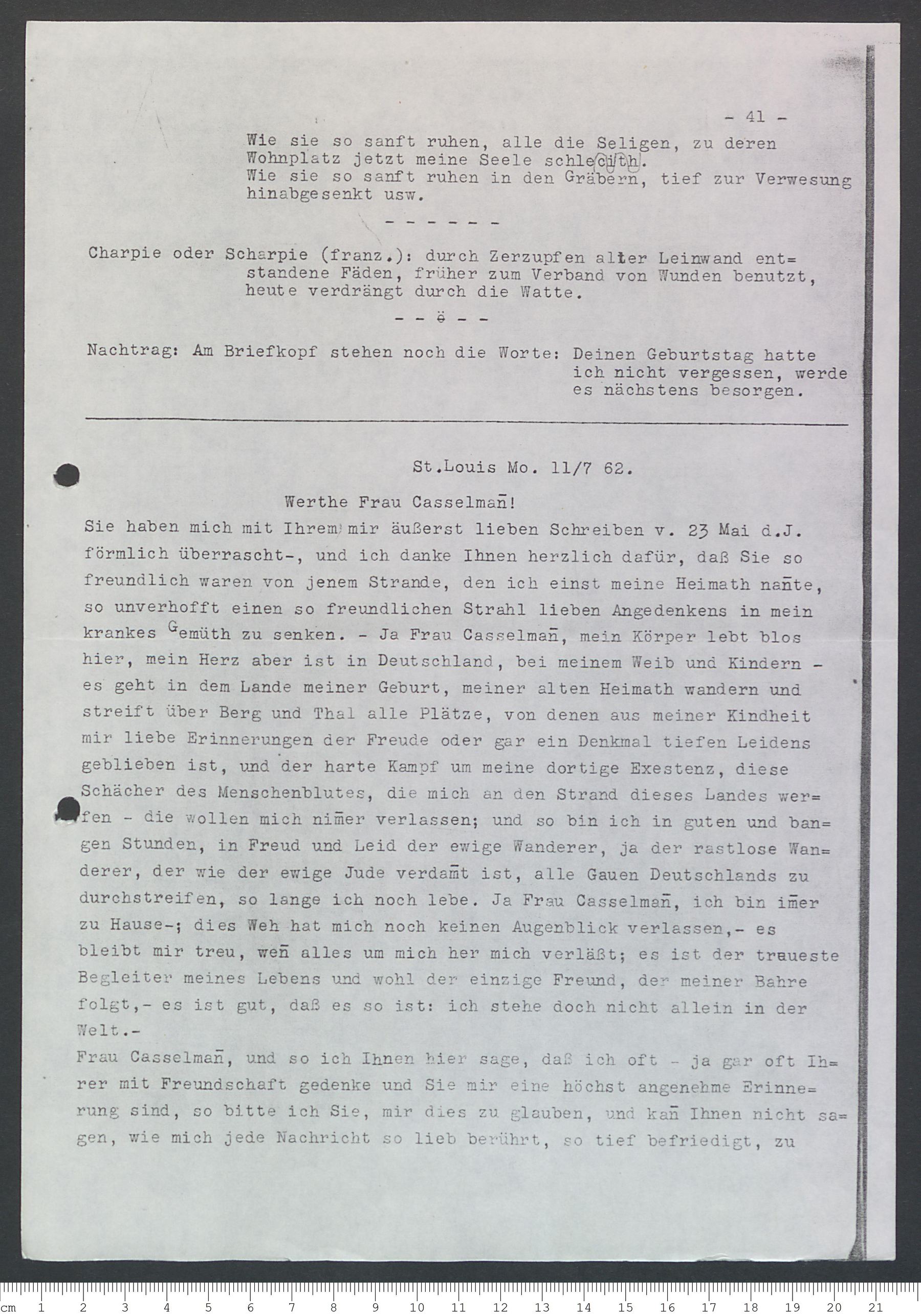 0094
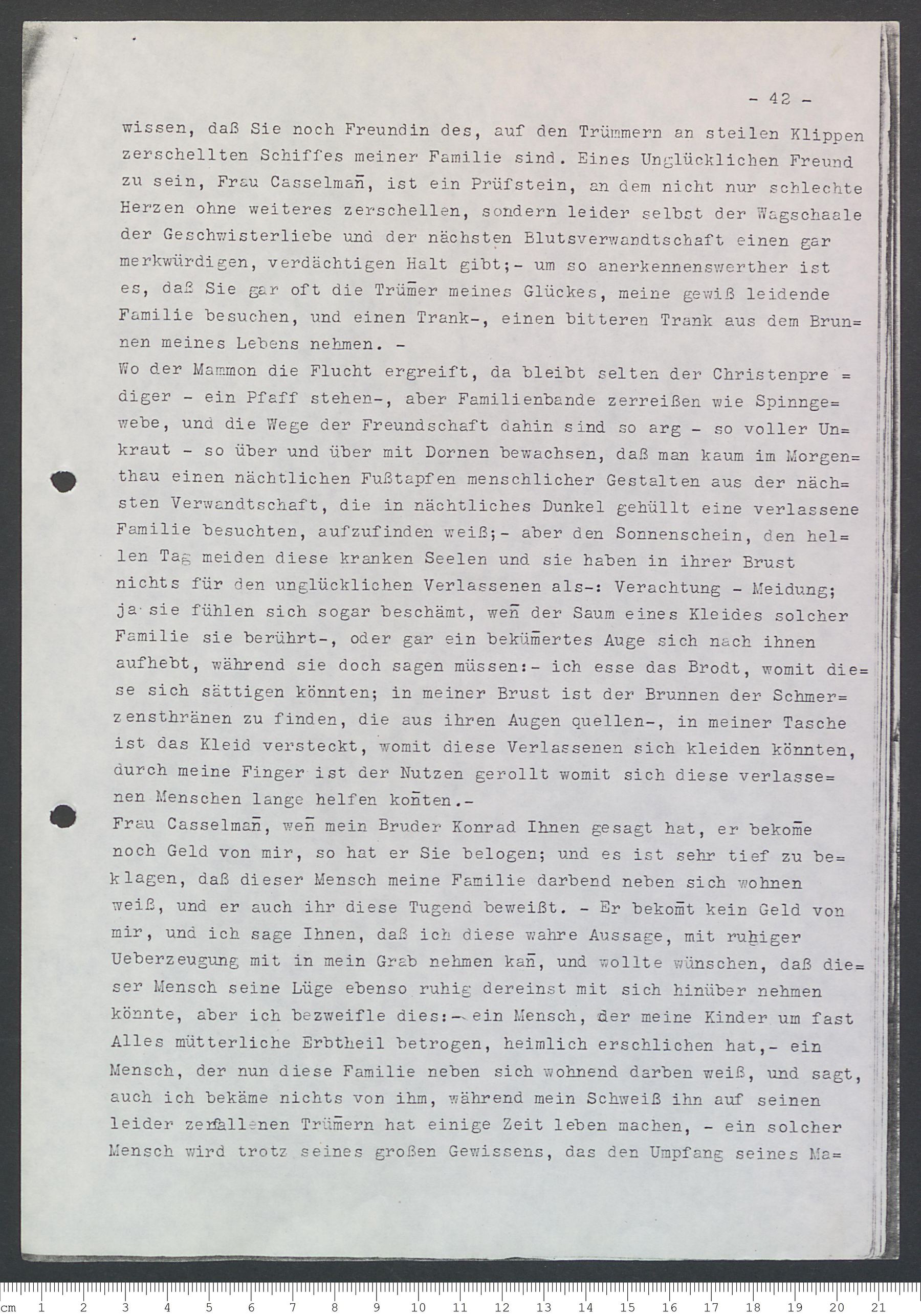 0095
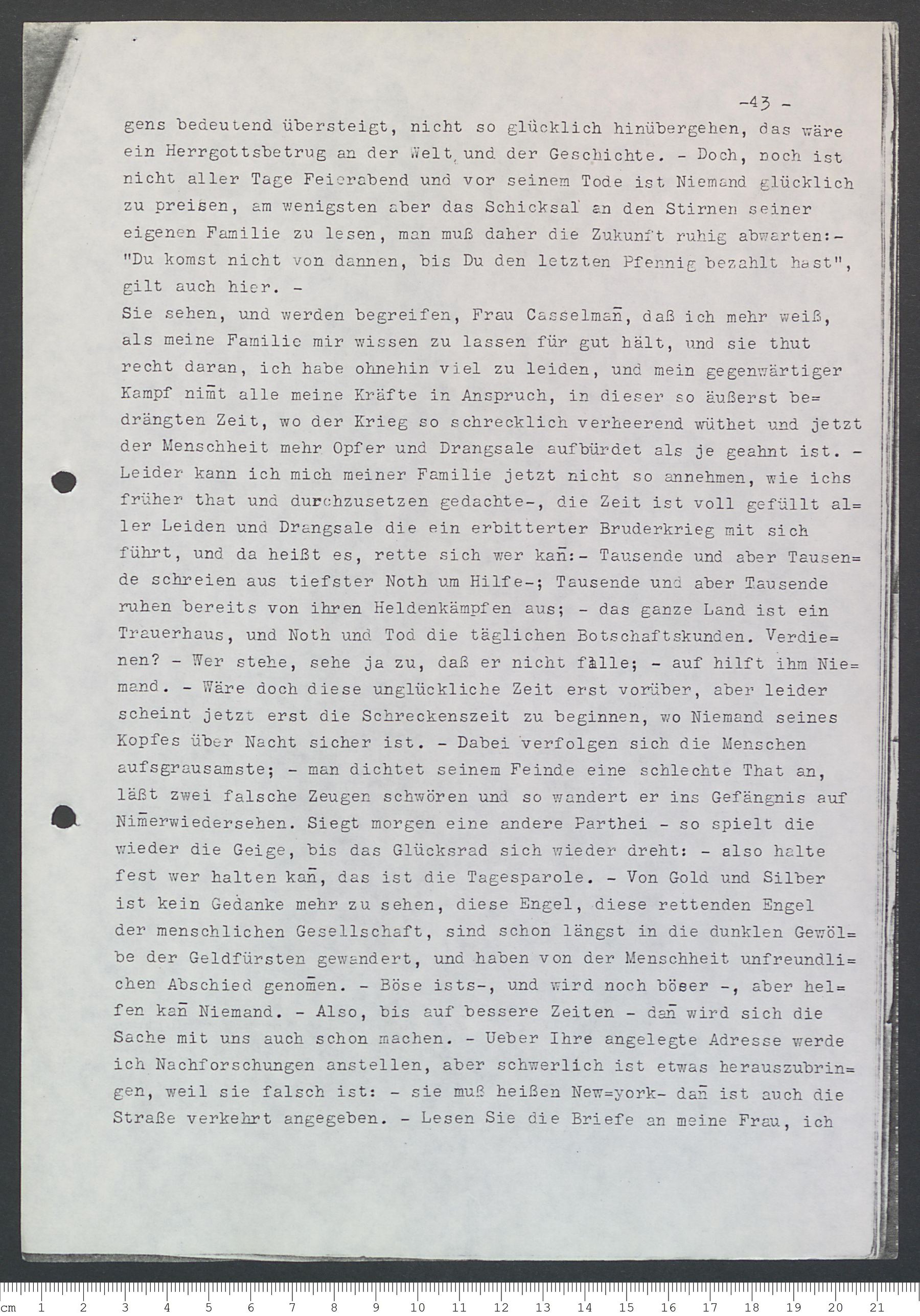 0096
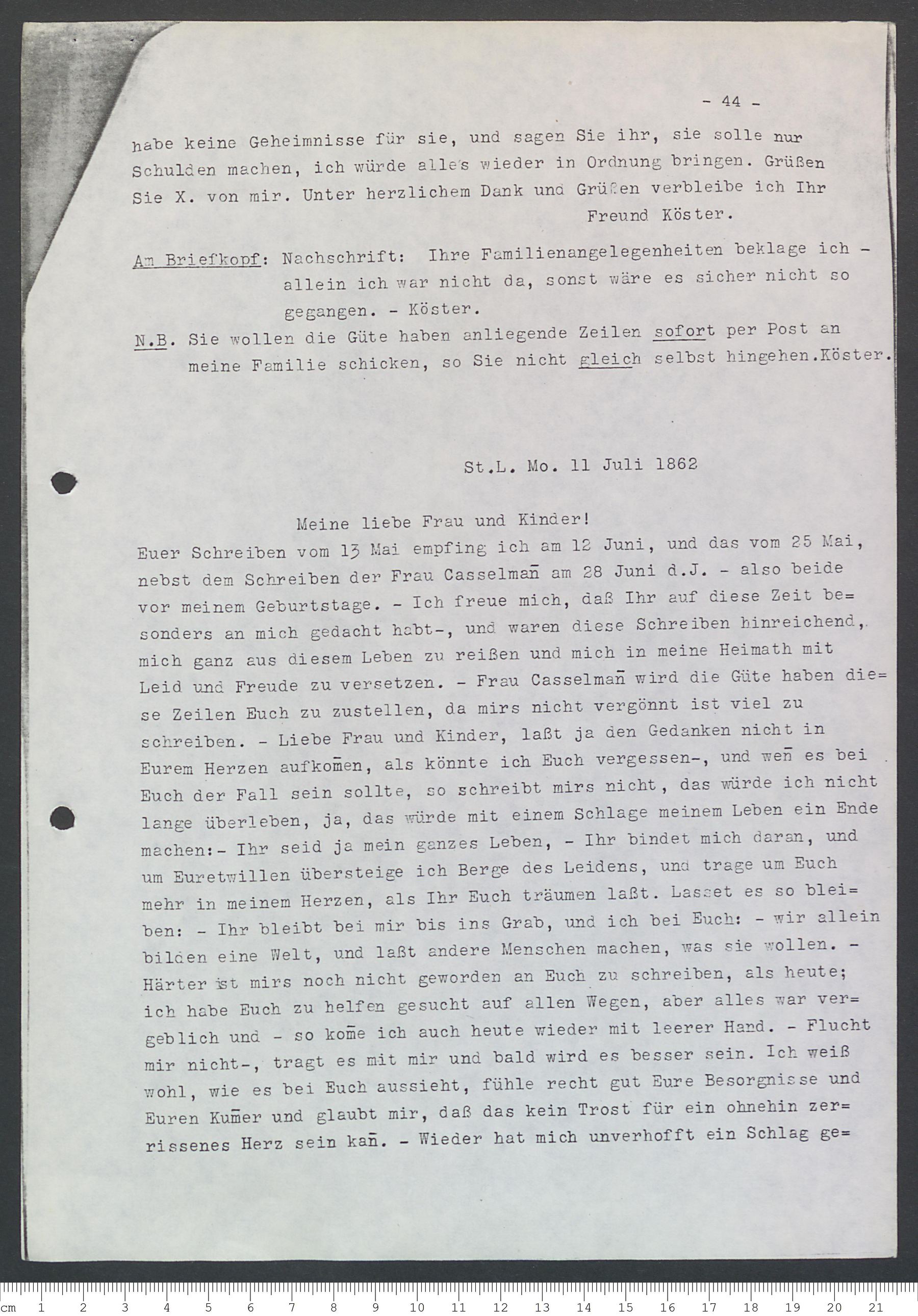 0097
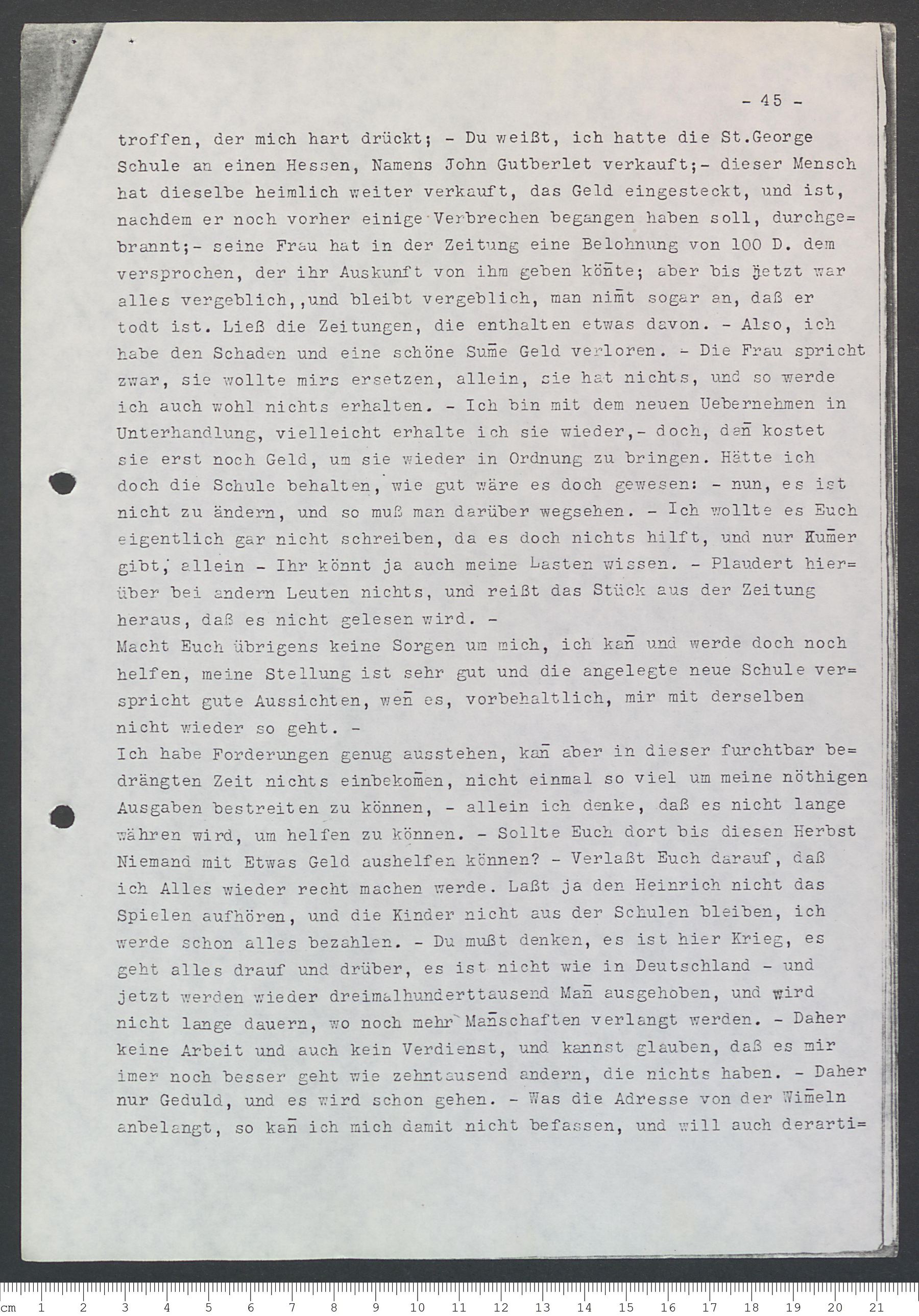 0098
 0099
 0100
 0101
 0102
 0103
 0104
 0105
 0106
 0107
 0108
Photographs described, an address, and family notes
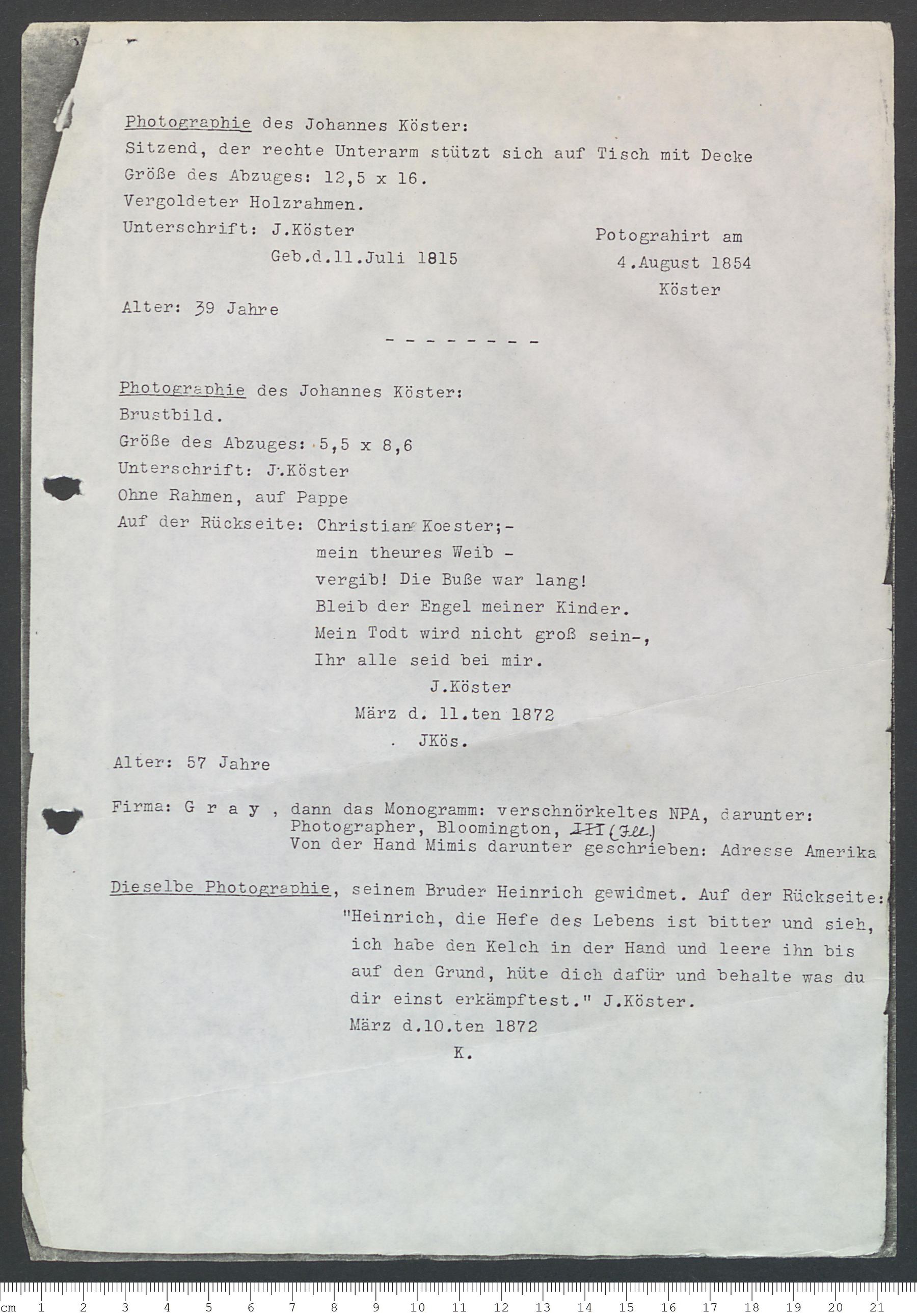
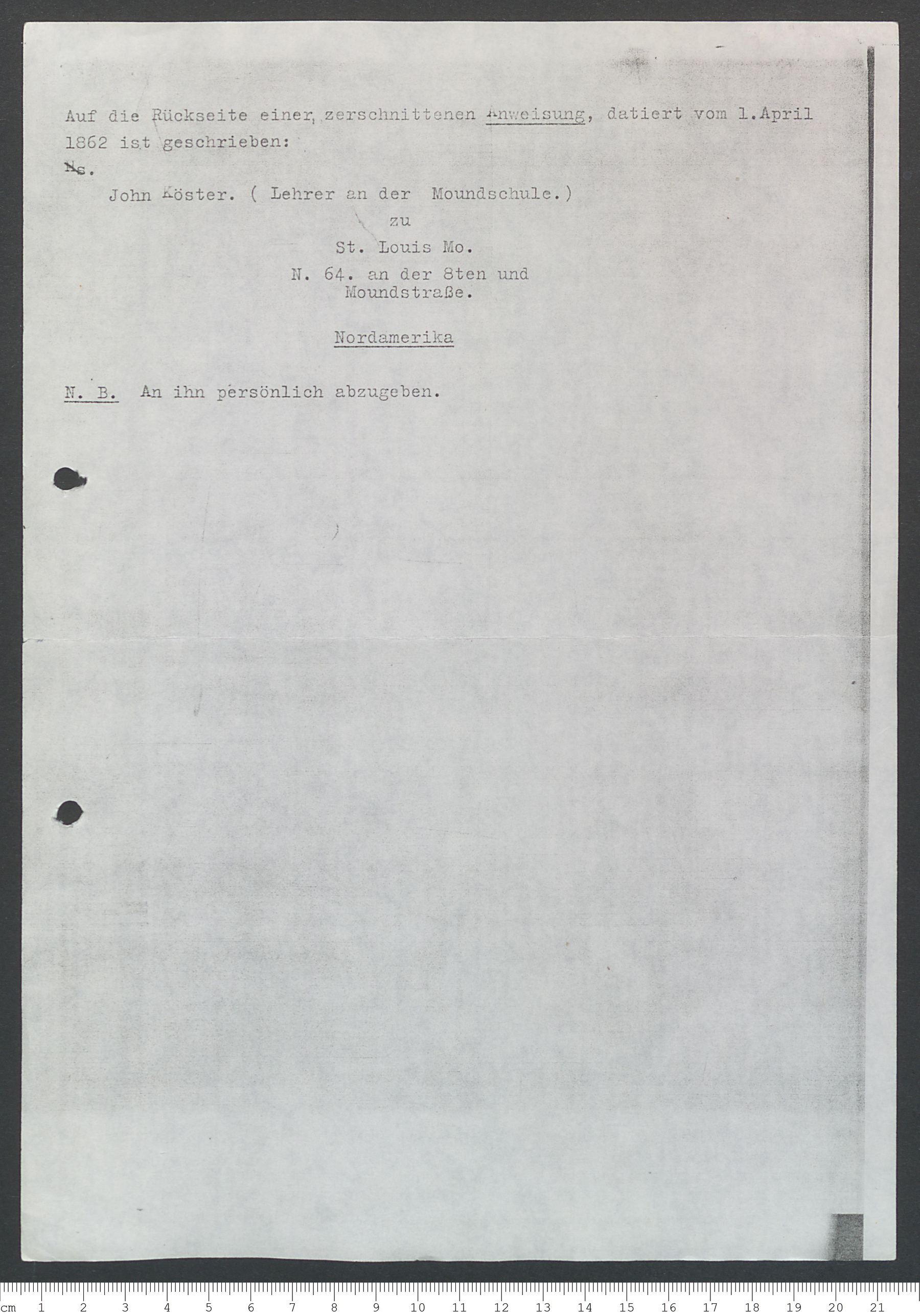
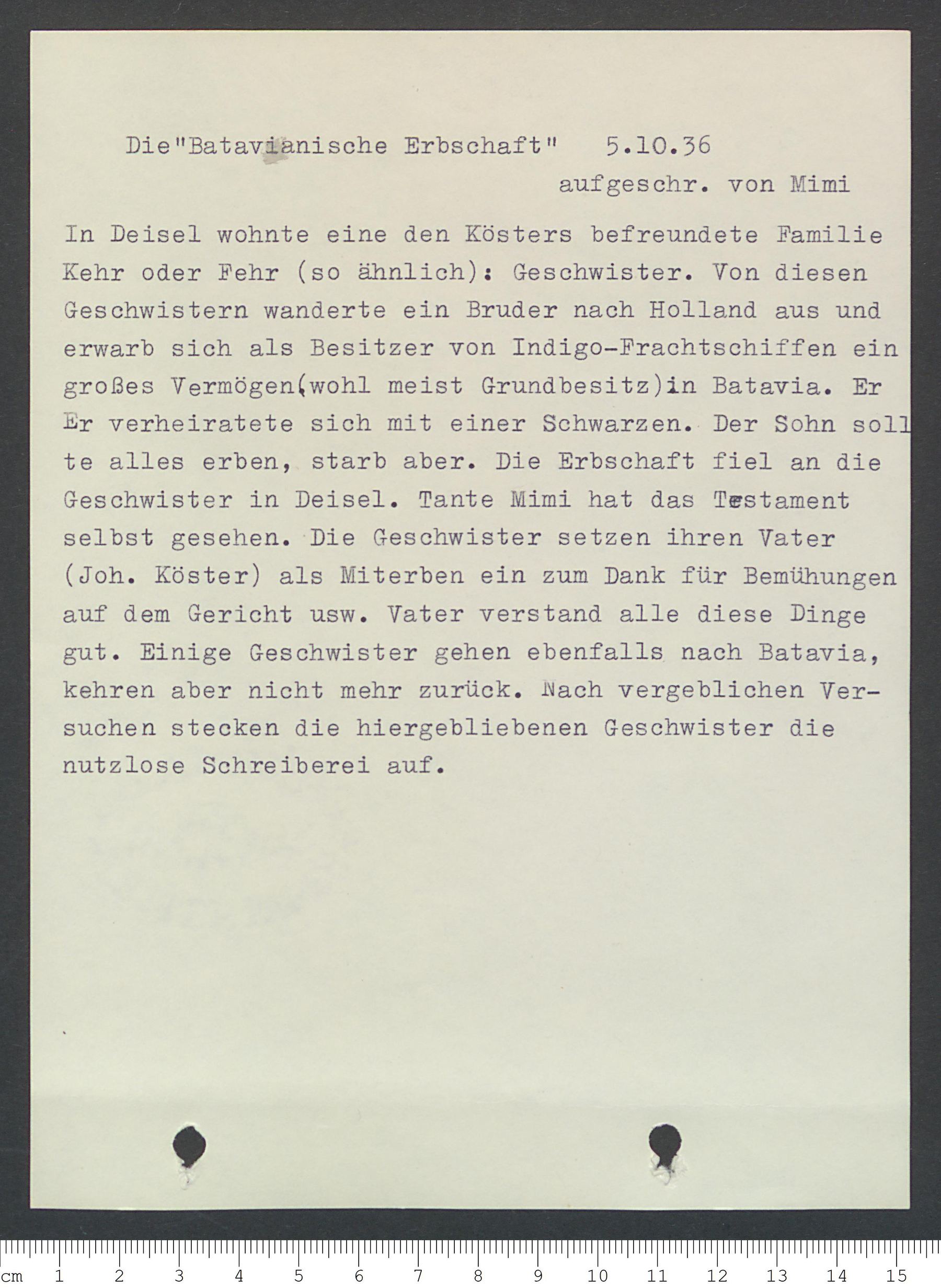
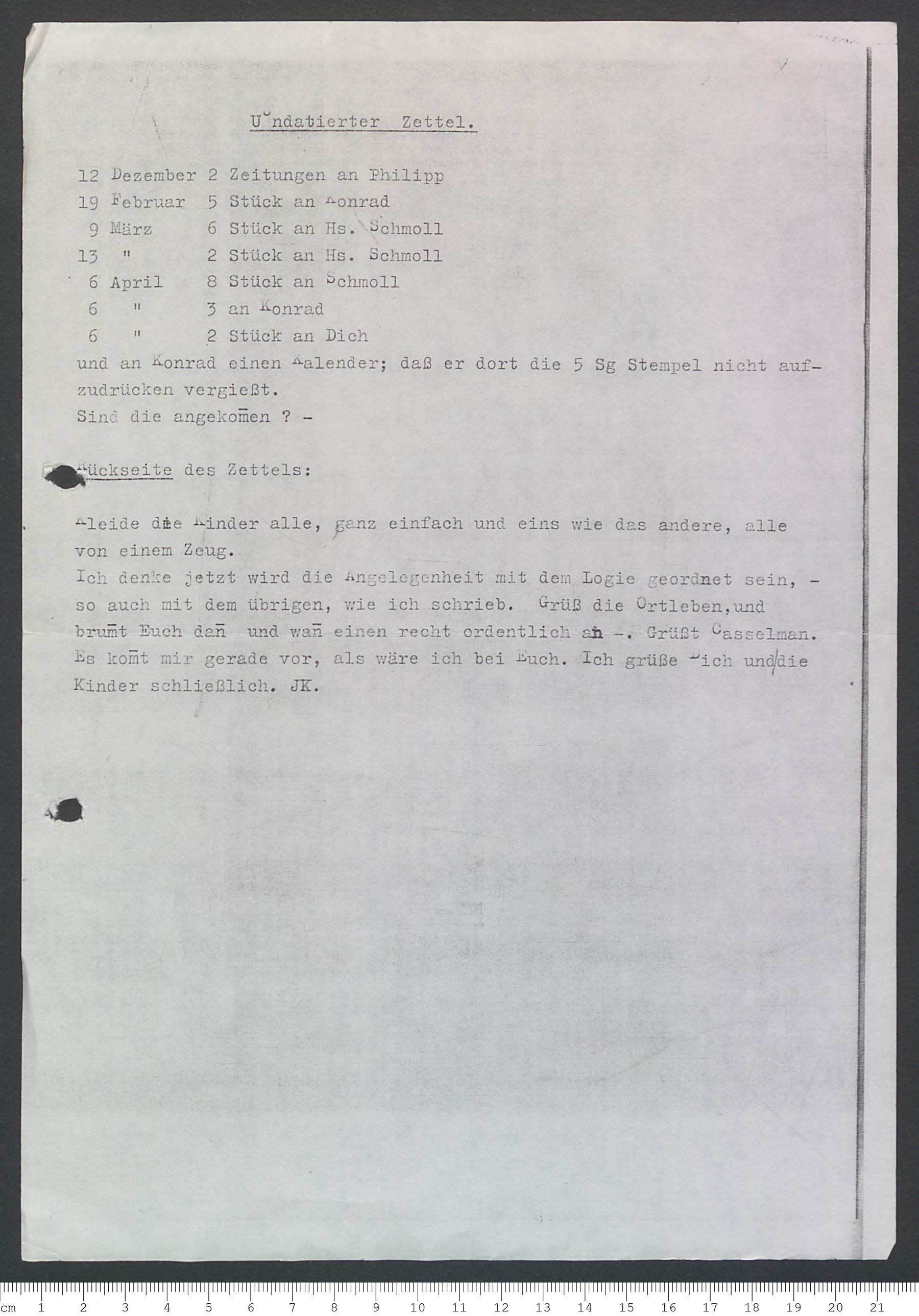
Four leaves that had not been read before the facsimile was prepared, and that repay it. 0109 describes two lost photographs of Köster — one of 1854, aged 39; one of March 1872, aged 57, inscribed on the back “Christiane Koester — mein theures Weib — vergib! Die Buße war lang!” 0110 is an address cut from a wrapper of 1 April 1862: “John Köster (Lehrer an der Mound-schule) zu St. Louis Mo., N. 64. an der 8ten und Moundstraße” (read from the image, 10 Oct 2026; earlier given here as “zwischen der 5ten”) — a street address for him in the city, in the year Charles enlisted there. 0111 records the Deisel “Batavianische Erbschaft” as told by Mimi in 1936.
Images 0109–0112 · 4 leaves · read: 0109, 0110, 0111, 0112
★ The autograph letters — Köster's own hand
Seven leaves of original correspondence in Kurrent on folded sheets, photographed against a centimeter rule — proof that not all the originals “burned in the bombing of Kassel”, as this project once said. They are the original manuscript of the letter of 24 April 1859 from St. Joseph — the same letter held in typescript at images 0058–0062 (a Kurrent reading from the scan, to be confirmed by a paleographer). The opening of 0113/0114 matches p. 5 word for word, and leaf 0119 carries the “Deißel” greeting passage of p. 9 — so the village spelling this project cites can be read in Köster's own hand. The archival label “24.4.1853” on 0113 is a misread of 1859. This is the voice that could have reached Deisel and pulled a young man after it.
Images 0113–0119 · 7 leaves · read: 0113, 0114, 0119
Also held, not reproduced here: eight full-resolution TIFFs (50 MB each) of images 0063–0070, covering the pages that carry the false-dateline and “Landsleute” passages. Supplied by Gotha in the same delivery; available on request.
Sources
Forschungsbibliothek Gotha der Universität Erfurt, Deutsche Auswandererbriefsammlung, Serie Köster–Köster (NABS Ordner 74, 119 scans + 8 hi-res TIFFs; Aktenzeichen K9P90). Delivered 13 July 2026 following approval by an archivist at the Gotha research library, 10 July 2026; analyzed 17 July 2026; published here in full 20 July 2026, the library having confirmed the same day that its digitisates are public domain and require no publication permission. (The folder holds 120 entries: 119 scans and one ZIP of TIFFs.) Personalkarte: Johannes Köster, b. Deisel 11 July 1815, father Johannes Köster (Gastwirt), mother Maria Fremder. Name index at images 0033–0035; the “Landsleute” passage at transcription p. 11 = image 0064 (the page’s own printed header reads 11).
Passenger manifest. List of passengers of the Bremen ship Rubens, Johann Seiler master, Bremen to New Orleans, sworn before Collector J. M. Hunt at the Port of New Orleans, 3 January 1859 — National Archives and Records Administration, Film M259, Reel 47, List 2. Transcribed by Gene Janssen for the Immigrant Ships Transcribers Guild, 19 November 2021: ISTG Vol. 21, Ship Rubens. Ship and master corroborated against the Bremen Chamber of Commerce / Staatsarchiv Bremen departures database (Die Maus / Juling), passage of 26 October 1857, captain “Seiler, J”. Identified 19 July 2026.