On Sunday 7 January 1866, eighteen days after his discharge, Charles married Auguste Kreichelt in the St. Marcus German Evangelical congregation, on the south side of St. Louis.1 He had been discharged at St. Louis on 20 December 1865.2 On Saturday, the day before the wedding, six or eight cattle broke through the ice while crossing the river at St. Louis, and two of them drowned. The newspaper that reported it also carried a shipping notice that mentioned the “suspension of navigation above Cairo.”3
In this chapter
In the records of that first year, Charles appears close to his wife’s family. Of the four witnesses at the wedding, only an army comrade was tied to Charles rather than to the bride’s family.4 Charles possibly lived on the Kreichelts’ street that year, as he later recalled.5
Pastor Georg Wendelin Wall, who had founded the congregation, performed the ceremony.6 Under the state’s new constitution of 1865, a minister could not preach or marry a couple until he had sworn its loyalty oath. The Catholic Church and many Protestant churches protested.7 In January 1866 the congregation still had its wooden church of 1845 at Jackson and Soulard Streets; it was not pulled down until that spring.8 The wedding was probably held there, though the register does not say. Wall recorded only that the year’s couples were married “in der evangelischen St. Marcus-Gemeinde,” in the St. Marcus congregation.9 Not every St. Louis wedding of the time took place in a church. On Christmas Eve 1865 the Missouri Republican listed three weddings of St. Louis brides held at the bride’s family home.10
Four witnesses were there, and Wall recorded their names in the last column of his register (the entry is translated below).11 The first, Adam Herweck, was a tailor who had enlisted beside Charles and had been made a sergeant with him. Of the four witnesses Wall recorded, Herweck is the only one tied to Charles rather than to the bride’s family.12 The entry ends with Wall’s word for the wedding, “Cop:” (copulirt, married), and his name.13
In the register Wall recorded the groom as “Carl Gonnson … aus Deiße, Kreis Caßel, Churheßen,” and the bride as Auguste Kreichelt “aus Clausthal, Königr. Hannover.”14 Deiße is Deisel, which was in fact in the district of Hofgeismar, not of Kassel. In 1860–66 Wall mostly recorded only a couple’s home in St. Louis. For Charles and Auguste he recorded the places they came from.15 These few words are the book’s main evidence that Deisel was probably his last home; the chapter “Kurhessen: Deisel and Trendelburg, c. 1835–1858” gives the reasoning.

In the author’s translation, column by column, the entry reads:16
No. 676, the fourth of the year. Carl Gonnson and Auguste Kreichelt.
From Deiße [Deisel], district of Kassel, Electorate of Hesse; from Clausthal, Kingdom of Hanover.
7 January 1866.
[Witnesses:] Adam Herweck, Philipp Weber, Anna Goetz and Sophie Lehm. Married (copulirt) by G. W. Wall, pastor.17
The Kreichelts
The bride was eighteen. Auguste Kreichelt was born on 12 May 1847 at Clausthal, a mining town in the Harz mountains of the Kingdom of Hanover. She came to America in 1853, at six, with her father, Georg Kreichelt, and three of her brothers.19 By the end of the war the family lived on South Seventh Street. Her father had served in the home guard in 1861, and her brother August in Charles’s own battery in 1864.20
Charles himself, in a statement to the Pension Bureau many years later, recalled living on South Seventh Street, the Kreichelts’ street, from his discharge until 1869. The statement was received at the Pension Bureau on 14 June 1890. It gives the address as “1518 [or 1516] S. 7th St.” His word is the main source for where the young couple lived in their first year. No contemporary record names him there, and the 1867–69 directories list him elsewhere, so the address possibly fits 1866 only.21 A directory line of early 1866, discussed below, possibly lists him by the riverfront instead. In the fifties and sixties, Kargau wrote, one could walk from Chouteau Avenue as far as the Arsenal without hearing anything but German, as on Second Street (see Chapter 3).22
St. Marcus
The old wooden church had served the congregation for twenty years. The congregation began on 31 July 1843, when Wall and seventy-six members left Holy Ghost Evangelical Church, the oldest German Protestant congregation in the city.23 Wall had led Holy Ghost since 1836, and four years later he saw it build a church of its own, at the northwest corner of Seventh Street and Clark Avenue. At the dedication, in the summer of 1840, a newly founded mixed chorus and an amateur orchestra joined in the service.24
St. Marcus belonged to the German Evangelical Synod of the West, later the German Evangelical Synod of North America. A handful of pastors trained at the mission schools of Basel and Barmen founded it in 1840, at the Gravois settlement southwest of the city. The Synod followed the Prussian Union, which joined the Lutheran and Reformed churches in one. All through the nineteenth century it used German for its services, registers and meetings.25 Auguste came from Clausthal in Hanover, a Lutheran town. Trendelburg and Deisel were in Niederhessen, where the church was Reformed. St. Marcus could serve them both.26
It was a large congregation: in the years Charles’s children were baptized there, it recorded more than three hundred baptisms a year.27
Wall, who married Charles and Auguste, was a native of Württemberg. He had trained for five years at the Basel Mission.29 In Charles’s day the German churches had bitter enemies in the city’s freethinkers, many of them refugees of the 1848 revolutions. The two camps often showed their hatred openly.30 Wall had felt it himself. At one time his small congregation guarded him for two weeks with shotguns and rifles.31 He served the congregation until his death on Easter Sunday, 21 April 1867, apart from a break from December 1845 to 1850, when ill health made him resign.32 His successors baptized Charles’s later children.33
The first year of peace
After the war, the German singing societies went back to work “with new zeal.”34
Charles’s army pay and food ended with his discharge; $75 of his bounty was still owed to him.35 Henry Niemeier and Michael Nolan later swore, for his 1890–91 pension claim, that he came out of the army with a hernia and was hard of hearing. They said they had known him since 1865.36
Two records of 1866 are possibly his. One is a directory line for a bartender, “Jansen Charles,” who lived at 24 North Second Street, by the riverfront, early in the year. The other is a $19 cigar debt owed by “Charles Gansen & Co.” The estate inventory of the tobacco dealers Christian Götting & Co. listed it that August. Neither can be tied to him.37 A bartender sold drink under his employer’s license.38
The first child
The couple’s first child, Friedrich Wilhelm, was born on 20 June 1866, five and a half months after the wedding of 7 January.39 The dates show that Auguste was already pregnant when they married. The child was conceived about the end of September 1865, while Charles was still serving at headquarters in the city.
He was born into a cholera summer. The disease came back to St. Louis at the end of July 1866, and by his baptism on 2 September it had killed more than two thousand people in the city. The city’s count for the year was 3,527 deaths, about one person in every fifty-eight, and nearly all of them came in August and September.40 The city census of 1866 counted 204,327 people. Nearly one in four of them, 49,791, had been born in the German states.41
On 12 August 1866 the congregation laid the cornerstone of a brick church for eight hundred people on the old site at Jackson and Soulard.42 On 2 September 1866, three weeks after the cornerstone was laid, Pastor Wall baptized the boy at St. Marcus.43 In the register he again recorded the family name as Gonnson.44 The sponsors, or godparents, were two married couples: Friedrich Wilhelm Pillmann and his wife, and Auguste’s own parents.45
The boy shared his names with his godfather, Friedrich Wilhelm Pillmann. The Elector of Hesse, Friedrich Wilhelm, who lost his throne to Prussia that fall, had the same names, but no record links the choice to him.46
The epidemic reached the congregation. Between 9 August and 21 September, Pastor Wall recorded eighteen deaths “an der Cholera” (of cholera) in the St. Marcus burial register. Maria Anna Fuchs, in her twelfth year, died of cholera at three in the afternoon on 2 September, the day Pastor Wall baptized Friedrich Wilhelm, and was buried the next morning.47 The register names no Kreichelt or Gonnson among the dead.48
Notes
48 notes
- St. Marcus Evangelical Church (St. Louis, Missouri), marriage register 1866, p. 135, entry 676/4. — Proven. [MAR66]
- Compiled Service Record cards, Charles Gannsen, Battery B, 2nd Missouri Light Artillery, National Archives microfilm M405, roll 327. [CSR]
- “Cattle Drowned” (under “City News”) and “Notice to Shippers” (under “River News”), Missouri Democrat (St. Louis; nameplate “The Democrat”), Mon. 8 Jan 1866, p. [4] (no page number printed) ( image 571016303, filed as St. Louis Globe-Democrat); imaged, (https://
www : accessed 6 November 2026). Read in the image. [MODEM66].newspapers .com/ image/ 571016303/ - St. Marcus Evangelical Church (St. Louis, Missouri), marriage register 1866, p. 135, entry 676/4; St. Marcus Evangelical Church (St. Louis, Missouri), marriage and baptism registers 1850–1866 and Old St. Marcus Cemetery register books (FamilySearch full-text search of image group numbers (IGN) 007769183 and 007769184, and the cemetery register books on IGN 008198626, 7 October 2026), searched for the wedding witnesses Philipp Weber and Sophie Lehm; the wedding itself is IGN 007769184, image 381 (https://
www : accessed 4 November 2026); National Archives, M405 roll 329, compiled service record of Adam Herweck. [MAR66] [WITN66] [GPHWCSR].familysearch .org/ ark:/ 61903/ 3:1:3Q9M-CSMZ-1NJC - Charles Gannson (Private, Battery B, 2nd Missouri Light Artillery, Civil War), pension application no. Inv. 749,432, certificate no. 684,507; Case Files of Approved Pension Applications of Veterans Who Served in the Army and Navy Mainly in the Civil War and the War with Spain, 1861–1934; Civil War and Later Pension Files; Record Group 15: Records of the Department of Veterans Affairs; National Archives, Washington, D.C.; digital copy of the file supplied to the author by the National Archives, imaged at https://
charles-research : accessed 30 October 2026. Mail-order copies ordered by the author, first a partial file, order F21-314123835E, submitted 14 February 2017 and delivered electronically, and then the complete file, order F41-523680269E, submitted 8 September 2019 and sent by mail. Charles was a sergeant from 7 November 1863 until 15 March 1865, p. 28. [PEN].netlify .app/ pension-file .html - J. Thomas Scharf, History of Saint Louis City and County, vol. 2, p. 1732; St. Marcus Evangelical Church (St. Louis, Missouri), marriage register 1866, p. 135, entry 676/4. [SCHARF] [MAR66]
- Kristen Layne Anderson, Abolitionizing Missouri, pp. 144–45, 176, p. 176. The constitution, as quoted in Cummings v. Missouri, said that no clergyman was competent “to teach, or preach, or solemnize marriages” unless he had first taken the oath. The United States Supreme Court struck the clause down in Cummings v. Missouri, 71 U.S. 277, decided 14 January 1867. No record says whether Wall took the oath. [ANDERSON16]
- J. Thomas Scharf, History of Saint Louis City and County, vol. 2, p. 1732. For the frame church. It gives 1867 for the razing; Scharf’s spring of 1866 fits the cornerstone laid on the site that August. St. Louis Genealogical Society, “St. Marcus UCC” (https://
stlgs : accessed 6 November 2026). [SCHARF] [STLGSM].org/ ?p =20907 - St. Marcus Evangelical Church (St. Louis, Missouri), marriage register 1866, p. 135, entry 676/4. [MAR66]
- “Married,” Missouri Republican (St. Louis; running head “The Missouri Republican”; editorial heading “The Republican,” Sunday morning, 24 Dec 1865), page 2 ( image 666868493, filed as The St Louis Republic): ten notices, among them Martin Pender and Anne Love “of St. Louis county,” “at the residence of the bride’s mother”; H. B. [or H. R.] Hall and Agnes Barrell “of this city,” 18 Dec, “at the residence of the bride’s father”; and J. B. Roberts and Emma Jones, “all of this city,” on the 21st, “at the residence of the bride’s parents”; imaged, (https://
www : accessed 12 November 2026). Read in the image. The notices are from an English-language paper. No notice of this kind is known for a St. Marcus wedding. [MOREP65].newspapers .com/ image/ 666868493/ - St. Marcus Evangelical Church (St. Louis, Missouri), marriage register 1866, p. 135, entry 676/4. [MAR66]
- St. Marcus Evangelical Church (St. Louis, Missouri), marriage register 1866, p. 135, entry 676/4. — Proven. St. Marcus Evangelical Church (St. Louis, Missouri); FamilySearch full-text search of the St. Marcus registers for “Lehm,” Oct 2026; St. Louis Genealogical Society, online indexes, p. 14. See “Enlistment: Battery B at St. Louis, 1862–1863.” The chapter “The Godparents and Witnesses, 1866–1881” tells who the others were. National Archives, M405 roll 329, compiled service record of Adam Herweck. [MAR66] [WITN66] [GPLEHM] [GPLEHM2] [GPHWCSR]
- St. Marcus Evangelical Church (St. Louis, Missouri), marriage register 1866, p. 135, entry 676/4. [MAR66]
- St. Marcus Evangelical Church (St. Louis, Missouri), marriage register 1866, p. 135, entry 676/4. — Proven. [MAR66]
- Every marriage entry, counted for this book, 5 November 2026, in the register images: St. Marcus German Evangelical Church, St. Louis, marriage register 1850–80, FamilySearch image group number (IGN) 007769184 (https://
www : accessed 5 November 2026), images 324–449 (1,961 entries; the yearly counts agree with the register’s running numbers and, for 1873–80, with the annual totals on image 449); Holy Ghost Evangelical Church, St. Louis, marriages, IGN 007857117 (https://.familysearch .org/ search/ film/ 007769184 www : accessed 5 November 2026), images 548–592 (April 1855–1858, 412 entries) and 776–891 (1872–80, 1,436 entries); St. Paul’s German Evangelical Church, Soulard, marriage register 1859–61, pp. 47–74, St. Louis Genealogical Society images, St. Paul UCC collection STPA06 (137 entries). A marriage counts as German when either party is from a German state, and as Kurhessian when either is written from Kurhessen, “Churhessen,” “Hessen-Kassel” or “Cassel,” or from a Kurhessian town named with its Kreis or Amt; “Hessen” alone is not counted. A blind second reading of 29 of the 288 images agreed on 225 of 225 German entries for Kurhessian or not. [MARDENOM].familysearch .org/ search/ film/ 007857117 - St. Marcus Evangelical Church (St. Louis, Missouri), marriage register 1866, p. 135, entry 676/4. [MAR66]
- The register’s German text is on the research website page “The Records, Transcribed.”
- Every marriage entry, counted for this book, 5 November 2026; Jed Johnson, comp., “Kurhessian parties in the marriage registers of St. Marcus, Holy Ghost and St. Peter’s Evangelical churches, St. Louis, 1850–1880,” dataset compiled for this book, version of 3 November 2026; Roger P. Minert, ed., German Immigrants in American Church Records, vol. 23, Missouri (St. Louis IV) (Orting, Wash.: Family Roots Publishing, 2018), 506 pp., St. Marcus German Evangelical Church (extracts of the vital records with German places of origin); publisher’s description, Heritage Books (https://
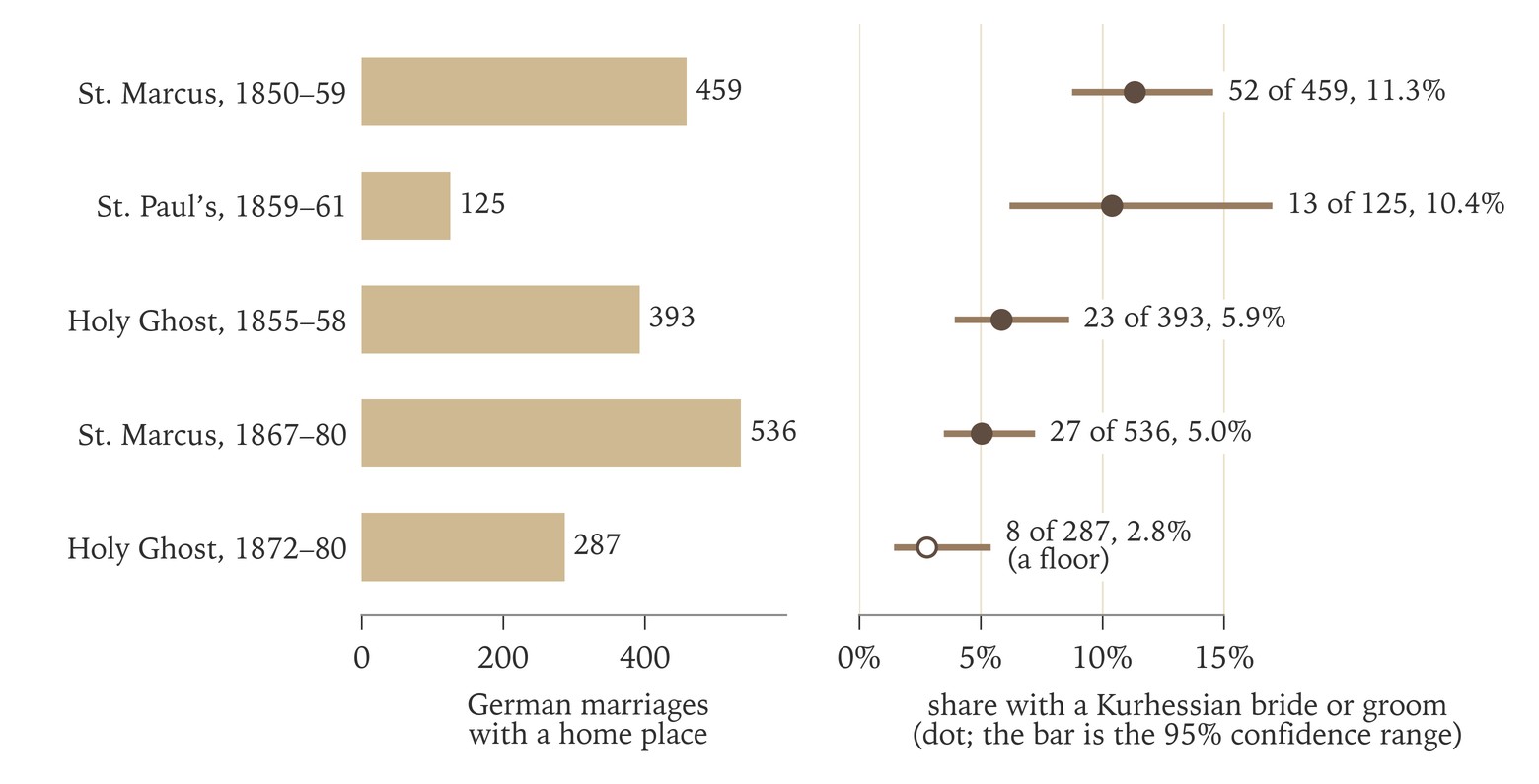
heritagebooks : accessed 4 November 2026). Not consulted for this book; its years for St. Marcus are not yet known; St. Marcus Evangelical Church (St. Louis, Missouri), marriage register 1866, p. 135, entry 676/4. In thirty-one years of St. Marcus marriages, 1850–80, only one other groom is recorded as coming from his home district of Hofgeismar: Wilhelm Freise of Helmarshausen, in 1874. Roger P. Minert has published extracts of the St. Marcus registers that give German birthplaces (2018). In the 1850s about one German marriage in nine at St. Marcus and St. Paul’s had a Kurhessian bride or groom; from 1867 it was about one in twenty. Hesse-Darmstadt is more common than Kurhessen in every period counted. At St. Marcus it is about 1.9 times as common in 1850–59, 5.5 times in 1860–66 (only 11 to 2, too few to rely on) and 4.2 times in 1867–80. At Holy Ghost it is about 1.65 times as common in 1855–58 and 1.25 times in 1872–80. At St. Marcus in 1860–66 Pastor Wall mostly wrote only the St. Louis home, so just 50 German marriages give a place, 2 of them Kurhessian, one of them Charles’s: too few for a bar. Holy Ghost recorded home places only in 1855–58 and 1872–80; in the later years 11 entries say only “Hessen” and are not counted, so 2.8 percent is a floor (6.6 percent if all 11 were Kurhessian). One St. Paul’s groom of 1859 is entered as from “Curhessen,” but his Kreis Wetzlar was Prussian, and he is not counted. Charles’s own entry gives his district as “Kreis Caßel.” From August 1877 the St. Marcus register often gives only the residence or the state. Each bar in the right panel is the 95 percent confidence range: given how many marriages could be counted, a range made this way holds the true share nineteen times in twenty. [MARDENOM] [DSKURH] [MINERT18] [MAR66].com/ products/ 121-fr0657 - St. Marcus German Evangelical Church (St. Louis, Missouri), death register 1896, pp. 120–121, no. 2631; Evangelisch-lutherische Kirchengemeinde Clausthal (Marktkirche) (Clausthal, Königreich Hannover), baptisms 1841–1848, 1847 No. 101; Passenger list of the Bremen ship Minerva, Bremen to New Orleans, arrived 28 Nov 1853, Nos. 323–327: “Ges. Krusheld,” 35, miner. — Proven. [KDR96] [KCLT] [KMIN]
- St. Louis city directories: 1863, p. 217 (business list) and p. 248 (advertisement); Ancestry (https://
www ), “U.S. Civil War Soldier Records and Profiles, 1861–1865” (Historical Data Systems), record 1163407 (accessed 6 November 2026), George Kreichelt, enlisted 7 May 1861, Co. B, 2nd U.S. Reserve Corps Infantry, mustered out 16 Aug 1861; Compiled Military Service Record, August Kreichelt, Battery B., roll 333. The chapter “Auguste Kreichelt and Her Family, 1847–1896” tells the family’s story in full. [KDIR] [GEORG] [AUGCSR].ancestry .com - Charles Gannson (Private, Battery B, 2nd Missouri Light Artillery, Civil War), pension application no. Inv. 749,432, certificate no. 684,507; Case Files of Approved Pension Applications of Veterans Who Served in the Army and Navy Mainly in the Civil War and the War with Spain, 1861–1934; Civil War and Later Pension Files; Record Group 15: Records of the Department of Veterans Affairs; National Archives, Washington, D.C.; digital copy of the file supplied to the author by the National Archives, imaged at https://
charles-research : accessed 30 October 2026. Mail-order copies ordered by the author, first a partial file, order F21-314123835E, submitted 14 February 2017 and delivered electronically, and then the complete file, order F41-523680269E, submitted 8 September 2019 and sent by mail. Charles was a sergeant from 7 November 1863 until 15 March 1865. Pension file p. 28. — Possible. [PEN].netlify .app/ pension-file .html - Ernst D. Kargau, The German Element in St. Louis, pp. 8–9. Page 124; for Second Street, pp. 8–9. [KARGAU]
- J. Thomas Scharf, History of Saint Louis City and County, vol. 2, p. 1732. They formed the German Evangelical Congregation, meeting at first in the Benton School. In 1845 the congregation built two identical wooden churches. The North Church was at Fifteenth and Carr Streets. The South Church, the “Untere Kirche” (Lower Church), was at Jackson and Soulard, and was dedicated on 14 December 1845. The two churches belonged to one congregation until 1856. Then the South Church took the name St. Marcus, and the North Church became St. Peter’s. Scharf, pages 1731–32. Schneider, page 165, for the name “Untere Kirche.” Scharf gives 1856 for the division and the name St. Marcus. Schneider, p. 165, gives January 1848 for separate organizations and the name, and 1855 for St. Peter’s. For the frame church. J. Thomas Scharf, History of Saint Louis City and County, vol. 2, p. 1732; Carl E. Schneider, The German Church on the American Frontier: A Study in the Rise of Religion among the Germans of the West, Based on the History of the Evangelischer Kirchenverein des Westens (Evangelical Church Society of the West), 1840–1866 (St. Louis: Eden Publishing House, 1939), p. 87 (Georg Wendelin Wall, “a native of pietistic Württemberg,” entered Basel at nineteen and stayed five years) p. 164 (“The new congregation founded by Wall in 1843”), p. 165 (“South Church” (Untere Kirche); “Because of ill health Wall resigned in December, 1845”), and p. 166 (in 1850 “Wall emerged from his quasi-retirement at Gravois”); Internet Archive, germanchurchonam00schn (https://
archive : accessed 4 November 2026); St. Louis Genealogical Society, “St. Marcus UCC” (https://.org/ details/ germanchurchonam00schn stlgs : accessed 6 November 2026). Two more congregations later grew out of it: St. Paul’s in 1848 and Jesus Church in 1894. Jesus Church kept German in its name and its registers, but by 1903 it also married couples in English. St. Louis County Library, “Saint Marcus Church, Saint Louis City, Missouri” (genealogy guide to United Church of Christ congregations; https://.org/ ?p =20907 slcl : accessed 9 November 2026); St. Louis Genealogical Society, “St. Marcus UCC” (https://.org/ research-learn/ genealogy/ united -church -christ -congregations -alphabetical/ united -church -christ -congregations -saint -lucas -saint -matthew/ saint -marcus -church -saint -louis -city -missouri stlgs : accessed 9 November 2026); St. Louis County Library, Hyphenated Genealogy Guide to St. Louis German Evangelical Congregations (2023), Jesus United Church of Christ, 1894–2001, and St. Pauls-Friedens (“merged with Jesus German Evangelical Church,” 1913); Jesus Evangelical Church (St. Louis, Missouri), marriage register, Wilhelm Fleschert and Louise Johnson, 20 May 1903, marked “Engl.” (FamilySearch image 3Q9M-CSLL-39G1-M, https://.org/ ?p =20907 www , accessed 6 November 2026). Read in the image. See the chapter on Louise. [SCHARF] [SCHARF] [SCHNEIDER39] [STLGSM] [SLCL] [SLCL] [JESUS03].familysearch .org/ ark:/ 61903/ 3:1:3Q9M-CSLL-39G1-M - Ernst D. Kargau, The German Element in St. Louis, pp. 8–9, p. 195. Kargau puts the split down to “differences of opinion between a part of the congregation and the Reverend Wall.” He says the members who left formed two congregations, “St. Marks” in South St. Louis and St. Peter’s in the north. Those who stayed chose Frederick Picker as pastor and renamed their church the Independent Protestant Church of the Holy Ghost, with a constitution adopted in 1843. Kargau adds (p. 200) that for some years the two owned their property in common, and Wall, Nollau, Cavizel, Ries and Baltzer took turns preaching in both. Scharf, followed here, has one congregation with two churches until 1856. [KARGAU]
- Albert Schory, Geschichte der Deutschen Evangelischen Synode von Nord-Amerika (St. Louis, 1889), pp. 13–17. [SCHORY]
- St. Marcus Evangelical Church (St. Louis, Missouri), marriage register 1866, p. 135, entry 676/4; Albert Schory, Geschichte der Deutschen Evangelischen Synode von Nord-Amerika (St. Louis, 1889), pp. 13–17. [MAR66] [SCHORY]
- St. Marcus baptism register 1868, p. 224, entry 5857/173, image 372; St. Marcus Evangelical Church (St. Louis, Missouri), baptism register 1881, p. 574, entry 10269, Bertha Jansen. The baptism register numbers its entries in one running series. From Maria Josephine’s baptism in June 1868 (entry 5857) to Bertha’s in September 1881 (entry 10269), the count rose by more than 4,400. St. Marcus Evangelical Church records, 1847–1981. The Synod’s seminary, later Eden Theological Seminary, holds the original registers, which have been microfilmed; the family appears in the baptism, confirmation, marriage, and burial books of 1847–1904. St. Louis County Library, “Saint Marcus Church, Saint Louis City, Missouri”. The congregation lives on as St. Marcus United Church of Christ, 2102 Russell Boulevard, in the church it dedicated in 1915. [MJ] [BER] [EDEN] [SLCL]
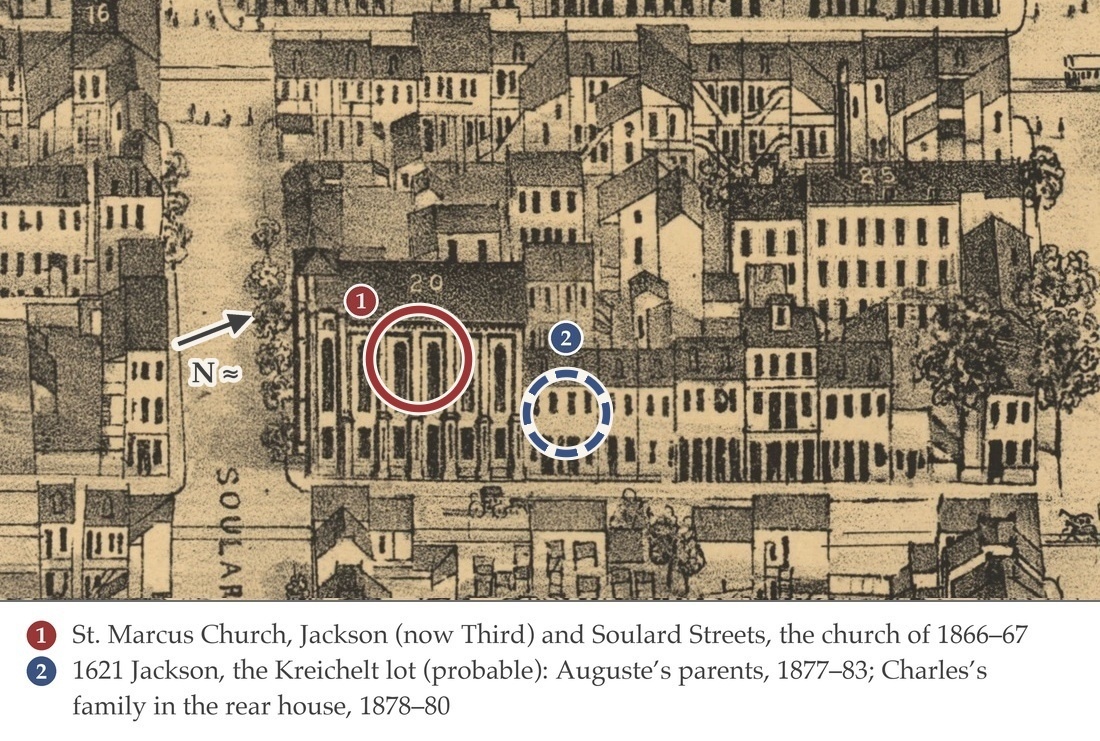
- J. Thomas Scharf, History of Saint Louis City and County, vol. 2, p. 1732. This is the brick church of 1866–67 at Jackson (now Third) and Soulard, built on the site of the first. The baptism of September 1866 probably took place while the new church was being built. The children baptized from 1868 on were probably baptized in this building. The numbered circles mark the church (1) and the probable place of the later Kreichelt house, 1621 Jackson (2) (see “Jackson Street and the Cotton Press, 1877–1884”). Glen Holt and Tom Pearson, St. Louis Streets Index, p. 121. Page 121: the part of today’s Third Street between Rutger and Arsenal Streets was named Jackson Street until 1883. [SCHARF] [STLSTR]
- Carl E. Schneider, The German Church on the American Frontier. [SCHNEIDER39]
- Audrey L. Olson, St. Louis Germans, 1850–1920, pp. 118–19 and 123. [OLSON]
- Audrey L. Olson, St. Louis Germans, 1850–1920, pp. 118–19 and 123, p. 119. Olson quotes the report from William Hyde and Howard L. Conard, Encyclopedia of the History of St. Louis (New York, Louisville, St. Louis: Southern History Company, 1899), vol. 2, p. 700 (her note 45, p. 311), and gives no year. Olson’s quotation reads “two weeks”; in the copy of Hyde and Conard read for this book, the word before “weeks” is cut off at the binding. [OLSON]
- Death notices of Rev. George W. Wall: “Died,” Missouri Republican (St. Louis), 22 April 1867, p. 2 (“Fell asleep in his Savior, on Easter Sunday morning, the Rev. GEORGE W. WALL … aged 56 years and 2 months”); imaged, (https://
www : accessed 4 November 2026); and “Died,” Missouri Democrat (St. Louis), 22 April 1867, p. 1, col. 5 (“On Easter Sunday, at 7 o’clock, A. M., Rev. GEORGE W. WALL”; funeral Tuesday at 2 p.m. from his church); imaged, (https://.newspapers .com/ image/ 666857067/ www : accessed 4 November 2026). Read in the page images. Easter fell on 21 April in 1867; Carl E. Schneider, The German Church on the American Frontier, pp. 165–66. Schory gives the break as three years, without dates. Albert Schory, Geschichte der Deutschen Evangelischen Synode von Nord-Amerika (St. Louis, 1889), pp. 13–17. Two St. Louis dailies printed his death notice the next morning, and the Missouri Democrat gives the hour as 7 a.m. Scharf gives the date as 20 April and Schory as 22 April; both are a day off. Death notices of Rev. George W. Wall; J. Thomas Scharf, History of Saint Louis City and County, vol. 2, p. 1732; Albert Schory, Geschichte der Deutschen Evangelischen Synode von Nord-Amerika (St. Louis, 1889), pp. 13–17. From the fall of 1864 the marriage register also records weddings performed by a second pastor, “Past. L. Nollau.” From the middle of 1867 the entries are in Pastor Braschler’s hand. He baptized Charles’s children of 1868, 1870, 1872 and 1874, and Auguste’s nephew August Kreichelt in December 1872. [WALLOB] [SCHNEIDER39] [SCHORY] [WALLOB] [SCHARF] [SCHORY].newspapers .com/ image/ 571035011/ - St. Marcus Evangelical Church (St. Louis, Missouri), marriage register 1850–1880, images 324–449; St. Marcus baptism register 1868, p. 224, entry 5857/173, image 372; St. Marcus Evangelical Church (St. Louis, Missouri), baptism register 1870, p. 285, entry 6644/141; St. Marcus Evangelical Church, St. Louis: baptism of Auguste Gonsen, 1872, p. 352; St. Marcus Evangelical Church (St. Louis, Missouri), baptism register 1874, p. 402, no. 8178/41, Louise Jansen; St. Marcus Evangelical Church (St. Louis, Missouri), baptism register 1872, p. 367. [HEIM] [MJ] [KATE] [AUG] [LOU] [GOD72]
- Ernst D. Kargau, The German Element in St. Louis, pp. 8–9, p. 167. [KARGAU]
- Compiled Service Record cards, Charles Gannsen, Battery B, 2nd Missouri Light Artillery, National Archives microfilm M405, roll 327. [CSR]
- Charles Gannson (Private, Battery B, 2nd Missouri Light Artillery, Civil War), pension application no. Inv. 749,432, certificate no. 684,507; Case Files of Approved Pension Applications of Veterans Who Served in the Army and Navy Mainly in the Civil War and the War with Spain, 1861–1934; Civil War and Later Pension Files; Record Group 15: Records of the Department of Veterans Affairs; National Archives, Washington, D.C.; digital copy of the file supplied to the author by the National Archives, imaged at https://
charles-research : accessed 30 October 2026. Mail-order copies ordered by the author, first a partial file, order F21-314123835E, submitted 14 February 2017 and delivered electronically, and then the complete file, order F41-523680269E, submitted 8 September 2019 and sent by mail. Charles was a sergeant from 7 November 1863 until 15 March 1865. Pension file pp. 18 and 20. Their evidence is weighed in the chapter “The Watchman and the Pension, 1885–1895.” [PEN].netlify .app/ pension-file .html - Edwards’ St. Louis Directory, 1866, p. 484, image 472, p. 723, image 709; St. Louis Probate Court, estate file of Christian Götting & Co., inventory of 25 Aug 1866, image 181; St. Louis directory, 1868, p. 414; City of St. Louis, deeds of trust, 14 May 1869, pp. 539–540, pp. 70–71. — Possible. The directory line reads “Jansen Charles, bartender, Charles Schneider, r. 24 n. 2d.” The employer was very probably Charles F. Schneider. His saloon was at Second and Chestnut Streets, on the same block, and he still had it in 1869. Two years later the directory spelled Charles’s name Jansen at Schnerr’s. But the 1866 line has no link to Schnerr, and Charles Jansen was a common name. Charles Mehl, one of the two men who valued the Götting estate, appears again three years later as trustee of Charles’s saloon loans. Two notices of April 1866, which probably name him, are told in “The Saloon Years, 1866–1870.” Edwards’ Eleventh Annual Directory of the City of St. Louis for 1869, p. 693, “Schneider Charles F. saloon, 2d sw. cor. Chestnut, r. same” (Internet Archive, Directory_St_Louis_1869, image n640, https://
archive : accessed 10 October 2026, read in the page image). [D1866] [GOTT66] [D1868] [DOT69] [D1869S].org/ details/ Directory_St_Louis_1869 - J. G. Woerner, ed. A Digest of the Charter and the Revised Ordinances of the City of St. Louis (St. Louis, 1866), art. IX. [OCC-DIG1866]
- Friedrich Wilhelm Gonnson, p. 164; St. Marcus Evangelical Church (St. Louis, Missouri), marriage register 1866, p. 135, entry 676/4. — Probable. [FW] [MAR66]
- Robert Moore, C.E., “Notes upon the History of Cholera in St. Louis,” in American Public Health Association, Public Health Papers and Reports, vol. 10, Presented at the Twelfth Annual Meeting of the American Public Health Association, St. Louis, Mo., Oct. 14–17, 1884 (Concord, N.H.: Republican Press Association, 1885), pp. 337–42 (1866: first deaths in the week ending 3 August; 991 in the week ending 24 August; total 3,527, the Board of Health’s count agreeing with the assessors’ house-to-house count plus the City Hospital’s deaths, against the 8,500 in McClellan’s report on the cholera of 1873; “Kerry patch” and “Frenchtown” in deep black on the accompanying map; “the close relation between cholera and filth”), and the unnumbered “Appended Table Showing Mortality from Cholera in St. Louis” that follows p. 342 (1866: July 2, August 2,388, September 1,082, October 51, November 4; total 3,527; population 204,327; 17.26 per thousand); Internet Archive, publichealthpape1018amer (https://
archive : accessed 4 November 2026). Title page, pp. 341–42 and the table read in the page images, 4 November 2026. Moore gives 2,388 deaths in August and 1,082 in September. He checked the Board of Health’s count against the assessors’ house-to-house count. He rejected the figure of 8,500 deaths in the federal report on the cholera of 1873, which the newspapers had copied. [MOORE84].org/ details/ publichealthpape1018amer - Kristen Layne Anderson, Abolitionizing Missouri, pp. 144–45, 176. Pages 144–45, her table numbered 5.1, from the city census as printed in the Neuer Anzeiger des Westens, 3 August 1866. The Irish-born numbered 26,142. Robert J. Rombauer, Map of Part of the City of Saint Louis, Showing the Location of Deaths from Cholera in 1866, prepared for the 12th annual meeting of the American Public Health Association, October 1884 (St. Louis: A. Gast & Co., 1884), 1 map, 39 × 71 cm, scale 1:26,400 (blocks shaded by the death rate per thousand; population 204,000, deaths from cholera 3,527, deaths from other causes 5,379); American Geographical Society Library, University of Wisconsin–Milwaukee Libraries, digital ID agsmap027498 (https://
collections : accessed 4 November 2026). Catalog record read, 4 November 2026; a copy of the map is bound in the American Public Health Association volume with Robert Moore’s “Notes upon the History of Cholera in St. Louis.” A map made in 1884 from the assessors’ count, for the American Public Health Association’s meeting in St. Louis that October, shades the deaths block by block. Robert Moore, C.E., “Notes upon the History of Cholera in St. Louis,” in American Public Health Association. Robert Moore, a civil engineer, wrote the epidemic’s history for the same meeting and used that map. He named the districts of Kerry Patch and Frenchtown as the worst, and blamed filth and well water. [ANDERSON16] [RMAP84] [MOORE84].lib .uwm .edu/ digital/ collection/ agdm/ id/ 27117 - J. Thomas Scharf, History of Saint Louis City and County, vol. 2, p. 1732; St. Louis Genealogical Society, “St. Marcus UCC” (https://
stlgs : accessed 6 November 2026). The new church was dedicated on 4 August 1867. [SCHARF] [STLGSM].org/ ?p =20907 - Friedrich Wilhelm Gonnson, p. 164; J. Thomas Scharf, History of Saint Louis City and County, vol. 2, p. 1732. [FW] [SCHARF]
- Friedrich Wilhelm Gonnson, p. 164. [FW]
- St. Marcus German Evangelical Church (St. Louis, Missouri), baptism register 1866, pp. 164–165. [GPB66]
- Friedrich Wilhelm Gonnson, p. 164; The New International Encyclopedia, 1st ed. (New York: Dodd, Mead, 1905), vol. 10, pp. 35–36, “Hesse-Cassel.” [FW] [NIE]
- St. Marcus Evangelical Church (St. Louis, Missouri), burial register, 1866, entries 567–587, 9 Aug–21 Sep 1866, Pastor G. W. Wall (“an der Cholera” at entries 567–571, 573–574 and 577–587; Maria Anna Fuchs, entry 578/39) (image group number (IGN) 007769184, images 709–710); imaged, FamilySearch (https://
www and https://.familysearch .org/ ark:/ 61903/ 3:1:3Q9M-CSMZ-1VMK www : accessed 6 November 2026); citing “St. Marcus Evangelical Church records, 1847-1981,” microfilm of originals at the Eden Archives in St. Louis, Missouri. Read in the images. — Proven. [BUR66].familysearch .org/ ark:/ 61903/ 3:1:3Q9M-CSMZ-1JGM - St. Marcus Evangelical Church (St. Louis, Missouri), burial register, 1866. [BUR66]
Also on this page
About the pictures
The printed captions of these pictures were shortened on 25 October 2026. Their full text is kept here.
St. Marcus Evangelical Church marriage register, 7 January 1866: “Carl Gonnson”, aus Deiße, Kreis Cassel, Churhessen, marries Auguste Kreichelt. Pastor Wendelin Wall officiating.
Under the same record image: Shown here: entry 676, the fourth of 1866; the last column names the witnesses, Adam Herweck, Philipp Weber, Anna Goetz and Sophie Lehm, and closes “Cop: GWWall, Pfr.”, married by G. W. Wall, pastor. The part of the page that holds the entry, with the two entries above it, is on the research website, on the page “Record Images: The Full Pages”, listed in the appendix “For Researchers and Online Records”.
Tables kept online
The printed chapter tells these records in its text. The table that stood in the book until 25 October 2026 is kept here in full; the bracketed keys are those of the book’s sources.
The family in the St. Marcus registers, 1866–1903
| Date | Register and entry | Name as written | Source |
|---|---|---|---|
| 7 Jan 1866 | Marriage register, p. 135, no. 676/4, Pastor G. W. Wall | Carl Gonnson, aus Deiße, Kreis Cassel, Churhessen; Auguste Kreichelt, aus Clausthal | [MAR66] |
| 2 Sep 1866 | Baptism of Friedrich Wilhelm, pp. 164–165, entry 5201/372, Pastor G. W. Wall | Gonnson | [GPB66] |
| 7 Jun 1868 | Baptism of Maria Josephine, entry 5857/173, Pastor Braschler | Gonnson | [MJ] |
| 22 May 1870 | Baptism of Friedrike Catharina Carolina Amalia (Kate), pp. 284–285, entry 6644/141, Pastor Braschler | Gansen | [KATE] |
| 23 Jun 1872 | Baptism of Auguste, pp. 352–353, entry 7519/196 | Gonsen | [AUG] |
| 8 Dec 1872 | Baptism of August Kreichelt, entry 7730/407: Charles and Auguste godparents | Charles Gansen u. s. G. Auguste, geb. Kreichelt | [GOD72] |
| 22 Feb 1874 | Baptism of Louise, p. 402, no. 8178/41 | Jansen | [LOU] |
| 3 Oct 1875 | Baptism of Erwin Carl (Charles Jr.), p. 453, entry 8854/282 | Konsen | [ERW] |
| 4 Sep 1881 | Baptism of Bertha, p. 574, entry 10269/179, Pastor Nollau | Jansen | [BER] |
| 5 May 1890 | Death register no. 1897, Maria Josephine Herr | geb. Konzen | [MJ] |
| 31 Dec 1890 | Death register no. 1961, Auguste Somers | geb. Konzen | [AUG] |
| 18 Mar 1894 | Confirmation, Palm Sunday class, probably Bertha | Bertha Johnson | [CONF] |
| 19 Dec 1896 | Death register, pp. 120–121, Auguste, Pastor E. H. Eilts | Auguste Conson geb Kreichelt | [AUG96] |
| 19 Dec 1903 | Burial register, pp. 240–241, no. 3393, Charles | (as Johnson) | [BUR03] |
Marriage, 1866: more on St. Marcus and its pastors
These passages were cut from the printed chapter on 16 November 2026. They are background on the congregation in later years, not evidence about Charles. Each one is given as it stood, with its sources.
1. How Jesus Church grew out of St. Marcus, 1894
From “St. Marcus,” first paragraph, the second note. The printed note keeps its first and last sentences: “Two more congregations later grew out of it: St. Paul’s in 1848 and Jesus Church in 1894,” and “Jesus Church kept German in its name and its registers, but by 1903 it also married couples in English.” The passage below stood between them (public edition and website only).
Jesus Church began when the pastor of St. Marcus left. L. G. Nollau resigned in the summer of 1894, and in October he began German services in Soulard Market Hall, where Jesus Church first met. [JESUS94] The St. Marcus centennial history of 1943 says: “Upon his departure in 1894, many of the younger members also left St. Marcus in order to found another congregation in South St. Louis.” [STM1943] Jesus Church’s own history of 1919 says only that it was organized on 2 November 1894 “by a number of former members” of St. Marcus, with Nollau conducting the first services. It gives no reason for the parting, and neither history says it was over language. At Jesus Church, confirmation classes, until then taught only in German, were also taught in English from 1904, and English services, held in the evening, began in 1905. [JESUS1919] At St. Marcus, the 1943 history says, Nollau’s successor, E. H. Eilts, found a congregation “torn by factional strife” and later brought in services in English. [STM1943]
- JESUS94 St. Louis Republic, 22 Aug 1894, p. 3 (https://www.newspapers.com/image/1368617034/), “Purely Personal” (Nollau resigned from St. Marcus); Westliche Post (St. Louis, Missouri), 13 Oct 1894, p. 5 (https://www.newspapers.com/image/640774008/), “Deutscher Gottesdienst” (Nollau’s German services in Soulard Market Hall); Anzeiger des Westens (St. Louis, Missouri), 27 Oct 1895, p. 5 (https://www.newspapers.com/image/642603728/), “Evang. Jesus-Gemeinde” (founded “more than a year” before; Nollau’s address at the cornerstone laying). Newspapers.com, read in the images, 1 Nov 2026 (accessed 6 November 2026).
- STM1943 St. Marcus Evangelical Church (St. Louis, Missouri), St. Marcus Evangelical Church, Saint Louis, Missouri: Centennial Observance, October 10, 1943 (St. Louis: the congregation, 1943), 10 (Louis Nollau’s pastorate, 1885–94, and his departure; E. H. Eilts from November 1894; the Ladies’ Aid Society under Pastor Hoffman, 1875–77); Eden Theological Seminary Archives, Webster Groves, Missouri. Scan of the cover and pp. 10–11 sent by the Archives’ librarian and archivist, 4 November 2026, for this book; quoted here, not reproduced. Read in the scan.
- JESUS1919 Jesus Evangelical Church (St. Louis, Missouri), The Twenty-Fifth Anniversary, November Second, Nineteen Hundred and Nineteen: Jubilee-Greeting (St. Louis: the congregation, 1919), 2–3, “A Brief Historical Review” (organized 2 November 1894 by former members of St. Marcus; Nollau’s first services; confirmation in German until 1904; English evening services from 1905; morning services in both languages from January 1913); Eden Theological Seminary Archives, Webster Groves, Missouri, B22-2. Scan of the cover and pp. 2–3 sent by the Archives’ librarian and archivist, 4 November 2026, for this book; quoted here, not reproduced. Read in the scan.
2. The later pastors of St. Marcus, 1890–1904
From “St. Marcus,” the paragraph on Pastor Wall, the note to “His successors baptized Charles’s later children.” The printed note keeps the second pastor of 1864 and Pastor Braschler, who baptized the children of 1868 to 1874. The three sentences below ended the note.
The Synod’s 1890 yearbook lists a later L. G. Nollau at the St. Marcus parsonage, 309 Soulard Street. The 1897 and 1904 yearbooks list Eilt Heeren Eilts there. [KAL] Nollau confirmed the class of 1892, and Eilts recorded Auguste’s death in December 1896. [CONF] [AUG96]
- KAL Evangelischer Kalender (St. Louis: Evangelical Synod), 1890, 1897 and 1904, pastors' directory (L. G. Nollau and E. H. Eilts, 309 Soulard St.). Internet Archive, 1890ESNA, 1897Kalender and 1904-kalender (https://archive.org/details/1890ESNA, https://archive.org/details/1897Kalender, https://archive.org/details/1904-kalender : accessed 9 November 2026), read in the full text. Der Friedensbote for 1866–1903 is held at Eden Theological Seminary Archives and is not available elsewhere.
- CONF St. Marcus Evangelical Church (St. Louis, Missouri), confirmation register, classes 1881–1894, read in full; Palm Sunday 10 Apr 1892 (51 boys, 59 girls, Pastor L. G. Nollau); Palm Sunday 18 Mar 1894, "Bertha Johnson, 20 Dec." FamilySearch image group number (IGN) 007769184, images 254–255 (1892) and 258 (1894); imaged, FamilySearch (https://www.familysearch.org : accessed 10 October 2026).
- AUG96 St. Marcus Evangelical Church (St. Louis, Missouri), death register 1896, pp. 120–121, no. 2631 (100), "Auguste Conson geb. Kreigell," d. 19 Dec 1896, bur. 22 Dec 1896, Pastor E. H. Eilts (image group number (IGN) 007769184, image 883); imaged, FamilySearch (https://www.familysearch.org/ark:/61903/3:1:3Q9M-CSMZ-1JSR : accessed 29 October 2026); citing “St. Marcus Evangelical Church records, 1847-1981,” microfilm of originals at the Eden Archives in St. Louis, Missouri.
Supplements
Records, images and data on this website that go with this chapter.