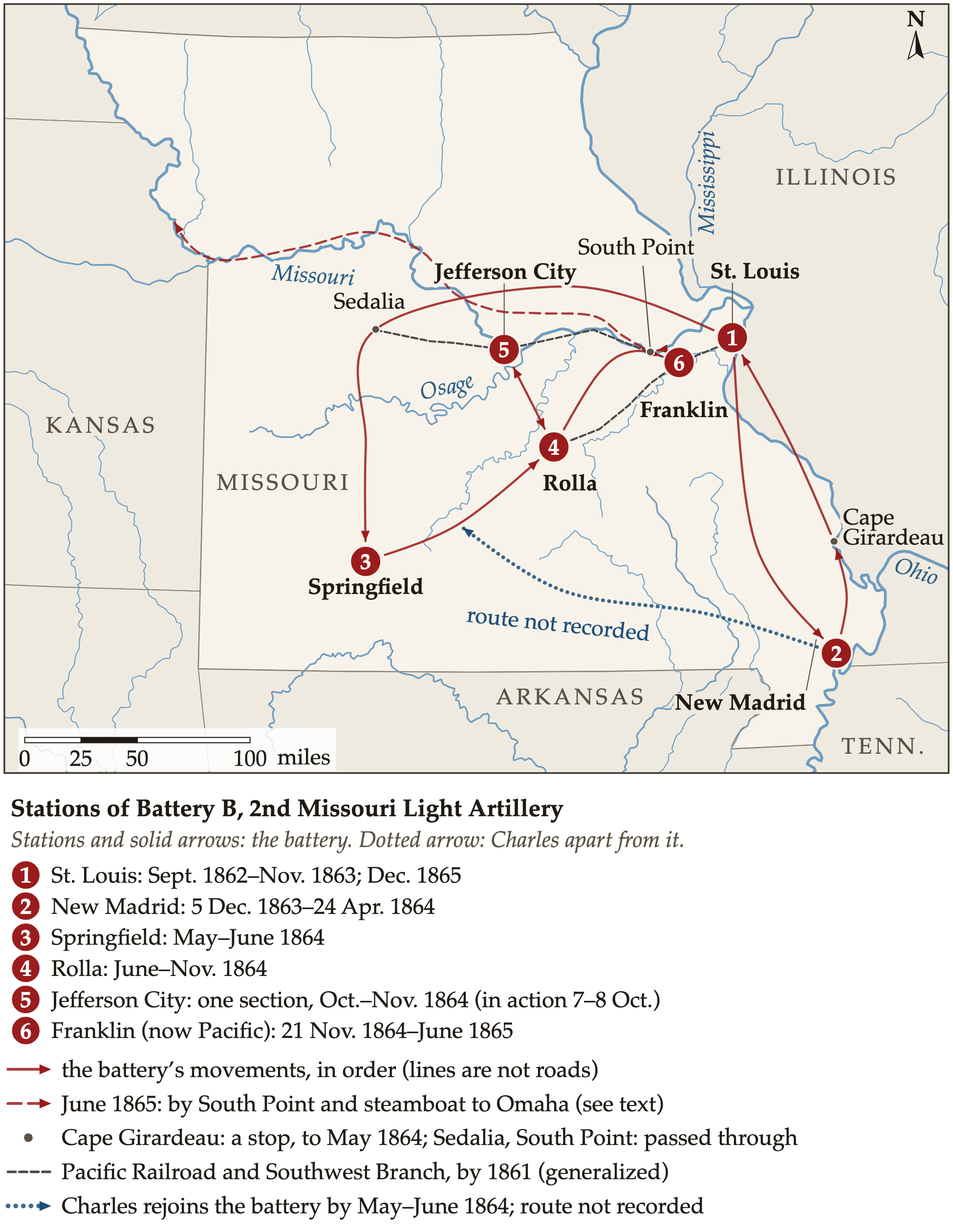
Charles reached New Madrid with Battery B on 5 December 1863.1 He had been a sergeant for four weeks.2 Four days later Captain John J. Sutter reported to Lieutenant Colonel Nelson Cole of the 2nd Missouri Light Artillery: “I arrived with my Company at New Madrid Mo. December 5th 1863.” He had reported to Captain Schmitz of the 25th Missouri Infantry and taken over the fort, “a very formidable one, and all the public property pertaining thereto.” He had little hope of filling his company by recruiting there. The post’s provost marshal, the officer in charge of military police, had not signed up a man in a month. Sutter enclosed a description of Adam Herweck, “of my Company,” then on recruiting service at St. Louis. He called the country around the post “rather thick with Guerrillas.”3
In this chapter
- The river fort
- A recruit from the Kreichelt family
- A sergeant of the garrison
- Guerrillas in the swamps
- Left behind, April 1864
- Cape Girardeau and Springfield
- A prisoner sent for water
- Rolla and Fort Wyman
- Price’s Raid
- The march to Jefferson City
- Two guns at Jefferson City
- Up the Missouri to Rocheport
- Winter at Franklin
- Notes
- About the pictures
- More of the chapter, as printed in the book until 6 November 2026
- More of the chapter, as printed until 11 November 2026
- Supplements
The rolls from that month to February 1865 show Charles a sergeant at every muster, present with the battery or absent on detached service or an expedition.4
The river fort
The Union army had won the post where Charles now served less than two years before. New Madrid lies on a great bend of the Mississippi in the Missouri Bootheel, the state’s far southeast corner, below Cairo and opposite Kentucky and Tennessee. The Confederates fortified it in 1861 and abandoned it to Major General John Pope’s army on the night of 13–14 March 1862.5
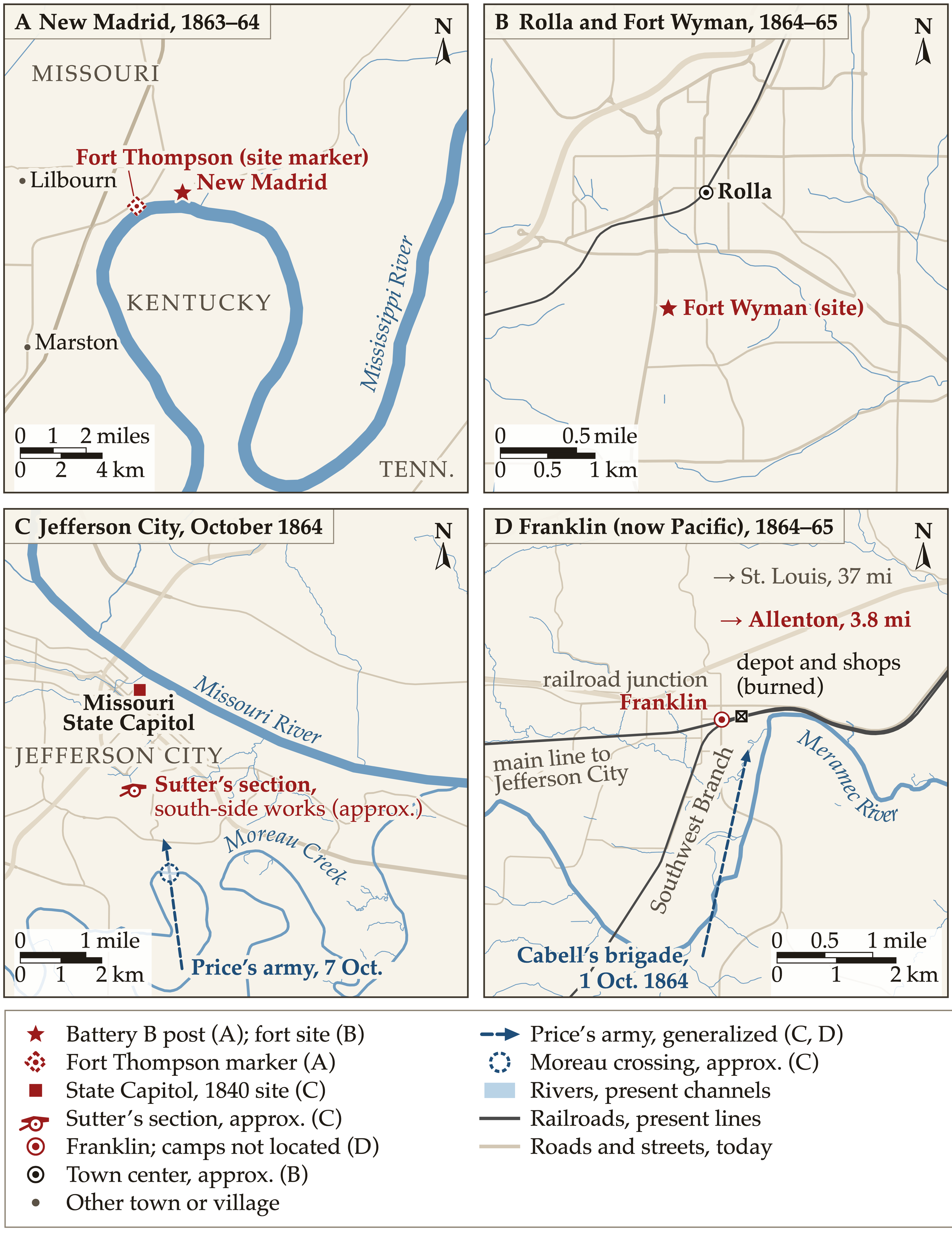
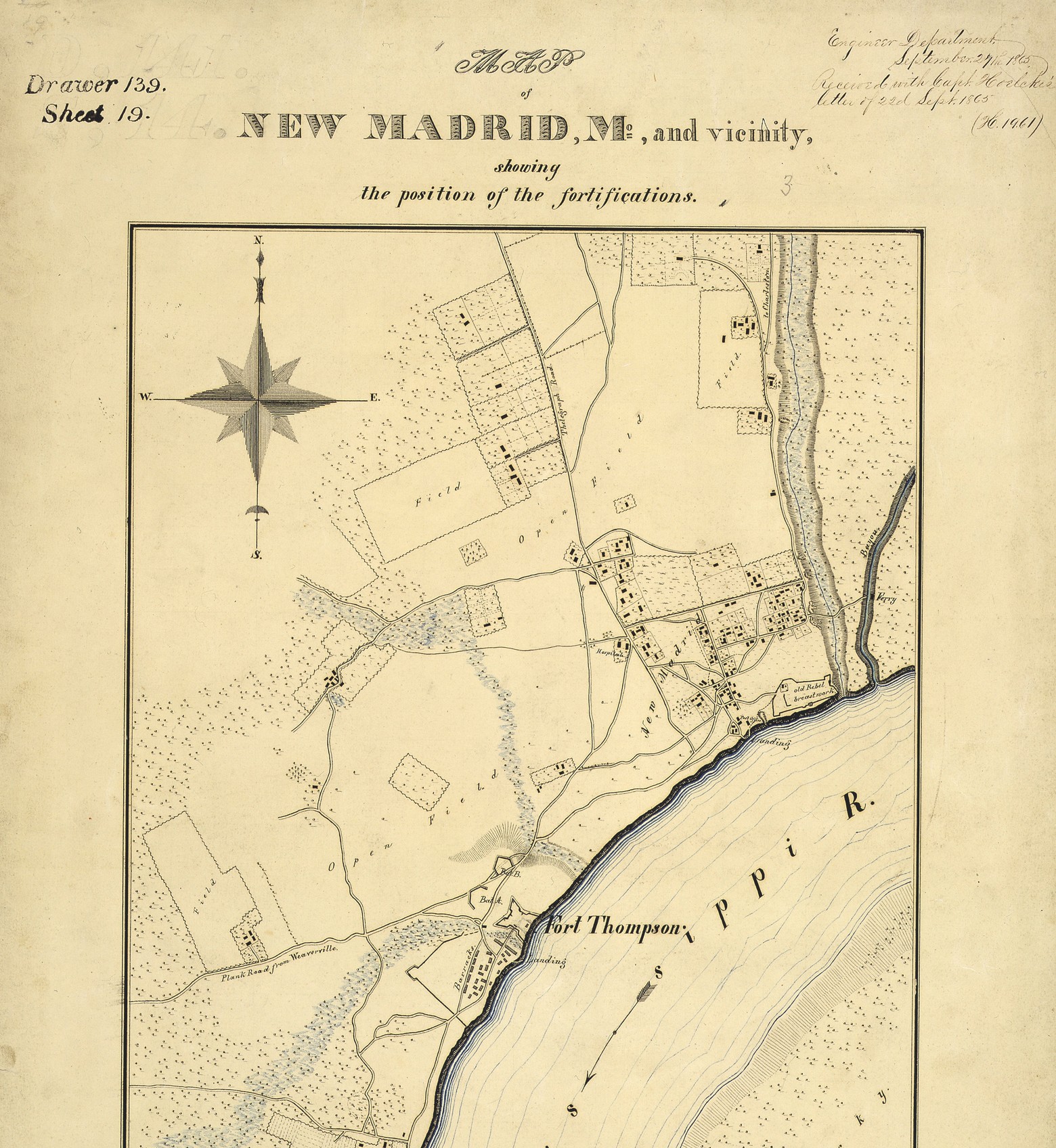
By the time Charles arrived, New Madrid was an army post that held a fort on the river.7 The town stood on a low bluff above the swamp. To the north, the Great Mingo Swamp ran thirty miles toward Commerce. One corduroy road, a road of logs laid crosswise, crossed it.8 The only fight near the town in 1863 was a skirmish on 7 August, four months before the battery came.9
Charles’s battery served as the post’s heavy artillery in December 1863 and January 1864, manning the big guns of the fort.10 For a sergeant and his men, duty at a post like this meant guard, patrols and work on the fort, much as at St. Louis.11 They served the fort’s big guns by the heavy-artillery drill (see Chapter 4).12
When Sutter arrived on 5 December the only other troops were two companies of the 25th Missouri Infantry, and he complained that there was no cavalry.13 By the end of the month the post had three companies of the 1st Missouri Cavalry.14 By the report of 31 January 1864, Sutter was in command of the post.15
A recruit from the Kreichelt family
In January 1864 August Kreichelt, a brother of Auguste Kreichelt, joined Charles’s battery at St. Louis. He came from a family that had served before. His father, Georg Andreas Kreichelt, had served in the home guard in 1861 (see “St. Louis before the War, 1859–1862”).16
Georg’s eldest son was baptized Carl Friedrich August Kreichelt at Clausthal on 1 January 1845, after his birth there on 8 December 1844. The army papers call him August.17 He served in the Union army three times. At sixteen he was in the 2nd U.S. Reserve Corps in the summer of 1861.18 He then served in the 15th Missouri Infantry, the “Swiss Rifles,” until he was discharged for “a disease of the heart” in May 1862.19 On 21 January 1864, thirteen months after Charles, he enlisted at St. Louis as a private in Battery B of the 2nd Missouri, Charles’s own battery.20 The witness to his enlistment signed “Adam Harwek.” He was probably the Adam Herweck who had been sworn in beside Charles, then recruiting in the city.21
A sergeant of the garrison
Charles was present with the battery on the roll for January and February 1864, still a sergeant.22 A garrison fired its guns in drill, in practice and in salutes. Governor Hamilton Gamble died in January 1864, and the district ordered thirteen minute guns fired at New Madrid in mourning, one a minute.23 Battery B very probably fired them.
In his 1890 pension claim Charles named New Madrid as the place where his rheumatism and his deafness began. He blamed exposure in “very severe weather” and the “Concussion of the guns.”24 At his pension examination twenty-six years later Charles’s hearing loss was worst in the right ear.25 His deafness possibly came more from three years of drill and practice firing beside the guns than from battle.26
The post stayed thin. The 25th Missouri’s two companies left in early January. By spring most of the cavalry had gone home on veteran furlough, and on 28 February the post had fifty-three cavalrymen fit for duty.27 The cavalry did the scouting. On 27 February a lieutenant of the 1st Missouri Cavalry came back from a scout through Pemiscot County to the Arkansas line. He did not try the swamps beyond, which his men could not have crossed without wading and swimming for twelve miles.28 In February three new companies of the 2nd Missouri came to the post: H, I and K, heavy artillery like Battery B.29
On the rebuilt company’s descriptive roll, signed on 1 April 1864, Charles’s line is the third of the six sergeants, just below Adam Herweck’s. Its remark reads “Promoted Sergeant Novbr 7. 63.”31 Charles was the farmer among the sergeants. Herweck had enlisted as a tailor and August Derr as a musician.32 Most recruits of 1864 and 1865 were born in America, and the German company of 1862 was becoming a mixed one.33 The clerks who kept its rolls spelled Charles’s name many ways. They probably recorded it as “Gannsen” sounded to them, not as a different name (see “The Name He Signed”).34
Guerrillas in the swamps
In early April a letter writer staying at New Madrid described the post for the St. Louis Daily Missouri Democrat. He dated his letter 5 April and signed it “O. K.” When the newsboy came off the steamboat, he wrote, the townspeople called for the Republican, the rival paper, and cursed the Democrat. “If it were not for the soldiers the Democrat would be badly patronized.” “Every hut, and house, and shed here is crowded with refugees,” he went on. He charged that some of the town’s merchants were carrying goods to the rebels. He called New Madrid, Pemiscot and Dunklin counties “a very cradle of treason.”35 The letter names no battery, but Battery B still held the fort, and Charles’s card for March and April places him at New Madrid.36
In April Major John W. Rabb of the 2nd Missouri, by then the post’s commander, went after the guerrilla bands in the swamps of Pemiscot Bayou. He took about two hundred men of the new Companies H, I and K down the river by steamboat. They marched on foot, as infantry, through cane and water a foot deep and in places three. Before dawn on 7 April, in heavy rain, about a hundred guerrillas attacked their camp at close range. Rabb had a lieutenant and two men killed and seven wounded. His men carried their wounded about six miles through the swamp on litters. His report does not name Battery B.37
A letter signed “Eye Witness,” printed in the Democrat on 23 April, told the night from inside the camp. The scouts, it said, were surprised “in camp and in bed.” Lieutenant Phillips was killed. Sergeant Reese and his men carried the wounded to a house. The scouts came back on the steamer Darling and reached New Madrid on the night of the 8th.38
The wounded came back to the post where Charles served. Private William H. Chasteen of Company I, who had enlisted in March, was among them. His wife had given birth to a son on 2 April, five days before the attack. Chasteen died of his wounds in the post hospital at New Madrid a few days later.39
In 1890 Charles swore that at New Madrid he had slept without a tent and been “out as Scout, and Skirmishing.”40 That is his own claim, and the scouting and skirmishing he describes did take place at New Madrid that winter, as these reports show. No record puts Battery B in any of it. The unit histories record no fighting by the battery at New Madrid, and its own record of events gives it garrison duty only.41 That does not show that Charles took no part. The records name only the larger expeditions, and most patrols found nothing. In the swamps of the southeast, a Wisconsin trooper wrote, guerrillas could hide where no horse could follow.42 Charles’s words possibly describe picket and patrol duty from the fort.
Left behind, April 1864
On 24 April 1864 the battery left New Madrid under the department’s Special Orders No. 105, “to take charge of a Light Battery.”43 The company that had manned the river fort was to become a field battery, with horses, limbers and caissons (ammunition wagons). Special Orders No. 114 of 26 April 1864, two days after the battery left New Madrid, ordered the regiment’s batteries to be given horses and field equipment as light artillery. They got them from June.44
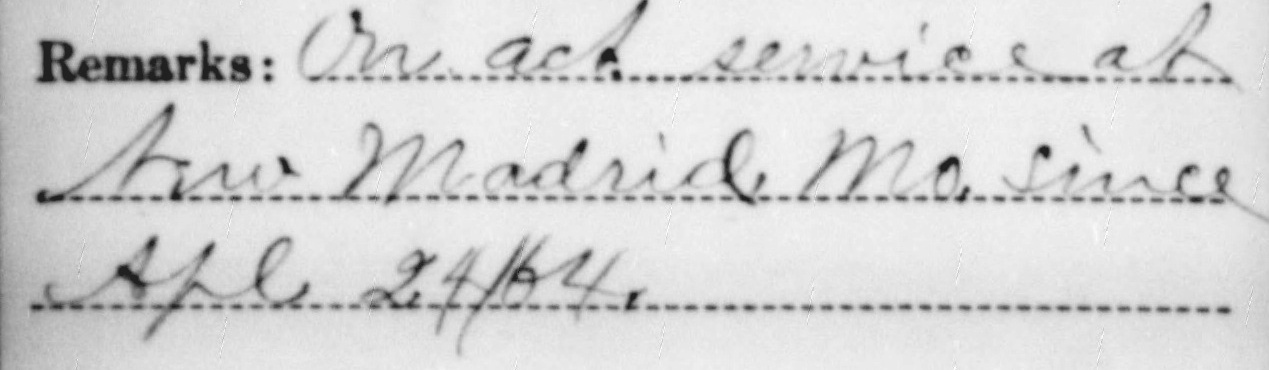
Charles did not go with the battery at first. His card for March and April 1864 reads: “On act. [det.?] service at New Madrid, Mo. since Apl 24/64.”45 The monthly report for April 1864 has “absent on det service,” meaning detached service, an assignment away from his unit.46 Only one other man of the battery stayed behind with him: George Wagner, whose card reads “Sick at New Madrid, Mo. since Apl 24/64.” Two more men left without permission the same day.47
Cape Girardeau and Springfield
From New Madrid the battery went by Cape Girardeau, the river town above it on the Mississippi. It then went by way of St. Louis and Sedalia to Springfield, the Union’s chief post in southwest Missouri.48 The battery left Sedalia on 6 May and reached Springfield on 13 May.49 Two days before, Brigadier General John B. Sanborn had written from Springfield that “Company B, Second Artillery, has not yet reported.”50 At Springfield, the Adjutant General’s report says, the battery was to take over the guns of a light battery once manned by a company of the 6th Missouri State Militia.51 Charles had rejoined the battery. He is present on the roll for May and June 1864, which covers the whole movement, so his detached service at New Madrid was short.52
The stay at Springfield was brief, and not every man left with the battery. Ten days after it arrived, Private William Rolf was admitted to the general hospital there. He died on 28 or 29 May 1864.53 Three years later Captain Sutter certified for Rolf’s widow, Margaret, that he had fallen ill “with his Company at Springfield.”54
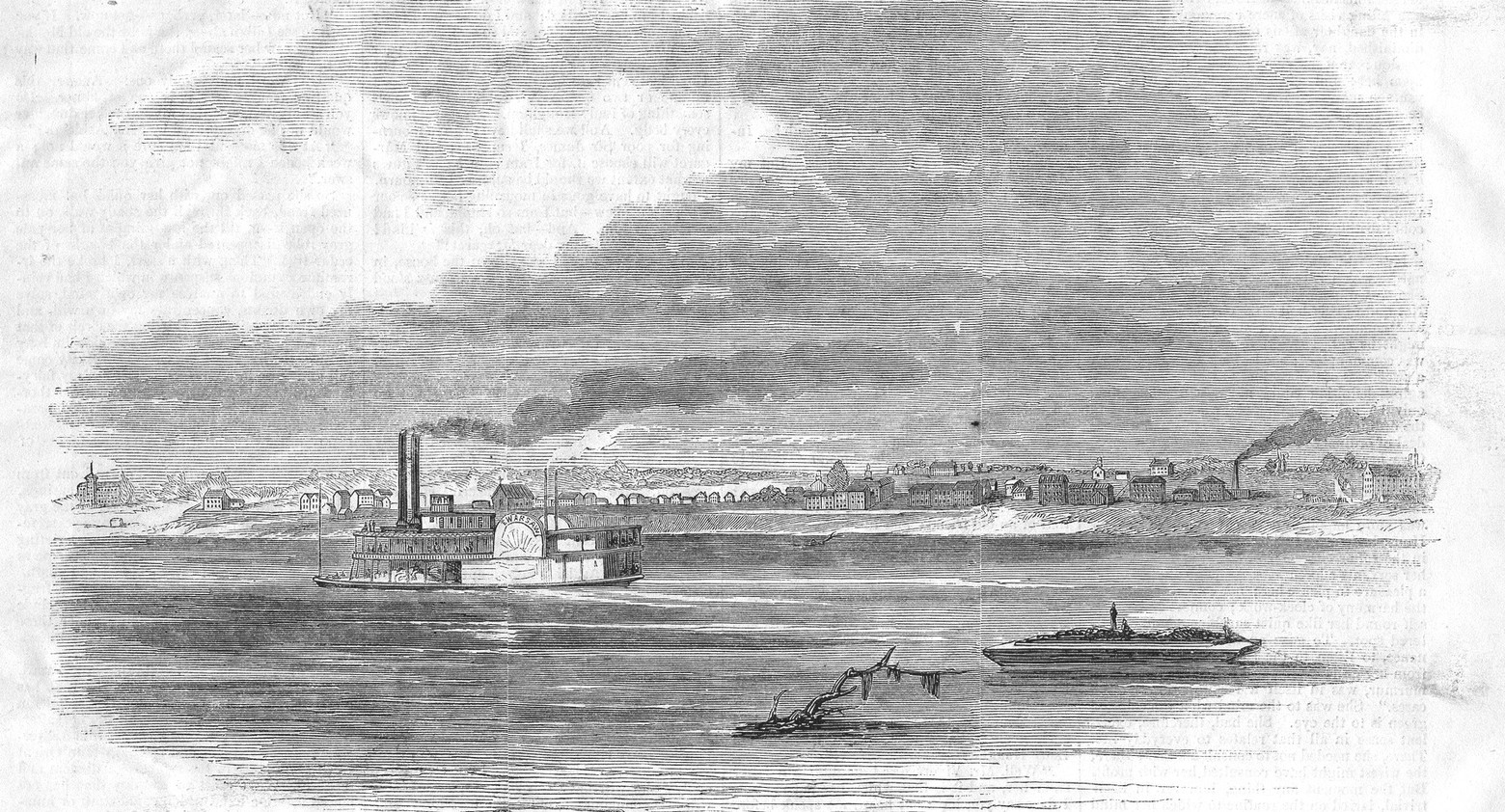
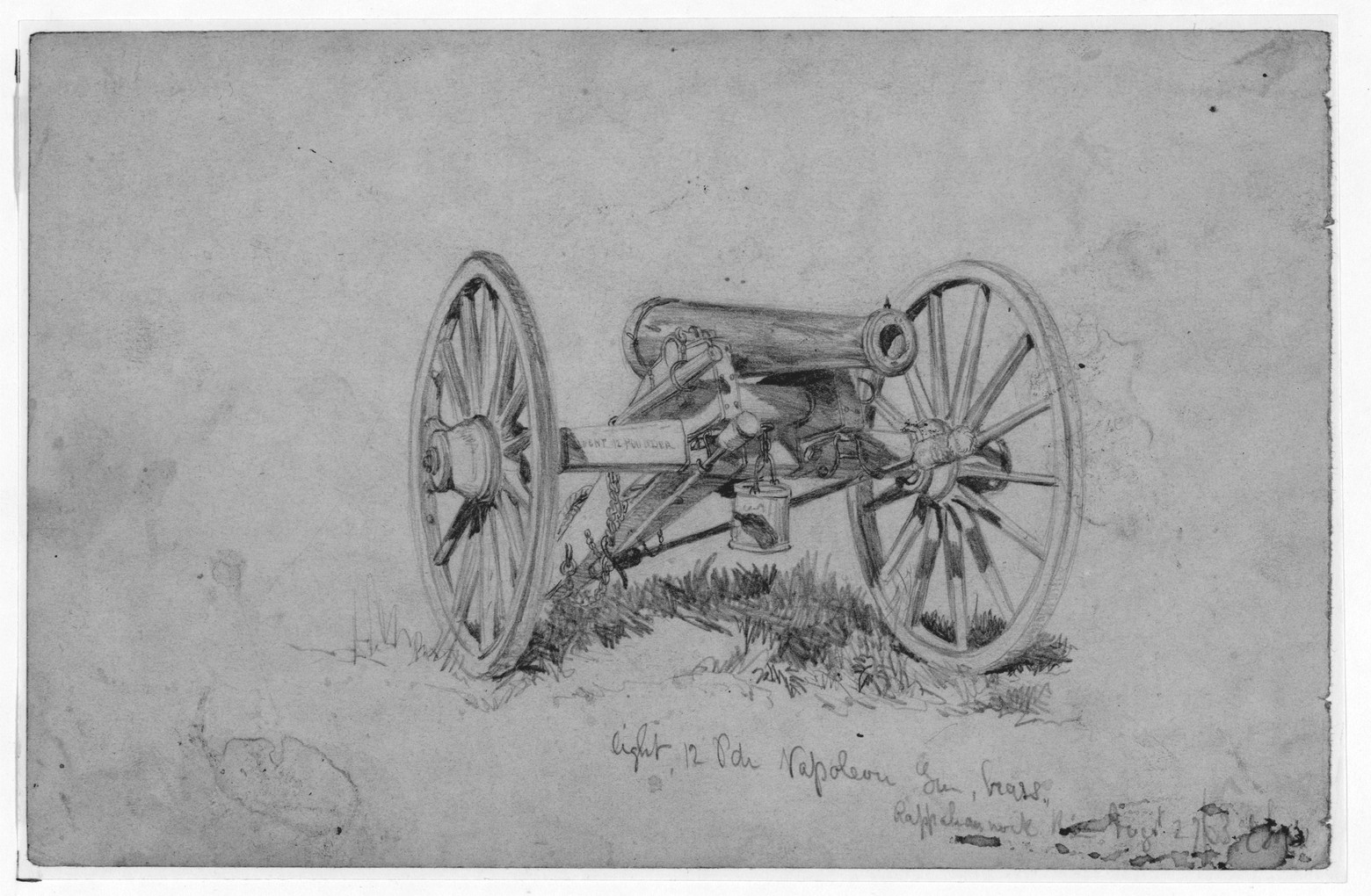
The battery marched from Springfield on 20 June 1864 and arrived at Rolla on the 27th.55 There its old guns and ammunition wagons were shipped to the St. Louis Arsenal and traded for a new battery of Napoleons.56 As a sergeant, Charles very probably drilled men on both kinds of gun, the big guns of the forts and now the battery’s light Napoleons.57
Congress raised the army’s pay on the day the battery marched. As a sergeant Charles drew $20 a month instead of $17 from May.58
A prisoner sent for water
August Kreichelt’s service in Charles’s battery was short. On 22 June 1864 the provost marshal at Springfield, Missouri, reported that August was “guilty of selling stolen property gold watch & chain, to the value of over two hundred (200) dollars” to two Germans named Young, Charles and August. The watch belonged to a man of August’s own battery. The provost marshal later corrected his report: the watch had been obtained “by A. Kreichel upon a forged order.”59 August’s muster card for May and June 1864 marks him “Absent … Conf’d,” that is, confined, under arrest.60
He was held in the post prison at Rolla, where the battery was then stationed. The officer of the guard reported what happened on the evening of 28 June 1864. The prisoner “was sent … by Serg’t of the guard for watter.” He “broke away from the guard, the guard firing without effect,” and “reached the brush,” where “darkness rendered further search useless.”61 The next day the provost marshal at Rolla, Captain Thomas B. Reed, reported that August had “escaped from the Guard House last night and is still at large.”62
The battery listed him as a deserter from 29 June 1864. Its muster-out roll of 20 December 1865 repeats: “Deserted from Rolla Mo June 29th 64.”63
Rolla and Fort Wyman
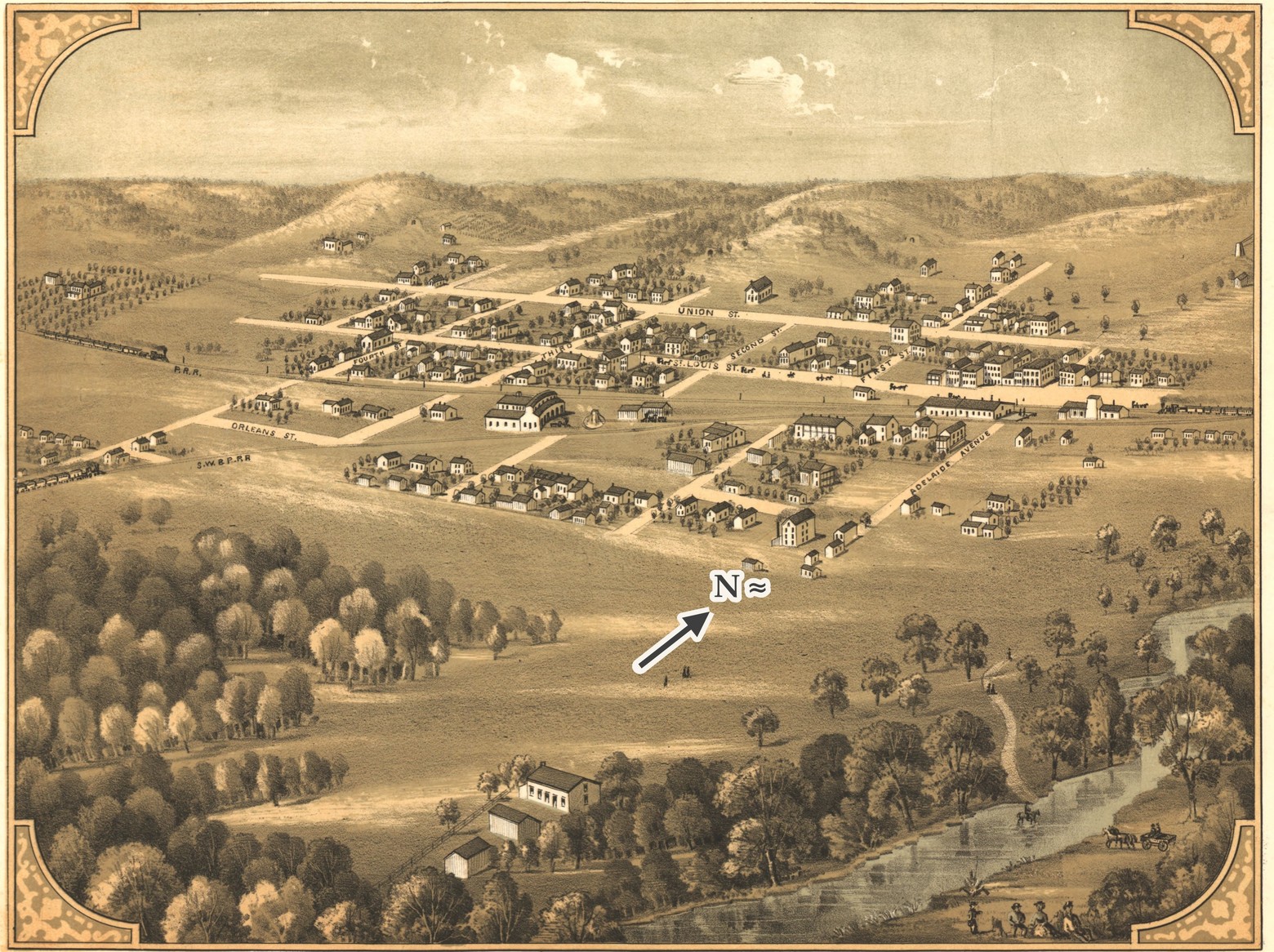
Rolla, where Charles’s battery now camped, was the end of the Pacific Railroad’s southwest branch. The railroad had reached it in December 1860, and the town was the Union’s forward supply depot for southern Missouri.64 After Wilson’s Creek in August 1861 the defeated Union army fell back there. Fort Wyman was built on the hill south of the town to guard the depot. It was a square earth fort with bastions, corners built out so the guns could fire along the walls. An 1865 engineer’s plan by Captain William Hoelcke shows an enclosed fort with a dry ditch, a single gate on the north side, gun platforms at the corners, a magazine (a powder store) and a well.65 In 1861 Union troops took over the Phelps County courthouse, begun in 1860, and used it as a hospital. It is one of the few buildings in Rolla that stood when Charles was there.66
In his 1890 pension claim Charles named Rolla as the place of his rupture, from heavy lifting in Fort Wyman. He swore that he had been “injured in the right side” while “detailed as drill Sergeant to instruct the 64th Ill. Inft. in the tactics of Heavy Artillery.” He dated the injury July 1862, five months before he enlisted.67
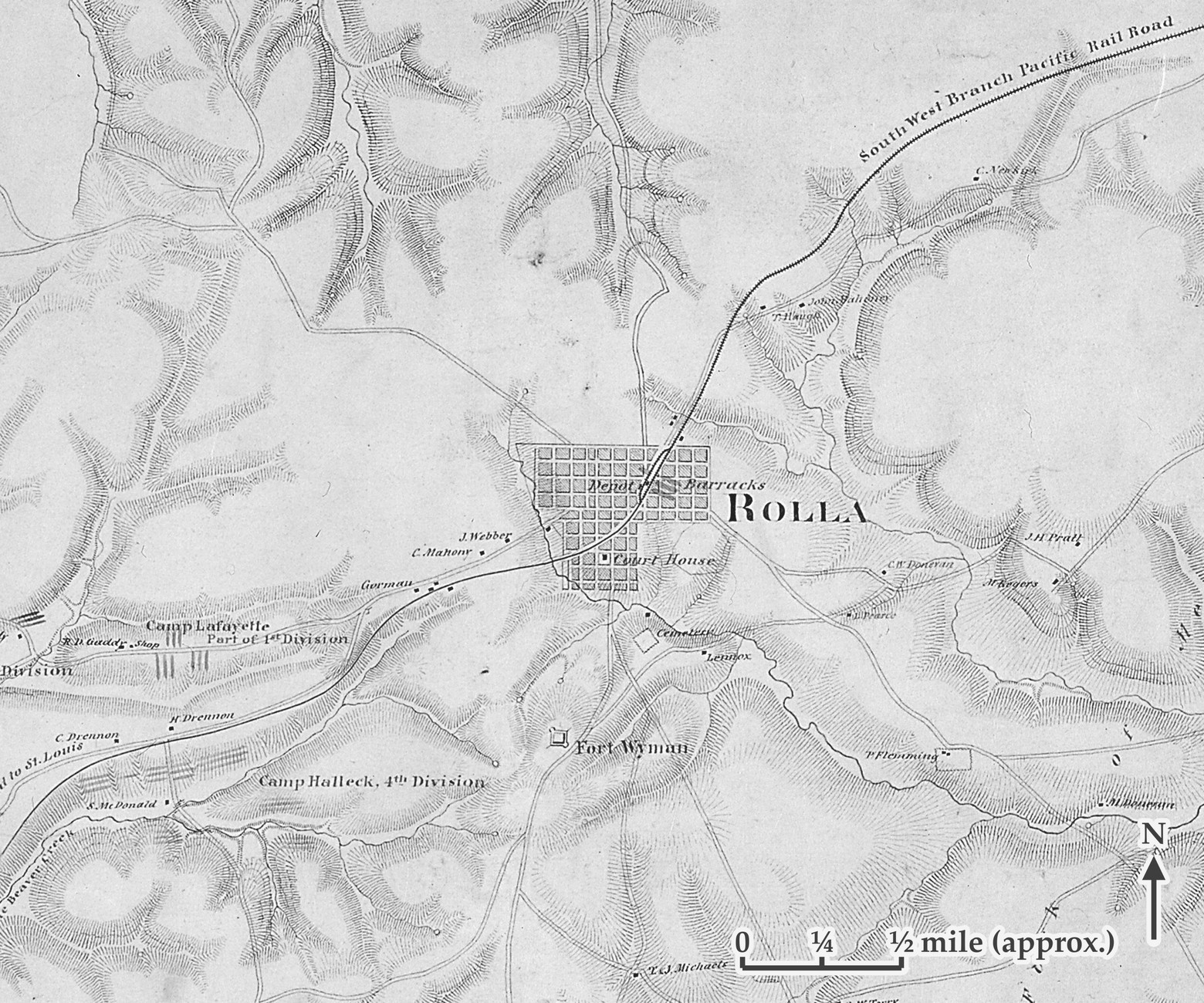
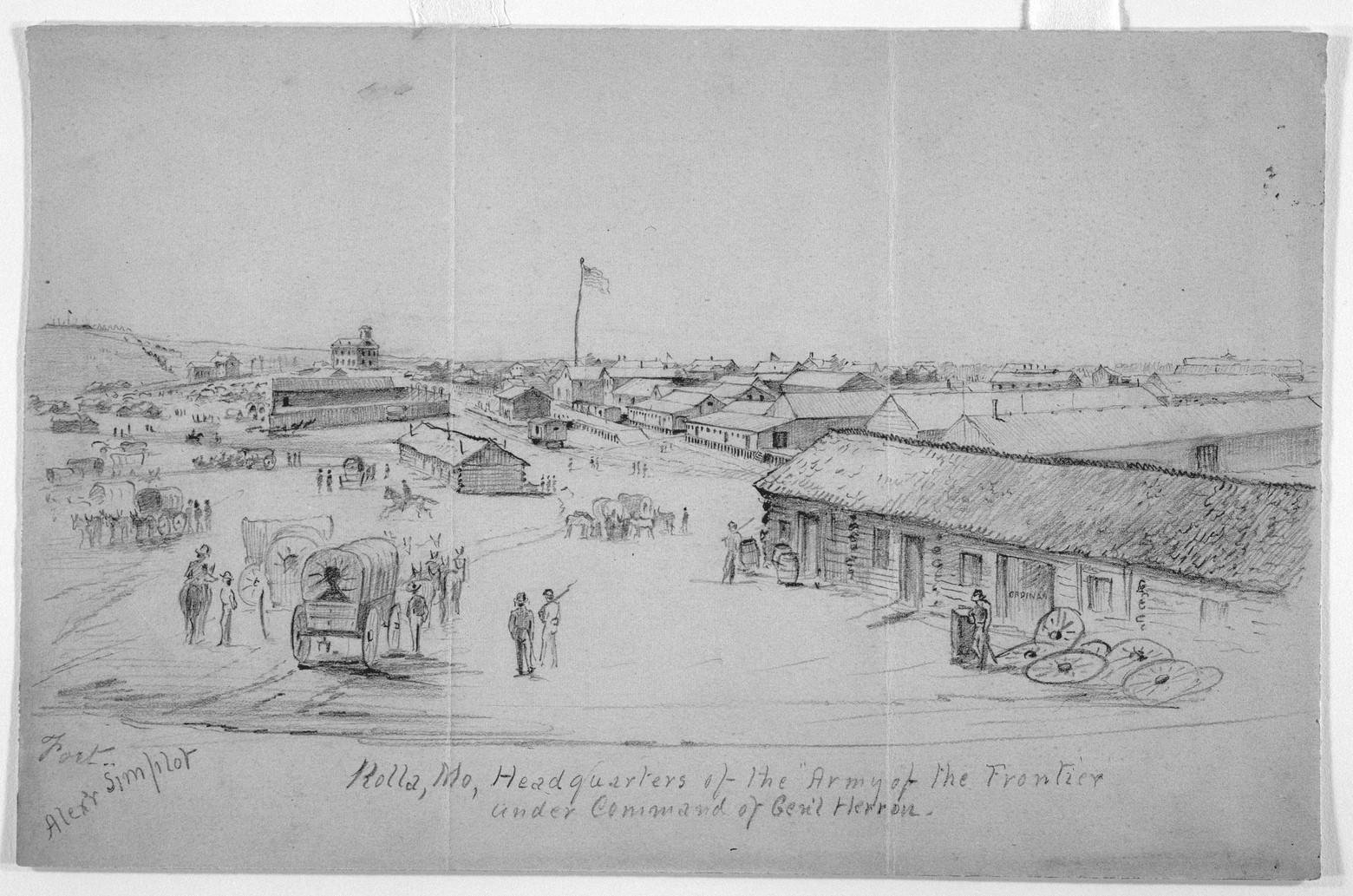
The report of 31 August lists “2d Missouri Artillery, Battery B, Capt. John J. Sutter,” now in Brigadier General John McNeil’s district, beside Illinois infantry and Missouri militia.69 McNeil had taken command of the District of Rolla that summer.70
Charles was present, a sergeant, on the roll for July and August 1864.71 By then Rolla was the Union army’s main base in south-central Missouri and a busy garrison town. One Iowa soldier who had served there called the work “hen roost guarding.”72
Price’s Raid
In September 1864, while Charles’s battery lay in camp at Rolla, Major General Sterling Price led a Confederate cavalry army of some twelve thousand men north from Arkansas into Missouri.73 The historian Kyle Sinisi argues that he meant to take and hold the state for the Confederacy.74 After his repulse at Pilot Knob on 27 September, he gave up on St. Louis: he had learned that a Union force at least twice his own held it. He marched west along the Missouri River toward the state capital at Jefferson City.75 Union troops were drawn in from the outlying districts to hold it.76
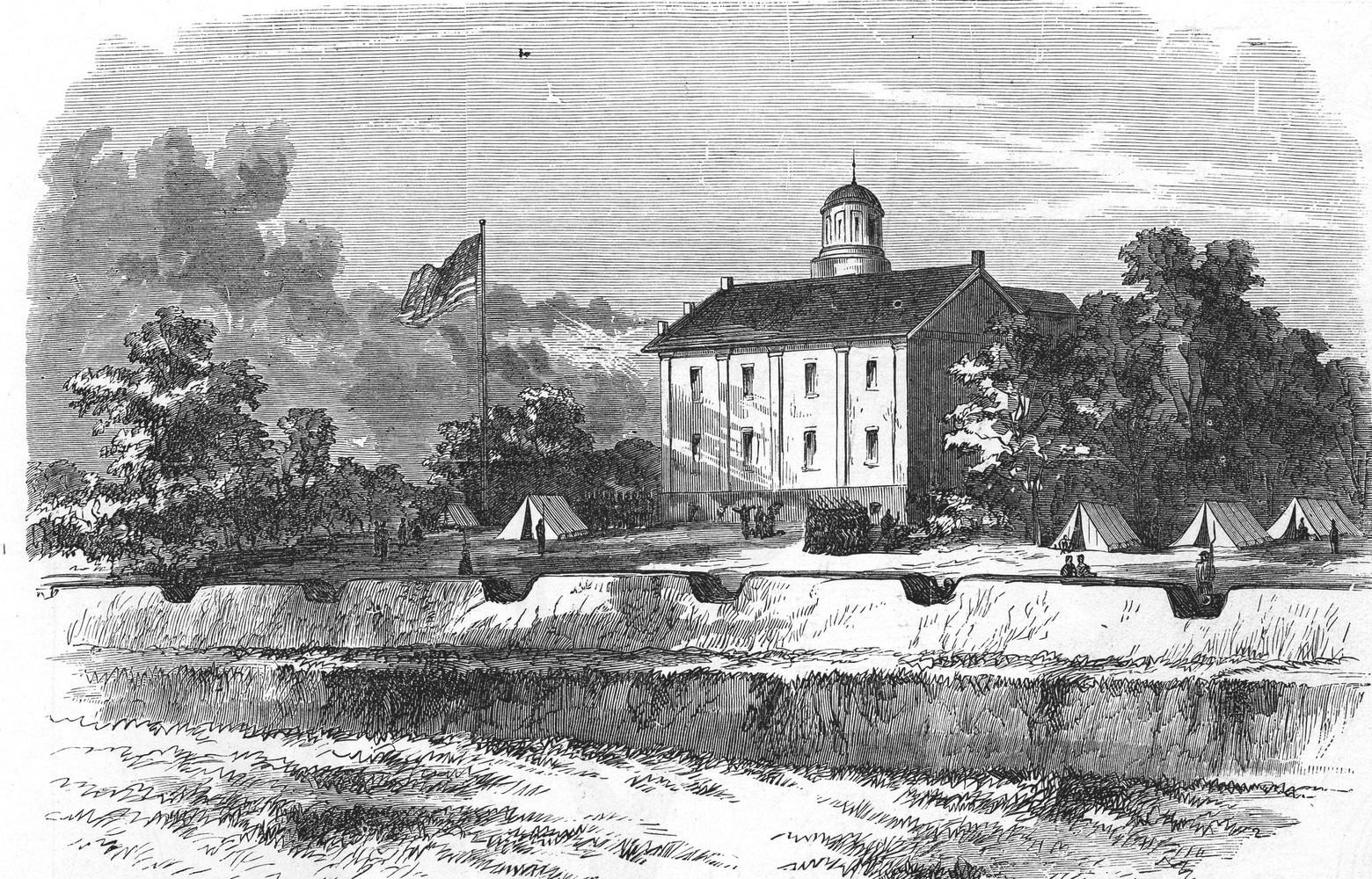
McNeil expected Rolla to be attacked, and he set every man in the town to work on its defenses.77
The march to Jefferson City
McNeil marched from Rolla for Jefferson City on the morning of 4 October with every man he thought Rolla could spare.78
One section of Battery B, two 12-pounder Napoleons, went with McNeil under Captain Sutter.79 McNeil’s orders of 3 October gave Sutter command of “all the artillery in the expedition,” not only his own two guns.80 The Adjutant General’s 1864 report describes the march in the regiment’s words: during Price’s advance on Jefferson City “a part of the battery, under command of Captain J. J. Sutter, proceeded by a forced march to that place and participated in the defence.”81 The battery’s roll records that Sutter left Rolla on 4 October with “one section of the Battery and 40 enlisted men.” No other part of Battery B went with McNeil, so Charles was one of the forty.82
Charles’s own file places him with McNeil’s column on the march. His muster card for September and October 1864 marks him absent and gives no reason.83 The battery’s monthly report for October 1864, copied onto a card in the second part of his file, gives the reason: “Oct 1864 absent on Exped’n under Com’d Brig. Gen. John McNeal.”84 The battery’s own cards name most of the forty. On the roll for September and October 1864, twenty-six men of Battery B are marked absent “On det. serv. in the field since Oct. 4/64,” the day the section marched. A returns card puts David Obrist, like Charles, “absent on exped. under Com’d Brig. Gen. McNeil.”85
Charles and Sergeant Adam Herweck were the only sergeants of the battery with the section. The rest of the battery stayed at Rolla under Lieutenant Thomas Davies.86
Rain fell at St. Louis on 3–5 October, as the column set out. Dr. George Engelmann’s weather record shows just over an inch on 4 October, the day the section left Rolla, and then dry days through the 10th.87 The roads out of Rolla were probably wet and heavy for the first day’s march. Sanborn’s brigade joined McNeil at Vienna, Missouri. On the next morning’s march north from Vienna, one account calls it “hard traveling for all, particularly the artillery horses,” which stuck in the mud of the clay hills.88 The column crossed the Osage River nearly a day ahead of Price. It reached Jefferson City on the 5th, in the afternoon, after seventy miles in two days.89 The historian Albert Castel counts the eight guns and 2,400 cavalry from Rolla as the strongest part of the garrison, and they arrived just ahead of Price. Had Price marched faster from Pilot Knob, Castel argues, he would have found the city nearly undefended.90 Sutter’s two guns were two of those eight.91
A German correspondent in the city kept a diary of those days, and the St. Louis German daily Neuer Anzeiger des Westens printed it. Before the column came, he wrote, “Sträflinge, Bürger und Soldaten” (convicts, citizens and soldiers) dug the trenches. By the evening of the 4th small forts and trenches ringed the city in a half-circle, with the Missouri River as its chord. He wrote that McNeil came in “mit 1100 Mann und 8 Kanonen” (with 1,100 men and eight guns), and that from then on everyone felt the city was saved. “Seine und McNeils Pferde waren jedoch sehr ermüdet,” he added: Sanborn’s and McNeil’s horses were very tired, though.92 (He dates their arrival to the evening of the 5th in one place and the 6th in another.)
Brigadier General Clinton B. Fisk, commanding the District of North Missouri, led the defense of Jefferson City. McNeil’s men went into the works on the 6th. Under Fisk, McNeil commanded the right wing, and Charles’s section, under Sutter, belonged to his brigade.93
Two guns at Jefferson City
Price reached the city on 7 October and judged its defenses too strong.94
On the 7th Charles’s section was posted in the works on the south side of the city, at the center of Sanborn’s line.95 Dyer calls the fight “Moreau Creek.”96 McNeil had sent the guns to Sanborn, he reported, because Sanborn held “the strongest position on the south side of the town.”97 Price’s columns crossed the Moreau that day and pushed the Union’s forward posts back toward the trenches. The fight came in the afternoon. At about one o’clock Fisk wired that “the ball is opening earnestly.”98 By then all the troops had been drawn back into the works.99
Charles was one of the section’s two sergeants. In a light battery each gun was in a sergeant’s charge, so he probably commanded one of the section’s two guns as “chief of the piece.”100 His own part that afternoon is not recorded.
When the Confederate main column came on down the road in full view, Sanborn “sent orders to Captain Sutter to open fire with his guns (12-pounder Napoleons) upon it, and after a few shots the enemy halted and then fell back behind the crest of a ridge.”101 A correspondent of the St. Louis Daily Missouri Democrat, writing from inside the city that day, saw the section go into action. At about two o’clock, he wrote, the Confederates “appeared in force” in front of the fortifications on the south side. “Two twelve-pounder Napoleons of company ‘B,’ 2d Missouri artillery at once opened upon them and fired ninety-eight rounds of shot and shell.”102 Those were Sutter’s two guns, the only guns of Battery B at Jefferson City.103 Charles was with them, one of the section’s forty men.104
The Democrat’s man saw the guns as the town saw them. They were “in plain sight from every part of the city.” Their “lurid flame, dark clouds of smoke, and stunning report” caused “no little consternation” among the townspeople. In his view the Confederates were trying to bring a battery within range of the works and “were only prevented by our continuous firing.”105 The German diarist watched the whole Confederate army pass the city. It “defilirte an uns von Mittag 12 Uhr bis Nachts 2 Uhr vorbei” (filed past us from noon until two in the morning).106
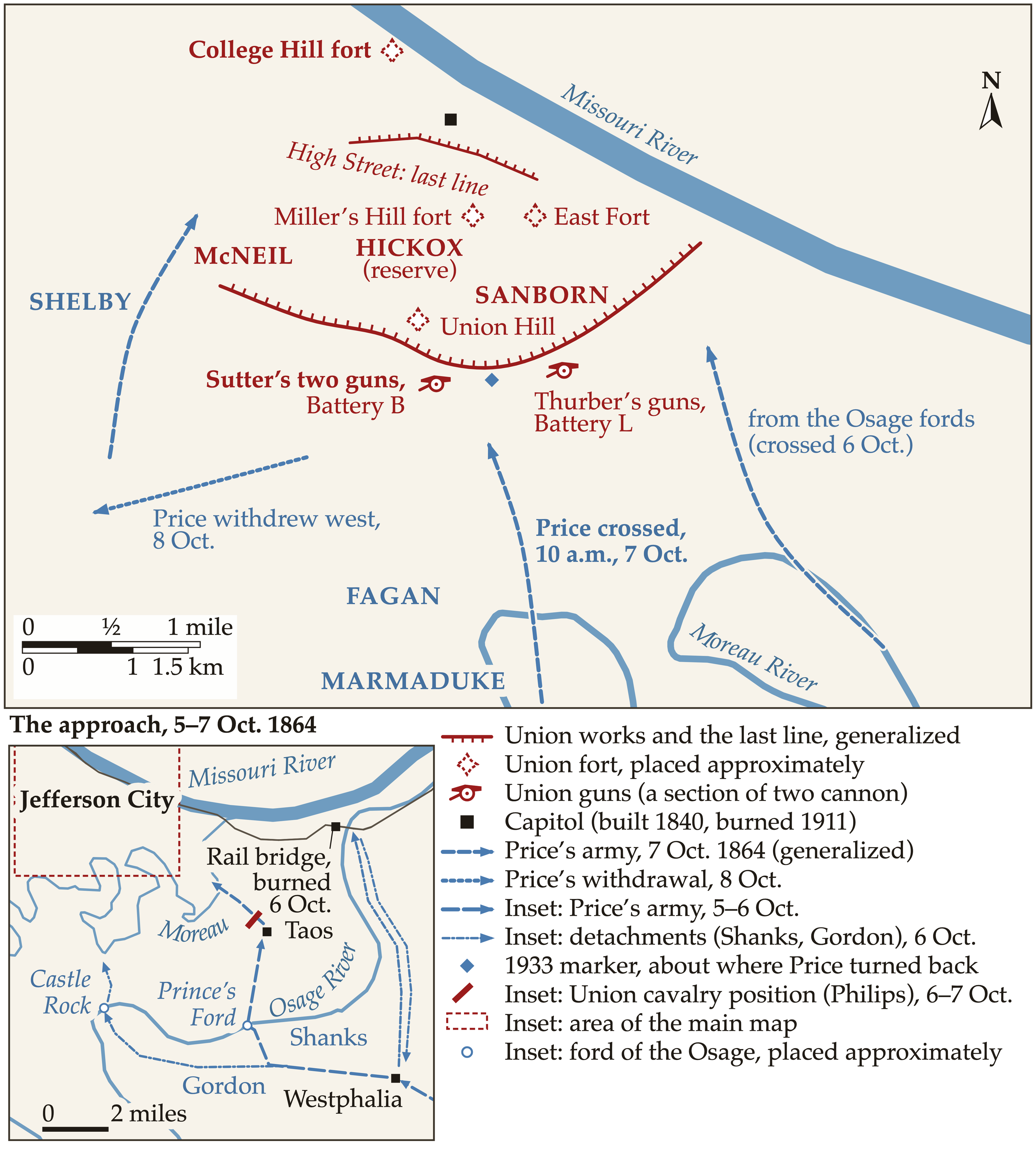
The day was not all order. The historian Mark Lause describes a moment when Sutter’s guns moved forward with two companies of infantry in support. Sanborn took the move for a relief and pulled his cavalry back. The infantry and the guns fell back too, the infantry in disorder. The line soon steadied, with Sutter’s guns placed again at its center.108
Charles’s section “engaged the enemy” for one hour, the battery’s own roll says.110 If the guns fired the correspondent’s ninety-eight rounds in about an hour, each fired about once every minute and a quarter. That is well within the rate the drill book gives for aimed fire: a piece could throw “two solid shot or three canisters per minute.”111
The officers did not agree about what the fire did. Fisk wrote that Thurber’s battery and Sutter’s fired on the Confederate guns, “dismounting one of his pieces at the first fire.” Colonel Phelps of the 2nd Arkansas Cavalry saw it differently: “The 12-pounder howitzers were tried without effect.” Phelps calls them howitzers; McNeil and Sanborn call Sutter’s guns Napoleons.112 The German diarist and another officer of the garrison sided with Fisk.113
On the 8th Charles’s section was in the line, and the 39th Missouri Infantry reported itself “in the trenches on the right of Sutter’s battery.”114
That day Price drew off to the southwest, down the road toward Russellville.115 The capital was never assaulted. After the skirmishing of the 7th and 8th he moved on west.116
The defense of Jefferson City was Battery B’s only fight against a Confederate army in Charles’s three years. Dyer lists Moreau Creek and Jefferson City as the battery’s actions of the raid.117
Up the Missouri to Rocheport
After Price passed, Charles’s section went with Fisk on the steamer Sioux City to Rocheport, upriver.118 On 12 October Fisk’s orders put the troops ashore at Providence, Missouri. The copy sent to Captain Sutter told him to camp “as near the town as convenient.”119 On the 13th Fisk was ordered back to Jefferson City along the north bank of the river, and he arrived at noon on the 14th.120 Two records give different days for the section’s return.121
Price was beaten at Westport on 23 October and driven south out of the state.122 The section made a second trip to Rocheport, arriving on 29 October. There it landed and destroyed a sawmill held by guerrillas.123 The section stayed at Jefferson City until 13 November, then marched back to Rolla under the department’s Special Orders No. 312.124 In all, the section had marched 220 miles since 4 October.125
Winter at Franklin
Charles’s battery left Rolla on 19 November 1864 and reached Franklin on 21 November, where it went into winter quarters.126 Franklin lay on the Pacific Railroad thirty-seven miles west of St. Louis, at the junction where the southwest branch to Rolla left the main line to Jefferson City. The town had been renamed Pacific in 1859, but the army’s reports still used the old name.127
On 1 October 1864, seven weeks before the battery came, a brigade of Price’s army entered Franklin at sunrise. It burned the depot, the car shops and the water tanks and looted the stores. Union troops sent out from St. Louis by rail attacked from the east that morning, and by noon the brigade had moved on west.128 Price’s men also tore up the Pacific Railroad east of Franklin.129
Franklin held the department’s artillery reserve. After Price’s Raid the department kept four batteries of the 2nd Missouri at the junction, B with H, K and M, ready to be sent by rail down either line.130
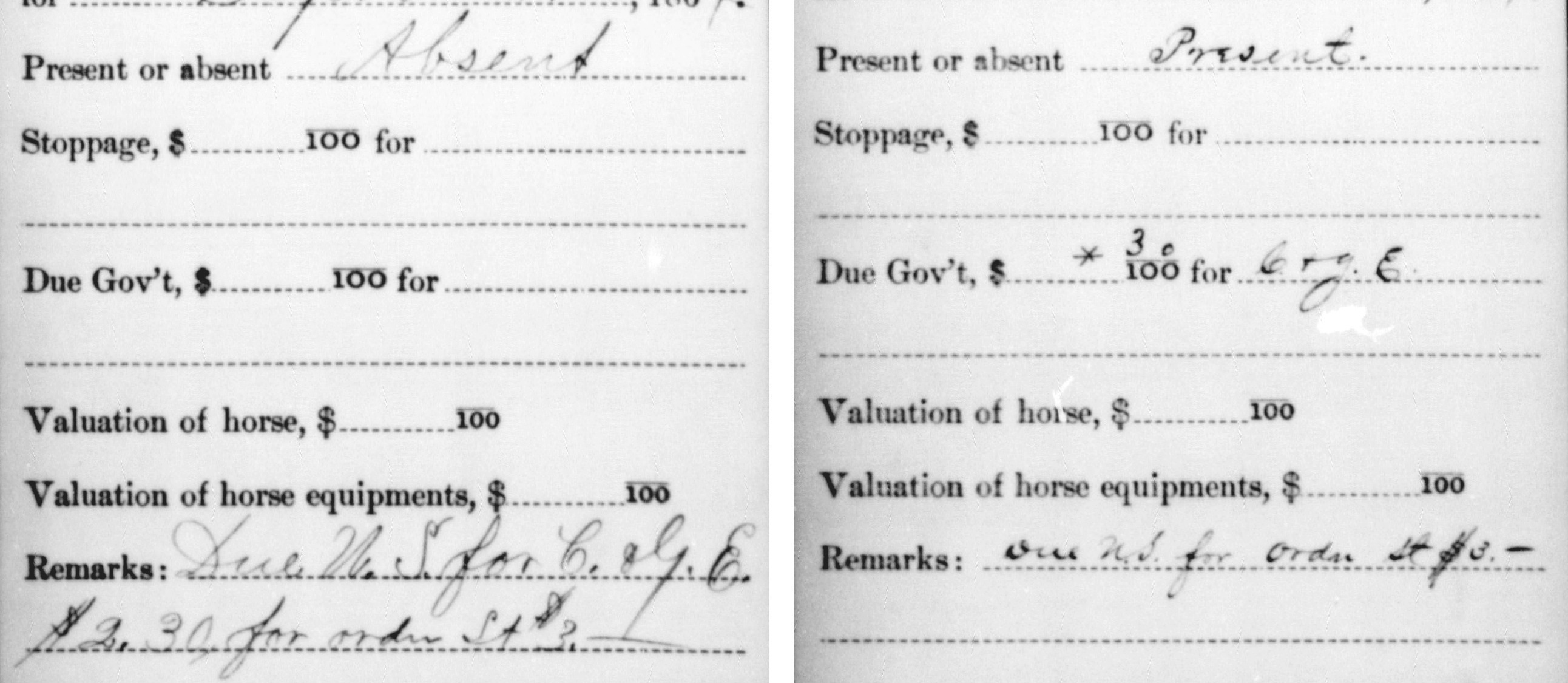
Charles was present on the roll for November and December 1864.131 The same roll shows $3 due for ordnance stores.132
Charles was not the only man of the battery who blamed the guns for his deafness. In his 1888 pension declaration the recruit James Kinsley dated his hearing loss to Price’s Raid in the fall of 1864. A comrade dated it to practice firing at Franklin in January or February 1865.134 Charles, who was with the guns at Jefferson City, blamed his own deafness on the guns at New Madrid.135
On Tuesday, 31 January 1865, at noon, the four batteries at Franklin turned out for their monthly inspection. They were Batteries B, H, K and M of the 2nd Missouri, about five hundred men with twenty-four guns. Lieutenant Colonel David Murphy, the district inspector, reviewed them. “The brass pieces were polished.” The guns were wheeled into battery, and a blank cartridge was fired from each, beginning at the right. Then the batteries passed in review, first at a walk and then at a gallop, and fired another round. “The men were well drilled,” the Daily Missouri Democrat reported. The review took three hours.137 The paper names no man. Charles was a sergeant of Battery B that winter, present on its roll for January and February.138
On 15 March 1865, at Franklin, he lost his sergeant’s rank.139
Notes
139 notes
- Capt. John J. Sutter to Lt. Col. N. Cole, New Madrid, 9 Dec 1863, roll 329, images 229010820–229010821. [SUTTER63]
- M405 roll 327 (Nov–Dec 1863 card: roll image 1572), Gannsen file: muster rolls Mar–Apr, May–June. [CSR63]
- Capt. John J. Sutter to Lt. Col. N. Cole, New Madrid, 9 Dec 1863, roll 329, images 229010820–229010821; Adam Herweck: CSR, NARA M405. — Proven. [SUTTER63] [HERWECK]
- Compiled Service Record cards, Battery B, 2nd Missouri Light Artillery (NARA M405, rolls 327 and 762; Fold3 files 228767500 and 237922666, https://
www and https://.fold3 .com/ file/ 228767500 www : accessed 29 October 2026): enrollment, hospital (22 Dec 1862), smallpox detail (20 Feb 1863), promotion (7 Nov 1863), New Madrid (24 Apr 1864), absent on the roll for September–October 1864 (roll 327, image 228767574), “Oct 1864 absent on Exped’n under Com’d Brig Gen John McNeal” (roll 762, returns card, image 237922690), reduction (15 Mar 1865, Co. O. No. 1), Rolla (S.O. 82, 27 Mar 1865), HQ (S.O. 159, 1 Jul 1865), muster-out (20 Dec 1865). CSR transcription. [CSR].fold3 .com/ file/ 237922666 - Louis S. Gerteis, The Civil War in Missouri, p. 138. The Confederate works were Fort Thompson at the town and more forts at Island No. 10, upstream. Pope’s army besieged the town briefly, and the Confederates left twenty-five cannon behind. Major General Henry W. Halleck wired Washington that there was “no rebel flag now flying in Missouri.” To get his troop boats past the island, Pope had his men cut a canal through the flooded lowlands in nineteen days. On 7–8 April the garrison of Island No. 10 surrendered, opening the river toward Memphis (pages 87–89). Official Records, ser. I, vol. 8 (operations at New Madrid and Island No. 10, Feb–Apr 1862), pp. 87–89 (Pope’s report: the canal, “For nineteen days the work was prosecuted,” and the surrender on the morning of 8 April); Internet Archive, warofrebellionco08unit (https://
archive : accessed 11 November 2026), read in the page images; New Madrid Chamber of Commerce, Driving Tour of Civil War Sites of New Madrid, Missouri (brochure, two sides, copy held by the author). [GERTEIS12] [NMHIST] [NMBROCH].org/ details/ warofrebellionco08unit - Sources of the map “The posts of Battery B, 1863–1865”: the arrow in (C), Price’s leading column on 7 October 1864, generalized from the Official Records and from Kyle S. Sinisi, The Last Hurrah: Sterling Price’s Missouri Expedition of 1864 (Lanham, Md.: Rowman & Littlefield, 2015), fig. 5.2, p. 105, as on the map of Jefferson City, 7–8 October 1864; the Moreau crossing marked at Green Berry Road, after “The Americanization of Francis Joseph Zeisberg: A German Immigrant’s Life in Jefferson City, Missouri, 1881–1892,” annotated by Walter A. Schroeder, Missouri Historical Review 114, no. 4 (July 2020): 249–84, at 275 n. 18. Fort Thompson: Louis Boedicker, “Map of New Madrid, Mo., and Vicinity” (1865), National Archives, RG 77, NAID 305776; New Madrid Chamber of Commerce, Driving Tour of Civil War Sites of New Madrid, Missouri. Sutter’s section: Official Records, ser. I, vol. 41, pt. 1, 376, 419. Cabell’s raid: Atlas to Accompany the Official Records, pl. XLVII (the arrow comes from the bearing of Richwoods, the last place before Franklin on the line marked “Cabell”); “The Battle of Pacific” marker, Missouri Civil War Heritage Foundation. Allenton: OpenStreetMap place name, ODbL. Details of the panels: in (A), Fort Thompson was the river fort below the town, very probably the work the battery garrisoned; its ground has been washed away by the Mississippi, and the mark is the site marker on the levee road. The Moreau crossing in (C) is marked where the generalized approach meets Moreau Creek (Dyer’s name for the Moreau River); its exact site is not known. Sutter’s section stood in the south-side works at the center of Sanborn’s line; the position is approximate and is the same as on the map of Jefferson City. In (D), Cabell’s brigade of Price’s army came up from the south on 1 October 1864 and burned the depot, the engine house, and the railroad shops; Union troops sent from St. Louis by rail drove it off at Allenton, 3.8 miles east-northeast of the town and beyond the edge of the panel. The arrow is generalized, and the site of the burned buildings is approximate.
- Capt. John J. Sutter to Lt. Col. N. Cole, New Madrid, 9 Dec 1863, roll 329, images 229010820–229010821. [SUTTER63]
- Louis S. Gerteis, The Civil War in Missouri, p. 136. [GERTEIS12]
- Official Records of the Union and Confederate Armies, ser. I, vol. 22, pt. 2 (1888). Pt. 1, p. 6. [OR22]
- The department’s monthly report of 31 December 1863 lists at New Madrid “2d Missouri Light Artillery, Battery B (heavy), Capt. John J. Sutter.” The battery served in the Department of the Missouri, with its headquarters at St. Louis. John M. Schofield commanded the department until January 1864, and William S. Rosecrans after him. Official Records of the Union and Confederate Armies, ser. I, vol. 22, pt. 2 (1888); Official Records, ser. I, vols. 22, 34, 41 and 48, vol. 22, pp. 344, 417 and 765. [OR22] [DEPT]
- Revised Regulations for the Army of the United States, 1861 (Philadelphia, 1861), art. XXVIII, p. 39, art. XXXIII, pp. 61–65. Paragraph 562 (page 83); article XXXIII, pages 61–66. [ARMYREG]
- War Department, Instruction for Heavy Artillery. [IHA]
- Capt. John J. Sutter to Lt. Col. N. Cole, New Madrid, 9 Dec 1863, roll 329, images 229010820–229010821; Frederick H. Dyer, A Compendium of the War of the Rebellion, pt. 3., p. 1313, p. 1317. [SUTTER63] [DYER]
- Official Records of the Union and Confederate Armies, ser. I, vol. 22, pt. 2 (1888); Official Records, ser. I, vol. 34, pt. 1, pp. 872–874 (New Madrid expedition, 5–9 Apr 1864, report of Maj. John W. Rabb: the cavalry mostly on veteran furlough; about 200 men of Companies H, I and K by the steamer Silver Moon; water about a foot deep, at times three); pt. 2, p. 73 (A. J. Smith, Columbus, Ky., 13 Jan 1864: the two companies of the 25th Missouri arrived from New Madrid on the 10th), pp. 453–454 (Rabb, New Madrid, 28 Feb 1864: Lieutenant Ralph’s scout through Pemiscot County to the Arkansas line; the swamp not crossable “without wading and swimming 12 miles”; cavalry “reduced to 53 men for duty”; pt. 1, p. 872 and pt. 2, pp. 73 and 454 read in the page images, Internet Archive warofrebellion341unit and warofrebellion342unit, 2 Nov 2026), p. 204 (return of 31 Jan 1864: New Madrid, Capt. John J. Sutter; 1st Missouri Cavalry, three companies, Capt. Valentine Preuitt); pt. 3, p. 551 (Sanborn, Springfield, 11 May 1864); pt. 4, p. 623 (return of 30 Jun 1864: District of Rolla, Brig. Gen. Odon Guitar; Rolla, Col. Albert Sigel; “2d Missouri Artillery, Battery B, Lieut. Oswald A. Roessel”; read in the page image, Internet Archive warofrebellion344unit, 12 Oct 2026). The reports of 31 December and 31 January list them, under Captain Valentine Preuitt, as the other troops. [OR22] [OR34]
- Official Records, ser. I, vol. 34, pt. 1, pp. 872–874. Pt. 2, p. 204. [OR34]
- Evangelisch-lutherische Kirchengemeinde Clausthal (Marktkirche) (Clausthal, Königreich Hannover), baptisms 1817–1832, 1819 No. 44, https://
www ; Ancestry (https://.archion .de/ de/ viewer/ churchRegister/ 358514 www ), “U.S. Civil War Soldier Records and Profiles, 1861–1865” (Historical Data Systems), record 1163407 (accessed 6 November 2026), George Kreichelt, enlisted 7 May 1861, Co. B, 2nd U.S. Reserve Corps Infantry, mustered out 16 Aug 1861. Charles married Georg’s daughter Auguste, the recruit’s sister, in January 1866 (see “Marriage, 1866”). St. Marcus German Evangelical Church (St. Louis, Missouri), marriage register, 7 Jan 1866, entry No. 676, Carl Gonnson and Auguste Kreichelt; witnesses Adam Herweck, Philipp Weber, Anna Goetz, Sophie Lehm; p. 135 (image group number (IGN) 007769184, image 381); imaged, FamilySearch (https://.ancestry .com www : accessed 29 October 2026); citing “St. Marcus Evangelical Church records, 1847-1981,” microfilm of originals at the Eden Archives in St. Louis, Missouri. [KCLT] [GEORG] [MARR].familysearch .org/ ark:/ 61903/ 3:1:3Q9M-CSMZ-1NJC - Clausthal, Lutheran parish, baptism of Carl Friedrich August Kreigelt, born 8 Dec 1844, baptized 1 Jan 1845, 1844 No. 298 (Archion register 358516, image 164; read in the image, 13 Oct 2026; the FamilySearch profile L5FW-572, which once gave the christening as 8 Apr 1845, was corrected to 1 Jan 1845 in September 2026); imaged, Archion (https://
www : accessed 13 October 2026) > Landeskirchliches Archiv der Evangelisch-lutherischen Landeskirche Hannovers > Kirchenkreis Clausthal-Zellerfeld > Clausthal > Taufen 1841-1848; citing Landeskirchliches Archiv der Evangelisch-lutherischen Landeskirche Hannovers, Hannover. [AUGBAP].archion .de/ de/ viewer/ churchRegister/ 358516 - Missouri State Archives, Soldiers’ Records, service card S187514 (image s00870_0655), August Kreichelt, Co. G, 2nd U.S. Reserve Corps: “Enlisted June 6 1861 … Mustered out Aug. 16 1861, St. Louis Arsenal” (https://
s1 : accessed 8 November 2026). [AUGRC].sos .mo .gov/ Records/ Archives/ ArchivesMvc/ Soldiers/ Detail ?id =S187514 &conflict =Civil %20War - Compiled Military Service Record, August Kreichelt, Co. G, 15th Missouri Infantry, Civil War (filmed as NARA microfilm publication M405); Fold3 images 231487514, 231487517 and 238318074 (enrollment 4 Sep 1861, muster 21 Sep 1861; surgeon’s certificate of 29 Apr 1862; discharge for disability, May 1862); Carded Records, Volunteer Organizations, Civil War; Record Group 94: Records of the Adjutant General’s Office, 1780s–1917; National Archives, Washington, D.C.; imaged, Fold3 (https://
www : accessed 10 October 2026). [AUG15].fold3 .com/ image/ 231487514 - Compiled Military Service Record, August Kreichelt, Battery B., roll 333. [AUGCSR]
- Compiled Military Service Record, August Kreichelt, Battery B., roll 333; Capt. John J. Sutter to Lt. Col. N. Cole, New Madrid, 9 Dec 1863, roll 329, images 229010820–229010821. [AUGCSR] [SUTTER63]
- M405 roll 327 (Nov–Dec 1863 card: roll image 1572), Gannsen file: muster rolls Mar–Apr, May–June; M405 roll 327 (Mar–Apr 1864 card: roll image 1570), Gannsen file: muster rolls Jan–Feb 1864 (image 228767609, present) and Mar–Apr 1864 (image 228767601, absent, “On act. [det.?] service at New Madrid, Mo. since Apl 24/64”); imaged, Fold3 (https://
www , https://.fold3 .com/ image/ 228767609 www : accessed 7 November 2026). [CSR63] [CSR64A].fold3 .com/ image/ 228767601 - Annual Report of the Adjutant General of Missouri, for the Year 1864, pp. 200–201. Page 4 (General Orders No. 6, District of St. Louis, 3 Feb 1864). — Very probable. [AGR1864]
- claimant’s statement to the Commissioner of Pensions, received 14 Jun 1890, in the file of Charles Gannson (Private, Battery B, 2nd Missouri Light Artillery, Civil War), pension application no. Inv. 749,432, certificate no. 684,507, pp. 28–29 (pages of the National Archives copy); Case Files of Approved Pension Applications of Veterans Who Served in the Army and Navy Mainly in the Civil War and the War with Spain, 1861–1934; Civil War and Later Pension Files; Record Group 15: Records of the Department of Veterans Affairs; National Archives, Washington, D.C.; General Affidavit of Christian Meyer, 5 May 1890, no. Inv, no. 684,507, pp. 22–23; General Affidavit of August Derr, 14 May 1890, no. Inv, no. 684,507, p. 26. Two comrades blamed “heavy cannonading” and exposure. He dated his injuries to November 1862, and they dated them to “about September 1863.” At both dates the battery was still at St. Louis. Bureau of Pensions request of 4 Jun 1890 and War Department reply of 5 Jun 1890 on August Derr and Christian Meyer, no. Inv, no. 684,507, p. 35; Battery B station table 1862–65: Official Records ser. I vols 22, 34, 41, 48; Missouri AG Annual Report for 1864, pp. 200–201, https://
www . The place fits his service. The winter of 1863–64 is probably when it began. The claim is examined in the chapter “The Watchman and the Pension, 1885–1895.” [PEN28] [PEN22] [PEN26] [PEN35] [STATIONS].fold3 .com/ image/ 228992978 - Surgeon’s Certificate of the examining board, St. Louis, 18 Jun 1890, in the file of Charles Gannson (Private, Battery B, 2nd Missouri Light Artillery, Civil War), pension application no. Inv. 749,432, certificate no. 684,507, p. 33 (pages of the National Archives copy); Case Files of Approved Pension Applications of Veterans Who Served in the Army and Navy Mainly in the Civil War and the War with Spain, 1861–1934; Civil War and Later Pension Files; Record Group 15: Records of the Department of Veterans Affairs; National Archives, Washington, D.C. [PEN33]
- Surgeon’s Certificate of the examining board, St. Louis, 18 Jun 1890. Pension file p. 33. — Possible. [PEN33]
- Official Records, ser. I, vol. 34, pt. 1, pp. 872–874. Pt. 1, p. 872 (veteran furlough); pt. 2, p. 454 (fifty-three men). [OR34]
- Official Records, ser. I, vol. 34, pt. 1, pp. 872–874. Pt. 2, pp. 453–454. [OR34]
- Annual Report of the Adjutant General of Missouri, for the Year 1864, pp. 200–201, p. 202. [AGR1864]
- On the map: Fort Thompson by the river, the barracks, the landing, the hospital, and the town. Lieutenant Louis Boedicker of the 2nd Missouri, Battery B’s own regiment, surveyed and drew the map. The army’s Engineer Department received it in September 1865. “Bat. B” on the map is the name of one of the earthworks, not of Charles’s company.
- Missouri Adjutant General, Descriptive Rolls, 2nd Regiment Artillery, Book 1 (Missouri State Archives roll 5), https://
www . Image 20 (https://.familysearch .org/ ark:/ 61903/ 3:1:3QHV-V3DP-9QY2 www : accessed 29 October 2026). His line reads “Gaunsen Charles, Sergeant, 23, 5 ft 5 in, Blond, Blue, Fair, Farmer, Freundburg, Kurhessen.” “Freundburg,” here as on every roll copied from the regiment’s book, is the clerks’ spelling of Trendelburg. The sergeants in order are F. L. Haeger, Adam Herweck, Charles, Frederick Schulze, August Derr and George Hasslinger. Haeger’s line already notes his reduction to the ranks by court-martial in November 1863, told in the previous chapter. He had been made sergeant again in March 1864, before the roll was signed on 1 April. So its list of six sergeants was probably still correct on that date. Missouri Adjutant General, Descriptive Rolls, 2nd Regiment Artillery, Book 1 (Missouri State Archives roll 5). The regiment had updated its records to match the reorganization while the battery held the river fort. Colonel Nelson Cole, by then the regiment’s commander, signed the roll at St. Louis as a true copy of the regiment’s records. Image 27. Missouri Adjutant General, Descriptive Rolls, 2nd Regiment Artillery, Book 1 (Missouri State Archives roll 5). [AGO1] [AGO1] [AGO1].familysearch .org/ ark:/ 61903/ 3:1:3QHV-J3DP-93T9 - Adam Herweck: CSR, NARA M405; Missouri Adjutant General, Descriptive Rolls, 2nd Regiment Artillery, roll 6; Missouri Adjutant General, Descriptive Rolls, 2nd Regiment Artillery, Book 1 (Missouri State Archives roll 5). Of the officers and sergeants on that roll, only Herweck and Derr appear with him in later records. Herweck was the first-named witness at his wedding in 1866, and Derr a witness for his pension in 1890. St. Marcus German Evangelical Church (St. Louis, Missouri), marriage register, 7 Jan 1866; General Affidavit of August Derr, 29 Sep 1890, in the file of Charles Gannson (Private, Battery B, 2nd Missouri Light Artillery, Civil War), pension application no. Inv. 749,432, certificate no. 684,507, p. 24 (pages of the National Archives copy); Case Files of Approved Pension Applications of Veterans Who Served in the Army and Navy Mainly in the Civil War and the War with Spain, 1861–1934; Civil War and Later Pension Files; Record Group 15: Records of the Department of Veterans Affairs; National Archives, Washington, D.C. [HERWECK] [AGO2] [AGO1] [MARR] [PEN24]
- Missouri Adjutant General, Descriptive Rolls, 2nd Regiment Artillery, Book 1 (Missouri State Archives roll 5). On the cards copied from those rolls it reads Gannsen, Gansen, Gonson, Gunnsen, and Granssen. The Adjutant General’s descriptive rolls, of the old company and of the new, have “Gaunsen” and “Gansen.” [AGO1]
- M405 roll 327 (Nov–Dec 1863 card: roll image 1572), Gannsen file: muster rolls Mar–Apr, May–June; M405 roll 327 (Mar–Apr 1864 card: roll image 1570), Gannsen file: muster rolls Jan–Feb 1864 (image 228767609, present) and Mar–Apr 1864 (image 228767601, absent, “On act. [det.?] service at New Madrid, Mo. since Apl 24/64”); M405 roll 327, Gannsen file: muster rolls May–June 1864 (image 228767598, Fold3 p. 11, https://
www : accessed 29 October 2026; present) and July–Aug 1864 (image 228767588, Fold3 p. 10, https://.fold3 .com/ image/ 228767598 www : accessed 29 October 2026; present, “Due U.S. for C.&G.E. $2.50, for ordnance $3.00”). [CSR63] [CSR64A] [CSR64B].fold3 .com/ image/ 228767588 - O. K., letter headed “The River Counties South of Us. Deplorable Condition of Affairs. Disloyalty in New Madrid, Pemiscot and Dunklin. Guerrilla Ravages,” dated New Madrid, Mo., 5 April 1864, Daily Missouri Democrat (St. Louis), Tue. 12 Apr 1864, p. 1 ( image 571012517, filed as “St. Louis Globe-Democrat”; https://
www : accessed 11 November 2026). The signature is partly cut off at the foot of the column. Read twice, independently, in the page image, 11 Nov 2026. [MODEM64NM].newspapers .com/ image/ 571012517/ - Battery B station table 1862–65: Official Records ser. I vols 22, 34, 41, 48; Missouri AG Annual Report for 1864, pp. 200–201; M405 roll 327 (Mar–Apr 1864 card: roll image 1570), Gannsen file: muster rolls Jan–Feb 1864 (image 228767609, present) and Mar–Apr 1864 (image 228767601, absent, “On act. [det.?] service at New Madrid, Mo. since Apl 24/64”). [STATIONS] [CSR64A]
- Official Records, ser. I, vol. 34, pt. 1, pp. 872–874. [OR34]
- “Scouts Surprised: Four Killed and Seven Wounded,” with a letter signed “Eye Witness,” Daily Missouri Democrat (St. Louis), Sat. 23 Apr 1864, p. 1 ( image 571012647, filed as “St. Louis Globe-Democrat”; https://
www : accessed 11 November 2026). Read twice, independently, in the page image, 11 Nov 2026. The letter gives “four killed, seven wounded,” all of Company I. Its four dead include two men who had been mortally wounded and had since died. Rabb’s report of 10 April gives a lieutenant and two men killed and seven wounded. “Scouts Surprised: Four Killed and Seven Wounded,” with a letter signed “Eye Witness,” Daily Missouri Democrat (St. Louis), Sat. 23 Apr 1864, p. 1; Official Records, ser. I, vol. 34, pt. 1, pp. 872–874. [MODEM64EW] [MODEM64EW] [OR34].newspapers .com/ image/ 571012647/ - National Archives, RG 15, approved pension file of Susan (Moore) Chasteen, widow of William H. Chasteen, Pvt., Company I, 2nd Missouri Light Artillery, widow’s certificate 128,010 (application 158,745), NARA catalog NAID 81045643, 17 images: image 8, Adjutant General’s Office, 29 Aug 1868 (muster roll of March–April 1864: “Died in Post-Hospital New Madrid Mo April 11th 1864 from wounds received in action”); image 15, Adjutant General of Missouri, 20 Oct 1868 (enrolled at Springfield 15 Mar 1864; died 11 Apr 1864 at New Madrid of wounds received in action); image 16, Surgeon General’s Office, 22 Oct 1868 (died 12 Apr 1864, Post Hospital, New Madrid, of measles and wounds); image 6, widow’s declaration, Oregon County, 20 Jan 1868 (husband died on or about 11 Apr 1864, the day and month written over; son born 2 Apr 1864); image 10, affidavit of the nurse and midwife present at the birth, 1869; imaged, National Archives Catalog (https://
catalog : accessed 12 November 2026). Read twice, independently, in the images, 12 Nov 2026. The “Eye Witness” letter names him among the mortally wounded. The War Department, from the company’s roll, the Missouri Adjutant General and his widow give 11 April. The Surgeon General gives 12 April, of measles and wounds. “Scouts Surprised: Four Killed and Seven Wounded,” with a letter signed “Eye Witness,” Daily Missouri Democrat (St. Louis), Sat. 23 Apr 1864, p. 1; National Archives, RG 15, approved pension file of Susan (Moore) Chasteen. [CHASTPEN] [MODEM64EW] [CHASTPEN].archives .gov/ id/ 81045643 - claimant’s statement to the Commissioner of Pensions, received 14 Jun 1890. Pension file p. 28. [PEN28]
- Frederick H. Dyer, A Compendium of the War of the Rebellion, pt. 3., p. 1313, p. 1317. National Archives, M405, 2nd Missouri Light Artillery, first roll, pp. 123–151, images 228672262, pp. 2–49. [DYER] [ROEB]
- Michael Fellman, Inside War, p. 164. — Possible. [FELLMAN89]
- National Archives, M405, 2nd Missouri Light Artillery, first roll, pp. 123–151, images 228672262, pp. 2–49. [ROEB]
- Annual Report of the Adjutant General of Missouri, for the Year 1864, pp. 200–201. [AGR1864]
- M405 roll 327 (Mar–Apr 1864 card: roll image 1570), Gannsen file: muster rolls Jan–Feb 1864 (image 228767609, present) and Mar–Apr 1864 (image 228767601, absent, “On act. [det.?] service at New Madrid, Mo. since Apl 24/64”); Compiled Service Record cards, Battery B, 2nd Missouri Light Artillery (NARA M405, rolls 327 and 762; Fold3 files 228767500 and 237922666, https://
www and https://.fold3 .com/ file/ 228767500 www : accessed 29 October 2026): enrollment, hospital (22 Dec 1862), smallpox detail (20 Feb 1863), promotion (7 Nov 1863), New Madrid (24 Apr 1864), absent on the roll for September–October 1864 (roll 327, image 228767574), “Oct 1864 absent on Exped’n under Com’d Brig Gen John McNeal” (roll 762, returns card, image 237922690), reduction (15 Mar 1865, Co. O. No. 1), Rolla (S.O. 82, 27 Mar 1865), HQ (S.O. 159, 1 Jul 1865), muster-out (20 Dec 1865). CSR transcription. — Proven. [CSR64A] [CSR].fold3 .com/ file/ 237922666 - M405 roll 762 (Second Light Artillery, G–L), Gannsen files, p. 6. [RET762]
- National Archives, M405 compiled service records, 2nd Missouri Light Artillery, cards for the roll of March–April 1864 of the men of Battery B, read in the NARA catalog images, 16 Oct 2026: George Wagner (NAID 36159092), “Sick at New Madrid, Mo. since Apl 24/64”; John M. Hauck (NAID 36113785) and Michael Kelly (NAID 36121224), “Absent without leave since Apl 24/64”; the others present. Imaged, U.S. National Archives, National Archives Catalog (https://
catalog ), by the NAIDs given. — Proven. [NMCARDS].archives .gov - Downtown Springfield Association, “Remembering the Quinine Brigade and the Battle of Springfield,” https://
www ; checked 10 Oct 2026; Frederick H. Dyer, A Compendium of the War of the Rebellion (Des Moines, 1908), pt. 3, Missouri regimental histories, “Defence of Springfield, Mo., January 8, 1863,” e.g. p. 1305. On 8 January 1863 the Springfield garrison, fighting from the forts and from the town, had turned back a Confederate cavalry attack. [SPRING] [DYERSP].itsalldowntown .com/ remembering -the -quinine -brigade -and -the -battle -of -springfield/ - National Archives, M405, 2nd Missouri Light Artillery, first roll, pp. 123–151, images 228672262, pp. 2–49; Frederick H. Dyer, A Compendium of the War of the Rebellion, pt. 3., p. 1313, p. 1317. [ROEB] [DYER]
- Official Records, ser. I, vol. 34, pt. 1, pp. 872–874. Part 3, page 551. [OR34]
- Annual Report of the Adjutant General of Missouri, for the Year 1864, pp. 200–201. [AGR1864]
- M405 roll 327, Gannsen file: muster rolls May–June 1864 (image 228767598, Fold3 p. 11, https://
www : accessed 29 October 2026; present) and July–Aug 1864 (image 228767588, Fold3 p. 10, https://.fold3 .com/ image/ 228767598 www : accessed 29 October 2026; present, “Due U.S. for C.&G.E. $2.50, for ordnance $3.00”). [CSR64B].fold3 .com/ image/ 228767588 - National Archives, RG 15, approved pension file of Margaret (Upperman) Rolf, widow of William M. Rolf, Pvt., Battery B, 2nd Missouri Light Artillery, widow’s certificate 101,258 (application 71,745), NARA catalog NAID 103456316, 25 images: image 9, certificate of “John J. Sutter late Capt. Batty ‘B’ 2nd Mo. Lt. Arty,” St. Louis, 25 Sep 1867 (contracted disease “with his Company at Springfield Mo” on or about 28 May 1864; died there on or about 25 Jun 1864 of chronic diarrhea); image 21, Medical Director, Department of the Missouri, 25 Mar 1865 (admitted to the General Hospital at Springfield 23 May 1864, died 29 May 1864), and M. King Moxley, Asst. Surgeon, Post Hospital, Springfield, 26 Jul 1865 (died at the General Hospital 28 May 1864 of “Gastro-Duodenitis”; the book of deaths names “Wm Rolf, Priv. Comp. B. 2nd Mo. Arty”); image 20, Adjutant General’s Office, 5 Jan 1866 (reported 30 Jun 1864 “died of disease June 18th 1864”); image 23, Adjutant General of Missouri, 16 Mar 1865 (died at Springfield 31 May 1864); imaged, National Archives Catalog (https://
catalog : accessed 12 November 2026). Read twice, independently, in the images, 12 Nov 2026. — Conflicting. The hospital’s book of deaths gives 28 May, and the medical director’s office 29 May. The Missouri Adjutant General gives 31 May, and the War Department, from the roll of 30 June 1864, 18 June. Captain Sutter’s certificate of 1867 has “on or about the 25 day of June.” This book follows the hospital’s records. National Archives, RG 15, approved pension file of Margaret (Upperman) Rolf. [ROLFPEN] [ROLFPEN].archives .gov/ id/ 103456316 - National Archives, RG 15, approved pension file of Margaret (Upperman) Rolf. [ROLFPEN]
- National Archives, M405, 2nd Missouri Light Artillery, first roll, pp. 123–151, images 228672262, pp. 2–49. [ROEB]
- Annual Report of the Adjutant General of Missouri, for the Year 1864, pp. 200–201; Battery B station table 1862–65: Official Records ser. I vols 22, 34, 41, 48; Missouri AG Annual Report for 1864, pp. 200–201. The department’s report of 30 June 1864 already places the battery at Rolla, under Lieutenant Oswald A. Roessel, in Brigadier General Odon Guitar’s District of Rolla.Part 4, page 623. Official Records, ser. I, vol. 34, pt. 1, pp. 872–874. [AGR1864] [STATIONS] [OR34]
- M405 roll 327, image 228767535, image 228767524; Instruction for Field Artillery, prepared by a board of artillery officers. [CSR65B] [IFA]
- Act of 6 Aug 1861, ch. 63, sec. 1, 12 Stat. 326, ch. 145; M405 roll 327 (roll image 1560), Gannsen file: Battery muster-out roll, St. Louis, image 228767518, p. 2. The Act of 20 June 1864, counting from 1 May 1864, raised privates from $13 to $16 a month, corporals to $18, and sergeants from $17 to $20. Like all army pay, it was paid in greenbacks, paper money. At their low point, in July 1864, a greenback dollar was worth well under half a dollar in gold. Wesley C. Mitchell, A History of the Greenbacks (1903), p. 234. Act of 22 Jul 1861, sec. 5 (bounty of $100 to volunteers on honorable discharge); War Department General Orders No. 74. [PAY] [CSRMO] [DOSSIER]
- Same file: statement of the provost marshal, Springfield, Mo. 22 Jun 1864, signed N. H. Burns; reply by order of Brig. Gen. J. B. Sanborn, 23 Jun 1864, and the amended statement (Fold3 images 228986765 and 228986764, pages 16 and 15 of the file, https://
www and https://.fold3 .com/ image/ 228986765 www : accessed 11 November 2026). [AUGPM].fold3 .com/ image/ 228986764 - Compiled Military Service Record, August Kreichelt, Battery B., roll 333. [AUGCSR]
- Same file (Fold3 images 228986760 and 228986762–228986763, https://
www : accessed 8 November 2026): “Statement of the Escape of August Kreichelt … from Post Prison on the evening of June 28,” Rolla, 29 Jun 1864, signed 2nd Lt. M. V. B. Parke, Co. C, 145th Illinois Infantry, officer of the guard. [AUGESC].fold3 .com/ image/ 228986762 - As in note 61. [AUGESC]
- Compiled Military Service Record, August Kreichelt, Battery B., roll 333. His file holds no court-martial papers. He does not appear in the Army’s registers of general courts-martial. He does not appear in the Missouri penitentiary’s register of military prisoners, and he never applied for a pension. Registers of the Records of the Proceedings of the U.S. Army General Courts-Martial, vols. 4, 6, 9, 12 and 14, vol. 12, image 379; Trevor K. Plante, “The Shady Side of the Family Tree: Civil War Union Court-Martial Case Files,” Prologue 30, no. 4 (Winter 1998), https://
www : accessed 1 November 2026 (RG 153, entry 15; registers on NARA microfilm M1105); Missouri State Archives, Missouri State Penitentiary database (including the Register of Military Prisoners, 1864–1875), https://.archives .gov/ publications/ prologue/ 1998/ winter/ union-court-martials .html s1 : searched under eleven spellings, 10 October 2026: no entry; National Archives, Organization Index to Pension Files of Veterans Who Served Between 1861 and 1900, roll 289. August later lived in St. Louis again. Charles and Auguste were godparents to his son August, baptized in December 1872. His later years belong to the chapter “Auguste Kreichelt and Her Family, 1847–1896.” Westliche Post, St. Louis, 25 Nov 1877, p. 2., p. 5; St. Marcus German Evangelical Church (St. Louis, Missouri), baptism register 1872, p. 367, No. 7730/407, August Kreichelt, born 27 Aug, baptized 8 Dec 1872. [AUGCSR] [M1105] [PLANTE98] [AUGMSP] [T289] [AUGDEATH] [KGOD72].sos .mo .gov/ records/ archives/ archivesmvc/ msp/ - City of Pacific, Missouri, “History,” https://
pacificmo (the Town of Franklin renamed Pacific in 1859); Missouri Encyclopedia (State Historical Society of Missouri), “St. Louis–San Francisco Railway Company,” https://.gov/ 199/ History missouriencyclopedia (the South West Branch begun in 1855 at Franklin, renamed Pacific, thirty-seven miles west of St. Louis; track to Rolla by December 1860; Rolla the railhead for the rest of the war); both accessed 9 November 2026. It was named for Colonel John B. Wyman of the 13th Illinois Infantry. Wyman had commanded at Rolla in 1861 and was killed at Chickasaw Bayou in December 1862. [PACIFIC].org/ groupsorganizations/ st -louis -san -francisco -railway -company - Capt. William Hoelcke, plan of Fort Wyman, Rolla, 1865, p. 1689. [WYMAN]
- Clio, “Old Phelps County Courthouse” (https://
theclio : accessed 9 November 2026). [PCCH].com/ entry/ 150066 - Declaration for an Original Invalid Pension, 15 Jan 1890, no. Inv, no. 684,507, p. 14; Pension certificate no. 684,507, 18 Nov 1891. Pension file p. 9: the certificate of 18 November 1891, for “Right hernia and rheumatism.” August Derr swore a statement in support. Derr had been a sergeant with Charles and was first sergeant from July 1864. The regiment Charles named, the 64th Illinois Infantry, is tied to Rolla through its colonel (see “Reduced to the Ranks and Mustered Out, 1865”). General Affidavit of August Derr, 29 Sep 1890. Pension file p. 24. M405 roll 325, file of August Derr, 2nd Missouri Light Artillery. Charles’s places, unlike his dates, are real stations of Battery B. Battery B station table 1862–65: Official Records ser. I vols 22, 34, 41, 48; Missouri AG Annual Report for 1864, pp. 200–201. The claim is examined in the chapter “The Watchman and the Pension, 1885–1895.” [PEN14] [PEN9] [PEN24] [DERR] [STATIONS]
- The town’s grid of streets lies around the depot and barracks of the South West Branch of the Pacific Railroad, which comes in from the upper right. Fort Wyman is marked on the hill south of the town, with Camp Halleck and Camp Lafayette to the west. Credit: National Archives. North arrow and scale bar added by the author; the scale is rough, good to about 15 percent.
- Official Records, ser. I, vol. 41, pt. 2, p. 975 (return of 31 Aug 1864, District of Rolla: 145th Illinois, four companies; 1st Missouri State Militia, four companies; 5th Missouri State Militia Cavalry, three companies; 9th Missouri State Militia Cavalry, two companies; Battery B, Capt. John J. Sutter; Internet Archive OCR text, warofrebellion412unit, https://
archive : accessed 8 November 2026). [OR41B].org/ details/ warofrebellion412unit - M405, file of Charles Rudolph, 2nd Missouri Light Artillery (Fold3 file 228992959, image 228992978): correspondence referred at Rolla 27 Sep 1864 by order of Brig. Gen. J. McNeil; reply of Capt. J. J. Sutter, “Camp Bat. B, 2nd Mo. Lt. Arty, Sept. 28, 1864”; imaged, Fold3 (https://
www : accessed 10 October 2026). [RUDOLPH].fold3 .com/ file/ 228992959 - M405 roll 327, Gannsen file: muster rolls May–June 1864 (image 228767598, Fold3 p. 11, https://
www : accessed 29 October 2026; present) and July–Aug 1864 (image 228767588, Fold3 p. 10, https://.fold3 .com/ image/ 228767598 www : accessed 29 October 2026; present, “Due U.S. for C.&G.E. $2.50, for ordnance $3.00”); Compiled Service Record cards, Battery B, 2nd Missouri Light Artillery (NARA M405, rolls 327 and 762; Fold3 files 228767500 and 237922666, https://.fold3 .com/ image/ 228767588 www and https://.fold3 .com/ file/ 228767500 www : accessed 29 October 2026): enrollment, hospital (22 Dec 1862), smallpox detail (20 Feb 1863), promotion (7 Nov 1863), New Madrid (24 Apr 1864), absent on the roll for September–October 1864 (roll 327, image 228767574), “Oct 1864 absent on Exped’n under Com’d Brig Gen John McNeal” (roll 762, returns card, image 237922690), reduction (15 Mar 1865, Co. O. No. 1), Rolla (S.O. 82, 27 Mar 1865), HQ (S.O. 159, 1 Jul 1865), muster-out (20 Dec 1865). CSR transcription. — Proven. His cards also record what he owed for equipment. The card for July and August 1864 shows $2.50 due for clothing and camp gear and $3.00 for ordnance (weapons and ammunition). The card for September and October shows $2.30 due for clothing and camp gear, and again $3.00 for ordnance. M405 roll 327 (roll images 1567 and 1566), Gannsen file: muster rolls Sept–Oct 1864 (image 228767574, absent, “Due U.S. for C.&G.E. $2.30, for ordn. st. $3.-”) and Nov–Dec 1864 (image 228767567, present, “Due U.S. for ordn. st. $3.-,” footnote “* Roll torn.”) [CSR64B] [CSR] [CSR64B] [CSR64C].fold3 .com/ file/ 237922666 - Michael Fellman, Inside War, pp. 79, 107 and 127. [FELLMAN89]
- M405, file of Charles Rudolph, 2nd Missouri Light Artillery. [RUDOLPH]
- Wesley Moody, review of The Last Hurrah: Sterling Price’s Missouri Expedition of 1864, by Kyle S. Sinisi (Lanham, Md.: Rowman & Littlefield, 2015), Arkansas Historical Quarterly 74, no. 4 (Winter 2015): 401–2, https://
www ; read through Utah Valley University Library (JSTOR), 2 Nov 2026. Kyle S. Sinisi, The Last Hurrah: Sterling Price’s Missouri Expedition of 1864, The American Crisis Series (Lanham, Md.: Rowman & Littlefield, 2015), xiii, 79–80, 84–85, 87–89, 93–94, 104–8 and 361–62; Weber State University Stewart Library copy (interlibrary loan), read in photographs of the pages, 8 November 2026; place, publisher and year from the title page and its verso. Pages xiii and 362. [MOODY15] [SINISI15].jstor .org/ stable/ 26281838 - Official Records, ser. I, vol. 41, pt. 1, pp. 445–52: report of Brig. Gen. Thomas Ewing Jr., Saint Louis, 20 October 1864 (Pilot Knob: 489 raw troops and 562 old troops for duty, p. 446). Pp. 446 and 448 read in the page images, Internet Archive warofrebellion411unit, 8 November 2026. Page 446: Ewing’s count of his troops fit for duty at Pilot Knob. Kyle S. Sinisi, The Last Hurrah, p. 79. Sinisi puts “over 1,300 defenders” in the fort (page 80) and the Union force at “nearly 1,500 soldiers” (page 85); Ewing’s report counts about 1,050 fit for duty. Kyle S. Sinisi, The Last Hurrah. Pages 84 and 87–89, on Ewing’s retreat from Pilot Knob to Leasburg. Official Records, ser. I, vol. 41, pts. 1–4 (Price’s Missouri expedition, Sept–Nov 1864); Mark A. Lause, Price’s Lost Campaign: The 1864 Invasion of Missouri (Columbia: University of Missouri Press, 2011), 164, 169, 171, 174; Kansas City Public Library, Civil War on the Western Border encyclopedia, “Price’s Missouri Expedition (or Price’s Raid),” https://
www : accessed 8 November 2026 (strength of about 12,000). Official Records, ser. I, vol. 41, pt. 1, page 630. [OR41E] [SINISI15] [SINISI15] [PRICE].civilwaronthewesternborder .org/ encyclopedia/ prices -missouri -expedition -or -prices -raid - Official Records, ser. I, vol. 41, pt. 1, pp. 375–376 (McNeil), 381–382, 395 (Sanborn), 401 (Phelps), 419–422 (Fisk): reports of the defense of Jefferson City and the Rocheport expedition, Oct 1864. Pp. 375, 376, 382, 395, 401 and 419 read in the page images, Internet Archive warofrebellion411unit, 13 Oct, 2 Nov and 8 Nov 2026; pp. 421–422 read in the page images, 11 Nov 2026. Page 375. Louis S. Gerteis, The Civil War in Missouri, p. 182. [OR41A] [GERTEIS12]
- Official Records, ser. I, vol. 41, pt. 1, pp. 375–376 (McNeil). [OR41A]
- Official Records, ser. I, vol. 41, pt. 1, pp. 375–376 (McNeil), pp. 375–76. [OR41A]
- Official Records, ser. I, vol. 41, pt. 1, pp. 375–376 (McNeil). One officer’s report called them howitzers. [OR41A]
- Official Records, ser. I, vol. 41, pt. 3, pp. 587–588 (Special Orders No. 156, Headquarters District of Rolla, Rolla, 3 Oct 1864, par. 9, “By order of Brig. Gen. John McNeil,” C. G. Laurant, assistant adjutant general: Capt. J. J. Sutter, Second Missouri Artillery, “will take command of all the artillery in the expedition about to leave this place”), p. 820 (Brig. Gen. Clinton B. Fisk to Col. D. P. Dyer, 49th Missouri Infantry, Headquarters U.S. Forces, Providence, 12 Oct 1864, “Same to … Capt. J. J. Sutter”) and p. 864 (Special Field Orders No. 14, Jefferson City, 14 Oct 1864). Pp. 587, 588 and 820 read in the page images, Internet Archive warofrebellion413unit (https://
archive : accessed 11 November 2026). Pages 587–88. He was to bring them to headquarters at seven the next morning. [OR41C].org/ details/ warofrebellion413unit - Annual Report of the Adjutant General of Missouri, for the Year 1864, pp. 200–201; Battery B station table 1862–65: Official Records ser. I vols 22, 34, 41, 48; Missouri AG Annual Report for 1864, pp. 200–201. [AGR1864] [STATIONS]
- National Archives, M405, 2nd Missouri Light Artillery, first roll, pp. 123–151, images 228672262, pp. 2–49; Official Records, ser. I, vol. 41, pt. 1, pp. 375–376 (McNeil); Compiled Service Record cards, Battery B, 2nd Missouri Light Artillery (NARA M405, rolls 327 and 762; Fold3 files 228767500 and 237922666, https://
www and https://.fold3 .com/ file/ 228767500 www : accessed 29 October 2026): enrollment, hospital (22 Dec 1862), smallpox detail (20 Feb 1863), promotion (7 Nov 1863), New Madrid (24 Apr 1864), absent on the roll for September–October 1864 (roll 327, image 228767574), “Oct 1864 absent on Exped’n under Com’d Brig Gen John McNeal” (roll 762, returns card, image 237922690), reduction (15 Mar 1865, Co. O. No. 1), Rolla (S.O. 82, 27 Mar 1865), HQ (S.O. 159, 1 Jul 1865), muster-out (20 Dec 1865). CSR transcription; CSR, NARA M405 roll 762, Returns card, p. 6; National Archives, M405 compiled service records, 2nd Missouri Light Artillery, cards for the roll of September–October 1864 of the 165 men of Battery B whose files run into 1865, read in the NARA catalog images. — Proven. [ROEB] [OR41A] [CSR] [RET64] [ROLLCALL].fold3 .com/ file/ 237922666 - M405 roll 327 (roll images 1567 and 1566), Gannsen file: muster rolls Sept–Oct 1864 (image 228767574, absent, “Due U.S. for C.&G.E. $2.30, for ordn. st. $3.-”) and Nov–Dec 1864 (image 228767567, present, “Due U.S. for ordn. st. $3.-,” footnote “* Roll torn.”) [CSR64C]
- M405 roll 762 (Second Light Artillery, G–L), Gannsen files, p. 6; CSR, NARA M405 roll 762, Returns card, p. 6. — Proven. [RET762] [RET64]
- National Archives, M405 compiled service records, 2nd Missouri Light Artillery, cards for the roll of September–October 1864 of the 165 men of Battery B whose files run into 1865, read in the NARA catalog images. The rest of the battery stayed at Rolla, among them the recruit James Kinsley and Christian Meyer. Meyer swore to Charles’s service for his pension in later years. — Proven. [ROLLCALL]
- National Archives, M405 compiled service records, 2nd Missouri Light Artillery, cards for the roll of September–October 1864 of the 165 men of Battery B whose files run into 1865, read in the NARA catalog images. The cards for September and October 1864 place the first sergeant and three other sergeants at Rolla, and one more at St. Louis. Official Records, ser. I, vol. 41, pt. 4, p. 368 (return of 31 Oct 1864, Lt. Thomas Davies), pp. 457–458 (6 Nov 1864), p. 509 (Special Orders No. 312, 10 Nov 1864), p. 978 (return of 31 Dec 1864: “Artillery Reserve. 2d Missouri Light, Batteries B, H, K, and M, Col. Nelson Cole, Franklin”; Internet Archive OCR text, warofrebellion414unit, https://
archive : accessed 4 November 2026; page image not seen); Missouri Adjutant General, Descriptive Rolls, 2nd Regiment Artillery, roll 6. The old company’s roll had listed Davies as Corporal “Thomas Davis,” a printer of twenty-five, born in Washington, D.C. [ROLLCALL] [OR41D] [AGO2].org/ details/ warofrebellion414unit - George Engelmann, daily weather observations, St. Louis (Smithsonian station 237452; readings at 7 a.m., 2 p.m. and 9 p.m., and daily rain), 1–10 Oct 1864, as keyed by the Climate Database Modernization Program and checked by the Midwestern Regional Climate Center, “FORTS” daily file MO_St_Louis.data.csv (https://
mrcc : downloaded 2 Nov 2026); Harrisonville, Mo. (station 233649), same file series, 3–5 Oct 1864. Read in the keyed transcription; the original forms not seen. [ENGEL64].purdue .edu/ FORTS/ - Official Records, ser. I, vol. 41, pts. 1–4. Lause, page 164. [PRICE]
- Official Records, ser. I, vol. 41, pt. 1, pp. 375–376 (McNeil), pp. 375–76. Official Records, ser. I, vol. 41; Kyle S. Sinisi, The Last Hurrah, p. 104. [OR41A] [OR41C] [SINISI15]
- Albert Castel, General Sterling Price and the Civil War in the West (Baton Rouge: Louisiana State University Press, 1968), 224–25; Internet Archive lending copy generalsterlingp0000cast_j5b9, read 1 Nov 2026; quotations checked in the page images, 2 Nov 2026. Page 225. [CASTEL68]
- National Archives, M405, 2nd Missouri Light Artillery, first roll, pp. 123–151, images 228672262, pp. 2–49; Official Records, ser. I, vol. 41, pt. 1, pp. 375–376 (McNeil). [ROEB] [OR41A]
- “Die Vorfälle bei Jefferson City während der letzten Tage,” correspondence signed “K. L.,” Jefferson City, 9 Oct 1864, Neuer Anzeiger des Westens (St. Louis, Missouri), Tuesday 11 Oct 1864, p. 2, cols. 2–3 (filed on as Abend-Anzeiger, image 642013057); imaged, (https://
www : accessed 2 November 2026). Read twice in the page image (Fraktur), 2 Nov 2026; translations by Charles Gannsen Research. [AA64].newspapers .com/ image/ 642013057/ - Official Records, ser. I, vol. 41, pt. 1, pp. 375–376 (McNeil). By McNeil’s account his men worked thirty-six hours without a break to finish the line. Sam Bushman, “Perspective: Price’s raid: The Battle That Never Was,” News Tribune (Jefferson City), 18 Oct 2020, https://
www ; checked 10 Oct 2026; Missouri Secretary of State, “The Missouri State Capitol” (), and Missouri State Archives on the fire of 5 Feb 1911; checked 10 Oct 2026. Civilians and militia had helped to entrench the town in haste. Works stood on College Hill, on Simonsen Hill and on Union Street, and entrenchments ran around what is now McClung Park on the south side. A last line ran along High Street, with barricades across the streets and loopholes, small holes to shoot through, cut in the back walls of the stores. The capitol, finished in 1840 and burned in 1911, stood above them on the bluff over the river. [OR41A] [JCNT] [CAP].newstribune .com/ news/ 2020/ oct/ 18/ Perspective -Prices -raid -The -Battle -That -Never -Was/ - Louis S. Gerteis, The Civil War in Missouri, p. 189. [GERTEIS12]
- Official Records, ser. I, vol. 41, pt. 1, pp. 375–376 (McNeil). [OR41A]
- Annual Report of the Adjutant General of Missouri, for the Year 1864, pp. 200–201. [AGR1864]
- Official Records, ser. I, vol. 41, pt. 1, pp. 375–376 (McNeil). [OR41A]
- Official Records, ser. I, vol. 41, pts. 1–4. Lause, page 171. [PRICE]
- Official Records, ser. I, vol. 41, pt. 1, pp. 375–376 (McNeil). [OR41A]
- Instruction for Field Artillery, prepared by a board of artillery officers; National Archives, M405 compiled service records, 2nd Missouri Light Artillery, cards for the roll of September–October 1864 of the 165 men of Battery B whose files run into 1865, read in the NARA catalog images. — Probable. [IFA] [ROLLCALL]
- Official Records, ser. I, vol. 41, pt. 1, pp. 375–376 (McNeil). Page 395 (Sanborn). [OR41A]
- “From Jefferson City,” special correspondence signed “A. M.,” Jefferson City, 7 Oct 1864, Daily Missouri Democrat (St. Louis, Missouri), 11 Oct 1864, p. 1, cols. 3–4 ( image 571038682, filed as “St. Louis Globe-Democrat,” https://
www : accessed 2 November 2026). The Battery B paragraph read three times in the page image, 2 Nov 2026; the count of ninety-eight rounds is found in no other source. [MODEM64].newspapers .com/ image/ 571038682/ - National Archives, M405, 2nd Missouri Light Artillery, first roll, pp. 123–151, images 228672262, pp. 2–49; Official Records, ser. I, vol. 41, pt. 1, pp. 375–376 (McNeil). — Proven. [ROEB] [OR41A]
- Compiled Service Record cards, Battery B, 2nd Missouri Light Artillery (NARA M405, rolls 327 and 762; Fold3 files 228767500 and 237922666, https://
www and https://.fold3 .com/ file/ 228767500 www : accessed 29 October 2026): enrollment, hospital (22 Dec 1862), smallpox detail (20 Feb 1863), promotion (7 Nov 1863), New Madrid (24 Apr 1864), absent on the roll for September–October 1864 (roll 327, image 228767574), “Oct 1864 absent on Exped’n under Com’d Brig Gen John McNeal” (roll 762, returns card, image 237922690), reduction (15 Mar 1865, Co. O. No. 1), Rolla (S.O. 82, 27 Mar 1865), HQ (S.O. 159, 1 Jul 1865), muster-out (20 Dec 1865). CSR transcription; CSR, NARA M405 roll 762, Returns card, p. 6. [CSR] [RET64].fold3 .com/ file/ 237922666 - “From Jefferson City,” special correspondence signed “A. M.,” Jefferson City, 7 Oct 1864. [MODEM64]
- “Die Vorfälle bei Jefferson City während der letzten Tage,” correspondence signed “K. L.,” Jefferson City, 9 Oct 1864. [AA64]
- Sources and details of the map “Jefferson City, Missouri, 7–8 October 1864”: Price’s army crossed the Moreau River about 10 a.m. on 7 October and withdrew west on the 8th. Hickox’s brigade was in reserve. Shelby’s Confederates marched in an arc south and west of the city, and Fagan’s division crossed the Moreau with Marmaduke’s behind it. In the inset, Price’s army reached Westphalia on 5 October. At daylight on 6 October Shanks burned the Pacific Railroad bridge over the Osage. Later that day Shelby crossed at Prince’s Ford, and Gordon’s regiment was sent to draw Union attention at Castle Rock. Philips’s Union cavalry gave ground slowly from Prince’s Ford to Taos. Hoelcke’s plan of 1865 shows the permanent works, among them East Fort and the fort on Miller’s Hill, probably the hill the 1st Iowa Cavalry held on 7 October. Miller’s Hill is probably today’s Simonsen Hill: fitted to today’s streets, the plan puts its fort near Simonsen School on East Miller Street. Union Hill is the fort on Union Street, where Jefferson City High School now stands. Sources: Official Records (ser. I, vol. 41, pt. 1); Lause, Price’s Lost Campaign (2011), 169–71; the News Tribune (Jefferson City), 25 July and 18 October 2020; the 1933 United Daughters of the Confederacy marker at Moreau Drive and Fairmount Boulevard; Wm. Hoelcke, “Map of Jefferson City, Mo., and Vicinity, Showing the Line of Defenses,” 1865, National Archives, RG 77, Fortifications Map File, Drawer 139, Sheet 29 (NAID 305777); Charles H. Lothrop, A History of the First Regiment Iowa Cavalry Veteran Volunteers (Lyons, Iowa: Beers and Eaton, 1890), 195; Kyle S. Sinisi, The Last Hurrah (2015), 105–8 and fig. 5.2 (the Confederate units); Annual Report of the Secretary of War for the Year 1890, vol. 2, pt. 3 (Washington, D.C.: Government Printing Office, 1890), app. Y, 1996 and 2000 (Prince’s Ford, from the Osage River survey of 1889); “The Americanization of Francis Joseph Zeisberg: A German Immigrant’s Life in Jefferson City, Missouri, 1881–1892,” annotated by Walter A. Schroeder, Missouri Historical Review 114, no. 4 (July 2020): 249–84, at 275 n. 18 (Castle Rock).
- Official Records, ser. I, vol. 41, pts. 1–4. Lause, pages 169 and 171. [PRICE]
- The light gun stands “in position covering the ford,” as Forbes’s inscription on the drawing’s mount says, drawn by Edwin Forbes in Virginia on 27 August 1863. The battery was issued guns of this type at Rolla in the summer of 1864, and Sutter’s section fired two of them in the defense of Jefferson City. Credit: Edwin Forbes, “Light 12 pdr. Napoleon gun, brass, Rappahannock,” drawing, 1863. Library of Congress, LC-DIG-ppmsca-20579.
- National Archives, M405, 2nd Missouri Light Artillery, first roll, pp. 123–151, images 228672262, pp. 2–49. The count is the Democrat correspondent’s. No officer’s report gives a number, and neither does the German diary. The rate is this book’s arithmetic, not the newspaper’s. [ROEB]
- Instruction for Field Artillery, prepared by a board of artillery officers. [IFA]
- Official Records, ser. I, vol. 41, pt. 1, pp. 375–376 (McNeil). Phelps, p. 401; Sanborn, p. 395. [OR41A]
- “Die Vorfälle bei Jefferson City während der letzten Tage,” correspondence signed “K. L.,” Jefferson City, 9 Oct 1864; Official Records, ser. I, vol. 41, pt. 1, pp. 375–376 (McNeil). [AA64] [OR41A]
- Annual Report of the Adjutant General of Missouri, for the Year 1864, pp. 200–201, p. 134. Official Records, ser. I, vol. 41, pts. 1–4. [AGR1864] [PRICE]
- Official Records, ser. I, vol. 41, pts. 1–4. Official Records, ser. I, vol. 41, pt. 1, pages 401–2. [PRICE]
- “The Rebel Raid—Assault upon Jefferson City—Price’s March Westward,” with the list of wounded from the hospital reports of Maj. Richardson, medical director, Missouri State Times (Jefferson City), 15 Oct 1864, p. 2 ( image 667000183); imaged, (https://
www : accessed 2 November 2026). The entry for Clause Heick read twice in the page image, 2 Nov 2026. One man of Battery B does appear in the record of those days. On the 8th the General Hospital at Jefferson City received “Clause Heick, private, Co. B. 2nd Mo. Art.,” with a bruised right side and a sprained left ankle, “injuries done by artillery horses.” “From Jefferson City,” special correspondence signed “A. M.,” Jefferson City, 7 Oct 1864. He is the only man of the battery on the hospital lists printed by the Democrat and the Missouri State Times. The Democrat’s lists closed on the morning of the 8th, before he was admitted. The Missouri State Times of Jefferson City, which printed his name, does not say when or where he was hurt. George Engelmann, daily weather observations, St. Louis, 1–10 Oct 1864. The weather turned on the 8th. At St. Louis the 7th was mild and dry, and the next morning was cooler, 41°F at seven o’clock. Albert Castel, General Sterling Price and the Civil War in the West, p. 224. Castel gives two reasons why Price did not attack. Price’s men feared another Pilot Knob. That night a spy told him, wrongly, that twelve thousand Union troops held the city. [MST64] [MODEM64] [ENGEL64] [CASTEL68].newspapers .com/ image/ 667000183/ - Frederick H. Dyer, A Compendium of the War of the Rebellion, pt. 3., p. 1313, p. 1317. Thirty-six years later, in October 1900, the Danville Branch of the National Home for Disabled Volunteer Soldiers recorded where he was disabled as “Jefferson City, Mo., 1864.” The Home admitted him on paper, but he never lived there. See the chapter “Widowhood and Last Years, 1896–1903.” Historical Register of National Homes for Disabled Volunteer Soldiers, p. 2072, no. 2072. [DYER] [DAN] [DAN]
- Annual Report of the Adjutant General of Missouri, for the Year 1864, pp. 200–201; Official Records, ser. I, vol. 41, pt. 1, pp. 375–376 (McNeil), p. 421. [AGR1864] [OR41A]
- Official Records, ser. I, vol. 41, p. 820. [OR41C]
- Official Records, ser. I, vol. 41, pt. 1, pp. 375–376 (McNeil), p. 422. [OR41A]
- National Archives, M405, 2nd Missouri Light Artillery, first roll, pp. 123–151, images 228672262, pp. 2–49; Annual Report of the Adjutant General of Missouri, for the Year 1864, pp. 200–201, p. 200. The regiment’s report has the 13th, and the battery’s own record the 15th. — Conflicting. [ROEB] [AGR1864]
- Official Records, ser. I, vol. 41, pts. 1–4. Official Records, ser. I, vol. 41, pt. 1, pages 303, 526, 528–29. [PRICE]
- Annual Report of the Adjutant General of Missouri, for the Year 1864, pp. 200–201; Official Records, ser. I, vol. 41, pt. 1, pp. 375–376 (McNeil). On 6 November 1864, with that section still away, the battery at Rolla reported one officer, seventy-three enlisted men and four guns. Official Records, ser. I, vol. 41, pt. 4, p. 368 (return of 31 Oct 1864, Lt. Thomas Davies). [AGR1864] [OR41A] [OR41D]
- Annual Report of the Adjutant General of Missouri, for the Year 1864, pp. 200–201; Official Records, ser. I, vol. 41, pt. 4, p. 368 (return of 31 Oct 1864, Lt. Thomas Davies). Pt. 4, p. 509 (Special Orders No. 312, 10 Nov 1864). [AGR1864] [OR41D]
- National Archives, M405, 2nd Missouri Light Artillery, first roll, pp. 123–151, images 228672262, pp. 2–49. The battery’s own record gives 16 November for the arrival at Rolla. [ROEB]
- Annual Report of the Adjutant General of Missouri, for the Year 1864, pp. 200–201. [AGR1864]
- City of Pacific, Missouri, “History,” https://
pacificmo . [PACIFIC].gov/ 199/ History - “The Battle of Pacific” marker, erected 2010 by Missouri’s Civil War Heritage Foundation, Pacific, Missouri (transcription and photographs, Historical Marker Database, https://
www : accessed 12 November 2026; read in the photograph of the panel), and Clio, “Battle of Pacific Missouri Historical Marker” (https://.hmdb .org/ m .asp ?m =169299 theclio : accessed 8 November 2026); checked 10 Oct 2026. [PACM].com/ entry/ 197423 - Louis S. Gerteis, The Civil War in Missouri, p. 189. Walter D. Kamphoefner, “St. Louis Germans and the Republican Party, 1848–1860,” Mid-America 57 (1975). The German farms of Franklin County suffered too. Adolph Frick, a storekeeper and militia captain at Campbellton, wrote that the raiders stripped his store and took three horses. He put his losses at two thousand dollars or more. Kamphoefner and Helbich, page 356. [GERTEIS12] [KAMPH]
- Official Records, ser. I, vol. 41, pt. 4, p. 368 (return of 31 Oct 1864, Lt. Thomas Davies); Official Records, ser. I, vol. 48, pt. 1, pp. 375–376 (report of Col. Nelson Cole: the storm of 8–10 September) and pp. 384–386 (report of “Capt. Samuel Flagg, Battery E, Second Missouri Light Artillery, commanding Battery B,” near Fort Connor, 20 Sep 1865, signed as “Captain, Second Missouri Light Artillery, Commanding Battery B”) and p. 1033 (return of 28 Feb 1865); pt. 2, p. 267 (return of 30 Apr 1865) and pp. 453–454 (Bvt. Maj. Gen. John B. Sanborn, Headquarters District of Southwest Missouri, Springfield, 15 May 1865, to “Captain Sutter, Second Missouri Light Artillery, Inspector of Ordnance”; read in the page images, Internet Archive warofrebellion482unit, https://
archive : accessed 11 November 2026). The department’s reports of 31 December 1864, 28 February 1865 and 30 April 1865 list it there. Colonel Nelson Cole commanded the reserve in December and February, and Major Clemens Landgraeber at the end of April. The regiment’s own report for 1865 says that Landgraeber, ordered on 27 February to report for duty, then took command of the camp. Battery B stayed there until 11 June 1865, when the camp was broken up. From December 1864 Grenville M. Dodge commanded the department. Annual Report of the Adjutant General of Missouri for the Year Ending December 31, 1865, pp. 411 and 414; National Archives, M405, 2nd Missouri Light Artillery, first roll, pp. 123–151, images 228672262, pp. 2–49; Official Records, ser. I, vols. 22, 34, 41 and 48, vol. 22, pp. 344, 417 and 765; Frederick H. Dyer, A Compendium of the War of the Rebellion, pt. 3., p. 1313, p. 1317. [OR41D] [OR48] [AGR1865] [ROEB] [DEPT] [DYER].org/ details/ warofrebellion482unit - Compiled Service Record cards, Battery B, 2nd Missouri Light Artillery (NARA M405, rolls 327 and 762; Fold3 files 228767500 and 237922666, https://
www and https://.fold3 .com/ file/ 228767500 www : accessed 29 October 2026): enrollment, hospital (22 Dec 1862), smallpox detail (20 Feb 1863), promotion (7 Nov 1863), New Madrid (24 Apr 1864), absent on the roll for September–October 1864 (roll 327, image 228767574), “Oct 1864 absent on Exped’n under Com’d Brig Gen John McNeal” (roll 762, returns card, image 237922690), reduction (15 Mar 1865, Co. O. No. 1), Rolla (S.O. 82, 27 Mar 1865), HQ (S.O. 159, 1 Jul 1865), muster-out (20 Dec 1865). CSR transcription. — Proven. [CSR].fold3 .com/ file/ 237922666 - M405 roll 327 (roll images 1567 and 1566), Gannsen file: muster rolls Sept–Oct 1864 (image 228767574, absent, “Due U.S. for C.&G.E. $2.30, for ordn. st. $3.-”) and Nov–Dec 1864 (image 228767567, present, “Due U.S. for ordn. st. $3.-,” footnote “* Roll torn.”) [CSR64C]
- A. Ruger’s bird’s-eye view looks across the Meramec bottomland to the town. The Pacific Railroad’s main line (“P.R.R.”) is at the left, and the Southwest Branch (“S.W.B.P.R.R.”) at the lower left. The roundhouse and the railroad shops stand near the junction, in the middle of the view. The railroad buildings shown are probably the ones rebuilt after the raid of 1 October 1864 by Cabell’s brigade. Credit: A. Ruger, “Pacific, formerly Franklin, Franklin Co., Missouri 1869,” lithograph. Library of Congress, Geography and Map Division. North arrow added by the author.
- National Archives, RG 15, approved pension file of James Kinsley, Battery B, 2nd Missouri Light Artillery, survivor’s certificate 522,035 (NARA catalog NAID 167776866, 165 images): image 144, War Department record of service, 30 Apr 1888 (enrolled Rolla 18 Jul 1864; mustered out with the company at St. Louis 20 Dec 1865); image 151, Declaration for an Original Invalid Pension, Miller County, 6 Feb 1888 (“at Price’s Raid … fall … 1864 his hearing became affected by concussion of cannon”; treated at Rolla; teamster); image 38, statement of R. A. Harper, Iberia, Mo., 21 Jun 1898; image 36, statement of D. [Daniel] Magness, Waco, Texas, 28 May 1897 (“sometime in Jany or Feby 1865 we were practising and he become deaf”); NARA catalog (https://
catalog : accessed 29 October 2026). Read in the images, 16 Oct 2026. [KINSLEY].archives .gov/ id/ 167776866 - Compiled Service Record cards, Battery B, 2nd Missouri Light Artillery (NARA M405, rolls 327 and 762; Fold3 files 228767500 and 237922666, https://
www and https://.fold3 .com/ file/ 228767500 www : accessed 29 October 2026): enrollment, hospital (22 Dec 1862), smallpox detail (20 Feb 1863), promotion (7 Nov 1863), New Madrid (24 Apr 1864), absent on the roll for September–October 1864 (roll 327, image 228767574), “Oct 1864 absent on Exped’n under Com’d Brig Gen John McNeal” (roll 762, returns card, image 237922690), reduction (15 Mar 1865, Co. O. No. 1), Rolla (S.O. 82, 27 Mar 1865), HQ (S.O. 159, 1 Jul 1865), muster-out (20 Dec 1865). CSR transcription; claimant’s statement to the Commissioner of Pensions, received 14 Jun 1890. Pension file pp. 28–29. [CSR] [PEN28].fold3 .com/ file/ 237922666 - Each card gives “Present or absent” at the top. Both show sums due for equipment. On the second, the clerk’s footnote “* Roll torn” marks an amount lost where the original roll was damaged.
- “Artillery Review at Franklin,” City News, Daily Missouri Democrat (St. Louis), Fri. 3 Feb 1865, p. 4 ( image 571012724, filed as “St. Louis Globe-Democrat”; https://
www : accessed 11 November 2026). The review was held “on Tuesday,” 31 January 1865. Read twice, independently, in the page image, 11 Nov 2026. [MODEM65F].newspapers .com/ image/ 571012724/ - M405 roll 327 (Jan–Feb and Mar–Apr 1865 cards: roll images 1565 and 1564), Gannsen file: muster rolls Jan–Feb 1865 (image 228767560, Fold3 p. 7, https://
www : accessed 29 October 2026; sergeant, present), Mar–Apr 1865 (image 228767550, https://.fold3 .com/ image/ 228767560 www : accessed 29 October 2026) and May–June 1865 (image 228767541, https://.fold3 .com/ image/ 228767550 www : accessed 29 October 2026), absent, “On det. serv. at Rolla Mo. S.O. No. 82 Hd. Qrs. Dept. of the Mo. March 27, 65.” [CSR65A].fold3 .com/ image/ 228767541 - M405 roll 327, image 228767535, image 228767524. [CSR65B]
Also on this page
About the pictures
The printed captions of these pictures were shortened on 25 October 2026. Their full text is kept here.
Battery B, 2nd Missouri Light Artillery, in Missouri, 1862–1865. The stations of Charles's battery in order: St. Louis from his enlistment until November 1863; New Madrid, December 1863 to April 1864; Springfield, May–June 1864; Rolla, June–November 1864, with one section at the defense of Jefferson City on 7–8 October 1864; and Franklin (now Pacific), from November 1864. The arrows show the order of movement, not roads; the small dots mark Cape Girardeau and Sedalia, which the battery only passed through in April–May 1864. In 1865 the battery went on to the Powder River country without him; Charles was on detached duty at Rolla and then at department headquarters in St. Louis, where he was mustered out on 20 December 1865. The department’s headquarters were in the city, on the Missouri side of the river; the St. Louis marker stands for the city and is drawn just west of the riverfront so that it does not cover the river.
The posts of Battery B, 1863–1865. Four of the Missouri posts of Charles's battery, in date order. (A) New Madrid on the Mississippi: Battery B garrisoned New Madrid from 5 December 1863 to 24 April 1864; according to his comrades, Charles's deafness began here. The town stands at the top of a great loop of the river, across from the Kentucky Bend; the river is drawn in its present channel, which has shifted since 1864. (B) Rolla and Fort Wyman: Rolla was the end of the railroad's Southwest Branch and the Union supply base for southern Missouri. Battery B was stationed here from June to November 1864, and Charles was sent back on detached duty from March to July 1865. Fort Wyman stood on the high ground south of the town; its earthworks are gone, and the site is shown at the place of the present Fort Wyman park. The streets are those of today. (C) Jefferson City, October 1864: during Price's raid, one section of Battery B under Captain John J. Sutter marched from Rolla with General McNeil and joined the defense of the state capital on 7–8 October 1864. Charles's card for that roll marks him absent “on Exped’n under Com’d Brig. Gen. John McNeal”, so he was with McNeil’s column and with Sutter’s guns at Jefferson City. The section belonged to McNeil's brigade but was posted in the south-side works at the center of Sanborn's line on 7 October, in the fight Dyer calls “Moreau Creek.” The Confederate approach from the east and southeast is drawn in generalized form; Union troops held the high ground south of the city, but their positions are not drawn because they cannot be placed precisely. (D) Franklin (now Pacific), 1864–1865: Franklin was the junction where the Pacific Railroad's Southwest Branch to Rolla left the main line to Jefferson City, 37 miles west of St. Louis by rail. From 21 November 1864 Battery B was stationed here with the other batteries of the artillery reserve, and here on 15 March 1865 Charles was reduced from sergeant to private. The camp sites are not known; roads and railroads are those of today, which follow the 1860s lines.
“Rolla, Mo., Headquarters of the Army of the Frontier under Command of Gen’l Herron”, a pencil sketch by the war artist Alexander Simplot, sent with a letter of 21 April 1863. It shows the post’s plank buildings, wagons and tents on open ground, a year before Battery B camped there. Alexander Simplot, pencil drawing, 1863. Missouri Historical Society, via Wikimedia Commons. Public domain.
More of the chapter, as printed in the book until 6 November 2026
These passages were taken out of both editions of the book on 6 November 2026. The text that stood in “Sergeant on the Missouri Posts, 1863–1865” is kept here.
Eugene Alcan, a tradesman of thirty-seven from Alsace, was the first lieutenant. The roll lists William Brethold, a baker of twenty-seven from Minden in Prussia, as first sergeant. But a note beside his name shows he had already moved up. He became the regiment’s sergeant major, its senior sergeant, on 1 November 1863, and second lieutenant of Battery D on 20 February 1864.
The Adjutant General’s 1864 report lists J. B. Atwater and William Brethold among the company’s officers as well. [AGR1864]
On 23 August 1864 the War Department dishonorably dismissed Alcan. He had offered to resign while under orders, and he had kept disobeying orders. Brethold, the company’s first sergeant of 1862, took his place as first lieutenant. [MOAGO65] [AGR1865]
Sources for this section
- AGR1864 Annual Report of the Adjutant General of Missouri, for the Year 1864 (Jefferson City: W. A. Curry, 1865), “Report of the 2d Missouri Light Artillery for 1864,” pp. 200–201 (history of the regiment; HathiTrust nyp.33433007111275, scan 206, https://babel.hathitrust.org/cgi/pt?id=nyp.33433007111275&seq=206 : accessed 29 October 2026), and p. 198 (officers’ table, Company B; scan 204); p. 202 (Batteries H, I and K, organized at Springfield as companies of heavy artillery, left Springfield 3 Feb 1864 for New Madrid); p. 4 (General Orders No. 6, Headquarters District of St. Louis, 3 Feb 1864: on Governor Gamble’s death, thirteen minute guns to be fired at Pilot Knob, Cape Girardeau and New Madrid); pp. 4, 200 and 202 read in the page images, Internet Archive bub_gb_OgdAAAAAYAAJ, 2 Nov 2026; 9th Missouri State Militia Cavalry report in the same volume. Annual Report of the Adjutant General of the State of Missouri, December 31, 1863 (Jefferson City: W. A. Curry, 1864), University of Missouri Digital Library, Civil War in Missouri collection (page images; not read for this book).
- MOAGO65 Missouri State Archives, Soldiers’ Records: War of 1812 – World War I, Adjutant General’s service cards, 2d (New) Reg’t Mo. Art. Vols., Company B: John J. Sutter (image s00878_0113), Samuel Flagg (s00877_0712), Eugene Alcan (s00876_2270: dishonorably dismissed by War Department Special Orders No. 278, 23 Aug 1864, “for tendering resignation whilst under orders and continued disobedience of orders”), Thomas Davis [Davies] (s00877_0498), William Brethold (s00877_0211). Read in the images, 10 Oct 2026.
- AGR1865 Annual Report of the Adjutant General of Missouri for the Year Ending December 31, 1865 (Jefferson City: Emory S. Foster, Public Printer, 1866), pp. 411 and 414, “Second Regiment Artillery, Missouri Volunteers. Reorganization,” Companies B and M: Sutter “Pro. Major Mar. 22, ’65,” mustered out as captain of Company B 18 Sep 1865; Samuel Flagg, first lieutenant of Company M, captain of Company B 22 Mar 1865, “Canceled by reason of non-muster of Captain Sutter”; Eugene Alcan, “Dis. S.O., 278, W.D. ’64”; Thomas Davies, “Dismissed by G.O. 15, Dept. Mo., Jan. 21, ’65”; M. Simington, captain 14 Nov 1865, mustered out as first lieutenant of Company H. HathiTrust nyp.33433007111283, scans 417 (read in the image; https://babel.hathitrust.org/cgi/pt?id=nyp.33433007111283&seq=417 : accessed 29 October 2026) and 420.
More of the chapter, as printed until 11 November 2026
A letter about Private Charles Rudolph, September 1864
This passage of the printed chapter was shortened on 11 November 2026 so that the chapter stays with Charles (engagement read of build 28). The text that stood in the book is kept here; the bracketed keys are those of the book’s sources.
One letter places the battery in camp at Rolla at the end of the summer. A German pastor at St. Joseph had written in September asking about Private Charles Rudolph of Battery B. Rudolph had enlisted without his parents’ consent. On 27 September 1864, at Rolla, General McNeil had the letter sent on to Captain Sutter. Sutter answered from “Camp Bat. B, 2nd Mo. Lt. Arty, Sept. 28, 1864” and returned it to “Brig. Gen. John McNeil Comdg. Rolla District.” [RUDOLPH] (The records read for this book hold few letters of Sutter’s, among them this reply and the New Madrid report of the previous December. [SUTTER63])
Sources for this section
- RUDOLPH M405, file of Charles Rudolph, 2nd Missouri Light Artillery (Fold3 file 228992959, image 228992978): correspondence referred at Rolla 27 Sep 1864 by order of Brig. Gen. J. McNeil; reply of Capt. J. J. Sutter, “Camp Bat. B, 2nd Mo. Lt. Arty, Sept. 28, 1864”; imaged, Fold3 (https://www.fold3.com/file/228992959 : accessed 10 October 2026).
- SUTTER63 Capt. John J. Sutter to Lt. Col. N. Cole, New Madrid, 9 Dec 1863, in M405 roll 329, file of Adam Herweck (Fold3 images 229010820–229010821); imaged, Fold3 (https://www.fold3.com/image/229010820 : accessed 19 July 2026).
Supplements
Records, images and data on this website that go with this chapter.