In brief
In this chapter
- What Charles signed
- The rule for counting
- What other people recorded
- The pattern in the twenty-eight
- His forename and the initial L
- The shift to Johnson
- The ending -en
- What the name scholars say
- What the trail can and cannot settle
- Notes
- Fuller account
- More of the chapter, as printed until 28 October 2026
- More of the chapter, as printed until 30 October 2026
- Supplements
Every readable signature of Charles’s starts with G, and the K forms are from other writers. The twenty-eight counted records of 1862 to 1900 carry fourteen spellings of the one name. Neither Gans nor Konze is proven.
Charles Gannsen signed his name in much the same way all his life, and the people around him recorded it in many other ways. In 1890 he signed his pension declaration “Charles Gannson,” and that same year the St. Marcus death register recorded two of his daughters under the maiden name Konzen.1 This chapter asks which of the many spellings came from Charles himself, spoken or in his own handwriting, and what they show about the name he was born with.
His own hand gives the plainest answer. Where his signatures can be read, they begin with a G, and the first vowel, where clear, is an a. The o in that syllable and the K come from other hands, and no readable signature of his has either. The spellings show which forms he wrote and which forms other people heard, but they do not show which German name he was born with.
Between 1862 and 1900 the name was written down in twenty-eight records that meet the rules of this chapter and can still be read in the original. Those twenty-eight carry fourteen different spellings: Gannsen, Gonnson, Gansen, Jansen, Gonsen, Konsen, Ganser, Gonson, Gannson, Konzen, Gonnsen, Conson, Koncen, and Gamson. All name the same man.2 Two of the counted spellings are his own signatures, and the others come from pastors, clerks, census takers, directory canvassers, a registrar of voters and newspaper typesetters. Most of those writers took the name from what they heard, and the typesetters set it from the notices sent in.
One more form, Johnson, was in use beside all of them. The clerk recorded him as Johnsen and Johnson on the earliest papers known to bear his signature, and Johnson is the name on the last papers written about him.3 In between, in November 1868, a notice that was very probably his own was signed “Charles Johnson.”4
What Charles signed
In 1862 Charles signed “Gannsen” himself, in German script, and from 1890 to 1898 he signed “Gannson” in Latin letters on his pension papers. Both forms begin with G, and both have the a.5 His two signatures of 1900 leave the vowel after the G unclear (see the chapter “Widowhood and Last Years, 1896–1903”).6
A German boy schooled in the 1840s learned two scripts: Kurrent, the angular German cursive, and Latin letters for foreign words and names.7 The St. Louis German pastors wrote their registers in Kurrent, and American clerks wrote in English round hand, so a name could change each time it passed from one script to the other. The letters most at risk in this name, the n, the u and the doubled s, are all made of the same short strokes.
These two plates show his own signatures, of 1862 and 1890 (figure 25.1 and figure 25.2), each cut from the image of the record, and each caption says whether the record is counted in table 25.1. The register entries of 1866, 1875, 1890 and 1903 are shown in the chapters that tell those years.8


The rule for counting
A record was admitted to the twenty-eight only if it met four rules. The spelling had to be read in the image of the record itself, and the letter that makes it different had to be secure. The name had to have been written down as someone heard it, not copied from an earlier written form, and it had to be securely tied to Charles or his household.11 City directories, deeds and court papers carry a dozen other forms besides Johnson, among them Gantzen, Gonst, Kouson, Gansel, Gansell, Kausen, and Ganzer. They show where he was, but a directory line is a weaker witness to how the name sounded. The canvasser often took the name from whoever answered the door, and the printer set it from his notes. The book counts only the 1895 and 1900 lines, which were admitted when the count was first drawn up. The appendix “Charles in the City Directories” lists the others year by year, each with its grade.
Table 25.1 lists the twenty-eight in date order and gives who held the pen, who supplied the name, and the vowel of the first syllable.12
Table 25.1. The twenty-eight attestations of his surname
| Year | Record | Form written | Who wrote it | Was Charles present? Who gave the name | Vowel |
|---|---|---|---|---|---|
| 1862 | Volunteer Enlistment and two other papers, 2 Dec13 | Gannsen | Charles, in Kurrent | Yes: his own signature | a |
| 1866 | St. Marcus marriage, 7 Jan14 | Gonnson | Pastor G. W. Wall | Yes: the groom gave his own name | o |
| 1867 | Picnic notice, Westliche Post, 23 Aug15 | Gannsen | Typesetter | The organizer supplied the text, so probably Charles | a |
| 1867 | Notary’s list, Neuer Anzeiger des Westens, 25 Aug16 | Gannsen | Notary; typesetter | Not known | a |
| 1867 | Son’s death notice, Westliche Post, 31 Oct17 | Gannsen | Typesetter | The family; signed by Charles and Augusta | a |
| 1868 | Maria Josephine’s baptism, 7 Jun18 | Gonnson | Pastor H. Braschler | At the font; either parent | o |
| 1868 | Opening advertisement, Westliche Post and Mississippi Blätter, 14–15 Jun19 | Gansen | Typesetter | His own advertisement | a |
| 1868 | Christening-dance notice, Mississippi Blätter, 16 Aug20 | Jansen | Typesetter | His own notice | a |
| 1870 | Kate’s baptism, 22 May21 | Gansen | Pastor Braschler | At the font; either parent | a |
| 1872 | Auguste’s baptism, 23 Jun22 | Gonsen (the father: Gansen) | Pastor Braschler | At the font; either parent | o |
| 1874 | Louise’s baptism, 22 Feb23 | Jansen | Pastor Braschler | At the font; either parent | a |
| 1875 | Erwin Carl’s baptism, 3 Oct24 | Konsen | Pastor Julius Hoffmann | At the font; either parent | o |
| 1880 | U.S. census, rear of 1621 Jackson St., Jun25 | Ganser | Census taker | Not recorded | a |
| 1880 | U.S. census, 2125 Jackson St., Nov26 | Gonson | Census taker | Not recorded | o |
| 1881 | Bertha’s baptism, 4 Sep27 | Jansen | Pastor Nollau | At the font; either parent | a |
| 1883 | Georg Kreichelt’s death notice, 22 Sep28 | Gansen | Typesetter | The Kreichelt family | a |
| 1890–98 | Pension papers, five signatures29 | Gannson | Charles, in Latin letters with the German long s | Yes: his own signature | a |
| 1890 | Josephine Herr’s death, 5 May30 | Konzen | Keeper of the St. Marcus death register | Probably the family, reporting the death | o |
| 1890 | Auguste Somers’s death, 31 Dec31 | Konzen | Keeper of the St. Marcus death register | The family, reporting the death | o |
| 1890 | Veterans’ census, rear of 2405 DeKalb St., Jun32 | Gonnsen | Census taker | Not recorded | o |
| 1894 | Henriette Kreichelt’s death notice, 17 Aug33 | Gansen (printed Ganßen) | Typesetter | The Kreichelt family | a |
| 1895 | Gould’s directory34 | Gannsen | Directory canvasser | Not known | a |
| 1895 | G.A.R. roster, Post 49635 | Gannsen | Roster compiler | The members | a |
| 1896 | Family death notice for Augusta, 21 Dec36 | Gannson | Typesetter | The family; signed “Charles Gannson, Gatte” | a |
| 1896 | Auguste’s death, St. Marcus register37 | Conson | Pastor E. H. Eilts | Probably Charles, the surviving husband | o |
| c. 1899–1900 | Register of voters, Ward 938 | Gansen | Registrar | Yes: Charles, registering to vote | a |
| 1900 | Gould’s directory39 | Koncen | Directory canvasser | Not known | o |
| 1900 | Danville soldiers’ home, admission register, 18 Oct40 | Gamson (a misspelling, m for n) | The Home’s clerk, from his admission papers | Charles, on admission | a |
Sources: the twenty-eight records, each cited in its row; table compiled by the author (dataset D6).
What other people recorded
Some of the other writers took the name from Charles himself. In 1866 he gave his name to Pastor Wall at his wedding, and the pastor recorded it as “Gonnson.”41 Notices that he probably placed himself in 1867 and 1868 printed Gannsen and Gansen, and about 1899–1900 the voter register recorded “Gansen” as he gave it.42 With his two signed forms, these are the strongest support for Gans.
The Kon- forms were written by others. They are Konsen at Erwin Carl’s baptism in 1875; Konzen for both daughters who died in 1890, probably given by the family; Conson at Auguste’s burial in 1896; and Koncen in the 1900 directory.43 These are the strongest support for Konze. A “Chas. Konzen” who witnessed a Holy Ghost wedding in 1874 was probably Charles too, but he is not counted, because the tie is only probable (see the chapter “The Name He Used: Gans, Konze or Another Name”).
Six records of 1868–1870 also give K- forms, but none of the six is counted, because none is securely tied to him. A court summons of April 1868 names “Kall [Karl?] Kausen,” probably Charles.44 A lease of 28 April 1869 names “Charles Konson,” and a concert notice of May 1869 names “Charley Konson’s Park Avenue Gardens”; both are very probably his.45 Notices in the Westliche Post of 31 July and 7 August 1869 are signed “C. Konson, Agent” and “Charles Konson, Agt.”; both are very probably his.46 A deed of trust of January 1870 names “Charles Kanson/Kansen,” probably Charles.47 The lease and the deed also survive only in the recorder’s copies, not as first written (see the chapter “The Saloon Years, 1866–1870”).
Two clerks recorded the name differently again. In 1890 the census taker of Union veterans recorded him as Gonnsen, a G with the o.48 In 1900 the clerk of the Soldiers’ Home at Danville recorded him as Gamson, a misspelling with m for n.49 Jansen, in an 1868 notice and at the 1874 and 1881 baptisms, is a form halfway between his name and Johnson.50 A police list of barrooms made in August 1868 also has “Jansen Chas,” at the address of his bar on DeKalb Street. It is very probably his, but it is not counted, because it is not securely tied to him.51
The government records are the exception to this variety. Every record of the army, the Pension Bureau and the Soldiers’ Home kept the army’s form or his own signed version of it. The reason was probably that the Pension Bureau had to match each claimant to a man on the muster rolls. Everywhere else the form varied from record to record.52
At least five pastors or register keepers wrote the parish entries, and outside the church the writers include census takers, canvassers, a roster compiler, a registrar and typesetters. Apart from the army clerks and the clerk of the Soldiers’ Home, who worked from his admission papers, none is known to have copied the name from an earlier record. Each took it from Charles or his family, by ear or from a notice they sent in.53
The pattern in the twenty-eight
The twenty-eight lean toward Gans in their letters, but no count of them decides between Gans and Konze. Set side by side, the fourteen spellings share the same shape. Each has a first consonant made at the back of the mouth (G, K or C, softened to J in the Jansen forms), a single vowel, n with s or z, and an unstressed ending. The real differences are only two: whether the first sound was soft (G) or hard (K), and whether the vowel was heard as a or o.54 In nineteenth-century America a name was known more by its sound than by its spelling, and in land claims the authorities even accepted names that were spelled differently but sounded the same as one owner’s.55
The twenty-eight split on the vowel. Ten have the o, from the Gonnson of his wedding to the Koncen of 1900, and five of those ten begin with K or C. The other eighteen have the a or the J, among them his 1862 signature, the pension signatures and the voter register. Gonnson, the form of his wedding, sits between the two sides, because it has the G of Gannsen and the o of Konzen.56
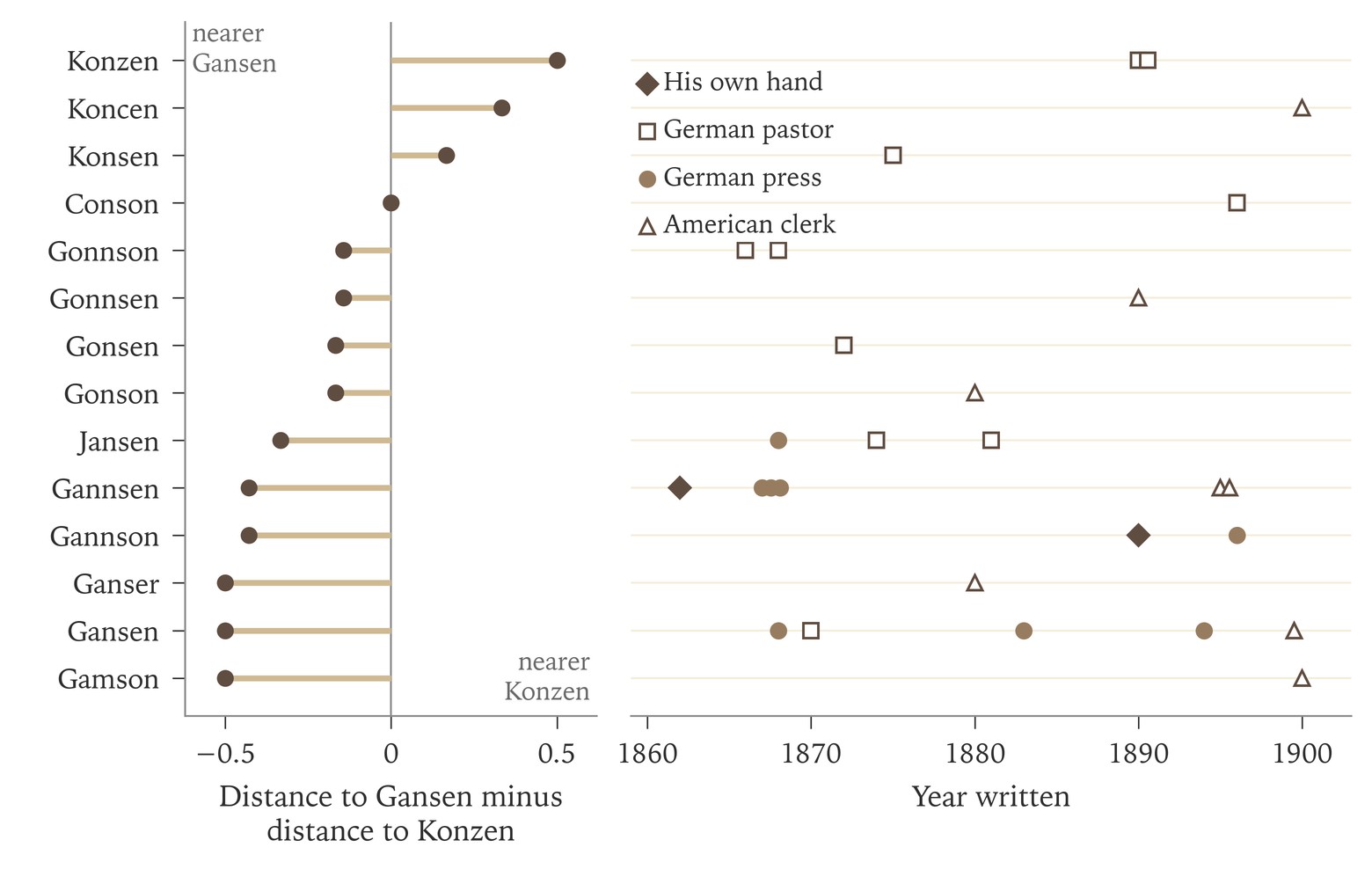
A simple count of letters does not settle the question, and neither do the standard sound codes, which join spellings for a search but cannot show which name he was born with.57 Counting the letters that must change to turn each spelling into Konzen or Gansen puts twenty-three of the twenty-eight closer to Gansen, four closer to Konzen and one halfway (figure 25.3). On this count the forms lean toward Gans, mostly because of the G and the s, but a letter count cannot hear how each writer heard the first sound.
The clearer pattern is in who wrote the vowel. Ten forms were set down from writing, not by ear: his two signatures and eight printed notices. Five of the notices probably came from Charles or his household, two from his wife’s family and one from a notary. None of the ten has the o, while ten of the other eighteen, which were written down by ear, have it. But chance could easily produce that split, so each name can explain the pattern, and the count does not decide between them.58
One reading is that the o was the name as it sounded and the a the name as the army had fixed it, but the records do not sort that cleanly. His wedding has the o, while the voter register, where a registrar recorded the name as Charles gave it, has the a, and so do the Kreichelt notices.60
His forename and the initial L
German pastors in St. Louis recorded him as Carl: “Carl Gonnson” at the wedding and “Carl Konsen” at Erwin Carl’s baptism.61 His in-laws’ 1894 notice calls him Karl, and the 1869 directory has “Ganssen Carl.”62 Most English records call him Charles. He signed himself “Karll” on the Volunteer Enlistment and “Karl” on the Declaration of Recruit.63
A middle initial L appears in his army papers and later, from the clerk’s “Charles L. Johnsen” of 1862 to the Pension Bureau’s “Chs. L. Gannson” of 1890.64 It is never written out, but it could stand for Ludwig, so boys baptized Carl Ludwig were examined closely in the German search. Two readers disagree about the initial in his own signature. A German paleographer reads the initial in his 1862 signature as a C, and a fellow researcher reads it as an L. Every clerk who wrote a middle initial wrote L, so the book reads it as L.65
The shift to Johnson
Johnson was in use from the start. The enlistment clerk recorded it in 1862, the 1866 saloon notice under that name was probably his, and the 1868 one very probably.66 It came back in the directories of the early 1870s, when Charles was a conductor on the St. Louis Railroad, again in 1879, and in most years from 1884.67
By about 1900 Johnson had become the family’s usual name. His children had married under it since 1886. The marriage records of 1886, 1887 and 1890 give the brides as Josephine, Katie and Augusta Johnson, and the 1895 license names the groom “Charles Johnson Jr.”68 In June 1900 the census recorded Charles as Johnson, a boarder at 170 Sidney Street, while the directory still printed Koncen and the voter register Gansen.69 At his death in December 1903 the death certificate, the newspaper notice, and the burial register all called him Charles Johnson.70 The family kept the name.
Studies of German emigrants’ names find that first names were turned into English almost at once, Carl to Charles among them. Surnames were usually kept by the emigrant and changed only by his children or grandchildren. Charles used Johnson unusually early, but it became the family’s own name only in the next generation, as the pattern would predict.71
The ending -en
Almost every form in the trail ends in -en or -on, and that ending was already in use in Germany.72 In the registers around Trendelburg, a name that ended in an unstressed e took -en in some grammatical forms, and a woman’s name could take a feminine ending. The 1786 Trendelburg register records “Anna Elisabeth Kontzin, Philipp Kontze ehl. Tochter,” the father under one form and the daughter under another.73 The registers wrote Konze.74 In speech, an -en form of such a name could survive, as in a phrase like “bei Konzen,” “at the Konzes’ house.”75
The last syllable was unstressed.76 An American clerk would most naturally have written that weak ending as -en or -on, and drifted toward the familiar -son of Anderson and Johnson. Said aloud, Gonnson, Konsen, and Gannsen come out nearly alike.77
The ending fits Konze most naturally, and the standard German surname dictionary agrees. It explains the surname Konzen, which still exists, as “Konze’s son”: a patronymic genitive, Konze with the old weak ending -en that is heard in “bei Konzen.” It reads Konze itself as a family name taken from a pet form of a given name such as Konrad.78 It has no entry for a Gansen, and it explains Gans as a nickname from the bird or a name for a keeper of geese.79 For Gans, a spoken form Gansen is possible, but the case rests only on comparison with other names, and no German register read for this book writes either Konzen or Gansen. The ending shows that Charles brought a spoken German form of his name with him, but it does not show which name it was.80
What the name scholars say
Germany’s name scholars cannot say which name Charles was born with, but they help in reading his trail. The surname dictionary’s article on such genitive names adds that a name of this kind could also mean “the one at Konze’s farm.”81 Studies of Hessian villages show how a name like that could pass to someone not born to it. Neighbors named people by their house, the house name first and then the given name, and a house kept its name for generations. Whoever came to live in it took the name too: a man who married in, a new owner or an heir. A boy raised in a Konze house could be “Konzen Karl” to the whole village without ever being baptized Konze. These studies come from Central and Upper Hesse, near Marburg and Giessen, not from the Diemel, and they also show the other side. In one small town a childless couple took in two children from Prussia, and the town named the children for the land they came from, not for the house. What Deisel called a foster child is not recorded.82
The historians of the US immigration service add that clerks did not change names when immigrants arrived. Names drifted afterward, as English-speaking record keepers wrote down what they heard, and some immigrants changed their names themselves. A 1952 instruction to immigration officers listed reasons why a newcomer’s recorded name could differ from the one he was born with. Among them were a stepfather’s surname, a father’s surname for a child born out of wedlock, and the name of the farm.83
The dialect scholars add a caution. Deisel and Trendelburg lay just north of the old line between High and Low German, and their people spoke a Low German dialect, not the Hessian of Kassel.84 About 1880 the school at Deisel wrote down forty set sentences in the village’s own speech for the German language atlas, and the sheet survives. It keeps K and G apart: Kind for child, Koken for cakes and Kögge for cows, but Geise for geese and Geschichte for story. So a village nickname from the bird would not have sounded like Gans. Where standard German has z, the sheet has t: Salt for Salz, Tihen for Zeiten, twe for zwei.85
The sheet for Trendelburg, the town Charles named as his birthplace, differs on one point. Its teacher, Uffelmann, also kept K and G apart in writing, but when the form asked how a g at the start of a word was spoken, he answered “wie leises k,” like a soft k.86 So at Deisel the K and G forms probably came from the pastors and clerks who recorded the name, each hearing it through his own ear. At Trendelburg the swing between the two could begin in the speaker’s own mouth.87
The vowel is another matter. The Deisel sheet writes Darb for Dorf and Karf for Korb, and it repeatedly adds a second spelling with “oa” beside an a, as in Abend (oabend) and Haf (Hoaf) for Hof. To an outsider a Deisel a could sound like an o, and an o like an a, which fits Gannsen, Gonnson and Konzen alike.88 All of this is a way of listening to the trail, not a finding about which German name he carried.
What the trail can and cannot settle
The trail proves that one man used many forms of one name, and it shows which forms he wrote and which others heard. Every signature of his whose first letter can be read begins with a G. Those of 1862 and 1890–98 have an a; on the 1900 paper the vowel is unclear. Every clear o in the first syllable was written by someone else, from what he heard.89
The name studies bear on the choice between Gans and Konze, though they prove nothing about Charles. The -en ending and the house name point toward Konze, and his own hand points the other way. In Deisel speech K and G were separate sounds, and an a could sound like an o. So his a fits a Konze name heard at Deisel, but his G does not. In Trendelburg speech, where a g was said like a soft k, a man named Konze could sign his own name with a G. If the village knew him as “Konzen Karl,” he did not simply write down what he heard. The records fit best a man who carried two names. The G and K forms were recorded side by side from 1869 to 1900, and no K form is known after 1900.90 He wrote Gannsen himself, with a G and an a, and his family probably gave Konzen twice, with a K and a z, as his daughters’ maiden name. Neither name is proven.91
The trail does not show what name the pastor at his German baptism recorded. A boy baptized Gans could grow up saying a name that Americans heard as Gonson, and a boy baptized Konze could learn to sign Gannsen. A boy raised under another family’s roof could carry a third name entirely. None of the records in table 25.1 resembles the surname under which the leading candidate was baptized.92
The next chapter, “The Name He Used: Gans, Konze or Another Name,” follows both names into the German registers and weighs them.
Notes
92 notes
- Charles Gannson (Private, Battery B, 2nd Missouri Light Artillery, Civil War), pension application no. Inv. 749,432, certificate no. 684,507; Case Files of Approved Pension Applications of Veterans Who Served in the Army and Navy Mainly in the Civil War and the War with Spain, 1861–1934; Civil War and Later Pension Files; Record Group 15: Records of the Department of Veterans Affairs; National Archives, Washington, D.C.; digital copy of the file supplied to the author by the National Archives, imaged at https://
charles-research : accessed 30 October 2026. Mail-order copies ordered by the author, first a partial file, order F21-314123835E, submitted 14 February 2017 and delivered electronically, and then the complete file, order F41-523680269E, submitted 8 September 2019 and sent by mail. Charles was a sergeant from 7 November 1863 until 15 March 1865. Pension file p. 14. St. Marcus Evangelical Church (St. Louis, Missouri), death register, entry 1897, “Josephine Herr geb. Konzen”, d. 5 May 1890 (FamilySearch image group number (IGN) 007769184, image 824); imaged, FamilySearch (https://.netlify .app/ pension-file .html www : accessed 8 October 2026), by the image group numbers and images given; citing “St. Marcus Evangelical Church records, 1847-1981,” microfilm of originals at the Eden Archives in St. Louis, Missouri; St. Marcus Evangelical Church (St. Louis, Missouri), death register, entry 1961, “Auguste Somers geb Konzen”, d. 31 Dec 1890 (FamilySearch image group number (IGN) 007769184, image 832, https://.familysearch .org www : accessed 7 November 2026). [PEN] [DTH90A] [DTH90B].familysearch .org/ ark:/ 61903/ 3:1:3Q9M-CSMZ-1JWR - The surname record: twenty-eight attestations of Charles’s surname in fourteen spellings. [SURN]
- Declaration of Recruit, Volunteer Enlistment and surgeon’s form for examining a recruit, 2 Dec 1862, St. Louis; City of St. Louis, certificate of death, burial permit no. 10619 (register no. 4166), image 1009. [ENL62] [DC03]
- Mississippi Blätter (St. Louis, Missouri), Sun 8 Nov 1868, p. 9, image 640593212. [MB68P]
- Declaration of Recruit, Volunteer Enlistment and surgeon’s form for examining a recruit, 2 Dec 1862, St. Louis; Charles Gannson (Private, Battery B, 2nd Missouri Light Artillery, Civil War), pension application no. Inv. 749,432, certificate no. 684,507; Case Files of Approved Pension Applications of Veterans Who Served in the Army and Navy Mainly in the Civil War and the War with Spain, 1861–1934; Civil War and Later Pension Files; Record Group 15: Records of the Department of Veterans Affairs; National Archives, Washington, D.C.; digital copy of the file supplied to the author by the National Archives, imaged at https://
charles-research : accessed 30 October 2026. Mail-order copies ordered by the author, first a partial file, order F21-314123835E, submitted 14 February 2017 and delivered electronically, and then the complete file, order F41-523680269E, submitted 8 September 2019 and sent by mail. Charles was a sergeant from 7 November 1863 until 15 March 1865. Pension file pp. 14, 29, 30, 11 and 13 (signatures of 1890–1898). [ENL62] [PEN].netlify .app/ pension-file .html - St. Louis Probate Court, application for guardianship, 15 Sep 1900, images 984–985. [GUARD]
- Roger P. Minert, Deciphering Handwriting in German Documents, https://
script . [MINERT].byu .edu/ german-handwriting/ tools/ basic -handwriting -techniques - The surname record: twenty-eight attestations of Charles’s surname in fourteen spellings. [SURN]
- Declaration of Recruit, Volunteer Enlistment and surgeon’s form for examining a recruit, 2 Dec 1862, St. Louis; A German paleographer and compiler of village family books, letters to the author by email; A fellow researcher, reading of the 1862 signature. The paleographer read “Karll C. Gannsen” and the fellow researcher read the initial as a small l, that is, L. [ENL62] [Paleographer's letters, 2026] [Fellow researcher's reading, 2026]
- Charles Gannson (Private, Battery B, 2nd Missouri Light Artillery, Civil War), pension application no. Inv. 749,432, certificate no. 684,507; Case Files of Approved Pension Applications of Veterans Who Served in the Army and Navy Mainly in the Civil War and the War with Spain, 1861–1934; Civil War and Later Pension Files; Record Group 15: Records of the Department of Veterans Affairs; National Archives, Washington, D.C.; digital copy of the file supplied to the author by the National Archives, imaged at https://
charles-research : accessed 30 October 2026. Mail-order copies ordered by the author, first a partial file, order F21-314123835E, submitted 14 February 2017 and delivered electronically, and then the complete file, order F41-523680269E, submitted 8 September 2019 and sent by mail. Charles was a sergeant from 7 November 1863 until 15 March 1865. Pension file p. 14. It has an a in the first syllable and an o in the second. [PEN].netlify .app/ pension-file .html - The surname record: twenty-eight attestations of Charles’s surname in fourteen spellings. [SURN]
- The surname record: twenty-eight attestations of Charles’s surname in fourteen spellings. [SURN]
- Declaration of Recruit, Volunteer Enlistment and surgeon’s form for examining a recruit, 2 Dec 1862, St. Louis. [ENL62]
- St. Marcus Evangelical Church (St. Louis, Missouri), marriage register 1866, p. 135, entry 676/4, image 381. [MAR66]
- Westliche Post (St. Louis, Missouri), Fri 23 Aug 1867, p. 2. [WP67A]
- Neuer Anzeiger des Westens (St. Louis, Missouri), Sun 25 Aug 1867, p. 5, image 576050225. [NADW67]
- “Neue Anzeigen” [New notices], Westliche Post (St. Louis, Missouri), Thu 31 Oct 1867, p. 2, death notice of the son George. [WP67B]
- St. Marcus baptism register, p. 224, entry 5857/173, Maria Josephine Gonnson, bapt. 7 Jun 1868 (image group number (IGN) 007769183, image 372; FamilySearch, https://
www : accessed 11 November 2026). [BAP68].familysearch .org/ ark:/ 61903/ 3:1:3Q9M-CSMZ-B3YS-H - Mississippi Blätter (St. Louis, Missouri), 14 Jun 1868, p. 9, image 640592645; Westliche Post (St. Louis, Missouri), 15 Jun 1868, p. 2, image 640596759. [MB68] [WP68]
- Mississippi Blätter (St. Louis, Missouri), Sun 16 Aug 1868, p. 9, image 640594500. [MB68K]
- St. Marcus baptism register, p. 285, entry 6644, Friedrike Catharina Carolina Amalia Gansen, 22 May 1870, Pastor Braschler (IGN 7769183, frame 403; https://
www : accessed 29 October 2026). [BAP70].familysearch .org/ ark:/ 61903/ 3:1:3Q9M-CSMZ-B3TT-Y - St. Marcus baptism register, pp. 352–353, entry 7519, Auguste Gonsen, 23 Jun 1872, Pastor Braschler (IGN 7769183, frame 437; https://
www : accessed 4 November 2026). [BAP72].familysearch .org/ ark:/ 61903/ 3:1:3Q9M-CSMZ-B3T5-1 - St. Marcus baptism register, p. 402, No. 8178/41, Louise Jansen, 22 Feb 1874 (IGN 7769183, frame 463; https://
www : accessed 4 November 2026). [BAP74].familysearch .org/ ark:/ 61903/ 3:1:3Q9M-CSMZ-B3TK-7 - St. Marcus baptism register, p. 453, entry 282 (running no. 8854). [BAP75]
- 1880 U.S. census, first enumeration (5 June 1880), St. Louis, SD 1, ED 40, p. 14, dwelling 77, family 135, “Ganser, Charles,” 36. [C1880J]
- 1880 U.S. census, second enumeration (9 November 1880), St. Louis, ED 137, p. 4D (penned), dwelling 15, sheet 4-D, image 204. [C1880]
- St. Marcus baptism register, p. 574, entry 10269, Bertha Jansen, 4 Sep 1881, Pastor Nollau (IGN 7769183, frame 550); imaged, FamilySearch (https://
www : accessed 8 November 2026). [BAP81].familysearch .org/ ark:/ 61903/ 3:1:3Q9M-CSMZ-B3T8-3 - Anzeiger des Westens (St. Louis, Missouri), 22 Sep 1883. [NOT83]
- Charles Gannson (Private, Battery B, 2nd Missouri Light Artillery, Civil War), pension application no. Inv. 749,432, certificate no. 684,507; Case Files of Approved Pension Applications of Veterans Who Served in the Army and Navy Mainly in the Civil War and the War with Spain, 1861–1934; Civil War and Later Pension Files; Record Group 15: Records of the Department of Veterans Affairs; National Archives, Washington, D.C.; digital copy of the file supplied to the author by the National Archives, imaged at https://
charles-research : accessed 30 October 2026. Mail-order copies ordered by the author, first a partial file, order F21-314123835E, submitted 14 February 2017 and delivered electronically, and then the complete file, order F41-523680269E, submitted 8 September 2019 and sent by mail. Charles was a sergeant from 7 November 1863 until 15 March 1865. Pension file pp. 14, 29, 30, 11 and 13. [PEN].netlify .app/ pension-file .html - St. Marcus Evangelical Church (St. Louis, Missouri), death register, entry 1897, “Josephine Herr geb. Konzen.”, image 824. [DTH90A]
- St. Marcus Evangelical Church (St. Louis, Missouri), death register, entry 1961. [DTH90B]
- 1890 U.S. census, Special Schedule of Union Veterans and Widows, St. Louis, “Charles Gonnsen”; Ancestry, “1890 Veterans Schedules of the U.S. Federal Census,” ED 55. [VET90]
- Anzeiger des Westens (St. Louis, Missouri), 17 Aug 1894, p. 4, image 642634158. [NOT94]
- Gould’s St. Louis Directory, 1895, p. 534. [D1895]
- Roster of the Department of Missouri, G.A.R. (Kansas City: Western Veteran, 1895), p. 39, Col. Meumann Post No. 496. [GAR95]
- Westliche Post (St. Louis, Missouri), 21 Dec 1896, p. 4. [WP96]
- St. Marcus Evangelical Church (St. Louis, Missouri), death register 1896, pp. 120–121, no. 2631. [AUG96]
- St. Louis Register of Voters, Ward 9, 1896-series book, line 22, image 191. [VOTE]
- Gould’s St. Louis Directory, 1900, p. 1034. [D1900]
- Historical Register of National Homes for Disabled Volunteer Soldiers, p. 2072, no. 2072. [DAN]
- St. Marcus Evangelical Church (St. Louis, Missouri), marriage register 1866, p. 135, entry 676/4, image 381. [MAR66]
- Westliche Post (St. Louis, Missouri), Fri 23 Aug 1867, p. 2; Westliche Post (St. Louis, Missouri), 15 Jun 1868, p. 2, image 640596759; St. Louis Register of Voters, Ward 9, 1896-series book, line 22, image 191. [WP67A] [WP68] [VOTE]
- St. Marcus baptism register, p. 453, entry 282 (running no. 8854); St. Marcus Evangelical Church (St. Louis, Missouri), death register, entry 1897, “Josephine Herr geb. Konzen.”, image 824; St. Marcus Evangelical Church (St. Louis, Missouri), death register, entry 1961; St. Marcus Evangelical Church (St. Louis, Missouri), death register 1896, pp. 120–121, no. 2631; Gould’s St. Louis Directory, 1900, p. 1034. [BAP75] [DTH90A] [DTH90B] [AUG96] [D1900]
- St. Louis Circuit Court, 1868, case no. 9422, p. 20, pp. 17–23. [SUB68]
- City of St. Louis, deed records, Book 382 pp. 392–393, lease of 28 Apr 1869; St. Louis Evening Post, Thu 13 May 1869, p. 4., image 1300830252. [LEASE69] [EP69]
- Westliche Post (St. Louis), Sat 31 Jul 1869, p. 2, col. 5, image 640764692; Westliche Post (St. Louis), Sat 7 Aug 1869, p. 2, col. 8, image 640764991. [WP69JUL31] [WP69AUG07]
- St. Louis deed records, vol. 400. [DOT70]
- 1890 U.S. census, Special Schedule of Union Veterans and Widows, St. Louis, “Charles Gonnsen”; Ancestry, “1890 Veterans Schedules of the U.S. Federal Census,” ED 55. [VET90]
- Historical Register of National Homes for Disabled Volunteer Soldiers, p. 2072, no. 2072. [DAN]
- Mississippi Blätter (St. Louis, Missouri), Sun 16 Aug 1868, p. 9, image 640594500; St. Marcus baptism register, p. 402, No. 8178/41, Louise Jansen, 22 Feb 1874; St. Marcus baptism register, p. 574, entry 10269, Bertha Jansen, 4 Sep 1881. [MB68K] [BAP74] [BAP81]
- “Whisky—Wine—Lager. Who Keeps the Barrooms and Where They Are Located. Reported by the Police for the Benefit of the City Collector,” Missouri Democrat (St. Louis, Missouri; title “St. Louis Globe-Democrat”), 8 Sep 1868, p. 4. [BAR68]
- The surname record: twenty-eight attestations of Charles’s surname in fourteen spellings. [SURN]
- The surname record: twenty-eight attestations of Charles’s surname in fourteen spellings. [SURN]
- The surname record: twenty-eight attestations of Charles’s surname in fourteen spellings. [SURN]
- Anna-Maria Balbach, “New Land – New Name? About the Name Changes of German Emigrants to North America,” in Antje Dammel. [BALB25]
- The surname record: twenty-eight attestations of Charles’s surname in fourteen spellings. [SURN]
- Phonetic codes for the fourteen counted spellings of Charles’s surname, the family names Konze and Gans, eighteen other forms of his surname and of the two names (directory and index spellings and German variants), and four control names (Johnson, Johnsen and two spellings of the leading candidate’s baptismal surname), under four systems: American Soundex, by the rules in National Archives and Records Administration, “Soundex System,” https://
www : accessed 8 November 2026; Daitch–Mokotoff Soundex, by the coding chart in JewishGen, “Soundex Coding,” https://.archives .gov/ research/ census/ soundex www : accessed 8 November 2026; Kölner Phonetik, by the rules of Hans Joachim Postel, “Die Kölner Phonetik,” IBM-Nachrichten 19 (1969): 925–31, as given in Christopher C. Little, Abydos, version 0.5.0, documentation, “abydos.phonetic package,” class Koelner (“Based on the algorithm defined by [Pos69]”), https://.jewishgen .org/ InfoFiles/ soundex .html abydos : accessed 8 November 2026; and Beider–Morse Phonetic Matching, by Alexander Beider and Stephen P. Morse, “Beider-Morse Phonetic Matching (BMPM),” https://.readthedocs .io/ en/ v0 .5 .0/ abydos .phonetic .html stevemorse : accessed 8 November 2026. Computed by the author on 8 November 2026 with the abydos library, version 0.5.0 (Beider–Morse in generic name mode, approximate match, under both the German rules and language detection); script and table in the research files. Two of them, the German Kölner Phonetik and the Daitch–Mokotoff Soundex, code G and K alike. They give Konze and Gans the same code, and they put twelve of the fourteen spellings, Gannsen and Konzen among them, under one code; only Ganser and Jansen fall outside it. The American Soundex, the census soundex of the National Archives, keeps the first letter as it is written, and the Beider–Morse system keeps G and K apart. Both file his G spellings and his K or C spellings under different codes. [SURNPHON].org/ phoneticinfo .htm - The surname record: twenty-eight attestations of Charles’s surname in fourteen spellings. That split was noticed after the count was made; it was not a test planned in advance. Many of the forms were copied, and one pastor wrote four of them. Counted once for each writer, the split is 0 of 3 against 7 of 13. Fisher’s exact test gives p = 0.21: if the writers did not differ at all, a split at least this uneven would still turn up about one time in five. [SURN]
- The surname record: twenty-eight attestations of Charles’s surname in fourteen spellings. Closeness is measured as the share of letters that must change (normalized edit distance; negative is closer to Gansen). Counting each of the sixteen writers once, thirteen of sixteen are. The 95 percent confidence ranges for those two shares (Wilson intervals: given so few records, a range made this way holds the true share nineteen times in twenty) run from 64 to 92 percent and from 57 to 93 percent. The split between written and heard forms is exploratory and well within chance. n = 28 attestations, 14 spellings. [SURN]
- The surname record: twenty-eight attestations of Charles’s surname in fourteen spellings. [SURN]
- St. Marcus Evangelical Church (St. Louis, Missouri), marriage register 1866, p. 135, entry 676/4, image 381; St. Marcus baptism register, p. 453, entry 282 (running no. 8854). [MAR66] [BAP75]
- Anzeiger des Westens (St. Louis, Missouri), 17 Aug 1894, p. 4, image 642634158; St. Louis city directories (Edwards’, Gould’s and others), 1866–1904, read year by year in the images, including 1868 p. 414. 1869, p. 337. [NOT94] [DIRS]
- Declaration of Recruit, Volunteer Enlistment and surgeon’s form for examining a recruit, 2 Dec 1862, St. Louis; A German paleographer and compiler of village family books, letters to the author by email. [ENL62] [Paleographer's letters, 2026]
- Declaration of Recruit, Volunteer Enlistment and surgeon’s form for examining a recruit, 2 Dec 1862, St. Louis; Regimental Descriptive Book card, “L. Charles Gannsen,” Pvt., roll 762; Compiled Service Record, Battery B, 2nd Missouri Light Artillery (NARA M405), copyist cards for the rolls of Nov–Dec 1862 to Jul–Aug 1863 (“Charles Gaunsen”) and the 1865 headquarters card (“C. L. Gaunsen”) (image group number (IGN) 9080602, image 1578 and following); Charles Gannson (Private, Battery B, 2nd Missouri Light Artillery, Civil War), pension application no. Inv. 749,432, certificate no. 684,507; Case Files of Approved Pension Applications of Veterans Who Served in the Army and Navy Mainly in the Civil War and the War with Spain, 1861–1934; Civil War and Later Pension Files; Record Group 15: Records of the Department of Veterans Affairs; National Archives, Washington, D.C.; digital copy of the file supplied to the author by the National Archives, imaged at https://
charles-research : accessed 30 October 2026. Mail-order copies ordered by the author, first a partial file, order F21-314123835E, submitted 14 February 2017 and delivered electronically, and then the complete file, order F41-523680269E, submitted 8 September 2019 and sent by mail. Charles was a sergeant from 7 November 1863 until 15 March 1865. The Pension Bureau form is on page 7 of the pension file, dated 4 June 1890. [ENL62] [RDB62] [CSR] [PEN].netlify .app/ pension-file .html - A German paleographer and compiler of village family books, letters to the author by email; A fellow researcher, reading of the 1862 signature. [Paleographer's letters, 2026] [Fellow researcher's reading, 2026]
- Declaration of Recruit, Volunteer Enlistment and surgeon’s form for examining a recruit, 2 Dec 1862, St. Louis; Mississippi Blätter (St. Louis, Missouri), Sun 15 Apr 1866, p. 9, col. 3; Neuer Anzeiger des Westens (St. Louis, Missouri), Sun 29 Apr 1866, p. 5, image 576047921, image 642733008; Mississippi Blätter (St. Louis, Missouri), Sun 8 Nov 1868, p. 9, image 640593212. [ENL62] [MB66] [NADW66] [MB68P]
- St. Louis city directories (Edwards’, Gould’s and others), 1866–1904, read year by year in the images, including 1868 p. 414. 1871, p. 352; 1879, p. 512; 1884, p. 574. [DIRS]
- St. Louis marriage records; St. Louis Post-Dispatch, 21 Dec 1895, p. 7, marriage licenses ( image 138140300; https://
www : accessed 2 November 2026); St. Louis marriage license No. 63946, p. 256, “Charles Johnson Jr” (FamilySearch 3:1:3QS7-898M-13HC, accessed 6 November 2026). Read in the image. [SMNAME] [SMLIC].newspapers .com/ image/ 138140300/ - 1900 U.S. census, City of St. Louis, Missouri, population schedule, Ward 9, ED 129, sheet 5-B (penned); Gould’s St. Louis Directory, 1900, p. 1034; St. Louis Register of Voters, Ward 9, 1896-series book, line 22, image 191. [C1900] [D1900] [VOTE]
- City of St. Louis, certificate of death, burial permit no. 10619 (register no. 4166), image 1009; St. Louis Post-Dispatch, 18 Dec 1903, p. 12, death notice of Charles Johnson ( image 137788634); St. Marcus Evangelical Church (St. Louis, Missouri), burial register, pp. 240–241, no. 3393, image 943. [DC03] [PD03] [BUR03]
- Anna-Maria Balbach, “New Land – New Name? About the Name Changes of German Emigrants to North America,” in Antje Dammel. [BALB25]
- The surname record: twenty-eight attestations of Charles’s surname in fourteen spellings. [SURN]
- Evangelische Kirchengemeinde Trendelburg (Trendelburg, Kreis Hofgeismar, Kurhessen), “Kirchenbuch 1773–1818” [Church book 1773–1818], confirmations, Easter 1786, p. 232, entry 5 (Archion register 220096, image 1109); imaged, Archion (https://
www : accessed 2 November 2026) > Hessen > Landeskirchliches Archiv der Evangelischen Kirche von Kurhessen-Waldeck > Kirchenkreis Hofgeismar > Trendelburg > Kirchenbuch 1773-1818; citing Landeskirchliches Archiv der Evangelischen Kirche von Kurhessen-Waldeck, Kassel. [TR1786].archion .de/ de/ viewer/ churchRegister/ 220096 - Ev. Kirchengemeinde Deisel, “Kirchenbuch 1796–1831” [Church book 1796–1831], image 1742, image 1746. [DEI1829]
- Charles Gannsen Research, “Konze in the Mouth,” pronunciation research log (28 Jun 2026, revised 5 Jul 2026), on the unstressed final syllable and on spoken forms such as “bei Konzen.” Its account of a softened initial K, drawn from the consonant weakening of North Hessian speech (binnendeutsche Konsonantenschwächung), was withdrawn on 5 November 2026, because Deisel and Trendelburg lay in the Low German speech area (Syntax hessischer Dialekte, “Dialekte in Hessen,” 2018). [PRONLOG]
- Charles Gannsen Research, “Konze in the Mouth,” pronunciation research log. [PRONLOG]
- Charles Gannsen Research, “Konze in the Mouth,” pronunciation research log; The surname record: twenty-eight attestations of Charles’s surname in fourteen spellings. [PRONLOG] [SURN]
- Kathrin Dräger, “Konzen,” in Digitales Familiennamenwörterbuch Deutschlands; Kathrin Dräger, “Konze,” in Digitales Familiennamenwörterbuch Deutschlands, ed. Akademie der Wissenschaften und der Literatur Mainz and Technische Universität Darmstadt, published 3 November 2026 (“Es handelt sich um ein Patronym zu einer deutschen Rufnamenkurzform mit dem Namenglied althochdeutsch kuoni, altsächsisch kōni ‘kühn’ zu Vollformen wie Konrad oder Kunibert. … Es liegt eine Koseform mit dem Suffix -ze vor”: a patronymic from a short form of German given names with the element Old High German kuoni, Old Saxon kōni, “bold,” as in Konrad or Kunibert; a pet form with the suffix -ze; the author’s translation), http://
www : accessed 8 November 2026. [DFD-KONZEN] [DFD-KONZE].namenforschung .net/ id/ name/ 16315/ 1 - Rita Heuser, “Gans,” in Digitales Familiennamenwörterbuch Deutschlands, ed. Akademie der Wissenschaften und der Literatur Mainz and Technische Universität Darmstadt, published 3 November 2026 (a nickname from Middle High German gans, goose, for a goose due as a rent or for a waddling or simple man; or an indirect occupational name for a keeper or dealer of geese; rarely a house name “(Zur) Gans”), http://
www : accessed 4 November 2026. A search of the dictionary for “Gansen” the same day found no entry. [DFD-GANS].namenforschung .net/ id/ name/ 3581/ 1 - The surname record: twenty-eight attestations of Charles’s surname in fourteen spellings. [SURN]
- Mirjam Schmuck, “Patronymische Genitive” [Patronymic genitives], thematic article in Digitales Familiennamenwörterbuch Deutschlands, ed. Akademie der Wissenschaften und der Literatur Mainz and Technische Universität Darmstadt, published 3 November 2026 (surnames in a frozen genitive, such as Jan Otten, “Otto’s [son]”; naming after a farm, “the one at Peter’s farm,” also possible; such surnames are most common west of the Rhine) (http://
www : accessed 5 November 2026). [DFD-GEN].namenforschung .net/ id/ thema/ 22/ 1 - Herbert Hohmann, “Die Neustädter Hausnamen: Ein Beitrag zur Namensforschung” [The house names of Neustadt: a contribution to name research], Zeitschrift des Vereins für hessische Geschichte und Landeskunde 89 (1982/83): 51–68, at 54 (house names kept when a man married in), 56 (passed with the mills to new families) and 65 (two foster children from Prussia named for their origin) (http://
www : accessed 5 November 2026); Thomas Euler, “Die Hausnamen (Dorfnamen) von Allendorf/Lahn” [The house names (village names) of Allendorf on the Lahn], Mitteilungen des Oberhessischen Geschichtsvereins 98 (2013): 303–74, at 304–07 (the house name joined to the given name with a possessive ending; house names passing by purchase, marriage or inheritance, one through three later families) (https://.vhghessen .de/ inhalt/ zhg/ zhg_89/ Hohmann _Neustaedter _Hausnamen .pdf jlupub : accessed 5 November 2026). [HOHMANN] [EULER13].ub .uni-giessen .de/ bitstreams/ 0855a 6e 4 -1e 77 -43ad -b 644 -952dff 5e 8ecd/ download - U.S. Citizenship and Immigration Services, History Office, “Immigrant Name Changes,” Genealogy Notebook, updated 24 January 2025 (names not changed on arrival; later drift and self-chosen changes; quoting INS Operations Instruction 500.1 I of 24 December 1952 on the reasons a recorded name could differ from the birth name) (https://
www : accessed 5 November 2026). [INSHIST].uscis .gov/ records/ genealogy/ genealogy-notebook/ immigrant-name-changes - Lena Schäfer, “Kurzbeschreibung der Dialekte Hessens” [Short description of the dialects of Hesse], section “Dialekte in Hessen,” 2018, Syntax hessischer Dialekte (SyHD), research project of the Universities of Marburg, Frankfurt am Main and Göttingen (Low German spoken north of the Benrath line in the north of Hesse, including the far north beyond Kassel), read in the Internet Archive copy of 23 May 2024 (https://
web : accessed 5 November 2026); the live page showed “Vorübergehend offline” on 4–5 November 2026; Brockhaus’ Konversations-Lexikon, 14th ed., vol. 5 (Leipzig: F. A. Brockhaus, 1894), s.v. “Deutsche Mundarten” [German dialects], p. 33 (the Low German “Hessisch-Engrisch” group spoken around Liebenau, Hofgeismar, Grebenstein, Immenhausen, Trendelburg and Helmarshausen); retro|bib (https://.archive .org/ web/ 20240523030944/ https:// www .syhd .info/ ueber-das-projekt/ ueber-einblicke/ kurzbeschreibung -der -dialekte -hessens/ index .html www : accessed 5 November 2026). [SYHD] [BROCK94].retrobibliothek .de/ retrobib/ seite .html ?id =124410 - Forschungszentrum Deutscher Sprachatlas, Marburg, “25256 – Deisel,” Erhebungsbögen zum Sprachatlas des Deutschen Reichs [Questionnaires for the language atlas of the German Empire, the Wenker sheets], sheet for Deisel, Kreis Hofgeismar, c. 1880, sentences 6, 7, 13, 14, 19, 21, 24, 33 and 37, read in the sheet image and compared with the volunteer transliterations nos. 46 and 502 in the Wenkerbogen app (https://
wenker ); CC BY-SA 4.0 (https://.online .uni-marburg .de/ wenker/ transliteration/ 46 doi : accessed 5 November 2026). [WENKER25256].org/ 10 .57712/ lingurep-9254 - Forschungszentrum Deutscher Sprachatlas, Marburg, “25158 – Trendelburg,” Erhebungsbögen zum Sprachatlas des Deutschen Reichs [Questionnaires for the language atlas of the German Empire, the Wenker sheets], sheet for Trendelburg, Kreis Hofgeismar, c. 1880, filled in by the teacher Uffelmann (born at Hümme); page 2, question 2 (initial g spoken “wie leises k”), and the K- and G-words of the forty sentences, read twice independently in the sheet image (no transliteration exists) (https://
doi : accessed 5 November 2026). [WENKER25158].org/ 10 .57712/ lingurep-17200 - Lena Schäfer, “Kurzbeschreibung der Dialekte Hessens” [Short description of the dialects of Hesse], section “Dialekte in Hessen,” 2018; Forschungszentrum Deutscher Sprachatlas, Marburg, “25256 – Deisel,” Erhebungsbögen zum Sprachatlas des Deutschen Reichs [Questionnaires for the language atlas of the German Empire, the Wenker sheets], sheet for Deisel, Kreis Hofgeismar, c. 1880, sentences 6, 7, 13, 14, 19, 21, 24, 33 and 37, read in the sheet image and compared with the volunteer transliterations nos. 46 and 502 in the Wenkerbogen app (https://
wenker ); CC BY-SA 4.0 (https://.online .uni-marburg .de/ wenker/ transliteration/ 46 doi : accessed 5 November 2026). [SYHD] [WENKER25256].org/ 10 .57712/ lingurep-9254 - Forschungszentrum Deutscher Sprachatlas, Marburg, “25256 – Deisel,” Erhebungsbögen zum Sprachatlas des Deutschen Reichs [Questionnaires for the language atlas of the German Empire, the Wenker sheets], sheet for Deisel, Kreis Hofgeismar, c. 1880, sentences 6, 7, 13, 14, 19, 21, 24, 33 and 37, read in the sheet image and compared with the volunteer transliterations nos. 46 and 502 in the Wenkerbogen app (https://
wenker ); CC BY-SA 4.0 (https://.online .uni-marburg .de/ wenker/ transliteration/ 46 doi : accessed 5 November 2026). [WENKER25256].org/ 10 .57712/ lingurep-9254 - The surname record: twenty-eight attestations of Charles’s surname in fourteen spellings. [SURN]
- City of St. Louis, deed records, Book 382 pp. 392–393, lease of 28 Apr 1869; Gould’s St. Louis Directory, 1900, p. 1034; The surname record: twenty-eight attestations of Charles’s surname in fourteen spellings. [LEASE69] [D1900] [SURN]
- Declaration of Recruit, Volunteer Enlistment and surgeon’s form for examining a recruit, 2 Dec 1862, St. Louis; Charles Gannson (Private, Battery B, 2nd Missouri Light Artillery, Civil War), pension application no. Inv. 749,432, certificate no. 684,507; Case Files of Approved Pension Applications of Veterans Who Served in the Army and Navy Mainly in the Civil War and the War with Spain, 1861–1934; Civil War and Later Pension Files; Record Group 15: Records of the Department of Veterans Affairs; National Archives, Washington, D.C.; digital copy of the file supplied to the author by the National Archives, imaged at https://
charles-research : accessed 30 October 2026. Mail-order copies ordered by the author, first a partial file, order F21-314123835E, submitted 14 February 2017 and delivered electronically, and then the complete file, order F41-523680269E, submitted 8 September 2019 and sent by mail. Charles was a sergeant from 7 November 1863 until 15 March 1865. Pension file signatures on pp. 11, 13, 14, 29 and 30. St. Marcus Evangelical Church (St. Louis, Missouri), death register, entry 1897, “Josephine Herr geb. Konzen.”, image 824; St. Marcus Evangelical Church (St. Louis, Missouri), death register, entry 1961; The surname record: twenty-eight attestations of Charles’s surname in fourteen spellings. [ENL62] [PEN] [DTH90A] [DTH90B] [SURN].netlify .app/ pension-file .html - The surname record: twenty-eight attestations of Charles’s surname in fourteen spellings. [SURN]
Also on this page
Fuller account
The forms not counted
This section of the printed chapter “The Name He Signed” was moved online on 26 October 2026. Its full text is kept here.
Around the twenty-six lie many more renderings, each a real record of Charles but each failing one of the four rules. They are listed here so that a reader searching for him knows what to look for.
- The city directories of 1866–1904 print Jansen (1866 and 1868, as a bartender and barkeeper), Gannssen (1867), Ganssen (1869, "Ganssen Carl, saloon, 1206 Park av."), Konsen and Conzen (1874), Gantzen and Gonson (1875), Kouson (1876), Gonst (1877), Gansel (1878), Gansell and Kausen (1882), Ganzer (1883) and Consenn (1894), as well as Johnson in other years. [DIRS]
- A justice's subpoena of 18 April 1868, in a suit against his father-in-law, calls a witness "K[ar]l Kausen, cor. Park Ave & 12". [SUB68]
- A lease and two deeds of trust of April to June 1869 for Schnerr's saloon name "Charles Konson", with one recorded signature "Charles Konnson". A deed of trust of 18 January 1870 has Kanson and Kansen. These are the recorder's copies, so the signatures are not autograph. [DEEDS] The St. Louis Evening Post of 13 May 1869 advertised a free concert at "Charley Konson's Park Avenue Gardens". [EP69]
- A St. Marcus baptism of 1872 has "Charles Gansen" as sponsor for a Kreichelt child, and a Holy Ghost marriage of 1874 has a witness "Chas. Konzen", probably Charles. [SPONS]
- Two notices for Schnerr's brewery saloon in the Neuer Anzeiger des Westens, 15 and 29 April 1866, print "Karl Johnsen" and "Chas. Ganhson"; they are probably Charles. [SURN]
- A notice in the Mississippi Blätter of 8 November 1868 for the beer saloon and garden at the corner of Park Avenue and 12th Street, Schnerr's corner, is signed "Charles Johnson". It is probably Charles: the first known notice he placed under that name. [MB68P]
- The War Department copyist's card for the battery roll of November–December 1863 has "Gunnsen", a copy of a copy. The card for the muster-out roll of 20 December 1865 has "Gannssen". [CSR] [CSR327]
- The Danville register of 1900 has been read both "Gannson" and "Gamson", and gives his son as "Chas. Gamson Jr."; the reading is not secure. [DAN]
- The army copyists' Gaunsen of 1862–63 and the 1891 Globe-Democrat "nee Gaunsen", discussed above, are held as probable. If a sharper image of either shows a secure u, Gaunsen would become a twelfth spelling. [SURN]
Sources
- DIRS St. Louis city directories (Edwards', Gould's and others), 1866–1904, read year by year in the images, including 1868 p. 414 (DGS 109296988, image 375), 1869 p. 337, 1871 p. 352, Gould’s 1874 p. 212 (Conzen), 1875 p. 340 (Gantzen), 1876 p. 507 (Kouson), 1877 p. 372 (Gonst), 1878 p. 340 (Gansel), 1882 pp. 423 and 614 (Gansell, Kausen), 1883 p. 405 (Ganzer), 1887 and 1894.
- SUB68 St. Louis Circuit Court, 1868 no. 9422, Buse v. George Kreichelt, subpoena of 18 Apr 1868 (Missouri State Archives).
- DEEDS St. Louis Recorder of Deeds, Book 382 pp. 392–393 (lease, 1869); Book 378 pp. 539–540 and Book 388 pp. 70–71 (deeds of trust, 1869); Book 400 pp. 170–171 (deed of trust, 18 Jan 1870).
- EP69 St. Louis Evening Post, Thu 13 May 1869, p. 4, "Free Concert … Charley Konson's Park Avenue Gardens" (Newspapers.com image 1300830252).
- SPONS Sponsor and witness lines: St. Marcus baptisms 1872, No. 7730/407, p. 367 (sponsor "Charles Gansen"; DGS 007769183); Holy Ghost Evangelical, St. Louis, marriage no. 993, 25 Aug 1874, Carl Franz Doering and Christiana Wolfsberger geb. Eber, witnesses "Chas. Konzen, Georg Hendel" (FamilySearch DGS 007857117, image 811).
- SURN The surname record: twenty-eight attestations of Charles's surname in fourteen spellings, 1862–1900 (twenty-eight since 30 October 2026, when the veterans' census of 1890 and the Danville register of 1900 were admitted), each read in the image of the original record or newspaper, with counting rules, readings and the forms held as probable or not admitted; compiled from the records cited in this chapter, as of 16 October 2026, when the baptisms of 1868 and 1874 (BAP68, BAP74) were admitted; the two notices of 1867 (WP67B, NADW67) were admitted on 14 October, and the christening notice of August 1868 (MB68K) and the June 1880 census (C1880J) on 26 October.
- MB68P Mississippi Blätter (St. Louis), Sun 8 Nov 1868, p. 9, notice “Großer republikanischer Sieges- und zugleich Eröffnungs-Lunch! … den Bier-Salon und Garten, Ecke der Park Avenue und 12. Straße übernommen und am Montag den 9. November eröffnen werde … Lagerbier aus Schnerr’s Brauerei … Charles Johnson” (Newspapers.com image 640593212). Read in the image; second independent read 26 Oct 2026.
- CSR Compiled Service Record, Battery B, 2nd Missouri Light Artillery (NARA M405), copyist cards for the rolls of Nov–Dec 1862 to Jul–Aug 1863 ("Charles Gaunsen") and the 1865 headquarters card ("C. L. Gaunsen"); FamilySearch DGS 9080602, image 1578 and following.
- CSR327 Compiled service record of Charles Gannsen, Battery B, 2nd Regiment Missouri Light Artillery. National Archives, RG 94, M405 (Compiled Service Records of Volunteer Union Soldiers Who Served in Organizations from the State of Missouri), roll 0327, "Second Light Artillery, Fo–Gh"; Fold3 file 228767500, images 228767500–228767688 (24 cards and documents). Cards read at full resolution, October 2026.
- DAN Historical Register of National Homes for Disabled Volunteer Soldiers, Danville Branch (NARA M1749), image 297, p. 2072, admitted 18 Oct 1900.
More of the chapter, as printed until 28 October 2026
The rule for counting, as printed until 28 October 2026
This passage of the printed chapter “The Name He Signed” was shortened on 28 October 2026 so that family readers can get through Part Four. The text that stood in the book is kept here.
Between 1862 and 1900 the name was written down in twenty-six records that meet the rules of this chapter and can still be read in the original or in the newspaper image. Those twenty-six carry twelve [now fourteen] different spellings. In the order they first appear, they are Gannsen, Gonnson, Gansen, Jansen, Gonsen, Konsen, Ganser, Gonson, Gannson, Konzen, Conson and Koncen. All are the same man. [SURN] Two of the counted spellings are signatures in his own hand. A third signature in his hand, of 1900, is discussed below. The others were written by pastors, clerks, two census takers, directory canvassers, a registrar of voters and newspaper typesetters, each putting down what he heard or what he had been handed.
This chapter takes the twenty-six in order. For each one it asks who held the pen, what script he wrote in and whether Charles was in the room. Then it asks what the spelling can and cannot tell about the German name behind it. It is the most technical chapter of the book. The section “The pattern in the twenty-six” gives the result without the argument. The plates at the end of the chapter show each written form.
The twenty-six were chosen by four rules. Each spelling was read in the image of the record itself, not in an index or a later abstract. The letter that makes it different is secure in that image. The record is a hearing of the name as Charles or his family spoke it, not a clerk's copy of an earlier written form. And the record is securely tied to Charles or his household. Repeated signatures inside one file count once, and so does a notice printed twice. [SURN]
These rules leave out a good deal. Six of Charles's seven children are counted by their baptisms. The first, Friedrich Wilhelm's of 1866, is not, for the reason given under 1866 below. City directories, deeds, court papers and later clerks' lists carry another dozen forms. Only two directory lines are counted, those of 1895 and 1900, which print father and son together at the family's address. They are listed in the online chapter, under “The forms not counted”. They are evidence that he was there, but they do not count toward the trail of how his name sounded. [SURN]
The table lists the twenty-six in date order. For each it gives the form, the man who held the pen, and who gave him the name, as far as the record shows. The last column gives the vowel of the first syllable. [SURN]
A German boy schooled in the 1840s learned two scripts. Ordinary German was written in Kurrent, the angular cursive whose letters differ sharply from Latin forms: its e looks like an n and its h has a loop below the line. Latin letters were taught as well, for foreign words and for names that a writer wished to set apart. [MINERT] Pastors in St. Louis German congregations kept their registers in Kurrent through the period of Charles's life. American clerks wrote in English round hand, the cursive taught in American schools. A name moving between these hands could change at each crossing. The three letters most at risk in this name were the n, the u and the doubled s. All three are made of the same short strokes.
1862 to 1868, as printed until 28 October 2026
This passage of the printed chapter “The Name He Signed” was shortened on 28 October 2026 so that family readers can get through Part Four. The text that stood in the book is kept here.
On 2 December 1862 Charles enlisted at St. Louis in Battery B of the 2nd Missouri Light Artillery. Three papers survive from that day: a Declaration of Recruit, a Volunteer Enlistment sworn before the notary John A. Hodgman, and the surgeon's form for examining a recruit. [ENL62] The clerk who filled them in wrote the recruit's name as "Charles L. Johnsen" on the enlistment and "Charles L. Johnson" on the surgeon's form. He recorded that the recruit was "born in Trennelburg in the State of Kurhessen". [ENL62] Charles signed all three himself, and he signed in Kurrent.
A German paleographer examined the images of the signature. The first letter is beyond doubt a G, and the ending is -nssen or -nßen with both n's written out. The small arc over the third letter is either the bow that German writers placed over a u or a stroke misplaced by an unpracticed hand. The same writer spelled his forename "Karll" on the form. [Paleographer's letters, 2026] The signature is therefore read as Gannsen, with Gunssen as the alternative. [SURN] (The signature was first read with an umlaut, as Gönssen; that reading has been withdrawn.)
This is the earliest record of the name and the only one in his own hand in German script. It is also why the papers stayed hidden so long: they were indexed under the clerk's "Johnsen" and "Johnson", so searches for the German name never reached them. [SURN]
The army's own copies took a different road. The Regimental Descriptive Book entered him as "L. Charles Gannsen". That form became his legal name in every federal record that followed. [RDB62] The War Department copyists who later abstracted the 1862–63 battery rolls onto cards wrote "Charles Gaunsen" six times, in two different hands. The Missouri Adjutant General's card is headed "Gaunsen, Charles (or Gansen, Chas. L.)". [CSR] [AGO] Gaunsen differs from Gannsen by a single stroke, the open top of a u where an n would be closed. The u of Gaunsen is probable but not secure, so the form is not counted. [SURN] (The cards are copies, the original rolls have not been seen, and the copyists may simply have misread Gannsen.)
On 7 January 1866, a few weeks after his discharge, Charles married Auguste Kreichelt at St. Marcus Evangelical Church. Pastor G. W. Wall, a Württemberger, wrote the groom's name as "Carl Gonnson, aus Deiße, Kreis Cassel, Churhessen" (Carl Gonnson, from Deisel, district of Cassel, Electoral Hesse). [MAR66] At a wedding the groom gives his own name. This is therefore the first record in which Charles spoke the name and someone else wrote it down. Wall heard a back vowel, the o of English "on", where the enlistment signature has an a. [MAR66] (The civil marriage license for the same wedding repeats Gonnson and gives the place as "Deisse"; it may have been copied from the church entry.)
The same form was used at the first two baptisms. Friedrich Wilhelm, born 20 June 1866, was entered as Gonnson by Wall himself at his baptism on 2 September, eight months after the wedding. Wall noted his own marriage entry in the margin, so the form may have been taken from his register rather than heard again. The father's surname also lies partly under an ink blot. That baptism is not counted. [GPB66] Maria Josephine, baptized 7 June 1868, was entered as Gonnson by another pastor, H. Braschler, a Swiss. That makes hers a second, independent hearing of the o, and it is counted. [BAP68]
After the war Charles kept a saloon. Five German newspaper notices of that period are counted, all printed rather than written. In the Westliche Post of Friday 23 August 1867, and again the next day, a notice advertised a "Großes Picnic an Laclede Station" (great picnic at Laclede Station) for Sunday the 25th. Tickets were to be had "bei dem Unternehmer, Charles Gannsen, in Schnerr's Brauerei" (from the organizer, Charles Gannsen, at Schnerr's brewery). [WP67A] The organizer of a picnic supplied the text of his own notice, so the form probably came from Charles. The place fits: the 1867 directory lists "Gannssen Charles, saloon, 1206 Park av.", the bar of Schnerr's brewery. [D1867]
Two days later, on Sunday 25 August 1867, the Neuer Anzeiger des Westens printed a notary's list of men who should collect bounties and back pay. It included "Herr Charles Gannsen". [NADW67] And on 31 October 1867 the Westliche Post printed a death notice for Charles and Auguste’s first son, Friedrich Wilhelm, called George, signed "Charles Gannsen" and "Augusta Gannsen geb. Kreichelt" of 1501 Closey. [WP67B] Both are counted, though neither adds a spelling: both print the Gannsen of his 1862 signature and of the picnic notice. [SURN] (The death notice was placed by the family, like the Kreichelt notices of 1883 and 1894 and the family's notice of 1896. The notary's list is the least direct of the twenty-six: how the notary came by the name is not known, but nothing shows that he copied it from an earlier written form.)
The next summer, on 15 June 1868, the Westliche Post carried an advertisement for a grand opening lunch. It was to be held "bei Charles Gansen, Südost-Ecke von De Kalb und Lesperancestraße, Weber's Haus" (at Charles Gansen's, southeast corner of DeKalb and Lesperance Street, Weber's house). [WP68] The same advertisement had appeared in the Mississippi Blätter the day before. [MB68] Here the typesetter, or Charles, dropped the second n.
Two months later the Mississippi Blätter printed a notice headed "Kindtaufsfeier" (christening party). On Sunday 16 August 1868 it announced a dance for the next day "in meinem Lokale" (in my place), signed "Charles Jansen, Ecke von DeKalb und Lesperancestr." (Charles Jansen, corner of DeKalb and Lesperance Street). [MB68K] The corner is that of the June advertisement, so the notice is his, and it is counted. It is the first Jansen in the trail, six years before a pastor wrote the form at Louise's baptism. The directory of the same year had already printed "Jansen Charles, barkeeper" at Schnerr's, but directory lines other than those of 1895 and 1900 are not counted. [D1868]
Three months later a notice in the Mississippi Blätter used a third name. On Sunday 8 November 1868, five days after the presidential election, it announced a "Großer republikanischer Sieges- und zugleich Eröffnungs-Lunch!" (grand Republican victory and opening lunch) at the beer saloon and garden at the corner of Park Avenue and 12th Street, Schnerr's corner. It was signed "Charles Johnson". [MB68P] If it is his, it is the first known notice he placed under the spelling Johnson. The identification is probable, not certain: the corner, the Schnerr beer and the lease of the same premises in April 1869 point to him, but no record ties this Charles Johnson to him by name. It is not counted, under the fourth rule. Johnson stands outside the twelve [now fourteen] spellings in any case (see "The shift to Johnson").
1870 to 1900, as printed until 28 October 2026
This passage of the printed chapter “The Name He Signed” was shortened on 28 October 2026 so that family readers can get through Part Four. The text that stood in the book is kept here.
On 22 May 1870 Pastor Braschler baptized a daughter, Friederike Catharina Carolina Amalia, later known as Kate, and wrote the father as Gansen. [BAP70] On 23 June 1872 the same pastor baptized Auguste and wrote Gonsen. [BAP72] One hand, two years apart, heard the vowel two ways. The 1872 entry itself shows both: the child is written "Gonsen" and the father "Carl Gansen", in the same hand on the same day. [AUG] (The entry is shown in the plates at the end of this chapter.) A single entry's vowel therefore tells less than it seems. At a baptism either parent might give the name, and Auguste Kreichelt, from the Harz, may have said it differently from her husband.
In 1875 Pastor Julius Hoffmann baptized a son, Erwin Carl, and wrote the parents as "Carl Konsen u. d. ihm Ehefrau Auguste geb. Kreic[k?]elt" (Carl Konsen and his wife Auguste née Kreichelt). [BAP75] (The baptism is entry 8854.) This is the first K in the trail. A city directory canvasser had already written "Konsen Charles, driver, r. 718 Gate" the year before, independently. [D1874]
On 4 September 1881 Pastor Nollau baptized Bertha and wrote Jansen. [BAP81] Braschler had already written the same form at Louise's baptism of 22 February 1874, which is counted too. [BAP74] Jansen is a common north German surname. A pastor hearing an unfamiliar name may have reached for a familiar one. But Charles had used the form himself, in his christening notice of 1868. [MB68K] The father lines in those baptisms show the same form: at Louise's baptism the father is "Charles Jansen", and at Bertha's "Karl Jansen". [BAP74] [BAP81]
Between those baptisms two census takers came. In June 1880, at 1621 Jackson Street, the first wrote "Charles Ganser", aged 36. In November, at 2125 Jackson Street, the second wrote "Charles Gonson", aged 39. [C1880J] [C1880] Neither census records who answered the door, so these are hearings of the name, but not necessarily Charles's own. Both are counted. A real Ganser family lived in the city, but the June household is Charles's: it names Augusta and all five children, Josephina, Kath, Augusta, Louisa and Charles, at ages that fit their baptisms. [GANSER] Ganser is the only form in the trail that ends in -er. (The Ganser entry was found in October 2026 and admitted to the count on 26 October 2026. The other family was that of Carl Joseph Ganser, who married Josephine Heine in 1871 and died in 1902, aged 59, as Joseph.)
Auguste's father, Georg Kreichelt, died in September 1883. The family placed a notice in the Anzeiger des Westens of 22 September, page 1. It lists "Auguste Gansen" among the children and "Charles Gansen" among the sons-in-law, printed in Fraktur (the black-letter type of German newspapers) with a single long s. The Westliche Post printed the same notice as "Chas. Gansen"; the two prints count once. [NOT83] (An earlier transcription had read "Ganssen", which the image does not support.)
Eleven years later, on 17 August 1894, the same paper carried the notice for Auguste's mother, Henriette Kreichelt: "Augusta Ganßen, geb. Kreichelt, Tochter" (Augusta Ganßen, née Kreichelt, daughter) and "Karl Ganßen, Schwiegersohn" (Karl Ganßen, son-in-law). The notice is counted under its secure form, Gansen. [NOT94] (The fourth letter matches the ß of "Straße" on the same clipping, but the clipping is small and a single long s cannot be ruled out. An uncertain letter cannot found a new spelling, so the notice is counted under its secure form.)
Both notices were written by the Kreichelt family, not by Charles. They show how his wife's relatives spelled him in German print: with an a, a G, and a soft s.
In January 1890 Charles applied for an invalid pension. The file is the largest body of his own handwriting. The clerks who typed and wrote the declarations used the army's legal form, Gannsen, throughout. Charles signed five of the papers: on 15 January 1890, on an address statement received at the Pension Office on 14 June 1890, on 7 October 1890, on 9 February 1891, and on 27 April 1898. [PEN] The declaration of 15 January 1890 is signed "Charles Gannson", in Latin letters with the German long s. The first vowel is an a and the second an o, two clearly different letters. The form Gannson is secure in 1890, and the later signatures do not contradict it. [PEN] (On the declaration of 9 February 1891 the pen is heavy and the vowels are blotted; the ending is consistent with -on, but the first vowel cannot be settled. On the circular he answered on 27 April 1898 an ink blot covers the first half of the surname, and only "…on" can be read.)
So in his own hand Charles wrote two forms, twenty-eight years apart: Gannsen in 1862, in Kurrent, and Gannson in 1890, in Latin letters. Both begin with G. The Pension Bureau's index adopted his form. In October 1900 he was admitted on paper (he never went there) to the National Home for Disabled Volunteer Soldiers at Danville. The Home's register entered him as Gannson as well. [DAN]
Two of Charles's daughters died in 1890, both married, both buried from St. Marcus. On 5 May 1890 the death register recorded "Josephine Herr geb. Konzen". [DTH90A] (The entry is number 1897 in the death register.) On 31 December 1890 it recorded "Auguste Somers geb Konzen". [DTH90B] (The entry is number 1961. It was once read as Konsen; a re-examination of the image confirmed the z.)
These are the only two of the twenty-six in which the name is written with a z. A maiden name in a death register is given by the family, so these are family hearings, eight months apart, written in the same register. The z matters because German spelling uses z for the sound ts. Konzen is an inflected form of Konze, the form the name took in phrases such as “bei Konzen” (at the Konzes’). Konze is a surname documented in the parishes Charles named. [SURN] (The chapter “The Name He Used: Gans, Konze or Another Name” takes up what weight that deserves.) The Globe-Democrat of 2 January 1891 gives Auguste as "nee Gaunsen", with the u probable but not certain. That notice is not counted. [GD91]
Two records of 1895 return to the legal form. Gould's St. Louis directory lists "Gannsen Charles, watch, r. rear 2407 DeKalb", with a "Gannsen Charles, jr., lab." at the same address. [D1895] The son is Erwin Carl, baptized as Konsen in 1875, who went by Charles. The Grand Army of the Republic's printed roster of the Department of Missouri for 1895 lists "Chas Gannsen" of Battery B, 2nd Missouri Artillery, in Col. Meumann Post No. 496. [GAR95] Both lists were compiled from what members and householders gave, and both agree with the form the army fixed in 1862.
Auguste died on 19 December 1896, and two records of that week are counted. The family's death notice in the Westliche Post of 21 December reads "Augusta Gannson, geb. Kreichelt" and is signed "Charles Gannson, Gatte, nebst 4 Kindern": Charles, husband, with four children. [WP96] It uses his own pension signature form. The St. Marcus death register, written by Pastor Eilt Heeren Eilts, reads "Auguste Conson geb Kreichelt". [AUG96] The informant was most likely the surviving husband. In the same week the newspaper's official list of death certificates printed "Auguste Gannsen", which is not counted. [WP96]
The St. Louis Register of Voters for the Ninth Ward has a supplementary entry, made about 1899 or 1900, on the G page: "[1]68 Sidney St. · Gansen Charles · Germany · naturalized · papers Oct [18]68 · C.C.C." [VOTE] (The signature column was filmed almost black, so the original book is still worth seeing.) The papers date and the court, C.C.C. for the Court of Criminal Correction, match his naturalization of 21 October 1868. [NAT68] A registrar wrote down the name as the voter gave it.
The last of the twenty-six is the 1900 Gould's directory, which prints two lines at 168 Sidney Street: "Koncen Charles, lab." and "Koncen Charles, jr. lab." [D1900] The c before e is read as ts in German spelling, so Koncen sounds like Konzen. Koncen is also a real and unrelated St. Louis surname, but the Sidney Street pair, a father and son both named Charles, is assigned to Charles's household. [D1900] (The same page lists a Joseph J., a Mathias and a Philip J. Koncen on Rutger Street and Iowa Avenue. The Sidney Street pair is assigned to Charles's household on the address, the father-and-son pair both named Charles, the occupation, and the fact that the same volume lists fifty men named Charles Johnson and none of them on Sidney Street.)
One more paper of 1900 carries his own hand. On 15 September 1900 a petition went to the probate court for a guardian (curator) for the two orphaned Gottlob boys, then in the care of Charles Jr. It names the petitioner as "Charles Gannsen" in the clerk's text and is signed twice "Charles Gannson". [GUARD] (The hand is the same as in the pension signatures: the same "Charles", the same G with its long looped descender and the same "nnson" ending with a long trailing stroke, written more slowly and steadily. The vowels are the same too: the first is the a, its stroke carried down to the line before the n begins, and the second the o, left from the top, as in 1890. The petition names him, "Charles Gannsen", apart from his son, "Charles Gannsen Jr.", in whose charge the boys were. The son wrote in the plain, upright Latin hand of his "Charles Johnson" in the voter register of October 1900.) The petitioner was Charles himself: the signature matches his signatures in the pension papers. The signature adds no new spelling to the twenty-six; it is one more autograph of the form Gannson, ten years after the first. In 1900, with no army clerk in sight, Charles still wrote the a.
The pattern, the ending and the shift to Johnson, as printed until 28 October 2026
This passage of the printed chapter “The Name He Signed” was shortened on 28 October 2026 so that family readers can get through Part Four. The text that stood in the book is kept here.
Set side by side, the twelve [now fourteen] spellings share a frame. Each has a first consonant made at the back of the mouth (G, K, or C; softened to J in the Jansen forms), a single vowel, a cluster of n and s or n and z, and an unstressed ending, -en or -on in all but the census Ganser of June 1880, which ends in -er. The real differences are only two: whether the first sound was soft (G) or hard (K), and whether the vowel was heard as a or o. [SURN]
On that second point the twenty-six split. Nine have the o vowel, from the Gonnson of his wedding to the Koncen of 1900. Five of those nine begin with K or C, and four with G. The other seventeen have the a vowel or the J, among them his 1862 signature, the pension signatures and the voter register of about 1899–1900. [SURN] (The nine with the o vowel are Gonnson (1866 and 1868), Gonsen (1872), Konsen (1875), Gonson (November 1880), Konzen twice (1890), Conson (1896) and Koncen (1900). The seventeen with the a vowel or the J are his 1862 signature, the picnic notice, the notary's list and the son's death notice of 1867, the advertisement and the christening notice of 1868, the baptism of 1870, the Jansen baptism of 1874, the June 1880 census, the Jansen baptism of 1881, the two Kreichelt notices of 1883 and 1894, the pension signatures, the 1895 directory and roster, the family's notice of 1896 and the voter register of about 1899.)
One tempting reading of this split sets speech against writing. The o forms would be the name as it sounded, and the a forms the name as it was written once the army had fixed it. The records do not sort that cleanly. His wedding, where he certainly spoke the name, has the o. But the voter register of about 1899–1900, where a registrar wrote down the name as Charles gave it, has the a. The Kreichelt family, who heard him for decades, printed the a as well. In the other direction, the 1872 pastor wrote both vowels in one entry. [SURN]
The parish entries were made by at least five different pastors or register keepers: Wall in 1866, Braschler in 1868, 1870, 1872 and 1874, Hoffmann in 1875, Nollau in 1881, the keeper of the death register in 1890, who may have been Nollau again, and Eilts in 1896. [SURN] Outside the parish, the hands include two census takers, two directory canvassers, a roster compiler, a precinct registrar and several newspaper typesetters. Apart from the army clerks, who copied from the enlistment papers, none of these men is known to have taken the name from another written record. Each heard it from Charles or his family.
Almost every form in the trail ends in -en or -on. That ending is older than America. In the church books around Trendelburg a surname did not always keep one fixed form. A woman's surname could take a feminine ending, and a name that ended in a weak (unstressed) e took -en in its other grammatical cases. The Trendelburg confirmation register of Easter 1786 enters a girl as "Anna Elisabeth Kontzin, Philipp Kontze ehl. Tochter" (Anna Elisabeth Kontzin, Philipp Kontze's legitimate daughter; ehl. is short for ehelich, born in wedlock), the father under one form and the daughter under another. [TR1786] At Deisel the baptism register of 1828–29 enters several mothers of the family as "geb. Konze", with no ending, among them Wilhelmine (wife of Ludwig Köster, 1828), Maria Elisabeth (wife of Ludwig Thiele, 1829) and Charlotte (wife of Ludwig Meimbresse, 1829). [DEI1829] The registers wrote Konze, but in speech an -en form could survive, the way a family name is used in phrases like "bei Konzen", at the Konzes' house. [SURN]
The ending fits Konze most naturally, because it is the ending a name in a weak e takes. For Gans, a spoken family form Gansen is possible, on the pattern of "bei Gansen", but the case rests on analogy. So the -en of the American forms fits Konze more readily on grammar and Gans less certainly. Still, no German register read for this book writes either Konzen or Gansen. The ending shows that Charles brought a spoken German form of his name with him. It does not show which name it was.
It may help to hear the name rather than read it. The last syllable was unstressed. [PRONLOG] To an English ear an unstressed ending is a weak, blurred sound that English spelling writes far more often as -en or -on than as -in. So an American clerk would most naturally have written -en or -on, whether the family said Konze, Konzen or, for a woman, Konzin. He would often drift toward the familiar -son of names like Anderson and Johnson. The first vowel he might hear as a or as o. [PRONLOG] Said aloud, then, Gonnson, Konsen and Gannsen come out nearly alike: they differ only in how hard the first sound was and how open the vowel. [PRONLOG] [SURN] Most of the twenty-six forms in the table were written by other men from what they heard. Charles’s own signatures, wherever the vowel can be read, have the a: Gannsen in 1862, Gannson from 1890 on. [ENL62] [PEN] [GUARD] This is a way of listening to the trail, not a finding about which German name he carried.
German pastors in St. Louis wrote him as Carl: "Carl Gonnson" at the wedding, "Carl Konsen" at Erwin Carl's baptism. [MAR66] [BAP75] His in-laws' notice of 1894 calls him Karl, and the 1869 directory "Ganssen Carl". [NOT94] [DIRS] In English records he was Charles. He signed himself "Karll" on both the Declaration of Recruit and the Volunteer Enlistment of 1862. [ENL62] [Paleographer's letters, 2026]
A middle initial L travels with him from the first record to the last. The 1862 enlistment clerk wrote "Charles L. Johnsen" and the descriptive book "L. Charles Gannsen". One of the 1865 headquarters cards has "C. L. Gaunsen", the Pension Bureau summary of 1890 "C. L. Gannson", and the death certificate of 1903 "Charles L. Johnson". [ENL62] [RDB62] [CSR] [PEN] [DC03] The initial is never written out. It could stand for Ludwig, so the German search has looked closely at boys baptized Carl Ludwig or Ludwig Carl. That is a reason to look, not a fact about him; the chapter “The Boy from the Goose Corner” follows it to the strongest candidate. His own hand is debated. In his 1862 signature a German paleographer read the initial as a C; a fellow researcher reads it as an L. Every clerk wrote L, so the paleographer may be mistaken. [Paleographer's letters, 2026] [Fellow researcher's reading, 2026]
Johnson was never a late invention. The enlistment clerk wrote it in 1862 on the papers Charles signed in Kurrent. [ENL62] A notice for Schnerr's saloon in April 1866 was signed "Karl Johnsen", and one for the same corner in November 1868 "Charles Johnson". Both are probably his. [NADW66] [MB68P] The name came back in the years when Charles worked as a conductor and driver for the St. Louis Railroad Company. The directories of 1871, 1872 and 1872–73 list "Johnson, Charles, conductor, St. Louis R.R., r. 718 Gate". [DIRS] Afterward the German forms returned, Konsen in 1874 and Gonson in 1876. Johnson appeared again in the 1887 directory as a watchman at the rear of 2407 DeKalb. [DIRS]
The pattern is not random. Apart from one headquarters card of 1865 filed under Johnson, every record of the army, the Pension Bureau and the Soldiers' Home after 1862 kept the army's form or his own signed version of it: the pension clerks' Gannsen, the Pension Bureau's Gannson, the Danville register's Gannson. A pension was paid only if the claimant could be matched to the man on the muster rolls, and a different name would have broken the match. Everywhere else, Charles or the clerk used whatever form came to hand that day: at the font, in the directory, at the door of the census taker. [SURN]
The household settled on Johnson between the 1900 and 1901 directory canvasses. In 1900 the Sidney Street household was printed only as Koncen. In the 1900 census, taken in June, Charles was boarding with Peter Kuhn at 170 Sidney Street and was entered as Johnson. [D1900] [C1900] His son registered to vote as Johnson each time, while Charles registered as Gansen. [VOTE] Charles died on 16 December 1903 (the certificate: 17 December). The city death certificate, the Post-Dispatch notice and the St. Marcus burial register all called him Charles Johnson, and the certificate adds the initial L. [DC03] [PD03] [BUR03] The family kept the name.
The trail proves that one man used many forms of one name, and it shows which forms he wrote and which forms others heard. The 1862 signature, written before the army had fixed any form, is the one record of his own that the army cannot have taught him. The trail shows that every signature of his whose first letter can be read begins with a G. His signatures of 1890 and 1900 have an a in the first syllable, and so most likely does that of 1862. The o is always another man's hearing. It also shows that his family twice gave his daughters' maiden name with a K and a z. It does not prove what name the pastor at his German baptism wrote. A boy baptized Gans could grow up saying a name that Americans heard as Gonson; a boy baptized Konze could learn to sign Gannsen. A boy baptized under his mother's surname, or a stepfather's, could carry a third name entirely. The trail narrows the search to a family of German sounds. His German baptism would say which one. [SURN]
Sources
- D1868 St. Louis directory, 1868, p. 414, “Jansen Charles, barkeeper, Constantine Schnerr, bds. 1206 Park av.” (FamilySearch DGS 109296988, image 375).
- GD91 St. Louis Globe-Democrat, 2 Jan 1891, p. 5, death notice "Augusta Somers (nee Gaunsen)".
More of the chapter, as printed until 30 October 2026
The records year by year, as printed until 30 October 2026
This passage of the printed chapter “The Name He Signed” was shortened on 30 October 2026: the printed chapter now keeps one section on the records that carry the argument, Table 27.1 and six plates. The text that stood in the book, and the other plates, are kept here.
1862: the enlistment papers, in his own hand
On 2 December 1862 Charles enlisted at St. Louis in Battery B of the 2nd Missouri Light Artillery. The clerk who filled in the papers wrote the recruit's name as "Charles L. Johnsen" and "Charles L. Johnson", "born in Trennelburg in the State of Kurhessen". Charles signed the two that called for his signature himself, in Kurrent; the third, the surgeon's form, bears only the surgeon's name. [ENL62]
A German paleographer examined the signature. The first letter is beyond doubt a G, and the ending is -nssen with both n's written out. The small arc over the third letter is either the bow German writers placed over a u or a slip of an unpracticed hand. The same writer spelled his forename "Karll". [Paleographer's letters, 2026] The signature is therefore read as Gannsen, with Gunssen as the alternative. [SURN] It is the earliest record of the name, and the only one in his own hand in German script. The papers stayed hidden for years because they were indexed under the clerk's "Johnsen". [SURN]
The army's own copies took a different road. The Regimental Descriptive Book entered him as "L. Charles Gannsen", and that became his legal name in every federal record that followed. [RDB62] Later copyists wrote "Gaunsen", one stroke away; that form is not counted. [CSR] [AGO] [SURN]
1866: the marriage, spoken by the groom
On 7 January 1866, a few weeks after his discharge, Charles married Auguste Kreichelt at St. Marcus Evangelical Church. Pastor G. W. Wall wrote the groom as "Carl Gonnson, aus Deiße, Kreis Cassel, Churhessen". [MAR66] A groom gives his own name, so this is the first of the twenty-six in which a pastor wrote down the name as Charles himself said it. Wall heard an o, where the enlistment signature has an a. [MAR66]
Two years later another pastor, the Swiss H. Braschler, entered Maria Josephine at her baptism as Gonnson too: a second, independent hearing of the o. [BAP68] The first son's baptism of 1866, by Wall himself, is not counted, because Wall may have copied the form from his own marriage entry. [BAP66]
1867 and 1868: the saloon keeper in print
After the war Charles kept a saloon, and five German newspaper notices of those years are counted. In August 1867 the Westliche Post advertised a "Großes Picnic an Laclede Station", with tickets "bei dem Unternehmer, Charles Gannsen, in Schnerr's Brauerei" (from the organizer, Charles Gannsen, at Schnerr's brewery). [WP67A] The organizer supplied the text of his own notice, so the form probably came from Charles. [D1867] Two days later a notary's list of men owed bounties and back pay printed "Herr Charles Gannsen". [NADW67] And on 31 October 1867 the Westliche Post carried the death notice for Charles and Auguste’s first son, Friedrich Wilhelm, called George, signed "Charles Gannsen" and "Augusta Gannsen geb. Kreichelt" of 1501 Closey. [WP67B]
In June 1868 he advertised a grand opening lunch "bei Charles Gansen", at the corner of DeKalb and Lesperance Street, with the second n dropped. [WP68] [MB68] In August, from the same corner, he invited the neighborhood to a dance to celebrate a christening, signed "Charles Jansen". [MB68K] That is the first Jansen in the trail, six years before a pastor wrote the form at Louise's baptism. In November, five days after the presidential election, a notice for a "grand Republican victory and opening lunch" at Schnerr's corner was signed "Charles Johnson". It is probably his, but no record ties it to him by name, so it is not counted (see "The shift to Johnson"). [MB68P]
1870 to 1881: the children at the font
Five more of the children's baptisms, from 1870 to 1881, are among the twenty-six.
In 1870 Pastor Braschler wrote the father at Kate's baptism as Gansen, and in 1872 at Auguste's he wrote Gonsen. [BAP70] [BAP72] The 1872 entry itself shows both: the child is "Gonsen" and the father "Carl Gansen", in the same hand on the same day. [AUG] A single entry's vowel therefore tells less than it seems. At a baptism either parent might give the name, and Auguste Kreichelt, from the Harz, may have said it differently from her husband.
In 1875 Pastor Julius Hoffmann baptized a son, Erwin Carl, and wrote the parents as "Carl Konsen u. dss. Ehefrau Auguste geb. Kreic[k?]elt". [BAP75] This is the first K among the twenty-six. A city directory canvasser had already written "Konsen Charles, driver" the year before, independently. [D1874]
Louise in 1874 and Bertha in 1881 were entered as Jansen, the form Charles had used himself in his christening notice of 1868. [BAP74] [BAP81] [MB68K]
Between those baptisms two census takers came. In June 1880 the first wrote "Charles Ganser", and in November the second wrote "Charles Gonson". [C1880J] [C1880] Neither records who answered the door, so these are hearings of the name, but not necessarily Charles's own. A real Ganser family lived in the city, but the June household is certainly Charles's: it names Augusta and all five children at ages that fit their baptisms. [GANSER]
1883 and 1894: the in-laws' notices
When Auguste's father, Georg Kreichelt, died in September 1883, the family's notice in the Anzeiger des Westens listed "Auguste Gansen" among the children and "Charles Gansen" among the sons-in-law, printed in Fraktur (the black-letter type of German newspapers). [NOT83] Eleven years later the notice for her mother, Henriette, named "Karl Ganßen, Schwiegersohn", son-in-law. [NOT94] Both notices were written by the Kreichelt family, not by Charles. They show how his wife's relatives spelled him in German print: with an a, a G and a soft s.
1890 to 1898: the pension signatures
In January 1890 Charles applied for an invalid pension. The file is the largest body of his own handwriting. The agent's office and the court clerk wrote Gannsen, the form of his army papers; the Pension Bureau's own clerks wrote Gannson. Charles signed five of the papers between 1890 and 1898, and the declaration of 15 January 1890 is signed "Charles Gannson", in Latin letters with the German long s. The first vowel is an a and the second an o. [PEN] The later signatures, two of them blotted, do not contradict it.
So in his own hand Charles wrote two forms, twenty-eight years apart: Gannsen in 1862, in Kurrent, and Gannson in 1890, in Latin letters. Both begin with G. The Pension Bureau's index adopted his form, and so did the register of the Soldiers' Home at Danville, where he was admitted on paper in 1900, though he never went there. [DAN]
1890: the daughters' deaths
Two of Charles's daughters died in 1890, both married, both buried from St. Marcus. In May the death register recorded "Josephine Herr geb. Konzen", and in December "Auguste Somers geb Konzen". [DTH90A] [DTH90B]
These are the only two of the twenty-six in which the name is written with a z. A maiden name in a death register is given by the family, so these are family hearings. The z matters because German spelling uses z for the sound ts. Konzen is an inflected form of Konze, the form the name took in phrases such as “bei Konzen” (at the Konzes’), and Konze is a surname of the parishes Charles named. [SURN] The next chapter, “The Name He Used: Gans, Konze or Another Name”, takes up what weight that deserves.
1895 and 1896: directory, veterans' roster and widowhood
Two records of 1895 return to the legal form. Gould's directory lists "Gannsen Charles, watch", with his son Charles Jr. at the same address, and the Grand Army roster lists "Chas Gannsen" of Battery B in Post No. 496. [D1895] [GAR95]
When Auguste died in December 1896, the family's notice in the Westliche Post was signed "Charles Gannson, Gatte, nebst 4 Kindern": Charles, husband, with four children. [WP96] The St. Marcus death register, written by Pastor Eilts, most likely from what the widower told him, reads "Auguste Conson geb. Kreigell". [AUG96]
1899 to 1900: the voter and the canvasser
About 1899 the St. Louis Register of Voters entered him on its G page as "Gansen Charles", of Sidney Street, naturalized in October 1868. [VOTE] [NAT68] A registrar wrote down the name as the voter gave it.
The last of the twenty-six is the 1900 Gould's directory, which prints father and son at 168 Sidney Street as "Koncen Charles". [D1900] The c before e is read as ts in German spelling, so Koncen sounds like Konzen.
One more paper of 1900 carries his own hand. On 15 September he petitioned the probate court for a curator for two orphaned boys in the care of Charles Jr., and signed twice "Charles Gannson". [GUARD] The hand is the same as in the pension papers. In 1900, with no army clerk in sight, Charles still wrote the a.
The other plates, as printed until 30 October 2026
Since 30 October 2026 two more records are counted, so the chapter now counts twenty-eight: the 1890 veterans' census “Gonnsen” (below, as text) and the Danville register of 1900, read “Gamson”. Other captions are as printed before that date.
This passage of the printed chapter “The Name He Signed” was shortened on 30 October 2026: the printed chapter now keeps one section on the records that carry the argument, Table 27.1 and six plates. The text that stood in the book, and the other plates, are kept here.











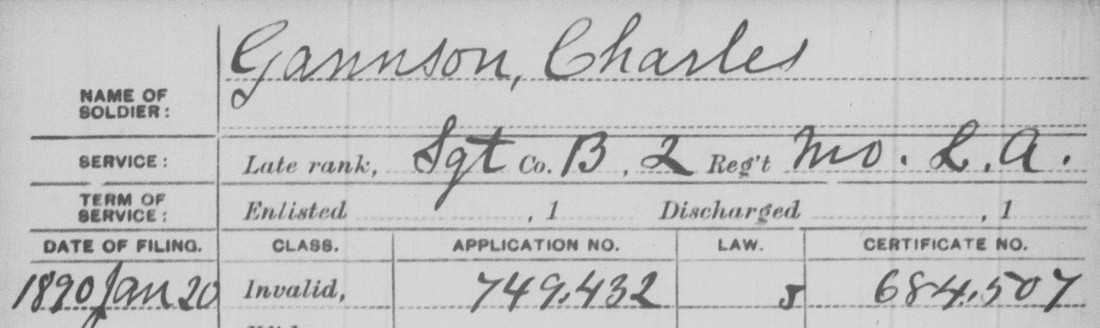
1890. Special census of Union veterans, St. Louis: "Charles Gonnsen," 2405 DeKalb, rear (read in the image; not reproduced here). One of the twenty-eight. [VET90]
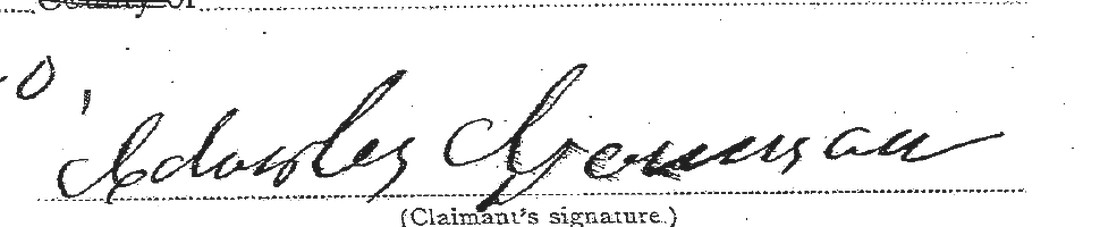
1895. Gould's St. Louis directory: "Gannsen Charles, watch, r. rear 2407 DeKalb" (image not reproduced). One of the twenty-six. The other directories of 1866–1904, which are not counted, are listed year by year in the appendix “Charles’s Addresses and Occupations, Year by Year”. [D1895] [RES]






Sources
- AGO Missouri Adjutant General, Record of Service card, 2d (Old) Reg't Art. Vols., Co. B, "Gaunsen, Charles (or Gansen, Chas. L.)", and descriptive rolls, Books 1 and 2 (FamilySearch DGS 008723493); Missouri State Archives.
- BAP66 St. Marcus Evangelical Church, St. Louis, baptism register, Friedrich Wilhelm Gonnson, b. 20 Jun 1866, bapt. 2 Sep 1866 (FHL film 1503034; FamilySearch DGS 7769183, frame 342).
- D1867 Edwards' St. Louis Directory 1867, p. 359, "Gannssen Charles, saloon, 1206 Park av. r. same" (FamilySearch DGS 109296997, image 1349), and p. 457, "Johnson Charles, brewer, r. 1501 Closey" (image 1447); both read in the image.
- MB68 Mississippi Blätter (St. Louis), Sun 14 Jun 1868, p. 9, "Großer Eröffnungs-Lunch … bei Charles Gansen" (Newspapers.com image 640592645).
- AUG St. Marcus baptisms 1872, p. 352, no. 7519 (196), Auguste Gonsen; DGS 007769183, image 437 (https://www.familysearch.org/ark:/61903/3:1:3Q9M-CSMZ-B3T5-1 : accessed 29 Oct 2026).
- D1874 St. Louis city directory 1874, "Konsen Charles, driver, r. 718 Gate".
- GANSER St. Louis Genealogical Society indexes: St. Louis Marriages 1804–1876, Carl Joseph Ganser and Josephine Heine, 10 Jun 1871, vol. 15 p. 60; Naturalization, Charles Joseph Ganser, Circuit Court, 7 Nov 1892; Death Registers 1850–1908, Joseph Ganser, 59, d. 18 Nov 1902, 2819 Arsenal St., b. Germany. Index only.
- DAN Historical Register of National Homes for Disabled Volunteer Soldiers, Danville Branch (NARA M1749), p. 2072, admitted 18 Oct 1900; Ancestry.com, “U.S., National Homes for Disabled Volunteer Soldiers, 1866-1938,” Danville, Register of Members 1500–2999, image 293 (https://www.ancestry.com/imageviewer/collections/1200/images/MIUSA1866_113797-00303 : accessed 29 Oct 2026).
- NAT68 St. Louis Court of Criminal Correction, naturalization, 21 Oct 1868, Vol. 10, p. 126 (Missouri State Archives reel C 46598); index card "Gausen, Charles" (FamilySearch, “Missouri, County Naturalization Records, 1830-1985,” DGS 007787201, image 4805, https://www.familysearch.org/ark:/61903/3:1:3Q9M-CSMB-S9W3-G : accessed 29 Oct 2026).
- AGO1 Missouri Adjutant General, Descriptive Roll, Volunteers, 2nd Regiment Artillery, Book 1 (Missouri State Archives roll 5), Company B (Capt. J. J. Sutter), image 20 (https://www.familysearch.org/ark:/61903/3:1:3QHV-J3DP-93T9 : accessed 29 Oct 2026), sergeants line 3, "Gaunsen Charles"; certificate image 27, St. Louis, 1 April 1864, N. Cole, Colonel. FamilySearch film 1021086, DGS 008723493 (arks 3:1:3QHV-J3DP-93T9 and 3:1:3QHV-V3DP-9QLV).
- CSR327 Compiled service record of Charles Gannsen, Battery B, 2nd Regiment Missouri Light Artillery. National Archives, RG 94, M405 (Compiled Service Records of Volunteer Union Soldiers Who Served in Organizations from the State of Missouri), roll 0327, "Second Light Artillery, Fo–Gh"; Fold3 file 228767500, images 228767500–228767688 (24 cards and documents). Cards read at full resolution, October 2026.
- FW St. Marcus baptisms 1866, p. 164, no. 5201 (372), Friederich Wilhelm Gonnson; FamilySearch DGS 007769183 (FHL film 1503034), image 342 (https://www.familysearch.org/ark:/61903/3:1:3Q9M-CSMZ-B3Y4-1 : accessed 29 Oct 2026).
- MJ St. Marcus baptisms 1868, p. 224, no. 5857 (173), Maria Josephine Gonnson, sponsors Jakob Reck and his wife Josephine née von Delian, Maria Agnes Götz and Georg Kreichelt; DGS 007769183, image 372 (https://www.familysearch.org/ark:/61903/3:1:3Q9M-CSMZ-B3YS-H : accessed 29 Oct 2026).
- DOT69 St. Louis deed records, vol. 378, pp. 539–540, deed of trust of 14 May 1869 (DGS 8115131, images 315–316); vol. 388, pp. 70–71, deed of trust of 1 June 1869 (DGS 8115149, image 75).
- DOT70 St. Louis deed records, vol. 400, pp. 170–171, deed of trust of 18 January 1870, Charles Kanson to Louis A. Raum for Jacob Orlemann; FamilySearch DGS 8115155.
- KATE St. Marcus baptisms 1870, p. 285, no. 6644/141, Friedrike Catharina Carolina Amalia Gansen; DGS 007769183, image 403 (https://www.familysearch.org/ark:/61903/3:1:3Q9M-CSMZ-B3TT-Y : accessed 29 Oct 2026).
- LOU St. Marcus baptisms 1874, p. 402, no. 8178 (41), Louise Jansen; DGS 007769183, image 463 (https://www.familysearch.org/ark:/61903/3:1:3Q9M-CSMZ-B3TK-7 : accessed 29 Oct 2026).
- BER St. Marcus baptisms 1881, p. 574, no. 10269, Bertha Jansen; DGS 007769183, image 550 (https://www.familysearch.org/ark:/61903/3:1:3Q9M-CSMZ-B3T8-3 : accessed 29 Oct 2026).
- T289 Organization Index to Pension Files of Veterans Who Served Between 1861 and 1900, National Archives T289, roll 289 (2nd Missouri Light Artillery); FamilySearch DGS 008498301, image 3648 (ark 3:1:3Q9M-C3SZ-BL2J).
- VET90 1890 U.S. census, Special Schedule of Union Veterans and Widows, St. Louis, "Charles Gonnsen"; Ancestry.com, “1890 Veterans Schedules of the U.S. Federal Census,” ED 55, p. 1, line 9, image 200 of 905 (https://www.ancestry.com/imageviewer/collections/8667/images/MOM123_27-0304 : accessed 29 Oct 2026).
- RES St. Louis city directories (Edwards', Gould's), 1866–1904, as set out in the appendix "Charles’s Addresses and Occupations, Year by Year."
- GUARD00 St. Louis Probate Court, application for guardianship, 15 September 1900, Gottlob minors; FamilySearch, "St. Louis County, Missouri guardianship case files," DGS 8458791, images 984–985.
Supplements
Records, images and data on this website that go with this chapter.
- Every record of his surname
- The surname puzzle
- Evidence card: the 1862 signature
- Record images: the full pages
- Story 6 · The pastor who wrote two different vowels
- Story 7 · The surname spelled twice, fifteen years apart
- Konze in the Mouth — Dialect & Pronunciation Research Log
- Naming-variant theory (methodology)