Charles left two statements about where he came from. On 2 December 1862 he swore that he was born at Trendelburg, written “Trennelburg,” in Kurhessen.1 On 7 January 1866 the pastor who married him recorded him as “aus Deiße, Kreis Caßel, Churheßen.”2 The 1900 census adds only that he was born in Germany and came in 1859.3 Every other record made in his lifetime names only his state or his country, and none contradicts these two places; only a later family tradition names Sweden.4
In this chapter
- Kurhessen, not Sweden
- Trendelburg or Deisel
- The pastor’s entry: Deisel
- The test between the two readings
- What the registers have not shown
- The people around him in St. Louis
- The year he was born
- November or 26 January
- How far can what he said be trusted?
- Notes
- More of the chapter
- More of the chapter, as printed until 28 October 2026
- Supplements
Two records give his birth month, and they disagree. The 1900 census, taken in his lifetime, gives his birth as November 1836.5 After his death his family told the St. Marcus pastor that he was born on 26 January 1835.6
This chapter weighs the place and the date, and its answers are grades, not proofs. He was possibly born at or near Deisel, which was probably his last home in Kurhessen, though he named Trendelburg. His birth year is uncertain within about 1833 to 1841, and of the two months November probably has the better claim.
Both answers bear on the question this part of the book asks: who were the parents of the Charles Gannsen who enlisted at St. Louis in 1862, and in which Kurhessian parish was he baptized?7 The place tells the search which registers to read, and the date which years.
Kurhessen, not Sweden
Every record of Charles’s own lifetime that names his homeland gives Kurhessen, Prussia, or Germany: his enlistment and his marriage, his naturalization, the 1880 and 1900 censuses, the voters’ register, and the Soldiers’ Home.8 Only a later family tradition names Sweden.
The answer “Prussia” fits his own account: when Charles was naturalized in St. Louis on 21 October 1868, he renounced allegiance to “the King of Prussia,” though the record names no place.9 Prussia had annexed Kurhessen after the war of 1866, so that is what a Kurhessian would be expected to renounce.10
Three censuses of Charles’s daughter Louise gave her father’s birthplace as Sweden: at Tacoma, Washington, in 1910 and 1920, and at O’Neal, in San Joaquin County, California, in 1930.11 In 2018 a descendant of Charles’s son Charles Jr. passed on the same family tradition.12 These are the only two traces of it. Louise’s censuses are wrong about her mother too: they give Missouri or the United States for Auguste, who was born at Clausthal.13 The source of the tradition was probably the family’s American surname. In the cities of Puget Sound, where Louise spent her middle years, a German family called Johnson was easily taken for Swedish.14 The Y-DNA gives the tradition no support either (see “What DNA Can and Cannot Say”).15 The tradition belongs to the story of his family after him, not to his own.
Trendelburg or Deisel
Charles was possibly born at or near Deisel and named the better-known town next door when he enlisted.16 His 1862 oath names Trendelburg, and his 1866 marriage entry names Deisel, a village about a mile and a half (2.3 km) north-northwest of the town. Read together, the two records allow two readings: he was born at Trendelburg and lived at Deisel, or he was born at Deisel and named the town.
Three records of 2 December 1862 bear on Trendelburg, a small town on the Diemel in the north of what was the Electorate of Hesse-Kassel, Kurhessen. In Charles’s time it lay in Kreis Hofgeismar, governed from the town of Hofgeismar.17 The Volunteer Enlistment, which Charles signed in Kurrent, says in the clerk’s English: “I, Charles L. Johnsen born in Trennelburg in the State of Kurhessen aged twenty three years, and by occupation a Farmer.”18 Trennelburg is Trendelburg with the nd of the middle syllable heard as nn, which is how the name sounds when spoken quickly. The Regimental Descriptive Book, for the same enlistment, gives “Freundburg, Kurhessen,” and the Missouri rolls copy it.19 Freundburg is not a Hessian place, and read with a T in place of the clerk’s F it is Trendelburg.20
The enlistment is his own sworn statement, and the descriptive book and the rolls are copies of it, not separate witnesses. His oath is why the search began at Trendelburg, but two cautions go with it. Until 1821 the Amt Trendelburg included the neighboring village of Deisel, so by “Trendelburg” a man of an older generation could mean the district, not the town.21 The colony of Friedrichsfeld, inside Trendelburg parish, also had its children baptized at Trendelburg: they were entered in the Trendelburg register until June 1830, and from July 1830 the colony kept its own.22
The pastor’s entry: Deisel
The evidence for Deisel is one line, “Carl Gonnson, aus Deiße, Kreis Caßel, Churheßen,” in the St. Marcus marriage register.23 “Aus” means “from,” and in German registers of the time it usually names where a person lived before, not necessarily where he was born. The entry is stronger than it first looks, because somebody, probably the groom, took the trouble to give it, and it does not look like a pastor’s guess.
Two details of the register show this: between January and April 1866 Pastor G. W. Wall recorded an American residence for every other couple he married. He entered St. Louis for all but three, and for those three St. Clair County, Illinois, St. Louis County and Jefferson City, so Charles’s entry is the only one with a German origin.24 The St. Marcus register also gives the homeland of at least sixty Kurhessians between 1850 and 1866, and none apart from Charles himself came from Kreis Hofgeismar.25
The book reads “Deiße” as Deisel, which had its own parish and its own registers from 1633 but belonged to the same church district as the town, the Klasse Trendelburg.26 The pastor’s spelling is close to the Electorate’s own, because its 1857 survey map of the district has “Deissel” for the village.27 “Deiße” is that same written form with the final l dropped, probably a slip made in taking the village name down from speech.
The difficulty is “Kreis Caßel,” because Deisel was in Kreis Hofgeismar, but Wall used “Cassel” as a loose label for northern Kurhessen. For a man from Immenhausen, which also lay in Kreis Hofgeismar, he recorded “Immenhausen bei Cassel,” and he placed Witzenhausen and Metze by Kassel in the same way.28 “Kreis Caßel” is therefore probably Wall’s own label for the region around Kassel, not the official district. The civil marriage license repeats the church entry and is not a second witness.29
The test between the two readings
A Trendelburg-born Charles who last lived at Deisel probably came there after confirmation and left no trace in its registers. He possibly came as a farmhand or a journeyman (a trained craftsman working for a master).30 The Deisel confirmation classes show why: the 1847–56 classes were read in full, and none of the children confirmed in those years was born in Trendelburg town. Nine had been baptized somewhere else, and none of those nine was a Gans or a Konze, born out of wedlock (such a boy could grow up under another surname), or born near 26 January. A boy born and confirmed at Deisel needs no such move, and he should appear in those classes. The leading candidate among the open boys (those of Trendelburg, Deisel and Friedrichsfeld, born 1833–41, whom no record has yet ruled out) was confirmed there.31 On this indirect evidence the book prefers the second reading.
What the registers have not shown
No baptism in the registers of Trendelburg and Deisel has yet been shown to be his.32 That is negative evidence, not proof: he was possibly born somewhere else and lived at Deisel before he left, or was baptized under a name not yet recognized. A pastor could also leave a baptism out of his register. The second copies that the parishes sent to the government (HStAM 315 k) would show such a gap, and they have not yet been read. Until a baptism is found, Trendelburg rests on his own statement and Deisel on the pastor’s entry.33 The chapter “The Candidates and How They Were Ruled Out” describes every boy of those years and how each one was followed.34
The people around him in St. Louis
None of the people in Charles’s own St. Louis records came from Kreis Hofgeismar, though a few emigrants from his villages lived in the city. This negative evidence does not count against Trendelburg or Deisel, for two reasons. No record says why none of them came from his district, and a young man who possibly had no kin in the city would leave just this kind of gap. But it also means that none of the people around him ties him to his village.35
Emigrants often followed relatives or neighbors, so those a man lived among in his new home can point back to his old one, and Charles’s St. Louis years were searched with that in mind. The search has found the birthplaces of seventeen of the people who appear with him in St. Louis records. They include his landlord and lenders, his comrades of the Grand Army post, his pension witnesses, his doctor, and his pension agent. None was born in Kreis Hofgeismar, and his wife’s family came from Clausthal in the Harz.36 No witness at his wedding and no sponsor at his children’s baptisms is known to have been his own kin or to have come from Kreis Hofgeismar (see “The Godparents and Witnesses, 1866–1881”).37 The wider German community of the city gives the same answer: the 1836–62 Holy Ghost marriage registers name about sixty Kurhessians, and only one from Kreis Hofgeismar.38
A Konze, very probably of the Trendelburg family, was in the city before him. He was the barber Anton Wilhelm Konze, there by 1856, whose story is told in the chapter “St. Louis before the War, 1859–1862.”39 Neither man appears in the other’s records. Konze’s widow’s 1891 probate file names no relative in Germany and no Gannsen, Johnson, or Kreichelt.40
A few emigrants from his villages did live in St. Louis, among them the Deisel-born schoolmaster Johannes Köster, who is met in the same chapter and whose letters home never mention Charles.41 August Hermann Bötte of Deisel is proven to have lived there too, by the birthplace on his army discharge.42 The St. Louis tanner Conrad J. Albrecht was probably Johann Conrad Albrecht, born at Trendelburg in 1835.43 In 1860 an Albrecht witnessed the St. Louis wedding of Wilhelmine Albrecht “of Trendelburg, Kurhessen,” probably his sister, and in 1864 Conrad was a sponsor with her husband.44 None of them appears in Charles’s records.45
The year he was born
Charles’s records point to a birth between about 1833 and 1841 and no closer. A man who swore to fifty-six in January 1890 and fifty-three thirteen months later probably did not know his age to the year. With no baptism found, the year must come from the American records of his age, all made when he was a grown man or after his death.46
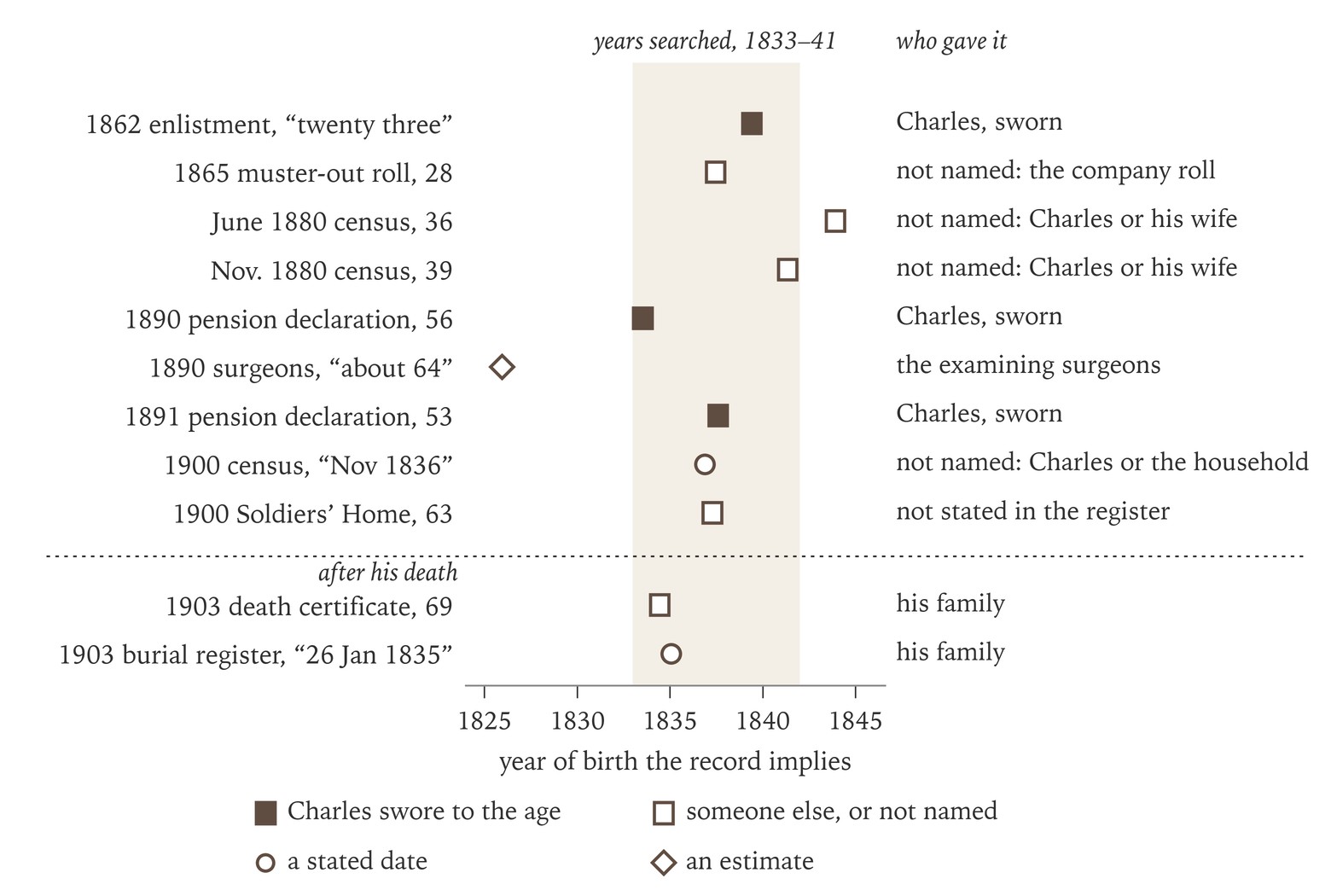
The ages and birth dates in the records do not agree with one another (figure 24.1). Charles gave three of them himself, under oath; the others came from the battery’s muster-out roll, the Soldiers’ Home register, and the examining surgeons, and from census informants and his family.
Several of these records share an informant. Charles gave the ages in the enlistment paper and the pension declarations himself, and his family gave those in the death records after he died. The Soldiers’ Home register does not say who gave its age, and neither does the muster-out card, a clerk’s copy of the roll. So the chart holds fewer independent witnesses than records.47
Two of the records are out of line with everything else. The surgeons’ “about 64” is an examiner’s estimate, not an age Charles gave, and five months later a second census taker contradicted the age of thirty-six given in June 1880. Even so, the June 1880 figure is one reason boys born as late as 1841 have not been ruled out. The earliest statement, made at enlistment when he was young and the question was simple, points to about 1839.48 Three years later the battery’s muster-out roll gave his age as twenty-eight, which points to a birth between late December 1836 and December 1837. On the card the 8 was possibly written over another figure.49
Mills warns that a man could change his age when a record served his own ends, as in an enlistment or a pension claim.50 No law of his time is known to have given Charles a reason to make himself younger. The ages his own statements imply for December 1862, 23 to 29, fall inside the army’s age limits of that time.51 His pension ages ran the wrong way for any gain. He swore to fifty-six in January 1890 and to fifty-three in February 1891, three years lower.52 His age at the Soldiers’ Home in October 1900 needs no motive at all, because it agrees with the census taken four months earlier.53
A man from Charles’s own district shows how far a stated age could drift. Anton Wilhelm Konze, the barber, was very probably born at Trendelburg on 12 September 1806. He gave his age about right when he had no reason to lower it, but to the census takers he gave much less: thirty-nine when he was fifty-three, and fifty-nine when he was seventy-three.55 In January 1861 he married Henriette Brenneke, then about nineteen, which is probably why.56 His case does not show that Charles changed his age; it shows that a man of his time and place could give an age far from the truth when he had a reason to.
The scatter in Charles’s ages is unusual. Other men from his villages who emigrated, and whose baptisms are known, usually gave their ages within a year. Even the 1900 census had their birth month and year right in all four cases that can be checked. The ages given for Charles, leaving out the surgeons’ estimate, spread over eleven years, 1833 to 1844, and they run both ways. His two census ages of 1880 point to birth years of about 1844 and 1841, later than any other record gives. His own sworn ages imply about 1833 to 1839.57 So no single age of Charles’s can be trusted on its own, not even the November 1836 of the 1900 census.58
Charles’s ages do not follow Konze’s pattern. Set out by date, the ages show scatter, not a steady drift. The ages Charles gave himself agree with one another better than the ages others gave for him. Every age Konze gave outside the census was within a year of the truth, and every census age was eight to fourteen years too young, but Charles’s records show no such split. His birth year therefore stays uncertain within about 1833 to 1841, and the records give no sign of which end is right.59
November or 26 January
Of the two months recorded for Charles, November probably has the better claim, because a record of his lifetime gives November and his family gave 26 January after his death. Neither date is proven, and the conflict between them is not resolved.
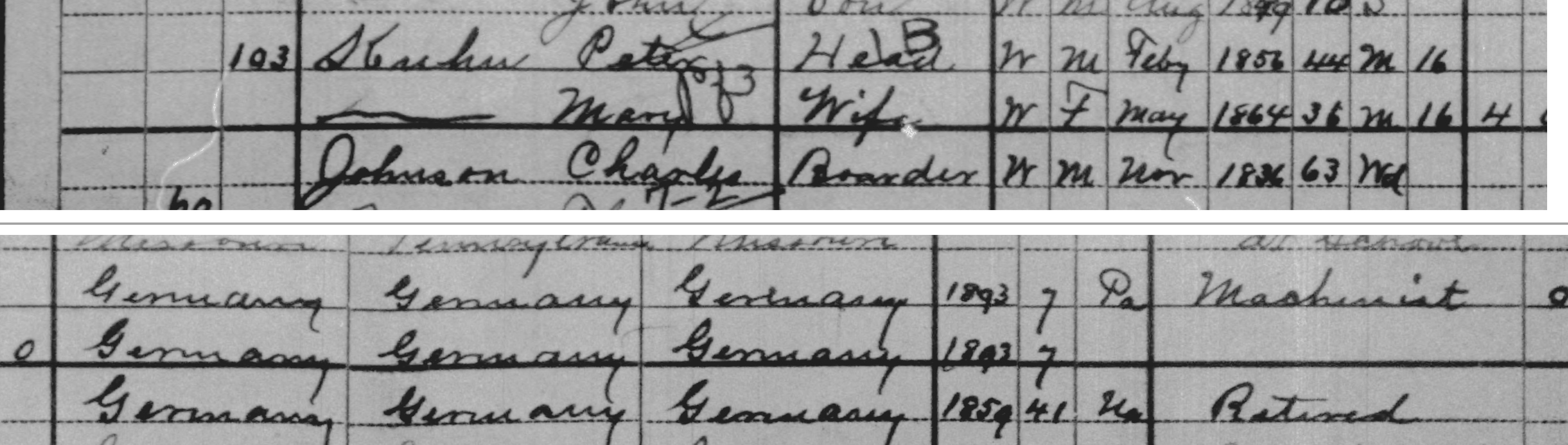
The 1900 census is the only record of his lifetime that names a month, and it names November, not January (figure 24.2).60 That census was the only one of its time to ask the month and year of birth. The Census Office asked for both because, its instructions said, “many a person who can tell the month and year of his birth will be careless or forgetful in stating the years of his age.”61 The census taker for his district, William D. Gallagher, took care with these entries, so “Nov 1836” very probably records the answer he was given.62 Who gave that answer is not known: Charles possibly gave it himself, or someone in the Kuhn household possibly answered.63 Even his own answer would be secondhand on this point, because no one can witness his own birth, and a man who states his birth date repeats what he was told.64
The full date, 26 January, is in one record only: the St. Marcus burial register, made on 19 December 1903. It gives “born 26 January 1835” and an age of sixty-eight years, ten months, and twenty days.65 The family supplied the date after Charles had died, and the age was worked out from the date, so it is not a separate check. Of the two months recorded for him, it is the weaker.
The registers around Trendelburg give 26 January no support: the January leaves of the registers of Trendelburg, Deisel, Friedrichsfeld, and the nearest parishes were read for every year from 1833 to 1841. No Carl was born on 25, 26, or 27 January in any of them, except Karl Wilhelm Weppe of Langenthal, a neighboring village, who married and died in his own village. No boy with a second name Ludwig was born on those days either, to fit the initial L on Charles’s army papers.67
The book therefore gives more weight to November than to 26 January. As for the year, the census gives 1836 and the burial register 1835; the charts give it as “c. 1835,” and that conflict is not resolved either. Early in the German search the day and month decided which boys were looked at first: those born on or near 26 January in any of those years. Neither the month nor the year is used to rule anyone out.68 The order of the search, set out in the appendix “How the Research Was Done,” follows this reasoning and adds no weight of its own. A baptism found in the registers would settle the date, and the battery’s medical cards could narrow it.
A boy born in November 1837, as the leading candidate was, fits Charles’s stated ages at least as well as a boy born in 1835 does.69 Two records of Charles’s lifetime give ages that fit a birth in November 1837 exactly: the December 1865 muster-out roll and his February 1891 sworn declaration. That adds some weight to 1837, against the enlistment’s twenty-three, which points to about 1839. Neither record speaks to the month: November rests on the 1900 census alone, and that census gives the year as 1836.70
How far can what he said be trusted?
The facts Charles left are not equally secure, and table 24.1 sets them in order by the standard that genealogists use to weigh evidence. His birthplace, Kurhessen, and his forename, Carl, are the most reliable things known about him, and the year of his birth is the least. His surname is not in the table, and no record names his parents.
The ranking follows the Genealogical Proof Standard of the Board for Certification of Genealogists and Elizabeth Shown Mills’s Evidence Explained.71 Both ask of every record whether it is an original or a copy, whether its informant knew the fact at first hand, and whether it answers the question directly. Two cautions follow. A precise answer is not necessarily an accurate one: “26 January 1835” is exact to the day and still rests on a single statement made after his death. And repeating a fact does not confirm it. The descriptive book and the rolls copied from one enlistment paper are one witness, not three. His age at death shows both cautions at work: the death certificate’s sixty-nine points to about 1834, and the burial register’s date is the family’s single statement.72
Table 24.1. How far each of his vital facts can be trusted
| Rank | Vital | What the records say | Reliability | Main reason |
|---|---|---|---|---|
| 1 | Country or state of birth | Kurhessen; Germany; Prussia | Very high | His own sworn statement, and nine or more records over forty years, none against it (Sweden is a later family error) |
| 2 | Forename | Carl or Karl (Charles) | High | His own signature (“Karll”, 1862), his marriage (“Carl”) and every later record |
| 3 | Town of birth | Trendelburg (“Trennelburg”) by his own statement; Deisel possible | Moderate (Trendelburg); low to moderate (Deisel) | His own sworn statement, but in one record only; the descriptive book and rolls are copies of it; no baptism has yet been found there, and the entry-by-entry read of the 426 boys baptized at Trendelburg, Deisel and Friedrichsfeld has not yet proved any boy to be him; 24 are not yet traced (see “The Candidates and How They Were Ruled Out”), and 3 are probably traced: together, the twenty-seven open boys |
| 4 | Last home in Germany | Deisel (“Deiße”) | Moderate | One original record, the 1866 marriage entry; the license probably copies it |
| 5 | Month of birth | November (1900 census); 26 January (burial register) | Moderate for November; low for 26 January | November is from a record of his lifetime, informant unknown, and that census asked for the month; 26 January is from the family after his death, in one record |
| 6 | Year of arrival | 1859 | Low to moderate | One census answer, informant unknown, forty-one years after the event; for the emigrants tested, such a year was exact about half the time (see “The Boy from the Goose Corner”) |
| 7 | Second initial | L (every clerk; a fellow researcher’s reading of his signature) or C (a German paleographer’s reading) | Moderate for L, from the clerks; the letter in his own signature is read both ways | The clerks wrote L; in his 1862 signature the paleographer reads the initial as C, the fellow researcher as L73 |
| 8 | Year of birth | 1833–41 (outliers 1826 and 1844) | Low | Twelve records, in the eleven rows of the age chart, disagree; his own sworn ages, thirteen months apart, imply birth years four years apart |
Sources: the author’s ranking, from his military records74, marriage75, naturalization76, censuses77, voter register78, Soldiers’ Home register79, burial80 and the comparison of his ages81.
His country and his forename are the firmest things he left. His surname is less certain even than his year of birth. The next two chapters take up the name.
Notes
81 notes
- Declaration of Recruit, Volunteer Enlistment and surgeon’s form for examining a recruit, 2 Dec 1862, St. Louis; Original record, signed by Charles; primary information for the enlistment; direct evidence. [ENL62]
- St. Marcus Evangelical Church (St. Louis, Missouri), marriage register 1866, p. 135, entry 676/4, image 381. [MAR66]
- 1900 U.S. census, City of St. Louis, Missouri, population schedule, Ward 9, ED 129, sheet 5-B (penned); direct evidence of residence and of his birth month and year, which are secondary information. [C1900]
- Regimental Descriptive Book card, “L. Charles Gannsen,” Pvt., roll 762; 1880 U.S. census, second enumeration (9 November 1880), St. Louis, ED 137, p. 4D (penned), dwelling 15, sheet 4-D, image 204; St. Louis Register of Voters, Ward 9, book of the 1896 series, G page, line 22, “Gansen Charles,” 168 Sidney; Historical Register of National Homes for Disabled Volunteer Soldiers, p. 2072, no. 2072. [RDB62] [C1880] [VOTE] [DAN]
- 1900 U.S. census, City of St. Louis, Missouri, population schedule, Ward 9, ED 129, sheet 5-B (penned); direct evidence of residence and of his birth month and year, which are secondary information. [C1900]
- St. Marcus Evangelical Church (St. Louis, Missouri), burial register, pp. 240–241, no. 3393, image 943. [BUR03]
- Thomas W. Jones, Mastering Genealogical Proof, NGS Special Topics Series, no. 107, chap. 5. [JONESMGP]
- Declaration of Recruit, Volunteer Enlistment and surgeon’s form for examining a recruit, 2 Dec 1862, St. Louis; Original record, signed by Charles; primary information for the enlistment; direct evidence; St. Marcus Evangelical Church (St. Louis, Missouri), marriage register 1866, p. 135, entry 676/4, image 381; St. Louis Court of Criminal Correction, naturalization, 21 Oct 1868, p. 126; 1880 U.S. census, first enumeration (5 June 1880), St. Louis, SD 1, ED 40, p. 14, dwelling 77, family 135, “Ganser, Charles,” 36; 1880 U.S. census, second enumeration (9 November 1880), St. Louis, ED 137, p. 4D (penned), dwelling 15, sheet 4-D, image 204; 1900 U.S. census, City of St. Louis, Missouri, population schedule, Ward 9, ED 129, sheet 5-B (penned); direct evidence of residence and of his birth month and year, which are secondary information; St. Louis Register of Voters, Ward 9, book of the 1896 series, G page, line 22, “Gansen Charles,” 168 Sidney; Historical Register of National Homes for Disabled Volunteer Soldiers, p. 2072, no. 2072. [ENL62] [MAR66] [NAT68] [C1880J] [C1880] [C1900] [VOTE] [DAN]
- St. Louis Court of Criminal Correction, naturalization, 21 Oct 1868, p. 126. [NAT68]
- Karl E. Demandt, Geschichte des Landes Hessen [History of the state of Hesse], 2nd ed. (Kassel: Bärenreiter, 1972), on the Prussian annexation of Kurhessen in 1866 (context); Meyers Großes Konversations-Lexikon, 6th ed., vol. 9 (Leipzig, 1907), “Hessen-Kassel,” pp. 274–278, at 276–277 (Kurhessen united with Prussia, 20 Sep 1866), , http://
www (accessed 30 October 2026); the passage falls on p. 277 of the 1909 printing (Internet Archive, https://.zeno .org/ nid/ 20006769284 archive ). [DEMANDT].org/ details/ meyersgroeskonve 0009unse/ page/ 277 - Census answers for Louise (Johnson) Fletcher, with her father’s and mother’s birthplaces, ED 265. [SWELOU]
- Correspondence of a descendant with the author, “Johnson Lineage” and “Johnson Surname,” November 2018 to April 2019, on the family tradition of a Swedish origin. Family memory. [SWELORE]
- Census answers for Louise (Johnson) Fletcher, with her father’s and mother’s birthplaces, ED 265. [SWELOU]
- Hans Högman, “Mass Emigration,” https://
www , accessed 7 November 2026 (about 1.2 million emigrants to the United States; in the 1880s about 325,000 to North America and 52,000 to other places); Wikipedia, “Swedish diaspora” (about 1.3 million emigrants, 1846–1930) and “Swedish emigration to the United States” (routes by Lübeck to Hamburg or Bremen, and the usual route from Gothenburg to Hull), consulted 20 Oct 2026 (https://.hhogman .se/ mass-emigration .htm en and https://.wikipedia .org/ wiki/ Swedish_diaspora en : accessed 19 November 2026); Marianne Forssblad, “Swedes in Seattle and King County,” Essay 3473 (2001), https://.wikipedia .org/ wiki/ Swedish _emigration _to _the _United _States www : accessed 19 November 2026 (19,046 Scandinavians in Seattle in 1910, 8,678 of them Swedes) (context). [SWEMIG].historylink .org/ File/ 3473 - FamilyTreeDNA Big Y-700 test of a direct male-line descendant of Charles. [BIGY]
- Evangelische Kirchengemeinde Deisel (Deisel, Kreis Hofgeismar, Kurhessen), confirmation register, classes 1847–56 (Archion register 218836, images 930–952), read in the images; imaged, Archion (https://
www : accessed 19 July 2026) > Hessen > Landeskirchliches Archiv der Evangelischen Kirche von Kurhessen-Waldeck > Kirchenkreis Hofgeismar > Deisel > Konfirmationen 1831-1926; citing Landeskirchliches Archiv der Evangelischen Kirche von Kurhessen-Waldeck, Kassel. The Deisel confirmation register enters Karl Ludwig Hofedietz in the class of 1852. [DEICONF].archion .de/ de/ viewer/ churchRegister/ 218836 - LAGIS Hessen, Historisches Ortslexikon, entries “Deisel, Kassel” (ID 2054) and “Trendelburg, Kassel” (ID 2095) (https://
lagis and https://.hessen .de/ resolve/ de/ ol/ 2054 lagis : accessed 9 November 2026) (population 1885, land use, grazing rights, Amt Trendelburg to 1821, fire of 1868) (context). [LAGISO].hessen .de/ resolve/ de/ ol/ 2095 - Declaration of Recruit, Volunteer Enlistment and surgeon’s form for examining a recruit, 2 Dec 1862, St. Louis; Original record, signed by Charles; primary information for the enlistment; direct evidence. [ENL62]
- Regimental Descriptive Book card, “L. Charles Gannsen,” Pvt., roll 762; Missouri Adjutant General, descriptive rolls, 2nd Regiment Artillery, image 183, line 65, image 20, https://
www . [RDB62] [AGO].familysearch .org/ search/ film/ 008723493 ?i =182 - Letters on the reading “Freundburg” = Trendelburg, 23 Mar 2018 and 4–6 Dec 2025. [CORR]
- LAGIS Hessen, Historisches Ortslexikon. [LAGISO]
- Evangelische Kirchengemeinde Trendelburg (Trendelburg, Kreis Hofgeismar, Kurhessen), “Kirchenbuch 1773–1818” [Church book 1773–1818] (Archion register 220096), image 1074, p. 181, baptisms 1812, no. 15, Sophia Dorothea, daughter of Christoph Hartgen, colonist and tailor at Friedrichsfeld; Ev. Kirchengemeinde Friedrichsfeld, “Kirchenbuch 1830–2011” [Church book 1830–2011] (Archion register 218959), title page, image 1324 (“vom 1ten Juli 1830”), title page of the marriage register, image 1511 (“Gemeinde Friedrichsfeld, Kirchspiel Trendelburg”), and baptisms 1836, no. 55, baptized at Trendelburg, 16 Oct 1836; read in the images, August and October 2026; imaged, Archion (https://
www , https://.archion .de/ de/ viewer/ churchRegister/ 220096 www : accessed 8 August 2026) > Hessen > Landeskirchliches Archiv der Evangelischen Kirche von Kurhessen-Waldeck > Kirchenkreis Hofgeismar, by the register numbers given; citing Landeskirchliches Archiv der Evangelischen Kirche von Kurhessen-Waldeck, Kassel. [FRBAP].archion .de/ de/ viewer/ churchRegister/ 218959 - St. Marcus Evangelical Church (St. Louis, Missouri), marriage register 1866, p. 135, entry 676/4, image 381. [MAR66]
- St. Marcus Evangelical Church (St. Louis, Missouri), marriage registers 1850–1880, images 324–449, image 331, image 355, p. 98, image 55. [WALL]
- St. Marcus Evangelical Church (St. Louis, Missouri), marriage registers 1850–1880, images 324–449, image 331, image 355, p. 98, image 55. [WALL]
- Evangelische Kirchengemeinde Deisel (Deisel, Kreis Hofgeismar, Kurhessen), “Kirchenbuch 1633–1736” [Church book 1633–1736] (Archion register 218818), images 954–1171, the oldest Deisel church book on Archion; LAGIS Hessen, Historisches Ortslexikon. [DKB1633] [LAGISO]
- Kurfürstenthum Hessen, Niveau-Karte auf 112 Blättern, sheet 4. [NIV1857]
- St. Marcus Evangelical Church (St. Louis, Missouri), marriage registers 1850–1880, images 324–449, image 331, image 355, p. 98, image 55. [WALL]
- St. Marcus Evangelical Church (St. Louis, Missouri), marriage register 1866, p. 135, entry 676/4, image 381. City of St. Louis marriage record, 7 Jan 1866, recorded 15 Feb 1866, “Marriage records 1865-1869 vol 12-13,” p. 146 (FamilySearch image group number (IGN) 007513821, image 87, https://
www : accessed 9 November 2026). [MAR66].familysearch .org/ ark:/ 61903/ 3:1:3QSQ-G98M-BQC3 - Forward trace of every boy baptized at Trendelburg, Deisel and Friedrichsfeld born 1833–41. [LEDGER]
- Evangelische Kirchengemeinde Deisel (Deisel, Kreis Hofgeismar, Kurhessen), confirmation register, classes 1847–56 (Archion register 218836, images 930–952), read in the images. The Deisel church-council minutes of 1828–66 can be read only in the reading room of the church archive at Kassel. They were never filmed or scanned, and they have not been read. [DEICONF]
- Ev. Kirchengemeinde Trendelburg, Taufen 1830–1863 (Archion register 220108), images 1395–1478, entries 58–333 (1833–41); imaged, Archion (https://
www : accessed 8 October 2026); citing Landeskirchliches Archiv der EKKW, Kassel; Forward trace of every boy baptized at Trendelburg, Deisel and Friedrichsfeld born 1833–41. [TRBAP] [LEDGER].archion .de/ de/ viewer/ churchRegister/ 220108 - Parish search coverage, 57 places of Kreis Hofgeismar. The battery’s descriptive book at the National Archives, which may give his birthplace again, can be seen only in the reading room in Washington; record agents there have been asked to copy it. [COVER]
- Forward trace of every boy baptized at Trendelburg, Deisel and Friedrichsfeld born 1833–41. [LEDGER]
- The 336 people named as principals in the release index for Deisel; St. Marcus German Evangelical Church (St. Louis, Missouri), marriage register 1866, p. 135. [COLONY] [GPMAR]
- Birthplaces of Charles’s associates from the U.S. censuses of 1870–1900 and St. Marcus marriage registers (FamilySearch image group number (IGN) 007769184); Holy Ghost Evangelical marriages 1836–62 (IGN 7857117), full-text search; LAGIS Hessen, Hessische Auswanderer, records of HStAM Best. 180 Hofgeismar (HStAM 180 Hofgeismar Nr. 134, pp. 375, 382); FamilySearch (https://
www : accessed 10 October 2026) and LAGIS (https://.familysearch .org lagis : accessed 10 October 2026). The seventeen birthplaces found, each with its census or register record, are listed in section 1, the “FAN table,” of the research log of 10 Oct 2026, in the research dataset. [FAN].hessen .de - St. Marcus German Evangelical Church (St. Louis, Missouri), marriage register 1866, p. 135. [GPMAR]
- Birthplaces of Charles’s associates from the U.S. censuses of 1870–1900 and St. Marcus marriage registers. Holy Ghost Evangelical marriages 1836–62 (FamilySearch image group number (IGN) 7857117), full-text search (https://
www : accessed 10 October 2026). [FAN].familysearch .org - Anton Wilhelm Konze: born 12 Sep 1806, baptized 17 Sep 1806, image 1059, p. 151. Declaration of intention, St. Louis, 4 April 1856, aged 50 (FamilySearch index, https://
www : accessed 8 November 2026). The St. Paul’s registers of 1859–66 have been read, and they do not name him with Charles. St. John’s, the one Evangelical register of those years not read, was never filmed. [AWK].familysearch .org/ ark:/ 61903/ 1:1:6LQK-744M - St. Louis Probate Court, estate of Henriette Konze, case 18212, 1891 (Missouri State Archives microfilm C41670; imaged, Missouri State Archives, Missouri’s Judicial Records, https://
www : accessed 19 November 2026), 37 pages read: order rejecting the will (“not proved … and is therefore rejected”); affidavit of heirship, 10 Apr 1891, naming Charles W. Konze, Ida, Emma, Ernest, Bertha, Albert H., Lizzie, Frederick and Louisa, all of St. Louis. Ida is the “Luie Konze geb. 27 Januar 1864” of a confirmation list (her death certificate of 1925 gives the same date). [HKPROB].sos .mo .gov/ Images/ Archives/ Judicial2/ c41670_156959 .pdf - Johannes Köster, letters to his wife and children at Kassel, 6 Nov 1858 – 2 Dec 1862, images 0033–0035. [KOESTER]
- National Archives, RG 94, Compiled Service Records of Volunteer Union Soldiers … State of Missouri (microfilm M405), roll 509; The 336 people named as principals in the release index for Deisel. [CSRBOE] [COLONY]
- The 336 people named as principals in the release index for Deisel; Friedens Evangelical Church, St. Louis, marriages 1860, no. 10, 14 Oct 1860, Ferdinand Meier of Barntrup, Lippe, and Wilhelmine Albrecht of Trendelburg, Kurhessen, witnesses L. Albrecht and H. Lehle (FamilySearch image group number (IGN) 7857750, image 96, p. 175), with the civil return, St. Louis, certified 7 Oct 1860 (FamilySearch image 3QSQ-G9CR-MJ1Z); Friedens baptisms 1864, no. 44, sponsors Ferdinand Meier and Conrad Albrecht (same IGN, image 23, p. 33); Trendelburg “Taufen 1830–1863” [Baptisms 1830–1863] (Archion register 220108), no. 146 (image 1424), Johann Conrad Albrecht, born 20 Nov 1835, and (220099) image 1251, p. 41, Maria Wilhelmine Albrecht, born 14 Mar 1826, children of Hartmann Albrecht; read in the images, 22 Oct 2026; imaged, Archion (https://
www , https://.archion .de/ de/ viewer/ churchRegister/ 220108 www : accessed 22 October 2026) > Hessen > Landeskirchliches Archiv der Evangelischen Kirche von Kurhessen-Waldeck > Kirchenkreis Hofgeismar > Trendelburg, by the register numbers given; also imaged, FamilySearch (https://.archion .de/ de/ viewer/ churchRegister/ 220099 www ), by the image group numbers and images given; citing Landeskirchliches Archiv der Evangelischen Kirche von Kurhessen-Waldeck, Kassel. [COLONY] [FRIED].familysearch .org - Friedens Evangelical Church, St. Louis, marriages 1860. [FRIED]
- The 336 people named as principals in the release index for Deisel. [COLONY]
- Forward trace of every boy baptized at Trendelburg, Deisel and Friedrichsfeld born 1833–41; Comparison of the eleven American records that state Charles’s age or birth date. [LEDGER] [BD]
- Thomas W. Jones, Mastering Genealogical Proof, NGS Special Topics Series, no. 107, chap. 5. Records that could narrow the date have not been read: the battery’s descriptive book and the carded medical records, which the National Archives shows only in its reading room in Washington, and the City Hospital register of 1903, which may not survive. A record agent has been engaged to photograph the descriptive book. For the medical records a price was asked in November 2026, and no answer has come. [JONESMGP]
- Comparison of the eleven American records that state Charles’s age or birth date. [BD]
- M405 roll 327 (roll image 1560), Gannsen file: Battery muster-out roll, St. Louis, image 228767518, p. 2. [CSRMO]
- Elizabeth Shown Mills, Evidence Explained. Section 1.39, p. 40. [MILLS]
- Declaration of Recruit, Volunteer Enlistment and surgeon’s form for examining a recruit, 2 Dec 1862, St. Louis; Original record, signed by Charles; primary information for the enlistment; direct evidence. When he enlisted in December 1862, the regular army took recruits between eighteen and thirty-five. Benjamin Apthorp Gould, the actuary of the U.S. Sanitary Commission, gave the limits of military age at the start of the war as eighteen and forty-five. Even the surgeons’ estimate of 1890 would make him about thirty-six then, over the regular army’s limit but well inside the one Gould gives. U.S. War Department, Revised Regulations for the Army of the United States, 1861; with a Full Index (Philadelphia: J. G. L. Brown, printer, [1861]), p. 130, ¶929 (recruits above eighteen and under thirty-five years of age) (imprint from the HathiTrust library record, no. 011618985); HathiTrust, Harvard copy hvd.hl29n4, scan 136 (https://
babel : accessed 7 November 2026); Benjamin Apthorp Gould, Investigations in the Military and Anthropological Statistics of American Soldiers, Sanitary Memoirs of the War of the Rebellion (New York: Published for the U.S. Sanitary Commission by Hurd and Houghton, 1869), p. 32 n. (the limits of military age at the start of the war, 18 and 45) (imprint and year from the title page, viewed); Internet Archive, investigationsi00goulgoog, scan 58 (https://.hathitrust .org/ cgi/ pt ?id =hvd .hl29n4 &seq =136 archive : accessed 7 November 2026); Charles Gannson (Private, Battery B, 2nd Missouri Light Artillery, Civil War), pension application no. Inv. 749,432, certificate no. 684,507; Case Files of Approved Pension Applications of Veterans Who Served in the Army and Navy Mainly in the Civil War and the War with Spain, 1861–1934; Civil War and Later Pension Files; Record Group 15: Records of the Department of Veterans Affairs; National Archives, Washington, D.C.; digital copy of the file supplied to the author by the National Archives, imaged at https://.org/ details/ investigationsi 00goulgoog/ page/ 32/ mode/ 1up charles-research : accessed 30 October 2026. Mail-order copies ordered by the author, first a partial file, order F21-314123835E, submitted 14 February 2017 and delivered electronically, and then the complete file, order F41-523680269E, submitted 8 September 2019 and sent by mail. Charles was a sergeant from 7 November 1863 until 15 March 1865. Pension file p. 33. [ENL62] [REGS61] [GOULD69] [PEN].netlify .app/ pension-file .html - Charles Gannson (Private, Battery B, 2nd Missouri Light Artillery, Civil War), pension application no. Inv. 749,432, certificate no. 684,507; Case Files of Approved Pension Applications of Veterans Who Served in the Army and Navy Mainly in the Civil War and the War with Spain, 1861–1934; Civil War and Later Pension Files; Record Group 15: Records of the Department of Veterans Affairs; National Archives, Washington, D.C.; digital copy of the file supplied to the author by the National Archives, imaged at https://
charles-research : accessed 30 October 2026. Mail-order copies ordered by the author, first a partial file, order F21-314123835E, submitted 14 February 2017 and delivered electronically, and then the complete file, order F41-523680269E, submitted 8 September 2019 and sent by mail. Charles was a sergeant from 7 November 1863 until 15 March 1865. Pension file p. 14 (aged 56, 15 Jan 1890) and p. 11 (aged 53, 9 Feb 1891). His pension claims rested on disability. The first had to show that his disabilities began in the service. The Act of 27 June 1890 paid for a disability that kept a man from manual labor, whether or not it began in the service, and set no age for the soldier. (Glasson, pp. 234–37.) The Pension Bureau did count old age when it rated claims under that Act. Its Order No. 78 of March 1904 says that its former rules had counted age from sixty-five to seventy-five; the order does not say when those rules began. Under such rules a higher stated age could help a claim, and a lower one could not. Both of his sworn ages are far below sixty-five. Inability Affidavit of the claimant, 7 Oct 1890, no. 749,432, no. 684,507; Act of June 27, 1890, ch. 634, §§2 and 4; William H. Glasson, Federal Military Pensions in the United States, p. 233; U.S. Bureau of Pensions, Order No. 78, 15 March 1904, signed by E. F. Ware, Commissioner of Pensions, and approved by E. A. Hitchcock, Secretary of the Interior; printed in “Report of the Secretary of the Interior,” secs. 26–28, in The Abridgment: Message from the President of the United States to the Two Houses of Congress at the Beginning of the Third Session of the Fifty-eighth Congress, with the Reports of the Heads of Departments and Selections from Accompanying Documents, vol. 2 (Washington: Government Printing Office, 1904), pp. 1404–5 (the order replaces “the former rules of the office fixing the minimum and maximum at 65 and 75 years,” p. 1405) (title from the title page; year from the HathiTrust library record); HathiTrust, mdp.39015087537034, scans 498–99 (https://.netlify .app/ pension-file .html babel : accessed 7 November 2026). [PEN] [PEN30] [OCC-ACT1890] [GLASSON18] [ORDER78].hathitrust .org/ cgi/ pt ?id =mdp .39015087537034 &seq =498 - Historical Register of National Homes for Disabled Volunteer Soldiers, p. 2072, no. 2072; 1900 U.S. census, City of St. Louis, Missouri, population schedule, Ward 9, ED 129, sheet 5-B (penned); direct evidence of residence and of his birth month and year, which are secondary information. The act of May 1900 that set who could be admitted named no age. An act of January 1901 that named disability “by age” came three months after he entered. Act of May 26, 1900, ch. 586, 31 Stat. 217 (the paragraph headed in the margin “Volunteer Soldiers’ Home. Who may be admitted”: honorably discharged men disabled by “disease, wounds, or otherwise” and unable to earn a living; no age is named); read in the image, United States Statutes at Large, vol. 31, govinfo (https://
www : accessed 7 November 2026); Act of January 28, 1901, ch. 184, §5, 31 Stat. 745 (“An Act To establish a branch soldiers’ home at or near Johnson City, Washington County, Tennessee”; §5 admits soldiers and sailors “who are disabled by age, disease, or otherwise”); read in the image, United States Statutes at Large, vol. 31, govinfo (https://.govinfo .gov/ link/ statute/ 31/ 217 www : accessed 7 November 2026). [DAN] [C1900] [HOME1900] [HOME1901].govinfo .gov/ link/ statute/ 31/ 745 - Declaration of Recruit, Volunteer Enlistment and surgeon’s form for examining a recruit, 2 Dec 1862, St. Louis; Original record, signed by Charles; primary information for the enlistment; direct evidence; M405 roll 327 (roll image 1560), Gannsen file: Battery muster-out roll, St. Louis, image 228767518, p. 2; 1880 U.S. census, first enumeration (5 June 1880), St. Louis, SD 1, ED 40, p. 14, dwelling 77, family 135, “Ganser, Charles,” 36; 1880 U.S. census, second enumeration (9 November 1880), St. Louis, ED 137, p. 4D (penned), dwelling 15, sheet 4-D, image 204; Charles Gannson (Private, Battery B, 2nd Missouri Light Artillery, Civil War), pension application no. Inv. 749,432, certificate no. 684,507; Case Files of Approved Pension Applications of Veterans Who Served in the Army and Navy Mainly in the Civil War and the War with Spain, 1861–1934; Civil War and Later Pension Files; Record Group 15: Records of the Department of Veterans Affairs; National Archives, Washington, D.C.; digital copy of the file supplied to the author by the National Archives, imaged at https://
charles-research : accessed 30 October 2026. Mail-order copies ordered by the author, first a partial file, order F21-314123835E, submitted 14 February 2017 and delivered electronically, and then the complete file, order F41-523680269E, submitted 8 September 2019 and sent by mail. Charles was a sergeant from 7 November 1863 until 15 March 1865. Pension file pp. 11, 14 and 33. 1900 U.S. census, City of St. Louis, Missouri, population schedule, Ward 9, ED 129, sheet 5-B (penned); direct evidence of residence and of his birth month and year, which are secondary information; Historical Register of National Homes for Disabled Volunteer Soldiers, p. 2072, no. 2072; City of St. Louis, certificate of death, burial permit no. 10619 (register no. 4166), image 1009; St. Marcus Evangelical Church (St. Louis, Missouri), burial register, pp. 240–241, no. 3393, image 943; Comparison of the eleven American records that state Charles’s age or birth date. [ENL62] [CSRMO] [C1880J] [C1880] [PEN] [C1900] [DAN] [DC03] [BUR03] [BD].netlify .app/ pension-file .html - Anton Wilhelm Konze: born 12 Sep 1806, baptized 17 Sep 1806, image 1059, p. 151; Ages stated by Anton Wilhelm Konze, St. Louis, image 291, line 1. [AWK] [AWKAGE]
- Ages stated by Anton Wilhelm Konze, St. Louis, image 291, line 1. [AWKAGE]
- Comparison of the eleven American records that state Charles’s age or birth date. The spread is as wide as the error in Anton Konze’s census ages, eight to fourteen years, but Konze’s ran one way. Many emigrants also rounded their ages: on one 1855 passenger list a third of the passengers aged 23 to 62 gave an age ending in 0 or 5, where a fifth would be expected (the ship Republic, New York, 25 September 1855: of 140 passengers aged 23–62, 47 gave ages ending in 0 or 5, against about 28 expected; NARA M237, roll 157; project index transcription, not the manifest image). [BD]
- Compiled from the emigration index (LAGIS Hessen, Auswanderer aus Hessen) and these American records: U.S. censuses 1850–1900 and naturalization, death and burial indexes on FamilySearch and Ancestry (https://
www ) (index level unless stated); Ages stated by Anton Wilhelm Konze, St. Louis, image 291, line 1. Konze’s census ages: 1860, St. Louis 1st Ward, p. 218, dwelling 740 (IGN 005170228, image 222); 1870, 2nd Ward East, p. 101, dwelling 409; 1880, first enumeration, ED 58, sheet 405-C (FamilySearch M6FV-Q17), and second enumeration, ED 142 (FamilySearch M6N9-PBZ). Place-keyed and name-keyed searches of the Hamburg passenger lists (Ancestry collection 1068). [VILLUS] [AWKAGE] [SHIPS].ancestry .com - Comparison of the eleven American records that state Charles’s age or birth date; Ages stated by Anton Wilhelm Konze, St. Louis, image 291, line 1. Konze’s census ages: 1860, St. Louis 1st Ward, p. 218, dwelling 740 (IGN 005170228, image 222); 1870, 2nd Ward East, p. 101, dwelling 409; 1880, first enumeration, ED 58, sheet 405-C (FamilySearch M6FV-Q17), and second enumeration, ED 142 (FamilySearch M6N9-PBZ). The birth years the ages imply run from about 1826 to 1844. A straight line fitted to the eleven records falls by about one and a quarter years for each decade (−1.2 years a decade; 95 percent confidence interval −3.5 to +1.0; r² = 0.15), so his stated age rose a little faster than time passed. But the line explains less than a fifth of the spread, and a slope of zero fits the records about as well. Charles’s own ages span six years and the others’ eighteen, and the average of his is within two years of theirs. [BD] [AWKAGE]
- Comparison of the eleven American records that state Charles’s age or birth date. [BD]
- Census Office, Twelfth Census of the United States, 1900. [INSTR1900]
- 1900 U.S. census, City of St. Louis, Missouri, population schedule, Ward 9, ED 129, sheet 5-B (penned); direct evidence of residence and of his birth month and year, which are secondary information. On Charles’s sheet and the two sheets on either side of it, every one of the 223 entries with a legible month, year and age gives an age that fits the month and year. Where Gallagher had no month to write, he left the space blank instead of writing one in. Elizabeth Shown Mills, Evidence Explained. Section 1.38, p. 39. [C1900] [MILLS]
- 1900 U.S. census, City of St. Louis, Missouri, population schedule, Ward 9, ED 129, sheet 5-B (penned); direct evidence of residence and of his birth month and year, which are secondary information. [C1900]
- Elizabeth Shown Mills, Evidence Explained. Section 1.26, p. 34. [MILLS]
- St. Marcus Evangelical Church (St. Louis, Missouri), burial register, pp. 240–241, no. 3393, image 943. [BUR03]
- 1900 U.S. census, City of St. Louis, Missouri, population schedule, Ward 9, ED 129, sheet 5-B (penned); direct evidence of residence and of his birth month and year, which are secondary information. He is on the bottom line of the sheet; the lower half continues the same three lines. [C1900]
- January leaves, 1833–41, of the baptism registers of Trendelburg (220108), Deisel (218842), Friedrichsfeld (218959), Sielen (220042), Stammen (220069) and Langenthal (219715) (Archion); imaged, Archion (https://
www ), by the register numbers and images given; citing Landeskirchliches Archiv der EKKW, Kassel. Read in the images; Entry-by-entry reads, 1833–41. [JAN] [PARISH2].archion .de - Working positions of the research, October 2026. [DEC]
- Forward trace of every boy baptized at Trendelburg, Deisel and Friedrichsfeld born 1833–41. [LEDGER]
- M405 roll 327 (roll image 1560), Gannsen file: Battery muster-out roll, St. Louis, image 228767518, p. 2; Charles Gannson (Private, Battery B, 2nd Missouri Light Artillery, Civil War), pension application no. Inv. 749,432, certificate no. 684,507; Case Files of Approved Pension Applications of Veterans Who Served in the Army and Navy Mainly in the Civil War and the War with Spain, 1861–1934; Civil War and Later Pension Files; Record Group 15: Records of the Department of Veterans Affairs; National Archives, Washington, D.C.; digital copy of the file supplied to the author by the National Archives, imaged at https://
charles-research : accessed 30 October 2026. Mail-order copies ordered by the author, first a partial file, order F21-314123835E, submitted 14 February 2017 and delivered electronically, and then the complete file, order F41-523680269E, submitted 8 September 2019 and sent by mail. Charles was a sergeant from 7 November 1863 until 15 March 1865. Pension file p. 11. Declaration of Recruit, Volunteer Enlistment and surgeon’s form for examining a recruit, 2 Dec 1862, St. Louis; Original record, signed by Charles; primary information for the enlistment; direct evidence; 1900 U.S. census, City of St. Louis, Missouri, population schedule, Ward 9, ED 129, sheet 5-B (penned); direct evidence of residence and of his birth month and year, which are secondary information; Comparison of the eleven American records that state Charles’s age or birth date. [CSRMO] [PEN] [ENL62] [C1900] [BD].netlify .app/ pension-file .html - Board for Certification of Genealogists, Genealogy Standards, 2nd ed. rev. (Nashville, Tenn.: Ancestry, 2021). E-book edition (2nd ed., rev.), chapter 1; standards 38, “Source preference”; 39, “Information preference”; and 40, “Evidence mining.” Elizabeth Shown Mills, Evidence Explained. Sections 1.14–1.17, pp. 28–30. [BCG] [MILLS]
- City of St. Louis, certificate of death, burial permit no. 10619 (register no. 4166), image 1009; St. Marcus Evangelical Church (St. Louis, Missouri), burial register, pp. 240–241, no. 3393, image 943. [DC03] [BUR03]
- A German paleographer and compiler of village family books, letters to the author by email; A fellow researcher, reading of the 1862 signature. [Paleographer's letters, 2026] [Fellow researcher's reading, 2026]
- Declaration of Recruit, Volunteer Enlistment and surgeon’s form for examining a recruit, 2 Dec 1862, St. Louis; Original record, signed by Charles; primary information for the enlistment; direct evidence; Regimental Descriptive Book card, “L. Charles Gannsen,” Pvt., roll 762; Missouri Adjutant General, descriptive rolls, 2nd Regiment Artillery, image 183, line 65, image 20. [ENL62] [RDB62] [AGO]
- St. Marcus Evangelical Church (St. Louis, Missouri), marriage register 1866, p. 135, entry 676/4, image 381. [MAR66]
- St. Louis Court of Criminal Correction, naturalization, 21 Oct 1868, p. 126. [NAT68]
- 1880 U.S. census, second enumeration (9 November 1880), St. Louis, ED 137, p. 4D (penned), dwelling 15, sheet 4-D, image 204; 1900 U.S. census, City of St. Louis, Missouri, population schedule, Ward 9, ED 129, sheet 5-B (penned); direct evidence of residence and of his birth month and year, which are secondary information. [C1880] [C1900]
- St. Louis Register of Voters, Ward 9, book of the 1896 series, G page, line 22, “Gansen Charles,” 168 Sidney. [VOTE]
- Historical Register of National Homes for Disabled Volunteer Soldiers, p. 2072, no. 2072. [DAN]
- St. Marcus Evangelical Church (St. Louis, Missouri), burial register, pp. 240–241, no. 3393, image 943. [BUR03]
- Comparison of the eleven American records that state Charles’s age or birth date. [BD]
Also on this page
More of the chapter
Sweden: a family tradition, as printed until 26 October 2026
This passage of the printed chapter “Where and When He Was Born” was shortened on 26 October 2026 to keep the middle of the book in balance. The full text that stood in the book is kept here.
Charles's daughter Louise lived for years in the West with her husband, William Fletcher. There three censuses in a row gave her father's birthplace as Sweden: at Tacoma, Washington, in 1910 and 1920, and at O'Neal, in San Joaquin County, California, in 1930. [SWELOU] The same idea lived on in another branch of the family. In 2018 a descendant of Charles's son Charles Jr. passed on the family tradition that Charles had come from Sweden. [SWELORE] (The tradition does not appear in the two family interviews recorded in 1986 and 2004. In them Charles's grandson Henry and Henry's son spoke of Charles Jr. and of Sidney Street but not of Charles's homeland at all.) These are the only two traces of it.
The censuses carry the usual cautions. The census takers of 1910 to 1930 did not note which member of a household answered their questions. [SWECEN] The three answers agree across twenty years and two states. They were probably the household's settled answer, and most likely Louise's own. But they are wrong about her mother as well. Each gives Auguste's birthplace as Missouri, though Auguste was born at Clausthal, in the Kingdom of Hanover, and came to America as a girl. And in June 1900, in Cleveland, the young wife who was probably Louise gave her father's birthplace as Germany. [SWELOU] (The Cleveland household is identified with Louise by her name and her exact birth month and year. No marriage record proves it. Her Social Security record, made later, names her parents correctly as Charles Johnson and "Augusta Kriekel".)
Against these answers stands every record made in Charles's own lifetime. He swore at his enlistment in 1862 that he was born at Trendelburg in Kurhessen. His battery's descriptive book and the Missouri rolls repeat Kurhessen. [ENL62] [RDB62] [AGO] The pastor who married him in 1866 wrote that he came from Deisel in Kurhessen. [MAR66] When he became a citizen in 1868 he renounced allegiance to the King of Prussia, who had ruled Kurhessen since 1866. A Swede would have renounced the King of Sweden and Norway. [NAT68] The censuses of 1880 and 1900, the voters' register and the Soldiers' Home at Danville all give Germany. [C1880] [C1900] [VOTE] [DAN] No record of him names Sweden.
His language points the same way. On the day he enlisted he signed his name in the German script, "Karll C. Gannsen". [ENL62] The script alone would not decide the matter. A German style of handwriting was also written in Scandinavia in the first half of the nineteenth century. [SWECTX] Nor does the spelling of his name decide it. Gannsen, the form of 1862, has the German ending -sen. But in 1890 and 1900 he signed “Charles Gannson”, with the -son that Swedish names such as Jansson and Johansson also have. [PEN] [GUARD] The rest tells against Sweden: the birthplace he swore to, the oath of 1868, the script he wrote and the language he lived in. He married at St. Marcus, a German Evangelical congregation, had his children baptized there and was buried from it. [MAR66] [BUR03] When he died, his children announced his death in German, in the Westliche Post, the city's German daily. The notice names Louise among the four mourning children, as "Louisa Flischy, geb. Johnson" (née Johnson; "Flischy" is the typesetter's garbling of Fletcher). [DC03]
The likeliest source of the tradition is the family's American surname. By 1900 the household had settled on Johnson. In America Johnson was above all a Swedish name, the form under which a great many men born Johansson or Jonsson lived. In St. Louis itself a Charles Johnson "aus Schweden", aged twenty-seven, married at Holy Ghost Evangelical Church in 1873. An index search of the census of 1870 for a Charles Johnson born in Germany at about Charles's age brings up nearly eighteen hundred men. The search ranks near matches instead of keeping only men born in Germany, and most of the men it brings up were born in Scandinavia. [SWEHG73] [SWEIDX] In the cities of Puget Sound, where Louise spent her middle years, Scandinavians were numerous. In 1910 Seattle alone counted about 19,000, nearly 8,700 of them Swedes. [SWEMIG] A German family that had become Johnson was easily taken for Swedish there. Neighbors could make that mistake, and in time, perhaps, the family itself. (One more path is possible. In German the names of the two countries, Hessen and Schweden, sound much alike, and a half-remembered "Hessen" could have become "Schweden" in a household where little German was still spoken. Nothing shows that it did.) The records do not show why the answer changed between 1900 and 1910.
Could Charles have been a Swede who settled in Germany before he crossed the Atlantic? Sweden's great emigration of the nineteenth century went overwhelmingly to North America. Of about 1.3 million Swedes who left between 1846 and 1930, some 1.2 million went to the United States. In the 1880s, its busiest decade, about 325,000 went to North America and some 52,000 to everywhere else together. [SWEMIG] Swedish emigrants did pass through Germany. Some agents shipped them to Lübeck and sent them on by train to Hamburg or Bremen. Most, though, went by way of Gothenburg and Hull. [SWEMIG] But a Swede who had only lived for a time in Kurhessen would not have sworn that he was born at Trendelburg.
Sweden's ties with northern Hesse are real, but they are far older than Charles. In the Thirty Years' War Landgrave William V of Hesse-Kassel allied himself with Gustavus Adolphus of Sweden. The troops of Sweden's enemy, the Catholic general Tilly, lay at Trendelburg and destroyed 51 of its 112 houses. Swedish troops plundered Hofgeismar in 1635. From 1730 to 1751 Hesse-Kassel and Sweden even shared a ruler. Frederick, King of Sweden by marriage since 1720, became Landgrave in 1730 and left Hesse to be governed by his brother William. Farther north, Sweden ruled Bremen-Verden, between the mouths of the Weser and the Elbe, from 1648 until 1712, and western Pomerania on the Baltic until 1815. [SWECTX] A family that remembered a forebear from one of those lands might have said, loosely, that its people came from Sweden. Nothing in Charles's records connects him with any of them.
The DNA gives the tradition no support either. Y-DNA passes from father to son. The two distant Y-DNA matches who name a paternal ancestor in Sweden meet Charles's line in the Middle Ages or earlier, far beyond the reach of any family memory (see “What DNA Can and Cannot Say”). [SWEDNA] The ethnicity estimates of a tested descendant are no help in either direction. MyHeritage finds no Swedish region at all, only a small Danish share of 3.4 percent. AncestryDNA's estimate is made up mainly of Germanic and British regions. [SWEDNA] (A great-great-grandchild carries only about a sixteenth of Charles's DNA, mixed with that of many British, Dutch and German ancestors. A small Scandinavian share could not be assigned to him even if one were reported. No test can rule out a single Swedish forebear several generations before Charles, but nothing in the results points to one.)
The records therefore support Germany, and Kurhessen in particular, as Charles's birthplace. They give no support to a Swedish origin, for him or, as far as the DNA can see, for his forebears. The Swedish answer in Louise's censuses most likely grew out of the family's American surname. The tradition belongs to the story of his family after him, not to his own.
Sources
- SWEDNA FamilyTreeDNA Big Y-700 and Y-STR match lists of a direct male-line descendant of Charles, terminal branch I-Y38863, retrieved 30 May 2026 and read again 10 and 18 Oct 2026: two Y-STR matches, placed on I-S23612 and I-BY2640 and not on I-Y38863, give a Swedish earliest-known paternal ancestor; the men on and just above I-Y38863 give Jewish ancestors in east-central Europe, some in Germany, and the four Big Y matches give east European Jewish ancestors. MyHeritage DNA, Ethnicity Estimate v2.5, of a descendant (7 Jun 2026): Germanic 36.4%, English 18.5%, Scottish and Welsh 17.0%, Dutch 12.0%, Danish 3.4%, no Swedish region; AncestryDNA ethnicity estimate of the same descendant (28 Jun and 18 Oct 2026). Living matches are not named.
The people around him in St. Louis, as printed until 26 October 2026
This passage of the printed chapter “Where and When He Was Born” was shortened on 26 October 2026 to keep the middle of the book in balance. The full text that stood in the book is kept here.
Emigrants often followed relatives or neighbors, so the people around a man in his new home can point back to his old one. The records of Charles's St. Louis years have been searched with that in mind.
A Konze very probably of the Trendelburg family was in the city before him. The barber Anton Wilhelm Konze was there by 1856. Probably at least three children of his brother Johann Carl Ludwig, the innkeeper in the city of Bremen, followed him between 1857 and 1867. [AWK] If Charles was a Konze, these are the people he would most likely have sought out. None of them appears in Charles's records, nor he in theirs. Anton Wilhelm's widow, Henriette Konze, died in 1891. Her probate file bears this out: it names no relative in Germany and no Gannsen, Johnson or Kreichelt. [HKPROB] (Her will was rejected because a witness had not seen her sign it, and her estate passed in equal shares to her nine children. The "Charles W. Konze" among them was her eldest son, William C. L., born in 1862.) The "Chas. Konzen" who witnessed a Holy Ghost wedding in 1874, probably Charles, leads no nearer home. [SPONS] [WIT74B] (The wedding and the two witnesses are told in the chapter “The Horse-Car Years, 1870–1876”.)
The birthplaces of seventeen of the people who appear with him in St. Louis records have been found in censuses or marriage registers. They include his landlord and lenders of the saloon years, his fellow members of the Grand Army post, the men who swore to his identity in the pension file, his doctor and his pension agent. None was born in Kreis Hofgeismar. His wife's family came from Clausthal in the Harz. His fellow car-man and pension witness Henry D. Niemeier came from Hanover, and the man who sold him a barroom outfit in 1870 came from the Palatinate. [FAN]
The wider German community gives the same answer as the St. Marcus register. The marriage registers of Holy Ghost Evangelical name about sixty Kurhessians between 1836 and 1862. Only one of them is entered with a place in Kreis Hofgeismar: Wilhelm Neumann, the man from Immenhausen whose entry of 1836 is quoted above. [FAN] (The Holy Ghost figures come from a full-text search of the marriage registers for Kurhessian places. Most of the Kurhessians are entered with the state only.) The Hessian emigrant database holds some five thousand emigration records of Kreis Hofgeismar. Only three name St. Louis as a destination, and they concern one family from Helmarshausen in 1857. Most records give only "North America", so this is a weak filter. [FAN]
One Deisel man, the schoolmaster Johannes Köster, certainly was in St. Louis while Charles was. His letters home never mention Charles (see the chapter “St. Louis before the War, 1859–1862”). [KOESTER] Of the other emigrants from his villages, one very probably lived in St. Louis: August Hermann Bötte of Deisel. Probably another was the tanner Conrad J. Albrecht, whom different sources give as born at Trendelburg and in Braunschweig: Johann Conrad Albrecht, born at Trendelburg in 1835. [FAN] In October 1860 an Albrecht witnessed the Friedens Church wedding of Wilhelmine Albrecht “of Trendelburg, Kurhessen”, probably his sister. In 1864 Conrad stood sponsor beside her husband. [FRIED] None of them appears in Charles's records. [COLONY] (Every person named in the release index for Trendelburg, Deisel and Friedrichsfeld between 1840 and 1866 has been looked for in the St. Louis censuses of 1860, 1870 and 1880. Bötte's death certificate of 1922 gives the day of birth of his Deisel baptism, 6 July 1839, but names his father August, where the baptism names Ludwig.)
The wedding and the font give the same answer. No witness and no sponsor is known to have been his own blood relative or to have come from Kreis Hofgeismar. His first witness, Adam Herweck, was a comrade from Hesse-Darmstadt, not a countryman. [GPMAR] [GPHWCSR] (The witnesses and sponsors are told in the chapter “The Godparents and Witnesses”.)
The birthplaces of the people around Charles in St. Louis therefore point everywhere except to Kreis Hofgeismar. That does not count against Trendelburg or Deisel. A young man who had left without a release, as Charles possibly did, and perhaps without kin, would leave this kind of blank. But it means that the circle around him offers no road back to his village.
More of the chapter, as printed until 28 October 2026
The two places, as printed until 28 October 2026
This passage of the printed chapter “Where and When He Was Born” was shortened on 28 October 2026 so that family readers can get through Part Four. The text that stood in the book is kept here.
Three records of 2 December 1862 bear on it. The Volunteer Enlistment, which Charles signed in Kurrent, says in the clerk's English: "I, Charles L. Johnsen born in Trennelburg in the State of Kurhessen aged twenty three years, and by occupation a Farmer". [ENL62] Trennelburg is Trendelburg with the nd of the middle syllable heard as nn, which is how the name sounds when spoken quickly. The Regimental Descriptive Book, for the same enlistment, gives "Freundburg, Kurhessen". [RDB62] The Missouri Adjutant General's bound descriptive rolls carry him three times, twice as "Freundburg" and once as "Freunelburg". All three rolls give the same description: 23 years old, 5 feet 5, blond hair, blue eyes, fair complexion, a farmer. [AGO] They all derive from one source, his statement at enlistment, and are not separate witnesses. Freundburg is not a Hessian place. Read with a T where the clerk saw an F, it is Trendelburg. [CORR] (The Trendelburg researcher suggested that reading in 2018 and again in 2025. It remained a guess until July 2026, when a fellow researcher found the Volunteer Enlistment on which Charles himself named “Trennelburg”.)
The enlistment is his own sworn statement and one of two original records of his birthplace. The other is his battery’s descriptive book, for the same enlistment. It is known from the muster-in card copied from it into his service record. Its “Freundburg” is a botched recording of Trendelburg. The Missouri rolls are later copies. That is why Trendelburg heads the search. Two cautions go with it. Until 1821 the Amt Trendelburg, the local administrative district, included the neighboring village of Deisel. A man of an older generation could therefore mean the district, not the town, by "Trendelburg". [LAGISO] And the colony of Friedrichsfeld, inside Trendelburg parish, baptized its children at Trendelburg. A Friedrichsfeld boy could say with truth that he was born at Trendelburg. [COVER]
The spelling itself points the same way. The Electorate's own survey map of the district, printed in 1857, writes the village "Deissel". [NIV1857] (The map is sheet "Trendelburg" of the 1:25,000 Niveau-Karte, surveyed 1841–42 and revised to 1856.) The pastor's "Deiße" is that same written form with the final l dropped. It is the kind of slip a pastor makes when he takes down an unfamiliar village name from a young man's speech.
The difficulty is "Kreis Cassel". Deisel was in Kreis Hofgeismar. But Wall used Cassel as a loose regional label for northern Kurhessen. In 1836 he was pastor of Holy Ghost Evangelical Church, before St. Marcus was founded. In its marriage register he wrote "Immenhausen bei Cassel in Churhessen" for a man from Immenhausen. That town, like Deisel, lay in Kreis Hofgeismar. In the St. Marcus register he wrote "Witzenhausen, Bezirk Cassel" (Witzenhausen, district of Cassel) in 1853 and "Metze b/ Cassel" in 1859, though neither place lay in Kreis Cassel. [WALL] (These parallels are not exact: they say "bei" (near) or "Bezirk" (region), not "Kreis". They show his habit of placing a northern Kurhessian village by its capital, not a habit of misnaming the Kreis. No entry has been found in which he named any groom's Kreis, rightly or wrongly.) "Kreis Cassel" is therefore probably his own label for the region around Cassel, not the official district. The couple's civil marriage license is not a second, independent witness. [MAR66] (The license also gives the place as "Deisse", but it carries the same unusual Gonnson and may have been copied from the church entry.)
The naturalization and Sweden, as printed until 28 October 2026
This passage of the printed chapter “Where and When He Was Born” was shortened on 28 October 2026 so that family readers can get through Part Four. The text that stood in the book is kept here.
One more American record bears on the region, though not on the village. Charles was naturalized as a former soldier in the St. Louis Court of Criminal Correction on 21 October 1868. The oath had him renounce allegiance to "the King of Prussia". [NAT68] Prussia had annexed the Electorate of Hesse-Kassel after the war of 1866. From then on a Kurhessian's former sovereign was the Prussian king. [DEMANDT] A man born in Kurhessen and naturalized after 1866 would be expected to renounce Prussia. The record is therefore consistent with his own account. It would also be consistent with an origin in older Prussian territory. It names no place.
Every record made in Charles's own lifetime is against it. He swore in 1862 that he was born at Trendelburg in Kurhessen, and the pastor who married him in 1866 wrote Deisel. When he became a citizen in 1868 he renounced allegiance to the King of Prussia, not the King of Sweden. The censuses of 1880 and 1900, the voters' register and the Soldiers' Home at Danville all give Germany, and no record of him names Sweden. [ENL62] [MAR66] [NAT68] [C1880] [C1900] [VOTE] [DAN] Louise's three censuses are wrong about her mother too: they give Missouri for Auguste, who was born at Clausthal. [SWELOU]
The likeliest source of the tradition is the family's American surname. In America Johnson was above all a Swedish name, and in the cities of Puget Sound, where Louise spent her middle years, Scandinavians were numerous. A German family that had become Johnson was easily taken for Swedish there. [SWEMIG] The DNA gives the tradition no support either (see “What DNA Can and Cannot Say”). [SWEDNA] The tradition belongs to the story of his family after him, not to his own. (The fuller discussion, with the census cautions, his script and the spelling of his name, Sweden's emigration and its old ties with Hesse, is kept in the online chapter “Where and When He Was Born” on the research website.)
The people around him in St. Louis, as printed until 28 October 2026
This passage of the printed chapter “Where and When He Was Born” was shortened on 28 October 2026 so that family readers can get through Part Four. The text that stood in the book is kept here.
A Konze very probably of the Trendelburg family was in the city before him. The barber Anton Wilhelm Konze was there by 1856. Probably at least three children of his brother Johann Carl Ludwig, the innkeeper in the city of Bremen, followed him between 1857 and 1867. [AWK] If Charles was a Konze, these are the people he would most likely have sought out. If a Konze family raised him, as Part Four suggests, it was a Deisel family, not Anton Wilhelm's people of Trendelburg. None of them appears in Charles's records, nor he in theirs. Anton Wilhelm's widow, Henriette Konze, died in 1891. Her probate file bears this out: it names no relative in Germany and no Gannsen, Johnson or Kreichelt. [HKPROB] (Her will was rejected because a witness had not seen her sign it, and her estate passed in equal shares to her nine children. The "Charles W. Konze" among them was her eldest son, William C. L., born in 1862.) The "Chas. Konzen" who witnessed a Holy Ghost wedding in 1874, probably Charles, leads no nearer home. [SPONS] [WIT74B] (The wedding and the two witnesses are told in the chapter “The Horse-Car Years, 1870–1876”.)
The birthplaces of seventeen of the people who appear with him in St. Louis records have been found in censuses or marriage registers. They include his landlord and lenders of the saloon years, his fellow members of the Grand Army post, the men who swore to his identity in the pension file, his doctor and his pension agent. None was born in Kreis Hofgeismar. His wife's family came from Clausthal in the Harz. His fellow car-man and pension witness Henry D. Niemeier came from Hanover, and the man who sold him a barroom outfit in 1870 came from the Palatinate. [FAN]
The wider German community gives the same answer as the St. Marcus register. The marriage registers of Holy Ghost Evangelical name about sixty Kurhessians between 1836 and 1862. Only one of them is entered with a place in Kreis Hofgeismar: Wilhelm Neumann, the man from Immenhausen whose entry of 1836 is quoted above. [FAN] (The Holy Ghost figures come from a full-text search of the marriage registers for Kurhessian places. Most of the Kurhessians are entered with the state only.) The Hessian emigrant database holds some five thousand emigration records of Kreis Hofgeismar. Only three name St. Louis as a destination, and they concern one family from Helmarshausen in 1857. Most records give only "North America", so this is a weak filter. [FAN]
Besides the Deisel schoolmaster Johannes Köster, whose letters home never mention Charles (see “St. Louis before the War, 1859–1862”), one emigrant from his villages very probably lived in St. Louis, August Hermann Bötte of Deisel. [KOESTER] Probably another was the tanner Conrad J. Albrecht, whom different sources give as born at Trendelburg and in Braunschweig: Johann Conrad Albrecht, born at Trendelburg in 1835. [FAN] In October 1860 an Albrecht witnessed the Friedens Church wedding of Wilhelmine Albrecht “of Trendelburg, Kurhessen”, probably his sister. In 1864 Conrad stood sponsor beside her husband. [FRIED] None of them appears in Charles's records. [COLONY] (Every person named in the release index for Trendelburg, Deisel and Friedrichsfeld between 1840 and 1866 has been looked for in the St. Louis censuses of 1860, 1870 and 1880. Bötte's death certificate of 1922 gives the day of birth of his Deisel baptism, 6 July 1839, but names his father August, where the baptism names Ludwig.)
The birthplaces of the people around Charles in St. Louis therefore point everywhere except to Kreis Hofgeismar. That does not count against Trendelburg or Deisel. A young man who had left without a release, as Charles possibly did, and perhaps without kin, would leave this kind of blank. But it means that the circle around him offers no road back to his village.
When he was born, as printed until 28 October 2026
This passage of the printed chapter “Where and When He Was Born” was shortened on 28 October 2026 so that family readers can get through Part Four. The text that stood in the book is kept here.
That is negative evidence, not proof. It may mean he was born somewhere else and lived at Deisel before he left, that he was baptized under a name not yet recognized, or that his date or his name in America differed from the one in the register. Until one of those is shown, Trendelburg rests on his own statement and Deisel on the pastor's entry. Neither is confirmed by a baptism. [COVER]
A man from Charles's own district shows how far a stated age could drift. Anton Wilhelm Konze, the barber who was in St. Louis before Charles, was very probably the man born at Trendelburg on 12 September 1806. He died in 1887 aged 81 years and 3 days. Where he had no reason to shade it, he gave his age about right. He gave 50 when he was 49, at his declaration of intention in 1856, but to the census takers much less: 39 when he was 53, in 1860, and 59 when he was 73, in June 1880. [AWK] [AWKAGE] (Every age he gave, with its record, is listed in the online chapter “Where and When He Was Born” on the research website.)
In January 1861 he married Henriette Brenneke, then about nineteen. [AWK] That is probably why he made himself younger. Nothing in the records says so. His case does not show that Charles bent his age. It shows that a man of Charles's time and place could give an age far from the truth when he had a reason to. That may help explain why the age Charles gave the army sits apart from the ages he gave later in life.
The January leaves of the registers of Trendelburg, Deisel, Friedrichsfeld, Sielen, Stammen and Langenthal were read for every year from 1833 to 1841. Apart from Karl Wilhelm Weppe of Langenthal, who married and died in his own village, no Carl, and no boy with a second name Ludwig, was born on 25, 26 or 27 January in any of them. [JAN] The baptism registers of Gottsbüren, Sielen, Langenthal and Mariendorf were later read entry by entry for the whole window. They hold no boy born on 26 January who survived infancy. [PARISH2] (A Gottsbüren "26 January 1840" proved on re-reading to be 16 January.)
The ranking follows the Genealogical Proof Standard, set out by the Board for Certification of Genealogists in Genealogy Standards, and Elizabeth Shown Mills’s Evidence Explained. [BCG] [MILLS] Both ask the same questions of every record. Is it the original or a copy? Did the information come from someone who knew it at first hand, or from someone who heard it later? Does it answer the question directly, or only by inference? Then they weigh who gave the information, how long after the event, whether he had any reason to shade it, and whether other records agree. Two cautions follow from this. A precise answer is not necessarily an accurate one: “26 January 1835” is exact to the day and still rests on a single posthumous statement. And repetition is not corroboration. The descriptive book and the rolls that were copied from one enlistment paper are one witness, not three.
His age at death shows both cautions at work. The death certificate, made out the day after he died, gives his age as 69, which points to about 1834. [DC03] That does not agree with the burial register’s 26 January 1835. The register’s age was worked out from the family’s date, so it is not a second witness. [BUR03] The year of birth stays last in the ranking. Even so, 1835, or about 1834 to 1835, is the best single estimate, and it rests on the burial entry, no. 3393. [BUR03] The main dissent is his own age at enlistment, which points to about 1839. [ENL62] A church entry deserves real weight, as Anton Wilhelm Konze’s shows (see “When he was born”). [AWK] Charles’s entry lacks a second record to agree with it: the enlistment is four years off, and the death certificate one year. The charts therefore keep “c. 1835”. (Burial no. 3393 (St. Marcus, 1903, FamilySearch DGS 007769184, image 943, pp. 240–41) was read three times, the third time without sight of the others, and the three readings agree. Every adult on that page has an age that matches his or her birth date to the day, so the pastor worked the ages out from the dates. The entry shows that the family gave 1835 in 1903. It is not a separate witness to the year.)
Sources
- COLONY The 336 people named as principals in the release index for Deisel, Trendelburg and Friedrichsfeld, 1840–1866 (LAGIS, retrieved 17 October 2026), compared by surname, given name and year of birth (within three years) with the U.S. censuses of St. Louis for 1860, 1870 and 1880 in the FamilySearch index, October 2026. St. Louis matches: August Boette, 1880 (FamilySearch M6FF-5ZW), and his Missouri certificate of death, St. Louis, 16 January 1922, registered no. 560 (state file 37485), August H. Boette, born 6 July 1839, Germany, retired post-office employee, father August Boette (informant Louise Boette), read in the image (Missouri State Archives, Missouri Death Certificates 1910–1975), against the Deisel baptism of August Hermann Bötte, born 6 July 1839, son of Ludwig Bötte, tailor, and Anna Katharina Dettmar (Archion register 218842, Nro 406), the father's given name differing; Conrad Albrecht, tanner (see the chapter “Leaving Hesse”); Chas Martini, born 1834, Prussia, with a son Louis, 1870 (M4FS-7TG), and Charles Martini, born 1835, Germany, 1880 (M6NM-YTN, M6FJ-N76), with the St. Louis Genealogical Society death register entry for a Charles Martini aged 71 and his naturalization at St. Louis, 24 October 1878; other Carl and Charles Martinis of about the same age lived in St. Louis in these years, so the identification is not secure. Charles's witnesses, sponsors, affiants and comrades as named in the chapters of Part One and in “The Godparents and Witnesses”. Index entries, not read in the image.
- SPONS Sponsor and witness lines: St. Marcus baptisms 1872, No. 7730/407, p. 367 (sponsor "Charles Gansen"; DGS 007769183); Holy Ghost Evangelical, St. Louis, marriage no. 993, 25 Aug 1874, Carl Franz Doering and Christiana Wolfsberger geb. Eber, witnesses "Chas. Konzen, Georg Hendel" (FamilySearch DGS 007857117, image 811).
- WIT74B Holy Ghost Evangelical Church, St. Louis, marriages 1867, p. 281, no. 55, 27 Oct 1867, "Franz Carl Döring & Christine Wilhelmine Niebuhr geb. Strautmann, beide v. St. Louis Cy.", witnesses Louis Christen and Ernst Arwin (St. Louis Genealogical Society scan HOLY11-M-1867-3, p. 4; read in the image); Missouri, Marriages, 1750–1920, Carl F. Doering and Christiana Wolfsberger, 25 Aug 1874 (FamilySearch V2DZ-RY7; FHL film 528180, DGS 007513822), index only; U.S. census 1870, Central Township, St. Louis County, Christ and Christena Wolfsberger (NARA M593, DGS 004273859, image 384, line 34; FamilySearch M4XL-952), index only; St. Louis City death register, Catharine Doering, 44, d. 14 May 1867, Cheltenham, buried Holy Ghost Cemetery (vol. 1, p. 574), St. Louis Genealogical Society index; Edwards’s and Gould’s St. Louis directories 1873–74 and 1874, "Doering Charles, gardener, r. Benton Station P. R. R."; Hümme confirmations 1846, no. 4, Johann Georg Carl Hendel, b. 18 Nov 1831 (Archion, Hümme Konfirmationen 219529, Bild 30, p. 53); St. Louis directories and U.S. censuses 1860–1880 and LAGIS Hessische Auswanderer searched for Georg Hendel without result (17 Oct 2026).
Supplements
Records, images and data on this website that go with this chapter.