Which German surname did Charles carry? The name he used in America fits two surnames best, Gans and Konze, though it could also be neither. Konze has more of the evidence. Neither name is proven.1 And the name a man uses is not always the name he was baptized under. “The Name He Signed” sets out the American spellings, and this chapter follows both names into the German registers and weighs them.
In this chapter
The case for Gans
The case for Gans rests on what Charles wrote. Where his signatures can be read, they have the G and the a. His Kurrent “Gannsen” of 1862, as a German paleographer read it, came before any army clerk had fixed a form of his name. From 1890 he signed his pension papers “Charles Gannson” (see “The Name He Signed”).2 His wife’s family’s notices and the voter register, which probably took the name from him, give Gansen.3 Gans, “goose,” is a common German surname. One point in his American records stands against it: the -en ending of his American name fits Konze more naturally than Gans (see “The Name He Signed”).4
The case for Konze
The case for Konze rests on what pastors and his daughters’ families heard, and on where he came from. The Kon- forms are set out in “The Name He Signed.” They are Konzen for his two daughters in the 1890 death register, Konsen at Erwin Carl’s baptism and in the 1874 directory, Conson at his wife’s burial, and Koncen in 1900.5 The form Konzen itself does not appear in the German registers read for this book.6 In 1874 the pastor of Holy Ghost Evangelical Church recorded a “Chas. Konzen,” probably Charles himself, as a witness at a wedding (figure 26.1). If it was Charles, it joins Konsen at Erwin Carl’s baptism in 1875 and Conson at Auguste’s burial in 1896 as Kon- forms he possibly gave in person.7 Konze is also a surname of the small cluster of villages around the two places he named (see the section “The Konze families” below).8

Two things in his American records stand against it. None of these records is in his own handwriting, and the notices his family placed in the German papers print the a, down to Auguste’s own of 1896, “Charles Gannson, Gatte” (husband).10 Even his daughter Auguste Somers, whom the 1890 death register records as Konzen, appeared in the Globe-Democrat as “nee Gaunsen” (the third letter probably a u).11
The Konze and Gans families in Germany
Two German surnames fit what Charles left behind, and families of both names lived in the country he named. The German registers test both cases, and they prove neither.
The Gans family
The places Charles named had only one known Gans family, and it had moved to Lippoldsberg on the Weser between 1833 and 1835. Only one son of those years grew up: Johann Ernst Dietrich, who was born at Deisel in January 1833 and died at Lippoldsberg in December 1859. No Jewish Gans family lived at Trendelburg or Deisel at all.12
The search read the baptisms of the Christian Gans parishes along the Weser (Lippoldsberg, Oedelsheim, and Gieselwerder) entry by entry for 1833–41. None read so far connects to Charles, though the Lippoldsberg Gans boys have still to be traced one by one. Their baptisms are online, but the forward trace (following each boy through later records, such as his confirmation, marriage and burial) has not yet been done.13 Carl Friedrich Lorenz Gans, the one Carl Gans of those years not yet accounted for, was born across the border in the Kingdom of Hanover. Two other Gans boys, neither of them a Carl, are still untraced.14
The Konze families
Konze, with its older spellings Kontze, Contze, and Konde, is a surname of the parishes Charles named. The Trendelburg registers document it from the early eighteenth century, and at Deisel it appears with Andreas Kontze, the sexton, who married there in 1739.15 A survey traced the surname through the registers of thirty-six parishes around Trendelburg. It found the Konze name almost only in one tight cluster: Trendelburg, Deisel, Friedrichsfeld, Stammen, and Hümme, all within a few miles of one another.16 Both places Charles named lie inside that cluster.
That cluster is the main geographic argument for Konze, but the argument is not independent: Konze became one of the two candidate surnames partly because it occurs in this region.17 The German surname dictionary also says that a few Konzen families took their name from the village of Konzen, now part of Monschau in the Rhineland.18 If Charles came from such a family, both of his statements about Hesse would be wrong.19
The Konze households of the 1830s
In the decade of Charles’s birth a handful of households had the name, most of them farming families. At Trendelburg the family appears under both Konze and Jungkonze (“young Konze”). In these villages a prefix such as Jung- could set one household apart from an older one of the same name, and in time it could become a surname of its own. It is not settled whether Jungkonze was still only a branch of the Konze family by the 1830s or already a separate name, so the book counts the Jungkonze households with the Konze ones. Every household of Trendelburg, Deisel and Friedrichsfeld with a son born from 1833 to 1841 is listed in table 26.1, with what became of each son (chart 26.1 and chart 26.2).20
Every Konze or Kontze boy born from 1833 to 1841 at Trendelburg, Deisel, Friedrichsfeld, and Stammen is accounted for, and that stands against Konze.21 The older Konze men can also be traced in their home villages. Philipp Konze of Deisel, born in 1825, became the village’s elected headman and died in 1872, and Carl Wilhelm Konze, born at Trendelburg in 1831, stayed there and married three times.22
Table 26.1. Konze households of the three parishes with a son born 1833–41
| Place | Parents | Sons | What became of them |
|---|---|---|---|
| Deisel | Johann Christoph Konze, an Ackermann, and Marie Drönner | Heinrich (1834), Ludwig (1836) and Karl (1839) | Heinrich married in 1865 and died in 1905; Ludwig married at Frankfurt in 1864; Karl, born 7 June 1839, became a schoolteacher, married Elisabeth Amalie Heise at Wölfterode in 1865 and died at Homberg in 192023 |
| Deisel | Christoph Konze and Wilhelmine Schrage | a stillborn son (1837), Ludwig Christian Theodor (1839) and Friedrich (18 November 1841) | Ludwig Christian Theodor married, and died in 1917; Friedrich was a tailor and died at Hamburg on 6 September 1877. (A younger brother, Heinrich Wilhelm, born 13 February 1844, died at Deisel on 6 May 1877.) |
| Deisel | Ludwig Konze and Amalie Meimbresse | Friedrich Wilhelm (1834) and Philipp (1839) | Friedrich Wilhelm died at Deisel in 1905; Philipp died in 1897 |
| Deisel | Andreas Konze and Maria Elisabeth Gräbe | Heinrich (1835) and Philipp Theodor (1840) | Heinrich married in 1863 and died in 1919; Philipp Theodor married twice and died in 1929 |
| Trendelburg | Ludwig Jungkonze, tailor, of house no. 53, and Marie Meerkamm | three sons, born 1833, 1835 and 1839 | all three died in early childhood |
| Trendelburg | Carl Ludwig Konze, Ackerbürger, and Wilhelmine Albrecht | Johann Heinrich, born 1 March 1837 (the entry once misread as “Berger”) | confirmed 1851; married at Trendelburg in 1872; died in 1907 |
| Trendelburg | Johann Christoph Konze, Ackerbürger, of house no. 14, and Catharina Elisabeth Kleine (Heine in the baptism) | Johann Friedrich Wilhelm, born 26 July 1841 | confirmed 1855; married at Trendelburg in 1865; died in 1914 |
| Friedrichsfeld | Andreas Konze, colonist, and his second wife Maria Sophia Hofeditz | a large family | no surviving son born 1833–41 (August, born October 1834, died two days later); Andreas left his family between 1837 and 1842 and died at Mainz in 185424 |
Sources: the parish registers, as cited in each row; the ledger of the boys, a record of each boy and what became of him, compiled by the author25; Hessian civil registers26.
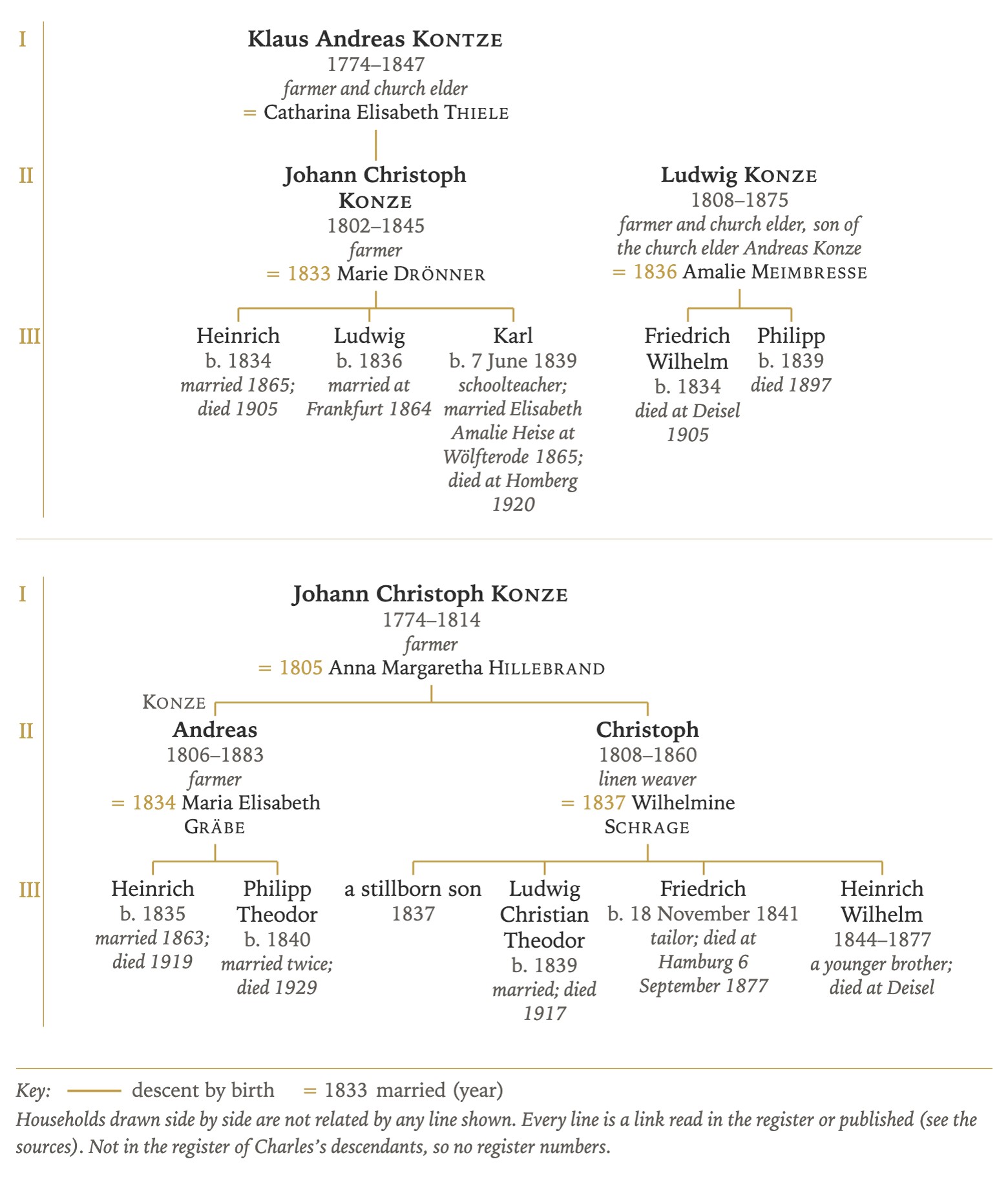
Most Konze men of Charles’s generation stayed in their home villages. Their later records are in the church registers and in the Hessian civil registers that begin in 1874. Each record matches a baptism, and none carries a note of time spent in America.28 The state database of Hessian emigrants lists only one Konze: Ludwig Konze of Deisel, released in October 1864 to go to Frankfurt am Main. He is not Charles, who had enlisted at St. Louis in December 1862.29
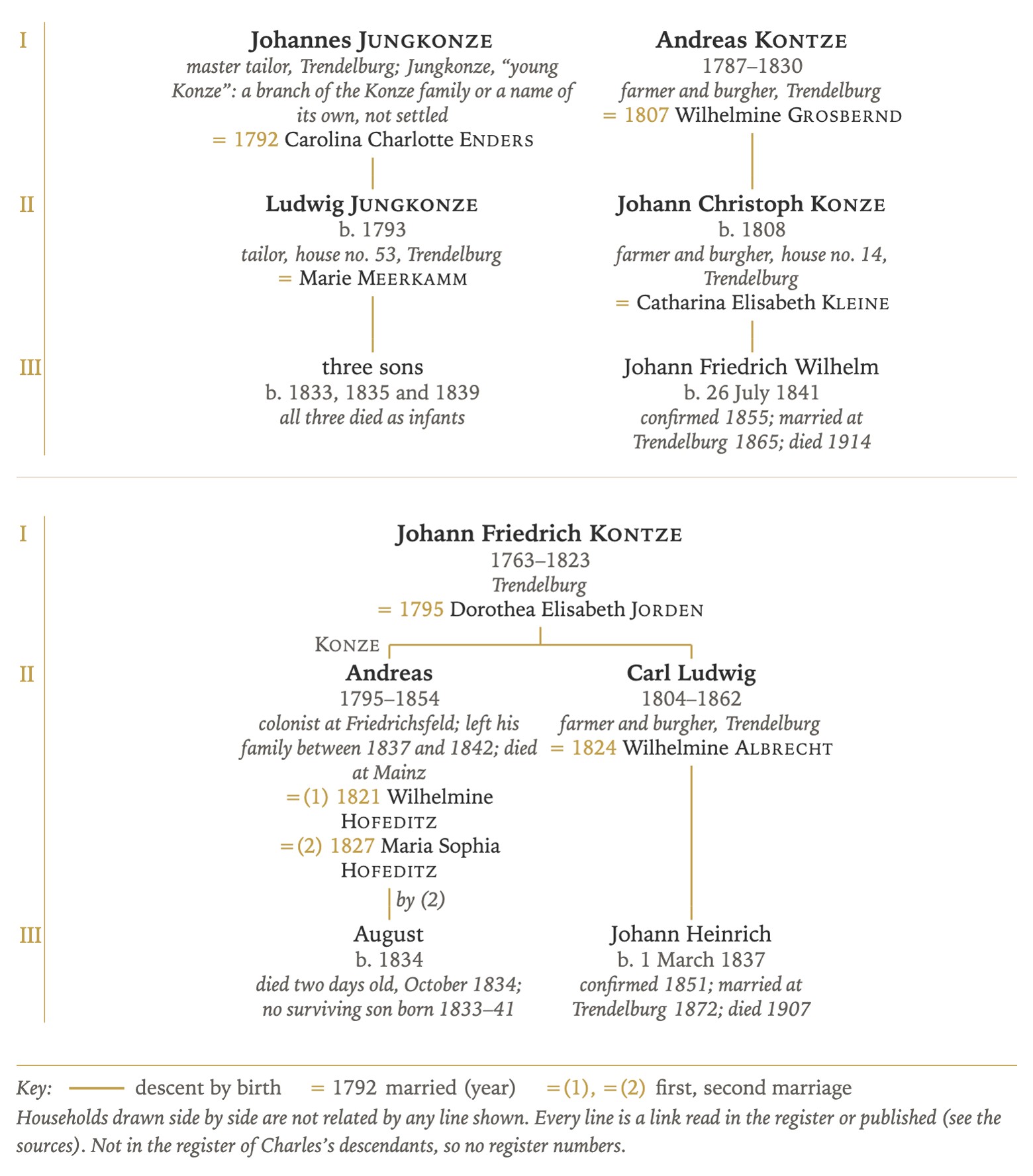
The question of parentage
If Charles was a Konze, the next question is whose son he was. He was probably not the legitimate son of any Konze father who baptized children in these parishes in the 1830s, because every son they baptized from 1833 to 1841 is accounted for.31 A researcher in Germany has worked in the Deisel and Trendelburg registers.32 The search tested eight Konze men of the district as possible fathers of a boy born in the 1830s, and their dates, the sex of their children or their own deaths ruled out six. Two remain possible: Carl Ludwig Konze, an Ackerbürger of Trendelburg, and Andreas Konze, the Friedrichsfeld colonist who left his family between 1837 and 1842. No record ties either man to a son of the right age.33
The search also tested one more Konze of Trendelburg as a possible father, not as Charles himself. He was Johann Carl Ludwig Konze, born in 1814, the brother of the St. Louis barber Anton Wilhelm Konze. He left in 1839 for Bremen, where he kept an inn and died in 1869. Nothing in his family’s records at Bremen or in St. Louis connects that family with Charles.34
Another Trendelburg Konze, the shoemaker Friedrich Wilhelm Kontze, settled at Grebenstein in 1839.35 His son Carl Louis, born there in 1841, is the only Carl of a Konze family found in the district’s confirmation registers outside the three parishes. He died in September 1903, three months before Charles died in St. Louis.36
The chapter “The Candidates and How They Were Ruled Out” takes up how the name Konze could still be his. It also takes up two more boys: a Trendelburg boy of Konze descent but not of the Konze name, who is still untraced, and a second boy with a possible Konze link.37
What the two families show
In the parishes Charles named, neither surname has a boy who could be him. Every Konze boy is accounted for, and the one Gans family had moved to the Weser by 1835. So either name would mean that Charles was born or baptized outside the usual pattern: out of wedlock, under a stepfather’s or his mother’s name, or in a parish not yet read in full. For Gans that includes Lippoldsberg, whose Gans boys of those years have not yet been followed one by one. Three Weser Gans boys, among them Carl Friedrich Lorenz Gans, are still untraced.38
The registers show other boys who were born somewhere else or baptized under another name. Andreas August Gans of Oedelsheim, who lived in America as “Willy Johnson or Jansen,” is the clearest case. The chapter “The Candidates and How They Were Ruled Out” tells his story under “If he is hidden: other names and other fathers.”39
Weighing the two
Of the two names, Konze has more of the evidence: it is the name of families in the very places he named. Neither name is proven. Place and the -en ending favor Konze, and the vowel favors Gans: Charles’s own signatures have the a of Gans wherever the vowel can be read.40
Gans has the better evidence for the spelling: his own handwriting, above all the 1862 signature.41 But the spelling a man writes is not always the name he was baptized under. Konze has the better evidence for the place and for what his family said. But other people recorded a spoken name from what they heard, and a pastor who knew Konze families could have spelled it that way.
The vowel of his American name does not decide it. Other people recorded both vowels in his name, but he himself wrote only the a.42 The Y-DNA result does not decide it either. It probably traces Charles’s male line to a Jewish forebear of the Middle Ages. Every Christian family proposed for Charles, Gans or Konze, would need the same explanation for it (see “What DNA Can and Cannot Say”).43
Only a record that neither side yet has would settle the choice. No man of a documented Konze or Gans male line has yet taken a Y-DNA test. A court file of 1829–30 that names a Konze has been ordered from Marburg but not yet received. Until a test is taken or the file is read, the case for Konze rests on the places and the name forms alone. The author favors one explanation, set out later in this part.
A researcher’s ideas about the name
From the summer of 2025 the Trendelburg researcher read the registers of the parishes around Trendelburg for this search and sent many ideas about the origin of the name Gannsen. The search tested each one against the records and closed most of them. Table 26.2 gives the three that the book has adopted or still tests.44
Table 26.2. A researcher’s ideas that still stand
| His idea | Status | What became of it |
|---|---|---|
| “Gannsen” as Gans-son, the son of a Gans, possibly born out of wedlock (October 2025) | Standing | It is the Gans half of this chapter. The search has read the registers of the Gans families nearest Trendelburg, and no boy yet fits. The Lippoldsberg Gans boys have not yet been traced one by one. |
| “Freundburg,” the birthplace the regiment’s clerks wrote for Charles in 1862, as Trendelburg: the clerk heard Trend- as Freund, the German word for friend | Adopted | This book reads Freundburg as the clerks’ rendering of Trendelburg, the place Charles gave on his own enlistment paper the same day.45 |
| A pastor’s shorthand (Bodenhausen written Bonsen) and the drift of names over a lifetime (Toeppe becoming Deppe) | Adopted | Both are part of how this book reads the American spellings. |
Source: the researcher’s letters to the author46.
He has also suggested that Charles chose Gannsen to name his village without giving his surname, because the people of Deisel were nicknamed for their geese. It remains a suggestion, with no record behind it.47 Two of his other suggestions pointed to sources.48 Martina Lüdicke’s study of the Deisel emigrants has since been read in full, and her study of church discipline at Deisel in part. The chapters “Kurhessen: Deisel and Trendelburg, c. 1835–1858” and “Leaving Hesse, c. 1858–1859” draw on both. The minutes of the Deisel church council are still unread, and the closing chapter “What We Still Do Not Know” describes them.49
Or neither?
The name is possibly neither Gans nor Konze. The American forms would fit a Gansen, Ganzen, or Kanzen family just as well. Since the 1862 clerk recorded him as “Johnsen” and the family later used Johnson, a Jansen or a Johannsen family has to be considered too.50
Two boys once seemed to carry such names, a “Ganzen” of Trendelburg and a “Karl Jansen” of Deisel. But both were misreadings, as the chapter “The Candidates and How They Were Ruled Out” shows. The Hessian state’s emigration index has no Gansen at all, and the Missouri soldiers’ cards have no Ganzen, Janssen, or Hansen. A full-text search of the 1869–72 St. Louis directories found no Charles under Kanzen or Ganzen (a machine-text search, a pointer only). No search under Johannsen is recorded.51 A third surname is not ruled out: Charles was possibly baptized under his mother’s name or a stepfather’s, or in a parish not yet read.52
Emigrants from his own district did not always give accurate facts about themselves. Anton Wilhelm Konze of Trendelburg gave census takers ages eight to fourteen years too young once he was about to marry (see “Where and When He Was Born”).53 The Deisel-born schoolmaster Johannes Köster crossed with a young woman whom the passenger list names “Wilhelmine Köster,” though she was not his wife.54 Hessian law required permission to emigrate, and one aim was to stop young men leaving to evade military service.55 A man who left without permission would not appear in the release records. If Charles did as these men did, his ages, his birthplace and even his surname record what he chose to say. Gannsen was possibly a name he took from his home place, with no family tie behind it. The researcher’s version of this idea, that it named Deisel’s geese, is given with his other ideas above.
The leading candidate among the open boys was baptized under neither name. If he was Charles, Gannsen and the Kon- forms were names he took, not names he was born with.56 These chapters weigh rival answers to the question of his name and origin. They do not yet prove one, because none of the rivals has been ruled out.57
So the chapter settles less than it weighs. His own hand favors Gans and the places he named favor Konze, and which name, if either, he was baptized under is still open.
The next chapter follows the boys who could have been Charles.
Notes
57 notes
- Working positions of the research, October 2026. [DEC]
- A German paleographer and compiler of village family books, letters to the author by email; Charles Gannson (Private, Battery B, 2nd Missouri Light Artillery, Civil War), pension application no. Inv. 749,432, certificate no. 684,507; Case Files of Approved Pension Applications of Veterans Who Served in the Army and Navy Mainly in the Civil War and the War with Spain, 1861–1934; Civil War and Later Pension Files; Record Group 15: Records of the Department of Veterans Affairs; National Archives, Washington, D.C.; digital copy of the file supplied to the author by the National Archives, imaged at https://
charles-research : accessed 30 October 2026. Mail-order copies ordered by the author, first a partial file, order F21-314123835E, submitted 14 February 2017 and delivered electronically, and then the complete file, order F41-523680269E, submitted 8 September 2019 and sent by mail. Charles was a sergeant from 7 November 1863 until 15 March 1865. Pension file signatures on pp. 11, 13, 14, 29 and 30. St. Louis Probate Court, application for guardianship, 15 Sep 1900, images 984–985. On the guardianship application of 1900, which he signed twice, the letter after the G is unclear. [Paleographer's letters, 2026] [PEN] [GUARD].netlify .app/ pension-file .html - The surname record: twenty-eight attestations of Charles’s surname in fourteen spellings; St. Louis Register of Voters, Ward 9, 1896-series book, line 22, image 191. [SURN] [VOTE]
- The surname record: twenty-eight attestations of Charles’s surname in fourteen spellings. [SURN]
- St. Marcus Evangelical Church (St. Louis, Missouri), death register, entry 1897, “Josephine Herr geb. Konzen.”, image 824, entry 1961; St. Louis directories, 1873–74 (Gould’s, title year 1874) and 1874, p. 509, p. 212, https://
www , https://.familysearch .org/ ark:/ 61903/ 3:1:3QHV-J38V-PS9F-8 www ; St. Marcus baptism register, p. 453, entry 282 (running no. 8854); St. Marcus Evangelical Church (St. Louis, Missouri), death register 1896, pp. 120–121, no. 2631, image 883; Gould’s St. Louis Directory, 1900, p. 1034. [DTH90] [D1874] [BAP75] [AUG96] [D1900].familysearch .org/ ark:/ 61903/ 3:1:3QHV-V38V-PSZM-Z - Ev. Kirchengemeinde Deisel, “Kirchenbuch 1796–1831” [Church book 1796–1831], image 1742, image 1746. [DEI1829]
- Holy Ghost Evangelical Church (St. Louis, Missouri), marriages 1874, no. 993, p. 71. [WIT74]
- Survey of the Konze, Kontze, Kontzen, Contze and Konzen surnames in the baptism, marriage and burial registers and indexes of 36 parishes around Trendelburg (Archion and Matricula), June 2026. The one exception the survey found in the 1830s is a shoemaker, Friedrich Wilhelm Kontze, very probably of Trendelburg, who had settled at Grebenstein by 1840. Klaus Kunze’s family books add Contze and Kontzen families farther down the Weser, at Gieselwerder and Bodenfelde, and the survey drew partly on name indexes. [SWEEP]
- Holy Ghost Evangelical Church (St. Louis, Missouri), marriages 1874, no. 993, p. 71. Doering was fifty-three or fifty-eight (unclear in the image) and Wolfsberger, born Ober [?], forty-three, both of St. Louis County. [WIT74]
- The surname record: twenty-eight attestations of Charles’s surname in fourteen spellings; Westliche Post (St. Louis, Missouri), 21 Dec 1896, p. 4, image 640916401. [SURN] [WP96]
- St. Louis Globe-Democrat, 2 Jan 1891, p. 5, death notice of Augusta Somers ( image 571324780; a clipping is also held as a family copy). [GD91]
- HStAM Best. 18 Nr. 2631, images 156–170; HHStAW Abt. 365, Jewish civil registers, Nr. 455, Nr. 375, Nr. 429. [JEW58] [JEWREG]
- Parish search coverage, 57 places of Kreis Hofgeismar; Klaus Kunze, Ortssippenbücher (HeiKun-Verlag) for Helmarshausen (1521–1950). [COVER] [OSB]
- Evangelische Kirchengemeinde Deisel (Deisel, Kreis Hofgeismar, Kurhessen), “Taufen 1830–1861” [Baptisms 1830–1861] (Archion register 218842), images 22–101; a German paleographer, Ortssippenbuch Lippoldsberg [Village lineage book of Lippoldsberg] (HeiKun-Verlag), families 759 (Johann Daniel Gans and Karoline Haacke, m. Deisel 8 Mar 1829) and 764 (Johann Ernst Dietrich Gans and Helene Friederike Auguste Simon, m. 24 Oct 1858). Published secondary source; Evangelische Kirchengemeinde Lippoldsberg (Lippoldsberg, Kreis Hofgeismar, Kurhessen), burial register, 1840 no. 216 (Carl August Gans; Archion register 219784, image 1096) and 1852 no. 458 (Friedrich Wilhelm Gans; image 1144), scans supplied by a German compiler of village family books, July 2026 and checked against Archion 30 Oct 2026; imaged, Archion (https://
www : accessed 30 October 2026) > Hessen > Landeskirchliches Archiv der Evangelischen Kirche von Kurhessen-Waldeck > Kirchenkreis Hofgeismar > Lippoldsberg > Beerdigungen 1830-1900; citing Landeskirchliches Archiv der Evangelischen Kirche von Kurhessen-Waldeck, Kassel. Read in the image; Forward trace of every boy baptized at Trendelburg, Deisel and Friedrichsfeld born 1833–41; Kirchengemeinde Heisebeck (Archion): Taufen 219175, image 1283, p. 46, 1839 no. 165 (Conrad Gottlieb Gans, margin: family emigrated to North America); Trauungen 219190, 1839 no. 47 (image 1063) and 1845 no. 80 (image 1079); Beerdigungen 219181 (Heinrich Ganß, b. Gieselwerder 1779, d. 1833, image 554; Ernst Wilhelm Gans, d. 1853, image 611; Wilhelmine Louise Gans geb. Scholle, b. Volkmarshausen 1800, d. 1854, image 613); Konfirmationen 219172, 1850 no. 4 (image 837). LAGIS Hessen, emigrants 82689, 82731, 82732, 82695, 89551. Baptism of Carl Friedrich Lorenz Gans searched without result at Gimte (358918), Hann. Münden St. Blasius (359022) and St. Aegidien (359008), and Göttingen St. Crucis (352665). Read 15 Oct 2026; imaged, Archion (https://.archion .de/ de/ viewer/ churchRegister/ 219784 www : accessed 2 November 2026). [DBAP] [OSB759] [LIPPBUR] [LEDGER] [HEISEG].archion .de - Konze, Kontze and Contze entries in the registers of Trendelburg and Deisel, images 1494 and 1558. [KONZE]
- Survey of the Konze, Kontze, Kontzen, Contze and Konzen surnames in the baptism. [SWEEP]
- Working positions of the research, October 2026. [DEC]
- Kathrin Dräger, “Konzen,” in Digitales Familiennamenwörterbuch Deutschlands. [DFD-KONZEN]
- Declaration of Recruit, Volunteer Enlistment and surgeon’s form for examining a recruit, 2 Dec 1862, St. Louis; St. Marcus Evangelical Church (St. Louis, Missouri), marriage register 1866, p. 135, entry 676/4, image 381. [ENL62] [MAR66]
- Konze, Kontze and Contze entries in the registers of Trendelburg and Deisel, images 1494 and 1558; Forward trace of every boy baptized at Trendelburg, Deisel and Friedrichsfeld born 1833–41. [KONZE] [LEDGER]
- Forward trace of every boy baptized at Trendelburg, Deisel and Friedrichsfeld born 1833–41; Ev. Kirchengemeinde Deisel, Taufen 1830–1861 (Archion register 218842), entries 194 and 195 (January 1835), image 40, p. 39; Beerdigungen 1830–1876 (Archion register 218851), image 1812 (accessed 7 August 2026), no. 140; imaged, Archion (https://
www , https://.archion .de/ de/ viewer/ churchRegister/ 218842 www : accessed 4 November 2026); citing Landeskirchliches Archiv der EKKW, Kassel; Evangelische Kirchengemeinde Stammen (Stammen, Kreis Hofgeismar, Kurhessen), “Taufen 1830–1915” [Baptisms 1830–1915] (Archion register 220069), Nro 125 (image 38; Johannes Jungkontze, 1838, son of Johannes Jungkontze and Catharine Kuncke; margin: married 1866) and Nro 146 (image 43; Johann Heinrich Kontze, born 16 Apr 1839, son of Christian Ludwig Kontze and Anne Gertrud Temme; margin: married 2 Nov 1863), October 2026; imaged, Archion (https://.archion .de/ de/ viewer/ churchRegister/ 218851 www : accessed 2 November 2026) > Hessen > Landeskirchliches Archiv der Evangelischen Kirche von Kurhessen-Waldeck > Kirchenkreis Hofgeismar > Stammen > Taufen 1830-1915; citing Landeskirchliches Archiv der Evangelischen Kirche von Kurhessen-Waldeck, Kassel. The table covers the first three places. At Stammen the two boys of those years, Johannes Jungkontze (1838) and Johann Heinrich Kontze (1839), both married in the 1860s, as the margins of their baptisms record. The chapter “The Candidates and How They Were Ruled Out” describes how Karl Konze, born at Deisel in 1839, was ruled out. Two Deisel entries of January 1835 that were once read as Konze children both proved to be Köster children. [LEDGER] [KOS195] [STAMKZ].archion .de/ de/ viewer/ churchRegister/ 220069 - Konze, Kontze and Contze entries in the registers of Trendelburg and Deisel, images 1494 and 1558. Philipp Konze’s burial, Deisel (Archion 218851), image 2023, 1872 no. 1397; Carl Wilhelm Konze’s baptism, Trendelburg (Archion 220108), image 1385, 1831 no. 25. [KONZE]
- Evangelische Kirchengemeinde Wölfterode (Kirchenkreis Rotenburg), p. 17, no. 48. [K1865]
- Ev. Kirchengemeinde Trendelburg, “Konfirmationen 1831–1914” [Confirmations 1831–1914], image 2244, no. 21, image 2255, no. 15, image 2257, p. 58, no. 9. [ANDREAS]
- Forward trace of every boy baptized at Trendelburg, Deisel and Friedrichsfeld born 1833–41. [LEDGER]
- Hessian civil registers (Standesämter Deisel and Trendelburg), deaths and marriages 1874–1925, HStAM Best. 909 and 910, read on the Arcinsys image server. The deaths of the seven Konze men born 1833–41 are in six volumes of HStAM 909: Nr. 954 (image 10), 963 (images 7 and 14), 9438 (image 7), 9445 (image 14), 975 (image 8) and 977 (image 12); each image is at https://
digitalisate-he followed by the volume number and image, for example https://.arcinsys .de/ hstam/ 909/ digitalisate-he (accessed 4 November 2026). The Trendelburg deaths of 1875 (909 Nr. 9406) are not digitized. [CIVIL].arcinsys .de/ hstam/ 909/ 9438/ max/ 00007 .jpg - Konze, Kontze and Contze entries in the registers of Trendelburg and Deisel, images 1494 and 1558; Forward trace of every boy baptized at Trendelburg, Deisel and Friedrichsfeld born 1833–41. [KONZE] [LEDGER]
- Hessian civil registers (Standesämter Deisel and Trendelburg), deaths and marriages 1874–1925, HStAM Best. 909 and 910, read on the Arcinsys image server. The deaths of the seven Konze men born 1833–41 are in six volumes of HStAM 909: Nr. 954. [CIVIL]
- Ludwig Konze of Deisel (born 25 Oct 1836): Landesgeschichtliches Informationssystem Hessen (LAGIS), Hessische Auswanderer, record 70405 (https://
lagis : accessed 8 November 2026), release of October 1864 to Frankfurt am Main, citing HStAM 180 Hofgeismar Nr. 841, p. 49 (index entry, not checked against the file); Amts-Blatt der freien Stadt Frankfurt, no. 123, 15 Oct 1864, p. 951 (“Bürgerliches Aufgebot,” 13 Oct), and no. 136, 15 Nov 1864, p. 1057 (“Auszug aus den hiesigen Standesbüchern. I. Getraute,” 11 Nov: “Konze, Ludwig, designirter hiesiger Bürger, aus Deisel in Kurhessen, mit Schleifer, Wilhelmine Rufine Eva, hiesige Bürgerin”), bound with Intelligenz-Blatt der freien Stadt Frankfurt, 1864 (Google Books UD8oAAAAYAAJ, full view, read in the page images, 8 Nov 2026); the civil register itself not seen. [LKFFM].hessen .de/ resolve/ de/ ha/ 70405 - Konze, Kontze and Contze entries in the registers of Trendelburg and Deisel, images 1494 and 1558; Forward trace of every boy baptized at Trendelburg, Deisel and Friedrichsfeld born 1833–41. [KONZE] [LEDGER]
- Forward trace of every boy baptized at Trendelburg, Deisel and Friedrichsfeld born 1833–41. [LEDGER]
- A researcher in Germany, emails to the author, 22 Apr and 4 May 2026, letters in the author’s files, American Fork, Utah. On the Quentin family of Trendelburg and the reading of Deisel baptism entry 195. [Researcher's letters, Apr–May 2026]
- The Konze families of Trendelburg, Friedrichsfeld and Deisel as reconstructed from the Trendelburg and Deisel registers; see this chapter and the chapter “The Candidates and How They Were Ruled Out”; Forward trace of every boy baptized at Trendelburg, Deisel and Friedrichsfeld born 1833–41; Ev. Kirchengemeinde Trendelburg, “Konfirmationen 1831–1914” [Confirmations 1831–1914], image 2244, no. 21, image 2255, no. 15, image 2257, p. 58, no. 9. [CARD2] [LEDGER] [ANDREAS]
- HStAM Best. 180 Hofgeismar Nr. 56, fol. 5–6, no. 39. Staatsarchiv Bremen 4.60/3-545, Zivilstandsamt Rablinghausen, deaths 1869 no. 39. [JCL]
- Kirchengemeinde Trendelburg (Archion): marriage of Andreas Kontze and Wilhelmina Grosbernd, 8 Mar 1807 (220096, image 1156, p. 322); baptisms of Joh. Christoph, 13 Jun 1808 (image 1064), Joh. Friedrich, 24 Aug 1810 (image 1070), and Johannes Andreas, 28 Nov 1814 (image 1082); burial of Andreas Kontze, house no. 14, 16 Oct 1830 (220114, image 682, no. 4); marriage of Joh. Christoph Kontze and Catharina Elisabeth Heine, 23 Aug 1840 (220120, image 247, no. 77). Kirchengemeinde Grebenstein: marriage of Friedrich Wilhelm Kontze, 23 Dec 1839 (Trauungen 219136, image 1717, no. 190); burials of Marie Sophie Kontze, 1850 (219124, image 668), and Carl Louis Kontze, died 15 Sep, buried 17 Sep 1903 (219127, image 1226, p. 312, no. 2879; the burial entry’s birth date “16. August 1841” is a slip for the 26th of the baptism); imaged, Archion (https://
www : accessed 2 November 2026) > Hessen > Landeskirchliches Archiv der Evangelischen Kirche von Kurhessen-Waldeck > Kirchenkreis Hofgeismar, by the register numbers given; citing Landeskirchliches Archiv der Evangelischen Kirche von Kurhessen-Waldeck, Kassel. Read in the images, 15 Oct 2026. [KONTZE14].archion .de - Evangelische Kirchengemeinde Grebenstein (Grebenstein, Kreis Hofgeismar, Kurhessen), “Taufen 1840–1854” [Baptisms 1840–1854] (Archion register 219109), image 45. [KONTZEGR]
- Forward trace of every boy baptized at Trendelburg, Deisel and Friedrichsfeld born 1833–41. [LEDGER]
- Forward trace of every boy baptized at Trendelburg, Deisel and Friedrichsfeld born 1833–41; Evangelische Kirchengemeinde Deisel (Deisel, Kreis Hofgeismar, Kurhessen), “Taufen 1830–1861” [Baptisms 1830–1861] (Archion register 218842), image 8. [LEDGER] [GANSDEI]
- Forward trace of every boy baptized at Trendelburg, Deisel and Friedrichsfeld born 1833–41. [LEDGER]
- Declaration of Recruit, Volunteer Enlistment and surgeon’s form for examining a recruit, 2 Dec 1862, St. Louis; Charles Gannson (Private, Battery B, 2nd Missouri Light Artillery, Civil War), pension application no. Inv. 749,432, certificate no. 684,507; Case Files of Approved Pension Applications of Veterans Who Served in the Army and Navy Mainly in the Civil War and the War with Spain, 1861–1934; Civil War and Later Pension Files; Record Group 15: Records of the Department of Veterans Affairs; National Archives, Washington, D.C.; digital copy of the file supplied to the author by the National Archives, imaged at https://
charles-research : accessed 30 October 2026. Mail-order copies ordered by the author, first a partial file, order F21-314123835E, submitted 14 February 2017 and delivered electronically, and then the complete file, order F41-523680269E, submitted 8 September 2019 and sent by mail. Charles was a sergeant from 7 November 1863 until 15 March 1865. Pension file signatures on pp. 11, 13, 14, 29 and 30. In the registers read for this book, Konze was an established name at Trendelburg, Deisel and Friedrichsfeld between 1800 and 1860. About ten Konze couples baptized children at Trendelburg and eight or more at Deisel, and Konze colonists lived at Friedrichsfeld. Gans was rare there. One Gans household lived at Deisel for a few years around 1830, and no register read shows one at Trendelburg or Friedrichsfeld. In 1858 Nathan Wolf Gans of Grebenstein was the only Gans among the district’s self-supporting Jewish households. (The register of Jewish marriages in the district, 1829–56, HStAM 180 Hofgeismar Nr. 666, has not been read; it is neither filmed nor digitized.) The -en ending of the name as Americans wrote it also fits Konze better, although a count of letters puts most of the American forms closer to Gansen (see “The Name He Signed”). But this evidence is indirect, and the vowel favors Gans. Eighteen of the twenty-eight forms read in the original have the a of Gans or begin with J, and only ten have the o of Konze. Forward trace of every boy baptized at Trendelburg, Deisel and Friedrichsfeld born 1833–41; Evangelische Kirchengemeinde Deisel (Deisel, Kreis Hofgeismar, Kurhessen), “Taufen 1830–1861” [Baptisms 1830–1861] (Archion register 218842), images 22–101; Ev. Kirchengemeinde Deisel, “Kirchenbuch 1796–1831” [Church book 1796–1831], image 1742, image 1746; a German paleographer, Ortssippenbuch Lippoldsberg [Village lineage book of Lippoldsberg] (HeiKun-Verlag); Evangelische Kirchengemeinde Lippoldsberg (Lippoldsberg, Kreis Hofgeismar, Kurhessen), burial register, 1840 no. 216; HStAM Best. 18 Nr. 2631, images 156–170; The surname record: twenty-eight attestations of Charles’s surname in fourteen spellings. [ENL62] [PEN] [LEDGER] [DBAP] [DEI1829] [DBAP] [OSB759] [LIPPBUR] [JEW58] [SURN].netlify .app/ pension-file .html - Declaration of Recruit, Volunteer Enlistment and surgeon’s form for examining a recruit, 2 Dec 1862, St. Louis. [ENL62]
- The surname record: twenty-eight attestations of Charles’s surname in fourteen spellings. [SURN]
- FamilyTreeDNA Big Y-700 test of a direct male-line descendant of Charles. [BIGY]
- A researcher in Germany, emails to the author, 26 Aug 2025 – 13 Jul 2026, letters in the author’s files, American Fork, Utah. The emails propose derivations of the surname and candidate families; each idea was tested in the project’s research notes, with an audit of all of them on 22 Oct 2026. Martina Lüdicke, Kirchenzucht und Alltagsleben. Untersuchungen in der reformierten hessischen Gemeinde Deisel 1781–1914 [Church discipline and everyday life: studies in the Reformed Hessian parish of Deisel, 1781–1914] (Kassel: Verein für hessische Geschichte und Landeskunde, 2003; Hessische Forschungen 41), table of contents read 22 Oct 2026. [Researcher's letters, 2025–26]
- Letters on the reading “Freundburg” = Trendelburg, 23 Mar 2018 and 4–6 Dec 2025. [CORR]
- A researcher in Germany, email to the author, 16 Oct 2025, letters in the author’s files, American Fork, Utah. Proposes “Gannsen” as Gans-son, the son of a Gans, possibly born out of wedlock; A researcher in Germany, email to the author, 6 Dec 2025, letters in the author’s files, American Fork, Utah. Proposes that the clerk heard Trendel- as Freund, so that “Freundburg” is Trendelburg; A researcher in Germany, email to the author, 22 Dec 2025, letters in the author’s files, American Fork, Utah. Notes that the village book shows Bodenhausen shortened to Bonsen; A researcher in Germany, email to the author, 30 Dec 2025, letters in the author’s files, American Fork, Utah. Notes a girl baptized Toeppe in 1801 who was called Deppe when she married in 1836. [RLET251016] [RLET251206] [RLET251222] [RLET251230]
- Village nicknames: “Orts-Uznamen im Landkreis Kassel und Stadt Kassel,” (read 23 Oct 2026); A researcher in Germany, email to the author, 27 Oct 2025, letters in the author’s files, American Fork, Utah. Proposes that “Gannsen” came from the nickname of the people of Deisel, the geese (Gans). [NICK] [RLET251027]
- A researcher in Germany, email to the author, 22 Nov 2025, letters in the author’s files, American Fork, Utah. Reports a book of the 1990s on the emigrants of Deisel and offers to buy it. [RLET251122]
- A researcher in Germany, email to the author, 12 Apr 2026. [RLET260412]
- Declaration of Recruit, Volunteer Enlistment and surgeon’s form for examining a recruit, 2 Dec 1862, St. Louis. [ENL62]
- Searches for other surnames, recorded in the research session logs: LAGIS Hessen, Hessische Auswanderer [Hessian emigrants], surname “Gansen,” no hits, and no Gans emigrant from Deisel, Trendelburg or Helmarshausen (2 Jul 2026); Missouri State Archives, Soldiers’ Records, Civil War, some thirty name forms including Ganzen, Gantzen, Gonzen, Janssen, Jansson and Hansen, no records (7 Oct 2026); FamilySearch full-text search of the St. Louis directories labeled 1869–1872 for twenty-two forms including Kanzen and Ganzen, no Charles except “Gansen Charles, driver, r. 720 Gate” (9 Oct 2026); 1860 census index passes for Jansen, Janson, Janssen, Jensen, Hansen and Hanson (7 Oct 2026). No search under Johannsen is recorded in the logs. [VARIANTS]
- Forward trace of every boy baptized at Trendelburg, Deisel and Friedrichsfeld born 1833–41. [LEDGER]
- Ages stated by Anton Wilhelm Konze, St. Louis, image 291, line 1. [AWKAGE]
- Passenger list of the ship Rubens, Johann Seiler, master, Bremen to New Orleans, roll 47; Johannes Köster, letters to his wife and children at Kassel, 6 Nov 1858 – 2 Dec 1862, images 0033–0035. [RUBENS] [KOESTER]
- Simone A. Wegge, “Occupational Self-Selection of European Emigrants,” European Review of Economic History 6, no. 3 (December 2002). [WEGGE02]
- Forward trace of every boy baptized at Trendelburg, Deisel and Friedrichsfeld born 1833–41. [LEDGER]
- Thomas W. Jones, Mastering Genealogical Proof, NGS Special Topics Series, no. 107, chap. 5. [JONESMGP]
Also on this page
Tables kept online
The printed chapter gives a shortened form of this table, with the three ideas that stand (25 October 2026). The full table is kept here; the bracketed keys are those of the book’s sources.
The Trendelburg researcher’s ideas and what became of them
| His idea | Status | What became of it |
|---|---|---|
| “Gannsen” as Gans-son, the son of a Gans, perhaps born out of wedlock (October 2025) | Standing | It is the Gans half of this chapter. Every Gans family of the district has been read, and no boy yet fits. |
| “Freundburg”, the birthplace the regiment’s clerks wrote for Charles in 1862, as Trendelburg: the clerk heard Trend- as Freund, the German word for friend | Adopted | This book reads Freundburg as the clerks’ rendering of Trendelburg, the place Charles gave on his own enlistment paper the same day. [CORR] |
| An unacknowledged son of Johann Daniel Gans of Deisel, born in the 1830s | Probably closed | No birth at Deisel in 1833–41 names a Gans father, and Gans died in the Kassel prison in 1839. Only the Deisel church-council minutes, where the elders questioned unmarried mothers, could still name such a father; they were requested in October 2026. |
| The people of Deisel nicknamed “Gänse”, geese, so that Gannsen would mean a Deisel man | Unproven | The published lists of village nicknames for the district give none for Deisel or its neighbors, though “Gänse” is known as a village nickname elsewhere in northern Hesse. |
| The Huguenot family Janson of Hofgeismar | Closed | The candidate, Johann Friedrich Ludwig Janson, was born on 7 January 1837, not on Charles’s birthday, and no trace of him was found in St. Louis. |
| The French name Gonsons, from a will of 1863 at Bad Nauheim | Closed | The will was ordered and names no one connected with Charles. |
| A “Ganson” in Kassel in 1676, a master of the city guard | Unproven | Not found in any source outside the Kassel database. A family in southern Hesse in the 1670s and 1680s was written both Ganson and Ganß, which shows that the two spellings could be one name. |
| A pastor’s shorthand (Bodenhausen written Bonsen) and the drift of names over a lifetime (Toeppe becoming Deppe) | Adopted | Both are part of how this book reads the American spellings. |
| A change of surname at baptism, as when Brasun became Person at Amelunxen, with Branson as the source of Gannsen | Precedent | Kept as a precedent; the Branson family itself was Catholic and from Westphalia, and is ruled out. |
| The Huguenot name Grandjot | Closed | Carl Ludwig Grandjot died in 1901. |
| Konze through “Grandma Konze”, Anna Christina Heidt, whose third husband was Andreas Kontze | Closed | That route failed: Andreas died in 1830, and the marriage had no children. Konze stands on its own evidence. |
| Jewish origins: Seligmann Ganß, a protected Jew at Trendelburg in 1740, and Samuel Gerson of Deisel | Closed | The lists of 1812, when the Jews of the canton took fixed surnames, contain no form of Gans or Gerson. |
Evidence for each name
This table was in the printed chapter until 28 October 2026. It does not repeat the twenty-eight attestations, which the chapter “The Name He Signed” lists; it shows what each main piece of evidence bears on and how much it weighs.
| Record and date | Form | Who supplied the name | Bears on | Weight |
|---|---|---|---|---|
| Enlistment signature, 2 Dec 1862 [Paleographer's letters, 2026] | Gannsen, in KurrentOriginal | Charles, in his own hand | G; a | Strong for the spellingwritten before any clerk fixed a form |
| Marriage register, 7 Jan 1866 [MAR66] | GonnsonOriginal | Charles, spoken; Pastor Wall wrote it | G; o | Moderatehis own voice, another man's ear |
| Signature on his pension declaration, 15 Jan 1890 [PEN] | Gannson, Latin letters with the long sOriginal | Charles, in his own hand | G; a | Strong for the spellingbut written after the army's rolls had settled on Gannsen |
| Signature on a probate petition, 15 Sep 1900 [GUARD] | GannsonOriginal | Charles, in his own hand | G; a | Moderaterepeats his 1890 form |
| Kreichelt family notices, 1883 and 1894 [SURN] | GansenOriginal (print) | His wife's family | G; a | Moderatepeople who heard him for decades |
| Voter register, c. 1899–1900 [VOTE] | GansenOriginal | Charles, to the registrar | G; a | Moderatehis own statement late in life |
| Daughters' deaths, St. Marcus, 1890 [DTH90] | Konzen, twiceOriginal | The family, reporting the deaths | K; o; the z fits Konze | Moderate for Konzethe only z forms |
| Directory 1874, baptism 1875, directory 1900 [D1874] [BAP75] [D1900] | Konsen, KoncenOriginal | The householder, to canvassers; a parent at the font (Pastor Hoffmann wrote it) | K; o | Weakstrangers’ hearings of what the household said |
| Wife's death, St. Marcus, Dec 1896 [AUG96] | ConsonOriginal | Probably Charles; Pastor Eilts wrote it | K; o | Moderate |
| Konze surname survey, 36 parishes, June 2026 [SWEEP] | KonzeDerivative: a survey of the registers | Not applicable | K; place | Moderate for the place; not independent of the choice of Konze |
| The Deisel Gans family, 1829–1835 [DBAP] [OSB759] | GansOriginal register; published family book | Not applicable | G; place | Against Gansthe family had left for the Weser by 1835 |
| Y-DNA, Big Y-700 [BIGY] | NoneTest result | Not applicable | Neither name | Does not decide |
More of the chapter, as printed until 28 October 2026
The Konze families, as printed until 28 October 2026
This passage of the section “The Konze and Gans families in Germany” of the chapter “The Name He Used: Gans, Konze or Another Name” was shortened on 28 October 2026 so that family readers can get through Part Four. The text that stood in the book is kept here.
Konze, with its older spellings Kontze, Contze, Konde and Konten, is a surname of the parishes Charles named. The Trendelburg registers document it from the early eighteenth century. At Deisel it appears with Andreas Kontze, the sexton, born about 1718 and married there in 1739. [KONZE] A survey of June 2026, made apart from the search for his baptism, traced the surname in the registers of thirty-six parishes around Trendelburg. The parishes lie in two states and are of both confessions, Protestant and Catholic. It found the Konze name in only one tight cluster: Trendelburg, Deisel, Friedrichsfeld, Stammen and Hümme, all within a few miles of one another. The surrounding parishes, among them Grebenstein, Immenhausen, Helmarshausen, Hofgeismar, Sielen, Karlshafen, Gieselwerder and Veckerhagen, showed no Konze household at that time. A Trendelburg son settled at Grebenstein only in 1839, as described below. [SWEEP] The survey drew partly on the registers' own name indexes, which can miss entries: at Stammen the index lacks two Kontze baptisms that the pages hold. Both places Charles named lie inside that cluster.
That cluster is the main geographic argument for Konze. It is not fully independent evidence: Konze went on the list of candidate names in the first place partly because it occurs in this region. And Klaus Kunze's family books for Gieselwerder and Bodenfelde carry Contze and Kontzen families farther down the Weser. [OSB] A separate and larger Konzen family name belongs to the Rhineland, around Monschau and Aachen, where a village is called Konzen. A Rhineland origin would require both of Charles's statements about Hesse to be wrong, and the Rhineland Konzens were mostly Catholic. The search therefore keeps this possibility on the list but ranks it last. [SURN]
The form Konzen, given twice in the St. Marcus death register, has not been found in the German registers. The Deisel baptisms of 1828–29 enter the mothers of the family as "geb. Konze", with no ending, although the same pastor wrote the ending -en in full when he meant it. [DEI1829] (The chapter “The Name He Signed” discusses how a name in a weak e took -en in speech.)
Every Konze or Kontze boy born from 1833 to 1841 at Trendelburg, Deisel, Friedrichsfeld and Stammen is accounted for. [LEDGER] [KOS195] (The chapter “The Candidates and How They Were Ruled Out” describes how Karl Konze was ruled out. Two Deisel entries of January 1835 that were once read as Konze children both proved to be Köster children. The second, born 21 January 1835, was baptized in an emergency and died two days later.) Of the older men, Philipp Konze of Deisel, born in 1825, was later a farmer and the village's Gemeinde-Vorsteher, its elected headman, and died in 1872. Carl Wilhelm Konze, born at Trendelburg on 15 September 1831, stayed there and married three times, in 1859, 1869 and 1885. The family reached beyond the parish: the godfather of the Jungkonze son of 1839 was a J. J. C. Jungkonze, court clerk at Lübbecke in Prussian Westphalia. [KONZE]
If Charles was a Konze, the next question is whose son he was. The Trendelburg researcher has worked the Deisel and Trendelburg registers for years. He found only one Konze on the Deisel emigrant list, and it is not Charles. [Trendelburg researcher's charts, 2025] The search tested eight Konze men of the Trendelburg parish complex, the Friedrichsfeld colony and the Konze emigrants to Mainz as possible fathers of a boy born in the 1830s. The dates, the sex of their children or their own deaths ruled out six. Two remain possible, though no record ties either to a son of the right age. [SURN]
Johann Carl Ludwig Konze of Trendelburg, born in 1814, is not Charles. He was another Konze emigrant of the district and the brother of the St. Louis barber Anton Wilhelm Konze. He left in 1839 for Bremen, kept an inn at Woltmershausen and died there in 1869. [JCL]
Another Trendelburg Konze left the town in Charles's childhood without going far. Friedrich Wilhelm Kontze was a master shoemaker. He was the son of the Trendelburg Ackerbürger Andreas Kontze and of an earlier Wilhelmine Grosbernd, not the one who crossed with Köster. He married a shoemaker's widow at Grebenstein in December 1839 and settled there. Neither he nor his two brothers had a son born before 1840. [KONTZE14] (Andreas Kontze was born at Trendelburg in 1787, married Wilhelmine Grosbernd in 1807 and died in 1830. His only children were three sons, and Friedrich Wilhelm was one of them. His elder brother Johann Christoph, born in 1808, was the Ackerbürger of house number 14 at Trendelburg and stood godfather to Friedrich Wilhelm’s son in 1841. The youngest, Johannes Andreas, was born in 1814.) His second son, Carl Louis Kontze, was born at Grebenstein on 26 August 1841. He was confirmed at Grebenstein at Easter 1855. He is the only Carl of a Konze family found in the district's confirmation registers for these years outside Trendelburg, Deisel and Friedrichsfeld. A note beside his baptism records his death on 15 September 1903, three months before Charles died in St. Louis. [KONTZEGR]
The Gans families, as printed until 28 October 2026
This passage of the section “The Konze and Gans families in Germany” of the chapter “The Name He Used: Gans, Konze or Another Name” was shortened on 28 October 2026 so that family readers can get through Part Four. The text that stood in the book is kept here.
The Konze families can be followed for generations in the registers Charles pointed to. The Gans name appears there only briefly: one Gans household lived at Deisel for a few years. Johann Daniel Gans, a day laborer born at Lippoldsberg in 1787, married Karoline Haacke of Wülmersen, in the Trendelburg parish, at Deisel on 8 March 1829. Their children were baptized there in 1831 and 1833; the elder, Karoline Wilhelmine, married at Uslar in 1863. [GANSDEI] The second, Johann Ernst Dietrich Gans, born 9 January 1833, is the only Gans boy among all the boys baptized at Trendelburg, Deisel and Friedrichsfeld with birth dates from 1833 to 1841. [LEDGER] Between 1833 and 1835 the family moved to Lippoldsberg, on the Weser. There Johann Ernst Dietrich was confirmed in 1847, married in 1858 and died of typhus on 24 December 1859. His father died in the prison at Cassel on 27 January 1839. Of the two younger brothers, Friedrich Wilhelm, born 24 June 1835, died at Lippoldsberg in 1852, and Carl August, born in 1838, died there in 1840. [GANSDEI] These registers show no other Gans household in the 1830s, and no Gans boy was confirmed at Deisel in 1847–56. [DEICONF]
Christian (non-Jewish) Gans families were numerous a few miles away, in the parishes along the Weser. Kunze's published family books for that area index about fifty Gans families and some thirty Ganß families at Lippoldsberg alone, and large Gans clans at Gieselwerder and Oedelsheim. The Lippoldsberg index has one family entered under the form "Ganson". [OSB] The Helmarshausen book indexes two families under both Konze and Gans. [OSB] (The index cannot say whether those are families known by both names or simply Konze men who married Gans women. The family entries in the printed book would decide it.) The compiler of those family books himself treats Gans, Ganß and Ganse as a root separate from the Konze group. [SURN]
The search has read the register entries of the Gans boys born from 1833 to 1841 in the families nearest to Trendelburg. At Gieselwerder five Gans boys were born between 1833 and 1841. Two stayed and married, one died there in 1912, and Heinrich Ludwig Gans, born 3 July 1835, died as an infant that November. The fifth, George Gottfried Gans, born in October 1834, was the son of the day laborer Johannes Gans and Anna Maria Simon. He has not been found after his baptism. None was born near 26 January and none was a Carl. [GIESBUR] [PARISH2] Lippoldsberg was home to the largest Gans clan. The search read its baptisms of 1831–1841 line by line, and they hold no Konze child. The Lippoldsberg Carl Gans born nearest to 26 January is Carl August of the Deisel family, born in February 1838, who died in 1840. The later lives of the Lippoldsberg Gans boys of those years have not been traced one by one. But the compiler of those family books found no one among his Gans families who could be a Carl of Charles's age. His family books cover Lippoldsberg, Gieselwerder, Oedelsheim and Bodenfelde. [COVER] [KUNZE5] An Oedelsheim "Adolf Carl Christian Gans" proved to have been born in 1843. [OEDEL]
Two brothers, both named Heinrich Wilhelm Gans, lived at Heisebeck, a village of the Wesertal some ten miles (16 km) east of Trendelburg. They were tailors and sons of a tailor born at Gieselwerder, and they emigrated to North America with their families in 1840 and 1846. Neither had a son of Charles's age. The farmhand Ernst Wilhelm Gans and Wilhelmine Scholle of Volkmarshausen in Hanover made a third Gans household there. Their son Carl Friedrich Lorenz was born on 17 January 1836, confirmed at Heisebeck in 1850 and not found there afterward. He was born in Hanover, not at Trendelburg. [HEISEG] The search also went through the National Archives' Germans to America database, an index of the arrival lists, for every entry under the surname Gans. It holds no Carl, Karl, Ludwig, Christian or Charles Gans aged 17 to 30 who landed between 1855 and 1862. An index can miss a man, so this is a pointer, not proof that none landed. [AAD]
If Charles was a Gans, a relative of the same name might have gone before him or followed him to St. Louis. One apparent case proved to be a misreading. The Holy Ghost Evangelical Church register of St. Louis seems to record the marriage of a Jacob Gans and Caroline Gerhard on 19 August 1859. But the groom was Jacob Gaus, a shoemaker born about 1830 in Baden, not a Gans. [HG1859] (In that pastor's hand the letters u and n are written alike. The civil copy of the same marriage, in the Recorder's book, reads "Mr Jacob Gaus", and the censuses of 1870 and 1880 and the city directories show him as Jacob Gaus.) A Wilhelm Gans, 28, shoemaker, and a Caroline Gans, 24, landed at Baltimore from Bremen on 24 May 1854. Both came from Bodenfelde, a Gans village across the Weser. [AAD]
The Jewish Gans route, as printed until 28 October 2026
This passage of the section “The Konze and Gans families in Germany” of the chapter “The Name He Used: Gans, Konze or Another Name” was shortened on 28 October 2026 so that family readers can get through Part Four. The text that stood in the book is kept here.
Gans is also a Jewish surname. Charles's Y-DNA places his direct male line in a small branch whose other tested men appear, from their own family records, to descend from Ashkenazi Jewish families. The search therefore tested a Jewish Gans origin. The chapter “What DNA Can and Cannot Say” tells how that reading arose. [DNA]
These records closed the Jewish route. The October 1823 list of Jewish households in Kreis Hofgeismar has six at Trendelburg and three at Deisel, and no Gans. [JEW] The list of 9 October 1858 names every self-supporting Jewish household in the Kreis, 169 households in all. It has six at Deisel and four at Trendelburg, and no Gans. The only Gans in the whole Kreis was Nathan Wolf Gans of Grebenstein. [JEW58] (The six households at Deisel were Brandenstein, Rosenmeier, Rosenthal, Ohmsberg, Meierhof and Wertheim. The four at Trendelburg were Rosenblatt, Dannenberg, Bloch and Giesberg.) He was probably the bookbinder Nathan Gans whose only child in the Grebenstein Jewish birth register of 1828–1841 is a daughter, Helene, born in 1840. The register has no Gans son, so this family offers no boy who could be Charles. [JEWREG] The Trendelburg Jewish cemetery served both places from 1746 to 1927, and its grave list has no Gans. [JEW] The Jewish birth registers of the neighboring communities have no boy born on 25–27 January in any year from 1833 to 1841, and no son of any Gans father. No Jewish birth register of Trendelburg or Deisel itself survives for those years, so a birth there cannot be tested directly. [JEWREG] (The neighboring communities are Hofgeismar, Grebenstein with Immenhausen, Helmarshausen with Karlshafen and Lippoldsberg, Liebenau, and Oberlistingen.)
The man written Gandt on the 1740 list of protected Jews (Jews allowed to live there under a paid letter of protection) at Trendelburg is very probably the Seeligmann Ganß, protected since 1720, of the list of 1731. But the Jews of the canton of Trendelburg took fixed surnames in 1812, and none of the thirty-three entries bore the name Gans. The canton was a district of the Napoleonic Kingdom of Westphalia, which then ruled Hesse. [PROT1740] [JEW1731] [JEW]
No Jewish Gans family lived at Trendelburg or Deisel in Charles's childhood, and the one Christian Gans family had left Deisel by 1835. This closes one road to the Gans surname. It does not touch the Y-DNA result, which concerns ancestry many generations back. Nor does it weaken the main evidence for Gans, which is his own signature. [DNA]
Sources
- DEI1829 Ev. Kirchengemeinde Deisel, Kirchenbuch 1796–1831 (Archion 218824), baptisms 1828, Bild 1742, Z.14; 1829, Bild 1746, Z.22 and "Eodem" (Dec.): mothers entered "geb. Konze". Read in the image, October 2026: the entry at Bild 1742, Z.12, once read "geb. Konzen", is "geb. Heer[en]"; on Bild 1746, Z.27, the same pastor writes "geb. Heeren" with the full ending. Landeskirchliches Archiv der EKKW, Kassel.
- DNA FamilyTreeDNA Big Y-700 of a direct male-line descendant of Charles (terminal subclade I-Y38863); YFull YTree v14.03; see the chapter “What DNA Can and Cannot Say”.
- JEW1731 HStAM Best. 17/2 Nr. 1109, specification of the Jews in the Ämter, 1728–1734, image 53 (fol. 34), Trendelburg, 26 Apr 1731: “Seeligmann Ganß”, letter of protection of 13 Sep 1720, one family of four persons (Arcinsys Hessen), read in the image.
- OEDEL Ev. Kirchengemeinde Oedelsheim, baptisms, 1843, p. 84, entry 384 (image 735), Adolf Carl Christian Gans, b. 20 May 1843 (Archion).
- PROT1740 List of protected Jews (Schutzjuden) at Trendelburg, 1740, photocopy supplied by the Trendelburg researcher; reading "Seelmann (Seligmann) Gandt".
More of the chapter, as printed until 30 October 2026
The Gans families, as printed until 30 October 2026
This passage of the section “The Konze and Gans families in Germany” of the chapter “The Name He Used: Gans, Konze or Another Name” was shortened on 30 October 2026, so that the printed chapter keeps to the Konze families. The text that stood in the book is kept here.
The Gans name appears in Charles's parishes only briefly. One Gans household lived at Deisel for a few years: the day laborer Johann Daniel Gans, born at Lippoldsberg, and Karoline Haacke, married at Deisel in 1829. [GANSDEI] Their son Johann Ernst Dietrich Gans, born 9 January 1833, is the only Gans boy among all the boys baptized at Trendelburg, Deisel and Friedrichsfeld from 1833 to 1841. [LEDGER] By 1835 the family had moved to Lippoldsberg, on the Weser. There Johann Ernst Dietrich married in 1858 and died of typhus in 1859, and his father died in the prison at Cassel in 1839. His younger brothers both died young. [GANSDEI] No other Gans household lived in these parishes in the 1830s, and no Gans boy was confirmed at Deisel in 1847–56. [DEICONF]
The Gans families of the region
Christian Gans families were numerous a few miles away, in the parishes along the Weser: Kunze's family books index about fifty Gans families at Lippoldsberg alone, and large Gans clans at Gieselwerder and Oedelsheim. [OSB] The compiler of those family books himself treats Gans as a root separate from Konze. [SURN]
The search has read the baptisms of the Gans boys born from 1833 to 1841 in the families nearest to Trendelburg. At Gieselwerder none was a Carl or born near 26 January, and only one, George Gottfried Gans, born in October 1834, has not been found after his baptism. [GIESBUR] [PARISH2] At Lippoldsberg, home of the largest Gans clan, the later lives of the boys have not been traced one by one, but the compiler of those family books found no one among his Gans families who could be a Carl of Charles's age. [COVER] [KUNZE5] At Heisebeck, ten miles east of Trendelburg, two Gans tailors emigrated with their families, one of them with his infant son Conrad Gottlieb, born in 1839, who has not been traced since. A third household, from Hanover, had a son, Carl Friedrich Lorenz Gans, born on 17 January 1836, who was confirmed there in 1850 and not found afterward. He was born in Hanover, not at Trendelburg. [HEISEG] The National Archives' index of arrival lists holds no Carl, Karl, Ludwig or Charles Gans of the right age who landed between 1855 and 1862. [AAD] The full search is described in the online version of this chapter.
Gans men in St. Louis
No Gans relative has been found in St. Louis. The one apparent Gans wedding there, in 1859, proved on checking to be that of a Jacob Gaus of Baden. [HG1859]
The Jewish Gans route, and why it is closed
Gans is also a Jewish surname, and Charles's Y-DNA points far back to an Ashkenazi Jewish line (see “What DNA Can and Cannot Say”), so the search tested a Jewish Gans origin. [DNA]
The records closed that route. The lists of Jewish households in Kreis Hofgeismar for 1823 and 1858 have no Gans at Trendelburg or Deisel. The only Jewish Gans household in the whole Kreis in 1858 was that of Nathan Wolf Gans of Grebenstein, whose only child in the Jewish birth register is a daughter. [JEW] [JEW58] [JEWREG] The Trendelburg Jewish cemetery has no Gans grave, and the Jewish birth registers of the neighboring communities have no son of any Gans father in those years. [JEW] [JEWREG] When the Jews of the canton took fixed surnames in 1812, none chose Gans. [JEW] The lists, with the older Jewish families of Trendelburg, are in the online version of this chapter.
This closes one road to the Gans surname. It does not touch the Y-DNA result, which concerns ancestry many generations back, nor the main evidence for Gans, which is his own signature. [DNA]
Supplements
Records, images and data on this website that go with this chapter.
- Claims dashboard
- Open questions
- Abstract: why Charles resists identification
- The Konze families, town by town
- Konze at Trendelburg
- Konze at Deisel
- Konze at Friedrichsfeld
- The Konze family
- The Gans families
- The Konze and Gans families in the parish books
- The Konze family in Gottsbüren
- The Konze family in Hümme
- The Konze family in Stammen
- The Konze family in The Jungkonze / Jungkontze branch
- Researcher's chart — Gans Family in Meimbressen
- Researcher's chart — Jewish Graveyard at Trendelburg
- Researcher's chart — Jewish Citizens of Trendelburg 1740
- Gans / Segelbaum (Jewish)
- Other Hessian Jewish families